GREAT Scholarships 2027: What Grades Do You Need for £10,000+ UK Scholarships? [2026]
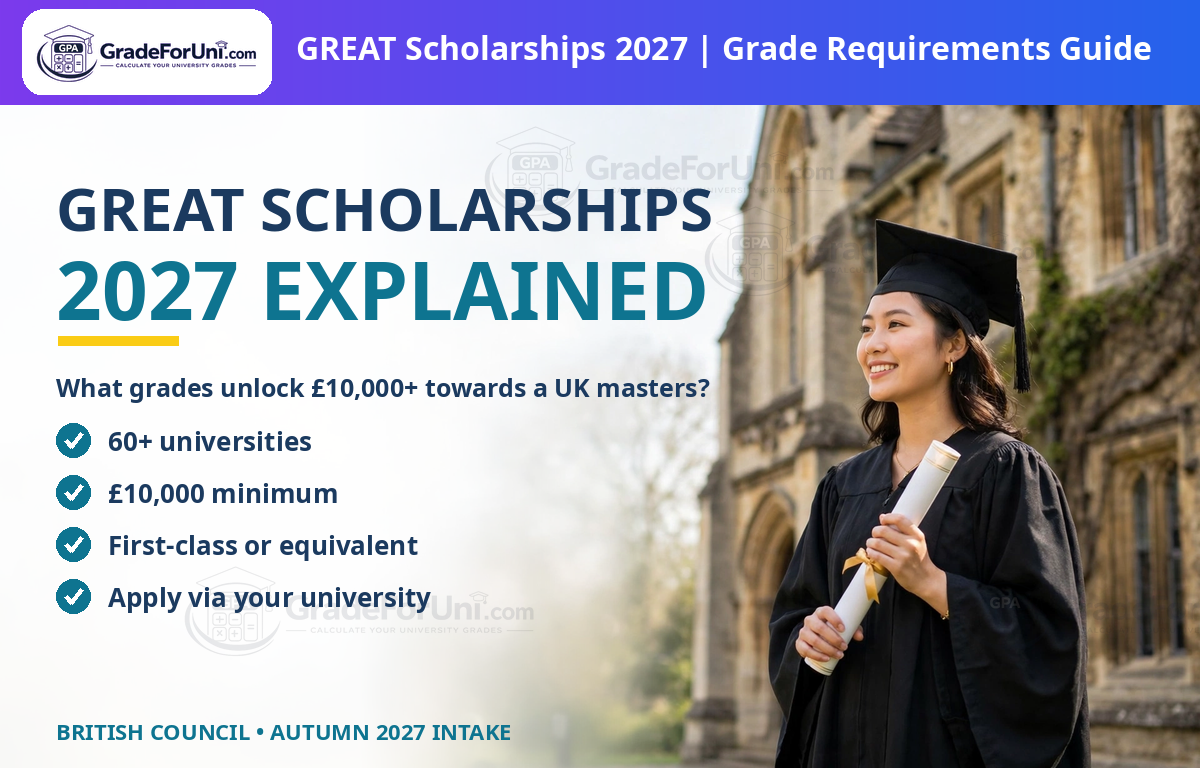
The British Council’s 2027 call for GREAT Scholarships confirms 153 scholarships across 19 countries for autumn 2027 entry — each worth a minimum of £10,000 towards tuition for a one-year taught masters. And the news is still breaking: on 14 October 2026, the British Council announced four Greater Manchester universities joining the 2027 programme for Indian students, while the central campaign launches in scholarship markets this November.
But GREAT Scholarships 2027 are merit awards, which means your grades do most of the talking. Most participating universities ask for an outstanding academic record — typically a UK first-class degree or its international equivalent — and they mean it: selection panels compare your marks against published country equivalencies, not vibes. If you are applying from India, Pakistan, Bangladesh, Nigeria, China or the USA, the question is not just whether your grades are good, but how they translate into the UK system.
This guide decodes the grade bar for GREAT Scholarships 2027: what first-class or equivalent actually means in marks, how international grades map onto UK classifications, two fully worked eligibility examples, what the £10,000 covers in real tuition arithmetic, and the mistakes that cost strong applicants their shot.
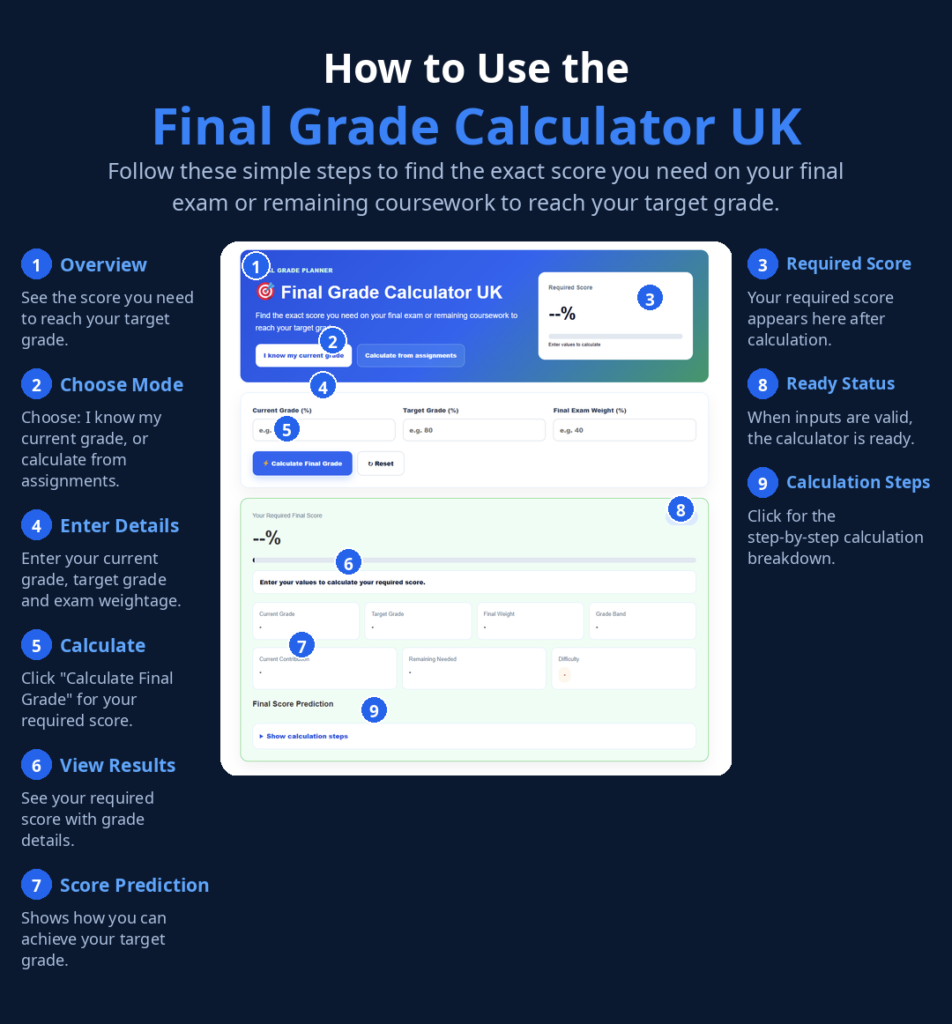
Click Here: Final Grade Calculator UK
What GREAT Scholarships Actually Are
GREAT Scholarships are a joint programme from the British Council and UK universities, run under the UK government’s GREAT Britain campaign. Each scholarship is jointly funded: a minimum £5,000 from the partner university plus £5,000 from the British Council/GREAT Campaign, making the £10,000 minimum per award. They are not one central award with one application form: each participating university offers its own GREAT Scholarships to students from specific countries, sets its own deadlines, and runs its own selection. The British Council coordinates the programme, but you apply directly to the university.
The 2027 round follows the established shape of the scheme: a minimum award value of £10,000 per scholarship, awards for one-year taught postgraduate (masters) courses only — not undergraduate degrees — and entry in the autumn 2027 intake. Funding goes towards tuition fees — it is a fee discount, not a maintenance grant, so it does not cover living costs, flights, or visa fees. For context, the 2026 round offered 130 scholarships with more than 60 higher education institutions; the 2027 call raises that to 153 scholarships across 19 scholarship markets.
The 19 markets for 2027, with the British Council’s scholarship allocations, are:
| Country | 2027 scholarships | Country | 2027 scholarships |
|---|---|---|---|
| India | 10 | Nigeria | 10 |
| Pakistan | 10 | Mexico | 10 |
| Indonesia | 10 | Bangladesh | 8 |
| China | 8 | Egypt | 8 |
| Thailand | 8 | Turkey | 8 |
| Vietnam | 8 | Ghana | 9 |
| Kenya | 9 | Malaysia | 9 |
| Germany* | 5 | Greece | 5 |
| Italy | 4 | Spain | 4 |
*Germany and the USA are new markets for 2027. Ten further scholarships were allocated to institutions that joined the May 2026 Study UK pop-up exhibition. One hard rule from the British Council: scholarships can only go to passport holders who are also permanent residents of the targeted country and do not hold British citizenship.
What Is New for the 2027 Round
Three things make the 2027 round worth acting on now rather than later. First, the scale: the British Council’s 2027 call confirms 153 scholarships across 19 markets, up from 130 in 2026 — with Germany and the USA joining as brand-new markets for 2027.
Second, the Greater Manchester announcement of 14 October 2026. During the Northern England India Mission’s visit to India, the British Council confirmed that four Greater Manchester universities — the University of Manchester, Manchester Metropolitan University, the University of Salford, and the Royal Northern College of Music — are joining GREAT Scholarships 2027 for Indian students, backed by the Greater Manchester Combined Authority. Each award is worth a minimum of £10,000 towards tuition for a one-year postgraduate course in the 2027–28 academic year, and applicants must have received an offer of entry from a participating university. If you are an Indian applicant targeting the North West, that is four more doors than last cycle.
Third, the timeline is already moving. University College Birmingham’s GREAT Scholarships 2027 page (for Nigeria and Pakistan) says applications open in October 2026, with a scholarship deadline of 31 May 2027. The British Council’s central campaign launches in the scholarship markets in November 2026, and universities must have selected their 2027 scholars by 30 June 2027. The window for autumn 2027 entry is open now — not months away.
The Grade Bar, Decoded: What First-Class or Equivalent Means
Here is the sentence that decides most applications: universities want candidates with an outstanding academic record, usually expressed as a UK first-class honours degree or an international equivalent. In UK marks, a first-class degree means a final average of 70% or above. That is the number the selection panel has in its head.
In practice, the bar has two layers. The published minimum is the grade stated on the university’s GREAT page — often a first-class honours degree or equivalent, sometimes a high upper second-class (2:1). The competitive reality is that merit scholarships are ranked: when ten eligible applicants chase two awards, the panel compares actual marks, and higher wins. A bare-minimum 70% clears the filter; an 82% wins the argument.
The table below shows the typical shape of published requirements. These are the patterns seen across university GREAT pages — always confirm the exact wording on the page of the university you are applying to, because each institution sets its own bar.
| Published requirement | What it means in UK marks | How panels read it |
|---|---|---|
| First-class honours degree or equivalent | 70%+ final average | The standard GREAT bar; most competitive universities use this |
| High 2:1 or equivalent | 65%+ final average | A slightly lower published bar at some universities; still strongly competitive |
| 2:1 or equivalent | 60%+ final average | The lowest published bar seen on some GREAT pages; expect heavy competition |
| Outstanding academic record (no class stated) | Usually 70%+ in practice | Vague wording that panels interpret strictly — aim for first-class territory |
If you are still studying — a final-year undergraduate, for example — universities assess you on your marks to date plus your predicted final classification. A strong trajectory helps: a student averaging 68% with final-year modules trending upward reads better than one trending down from 74%. Panels see your full transcript, not just the headline number.
For the exact flavour of the wording, two real pages: University College Birmingham’s GREAT Scholarships 2027 page (Nigeria and Pakistan) says preference will be given to those with an outstanding academic record, such as a UK first-class degree or its equivalent. The University of Edinburgh’s GREAT page says the scholarship is awarded on the basis of academic merit and candidates must have, or expect to obtain, the overseas equivalent of a UK first-class honours degree — though its page still describes the 2026 cycle, with 2027 details marked coming soon. Always read the exact sentence on your target university’s page; that sentence is the rule you are playing by.
International Grade Maps: How Your Marks Translate to UK Classes
This is the section most applicants get wrong. UK universities do not convert your grades with a single universal formula; each university publishes its own international equivalencies for postgraduate entry. The bands below are Queen Mary University of London’s published country equivalencies — one of the most detailed public tables, and representative of how Russell Group universities calibrate — but always confirm against your target university’s own country pages. QMUL itself stresses these are only a guide and that offer conditions vary by institution.
| Country / system | Maps to UK First (70%+) | Maps to UK 2:1 (60–69%) | Maps to UK 2:2 (50–59%) |
|---|---|---|---|
| India (percentage) | 75–80% | 60–70% | 50–60% |
| Bangladesh (CGPA, 4.0 scale) | 3.2–3.7 | 3.0–3.3 | 2.3–2.7 |
| Nigeria (CGPA, 5.0 scale) | 4.50 | 3.50 | 2.80 |
| Pakistan (GPA, 4.0 scale) | 3.0–3.8 | 2.6–3.6 | 2.0–3.0 |
| China (percentage) | 85–95% | 70–80% | 65–75% |
| USA (GPA, 4.0 scale) | 3.7 | 3.2 | 2.5 |
Read the table the way a panel does. A first-class bar means roughly 75%+ from India, 85%+ from China, a 4.50 CGPA from Nigeria, or a 3.7 GPA from the USA. A 2:1 bar means roughly 60–70% from India or 70–80% from China. Two warnings: bands are ranges, not cut-offs — the top of one band overlaps the bottom of the next, and the awarding university’s own table is the only one that counts. And panels rank finalists, so clearing the bottom of the First band is weaker than sitting at its top. Treat the table as your eligibility check, not your guarantee.
Not sure where your own average lands? Run your module marks through the degree classification calculator to see your UK-equivalent class, and use the final grade calculator to work out what your remaining modules need to deliver.
Worked Example 1: An Indian Applicant Checks Her Eligibility
Priya is in her final year of a BSc at a state university in India. Her marks so far: 72% overall across completed semesters. She wants a GREAT Scholarship 2027 for a one-year MSc in Data Science starting autumn 2027. Her target university’s GREAT page asks for a first-class honours degree or equivalent.
Step 1 — map the percentage. Against Queen Mary University of London’s published India bands, 72% sits in the 2:1 range (60–70%) — just above its top edge, but below the First band of 75–80%. On the published bar, she is a near-miss, not a clear pass.
Step 2 — check the trajectory. Priya has one semester left, worth 25% of her degree. Her current 72% covers 75% of the degree. To finish at 75.0% overall — the bottom of the First-equivalent band — she needs: (75 − 72 × 0.75) ÷ 0.25 = (75 − 54) ÷ 0.25 = 84%. She needs an 84% final-semester average to hit the first-class equivalent.
Step 3 — read the verdict honestly. An 84% final semester is ambitious but achievable for a strong student, and a documented upward plan is exactly what a personal statement should evidence. But if she finishes at 72–74%, she should target universities whose GREAT pages publish a 2:1 bar — Plymouth’s listing, for example, asks for a minimum 2:1 or equivalent — rather than spending her application on first-class-only awards. The grade bar is a filter first and a ranking second.
Worked Example 2: A UK Final-Year Student Targets the First
James is in his final year of a BSc in Manchester. His year 2 average was 66%, and his university weights year 2 at 40% and year 3 at 60% for classification. He wants to know what his final year must deliver for a 70% First — the level GREAT panels (and many employers) notice.
The arithmetic: (70 − 66 × 0.40) ÷ 0.60 = (70 − 26.4) ÷ 0.60 = 72.7%. James needs a 72.7% final-year average for a First. For context, a 2:1 needs only (60 − 26.4) ÷ 0.60 = 56% — already banked in practice. The gap between his likely 2:1 and a First is 16.7 percentage points of final-year performance, concentrated in the year that counts most.
For international applicants the lesson transfers directly: if your degree is still in progress, your remaining assessments are where scholarship eligibility is won or lost. Work out the exact number your final modules need — guessing is how near-miss applicants are made.
What the £10,000 Actually Covers
A one-year taught masters for international students at a UK university typically costs between £18,000 and £30,000 in tuition, depending on the university and subject — laboratory and business programmes sit at the top end. Against a £24,000 tuition fee, a £10,000 GREAT Scholarship leaves £14,000 in tuition to fund, a 41.7% reduction. Against a £19,000 fee, it leaves £9,000 — more than half the tuition covered. Remember the funding split behind that number: a minimum £5,000 comes from the university and £5,000 from the British Council/GREAT Campaign per scholarship.
Remember the boundary of the award: it is a tuition-fee discount. It does not cover the maintenance funds you must show for your student visa (from 30 November 2026, £1,570 per month in London and £1,203 elsewhere, held for 28 consecutive days — see our maintenance funds guide), the visa fee, the immigration health surcharge, or living costs. Budget the full picture, not just the tuition line.

GREAT Scholarships 2027: a minimum £10,000 tuition award at 60+ UK universities — but grades decide who gets one.
How Selection Really Works Beyond Grades
Grades open the door; they do not walk you through it. GREAT selection at most universities runs roughly like this: an academic eligibility screen (your grades against the published bar), then a comparative ranking on the strength of your application — your personal statement, your subject fit, and evidence of motivation and future plans.
Three practical points applicants miss. First, you usually need an offer of a place — and at some universities, an accepted offer — before the scholarship decision. University College Birmingham requires 2027 GREAT applicants to have received and accepted an offer for a full-time postgraduate programme starting September 2027; Norwich University of the Arts requires a valid offer for a full-time postgraduate-taught course. The scholarship and the admissions application are separate processes with separate deadlines.
Second, there is no central GREAT application: you apply through each university’s own scholarship form, and deadlines differ by university. Verified 2027 examples: Norwich University of the Arts closes on 2 May 2027 (decisions notified 31 May), while University College Birmingham’s deadline is 31 May 2027. The British Council requires universities to have selected their scholars by 30 June 2027. UCB asks for a personal statement of no more than 500 words; Norwich decides on the holistic merits of the applicant and gives winners ten working days to accept.
Third, your statement should connect your past grades to your future: panels favour applicants who can show what they will do with the masters, not just that they scored well. UCB evaluates the written application alongside prior academic achievement — the statement is where a strong-but-not-perfect transcript gets its context.
January-entry applicants should note the separate rhythm: our January 2027 intake guide covers deadlines and the visa countdown for the spring cohort, while GREAT targets the autumn 2027 intake.
7 Mistakes That Cost Strong Applicants Their Scholarship
These are the errors selection panels see every cycle — each one avoidable.
1. Applying below the published grade bar and hoping. The bar is a filter, not a suggestion. If the page says first-class or equivalent and you map to a 2:1, your application is screened out before anyone reads your statement. Target universities whose bar you clear.
2. Using the wrong conversion for your country. Indian applicants quoting a raw CGPA without the premier-institute adjustment, or Chinese applicants assuming 70% is enough, misjudge their own band. Check your target university’s published country equivalencies — they are usually one search away.
3. Treating predicted grades as achieved grades. Final-year applicants: panels discount predictions. If your offer is conditional on hitting the bar, the scholarship decision may wait for — or hinge on — your final transcript.
4. Missing the university’s own deadline. There is no single GREAT deadline. Each university sets its own, and popular ones close early. The British Council directory links each award to the university’s page — that page’s date is the only one that matters.
5. Writing a generic personal statement. Panels read hundreds of statements about passion for the subject. What stands out: specific modules, specific academics, and a concrete plan for the degree — the evidence behind the grades.
6. Forgetting the money beyond tuition. Winning £10,000 off tuition and then failing the visa maintenance-funds requirement helps nobody. Cost the whole year — tuition balance, maintenance, visa, surcharge — before you apply (see the maintenance funds guide).
7. Applying to only one university. GREAT awards are per-university and per-country. Eligible applicants can apply to several participating universities’ GREAT awards in parallel — each application is independent, and spreading applications across two or three realistic targets multiplies your chances.
What grades do I need for a GREAT Scholarship 2027?
Most participating universities ask for an outstanding academic record, usually a UK first-class honours degree (70%+) or its international equivalent. Some publish a slightly lower bar such as a high 2:1. Because awards are competitive and ranked, higher marks beat the bare minimum — treat the published bar as the filter and aim above it. Always confirm the exact requirement on your target university’s GREAT page.
What is the international equivalent of a UK first-class degree for GREAT Scholarships?
It depends on your country and university. Queen Mary University of London publishes: India 75-80%, Bangladesh GPA 3.2-3.7 out of 4.0, Nigeria CGPA 4.50 out of 5.00, Pakistan GPA 3.0-3.8 out of 4.0, China 85-95%, and USA GPA 3.7 out of 4.0. Each UK university publishes its own country equivalencies and QMUL stresses its table is only a guide — check the page of the university you are applying to.
How much is a GREAT Scholarship 2027 worth?
Every GREAT Scholarship 2027 is worth a minimum of £10,000 towards tuition fees for a one-year taught postgraduate course. Some universities offer larger awards or combine GREAT funding with their own international scholarships. It is a tuition-fee discount, not a maintenance grant — living costs, visa fees and the immigration health surcharge are not covered.
Which universities offer GREAT Scholarships 2027?
The British Council’s 2027 call confirms 153 scholarships across 19 countries; more than 60 universities took part in the last cycle. Newly announced on 14 October 2026 for Indian applicants are four Greater Manchester institutions: the University of Manchester, Manchester Metropolitan University, the University of Salford, and the Royal Northern College of Music. The per-country award list is on the British Council’s GREAT pages, with each award linking to the university’s own application page.
Can I apply for a GREAT Scholarship with a 2:1?
Possibly — it depends on the university. A published GREAT listing for the University of Plymouth asks for a minimum 2:1 or equivalent, and a strong 2:1 with an excellent statement can win where the bar is set there. But most competitive universities publish a first-class bar — Edinburgh requires the overseas equivalent of a UK first-class honours degree — and panels rank applicants by marks when awards are oversubscribed. If you hold a 2:1, target universities that explicitly publish a 2:1 minimum rather than first-class-only awards.
Do I apply for GREAT Scholarships through UCAS or the British Council?
Neither. There is no central GREAT application and UCAS is not involved — GREAT Scholarships are for postgraduate taught courses, which are applied for directly to the university. You apply through each participating university’s own scholarship application, and each university sets its own deadline. You will usually need an application (often an offer) for the masters course itself as well.
When is the deadline for GREAT Scholarships 2027?
There is no single deadline — each participating university sets its own. Verified 2027 examples: Norwich University of the Arts closes on 2 May 2027 and University College Birmingham on 31 May 2027; the British Council requires universities to select scholars by 30 June 2027. University College Birmingham opened applications in October 2026. Check the deadline on your target university’s GREAT page and treat that date as final.
Is the GREAT Scholarship only for masters courses?
Yes — GREAT Scholarships are for one-year taught postgraduate (masters) courses starting in the autumn intake. They do not cover undergraduate degrees, PhDs, or part-time and distance-learning courses. If you are an undergraduate applicant, look at each university’s separate undergraduate international scholarships instead.
Conclusion
GREAT Scholarships 2027 come down to a simple equation: a minimum £10,000 tuition award — £5,000 from your university plus £5,000 from the British Council — with 153 scholarships across 19 countries for autumn 2027, decided mostly by grades. The published bar is usually a first-class honours degree or its international equivalent — 70%+ in UK marks, roughly 75–80% from India or 85–95% from China on published university tables — and competitive ranking means the strongest marks win when awards are oversubscribed. Some universities publish a lower 2:1 bar, so the exact sentence on your target university’s page is the rule you play by.
The applicants who succeed do three things: they map their grades honestly against their target university’s published equivalencies instead of guessing, they work out exactly what their remaining assessments must deliver if they are still studying, and they respect the per-university deadlines — there is no central form and no single closing date. The 2027 round is already open at some universities, so the arithmetic in this guide is not theoretical. Run your numbers, check the bar, and apply where your grades clear it.
Start with the number that matters most: your UK-equivalent average. The final grade calculator will tell you what your final modules need to deliver for the classification your target scholarship demands — because for GREAT Scholarships 2027, the difference between 69% and 70% can be worth £10,000.