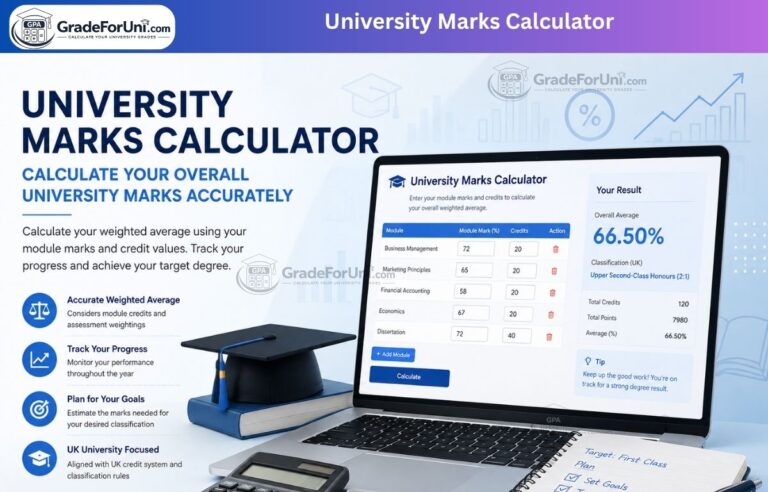
Working out your degree average shouldn't feel like a maths exam in itself. Yet every year, thousands of UK students open a calculator app, try to remember how their university weights credits, and end up with three different numbers depending on which formula they used.
This University Grade Calculator was built to fix that. It takes your module marks, your credit values, and your grading system, then works out your weighted average, your likely degree classification, and an estimated GPA — all in seconds. No spreadsheets, no guesswork, no formulas to memorise.
Whether you're checking your progress after Year 1, working out whether you're on track for a 2:1 in Year 2, or trying to calculate exactly what mark you need in your final dissertation to secure a First, this tool handles it. It understands how UK universities actually calculate grades, including credit weighting, year weighting, and the difference between a simple average and a proper weighted average. You don't need to be good at maths to use it. You just need your marks and your credits.
UK Degree Classification Bands
Quick Answer
A University Grade Calculator is a free online tool that works out your weighted average mark based on your module scores and their credit values. Instead of adding up percentages and dividing by the number of subjects, it multiplies each mark by its credit weight, so that a 40-credit module counts more towards your final grade than a 10-credit one — exactly how UK universities calculate degree results.
You enter your module names, marks and credits, choose your grading system, and the calculator instantly shows your current weighted average, your likely degree classification (First, 2:1, 2:2, Third), an estimated GPA, and — if you switch on target grade mode — the mark you'd need in your remaining assessments to hit a specific classification.
What is a University Grade Calculator?
A University Grade Calculator is a tool that converts your individual module marks into one overall average, using the same weighting logic your university applies when it calculates your final degree result. It removes the need to manually track credit values, work out percentages, or check which classification band your average falls into.
It's useful for a wide range of students, not just those in their final year:
Undergraduates
Undergraduate students use it after every semester to check where their average currently sits, and whether they're tracking towards a 2:1 or First.
Postgraduate & Masters
Postgraduate and Masters students use it because Masters grading often uses different boundaries (Distinction is 70%+, Merit is 60–69%), and the calculator adjusts to that scale.
International Students
International students use it to translate a UK percentage mark into a GPA equivalent, which is often needed for scholarship applications, visa extensions, or applying to graduate schools back home.
Single Module Calculations
Students calculating a single module use it simply to check one result against the credit value, without needing the rest of their transcript.
Final Degree Averages
Students calculating their final degree average use it to combine every year's results, correctly weighted, into one final percentage and classification.
Target Grade Planning
Students planning a target grade use it to reverse-engineer the mark they need in an upcoming exam or dissertation to reach a specific classification band.
What Can This University Grade Calculator Do?
Our interactive tool is more than a simple average checker. It incorporates all facets of UK university assessment rules to give you a highly customized breakdown:
Here is a detailed look at what each function offers:
- Uni Grade Calculator: Enter your marks, enter your credits, and get an instant weighted average. A student with five modules can see their full-year average within a minute.
- University Grade Calculator by Credits: Accounts for module credit values (usually 10, 15, 20, 30, or 40 credits) so that a 40-credit dissertation is automatically weighted four times more heavily than a 10-credit optional module.
- University Grade Percentage Calculator: All UK results are shown as percentages, displayed alongside UK classification bands so you know exactly where you stand.
- Average University Grade Calculator: Leaving the credit fields blank switches the calculator to a simple unweighted average automatically.
- Final University Grade Calculator: Built for students in their last semester. Combine every module from every year that counts, and turn on target grade mode to see the exact mark you need in remaining assessments.
- University Grade Calculator for Year 2: Enter Year 2 modules to isolate that year's performance.
- University Grade Calculator for Year 3: Isolates your final year, which typically carries the heaviest weighting towards your final degree (commonly around 67%).
- Weighted University Grade Calculator: Core function that combines marks and credits using the proper weighted average formula instead of treating every module as equally important.
- University GPA Estimate: Produces an estimated GPA on a standard 4.0 scale alongside your UK percentage and classification, useful for international applications.
Benefits of Using Our Calculator
- Instant calculations — no manual maths, results appear as soon as you click Calculate
- Weighted averages — reflects how your university actually scores your degree
- Credit weighting — accounts for 10, 15, 20, 30 and 40-credit modules automatically
- Target grade mode — shows the mark you need in remaining assessments
- Degree classification — matches your average to First, 2:1, 2:2 or Third instantly
- GPA estimate — converts your UK percentage to an approximate 4.0-scale GPA
- Save your results — come back and update your marks as the year progresses
- Download as PDF — keep a record for your own tracking or to share
- No registration required — use it straightaway, no account needed
- Simple, clean interface — built for students, not spreadsheets
How to Use the University Grade Calculator
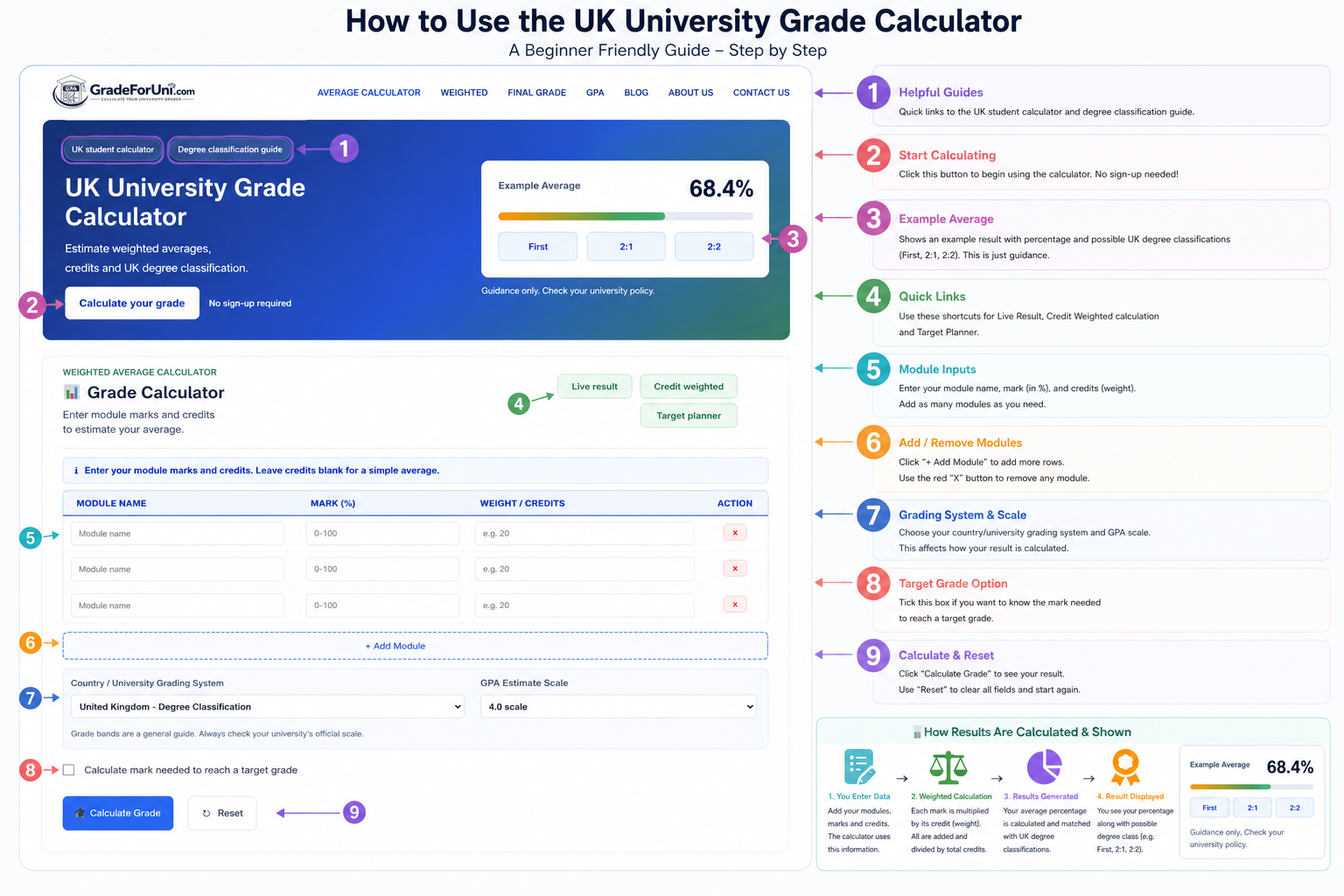
Enter module names
Add each subject or module you want included, for example "Databases" or "Contract Law." This just helps you keep track of which mark belongs to which module.
Enter marks
Type in your percentage mark for each module, from 0 to 100. If you only have a provisional mark, you can still enter it and update it later.
Enter credits
Add the credit value for each module — usually found on your university's module handbook or timetable. Leave this blank for any module you want treated as an unweighted equal average.
Choose grading system
Select whether you're working on the standard UK percentage scale or a Masters-level scale, where Distinction, Merit and Pass boundaries differ from undergraduate classifications.
Choose GPA scale
Pick the GPA conversion scale you need, typically the standard US 4.0 scale, so your estimated GPA is calculated alongside your UK result.
(Optional) Enable Target Grade
Switch this on if you have remaining assessments and want to know exactly what mark you need to reach a specific classification.
Click Calculate Grade
The calculator processes your marks and credits instantly and displays your full results breakdown.
Understand the results
Review your weighted average, classification, GPA estimate, and module-by-module breakdown — explained fully in the next section.
Download PDF
Save a PDF copy of your results if you want a record for your own files or to share with a tutor or advisor.
Save results
Store your entries so you can return later in the term, add new marks, and see your updated average without starting again.
Understanding Every Result
When the calculator completes its calculations, it returns a breakdown of multiple points of data. Here is what each result means:
| Result Parameter | What It Means |
|---|---|
| Current Weighted Average | Your overall mark based on marks and credits entered so far |
| Calculation Type | Whether the result used weighted or simple averaging |
| Modules Entered | The number of modules included in the calculation |
| Total Credits | The combined credit value of all modules entered |
| Grading System | The scale used — undergraduate percentage or Masters |
| Estimated GPA | Your approximate result converted to a 4.0 GPA scale |
| Local Grade | Your result matched to a UK classification band |
| Next Grade Band | The classification just above your current average |
| Highest Module | The module with your best mark |
| Lowest Module | The module with your weakest mark |
| Biggest Impact | The module affecting your average the most, due to its credit weight |
| Credit Effect | How much a module's credit value shifted your final average |
| Mark Needed | In target grade mode, the score required in remaining work |
| Ready Status | Confirms whether enough data has been entered for an accurate result |
How Universities Calculate Grades
UK universities don't all use identical methods, but most follow the same core principles:
- Simple Average: Treats every module equally, regardless of credit value. It's rarely how real degree classifications are calculated, but useful for quick comparisons.
- Weighted Average: Multiplies each mark by its credit value before dividing by total credits. This reflects the fact that a 40-credit module represents far more study time and assessment than a 10-credit one. Access our dedicated Weighted Average Calculator for module-level tracking.
- Credit Weighted Average: The standard method across almost all UK institutions — every module's mark is scaled by its proportion of your total annual or degree credits.
- Year Weighting: Applies once you combine multiple years. Year 1 is commonly excluded or given a very small weighting, while Year 2 and Year 3 (or Year 3 and Year 4 on integrated Masters) carry the real weight towards your final classification.
- Degree Classification Weighting: The final step, where your combined, year-weighted, credit-weighted average is matched against the First, 2:1, 2:2 and Third boundaries to determine your classification.
The Mathematical Formulas Explained
Each mark is multiplied by its own credit value, the results are added together, then divided by the total credits.
Used when credits are equal or not provided — every module counts the same amount.
Converts raw scores into the percentage format UK universities use for classification.
Rearranges the weighted average formula to solve for the score you need in your remaining modules.
A simplified conversion — actual GPA scales vary by country and institution, so this gives a close estimate.
Worked Examples
Select a student profile below to see how credits and module weighting combine to produce the final classification. Notice how modules with higher credit values exert a stronger pull on the overall average grade.
An isolated calculation of Year 2 modules for a Marketing student:
| Module | Mark (%) | Credits | Calculation Contribution |
|---|---|---|---|
| Consumer Behaviour | 61% | 20 | 61 × 20 = 1,220 points |
| Digital Marketing | 67% | 20 | 67 × 20 = 1,340 points |
| Market Research Methods | 58% | 20 | 58 × 20 = 1,160 points |
Weighted Year 2 Average: 62.0% — Upper Second Class (2:1).
Calculation: (1,220 + 1,340 + 1,160) ÷ 60 credits = 62.0%.
Note: This is the Year 2 average only — it will later be combined with Year 3 using the university's weighting split.
The same Marketing student's Year 3 modules and the combined final degree average:
| Module | Mark (%) | Credits | Calculation Contribution |
|---|---|---|---|
| Strategic Brand Management | 74% | 20 | 74 × 20 = 1,480 points |
| International Marketing | 69% | 20 | 69 × 20 = 1,380 points |
| Dissertation | 72% | 40 | 72 × 40 = 2,880 points |
Weighted Year 3 Average: 71.75% — First Class.
Calculation: (1,480 + 1,380 + 2,880) ÷ 80 credits = 71.75%.
Combined Final Result (using 33:67 Year Weighting Split):
Final Average = (Year 2 Average × 0.33) + (Year 3 Average × 0.67)
Final Average = (62.0% × 0.33) + (71.75% × 0.67) = 20.46% + 48.07% = 68.5% — Upper Second Class (2:1)
A Biology student showing how credit sizes change the final average:
| Module | Mark (%) | Credits | Weighted Contribution |
|---|---|---|---|
| Cell Biology | 55% | 10 | 55 × 10 = 550 points |
| Genetics | 62% | 20 | 62 × 20 = 1,240 points |
| Ecology Fieldwork Project | 70% | 30 | 70 × 30 = 2,100 points |
Weighted Average: 64.5% — Upper Second Class (2:1)
Calculation: (550 + 1,240 + 2,100) ÷ 60 credits = 64.5%.
Simple Average: 62.3% — Upper Second Class (2:1)
Calculation: (55 + 62 + 70) ÷ 3 = 62.33%.
Key Insight: Notice the weighted result is higher — because the Ecology Fieldwork Project carries the most credits and the student scored well in it, it pulls the average up more than a simple average would show.
A History student who wants to secure a First Class degree and needs to plan the mark required in their final dissertation:
| Module | Mark (%) | Credits | Status |
|---|---|---|---|
| Modern European History | 66% | 20 | Completed |
| Historiography | 59% | 20 | Completed |
| Dissertation | Pending | 40 | Remaining |
Current Average (Completed modules only): 62.5%.
Calculation: (66 × 20 + 59 × 20) ÷ 40 credits = 62.5%.
Target Grade Planner Resolution:
Goal: First Class (70.0% overall average across 80 total credits).
Dissertation Mark Needed = [(Target Average × Total Credits) − Sum of (Completed Marks × Credits)] ÷ Remaining Credits
Dissertation Mark Needed = [(70 × 80) − (66×20 + 59×20)] ÷ 40
Dissertation Mark Needed = [5,600 − 2,500] ÷ 40 = 3,100 ÷ 40 = 80.0%
Key Benefit: This student needs 80% in their dissertation to reach a First overall — a realistic check before deciding how much revision time to invest.
An Accounting student checking their UK marks and estimating their US GPA conversion:
| Module | Mark (%) | Credits | Calculation Contribution |
|---|---|---|---|
| Financial Reporting | 68% | 20 | 68 × 20 = 1,360 points |
| Taxation | 61% | 20 | 61 × 20 = 1,220 points |
| Audit & Assurance | 73% | 20 | 73 × 20 = 1,460 points |
Weighted Average: 67.3% — Upper Second Class (2:1).
Calculation: (1,360 + 1,220 + 1,460) ÷ 60 credits = 67.33%.
Estimated GPA: 3.4 – 3.5 (on a standard 4.0 scale)
A Philosophy student whose modules carry equal weighting, leaving the credit fields empty:
| Module | Mark (%) | Credits Entered |
|---|---|---|
| Ethics | 71% | None (blank) |
| Logic | 64% | None (blank) |
| Political Philosophy | 68% | None (blank) |
Simple Average: 67.7% — Upper Second Class (2:1).
Calculation: (71 + 64 + 68) ÷ 3 modules = 67.67%.
Note: Since no credit values were entered, the calculator automatically switched to a simple unweighted average.
University Credits Explained
Credits matter because they represent study time and assessment weight, not just a module's importance. A module you found easy but which carries 40 credits will influence your average far more than a hard module worth only 10 credits. Here is a breakdown of common credit sizes in UK higher education:
10 Credits
Small optional modules or short assessed units. Low impact on overall classification.
15 Credits
Common at some universities for standard terminal modules.
20 Credits
The most common single-module credit value in the UK, representing a standard term-long class.
30 Credits
Larger modules, often including a major project component or intensive lecture blocks.
40 Credits
Year-long or double modules with substantial assessment weight, like dissertations or science labs.
60 Credits
A full half-year's worth of credit. Highly significant influence on final classification.
Year 2 and Year 3 Weightings
Most UK undergraduate degrees weight Year 2 and Year 3 towards your final classification, while Year 1 typically counts for 0% (though it usually still needs to be passed to progress). A common structure is:
Standard Year Weights:
- Year 1 — 0%
- Year 2 — 33%
- Year 3 — 67% (often referred to as a 1:2 ratio)
Some universities use a 40:60 split instead, and integrated Masters degrees often add a fourth year into the calculation. Policies genuinely vary between institutions, so it's worth checking your own university's regulations — but this calculator lets you enter each year separately, then combine them using whichever split applies to you.
Example Calculation: A student with a Year 2 average of 58% and a Year 3 average of 67%, using a 33:67 split:
This average lands in the Upper Second Class (2:1) band.
UK Degree Classification Boundaries
Once your weighted percentage average has been computed, it is matched directly against the official UK undergraduate honours classification boundaries:
| Classification | Percentage Range | Honours Abbreviation | Typical Career/Study Impact |
|---|---|---|---|
| First Class | 70% – 100% | 1st | Prioritised for competitive graduate schemes and postgraduate scholarships. |
| Upper Second Class | 60% – 69% | 2:1 | The standard requirement for most UK graduate jobs and Masters courses. |
| Lower Second Class | 50% – 59% | 2:2 | Opens doors to many careers, though some corporate schemes set a 2:1 minimum. |
| Third Class | 40% – 49% | 3rd | Counts as a passing Honours degree, though restricts graduate school entry. |
| Fail | Below 40% | — | Unclassified. Usually requires a resit or yields an ordinary degree. |
Boundaries can vary slightly between universities, so always confirm the exact figures with your own institution's regulations.
GPA Estimate Explained
GPA (Grade Point Average) is the standard grading measure used in the US and several other countries, typically on a 0.0–4.0 scale. UK universities use percentages instead, which means students applying abroad often need a rough GPA equivalent. You can use our dedicated GPA Calculator for a direct and detailed conversion:
| UK Classification | Percentage Boundary | Approximate GPA Range |
|---|---|---|
| First Class | 70%+ | 3.7 – 4.0 |
| Upper Second (2:1) | 60% – 69% | 3.3 – 3.6 |
| Lower Second (2:2) | 50% – 59% | 2.7 – 3.2 |
| Third Class | 40% – 49% | 2.0 – 2.6 |
| Fail | Below 40% | Below 2.0 |
This conversion is an estimate, not an official scale — different universities and countries use slightly different GPA formulas, so always check the specific conversion required by the institution or employer you're applying to.
Common Mistakes When Calculating University Grades
Small input discrepancies can lead to major errors in your overall average calculation. Be sure to avoid these pitfalls:
Entering Incorrect Credits
Using the wrong module credit value skews your entire weighted average calculation. Double-check your transcript.
Mixing Percentages and GPA
Entering a 4.0 scale GPA value into the percentage input field produces meaningless results. Keep inputs as percentages (0-100) and use our GPA Calculator for GPA-specific work.
Ignoring the Dissertation
Leaving out your dissertation (worth 30, 40, or 60 credits) misses a major component with significant weighting.
Wrong Module Weights
Assuming all modules carry equal credits. In the UK, credits vary across departments and module formats.
Ignoring University Policies
Assuming a standard 33:67 year split when your specific university uses 40:60, or rules that drop your lowest module.
Using Simple Average Incorrectly
Treating modules of unequal sizes as identical, which understates or overstates your actual average.
Practical Scenarios
Can I calculate one semester?
Yes. Enter only the modules completed in that semester along with their credits for an isolated semester average.
Can I calculate Year 2 only?
Yes. Enter just your Year 2 modules and credits to see that year's standalone result.
Can I calculate Year 3 only?
Yes, the same way — enter only Year 3 modules for a final-year-specific average.
Can I calculate my dissertation?
Yes. Enter it as its own module with its correct credit value (commonly 30, 40 or 60 credits).
Can I calculate resits?
Yes. Update the relevant module's mark once your resit result is confirmed, and recalculate.
Can I estimate my final classification?
Yes. Combine all relevant years using your university's year-weighting split on our main University Grade Calculator homepage to estimate your final degree result.
Can I calculate my honours classification?
Yes. Once your weighted average is calculated, it's automatically matched to the correct UK honours band.
Frequently Asked Questions
It's used to work out your overall average mark from individual module scores and credits, matching the method your university uses to calculate degree classifications. Students use it to track progress, plan target grades, and estimate their final result before official confirmation.
The core weighted average formula is used by the vast majority of UK universities, but year-weighting splits and classification boundaries can vary slightly by institution. Always confirm exact figures with your own university's academic regulations.
It's recommended, since credits determine how much each module counts. If you leave credits blank, the calculator switches to a simple unweighted average instead.
A weighted average accounts for each module's credit value, so larger modules count more. An unweighted average treats every module equally, regardless of size.
Yes. Select the Masters grading system, which uses Distinction, Merit and Pass boundaries instead of the undergraduate First, 2:1, 2:2 scale.
It's usually based on a weighted combination of Year 2 and Year 3 (or Years 2–4 for integrated Masters), using your university's specific weighting split, applied to your credit-weighted module averages.
At most UK universities, Year 1 doesn't count towards your final classification, though you still need to pass it to progress. Some universities do include a small Year 1 weighting, so check your own regulations.
It calculates the mark you need in your remaining modules or assessments to reach a specific classification, based on your current average and remaining credits. You can enable this on the homepage or try our dedicated Final Grade Calculator.
It's a close approximation based on standard conversion ranges, not an official scale. Different universities and countries convert UK percentages to GPA slightly differently. Use our GPA Calculator to learn more about conversion methods.
Yes. It's particularly useful for converting a UK percentage average into an estimated GPA for scholarship applications, further study, or job applications abroad. Visit the dedicated GPA Calculator to convert transcript details.
You can still use the calculator to get your weighted average — just check your own university's published boundaries if they differ from the standard bands.
Yes, though the result will simply reflect that one module's mark rather than an overall average.
Yes, you can save your results and return later to update marks as new results are released.
Yes, results can be downloaded as a PDF for your own records.
Enter the mark as normal — the calculator includes it in your average, though you'll also need to check your university's specific rules on module failure and resits.
Once you have a confirmed resit mark, update that module in the calculator and recalculate — most universities cap resit marks at the pass boundary (typically 40%), so check your institution's policy.
Yes, a 2:1 meets the minimum requirement for the majority of UK graduate schemes and postgraduate courses, though some competitive employers ask for a First.
Yes, simply recalculate using each split (for example 33:67 versus 40:60) to see how your final average changes.
Generally yes, assuming its mark differs from your other modules — the higher the credit value, the more that module's result shifts your overall weighted average.
Yes, it's completely free, with no registration required to calculate, save, or download your results.
Related Academic Calculators
If you found this useful, you might also want to try our other specialized grading planners:
Conclusion
Working out your real university average takes more than adding up percentages — credits, year weighting, and classification boundaries all play a part, and getting any of them wrong can leave you with a misleading picture of where you actually stand.
This University Grade Calculator handles all of that for you, using the same weighted logic UK universities apply to real degree results. Enter your marks, add your credits, and see exactly where your average sits — whether you're checking one module, planning your target grade, or working out your final classification.
By using this tool, you agree to our Terms and Conditions and acknowledge our Privacy Policy.