

Graduate Entry Medicine: What Grades Do You Need? [2026]
Graduate entry medicine is the UK’s four-year fast track into a medical degree for people who already hold a university degree — and the grades that decide your offer are almost certainly not the ones you are worrying about. If you are sitting on an English degree, an engineering degree or a business degree and wondering whether the door to medicine has closed, this guide is for you. The short version: most graduate entry medicine (GEM) courses care far more about your degree classification and an admissions test score than about your old A-levels.
That sounds liberating, but the filters are no less ruthless for being different. A 2:1 is the near-universal academic floor, the admissions test (GAMSAT or UCAT, depending on the school) does the heavy lifting in shortlisting, and the UCAS deadline falls in October — a full year before you would start. Then there is the money: medicine is one of the few subjects where a second degree still attracts full student finance, but the year-by-year funding split catches applicants out every cycle.
This guide walks through each filter in order: what “2:1 in any subject” actually means (and the honours-versus-ordinary trap), how GAMSAT and UCAT scores are really used, what selectors score beyond grades, how the October application cycle works, and exactly who pays what across the four years. Every threshold below is sourced from published admissions pages — never invented — and worked examples show the arithmetic behind the filters.
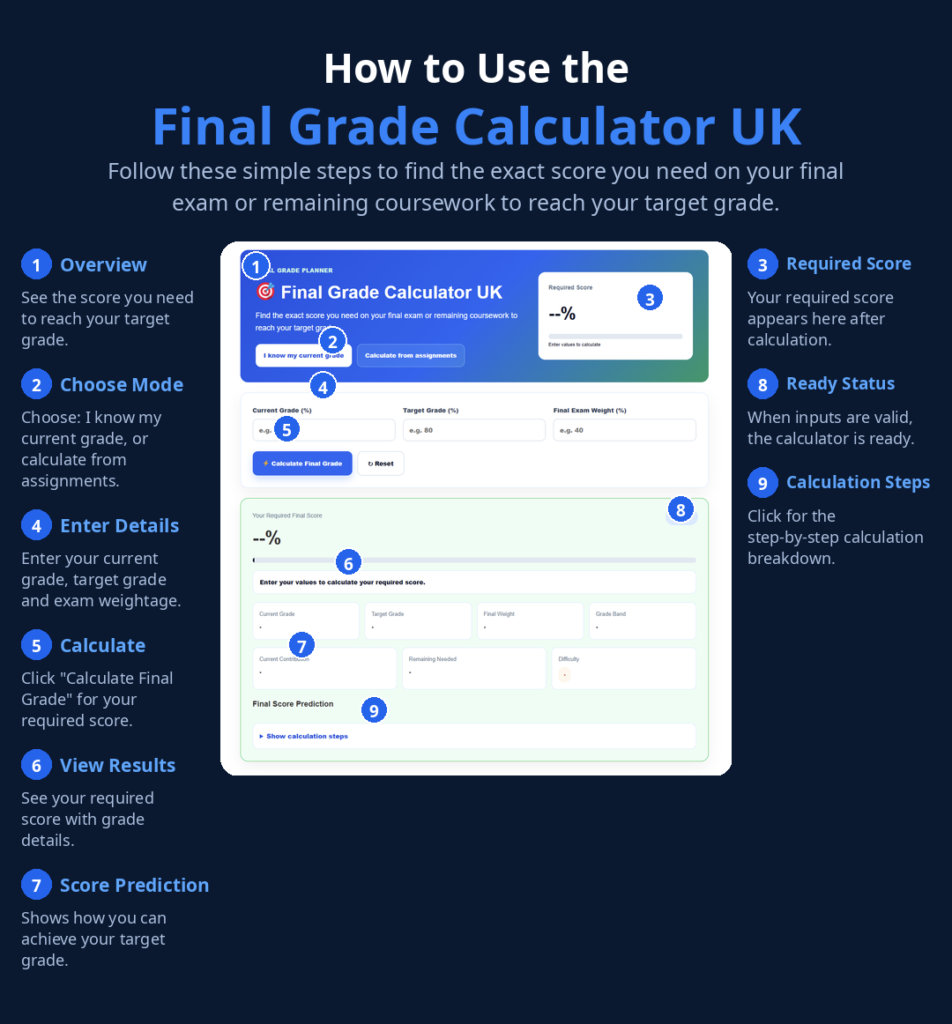
Click Here: Final Grade Calculator UK
What Graduate Entry Medicine Actually Is (and Isn’t)
Graduate entry medicine means four-year accelerated medical degrees — MBBS or MBChB — open only to applicants who already hold a degree. They typically carry the UCAS code A101 (Pears Cumbria’s uses A102) and compress the pre-clinical teaching so graduates cover in four years what school leavers cover in five or six. Around two dozen UK medical schools run one, either as a standalone graduate-only course or as a graduate stream alongside the standard five-year A100 course.
It is not a back door for weaker academics. The applicants who succeed tend to be people whose school grades never reflected their ability, career changers with a decade of work behind them, or graduates who discovered medicine late and are willing to sit a brutal admissions test to prove it. What GEM does offer is a different scoring system: your university degree replaces your A-levels as the main academic evidence, and the test replaces the predicted-grades lottery. If your A-levels were the weakest part of your record, that swap is the entire point of the route.
One thing to keep separate in your head: this article is about getting into graduate entry medicine. Once you are enrolled, medical degrees are graded on a completely different system — pass/fail with honours and deciles rather than degree classes — which our guide to how medical degrees are graded in the UK explains. Don’t confuse the two: a 2:1 gets you through the door; it plays no role in how you are assessed once inside.
The 2:1 Filter: How Graduate Entry Medicine Judges Your Degree
The single most important grade filter in graduate entry medicine is your degree classification. The modal requirement across UK medical schools is at least a 2:1 (upper second-class honours). For 2027 entry, 15 of the 22 graduate entry courses accept a degree in any subject at 2:1 or above, according to the Medical Schools Council’s course finder data — so a 2:1 in history, law, engineering or languages clears the academic bar at most schools.
The exceptions matter, though. A group of schools requires a science or health-related degree: Bangor, Cardiff, King’s, Manchester, Oxford, Pears Cumbria and Sheffield all ask for one. King’s Graduate Entry programme, for example, requires a minimum 2:1 in a biosciences subject containing both biology and chemistry content. Some schools add conditions rather than a subject requirement — Barts asks for a 2:1 in a listed biomedical subject or a 2:1 in any subject plus A-level sciences. The lesson: “2:1 in any subject” is the headline, but the course page of each school on your shortlist is the contract.
There is also a quieter trap in the wording: the requirement is almost always an honours degree. An ordinary (non-honours) degree — the kind awarded without the final-year dissertation or below the honours threshold — generally does not meet the bar. Worcester’s entry criteria spell it out explicitly: a “1st or 2:1 undergraduate honours degree in any subject”. If you left university with an ordinary degree, confirm your award type with your university before you spend months preparing for an admissions test.
And what about a 2:2? It is not automatically the end. Several schools accept a 2:2 paired with postgraduate study: Chester and Worcester accept a 2:2 with a master’s or doctoral degree, Swansea accepts a 2:2 with a postgraduate degree, and Ulster accepts a 2:2 with a master’s at 60% or above. A master’s taken specifically to repair a 2:2 is a real, published route — but it is a school-by-school exception, not a general rule, and the postgraduate bar (a merit or distinction, or 60%+) is itself a filter.
Worked Example: The Arithmetic Behind a 2:1
Consider Priya, a final-year biomedical sciences student targeting graduate entry medicine. Her university weights the final degree as 25% second year and 75% final year. Her marks:
| Year | Average mark | Weight | Weighted contribution |
|---|---|---|---|
| Year 2 | 63.5% | 0.25 | 63.5 × 0.25 = 15.875 |
| Final year | 58.9% | 0.75 | 58.9 × 0.75 = 44.175 |
| Degree aggregate | 15.875 + 44.175 = 60.05% |
60.05% sits just inside the 2:1 band (60–69%), so Priya clears the 2:1 filter — but only just. Now compare her coursemate Daniel, whose aggregate comes out at 59.4%. That is a 2:2, and at every school requiring a straight 2:1, his application fails the academic filter before anyone reads a word of it. The difference between 59.4% and 60.05% is 0.65 of a percentage point — roughly one stronger exam answer in one final-year module — and it is the difference between eligible and ineligible at most GEM courses.
If you are still studying and hovering near the boundary, this is exactly the calculation to run now. Our Final Grade Calculator UK works backwards from a 60% target to tell you the marks you need on your remaining assessments, and the degree classification calculator models your final class under your own university’s weighting scheme. A borderline 2:2 that could become a 2:1 is worth fighting for far more than a safe 2:1 is worth polishing into a First — because for GEM, the filter is binary.
Graduate Entry Medicine Myths That Cost People Their Application
Myth 1: “You need a science degree.” You don’t — at most schools. As above, 15 of 22 courses accept any subject for 2027 entry. Non-science graduates do face a couple of extra wrinkles (Worcester, for instance, asks non-science graduates for GCSEs in two science subjects), but the default assumption should be eligibility, not exclusion.
Myth 2: “You need a First.” Nobody’s GEM offer has ever required a First as standard. The filter is a threshold, not a ranking: a 2:1 meets it, and a First meets it no better. Spend the energy you would have spent chasing 70s on the admissions test instead — that is where ranking actually happens.
Myth 3: “A-levels don’t matter at all.” Often true, not always. Chester states outright that A-levels are “not reviewed”. But Cambridge and Oxford still mention A-level subjects for their graduate courses, and Sheffield and Queen Mary reference them too. Weak A-levels rule you out of far fewer GEM courses than weak A-levels rule you out of A100 — but “far fewer” is not “none”.
Myth 4: “50 on the GAMSAT is a pass.” The GAMSAT has no pass mark. A score of 50 is a published minimum at some schools (Swansea set 50 overall for 2026 entry; St George’s requires at least 50 in each section), and the interview cut-off — the score that actually gets you shortlisted — is set yearly from the applicant pool and sits above the minimum. Treating the minimum as the target is the most expensive misunderstanding in GEM admissions.
Myth 5: “Student finance works like it did for my first degree.” It almost does — medicine is a genuine exception to the second-degree funding block — but the year-by-year split is different, with a self-funded tuition chunk in year one and NHS bursary funding from year two. The funding section below works the numbers.
GAMSAT vs UCAT: How Graduate Entry Medicine Tests You
Every GEM course requires an admissions test, and which test you sit decides which schools you can apply to — so this choice comes before the shortlist, not after. Broadly: City St George’s, Ulster, Nottingham, Southampton and the Scottish ScotGEM programme use the GAMSAT; Warwick, Cambridge, Cardiff and Barts use the UCAT; and a middle group — Chester, Surrey, Swansea, Worcester and Pears Cumbria — accepts either. A few also accept the MCAT as an alternative (Chester and Swansea among them).
The tests measure different things. The GAMSAT runs over a gruelling 5+ hours in three sections: Section I (reasoning in humanities and social sciences — 62 questions in 100 minutes), Section II (written communication — two essays in 65 minutes), and Section III (reasoning in biological and physical sciences — 75 questions in 150 minutes, roughly 40% biology, 40% chemistry, 20% physics at around first-year undergraduate level for the first two and A-level for physics). The UCAT is a shorter, computer-based aptitude test of verbal, decision-making and quantitative reasoning plus situational judgement — since the removal of abstract reasoning, the cognitive total runs 900–2700 with situational judgement banded 1–4. Our guide to a good UCAT score for medicine breaks down what the numbers mean in practice.
Timing rules are strict and they differ. GAMSAT scores are valid for two years — results from the September 2026 sitting count for both 2027 and 2028 entry — while the UCAT must be sat in the same year as your UCAS application. Pears Cumbria’s published wording is typical: the GAMSAT must have been taken within the two years before your UCAS submission date; the UCAT must be taken in the application year, with results reaching admissions teams in November.
On thresholds, the honest picture is this: schools publish minimums, and the applicant pool sets the real cut-off. Named, published examples: Swansea set a minimum of 50 overall on the GAMSAT or 1900 on the UCAT for 2026 entry; City St George’s requires at least 50 in each GAMSAT section plus a yearly overall cut-off on top; ScotGEM’s published 2025 selection data shows an unweighted overall of 50 with no section below 42; Pears Cumbria published a 1960 UCAT threshold for home applicants in 2025/26. Nottingham adds a wrinkle worth knowing: it calculates your score both ways — weighted and unweighted — and uses the better one. For every other number you see quoted on forums, treat it as gossip until the school’s own course page confirms it, because cut-offs move every year with the cohort.
Worked Example: How Your GAMSAT Score Is Actually Calculated
The GAMSAT overall score is a weighted average that doubles the science section:
Overall = (Section I + Section II + 2 × Section III) ÷ 4
Take Tom, an applicant with Section I = 62, Section II = 71 and Section III = 56. His weighted overall is:
| Step | Calculation | Result |
|---|---|---|
| Weight the sections | 62 + 71 + (2 × 56) | 62 + 71 + 112 = 245 |
| Divide by 4 | 245 ÷ 4 | 61.25 → reported as 61 |
| Unweighted check (some schools) | (62 + 71 + 56) ÷ 3 | 189 ÷ 3 = 63 |
How does Tom fare against published filters? Swansea’s 2026 minimum of 50 overall: passed comfortably. St George’s per-section floor of 50: passed (his lowest section is 56). ScotGEM’s unweighted 50 with no subset below 42: passed on both counts. But — and this is the crucial distinction — passing every published minimum only means Tom survives the filter. Whether 61 (or 63 unweighted) reaches the interview cut-off depends on that year’s applicant pool, and that number is published retrospectively, if at all. Notice too how the doubling punishes a weak science section: Tom’s 56 in Section III drags his weighted score two full points below his unweighted one. For non-science graduates, Section III preparation is where GAMSAT applications are won and lost.
What Gets Scored Beyond Grades: Experience and Values
No UK medical school publishes a marking rubric for work experience, so anyone selling you a precise formula is guessing. What schools do publish is the shape of what they look for. Chester asks for around 70 hours of healthcare experience in the three years before application; Warwick asks for at least 70 hours of health or social care work. Pears Cumbria takes the opposite approach and states outright that clinical experience is not required — instead it looks for evidence of the values of a “future medic”: teamwork, leadership, communication, resilience, commitment and empathy, demonstrated through whatever responsible, caring roles you have actually done.
The pattern across schools is consistent even where the wording differs: selectors score what your experience shows about you, not the prestige of where you did it. Six months as a healthcare assistant with genuine patient contact and honest reflection on what it taught you about communication under pressure will beat a fortnight shadowing a consultant that you can only describe in generalities. The personal statement is where this gets tested — at Cumbria it is explicitly “used during the interview”, which means every claim in it should be something you can defend in person for five minutes. Write about what you noticed, what surprised you, and what you would do differently — that is what “reflection” means, and it is the currency of every GEM interview.
The Application Route: UCAS Choices and the October Deadline
Graduate entry medicine goes through UCAS like any other undergraduate application, but with two rules that surprise first-timers. First, you get a maximum of four choices across medicine and dentistry combined — not the usual five. Every one of those four slots should be a school whose test, degree requirements and fee status you have verified against its current course page, because a wasted choice on an ineligible school is a quarter of your application gone.
Second, the equal-consideration deadline for medicine is 15 October — months ahead of the January deadline for most other courses. For 2027 entry that date was 15 October 2026, which has now passed; this guide is therefore aimed squarely at the 2028-entry cycle, with its deadline in October 2027. Work backwards from there: the UCAT must be sat in the summer of the application year, the GAMSAT in March or September sittings, and your UCAS form — personal statement, reference and all — submitted by mid-October. Miss the deadline and there is no late route; medicine simply does not accept late applications.
If you are applying in your final year of your first degree, predicted grades still do real work — schools need to see you are on track for the 2:1 before they shortlist you. Our guides to predicted grades on UCAS and the UCAS deadline cycle cover the mechanics in detail.
Funding Graduate Entry Medicine: The Second-Degree Rules That Actually Apply
Here is the funding fact that surprises most graduates: you can get student finance for medicine as a second degree. The normal rule — no tuition fee loan if you already hold an equivalent or higher qualification — has a published exception list, and medicine and dentistry sit at the top of it. This is official Student Finance England policy, not a loophole: the exception exists because the NHS needs the doctors. The government’s own student finance guidance is the place to confirm your personal eligibility: GOV.UK student finance.
But “full funding” does not mean “identical to your first degree”. For a four-year GEM course in England, the years split between Student Finance England and the NHS bursary. Using City St George’s published 2025/26 figures as a worked example (figures rise most years, so treat these as the shape, not the exact pounds):
| Year | Tuition fees | Living costs |
|---|---|---|
| Year 1 (SFE only) | You self-fund the first £3,571; SFE provides a partial tuition fee loan of £5,964 (total £9,535) | Full means-tested SFE maintenance loan |
| Years 2–4 (NHS bursary + SFE) | NHS partial tuition fee grant £3,830 + SFE partial tuition fee loan £5,705 (total £9,535) | Income-assessed NHS bursary + £1,000 non-income-assessed grant; reduced-rate SFE maintenance loan (£3,865 in London / £2,066 at home, full year) |
The arithmetic that matters: across all four years, the out-of-pocket tuition total is £3,571 — the year-one chunk only. Everything else is loans or bursary. That is dramatically cheaper than the alternative some graduates consider — a five-year standard-entry course as a graduate, where SFE offers a maintenance loan but no tuition fee loan for the first four years, leaving four years of fees to self-fund before the NHS bursary kicks in for years five and six. This funding gap is a genuine, structural reason GEM exists, and it should be part of your decision, not an afterthought.
Two forward-looking notes. First, the NHS bursary on a four-year graduate course starts in year 2 (years 2, 3 and 4) — a common point of confusion because the five-year course’s bursary starts in year 5. Second, under the new Lifelong Learning Entitlement, graduates starting a medical degree as a second degree from January 2027 are expected to be able to borrow a full tuition fee loan for year one — but at the time of writing this is described by universities as expected rather than confirmed, so plan on the current rules and treat any improvement as a bonus. Apply for the NHS bursary through the NHS Business Services Authority in the spring/summer before each bursary year; it is not automatic.
6 Mistakes That Sink Graduate Entry Medicine Applications
| Mistake | Why it hurts | What to do instead |
|---|---|---|
| Assuming you need a science degree | You rule out most schools before reading their course pages | Start from the 15 schools accepting any subject; add science-only schools only if eligible |
| Treating the minimum test score as the target | Minimums filter applicants; yearly cut-offs decide interviews — they sit higher | Research each school’s recent cut-offs and aim above them, especially in your weaker section |
| Applying with an ordinary (non-honours) degree | “Honours degree” wording fails you at the first check | Confirm your exact award type with your university before preparing |
| Missing the 15 October UCAS deadline | Late medicine applications are not considered, full stop | Plan the cycle backwards: test in summer, form submitted by early October |
| Recycling a first-degree personal statement | Selectors score reflection on care values, not academic enthusiasm | Rewrite around patient-facing experience and what it taught you |
| Budgeting as if funding matches your first degree | The year-one tuition gap and bursary switch surprise people mid-course | Model the ~£3.5k year-one chunk plus living costs before you accept any offer |
Graduate Entry vs the 5-Year Route: A Decision Framework
Graduates actually have two ways into medicine — the four-year GEM course or the standard five-year course taken as a graduate — and the right choice is structural, not emotional. Use this framework:
| Factor | 4-year graduate entry (A101) | 5-year standard entry as a graduate (A100) |
|---|---|---|
| Degree class needed | 2:1 usually mandatory (2:2 + master’s at some schools) | 2:1 usually required too — no easier |
| Admissions test | GAMSAT and/or UCAT depending on school | UCAT at most schools |
| A-levels | Often waived or not reviewed | Usually AAA with chemistry still required |
| Funding (England) | ~£3.5k self-funded tuition in year 1; NHS bursary years 2–4 | No tuition fee loan for years 1–4; NHS bursary years 5–6 |
| Pace | Compressed and intense from day one | Standard pace; more breathing room |
| Choose it when… | Your degree class is strong, your A-levels are weak, and you test well | Your A-levels are strong, you can fund four years of fees, or you want the gentler pace |
The funding row is the one applicants underweight. A graduate on the five-year route must self-fund four years of tuition — roughly £38,000 at current fee levels — before the NHS bursary arrives. On GEM, the equivalent figure is one partial year. Unless you have savings or family support, that single row often decides the question by itself.
A Short Note for International Graduates
If your degree is from outside the UK, three cautions. First, several GEM courses are home-fee-status only — Pears Cumbria, Barts and King’s among them — so check fee-status eligibility before anything else. Second, a non-UK degree must be recognised as equivalent to a UK 2:1 honours degree; schools typically use UK ENIC comparability for this, and borderline cases deserve an email to admissions before you apply. Third, the funding picture above is England-and-SFE-specific: international students generally cannot access Student Finance England or the NHS bursary, which turns the funding arithmetic upside down. International places on GEM courses are also far scarcer than home places. None of this makes it impossible — a handful of schools accept the MCAT as an alternative test, which suits North American graduates — but it makes early, school-by-school verification essential rather than optional.

Do I need a science degree for graduate entry medicine?
No — at most UK medical schools. For 2027 entry, 15 of the 22 graduate entry courses accept a degree in any subject at 2:1 or above. A smaller group of schools (including Bangor, Cardiff, King’s, Manchester, Oxford, Pears Cumbria and Sheffield) requires a science or health-related degree, so always check the course page of each school on your shortlist.
Can I apply for graduate entry medicine with a 2:2?
Possibly. Several schools accept a 2:2 paired with postgraduate study — Chester and Worcester accept a 2:2 with a master’s or doctoral degree, Swansea accepts a 2:2 with a postgraduate degree, and Ulster accepts a 2:2 with a master’s at 60% or above. A straight 2:2 with no postgraduate qualification will not meet the 2:1 filter at most schools.
What GAMSAT score do I need for graduate entry medicine?
There is no pass mark — schools set their own minimums and the applicant pool sets the interview cut-off each year. Published minimums include 50 overall (Swansea, 2026 entry), at least 50 in each section (City St George’s, plus a yearly overall cut-off), and an unweighted 50 with no section below 42 (ScotGEM, 2025). Aim above the minimums, especially in Section III, which is double-weighted in the overall score.
Should I sit the GAMSAT or the UCAT?
Sit the test your target schools require. City St George’s, Ulster, Nottingham, Southampton and ScotGEM use the GAMSAT; Warwick, Cambridge, Cardiff and Barts use the UCAT; Chester, Surrey, Swansea, Worcester and Pears Cumbria accept either. Remember the timing rules: GAMSAT scores are valid for two years, while the UCAT must be sat in the year you apply.
Do my A-levels matter for graduate entry medicine?
Far less than for standard entry, but they are not universally irrelevant. Some schools waive them entirely — Chester states A-levels are ‘not reviewed’ — while Cambridge, Oxford, Queen Mary and Sheffield still mention A-level subjects for graduate applicants. If your A-levels are weak, favour the schools that do not review them.
How many UCAS choices do I get for medicine?
Four. Medicine and dentistry share a cap of four UCAS choices combined, rather than the usual five. Each choice should be a school whose admissions test, degree requirements and fee-status rules you have verified, because an ineligible choice wastes a quarter of your application.
Can I get student finance for medicine as a second degree?
Yes. Medicine and dentistry are published exceptions to the rule that blocks student finance for second degrees, so Student Finance England funding is available. For a four-year graduate entry course in England, year one combines a self-funded tuition chunk (around £3,500) with a partial SFE tuition fee loan and a full maintenance loan; years two to four are funded by the NHS bursary plus a reduced-rate SFE maintenance loan.
When does the NHS bursary start on a graduate entry course?
From year two. On a four-year graduate entry medicine course you can apply for the NHS bursary for years 2, 3 and 4 — covering a partial tuition fee grant plus a maintenance bursary. This differs from the five-year standard course, where the bursary starts in year five. Apply through the NHS Business Services Authority in the spring or summer before each bursary year.
Conclusion
The grades you need for graduate entry medicine are simpler than the process around them: a 2:1 honours degree (in any subject at most schools, with a 2:2-plus-master’s route at several), an admissions test score comfortably above the published minimums, and the discipline to hit an October deadline a year before you start. The A-levels that defined your school-leaver chances matter far less here — your degree and your test score are the evidence that counts.
Two things deserve your attention before anything else. First, the arithmetic: if you are still studying, run your marks through the Final Grade Calculator UK today and find out exactly what you need for the 2:1 — the boundary between 59.4% and 60% is the boundary between eligible and ineligible. Second, the money: medicine’s second-degree funding exception is genuine, but the year-one tuition gap and the NHS bursary switch from year two need to be in your budget before you apply, not after you accept.
Graduate entry medicine rewards a particular kind of applicant: someone whose degree proves they can handle sustained academic work, whose test score proves they can think under pressure, and whose experience shows they understand what caring for patients actually involves. If that description fits, the route is open — start with the course pages, sit the right test, and submit in October.