
![You are currently viewing How Are Medical Degrees Graded in the UK? Marks, Deciles & the MLA [2026]](https://gradeforuni.com/wp-content/uploads/2026/10/featured-medical-degrees-grading.png)
Ask a final-year medic what degree classification they’re on track for and you’ll get a blank stare — not because they don’t know, but because the question doesn’t make sense. If you’re wondering how are medical degrees graded in the UK, here’s the answer that surprises almost everyone outside medicine: there are no Firsts, no 2:1s, no 2:2s and no Thirds. A medical degree (MBChB, MBBS, BMBS — the letters differ by university) is an unclassified degree, graded on a pass-or-fail base, with merit and distinction awards layered on top for the strongest students.
That single fact reframes everything. Your transcript won’t say “First Class Honours” no matter how brilliantly you perform. Instead, medical schools rank you against your own cohort in deciles, hand out merits to the top fifth and distinctions to the top tenth, and — since the 2024–25 academic year — every graduate must also pass the Medical Licensing Assessment (MLA), a national exam set by the General Medical Council, before their degree counts as a recognised medical qualification. Meanwhile the old system that turned your medical school ranking into foundation job points has been scrapped entirely.
This guide walks through exactly how the system works at real UK medical schools — using UCL’s published 2025–26 MBBS mark scheme as a worked example, the GMC’s MLA framework, and the current UK Foundation Programme allocation rules. If you’re applying to medicine, already studying it, or a parent trying to decode what “merit” on a med school transcript means, this is the full picture.
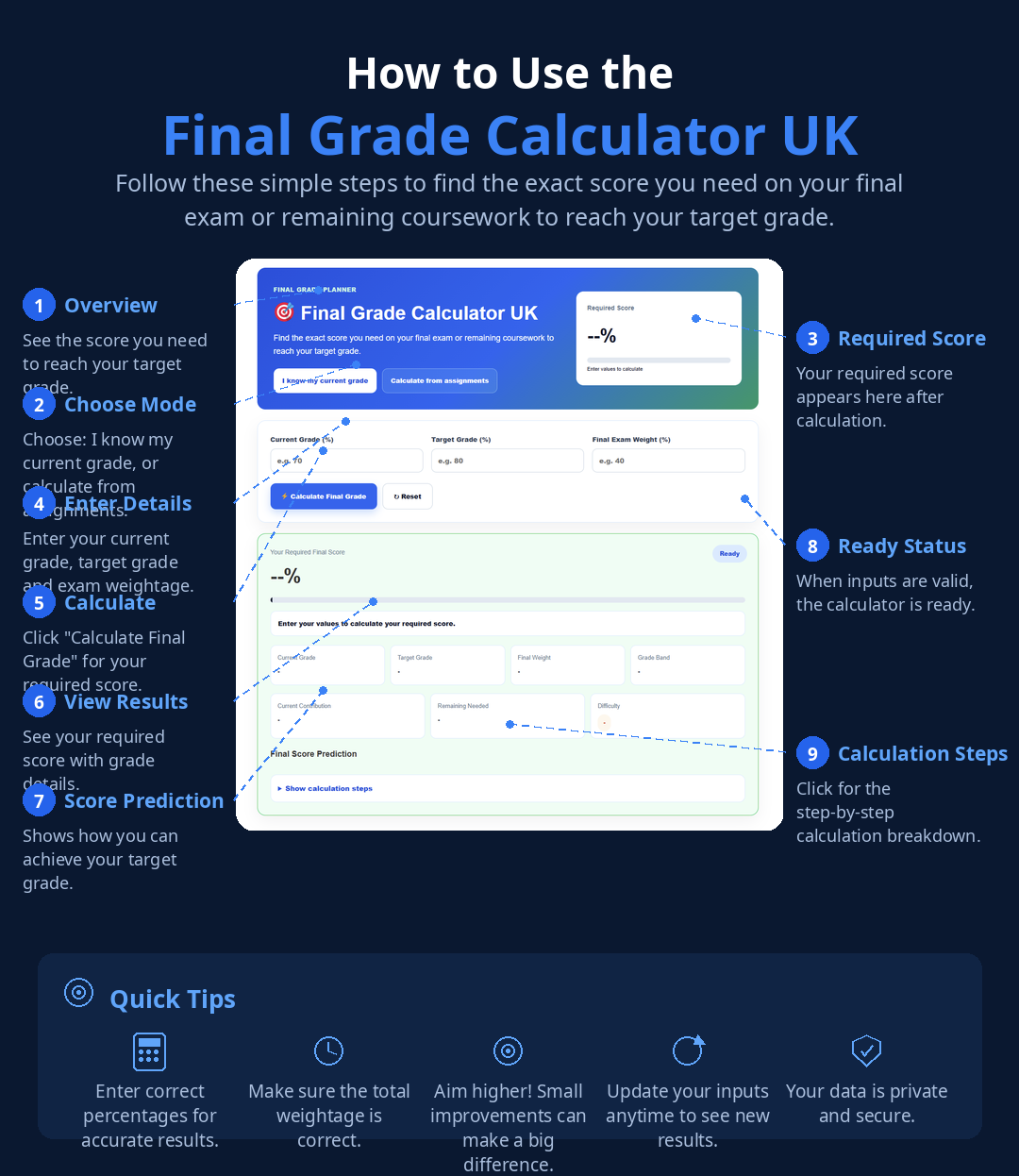
Click Here: Final Grade Calculator UK
The Short Answer: No Firsts, No 2:1s, No Thirds
On a standard UK honours degree, your final mark is crunched through a weighting algorithm and out pops a classification: First (70%+), 2:1 (60–69%), 2:2 (50–59%) or Third (40–49%). Medicine doesn’t do this. The MBChB and MBBS are unclassified degrees — your degree certificate will not carry honours, and you will never be “a First-class medic” in the way a historian can be a First-class historian. The overwhelming majority of UK doctors graduate with an unclassified MBBS or MBChB, and it has never held any of them back, because the entire profession is built around this system.
The reason is structural. Medicine is a professional, competency-based degree: the point is certifying that you are safe to treat patients, not ranking how elegantly you write essays. Every UK medical school therefore runs its assessments as a threshold system first — you either meet the standard or you don’t — and only then layers a relative ranking on top for the strongest performers. Think of it as two separate questions: “Are you good enough to be a doctor?” (pass/fail) and “Where do you sit among your cohort?” (deciles, merit, distinction).
There is one famous exception. Oxford and Cambridge award their medical degrees through the Tripos system, and Cambridge medics can and do earn double and triple Firsts along the way — but that reflects the BA portion of the course (the pre-clinical years count as a classified BA), not the clinical MB BChir itself. Similarly, a handful of schools let their very top graduates use “MBChB (Hons)” post-nominals. Neither changes the national picture: for licensing, employment and specialty applications, your medical degree itself carries no classification.
What You’re Actually Assessed On
Before the rankings, the marks. A typical UK medical school year combines several assessment formats, each testing something different — and each with its own pass mark. The balance shifts as you move from lecture-heavy early years to placement-heavy clinical years:
| Assessment type | What it tests | Typical format | How the pass mark is set |
|---|---|---|---|
| Written knowledge exams (AKT-style) | Applied medical knowledge | Single-best-answer MCQs, short answers | Criterion-referenced standard setting — a fixed standard, not a curve |
| OSCE / OSPE (clinical/practical exams) | Hands-on clinical skills and communication | Timed stations with examiners or actors | Station pass marks plus a minimum number of stations passed |
| Workplace-based assessments | Real-world performance on placement | Mini-CEX, DOPS, case discussions | Competency sign-off, usually pass/fail |
| Coursework and projects | Research, reflection, critical appraisal | Essays, SSC projects, audits | School-specific marking schemes |
| Professionalism | Conduct, attendance, probity | Continuous monitoring | Threshold — fail this and marks elsewhere can’t save you |
The crucial detail is that pass marks are criterion-referenced, not norm-referenced. Medical schools do not “curve” grades — nobody decides in advance that 10% must fail. A panel of experts sets the pass standard (often using the Angoff method, where judges estimate how a borderline student would perform on each question), and everyone above the standard passes. In a strong cohort, everyone can pass; the school doesn’t sacrifice the bottom 10% to fill a quota. This is the opposite of decile ranking, which is purely relative — and the two systems run side by side, which confuses a lot of students.
How Are Medical Degrees Graded Beyond Pass and Fail: Deciles, Merit and Distinction
Once everyone who meets the standard has passed, schools rank the cohort to identify the strongest students. This is where deciles come in. Your year group is ordered from the highest aggregate score to the lowest and split into ten equal bands: the 1st decile is the top 10%, the 10th decile the bottom 10%. From these bands flow the only formal “grades” a medical degree carries: merits and distinctions.
UCL’s published MBBS mark scheme for 2025–26 — one of the most transparent in the country — shows exactly how the machinery works. Distinctions are awarded to the top decile of the cohort, merits to the top quintile (top 20%), and the awards are sliced by phase of the course:
| UCL MBBS phase | Distinction | Merit |
|---|---|---|
| Years 1–2 (Medical Sciences) | Top decile (top 10%) | Top quintile (top 20%) |
| Years 4–5 (Clinical Science) | Top decile (top 10%) | Top quintile (top 20%) |
| Year 6 (Clinical Practice) | Top decile (top 10%) | Second decile (11–20%) |
| Year 3 | The intercalated iBSc year — classified under standard honours rules (see below) | |
Two conditions attach that students often miss. Distinctions and merits are awarded only to students who passed both components (knowledge test and clinical/practical skills) at the first sitting and fulfilled all in-course requirements — a resit pass, however strong, takes you out of the running. And distinctions are part of the degree award itself: they are printed on your degree certificate. A “Distinction in Clinical Practice” on a UCL MBBS certificate is a permanent, verifiable record that you finished in the top tenth of your final year.
Other schools run the same idea with local variations. Some award merits per module or per sitting rather than per phase; some use quartiles instead of quintiles; some attach the words “with honours” to the degree for consistently top-decile students. But the principle is national: absolute marks decide whether you pass, relative rank decides whether you get the extra letters.
Worked example: how a 3-mark swing moves you across the merit line
Take a fictional UCL-style cohort of 340 students in Year 5. The merit cut-off is the top quintile: 340 ÷ 5 = 68 students. The distinction cut-off is the top decile: 340 ÷ 10 = 34 students.
Amara finishes the year ranked 71st on aggregate — just outside the merit band. Her aggregate is 71.4%. The student ranked 68th sits on 71.9%. The gap between “merit” and “no merit” is half a percentage point: roughly one extra MCQ correct, or one station nudged from a bare pass to a clear pass. Nothing about her competence as a future doctor changes across that line — she passed everything comfortably — but the rank-based award is binary. This is the defining psychological feature of medical grading: near the cut-offs, tiny absolute differences produce large nominal outcomes, because the system ranks rather than thresholds.
The clinical-skills side adds its own tripwire. UCL’s scheme requires students to reach the station pass mark in a minimum of 55% of stations where the assessment is an OSCE-style exam. On a 16-station OSCE, 55% of 16 is 8.8 — so you must pass at least 9 stations, even if your total score clears the overall pass mark. A student who aces 8 stations and collapses on 8 more can fail the component outright. Schools publish these rules precisely so students allocate revision time across breadth, not just depth.

The Intercalated Degree: The One Part That IS Classified
Most UK medical students take an extra year — usually after year 2, 3 or 4 — to complete an intercalated degree: a BSc, BMedSci or iBSc in a subject like anatomy, pharmacology, global health or medical humanities. And here, finally, the familiar honours system applies. The intercalated degree is a separate, classified degree governed by the university’s standard undergraduate regulations: a First at 70%+, a 2:1 at 60%+, and so on.
This matters more than students expect. For many medics, the intercalated degree is the only classified degree they will ever hold — and it is the classification that follows them onto CVs, postgraduate applications and academic job shortlists. A First in an intercalated BSc signals something concrete to everyone outside medicine who still thinks in degree classes. It also carries real weight in specialty training applications, where additional degrees routinely attract portfolio points — an intercalated First typically outscores a 2:1, and both outscore no additional degree at all. If you’re weighing whether to intercalate, the classification is part of the return on that extra year of tuition.
One caution: the intercalated year usually sits outside the medical degree’s own ranking. Your iBSc First doesn’t earn you a distinction on the MBBS, and a 2:2 on the iBSc doesn’t drag down your medical decile. They are parallel systems that happen to run in the same student. Students chasing competitive specialties often treat the intercalated year as the highest-leverage academic year of the whole course — which, given the portfolio arithmetic, is not irrational. Our guide to improving a 2:2 to a 2:1 covers the classification mechanics that apply here.
The MLA: The National Exam Every Graduate Must Pass
Since the 2024–25 academic year, no UK medical degree counts as a recognised primary medical qualification unless the graduate has passed the Medical Licensing Assessment (MLA). This is the single biggest structural change to medical grading in a generation, and it applies to every UK medical school on the GMC’s list of awarding bodies.
The MLA has two parts, both owned by the GMC’s framework but delivered through each medical school’s own finals:
| MLA component | What it is | How it’s graded |
|---|---|---|
| Applied Knowledge Test (AKT) | A written test of clinical knowledge mapped to the GMC’s MLA content map | Criterion-referenced pass mark — pass/fail |
| Clinical and Professional Skills Assessment (CPSA) | The school’s OSCE-style clinical exam, meeting GMC CPSA requirements | Station pass marks and overall standard — pass/fail |
The key point for students: the MLA is a threshold, not a ranking. You cannot get a distinction in the MLA; you pass it or you don’t. Its content derives from a single national content map, which means finals at every UK medical school now test the same core curriculum — a quiet standardisation of what used to vary considerably between schools. For international medical graduates the MLA framework also reshapes the route in: from 2024 the GMC’s requirements apply to the assessments that count toward registration.
Practically, most students experience the MLA as their finals wearing a national badge: the AKT is usually the school’s final written paper, aligned to the GMC content map, and the CPSA is the school’s final OSCE, run to GMC requirements. Fail either part and you cannot be awarded a recognised medical degree — you resit under your school’s rules until you pass. The UCL MBBS mark scheme (2025–26) shows how one school folds the national requirements into its own progression regulations.
What Your Marks Actually Decide (and What They Don’t)
Here’s where medical grading gets genuinely strange by the standards of other degrees: for the most important career step after graduation — your first two years as a doctor — your medical school marks no longer matter at all.
Until 2023, final-year medics were ranked for Foundation Programme jobs using their Educational Performance Measure (EPM) — a decile ranking produced by their own medical school — plus a national Situational Judgement Test (SJT) score. High rankers got their preferred foundation school; low rankers often didn’t. From the 2024 allocation round onwards, both the EPM and the SJT were removed from the process. Under the current Preference Informed Allocation (PIA) system, every eligible applicant is assigned a randomised, computer-generated rank, and an algorithm allocates as many applicants as possible to their first-preference foundation school. Your decile, your merits, your distinctions: none of them enter the calculation. The BMA confirmed the system has now run for three years and will continue for the 2027 application cycle.
The change was deliberate — backed by the Medical Schools Council, the BMA and all four UK governments after a consultation in which two-thirds of student respondents supported it — and it was designed to remove differential attainment and a famously stressful exam period. It also removed the extra “educational achievement” points that graduates from 2023 onwards used to collect for additional degrees and publications in the foundation application. Whether PIA is fairer is still argued about in the medical press, but its mechanics are settled: rank your 18 foundation schools honestly, because merit can’t rescue a bad lottery number — and can’t sink you either. The BMA’s explainer on foundation allocation walks through how the two-pass PIA algorithm works.
Where marks and achievements do still count is specialty training applications — the competitive entry to GP, surgery, psychiatry, radiology and every other specialty after the foundation years. These run on portfolio scoring: published person specifications award points across domains including additional degrees (an intercalated BSc, MSc or PhD), publications and presentations, prizes and distinctions, audits and quality-improvement work, teaching experience, and commitment to the specialty. The exact tariffs differ by specialty and change year to year, but the shape is consistent: achievements you bank during medical school — the intercalated classification, a national prize, a published paper, a distinction on your certificate — convert directly into shortlisting points years later. This is the real long-run grading system of a medical career, and it’s portfolio-based, not transcript-based.
Failing, Resitting and Fitness to Practise
Failing happens in medicine like everywhere else — and the machinery for handling it is stricter than on most degrees, because patient safety sits behind every decision. The standard pattern at most UK schools: one resit opportunity (usually in late summer), with the resit typically recorded as a bare pass rather than a numerical mark, and — as UCL’s scheme makes explicit — resit passes are excluded from merit and distinction calculations. Fail the resit and the usual next step is repeating the year; repeated failure can mean being required to withdraw.
Two features are unique to medicine. First, fitness to practise proceedings run alongside academic regulations: serious professionalism or conduct concerns — dishonesty in exams, criminal convictions, health issues affecting safe practice — can end a medical career even with perfect marks, because the GMC’s standards apply to students as well as doctors. Second, progression rules are absolute in a way they aren’t elsewhere: you cannot “trail” a failed clinical module into the next year the way you might carry a failed essay module, because each phase gates entry to patient contact. The safety net exists — extenuating circumstances claims, appeals and repeat-year routes all operate in medical schools — but the thresholds are applied with unusual seriousness, and exam boards document their reasoning accordingly.
Where Your Effort Actually Pays Off: An Honest Framework
Put it all together and medical school rewards effort unevenly. Some marks change your life; most change nothing. Here’s the honest map:
| Effort target | What it buys you | Leverage |
|---|---|---|
| Passing everything first time, comfortably | Staying in the merit/distinction conversation; no resit stigma | High — the foundation everything else builds on |
| Cracking the top decile/quintile in clinical years | Merits and distinctions printed on your degree certificate | Medium-high — permanent CV lines, specialty portfolio points |
| A strong intercalated degree classification | A classified honours degree; specialty application points | High — the only “First” most medics will ever hold |
| Publications, prizes, presentations | Specialty training shortlisting points | High for competitive specialties; low elsewhere |
| Chasing rank for foundation jobs | Nothing — PIA allocation ignores medical school performance | Zero (since 2024) |
| Obsessing over a 68% vs 72% on a passed module | Almost nothing — unclassified degree, no GPA | Low — redirect the hours to the rows above |
The strategic takeaway most senior medics give juniors: protect the pass first, then aim at the things that compound — the intercalated classification, one or two genuine achievements (a prize, a publication, a distinction), and a clean professionalism record. The difference between the 40th and 60th percentile of a cohort is, for career purposes, close to invisible. The difference between a bare pass and a fail, or between an intercalated 2:1 and a First, is not.
Can you get a First in medicine in the UK?
No. UK medical degrees (MBChB, MBBS, BMBS) are unclassified — they are not awarded as First, 2:1, 2:2 or Third. You graduate with a pass (plus any merit or distinction awards), and that is true however high your marks are. The exception is the intercalated degree, which is a separate classified honours degree.
What is a decile ranking in medical school?
Your year group is ordered by aggregate score and split into ten equal bands. The 1st decile is the top 10% of the cohort and the 10th decile the bottom 10%. Schools use deciles to award merits (often top 20%) and distinctions (top 10%). Since 2024, deciles are no longer used to allocate Foundation Programme jobs.
What is the MLA and do I have to pass it?
The Medical Licensing Assessment has been required since the 2024–25 academic year. It has two parts: an Applied Knowledge Test (AKT), a written exam mapped to the GMC’s content map, and a Clinical and Professional Skills Assessment (CPSA), the school’s OSCE-style clinical exam run to GMC requirements. You must pass both for your degree to count as a recognised medical qualification.
Do medical schools do resits?
Yes — usually one resit opportunity per failed assessment, typically in late summer. Resit passes are generally recorded as a bare pass and most schools exclude resit passes from merit and distinction calculations. Failing a resit usually means repeating the year.
How do merit and distinction work at medical school?
They are rank-based awards for the strongest students in a cohort. A common pattern (used at UCL) is distinctions for the top decile and merits for the top quintile, sliced by course phase — for example, Medical Sciences, Clinical Science and Clinical Practice. Distinctions are printed on the degree certificate. Exact rules vary by school.
Does your medical school ranking affect your foundation job?
Not any more. From the 2024 allocation round, the UK Foundation Programme uses Preference Informed Allocation (PIA): applicants rank the 18 foundation schools and are allocated using a randomised computer-generated rank. Medical school performance (EPM deciles) and the SJT no longer play any role.
Is the intercalated degree classified?
Yes. The intercalated BSc, BMedSci or iBSc is a separate degree governed by standard UK honours regulations, so it is classified as a First, 2:1, 2:2 or Third. For many medics it is the only classified degree they hold, and the classification carries weight in specialty training applications.
Can you fail out of medical school?
Yes. Failing resits typically leads to repeating the year, and repeated failure can lead to required withdrawal. Separately, fitness-to-practise proceedings can end a student’s course over professionalism or conduct concerns regardless of academic marks, because GMC standards apply to medical students too.
Conclusion
Medical degrees are graded on a logic all of their own: an absolute pass/fail threshold that certifies you are safe, a relative decile ranking that hands merits and distinctions to the top of the cohort, a classified intercalated degree running in parallel, and — since 2024–25 — a national licensing exam that every graduate must clear. None of it produces a degree classification, and since 2024 none of your medical school marks decide your first job as a doctor either.
What does decide things is narrower than most students think: passing first time, landing in the merit or distinction bands in your clinical years, earning a strong classification on the intercalated degree, and banking a small number of genuine achievements — a prize, a publication, a distinction on the certificate — that convert into specialty training points later. Everything else, from the exact percentage on a passed module to your precise position in the middle deciles, is noise. Medicine’s grading system looks opaque from the outside, but its message is simple: be safe, be in the top slice where it counts, and put your extra effort where it compounds.

![Read more about the article Academic Probation UK: What It Means at UK Universities [2026]](https://gradeforuni.com/wp-content/uploads/2026/10/featured-academic-probation-uk-300x192.png)
![Read more about the article Do All UK Universities Use the Same Grade Boundaries? [2026]](https://gradeforuni.com/wp-content/uploads/2026/10/featured-grade-boundaries-uk-300x192.png)