
![You are currently viewing Missed the 15 October UCAS Deadline? What Still Works for Medicine & Oxbridge [2026]](https://gradeforuni.com/wp-content/uploads/2026/10/featured-missed-ucas-deadline.png)
Missed the 15 October UCAS Deadline? What Still Works for Medicine & Oxbridge [2026]
Right now — Saturday 10 October — the UCAS clock for 2027 entry reads five days. At 18:00 UK time on Thursday 15 October 2026, the equal-consideration deadline closes for applications to the universities of Oxford and Cambridge and for most courses in medicine, dentistry and veterinary medicine/science. If that deadline feels impossibly close, or if you have already watched it slip past because your reference was stuck in a school queue, take a breath. A missed UCAS deadline is not the end of an Oxbridge or medicine dream. It changes the route, not the destination.
This guide maps every practical route that remains open after a missed UCAS deadline. If the deadline has not passed yet, the cheapest and simplest route is still the obvious one: get your completed, paid application into UCAS before Thursday 18:00. If that ship has sailed, three routes remain — use the fifth-choice rule and the January deadline, take a gap year and reapply with achieved grades, or plan a next-cycle strategy that treats this year as reconnaissance. Which one fits you depends on your grades, your test scores and how close you actually came to submitting.
Everything below is grounded in UCAS’s own published guidance, verified at the time of writing. No rumours about colleges that “sometimes accept late applications”, no forum folklore — just the rules as they stand and the grade maths that should drive your decision.
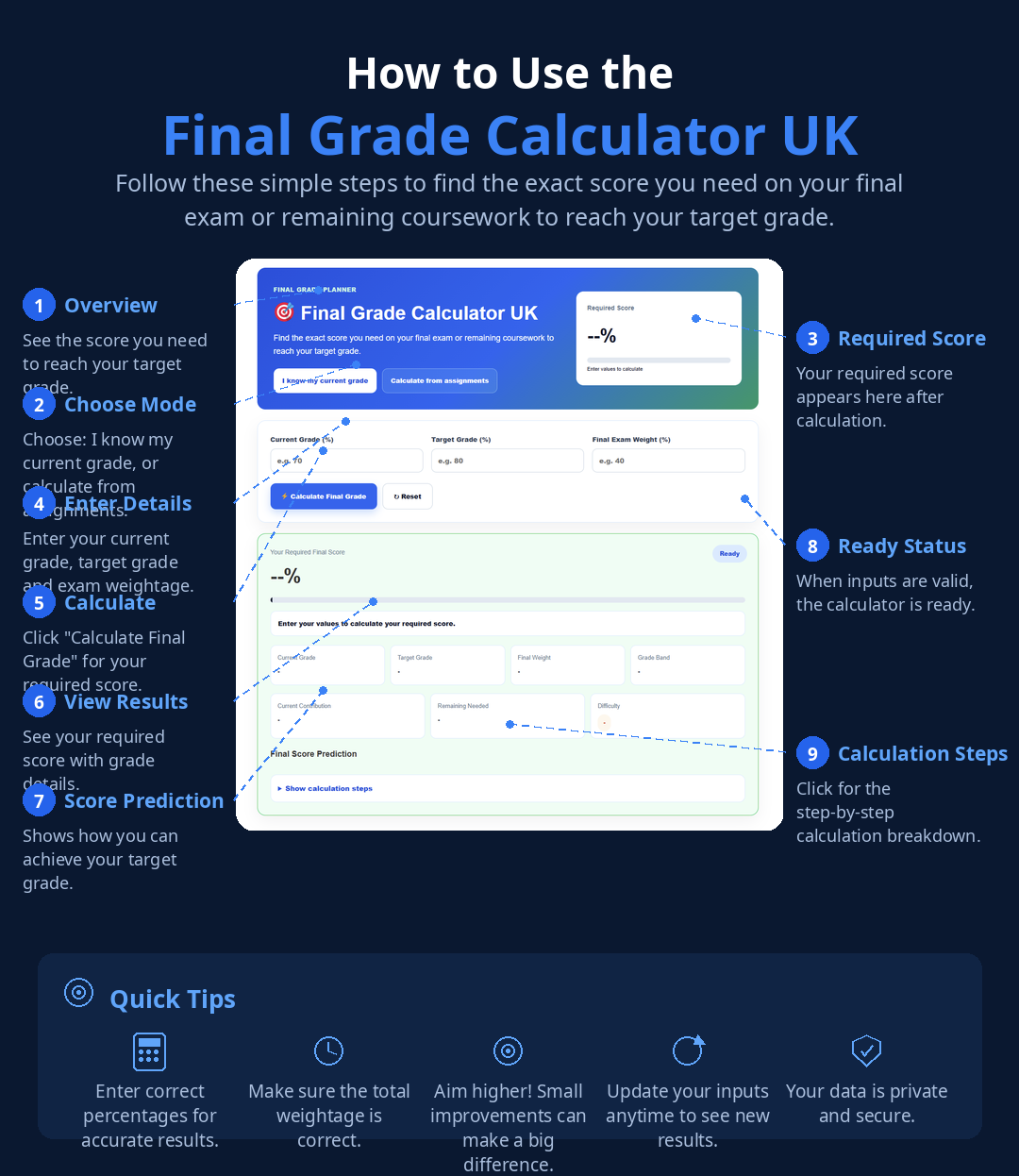
Click Here: Final Grade Calculator UK
What the 15 October Deadline Actually Is — and What a Missed UCAS Deadline Really Means
The 15 October deadline is not a ban on applying. It is an equal-consideration deadline: UCAS guarantees that any completed application received before 18:00 UK time on 15 October will be considered equally alongside every other on-time application. All of the dates below are published on UCAS’s official dates and deadlines page, verified at the time of writing. After that moment, two things happen at once. For most courses, nothing changes — the main equal-consideration deadline of 13 January 2027 at 18:00 UK time still applies, and a late-September or October application to those courses is treated exactly the same as one submitted in December.
For the 15 October courses, the picture is different. UCAS’s own “Missed deadline?” guidance puts it bluntly: you can still apply for many courses, but for courses with a 15 October deadline “it’s unusual for them to consider late applications because their courses are really competitive.” In practice, Oxford, Cambridge and medicine courses close for the cycle. They do not keep a side door open for latecomers; with roughly five to ten applicants per place, they do not need to.
Here is how the two deadlines divide the landscape:
| Course type | Equal-consideration deadline | What happens after you miss it |
|---|---|---|
| Oxford and Cambridge (all courses) | 15 Oct 2026, 18:00 UK time | Effectively closed for 2027 entry; late applications are rarely considered |
| Medicine, dentistry, veterinary medicine/science (most courses) | 15 Oct 2026, 18:00 UK time | Effectively closed for 2027 entry; late applications are rarely considered |
| Most other undergraduate courses | 13 Jan 2027, 18:00 UK time | Fully open — apply normally and receive equal consideration |
| PGCE teacher training (Wales) | 15 Dec 2026, 18:00 UK time | Separate deadline; check the UCAS course search |
One thing the deadline does not touch: your grades and test scores. A missed UCAS deadline changes which application round you are in. It does not change your predicted grades, your UCAT score, or your GCSE results. Keeping that separation clear is what stops a missed deadline from feeling like an academic failure — it is an administrative event, and administrative events have administrative solutions.
After 18:00 on Thursday: What Actually Happens to a Late Application
Suppose it is 18:01 on Thursday 15 October and your application is still sitting with your school, unpaid, or half-finished in your UCAS Hub. Technically, you can still press send. UCAS will still accept the application and forward it. But for Oxford, Cambridge or medicine courses, “forwarded” and “considered” are very different things — and UCAS is explicit that equal consideration is not guaranteed after the deadline.
The single most important rule in this situation comes from UCAS itself: ask the university whether it has vacancies first. Do not assume. For 15 October courses, the answer will almost always be no, and you will have spent a choice (and your one application fee) to find out. For January-deadline courses, a late application is completely normal — universities do not even see it as late.
There are no national exceptions and no secret lists of colleges that take late medicine applications. Individual universities do occasionally depart from the pattern for January-deadline courses with genuine vacancies, but anything you read about a specific medical school accepting a late application should be treated as unverified unless it appears on that school’s own admissions page. This guide cites only UCAS’s own guidance — and that guidance says late applications to 15 October courses are rarely considered.
And one mechanical point that decides more cases than any other: sending your application to your school is not the same as sending it to UCAS. Your application only counts as submitted when UCAS has received it — complete, with reference attached, and paid. If your school misses its internal send-off, you have missed the deadline even though you personally did everything right. That is why most schools set internal deadlines days or weeks earlier, and it is the subject of a full section below.
Route A — Use the Fifth Choice and the January Deadline
If you applied to medicine, dentistry or veterinary courses, you already know the four-choice rule: UCAS caps applications to medicine, dentistry, veterinary medicine and veterinary science at four choices in total across all of those subjects, even though every applicant gets five UCAS choices overall. The fifth choice has to be something else — and here is the detail most applicants miss:
You do not have to decide your fifth choice by 15 October — and this is the detail most applicants agonising over a missed UCAS deadline never hear. UCAS’s deadlines page states that you can add choices with a different deadline later, and the specialist 2027 medicine guides confirm the fifth choice can be added any time up to the January equal-consideration deadline — as long as you have not already replied to offers. So the scenario that worries students most — “I submitted my four medicine choices on time but never picked a fifth” — is fixable well into the new year.
This matters because the fifth choice is not a consolation prize; it is insurance you have already paid for. The 2027-cycle application fee is £34.50 — one flat fee covering up to five choices, whether you use one or all five (confirmed on UCAS’s 2027-cycle fee page). Leaving the slot empty costs you the same and buys you nothing. A well-chosen fifth choice does three jobs at once:
- It keeps a university place in play for September 2027. Popular picks include biomedical science, pharmacy, nursing, psychology and physiotherapy — courses with genuine overlap with medicine and realistic routes onward, including graduate-entry medicine. If allied health is on your shortlist, our guide to how nursing degrees are graded in the UK explains how those degrees are actually assessed.
- It protects your UCAS Extra eligibility. Extra, which opens on 25 February 2027, is designed for applicants who have used all five choices and hold no offers. Apply to only four courses and all four reject you, and you generally cannot use Extra — you would be left phoning universities individually.
- It does not damage your medicine application. Universities cannot see where else you applied — each one sees only the courses you listed at that institution. The Medical Schools Council’s own applicant guidance describes the fifth choice as optional and states it won’t impact your medical school application.
Two practical rules for choosing it. First, look for genuine headroom between your predicted grades and the offer — a backup that asks for A*AA when you are predicted AAA is not a backup. Second, pick a course you would actually complete: a low offer you resent for three years produces a weak degree, and a weak degree closes the graduate-entry medicine door you were trying to keep open. For UCAT strategy behind your medicine choices, see our guide on what counts as a good UCAT score with the final 2026 deciles.
One more mechanical note: since 2026 entry, the personal statement is three structured questions (not one essay) totalling 4,000 characters, and one set of answers goes to all five choices — you cannot tailor it per university. If your fifth choice is in a different subject, frame your answers around transferable skills (scientific curiosity, care experience, communication) rather than a single-subject narrative.

Route B — Take a Gap Year and Reapply with Achieved Grades
For Oxbridge applicants, there is no January route — if a missed UCAS deadline took you past 15 October without your application being received, 2027 entry to Oxford or Cambridge is over. For medicine applicants whose predictions were shaky anyway, reapplying may beat a salvage operation. Route B is the gap year: sit out the 2027 cycle, bank your actual A-level results in August 2027, and apply in October 2027 with achieved grades instead of predictions. This is the route where the grade maths genuinely favours you.
The prediction-accuracy problem, in numbers
Our predicted-grades guide documents the UCAS figures: in 2024, around 50% of UK 18-year-olds were predicted AAA or better, but only about 26% of accepted students actually achieved AAA+. Overall prediction accuracy has been falling — from about 40% in 2014 to roughly 30% in 2024. Predictions systematically overshoot, which means a predicted-AAA application carries a hidden coin-flip: roughly half of AAA-predicted applicants will not achieve AAA on results day.
Now run the worked comparison for one applicant — call him Sam, predicted AAA, aiming for medicine where typical offers sit at AAA or A*AA:
| Path 1: Apply now (predicted AAA) | Path 2: Gap year (achieved AAB) | |
|---|---|---|
| Grades the tutor sees | Predicted AAA — historically, only ~26% of accepted students turn a AAA+ prediction into achieved AAA+ | Achieved AAB — certain, in hand, no grade risk |
| Offer type for AAB/ABB courses | Conditional AAB — missable on results day | Often unconditional — the grades are already banked |
| Results-day risk | Real: miss AAA and the medicine offer falls away, with no Clearing route for these courses | Zero grade risk; the only variable is the interview |
| Admissions test | UCAT taken autumn 2026 for 2027 entry | Re-sit the test in autumn 2027 for 2028 entry — tests are tied to the entry year |
| Start date | September 2027 | September 2028 |
| Application fee | £34.50 now | £34.50 next cycle (fees are per application, per cycle) |
Notice what the table shows: Path 1’s appeal is speed, not strength. If Sam’s predictions are honest and his mock results back them up, Path 1 is reasonable. But if his AAA prediction was generous — and the national data says generous predictions are the norm — Path 2 converts the same applicant into a fundamentally stronger file. Achieved grades remove the single biggest uncertainty in a medicine or Oxbridge application. Tutors deciding between two similar candidates will always prefer the one whose grades are facts rather than forecasts.
The gap year also buys time for the parts of the application that predictions cannot fix. Work experience, a stronger UCAT sitting, and — for Oxbridge — the admissions tests all get a second, better-prepared attempt. Our Oxbridge admissions tests guide explains how the TMUA, ESAT and TARA scores work and which sitting counts for which entry year — the October tests you sit are for the following year’s entry, so a gap-year applicant simply takes the next October sitting.
Be honest with yourself about the cost, though. A gap year is twelve months of your life and a year of lost graduate earnings, and it only pays off if you use it: relevant work or volunteering, test preparation, and — if your achieved grades still fall short — a realistic reassessment of your course list. A gap year spent hoping is just a deferred disappointment.
Route C — If You Miss Both Deadlines: Extra, Clearing and the Next Cycle
What if you miss the 15 October deadline and let January slip by too? Two safety nets exist — UCAS Extra and Clearing — but for 15 October courses, both are far weaker than applicants assume.
UCAS Extra opens on 25 February 2027 for applicants who have used all five choices and hold no offers, letting them add one choice at a time. The catch for medicine applicants is structural: if you applied to only four medicine courses, you have not used all five choices, so you generally cannot use Extra. This is another reason Route A’s fifth choice matters — it is the key that unlocks Extra in February if everything else falls through. Extra also does not include 15 October courses in any meaningful sense; it is for courses with places still available, which competitive medicine and Oxbridge courses will not have.
Clearing opens on 2 July 2027, after the 30 June deadline when remaining applications are automatically entered into Clearing. Clearing is a genuine second chance for January-deadline courses — thousands of places at good universities change hands every August. But for medicine, dentistry and Oxbridge, treat Clearing as non-existent: these courses fill through the October round, and UCAS’s own guidance says it is unusual for them to consider late applications precisely because they are so competitive. Planning your future around a medicine Clearing place is planning around something that, in practice, does not happen.
So Route C’s honest version is this: if both deadlines pass and you are set on a 15 October course, the productive move is not to hunt for loopholes in Extra or Clearing — it is to start preparing a next-cycle application immediately. That means using the coming months the way a gap-year applicant would (work experience, test preparation, achieved grades in hand by August) and treating the missed cycle as an expensive lesson in deadline logistics. Applicants considering a change of university later should also read our guide to transferring universities in the UK, which covers how earned credits and grades carry across institutions.
The School Pipeline: Why Most Misses Happen Before 18:00
Here is an uncomfortable truth about missed UCAS deadlines: most of them are not caused by students forgetting. They are caused by the pipeline between the student and UCAS breaking down in the final 48 hours. If you are applying through a school or college, your application passes through four gates before it counts — and all four must clear before 18:00 on Thursday:
- You complete and send it to your school. Every section finished, every qualification entered correctly. UCAS warns that schools will send applications back for corrections — a missing subject, a wrong grade — and each round trip costs hours.
- Your tutor writes and attaches the reference. You cannot send your application to UCAS without a reference. Your school needs working hours to read your application, check it, write the reference and approve the send-off. Yours is not the only application in the queue.
- Your school sends it to UCAS. Many schools set internal deadlines days or even weeks before 15 October precisely because of this queue. If your school’s internal deadline was last Friday, the UCAS deadline is already behind you.
- Payment clears. The £34.50 fee must be paid before UCAS will accept the application. Have the card ready and check the balance — UCAS’s own 15 October guidance warns that five failed payment attempts lock the account and require a phone call to unlock.
UCAS states the rule plainly: simply sending your application to your school or college before the deadline does not count as sending it on time — it has to be received by UCAS. If you are reading this with days to spare, the single highest-value action is to message your tutor today, confirm exactly when they will send your application, and ask what could still delay it. Independent applicants (not through a school) should chase their referee the same way — UCAS specifically advises asking referees to complete references well in advance.
Myths vs Facts: The 15 October Deadline
Every October, the same confident claims about a missed UCAS deadline circulate on student forums and group chats. Here is what UCAS’s own published guidance actually says.
| Myth | Fact |
|---|---|
| Missing the 15 October deadline bans you from applying this cycle. | False. You can still apply — most courses stay open until the 13 January 2027 equal-consideration deadline. Only the 15 October courses (Oxbridge, most medicine/dentistry/vet) are effectively closed. |
| Universities keep a few places back for late Oxbridge/medicine applications. | False. UCAS’s own guidance: “it’s unusual for them to consider late applications because their courses are really competitive.” |
| Your fifth UCAS choice must be decided by 15 October. | False. The fifth (non-medicine) choice can be added any time up to the January deadline, as long as you haven’t replied to offers. |
| Leaving the fifth choice blank proves your commitment to medicine. | False — and costly. Universities can’t see your other choices, and a blank fifth slot generally blocks you from using UCAS Extra in February. |
| You can get into medicine through Clearing if you miss the deadline. | Effectively no. These courses fill via the October round; plan around Extra, the fifth choice, or reapplying instead. |
| A missed deadline affects your predicted grades or UCAT score. | False. Grades and test scores are untouched. The deadline changes your application round, not your academic record. |
| A gap year counts against you at Oxbridge or medical schools. | False. Universities assess reapplicants on merit, and applying with achieved grades removes the grade-uncertainty that predictions carry — often a stronger position, not a weaker one. |
Which Route Fits You? The Decision Framework
After a missed UCAS deadline, the route you take should follow your situation, not your panic. Match your situation to the row below — and be honest about which row you are actually in, not the one you wish you were in.
| Your situation | Best route | Why |
|---|---|---|
| Four medicine choices submitted on time; fifth slot still empty | Route A | Add a non-medicine fifth choice before 13 January 2027 — it costs nothing extra and unlocks Extra in February |
| Predicted grades are below typical medicine/Oxbridge offers (e.g. AAB predicted, AAA required) | Route A + B combined | Use the fifth choice now for a 2027 start; simultaneously plan a gap-year reapplication with achieved grades if medicine is non-negotiable |
| Missed 15 October entirely; set on medicine or Oxbridge | Route B | There is no January route for these courses — a gap year with achieved grades is the strongest available play |
| Genuinely interested in a backup subject (biomedical science, nursing, pharmacy) | Route A | A fifth choice you would happily complete is the best insurance in the system — and a real degree in its own right |
| Missed 15 October but your target courses have January deadlines | Route A | You haven’t missed anything that matters — apply normally before 13 January 2027 for full equal consideration |
| Missed both deadlines and still want a 15 October course | Route C | Skip the Clearing fantasy; start next-cycle preparation now with achieved grades as the foundation |
If you are still within the five-day window as you read this, there is a Route 0 that beats all three: finish the application, pay the £34.50, confirm with your tutor that the reference is attached and the school will send it before Thursday 18:00 — and then stop worrying. The best missed-deadline strategy is the one you never need.
Frequently Asked Questions
What happens if I miss the 15 October UCAS deadline?
You can still apply to most courses until the 13 January 2027 equal-consideration deadline and be treated exactly the same as everyone else. For 15 October courses — Oxford, Cambridge, and most medicine, dentistry and veterinary courses — UCAS says it is unusual for late applications to be considered because these courses are so competitive. In practice, those courses are closed for the cycle.
Can I still apply to Oxford or Cambridge after 15 October?
Technically UCAS will accept and forward a late application, but it will not receive guaranteed equal consideration, and UCAS guidance states it is unusual for 15 October courses to consider late applications. Realistically, an Oxford or Cambridge application after 18:00 on 15 October will not be considered for 2027 entry. A gap year and reapplication with achieved grades is the stronger route.
Does my fifth UCAS choice have to be decided by 15 October?
No. UCAS allows you to add choices with a different deadline later, and the fifth choice — which for medicine applicants must be a non-medicine, non-dentistry, non-veterinary course — can be added any time up to the 13 January 2027 equal-consideration deadline, as long as you have not already replied to offers.
Will missing the UCAS deadline affect my predicted grades or UCAT score?
No. A missed UCAS deadline is an administrative event, not an academic one. Your predicted grades, achieved grades, GCSE results and UCAT score are completely unaffected — the deadline only changes which application round you are in and which courses remain open to you.
Can I get into medicine through Clearing if I miss the deadline?
Effectively, no. Medicine, dentistry and Oxbridge courses fill through the October application round, and UCAS notes it is unusual for these courses to consider late applications because they are so competitive. Clearing, which opens on 2 July 2027, is a genuine second chance for January-deadline courses — not for 15 October courses.
Is a gap year a good idea if I miss the 15 October deadline?
Often, yes — especially if your predicted grades were below typical offers. Reapplying with achieved grades removes the grade-uncertainty that predictions carry (UCAS data shows predictions systematically overshoot), which can make your application stronger, not weaker. Use the year for relevant work experience and admissions test preparation rather than simply waiting.
My school hasn’t sent my application yet — does that count as missing the deadline?
Yes, if UCAS has not received it by 18:00 on 15 October. Sending your application to your school is not the same as sending it to UCAS — it must be complete, with your reference attached and the fee paid, and received by UCAS before the deadline. Check with your tutor exactly when they will send it.
How much does a UCAS application cost, and does the fee cover all five choices?
For the 2027 cycle, the UCAS application fee is £34.50 — one flat fee covering up to five choices, whether you use one or all five. That makes the fifth choice free insurance: leaving it empty costs the same and, for medicine applicants, generally blocks access to UCAS Extra in February.
Conclusion
A missed UCAS deadline feels catastrophic in the moment, but the system has more give in it than panicked applicants assume. The fifth choice can still be added up to January, the main equal-consideration deadline for most courses is 13 January 2027, and a gap year with achieved grades is — by the grade maths — often a stronger application than the predicted-grades version that missed the window. What the deadline does not offer is a loophole: UCAS is explicit that 15 October courses rarely consider late applications, and no amount of forum optimism changes that.
The decision that matters most is an honest one. If your predictions were solid and the miss was purely logistical, Route A keeps September 2027 alive. If your predictions were generous — and the national data says generous predictions are the norm, with only about 26% of accepted students turning AAA+ predictions into achieved AAA+ — then the gap year is not a consolation prize but an upgrade. Either way, act on facts from UCAS’s own pages, confirm every date with your tutor before Thursday 18:00 if the window is still open, and remember: the deadline changed your route, not your grades.


![Read more about the article Degree Apprenticeship Grading Explained: How EPA, Merit and Distinction Work [2026]](https://gradeforuni.com/wp-content/uploads/2026/10/featured-degree-apprenticeship-grading-300x192.png)