
![You are currently viewing Degree Apprenticeship Grading Explained: How EPA, Merit and Distinction Work [2026]](https://gradeforuni.com/wp-content/uploads/2026/10/featured-degree-apprenticeship-grading.png)
A degree apprenticeship grading conversation usually starts the same way: an apprentice sits across from their manager at a progress review and asks the question no one has answered cleanly — “so, do I get a 2:1 or a Distinction?” Both, it turns out. A degree apprentice in England finishes with two results that are graded by two different systems, awarded by two different bodies, and understood by two different audiences. The university awards your degree and classifies it — First, 2:1, 2:2, Third — exactly as it does for a full-time student. The apprenticeship itself is graded separately by an end-point assessment (EPA), and that grade is Fail, Pass, Merit or Distinction. Neither one is the “main” result, and confusing the two is where almost every grading headache starts.
This matters more than it sounds. The two tracks interact in ways the glossy UCAS pages never explain: on an integrated degree apprenticeship, your EPA performance can actually feed into your degree classification, and a failed EPA can stop your degree being awarded at all — even if every university module is passed. On a non-integrated programme, the EPA sits entirely outside the degree and touches none of your module marks. Which kind you are on determines which grading rules apply to you, including whether your university’s usual safety nets — condonement, compensation, borderline uplift — reach the EPA. In most cases, they do not.
This guide explains the whole picture as a UK higher-education specialist would: the two grading tracks and what each certificate actually says, the integrated vs non-integrated fork, how the end-point assessment is graded method by method (with a real grading combination table from a published assessment plan), the little-known rules that trip apprentices up — resit caps, gateway sign-off, the missing merit on some standards — and two fully worked numerical examples showing exactly how one apprentice’s module marks became a 2:1 and an apprenticeship Distinction. Everything here is drawn from real sources: Skills England assessment plans, university regulations, and GOV.UK-adjacent guidance.
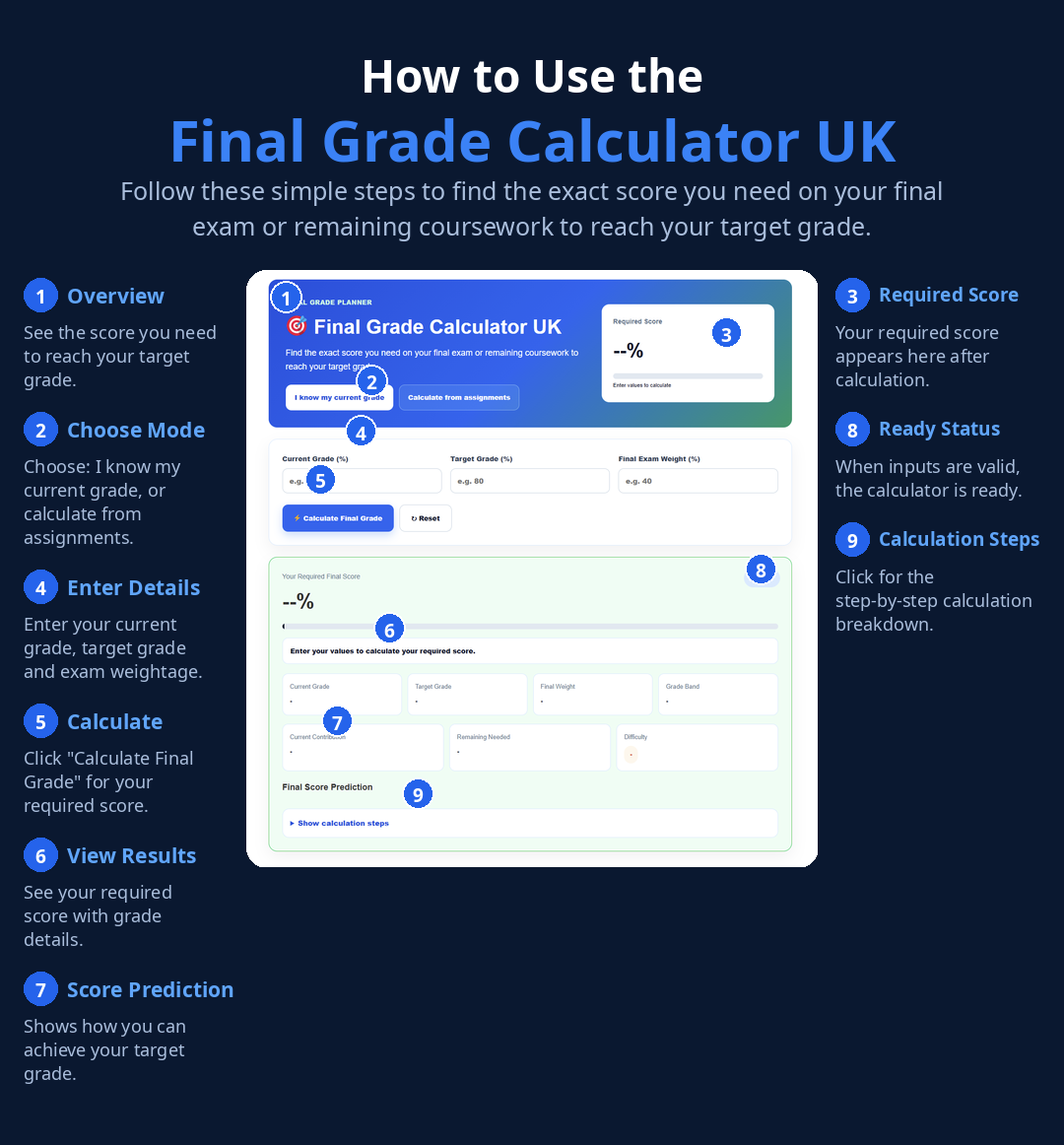
Click Here: Final Grade Calculator UK
Two Results, Two Systems: The Degree Track and the Apprenticeship Track
The single most important thing to internalise about degree apprenticeship grading is that you are on two tracks at once. The university assesses your academic modules through its normal assessment regulations — exams, coursework, the same marking scales and classification boundaries as every other undergraduate: 70+ for a First, 60–69 for a 2:1, 50–59 for a 2:2, 40–49 for a Third. Your degree certificate will carry a classification computed from your module marks, exactly as explained in our guide to First Class Honours and the honours vs ordinary degree breakdown. Yes — degree apprenticeships award full honours degrees (BSc (Hons), BEng (Hons) and the rest); there is no asterisk on the degree itself.
The apprenticeship track is a different world. Every apprenticeship standard in England ends with an end-point assessment: an independent, synoptic test of the knowledge, skills and behaviours (KSBs) you built up during the programme. It is assessed by independent assessors working for an end-point assessment organisation (EPAO) — not by your usual lecturers — and the overall result is one of four labels: Fail, Pass, Merit or Distinction. Your apprenticeship completion certificate (claimed from the Apprenticeship Assessment Service by the EPAO) records this grade, not your degree classification. Two certificates, two grades, two audiences: employers recruiting from your occupation read the apprenticeship grade; universities, postgraduate programmes and credential evaluators read the degree classification.
| The degree track | The apprenticeship track | |
|---|---|---|
| What is graded | University modules: exams, coursework, projects | The end-point assessment (EPA): work-based project, interview, tests |
| Who grades it | University examiners and external examiners | Independent assessors via the EPAO |
| Grades available | Module marks 0–100; degree classes First / 2:1 / 2:2 / Third | Fail / Pass / Merit / Distinction (some standards: Fail / Pass / Distinction only) |
| Certificate | Degree certificate + transcript | Apprenticeship completion certificate |
| Borderline and resit rules | University’s own regulations (see below) | The apprenticeship standard’s own assessment plan — usually stricter |
Where the two tracks meet — and where they diverge — depends on one fork in the road that many apprentices never clearly get told about. That fork is whether your EPA is integrated or non-integrated, and it changes the grading maths considerably.
Integrated or Non-Integrated: The Fork That Changes Everything
An integrated EPA is built into the university qualification itself. The assessment methods of the EPA are also credit-bearing university modules, which means the EPA grade is converted into a numerical mark and folded into the academic calculation — as Cranfield University’s EPAO handbook puts it, for the final academic award the EPA grade is given a numerical mark to inform the academic element of the award, while the apprenticeship is still graded Fail/Pass/Merit/Distinction separately. A published example is the Sustainability Business Specialist integrated degree apprenticeship (ST0748), whose published assessment plan states explicitly: “Performance in the EPA will count towards the overall degree classification. Apprentices cannot successfully complete the degree or the apprenticeship without successfully passing the EPA.”
A non-integrated EPA is a separate assessment run by a third-party organisation after you have finished the university qualification. Your degree classification is computed from your modules alone and the EPA never touches it; the standard university assessment regulations apply in full. The University of Nottingham’s EPA guidance draws the line cleanly: an integrated EPA is incorporated into the university qualification, while a non-integrated EPA is a separate assessment carried out by a third-party organisation after the apprentice has completed the university qualification.
| Integrated EPA | Non-integrated EPA | |
|---|---|---|
| Who runs the EPA | The university itself, acting as the EPAO | An external EPAO (third-party organisation) |
| Does the EPA affect your degree classification? | Yes — the EPA grade is converted to a mark and counts (see worked example below) | No — the degree is classified from university modules alone |
| Can you get the degree without passing the EPA? | No. Newcastle’s taught regulations state the EPA “must be successfully completed prior to an Honours or Master’s degree being awarded” | Yes — but you cannot complete the apprenticeship without the EPA |
| Which grading rules apply to the EPA? | The assessment plan takes precedence over standard university regulations (Teesside’s apprenticeship annex) | The EPAO’s assessment plan; university regs govern the degree |
| Typical programmes | Nursing, policing, many engineering and surveying standards | Digital and technology, some business and management standards |
That Teesside point deserves underlining, because it is the single biggest grading shock apprentices report: where the EPA is integrated, the apprenticeship assessment plan overrides the university’s normal assessment regulations. Condoned passes, compensation, borderline uplift — the safety nets that protect ordinary students — typically do not exist inside the EPA. Fail one assessment method and you fail the EPA outright, no matter how strong your university module marks are. (Our explainer on condoned passes covers exactly the university safety net that the EPA strips away.)
How the End-Point Assessment Is Actually Graded
Strip away the branding and every EPA in England works the same way at the top level: a small number of assessment methods — typically two or three — each graded independently, then combined into one overall apprenticeship grade. Typical methods are a work-based project with a presentation, a professional discussion or technical interview underpinned by a portfolio of evidence, and sometimes a knowledge test, practical observation or case study. Each method is graded Fail / Pass / Distinction (a few standards use Fail / Pass / Merit / Distinction at method level too), and each method’s grading criteria are spelled out in the standard’s published assessment plan. A project report can earn a distinction only by hitting the plan’s distinction descriptors — usually evidence that the apprentice went demonstrably beyond the minimum occupational standard, applied KSBs in novel situations, or produced work of publishable or industry-exemplary quality.
The combination step is where apprenticeship grading diverges most from university marking. There is no averaging of marks and no compensation between methods: a fail in any single method produces an overall fail, regardless of how strong the other methods were. Above the pass line, the standard’s plan fixes a combination table that apprentices must satisfy. The pattern below is from the published plan for the Sustainability Business Specialist integrated degree apprenticeship (ST0748), and it is representative of the most common two-method structure in degree apprenticeship standards:
| Work-based project grade | Technical interview grade | Overall apprenticeship grade |
|---|---|---|
| Fail | Any grade | Fail |
| Any grade | Fail | Fail |
| Pass | Pass | Pass |
| Pass | Distinction | Merit |
| Distinction | Pass | Merit |
| Distinction | Distinction | Distinction |
Two consequences follow that every apprentice should understand before the EPA period begins. First, a distinction overall requires distinction-level performance in every assessment method — one merely-pass method caps you at a merit at best, exactly like the table above. Second, not all standards even offer a merit: published plans for standards such as Recruiter, Fishmonger and Optical Assistant grade the apprenticeship Fail / Pass / Distinction only. If your standard is one of those, the jump from pass to distinction has no intermediate step, and the distinction bar is correspondingly steep. Your own standard’s plan — findable on Skills England’s site — is the only document that defines your grade boundaries. Nothing on a university web page can override it.
Who decides the grades matters too. The EPA is assessed by independent assessors employed or contracted by the EPAO — deliberately separate from the people who taught you, so that the occupational judgement is impartial. In integrated programmes the university acts as the EPAO (Cranfield’s handbook describes the whole apparatus: assessor recruitment, standardisation, external examiner-style moderation), and grades cannot be confirmed until after moderation. That separation is why employer opinions do not set grades: your manager’s sign-off gets you into the EPA, but cannot lift you out of a fail once the independent assessors have marked your work.
Before You Can Be Graded: The Gateway
The EPA has a front door, and it is called the gateway. You cannot attempt the assessment until it opens, and three parties must turn the key together. The employer must be content that you are occupationally competent — working at or above the level of the standard. You must confirm you are ready. And you must have completed the gateway evidence the plan requires: typically your portfolio of evidence, plus English and mathematics qualifications at the level the funding rules demand (usually GCSE grade 9–4 or equivalent; Newcastle’s regulations require this before completion of any integrated degree). The EPAO reviews the evidence, confirms the gateway requirements are met, and only then does the EPA period start — typically three months, during which the assessment methods are completed.
Apprentices underestimate the gateway’s grading significance. Because independent assessors only see you during the EPA period, the gateway is the last point at which your normal support network — your university tutor, your workplace mentor — can formally vouch for you. An employer who signs you off prematurely does you no favours: every EPA plan reviewed for this article repeats the same warning in different words, that apprentices should only enter the gateway when they can demonstrate the full range of KSBs, because the assessment itself offers no credit for potential, only for demonstrated competence. One related statutory requirement worth knowing, since it is evidenced alongside your progress reviews: since August 2022 apprentices in England must complete a minimum of six hours of off-the-job training per week (replacing the old 20% rule), and missing those hours can itself delay your gateway.
Resits, Retakes and the Pass Cap — the Strictest Rule in Apprenticeship Grading
If the gateway is the strictest front door, the resit rule is the strictest back door. Across virtually every published EPA plan, a resit or retake of a failed EPA method is capped at a pass. The exact wording recurs like a refrain: “Retake and resit grade cap: pass”, with typical windows of around two months for a resit (same method, no further learning needed) and around four months for a retake (with additional training first). The practical effect is brutal and deliberate: fail your work-based project the first time, and no matter how exceptional your resubmission is, your overall apprenticeship grade can never rise above a pass — and on standards with no merit, the only grades available to you are pass or distinction, so the cap simply removes distinction from the table.
Compare that with the university track, where a resit module is usually also capped — but at 40% (the bare pass), and where condoned passes or compensation can rescue a failed module entirely. The EPA offers no equivalent rescue. This is also why the EPA is the highest-stakes assessment in a degree apprenticeship: university modules can be retaken within the degree’s own rules, but a failed EPA on an integrated programme simultaneously blocks the degree itself (per Newcastle’s rule quoted above), while on a non-integrated programme it blocks the apprenticeship completion certificate. Either way, the clock and the cap are working against you.
Worked Example: How Aisha’s Module Marks Became a 2:1 and an Apprenticeship Distinction
Theory is fine; numbers are better. Below is a realistic final-year computation for a fictional apprentice — Aisha Rahman, on an integrated BSc Digital and Technology Solutions degree apprenticeship with a 40:60 weighting between Level 5 and Level 6, where the integrated EPA sits inside final year as a 40-credit module alongside 80 credits of taught modules. Two stated assumptions keep the arithmetic honest: her university maps EPA grades to module marks (a common arrangement on integrated programmes — check your own course handbook for your mapping), using Distinction = 75 and Pass = 45 here, and Level 4 is excluded from classification as at most English universities.
| Component | Credits | Detail | Weighted contribution |
|---|---|---|---|
| Level 5 modules (40% weight) | 120 | Credit-weighted average: 64.0% | 0.40 × 64.0 = 25.60 |
| Level 6 taught modules (60% weight) | 80 | Credit-weighted average: 68.0% | 0.60 × 70.3 = 42.20 |
| Level 6 integrated EPA module (60% weight) | 40 | EPA Distinction → mapped mark 75: (68×80 + 75×40) ÷ 120 = 70.3% | |
| Final degree average | 25.60 + 42.20 = 67.8% → Upper Second Class (2:1) | ||
So the degree track gives Aisha a comfortable 2:1 at 67.8%. Now the apprenticeship track, graded from the same EPA evidence but by the combination table, not by averaging. Her work-based project earned a Distinction (the assessors judged it beyond the occupational minimum) and her technical interview also earned a Distinction — Distinction plus Distinction gives an overall apprenticeship Distinction. Her two certificates therefore read: BSc (Hons) Digital and Technology Solutions, Upper Second Class — and Degree Apprenticeship, Distinction. Neither result “carried” the other; they were computed by different rules from partially overlapping evidence.
Now the counterfactual that shows why the EPA is the hinge of the whole programme. Suppose Aisha had failed her technical interview first time, resat two months later and passed — capped at a pass for the apprenticeship. University track: the EPA maps to a Pass mark of 45, so her Level 6 average becomes (68×80 + 45×40) ÷ 120 = 60.3%, and her final degree average drops to 25.6 + 36.2 = 61.8% — still a 2:1, but six points lower and uncomfortably close to the 2:2 boundary. Apprenticeship track: a resit pass caps the overall grade at a pass, so her certificate reads Degree Apprenticeship, Pass, whatever her module marks were. One failed method cost her roughly six percentage points of degree average and the Distinction — which is exactly why apprentices should treat the EPA as the single highest-stakes assessment they will ever sit.
Predicting Your Final Grade as a Degree Apprentice
Because you are graded twice, you need to predict twice — and the two predictions use different tools. For the degree track, run your university module marks through a credit-weighted average calculation exactly as a full-time student would: list every module that counts toward classification, multiply each mark by its credits, divide by total credits, and apply your university’s year weightings (40:60 is the most common in England, but check your regulations — some use 25:75 or count only final year). Our guide to how UK universities round marks is worth reading here, because a 67.8 like Aisha’s sits exactly where borderline rules and rounding conventions decide classifications — and note that borderline uplift applies to degree classifications, not to apprenticeship grades.
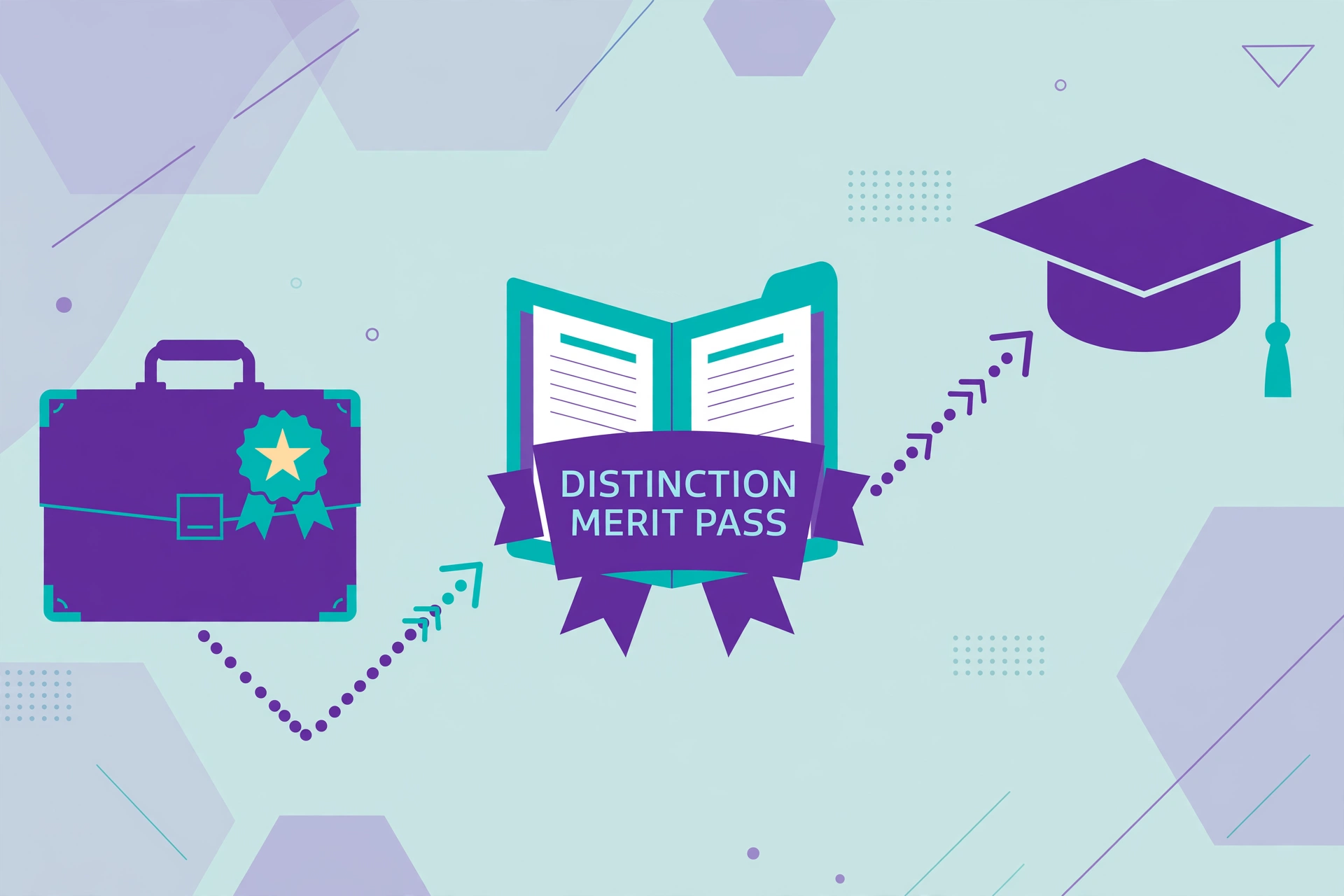
For the apprenticeship track, prediction is qualitative, not numerical: work through your standard’s assessment plan method by method and ask, for each distinction descriptor, whether your evidence demonstrably meets it. If the answer is “pass, comfortably” on every method, your realistic ceiling is a pass. A distinction requires evidence beyond the occupational minimum in every method — the plan’s descriptors will tell you what “beyond” looks like (novel application of KSBs, mentoring others, work adopted as organisational practice). Be brutally honest here: across the published plans, distinction in one method plus pass in another yields a merit at best, and on standards with no merit grade it yields a pass.
What Employers Actually See
When Aisha applies for jobs, recruiters will encounter her results in two places. Her university transcript and degree certificate show the modules, the EPA-derived module mark, and the 2:1 classification — the academic record, verified by the university. Her apprenticeship completion certificate, issued through the Apprenticeship Assessment Service, shows the occupational standard and the Distinction — the professional record, verified by the EPAO. Smart applicants list both: the 2:1 answers “can she do the academic work?”, the Distinction answers “is she occupationally competent at the standard, judged independently?” Together they are a stronger signal than either alone, which is the entire design logic of the degree apprenticeship.
One last practical note. A merit or distinction on the apprenticeship certificate is not the same thing as the merit/distinction on a taught masters (explained in our masters grading guide) — the words are identical, the systems are unrelated, and conflating them on a CV is a quick way to confuse a recruiter. Label it precisely: “Degree Apprenticeship (Digital and Technology Solutions) — Distinction”.
Degree Apprenticeship Grading: FAQs
Do I get two grades from a degree apprenticeship?
Yes. Your university awards and classifies your degree (First, 2:1, 2:2 or Third) from your module marks, while your apprenticeship is graded separately by the end-point assessment as Fail, Pass, Merit or Distinction. You receive a degree certificate for the first and an apprenticeship completion certificate for the second.
Does the end-point assessment count towards my degree classification?
On an integrated degree apprenticeship, usually yes: the EPA is built into the qualification as credit-bearing assessment and its grade is converted into a numerical mark that feeds your classification. On a non-integrated programme, no: the EPA is run separately by an external organisation after you finish the degree, and your classification comes from university modules alone. Check whether your programme is integrated to know which applies to you.
Can I get a merit on a degree apprenticeship?
It depends on your apprenticeship standard. Many standards grade the apprenticeship Fail, Pass, Merit or Distinction, but some grade Fail, Pass or Distinction only, with no merit available. On two-method EPAs the common combination is: distinction in both methods for an overall distinction, distinction in one method for a merit, and pass in both for a pass. Your standard’s published assessment plan is the authority.
What happens if I fail the end-point assessment?
A fail in any single EPA method means an overall EPA fail — there is no averaging or compensation between methods. On an integrated programme, the degree cannot be awarded until the EPA is passed, so a failed EPA also blocks graduation. You will normally be offered a resit (typically within about two months) or a retake with further training (typically within about four months).
Is an EPA resit really capped at a pass?
Yes. Across published assessment plans, resits and retakes of EPA methods are capped at a pass. Even a flawless resubmission cannot earn a merit or distinction, so your overall apprenticeship grade after a failed method is capped at a pass. The cap is one reason the EPA is treated as the highest-stakes assessment in a degree apprenticeship.
Does my employer decide my EPA grade?
No. Your employer’s role is at the gateway: they confirm you are occupationally competent and ready to attempt the EPA. The grading itself is done by independent assessors working for the end-point assessment organisation, and grades are only confirmed after moderation. This separation is deliberate, so the grade is an impartial judgement of your competence.
Do condoned passes and borderline uplift apply to the EPA?
Generally no. Where the EPA is integrated, the apprenticeship assessment plan takes precedence over the university’s normal assessment regulations, which means condonation, compensation and borderline uplift rules do not apply inside the EPA. Those safety nets still apply to your ordinary university modules — but not to the EPA methods themselves.
Is a degree apprenticeship an honours degree?
Yes. Degree apprenticeships award full honours degrees such as BSc (Hons) or BEng (Hons), classified under the same boundaries as full-time degrees (70+ First, 60+ 2:1, 50+ 2:2, 40+ Third). The degree certificate carries the classification; the separate apprenticeship certificate carries the Pass, Merit or Distinction grade.
Conclusion
Degree apprenticeship grading stops being confusing the moment you separate the two tracks. The university grades your modules and classifies your honours degree under its normal regulations — the same First, 2:1, 2:2 and Third as any other student, with condonement, borderline rules and resit conventions applying to those modules. The apprenticeship grades your occupational competence through the end-point assessment: a handful of independently-assessed methods combined into Fail, Pass, Merit or Distinction, with no compensation between methods, no condonation, and resits capped at a pass. On integrated programmes the two tracks are braided together — the EPA feeds your classification and a failed EPA blocks the degree — while on non-integrated programmes they run in parallel and meet only at the end. Know which kind you are on, read your standard’s assessment plan as carefully as your course handbook, and give the EPA the preparation its stakes demand: it is the one assessment in your whole degree where a single bad day can cost you both a Distinction and several points of degree average.

![Read more about the article How to Interrupt Your Studies at a UK University: Fees, Funding & Visa Rules [2026]](https://gradeforuni.com/wp-content/uploads/2026/10/featured-interrupt-studies-uk-300x192.png)
![Read more about the article How Do University Marking Criteria Work? Rubrics Explained [2026]](https://gradeforuni.com/wp-content/uploads/2026/10/featured-marking-criteria-300x192.png)
![Read more about the article University Exit Awards Explained: CertHE, DipHE & Aegrotat Degrees [2026]](https://gradeforuni.com/wp-content/uploads/2026/10/featured-exit-awards-uk-300x192.png)