

A first class honours degree — the “First” — is the highest classification a UK university can award. It means your final weighted average finished at 70% or above, and it sits at the top of a ladder that runs from First (70%+) through 2:1 (60–69%), 2:2 (50–59%) and Third (40–49%). For many students it is the goal their entire degree is built around; for others it is a mark they only start chasing once they realise how close they are.
But here is the part most advice skips: getting a First is not just about working hard. It is about understanding the algorithm your university uses to turn module marks into a classification — the year weightings, the borderline rules, and the little-known uplift policies that decide near-misses like 68.7% or 69.4%. Two students with identical module marks can end up with different degree classifications at different universities.
This guide explains what first class honours actually means, how it is calculated, how many students really get one, what it means for your career — and, crucially, the maths of how to get a first class degree at a UK university, with two fully worked scenarios you can adapt to your own marks.
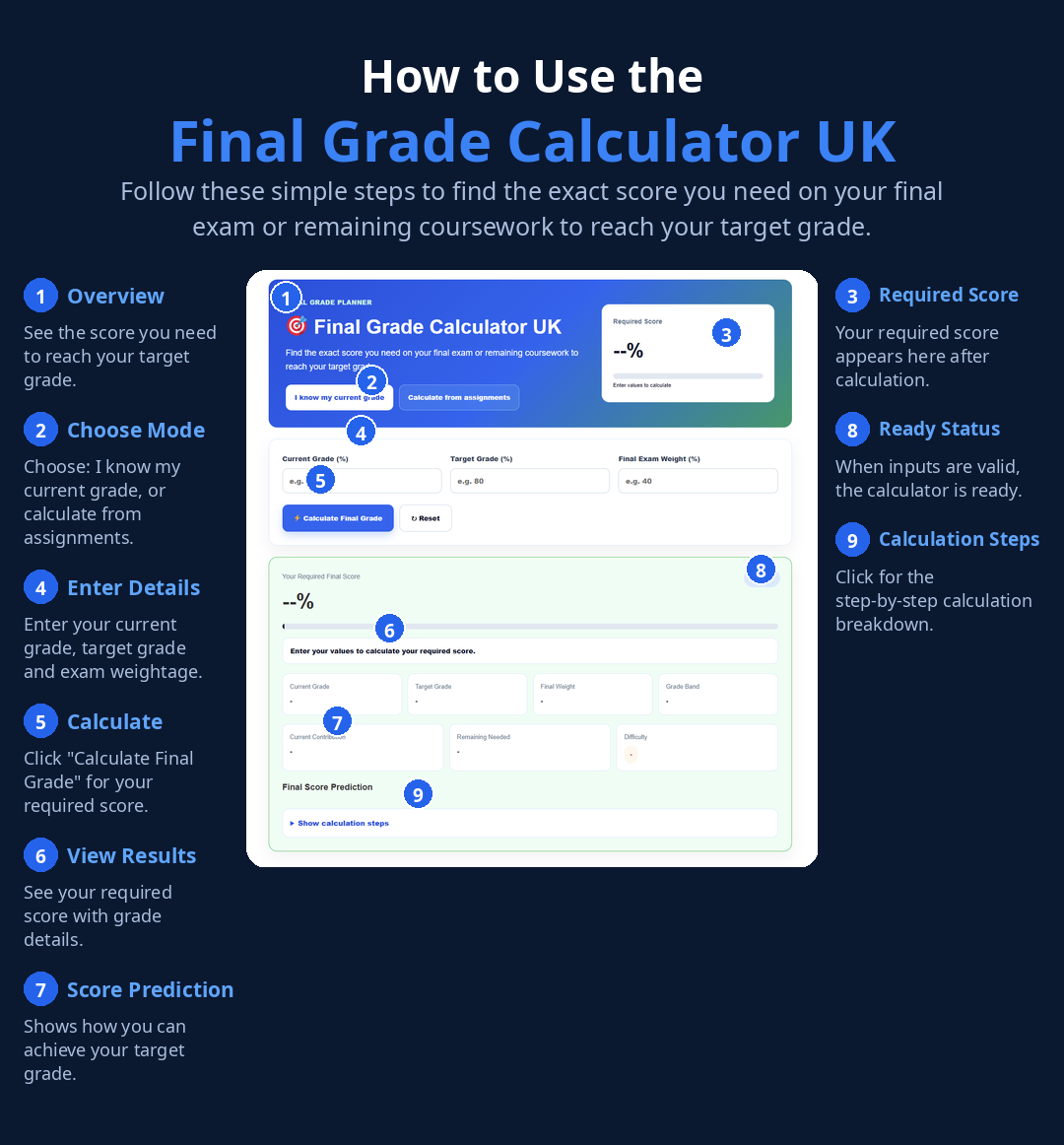
Click Here: Final Grade Calculator UK
What Is a First-Class Honours Degree?
In the UK, an honours degree is classified into four main bands based on your overall weighted average:
| Classification | Shorthand | Overall average |
|---|---|---|
| First-Class Honours | First / 1st | 70% and above |
| Upper Second-Class Honours | 2:1 | 60–69% |
| Lower Second-Class Honours | 2:2 | 50–59% |
| Third-Class Honours | Third / 3rd | 40–49% |
The 70% threshold for a First is consistent across the sector — the Prospects guide to UK university grades, which draws on HESA data, uses these same boundaries, and university regulations from Edinburgh to Reading all award first class honours at 70% and above. What differs between institutions is not the boundary itself, but how your average is computed and what happens at 68 or 69%.
One expectation to reset early: a 70% average at university is genuinely hard to achieve. Marks of 90–100% are rare at this level; most excellent work sits in the 70s. So a First does not require near-perfect scores — it requires consistently strong scores, mostly in the 65–75 range, weighted cleverly across your degree.
How Firsts Are Actually Calculated: The Algorithm Behind Your Degree
Your classification is not simply the average of everything you ever scored. Nearly every UK university applies a weighting formula, and the two most common are:
- Year 2: 25% / Year 3: 75% — the single most common scheme. Your final year dominates.
- Year 2: 30% / Year 3: 70% — also widespread.
- 1:3:5 weighting — used by UCL for single-honours Geography and similar schemes, where Year 1 contributes at weight 1, Year 2 at weight 3, and Year 3 at weight 5.
Many universities also use the best credits rule — for example, counting your best 100 of 120 final-year credits — which lets you drop your weakest module. Our full guide to calculating your final degree classification walks through these schemes in detail, and module weighting by credits explains how a 40-credit dissertation pulls your average four times harder than a 10-credit module.
Why does this matter for students chasing first class honours? Because the algorithm decides where effort pays off. At a 25/75 university, ten extra marks in a final-year exam are worth three times what the same improvement was worth in second year. Students who understand this stop trying to lift every module equally and start targeting the marks that actually move the classification needle.
The Borderline Rules: When 68% or 69% Becomes a First
Here is the little-known machinery that decides a surprising number of Firsts. Most UK universities have a borderline zone just below 70% where near-misses are automatically reconsidered for an uplift. The zone and the test differ by institution:
| University | Borderline zone for a First | Uplift test |
|---|---|---|
| Surrey | 68–70% | Weighted final-level average at or above 70% → automatic uplift |
| Reading | Within 2% of 70% | Dominant quality: half or more weighted credits already at First level, or exit velocity: final-year average in the First band |
| Edinburgh | 68–69.99% | 50% or more of credits at the higher class → uplift must be awarded |
| Heriot-Watt | 68.5–69.9% | 50% or more of qualifying credits at the higher grade → award board may uplift |
| UCL (SHS) | Within 1% of 70% | Board of Examiners discretion — considers mean, distribution and final-year results |
The pattern is clear: an average of 68–69% is not a closed door. At Reading, if half your weighted credits are already sitting at 70%+, that “dominant quality” is enough on its own. At Surrey, a strong final year does the job. These rules are published in university regulations — they are not favours — and our guide to borderline grades and discretionary uplift explains exactly how to check whether your profile qualifies.
The practical takeaway: if you finish at 68.4%, do not simply accept a 2:1. Check your university’s borderline regulation before results are confirmed, work out whether your credit profile meets the uplift test, and raise it with your department or personal tutor if you think the board may have missed it. Boards process thousands of students; the student who knows the rule is the one who benefits from it.
Worked Example 1: Second-Year Student Targeting a First
Meet Emma, a second-year history student at a university using the 25% Year 2 / 75% Year 3 scheme. Her Year 2 average is 68%. She wants to know: what does she need in her final year to graduate with first class honours?
The formula:
(0.25 × Year 2 average) + (0.75 × Year 3 average) ≥ 70
(0.25 × 68) + (0.75 × X) = 70
17 + 0.75X = 70
0.75X = 53
X = 70.67%
Emma needs a 70.67% final-year average — just under three marks above her current level. Now let’s translate that into module targets. Her final year is 120 credits: a 40-credit dissertation and four 20-credit modules.
| Module | Credits | Target mark | Mark × credits |
|---|---|---|---|
| Dissertation | 40 | 72% | 2,880 |
| Module A | 20 | 70% | 1,400 |
| Module B | 20 | 71% | 1,420 |
| Module C | 20 | 70% | 1,400 |
| Module D | 20 | 70% | 1,400 |
| Total | 120 | Average: 70.83% | 8,500 |
8,500 ÷ 120 = 70.83% — a First, with margin to spare. Notice the strategy: the dissertation, at 40 credits, carries one-third of the whole year. A 72 there is worth twice as much as a 72 in any 20-credit module. Emma’s smartest move is not “work harder on everything” — it is making the dissertation her flagship piece, because that is where each extra mark counts most.
Worked Example 2: Final-Year Student — Is a First Still Possible?
Now Sam, a final-year economics student at a university using the 30% Year 2 / 70% Year 3 scheme. His Year 2 average was 64%. In his final year he has completed 100 credits at an average of 68.5%, with one 20-credit module still unmarked. Can he still get a First?
First, the required final-year average:
(0.30 × 64) + (0.70 × X) = 70
19.2 + 0.70X = 70
0.70X = 50.8
X = 72.57%
Sam needs 72.57% across his final year. In mark-credits: 120 × 72.57 = 8,708.6 needed. He already has 100 × 68.5 = 6,850. The remaining 20-credit module must supply 8,708.6 − 6,850 = 1,858.6, which means a mark of 92.9%.
That is effectively impossible — marks above 90 are vanishingly rare. So the honest answer is: a straight First is mathematically out of reach. But the story does not end there. If Sam’s remaining module lands at a strong 75%, his final-year average becomes (6,850 + 1,500) ÷ 120 = 69.58% — inside the borderline zone. At a university like Reading, if half or more of his weighted final-year credits are at 70%+, “dominant quality” could still lift him to a First. At Surrey, a final-level average above 70% would do it automatically.
This is why the calculation matters more than wishful thinking: Sam now knows his realistic target is not 92.9% (impossible) but a strong 70s mark plus a qualifying borderline profile. Run your own numbers in the Final Grade Calculator UK and see where your line is.

How Many Students Actually Get a First?
More than you might expect — and the trend is the most talked-about number in UK higher education. According to HESA data summarised by Prospects, in the 2024/25 academic year 30% of UK graduates were awarded first class honours, 49% with a 2:1, 19% with a 2:2 and 3% with a third. The Office for Students puts the 2023-24 figure at 28.8%, and The Times reports that this is up from fewer than 13% in 2006-07, peaking at 36% during the pandemic year of 2020-21.
The distribution is wildly uneven. Imperial College London awarded firsts to 53% of its graduates; Durham 40%, Manchester 38% and Leeds 37% — all roughly doubling their share since 2010. Even Oxford and Cambridge now award firsts to more than a third of their cohorts. At the other end, some institutions sit well below the sector average.
Two caveats before you read these numbers as “Firsts are easy now”. First, the OfS’s own modelling found that a large part of the increase is unexplained by student characteristics — its 2024 analysis estimated first-class attainment in 2023-24 would have been just 17.7% had awarding behaviour stayed at 2010-11 levels — and universities have been asked to review the algorithms behind their classifications. Second, subject matters enormously: STEM degrees with heavy exam components (maths, engineering, physics) routinely award far more firsts than essay-based humanities subjects where markers rarely go above 75. A First in one subject is not the same statistical achievement as a First in another — and employers increasingly know it.
What Does a First Class Honours Degree Mean for Jobs and Further Study?
Honestly: less than students fear, but more than sceptics admit.
For graduate jobs, the 2:1 remains the standard entry requirement for most competitive schemes — and many major employers accept a 2:2, including BAE Systems, the Civil Service, EY, the NHS and Network Rail. A 2:1 opens the overwhelming majority of doors. Where a First genuinely helps is at the extreme end of competition: investment banking, strategy consulting, magic circle law, and a handful of elite graduate programmes where recruiters use it as a filter. It also signals something real — sustained excellence over three years — that interviews cannot easily fake.
For postgraduate study, a First is the expected entry profile for funded PhDs and competitive Masters programmes, especially where scholarships are attached. Most taught Masters ask for a 2:1 minimum, but a First strengthens funding applications and academic references considerably.
For teaching, the civil service fast stream and most professional roles, a 2:1 is the benchmark and a First is a nice-to-have. Nobody’s career was ever blocked by “only” a 2:1 — but in a market where 30% of graduates hold a First, it no longer carries the rarity premium it did twenty years ago. Aim for it because of what it represents (mastery of your subject), not because you fear a 2:1 is a failure. It very much is not.
The First-Class Playbook: Seven Rules That Actually Move the Needle
Forget generic “study harder” advice. These are the levers that the maths of classification rewards:
1. Learn your algorithm before anything else. Download your university’s academic regulations and find the weighting scheme, the borderline zone and the uplift test. Everything below depends on these numbers. A student at a 25/75 university with a 2% borderline zone plays a different game from one at a 1:3:5 scheme with board discretion.
2. Weight your effort by credit, not by anxiety. A 40-credit dissertation is worth four 10-credit modules. Most students spread effort evenly because it feels fair; the algorithm does not care about fairness. Rank your modules by (credits × distance from your target) and attack the top of the list.
3. Master the marking rubric, not just the material. The difference between 65 and 72 is rarely knowledge — it is demonstrating analysis, evaluation and critical engagement in the exact form the rubric rewards. Ask markers what a 70+ answer looks like in your subject; most departments will show you exemplar scripts.
4. Make the dissertation your flagship. It is typically the largest single assessment of your degree and it is double-marked with external examiner oversight — meaning strong work gets properly recognised. A first-class dissertation at 30–40 credits can single-handedly drag an average over 70.
5. Engineer your borderline profile from year two. Since uplift rules reward having half your credits already at 70%+ (Reading, Edinburgh, Heriot-Watt), every first-class module mark you bank early is insurance. It is much easier to push a 68 into the borderline zone than to claw up from 63.
6. Front-load feedback, don’t back-load panic. The students who get Firsts are not the ones who cram in May — they are the ones who submitted drafts, attended office hours and acted on feedback in October. Each feedback cycle compounds: essay 2 is better because essay 1 was critiqued.
7. Protect the floor, don’t just chase the ceiling. One 45 in a 20-credit module costs more than the difference between 68 and 72 in another. Consistency beats brilliance-with-gaps: a profile of 68, 70, 71, 69 beats 75, 58, 72, 66 almost every time the algorithm runs.
Run the numbers for your own situation — plug your current marks into the Final Grade Calculator UK and find out exactly what your final year needs to deliver. And if your average is hovering near a boundary, read how university exam marks are calculated so you understand precisely what each remaining assessment is worth.
What percentage is a first class honours degree in the UK?
A first class honours degree requires an overall weighted average of 70% or above. This threshold is consistent across UK universities, though how your average is calculated (year weightings, best-credit rules) and what happens at 68–69% (borderline uplift policies) differ by institution.
Is getting a First the same at every UK university?
No. While the 70% boundary is universal, universities use different algorithms: common schemes include 25% Year 2 / 75% Year 3, 30/70, and 1:3:5 weightings. Borderline zones also vary — Surrey and Reading use a 2% zone below 70% with defined uplift tests, while UCL uses a 1% zone with board discretion. Always check your own university’s academic regulations.
Can I still get a First if I got a 2:2 in second year?
It depends on your university’s weighting. At a 25/75 university, a 58% Year 2 average means you would need (70 − 0.25 × 58) ÷ 0.75 = 74% in your final year — difficult but possible with a strong dissertation. At a 1:3:5 scheme the maths is harder. Use a final grade calculator with your real marks to see your exact target.
Is 69% a First?
Not automatically — the boundary is 70%. But 68–69% falls inside most universities’ borderline zones, where you may be uplifted to a First if you meet the institution’s test (for example, half or more of your weighted credits at 70%+, or a final-year average in the First band). Check your university’s published borderline regulation before results are confirmed.
What percentage of UK students get a first class degree?
According to HESA data, 30% of UK graduates were awarded a first in 2024/25 (49% got a 2:1, 19% a 2:2, 3% a third). The share varies hugely: Imperial College London awarded firsts to 53% of graduates, while some institutions sit well below the average. The figure has risen from under 13% in 2006-07.
Do employers care about a First vs a 2:1?
For most graduate jobs, no — the 2:1 is the standard requirement and many major employers (Civil Service, EY, NHS, BAE Systems) accept a 2:2. A First matters most for ultra-competitive fields like investment banking, strategy consulting and magic circle law, and it significantly strengthens PhD and scholarship applications.
Does a First help with Masters and PhD applications?
Yes. Most taught Masters require a 2:1 minimum, but a First strengthens your application considerably, especially for competitive programmes and funding. For funded PhDs, a First (or a Distinction at Masters level) is effectively the expected entry profile at research-intensive universities.
Is it harder to get a First in some subjects?
Yes. STEM subjects with heavy exam components (maths, engineering, physics) award far more firsts than essay-based humanities, where markers rarely award marks above 75. HESA data consistently shows Imperial College London — a science and engineering specialist — awarding firsts to over half its graduates, compared with much lower rates at arts-focused institutions.
Conclusion
A First is two challenges wearing one name. The academic challenge is real — sustained 70%+ work across your best-weighted years. But the strategic challenge is just as important: knowing your university’s weighting algorithm, which modules carry the most credit, and exactly where the borderline uplift rules kick in at 68–69%. Students who get Firsts tend to understand both.
The seven rules in the playbook distil to a single habit: run the numbers early and often. Worked examples 1 and 2 show how a second-year student and a final-year student face completely different maths — and completely different decisions. Don’t guess from your portal average; calculate what each remaining module needs to contribute.
Finally, keep perspective. A First opens doors — competitive graduate schemes, funded PhDs, scholarships — but the difference between a high 2:1 and a First is rarely the difference between success and failure. Aim for the First with a clear plan, but build the skills (writing, analysis, independent research) that make the grade meaningful either way.

![Read more about the article How to Improve a 2:2 to a 2:1 in Final Year: UK Degree Recovery Guide [2026]](https://gradeforuni.com/wp-content/uploads/2026/10/featured-improve-2-2-to-2-1-300x192.png)
![Read more about the article What Is a Good UCAT Score for UK Medicine? Final 2026 Deciles Explained [2026]](https://gradeforuni.com/wp-content/uploads/2026/10/featured-good-ucat-score-300x192.png)