
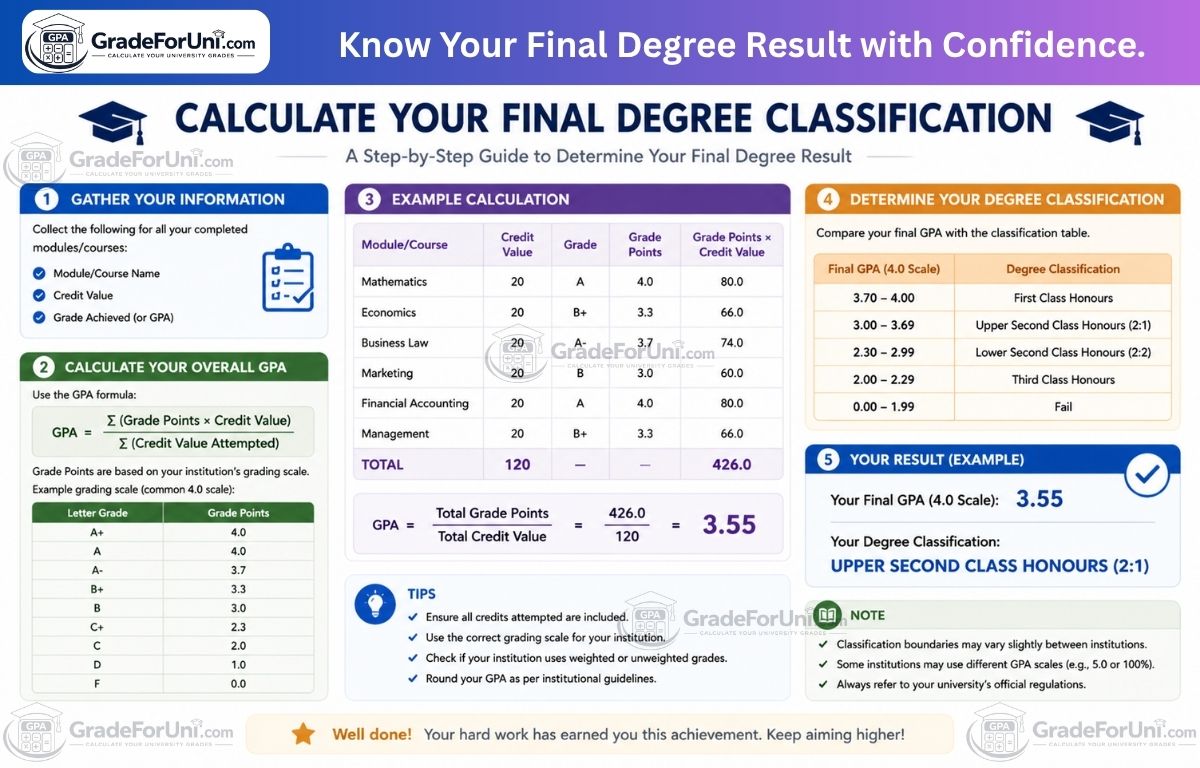
Imagine opening your university results portal after your final exams. Most of your marks are already available, but one important question remains: “What degree classification will I graduate with?”
Many students try to calculate their final result themselves, only to discover that UK universities use weighted averages, module credits and year weightings rather than a simple average. Understanding these rules can make estimating your final classification much easier.
This guide explains how UK universities calculate degree classifications, how different year weightings affect your result and how you can estimate your outcome accurately.
Calculate Your Final Degree Classification Instantly
Instead of working through complex calculations manually, use our calculator to estimate your final degree classification in seconds.
CLICK HERE:Final Grade Calculator UK
Quick Answer
A Final Degree Classification is the overall honours award you receive after completing your UK university degree. Most universities calculate it using a weighted average of your Level 5 and Level 6 marks, although the exact weighting varies by institution. Your final percentage determines whether you graduate with a First-Class Honours, Upper Second (2:1), Lower Second (2:2), Third-Class Honours, or another recognised award.
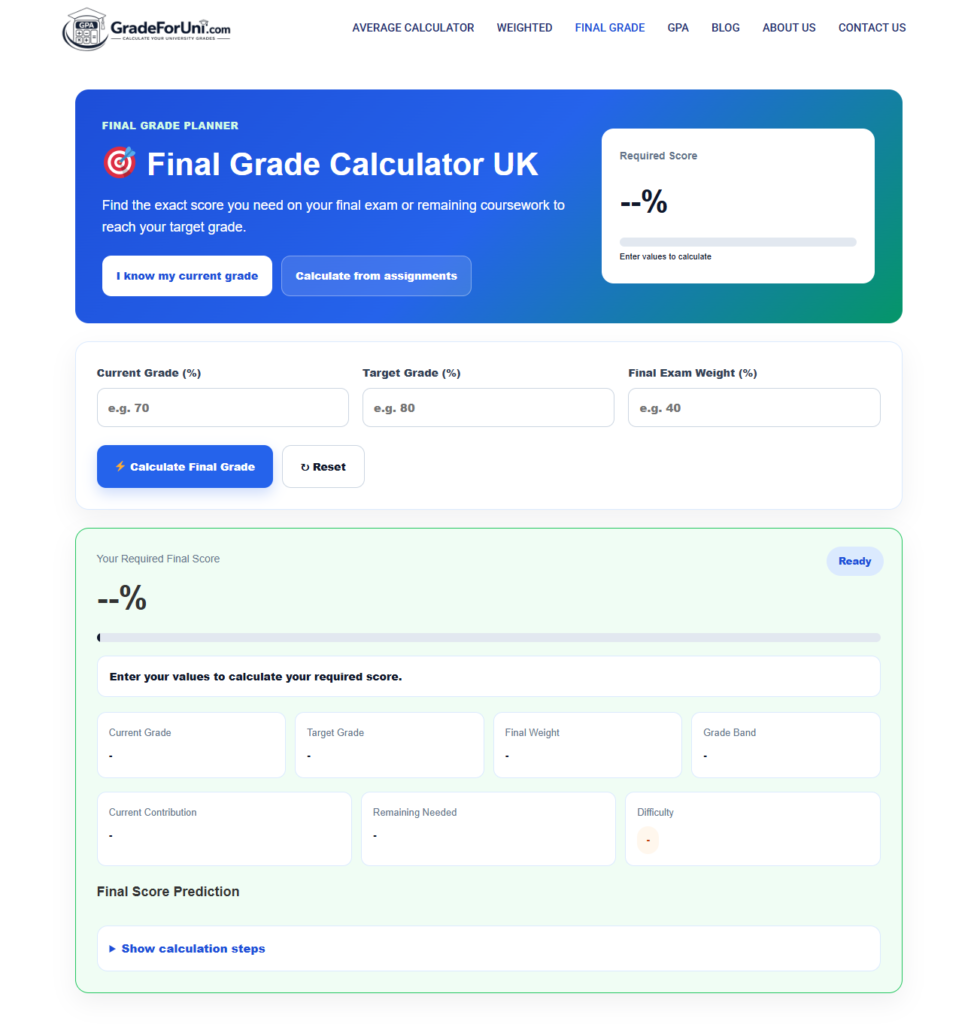
How to Use The Final Grade Calculator
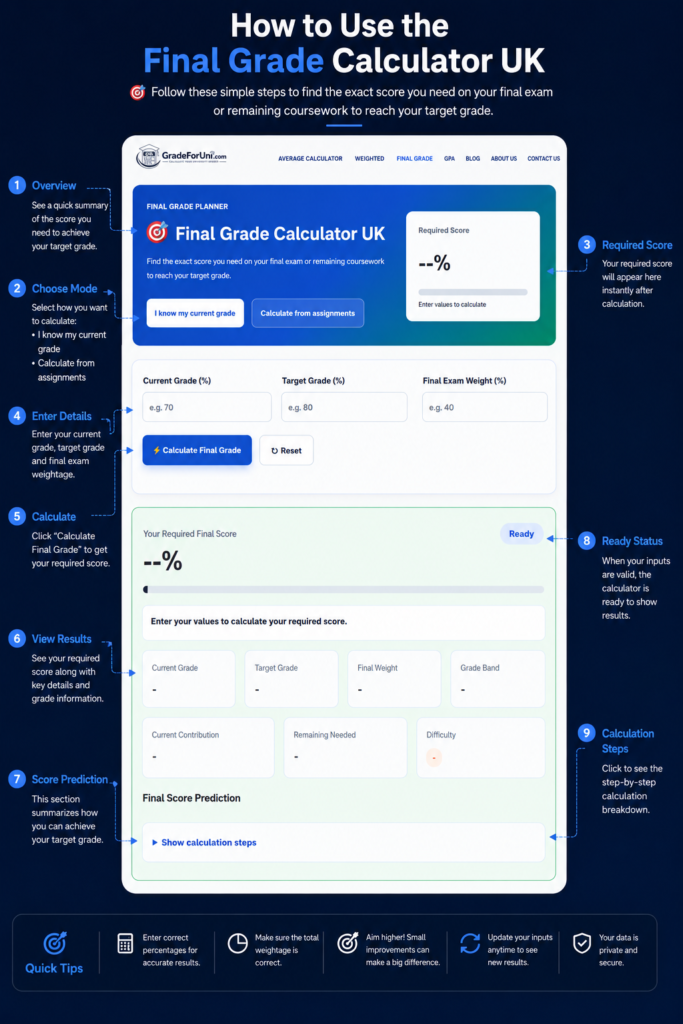
What Is a Final Degree Classification?
A final degree classification is the overall academic result awarded at the end of your degree. Rather than considering individual module marks on their own, universities combine your performance using their published assessment regulations.
Your classification appears on your degree certificate and academic transcript and may be considered for graduate jobs, postgraduate study and professional qualifications.
Why Your Final Classification Matters
Your degree classification can influence opportunities after graduation, including:
- Graduate jobs
- Postgraduate courses
- Scholarships
- Competitive internships
- Professional training programmes
While many employers ask for a 2:1, your skills, experience and interview performance are also important when applying for jobs.
Visit Now: Taxsal.comWho This Guide Is For
This guide is designed for students who want to:
- Calculate their final degree classification.
- Understand weighted averages and year weightings.
- Estimate results before graduation.
- Learn how module credits affect their overall mark.
Read More: University Grade CalculatorUK Degree Classification Bands Explained
Although assessment regulations differ between universities, most UK honours degrees use the following classification ranges.
| Degree Classification | Typical Percentage |
|---|---|
| First-Class Honours | 70% and above |
| Upper Second-Class Honours (2:1) | 60–69% |
| Lower Second-Class Honours (2:2) | 50–59% |
| Third-Class Honours | 40–49% |
| Ordinary Degree / Pass | Below honours requirements |
Always check your university’s academic regulations, as some institutions apply different boundaries or borderline rules
| Degree Classification | Description |
|---|---|
| First-Class Honours (First) | Awarded to students with a final weighted average of 70% or above. It represents outstanding academic performance and is often preferred for competitive graduate schemes and postgraduate study. |
| Upper Second-Class Honours (2:1) | Usually awarded for an overall average between 60% and 69%. A 2:1 is the minimum requirement for many graduate employers and master’s programmes. |
| Lower Second-Class Honours (2:2) | Typically awarded for averages between 50% and 59%. Many employers and postgraduate courses still accept applicants with a 2:2, particularly when supported by relevant experience. |
| Third-Class Honours | Usually awarded for a final average between 40% and 49%. It still represents successful completion of an honours degree. |
| Ordinary Degree and Pass Degrees | Students who do not meet the honours requirements may receive an Ordinary Degree or another exit award, depending on their university’s academic regulations. |
How Do UK Universities Calculate Final Degree Classification?
Most UK universities do not calculate your final degree classification by simply averaging all module marks. Instead, they use a weighted average, where module credits and the weighting of each academic year determine your final result. The exact calculation varies between universities, so it’s always worth checking your course handbook.
When calculating your classification, universities typically consider:
- Module marks
- Module credit values
- Year averages
- Year weightings
- Assessment regulations
- Borderline policies (where applicable)
The Basic Calculation Process
Although each university has its own regulations, the process usually follows these steps:
- Calculate each module mark.
- Apply module credit weightings.
- Calculate the average for each contributing academic year.
- Apply the university’s year weightings.
- Calculate the final weighted average.
- Match the final percentage to the appropriate degree classification.
Because universities use different credit structures and weighting models, two students with similar marks may receive different final averages.
Understanding Weighted Averages
A weighted average gives more importance to certain years or modules instead of treating every mark equally. At most UK universities, later years contribute more because they reflect your most advanced academic performance.
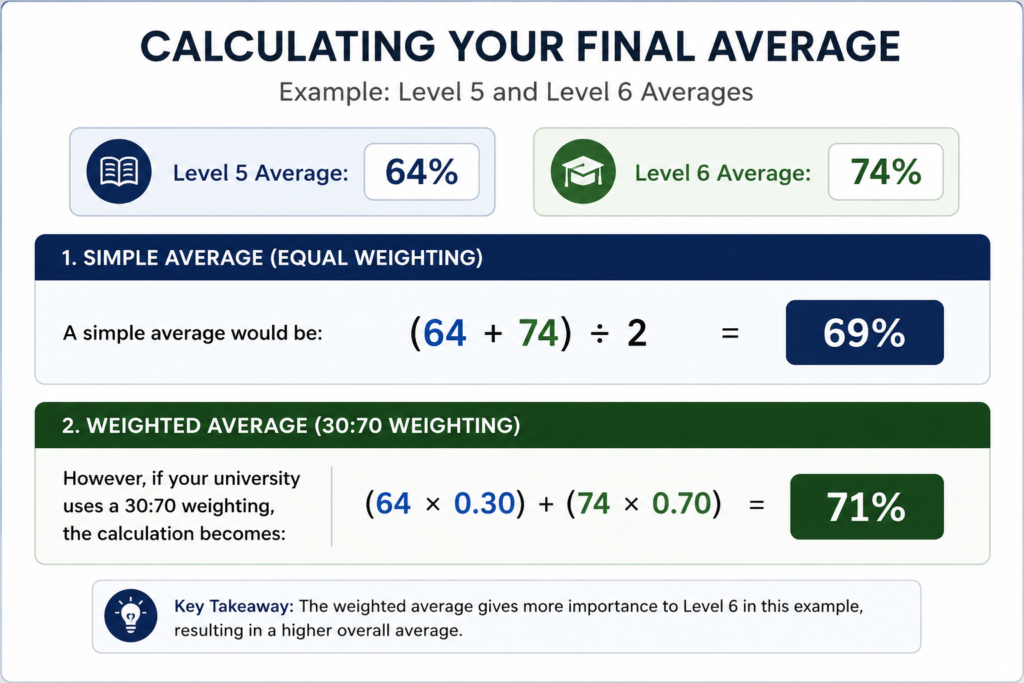
For example, if your university uses a 30:70 weighting, your final-year results have a much greater impact than your second-year marks.
Formula Box
Final Average = (Year Average × Weighting) + (Year Average × Weighting)
For courses with more than two contributing years:
Final Average = Σ (Year Average × Year Weight)
Tip: The year weightings should always add up to 100% (or 1.00).
Why Your Final Average May Differ from a Simple Average
Suppose your results are:
| Step | Calculation | Result |
|---|---|---|
| Level 5 Average | Given | 64% |
| Level 6 Average | Given | 74% |
| Simple Average | (64 + 74) ÷ 2 | 69% |
| 30:70 Weighted Calculation | (64 × 0.30) + (74 × 0.70) | 71% |
Because Level 6 carries more weight, your stronger final-year performance increases your overall average.
Which University Years Count Towards Your Final Degree?
The years included in your final classification depend on your university’s regulations. For most undergraduate honours degrees, Level 5 and Level 6 contribute to the final result, while Level 4 is often used only to determine progression.
Does First Year (Level 4) Usually Count?
At many UK universities, Level 4 (first year) does not contribute to your final honours classification. Instead, it helps students build the academic skills needed for later years.
However, you must still pass the required credits to progress, and some universities or courses may include a small Level 4 weighting. Always check your programme regulations.
How Level 5 Marks Are Used
Level 5 is usually the first year that contributes to your final classification. Depending on your university, it may account for 25% to 50% of your overall degree.
Strong Level 5 results can provide a solid foundation before entering your final year.
Read More: University Grade BoundariesHow Level 6 Marks Are Used
Level 6 usually carries the greatest weighting, often contributing 50% to 75% of your final classification. It includes your most advanced assessments, such as:
- Dissertation or final project
- Independent research
- Advanced subject modules
- Practical assessments
- Final examinations
Because of its higher weighting, strong Level 6 performance can significantly improve your final degree classification, especially if you’re aiming for a 2:1 or First-Class Honours.
Common Year Weighting Models Used by UK Universities
There is no standard weighting system across all UK universities. Each institution sets its own assessment regulations, so the contribution of each academic year may differ.
Some common weighting models are:
| Model | Level 4 | Level 5 | Level 6 |
|---|---|---|---|
| Model A | 0% | 30% | 70% |
| Model B | 0% | 40% | 60% |
| Model C | 10% | 30% | 60% |
| Model D | 0% | 50% | 50% |
Integrated master’s degrees, placement years and some professional courses may follow different rules. Always check your university’s academic handbook before calculating your final classification.
Read More: University Marking CriteriaUnderstanding Module Credits and Their Impact
Alongside your marks, universities also use module credits when calculating your final degree classification. Modules with higher credit values contribute more to your overall average than lower-credit modules.
What Are University Credits?
Credits indicate the workload assigned to a module. Most undergraduate honours degrees require 360 credits, although only the credits from the years included in your classification are used in the final calculation.
Typical examples include:
| Module | Credits |
|---|---|
| Marketing Principles | 20 |
| Business Law | 20 |
| Research Methods | 20 |
| Dissertation | 40–60 |
Why Credit Weighting Matters
Credit weighting ensures that larger pieces of work have a greater influence on your final result.
For example:
- Module A: 20 credits, 80%
- Module B: 60 credits, 60%
Although Module A has the higher mark, Module B contributes more because it carries three times as many credits.
How Different Credit Values Affect Your Final Average
| Module | Credits | Mark |
|---|---|---|
| Finance | 20 | 78% |
| Economics | 20 | 70% |
| Marketing | 20 | 65% |
| Dissertation | 60 | 68% |
Instead of averaging these marks equally, universities multiply each mark by its credit value before calculating the weighted average. As a result, the dissertation has the greatest impact on the final score.
Do Optional Modules Count?
Yes. Optional modules count towards your final classification if they form part of your degree and carry academic credits. They are usually weighted in the same way as compulsory modules unless your university states otherwise.
Comparison Table
| Credit Value | Typical Influence |
|---|---|
| 10 Credits | Low |
| 20 Credits | Standard |
| 40 Credits | High |
| 60 Credits | Very High |
Read More: University Credits CalculatorStep-by-Step Guide to Calculating Your Final Degree Classification
Once you know your module marks, credits and year weightings, calculating your final degree classification is straightforward.
Step 1: Gather Your Module Marks
Collect the official marks for every module that contributes to your final classification. Use confirmed university results whenever possible.
Step 2: Record Module Credits
Note the credit value for each module.
| Module | Credits | Mark |
|---|---|---|
| Business Strategy | 20 | 68% |
| Marketing | 20 | 72% |
| Dissertation | 60 | 70% |
Step 3: Calculate the Credit-Weighted Average
Multiply each module mark by its credit value, add the results together, then divide by the total number of credits.
Example:
| Module | Calculation |
|---|---|
| Business Strategy | 68 × 20 = 1,360 |
| Marketing | 72 × 20 = 1,440 |
| Dissertation | 70 × 60 = 4,200 |
Step 4: Calculate Each Year’s Average
Calculate the weighted average for each academic year.
Example:
- Level 5 Average = 65%
- Level 6 Average = 72%
Step 5: Apply Your University’s Year Weightings
If your university uses a 30:70 weighting:
- Level 5: 65 × 0.30 = 19.5
- Level 6: 72 × 0.70 = 50.4
Final Average = 69.9%
Step 6: Find Your Degree Classification
Compare your weighted average with your university’s classification boundaries.
| Final Average | Classification |
|---|---|
| 70%+ | First-Class Honours |
| 60–69% | Upper Second (2:1) |
| 50–59% | Lower Second (2:2) |
| 40–49% | Third-Class Honours |
Formula Box
Credit-Weighted Average
This formula is used to calculate module and yearly averages before applying year weightings.
Worked Examples
These examples show how different situations can affect your Final Degree Classification.
| Worked Example | Description |
|---|---|
| Worked Example 1: Year Weighting | Emma scores: Level 5: 64% Level 6: 72% Using a 30:70 weighting, her final average is 69.6%, placing her close to the First-Class boundary. |
| Worked Example 2: Credit Weighting | Ryan completes three 20-credit modules and a 60-credit dissertation. Although his dissertation mark is lower than one of his modules, it has the greatest impact because it carries more credits. |
| Worked Example 3: Improving to a First | Sophie has a 69% Level 5 average and wants to graduate with a First. She calculates the Level 6 marks she needs before her final assessments to reach an overall average of 70%. |
| Worked Example 4: Failed Module and Resit | Daniel fails a module with 35% but scores 67% in the resit. Because his university caps resit marks at 40%, the capped mark is used when calculating his final classification. |
| Worked Example 5: Borderline Classification | Aisha graduates with 69.4% overall. Her university reviews students close to a classification boundary, so she may be considered for a First-Class Honours award under its borderline policy. |
| Worked Example 6: Different University Weightings | Two students achieve identical yearly averages, but one university uses 30:70 while the other uses 40:60. Their final averages differ slightly, showing why it’s important to use your own university’s weighting system. |
How Does Your Dissertation Affect Your Final Degree Classification?
For many students, the dissertation is the single most significant piece of academic work completed during university. It often carries more credits than a standard module, meaning it can have a noticeable impact on your Final Degree Classification.
If your dissertation is worth 40 or 60 credits, a strong mark can increase your overall weighted average more than a high score in a typical 20-credit module. Likewise, a poor dissertation mark can make it harder to reach your target classification.
Understanding how your dissertation contributes allows you to plan your time and effort more effectively.
Why Dissertation Marks Carry More Weight
Unlike most taught modules, dissertations involve independent research over several months. Because of the depth of work involved, universities usually assign them a higher credit value.
For example:
| Assessment | Typical Credits |
|---|---|
| Standard Module | 20 |
| Large Project | 40 |
| Dissertation | 60 |
A 60-credit dissertation has the same influence as three standard 20-credit modules combined.
This means improving your dissertation mark by just a few percentage points can have a greater effect on your final average than improving a single taught module.
High-Credit Dissertation Example
Imagine the following Level 6 results:
| Module | Credits | Mark |
|---|---|---|
| Strategic Management | 20 | 66% |
| International Marketing | 20 | 68% |
| Business Ethics | 20 | 65% |
| Dissertation | 60 | 74% |
Although only one assessment scored above 70%, the dissertation’s higher credit value pulls the overall Level 6 average upwards.
This is why many students prioritise dissertation planning, research and supervisor feedback.
Can a Strong Dissertation Improve Your Classification?
Yes, provided your dissertation carries significant credits and your university includes it in the classification calculation.
For example, if you’re currently averaging 68%, achieving a high dissertation mark could move your overall weighted average closer to 70%, depending on:
- Your dissertation credit value
- Other Level 6 module results
- Your university’s weighting model
- Borderline classification policy
However, it’s important to remember that one assessment rarely guarantees a higher classification on its own. Your overall performance across the course still matters.
How Resits, Repeat Modules and Compensation Affect Your Classification
Resits, repeat modules and compensation can all affect your Final Degree Classification, but the impact depends on your university’s assessment regulations.
Do Resits Change Your Final Classification?
Yes, but not always in the same way.
A university may:
- Cap the resit mark at the pass mark.
- Record the actual resit mark.
- Apply different rules for approved mitigating circumstances.
Always check your course handbook before estimating how a resit will affect your final average.
What Is a Capped Mark?
Many UK universities cap successful resits at 40%, the typical undergraduate pass mark.
| Assessment | Mark |
|---|---|
| Original Attempt | 33% |
| Resit Result | 71% |
| Recorded Mark | 40% |
Although the student achieved 71%, only the capped mark contributes to the final classification unless the university applies different regulations.
How Repeat Modules Are Calculated
If you repeat a module, your university decides how the new mark is recorded. Common approaches include:
- Recording the repeated mark.
- Applying a capped pass mark.
- Following programme-specific regulations.
What Is a Compensated Pass?
A compensated pass allows a student to progress after narrowly failing a module, provided they meet the university’s academic requirements, such as passing enough credits in other modules.
Comparison Table
| Situation | Effect on Classification |
|---|---|
| Passed first attempt | Normal calculation |
| Capped resit | Lower contribution |
| Repeat module | Depends on regulations |
| Compensated pass | University specific |
| Mitigating circumstances | May change assessment rules |
Read More: Resit Grade CalculatorWhat Is a Borderline Degree Classification?
A borderline classification applies when your final average falls just below the next classification boundary. Some universities review these cases before confirming the final award.
How Borderline Decisions Work
A review may be considered if your average is close to a boundary, such as:
- 69.6%
- 59.7%
- 49.8%
Universities usually consider your overall academic profile, not just the final percentage.
What Do Universities Consider
Borderline reviews may take into account:
- Final-year performance
- Higher-level module results
- Credits above the higher boundary
- Consistent academic improvement
- Approved mitigating circumstances
Meeting these criteria does not guarantee a higher classification.
Comparison Table
| Weighted Average | Typical Outcome |
|---|---|
| 69.9% | Borderline review may apply |
| 69.0% | Usually remains a 2:1 |
| 59.8% | Possible review for 2:1 |
| 49.7% | Possible review for 2:2 |
Do All UK Universities Calculate Degree Classifications the Same Way?
No. While most universities use weighted averages, there is no single UK-wide calculation method. Assessment regulations vary between institutions, so identical marks can produce different final classifications.
What Can Vary Between Universities?
Universities may use different:
- Year weightings
- Module credit structures
- Resit policies
- Borderline rules
- Dissertation weightings
- Integrated master’s calculations
Check Your University’s Academic Handbook
Before calculating your final result, confirm your university’s:
- Classification boundaries
- Year weightings
- Credit requirements
- Resit regulations
- Graduation requirements
Your university’s official regulations always take priority over general online guidance.
Practical Scenarios
These examples show how different situations can affect your Final Degree Classification.
| Scenario | Description |
|---|---|
| Scenario 1: Improving to a First | Lucy has a 67% Level 5 average. Because her university uses a 30:70 weighting, she focuses on achieving higher marks in Level 6 and her dissertation to improve her overall classification. |
| Scenario 2: Failing One Module | Ahmed fails a 20-credit module but passes the resit. Before estimating his final result, he uses the recorded mark published by his university rather than the raw resit score. |
| Scenario 3: High-Credit Dissertation | Sophie’s dissertation is worth 60 credits, so she prioritises it over standard 20-credit modules, knowing it has a greater impact on her final average. |
| Scenario 4: Different University Weightings | Emily initially calculates her result using a 30:70 model, then discovers her course uses 40:60. Recalculating with the correct weighting gives a more accurate estimate. |
| Scenario 5: Integrated Master’s Degree | James studies an integrated master’s programme with different assessment rules. Instead of using a standard honours calculation, he follows his programme’s regulations. |
Common Mistakes When Calculating Final Degree Classification
Avoid these common mistakes:
- Using a simple average instead of a weighted average.
- Ignoring module credit values.
- Including Level 4 when it doesn’t count.
- Forgetting dissertation weighting.
- Assuming resit marks are always recorded in full.
- Using another university’s weighting system.
- Misunderstanding borderline classifications.
- Entering incorrect module marks.
- Forgetting to apply credit weightings.
- Not checking your university’s academic regulations.
Expert Tips for More Accurate Calculations
- Check your university’s assessment handbook first.
- Prioritise high-credit modules and dissertations.
- Track your weighted average after each semester.
- Calculate the marks needed for your target classification.
- Double-check all marks, credits and weightings.
- Use confirmed results whenever possible.
- Compare best-case and expected outcomes.
- Understand your university’s resit policy.
- Keep your dissertation on schedule.
- Verify your calculations using a degree classification calculator.
How do I calculate my final degree classification in the UK?
Most UK universities calculate your final degree classification by combining your yearly averages using a weighted average. In many honours degrees, Level 5 and Level 6 contribute to the final result, although the exact weighting varies between universities. Module credits are also taken into account, so higher-credit modules have a greater influence on your overall average.
Does first year count towards my final classification?
In many undergraduate honours programmes, Level 4 (first year) does not contribute to the final degree classification. However, you must still pass the required credits to progress. Some universities and specific courses may include a small weighting, so always check your institution’s academic regulations.
What percentage is needed for a First-Class degree?
At most UK universities, a First-Class Honours degree requires a final weighted average of 70% or above. Some universities also operate borderline policies for students who finish just below this threshold, but these rules vary by institution.
Can I still get a 2:1 after failing a module?
Possibly. It depends on several factors, including:
Whether you pass the resit.
Whether the resit mark is capped.
The number of credits affected.
Your performance in other modules.
Your university’s assessment regulations.
A single failed module does not automatically prevent you from graduating with a 2:1.
How does dissertation weighting affect my degree?
Dissertations often carry 40 or 60 credits, making them more influential than standard 20-credit modules. A strong dissertation can improve your overall weighted average, while a lower mark may have a greater impact because of its higher credit value.
How are university credits used in classification?
Credits determine how much each module contributes to your final average. Universities multiply each module mark by its credit value before calculating the weighted average, ensuring larger modules have a proportionately greater influence.
What is a borderline degree classification?
A borderline classification applies when your final weighted average falls close to the next classification boundary. Depending on your university’s regulations, your academic profile may be reviewed to determine whether you qualify for the higher classification.
Do resits affect my final classification?
Yes, they can. Many universities cap successful resit marks at the pass mark, while others apply different rules depending on the circumstances. The recorded mark used in your final calculation depends on your university’s academic regulations.
Can different universities calculate classifications differently?
Yes. Although the honours classification system is broadly similar across the UK, universities have different rules for year weightings, module credits, resits, borderline decisions and integrated master’s programmes. Always use your own university’s published regulations when estimating your final result.
Can I estimate my degree classification before graduating?
Yes. If you know your confirmed module marks, credit values and your university’s weighting system, you can estimate your final degree classification using a weighted average calculation or a dedicated degree classification calculator. Remember that the final award is confirmed only after your university applies its official assessment regulations.
Conclusion
Calculating your Final Degree Classification is much easier once you understand how module credits, year weightings and university regulations work together. Using the correct calculation method gives you a far more accurate estimate than relying on a simple average.
Before estimating your result, make sure you use your official module marks, credit values and your university’s published weighting system. If you’re close to a classification boundary or have completed a resit or dissertation, remember that these can also influence your final outcome.
To save time and minimise calculation errors, use our Final Degree Classification Calculator for a quick estimate. Your university will confirm the official result, but knowing your likely classification in advance can help you plan your next academic or career steps with confidence.