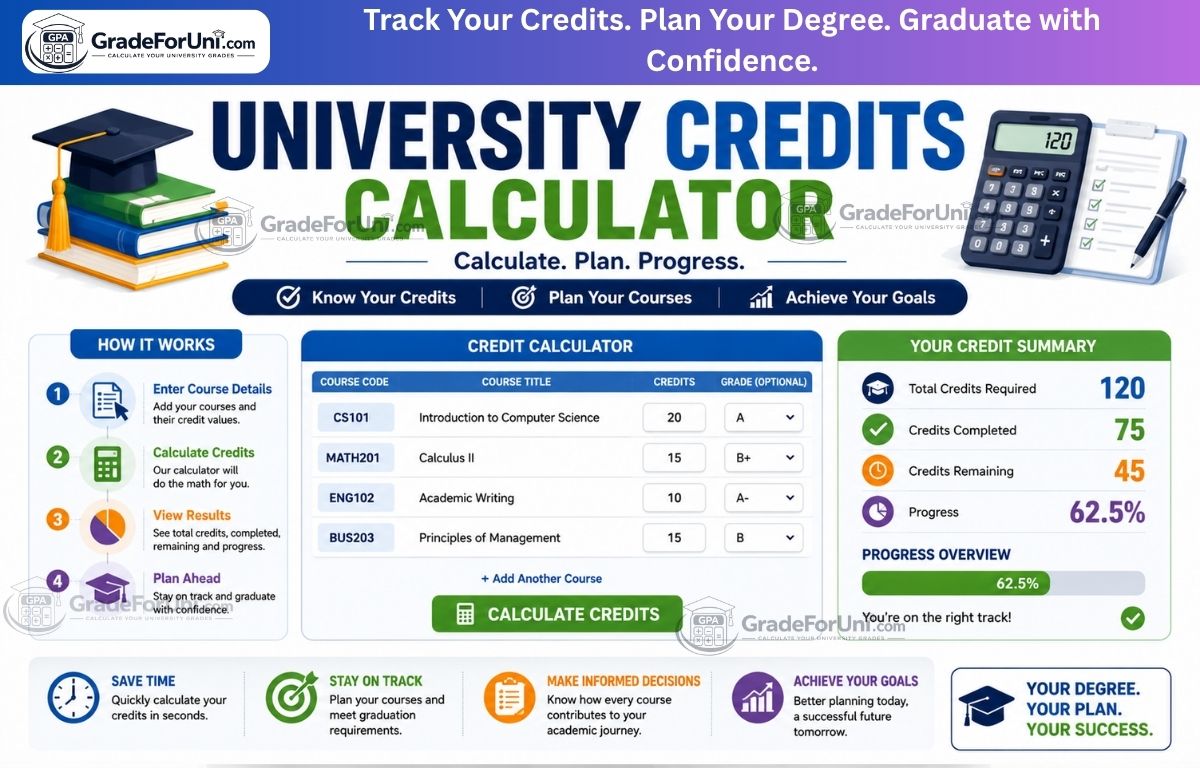
Understanding your academic progress isn’t about grades it’s also about the credits you’ve earned. If you want to know how many credits you’ve completed or how many you still need to graduate, a University Credits Calculator provides a quick and simple way to find out without adding module values manually.
Whether you’re studying full-time, part-time, transferring between universities or preparing for graduation, using a University Credits Calculator helps you to track your completed credits and plan your next steps with confidence. While it’s a useful tool for estimating your progress, always compare your results with your university transcript and programme handbook, as credit requirements vary between institutions.
Calculate Your University Credits in Seconds
Enter the credit value of the modules you have completed, compare the total with your programme requirements and instantly see how many credits you have earned and how many you still need.
Click Here: UK University Grade Calculator
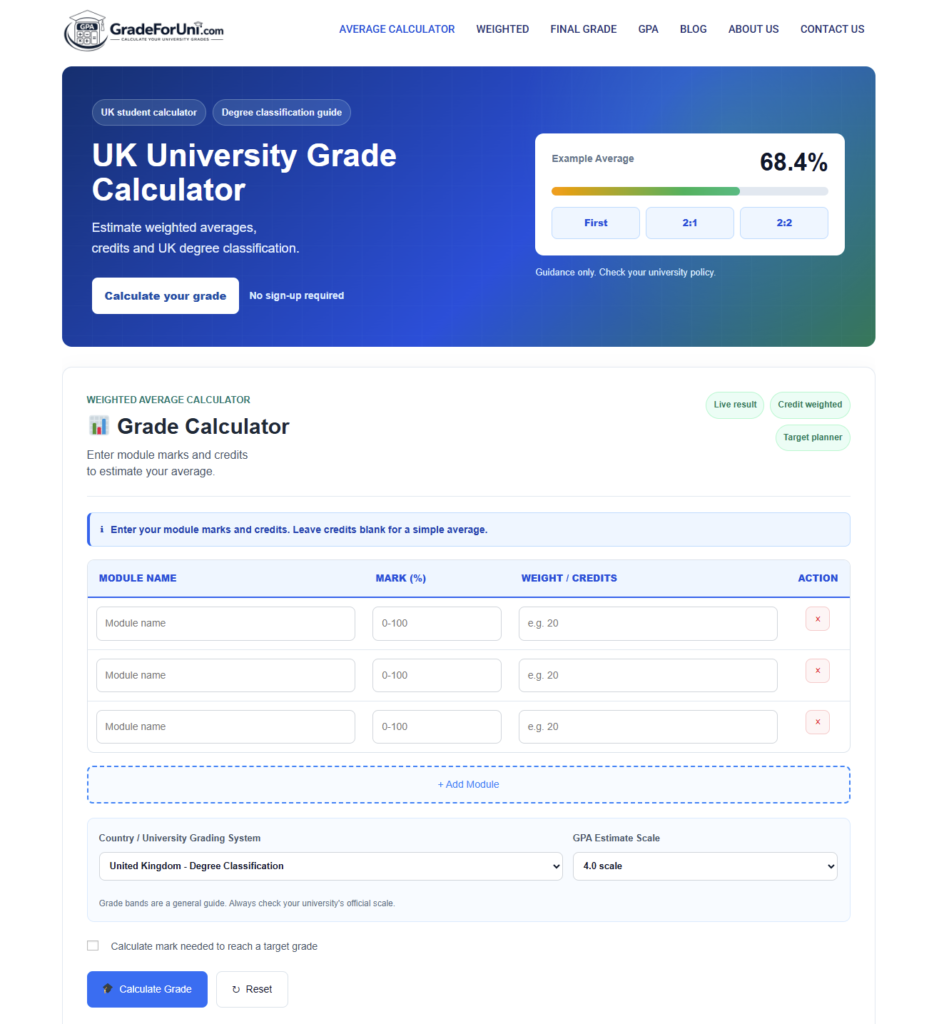
How to Use the UK University Grade Calculator
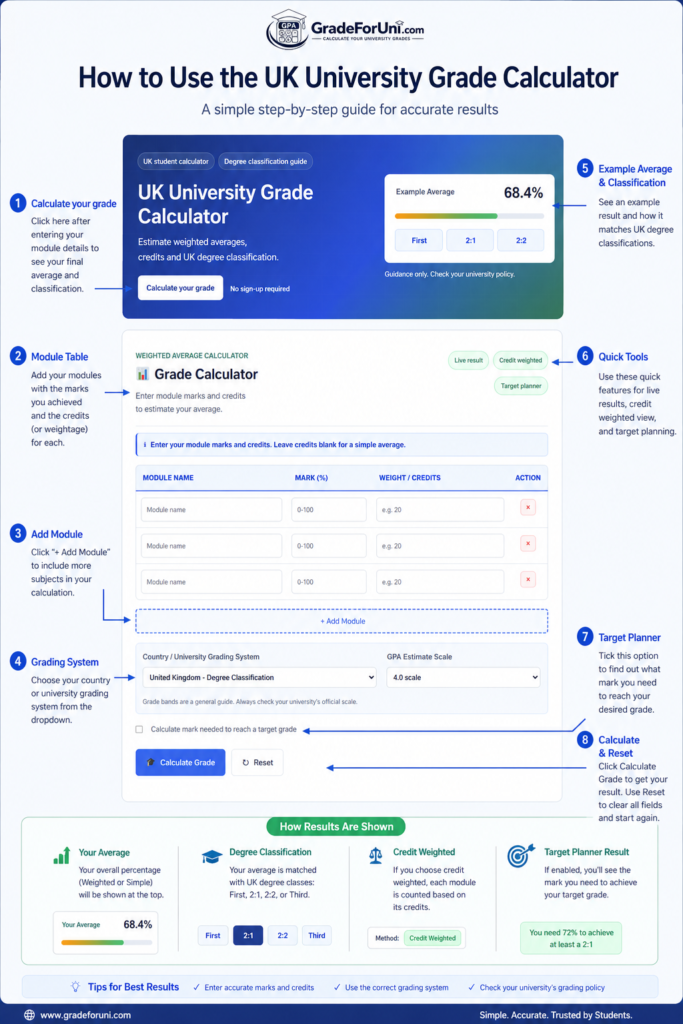
What Is a University Credits Calculator?
A University Credits Calculator is an online tool that totals the academic credits you’ve earned throughout your course. Rather than manually adding every completed module, the calculator performs the calculation instantly and compares your total with your programme’s credit requirements.
Unlike a grade calculator, which focuses on marks or percentages, this calculator measures your academic progress towards completing your qualification.
What Does the University Credits Calculator Do?
The calculator helps you:
- Add completed module credits.
- Calculate total earned credits.
- Estimate remaining credits.
- Track progress towards graduation.
- Plan future module selections.
- Check progression requirements.
For many students, this becomes especially useful after each semester or academic year when reviewing results.
Who Should Use It?
This calculator is useful for:
- Undergraduate students
- Postgraduate students
- Foundation year students
- Part-time learners
- Students returning after a study break
- Transfer students
- Students preparing for graduation
- Anyone planning future module choices
If you’re in your first semester or your final year, then knowing your credit position helps you to make informed academic decisions.
Read More: University Grade CalculatorWhy Calculating University Credits Matters
Your university credits affect much more than graduation.
They help determine whether you can:
- Progress to the next academic year
- Complete your degree on time
- Meet professional accreditation requirements
- Transfer between universities
- Apply for postgraduate study
- Study abroad through exchange programmes
Knowing your credit total early allows you to identify problems before they become serious.
For example, discovering you’re missing 20 credits several weeks before graduation gives you time to explore available options rather than finding out after final results are released.
How Does the UK University Credit System Work?
The UK university credit system measures the amount of learning required to complete a module or qualification. Instead of focusing only on examination results, universities use credits to represent the overall learning completed, including lectures, seminars, coursework, independent study, practical work and assessments.
Credits are awarded only after successfully meeting the assessment requirements set by your university.
What Are University Credits?
A university credit represents the amount of learning expected for a particular module.
Generally:
- More study hours usually mean more credits.
- Larger modules carry higher credit values.
- Credits accumulate throughout your degree.
For example:
| Module | Credit Value |
|---|---|
| Academic Writing | 20 |
| Statistics | 20 |
| Research Methods | 20 |
| Final Dissertation | 40 |
Completing all four modules successfully would earn 100 credits.
How University Credits Are Awarded
Credits are usually awarded after you successfully pass a module, in accordance with your university’s assessment regulations.
This normally involves:
- Completing coursework.
- Sitting examinations where required.
- Achieving the minimum pass mark.
- Meeting attendance or placement requirements (if applicable).
If you fail a module, credits are usually not awarded until you complete a resit or repeat the module, although some universities have compensation rules for marginal fails.
Credits vs Grades
Although often confused, credits and grades measure different things.
| Credits | Grades |
|---|---|
| Measure learning completed | Measure academic performance |
| Required for graduation | Affect degree classification |
| Earned by passing modules | Expressed as percentages, marks or classifications |
| Usually fixed per module | Vary according to assessment performance |
A student could earn the same 20 credits whether they score 42% or 82%, provided both marks meet the module’s pass requirements.
Read More: How to Improve Your University gradesCredits vs UCAS Points
UCAS points apply before university.
University credits apply during university.
| UCAS Points | University Credits |
|---|---|
| Used for university admission | Used to complete a degree |
| Based on qualifications like A Levels | Based on completed university modules |
| Calculated before enrolment | Accumulated after enrolment |
| Help universities assess applicants | Help universities track academic progress |
The two systems are completely separate and should not be confused.
Understanding CATS and ECTS Credits
Many UK universities use the Credit Accumulation and Transfer Scheme (CATS).
Students participating in international exchange programmes may also encounter the European Credit Transfer and Accumulation System (ECTS).
| UK Credits (CATS) | Approximate ECTS |
|---|---|
| 20 | 10 |
| 40 | 20 |
| 60 | 30 |
| 120 | 60 |
| 180 | 90 |
| 360 | 180 |
Although these conversions are widely recognised, always check your university’s transfer policy before assuming credits will convert automatically.
Read More: GPA vs PercentageHow Many Credits Do You Need for a UK Degree?
The number of credits required depends on the qualification you’re studying. While individual universities may have specific regulations, most UK higher education institutions follow similar credit structures.
Knowing your target credit total helps you monitor your progress from the beginning of your course rather than waiting until your final year.
Bachelor’s Degree Credit Requirements
A standard bachelor’s degree usually requires 360 credits.
These are commonly divided across three academic years.
| Academic Level | Typical Credits |
|---|---|
| Level 4 | 120 |
| Level 5 | 120 |
| Level 6 | 120 |
| Total | 360 |
Completing each level keeps you on track for graduation.
Visit Now: TaxsalMaster’s Degree Credit Requirements
Most taught master’s programmes require 180 credits.
A typical structure may include:
| Component | Credits |
|---|---|
| Taught Modules | 120 |
| Dissertation | 60 |
| Total | 180 |
The dissertation usually represents a significant proportion of the overall programme, making successful completion particularly important.
Foundation Degree Credit Requirements
Foundation degrees generally require 240 credits, normally completed over two years of full-time study.
Many students later progress to a bachelor’s degree by completing an additional year.
Integrated Master’s Credit Requirements
Integrated master’s programmes combine undergraduate and postgraduate study into a single qualification.
These programmes commonly require 480 credits, although exact requirements depend on the institution and course structure.
Credits Required by Academic Level
Each academic level builds on the previous one.
| Academic Level | Typical Study Stage | Credits |
|---|---|---|
| Level 4 | First Year | 120 |
| Level 5 | Second Year | 120 |
| Level 6 | Final Year | 120 |
| Level 7 | Master’s Level | 180 |
Completing the required credits at each stage usually allows progression to the next level, provided you also satisfy your university’s academic regulations.
How to Calculate Your University Credits
Calculating your university credits is straightforward when you have your module results and programme handbook available. The goal is to total only the credits you have successfully earned and compare that figure with the total required for your qualification.
Step 1: List All Completed Modules
Begin by writing down every module you have completed during your course.
Include:
- Module name
- Credit value
- Pass or fail result
Your transcript or student portal is usually the easiest place to find this information.
Step 2: Add the Credits You Have Earned
Next, add together the credit values of all modules you have successfully passed.
For example:
- Introduction to Psychology – 20 credits
- Research Skills – 20 credits
- Statistics – 20 credits
- Academic Writing – 20 credits
Total earned = 80 credits
Step 3: Exclude Failed or Incomplete Modules
Do not include modules that:
- Have failed and not yet passed through a resit
- Are still in progress
- Have been withdrawn from
- Have not yet been assessed
If your university awards compensated credits, check your regulations before including them.
Step 4: Compare with Your Degree Requirement
Finally, compare your earned credits with the total required for your qualification.
For example:
- Credits earned: 260
- Credits required: 360
- Credits remaining: 100
This tells you how much further study is needed before you meet the academic credit requirement for graduation.
| Formula | Calculation |
|---|---|
| Total Credits Earned | Sum of Credits for All Successfully Completed Modules |
| Remaining Credits | Total Credits Required − Credits Earned |
Worked Example
Emma is studying a three-year bachelor’s degree requiring 360 credits.
| Item | Details |
|---|---|
| Student | Emma |
| Degree requirement | Three-year bachelor’s degree requiring 360 credits |
| Completed | Year 1: 120 credits |
| Completed | Year 2: 100 credits (one 20-credit module failed) |
| Credits earned | 220 credits |
| Remaining credits | 360 − 220 = 140 credits |
Emma now knows she must complete her remaining Year 3 modules and recover the failed 20-credit module if required under her university’s regulations.
Typical Module Credit Values in UK Universities
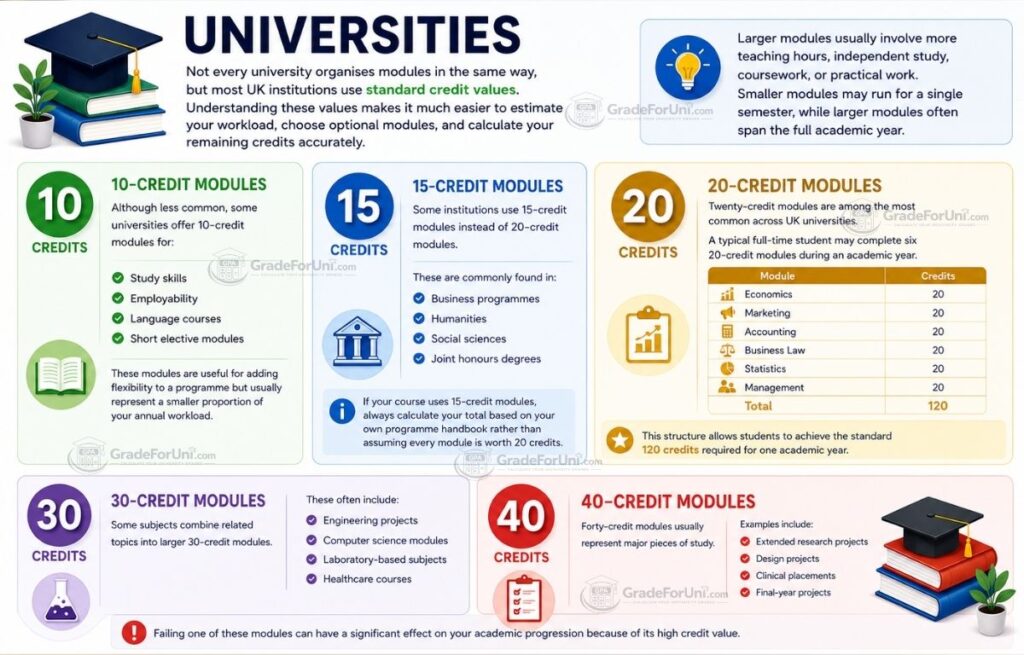
Not every university organises modules in the same way, but most UK institutions use standard credit values. Understanding these values makes it much easier to estimate your workload, choose optional modules, and calculate your remaining credits accurately.
Larger modules usually involve more teaching hours, independent study, coursework, or practical work. Smaller modules may run for a single semester, while larger modules often span the full academic year.
10-Credit Modules
Although less common, some universities offer 10-credit modules for:
- Study skills
- Employability
- Language courses
- Short elective modules
These modules are useful for adding flexibility to a programme but usually represent a smaller proportion of your annual workload.
15-Credit Modules
Some institutions use 15-credit modules instead of 20-credit modules.
These are commonly found in:
- Business programmes
- Humanities
- Social sciences
- Joint honours degrees
If your course uses 15-credit modules, always calculate your total based on your own programme handbook rather than assuming every module is worth 20 credits.
20-Credit Modules
Twenty-credit modules are among the most common across UK universities.
A typical full-time student may complete six 20-credit modules during an academic year.
Example:
| Module | Credits |
|---|---|
| Economics | 20 |
| Marketing | 20 |
| Accounting | 20 |
| Business Law | 20 |
| Statistics | 20 |
| Management | 20 |
| Total | 120 |
This structure allows students to achieve the standard 120 credits required for one academic year.
30-Credit Modules
Some subjects combine related topics into larger 30-credit modules.
These often include:
- Engineering projects
- Computer science modules
- Laboratory-based subjects
- Healthcare courses
Because they carry more credits, they also contribute more towards your yearly total.
40-Credit Modules
Forty-credit modules usually represent major pieces of study.
Examples include:
- Extended research projects
- Design projects
- Clinical placements
- Final-year projects
Failing one of these modules can have a significant effect on your academic progression because of its high credit value.
Dissertation Credits
Many undergraduate and postgraduate programmes include a dissertation.
Typical credit values are:
| Qualification | Dissertation Credits |
|---|---|
| Bachelor’s Degree | 40–60 |
| Master’s Degree | 60 |
Because dissertations often account for a large proportion of the programme, it’s important to begin planning early and understand your submission deadlines.
What Happens If You Fail a University Module?
Failing a university module doesn’t necessarily mean you’ve failed your degree, but it can affect your credit total, progression, and graduation timeline. The outcome depends on your university’s regulations, the module, and whether you’re eligible for a resit, repeat, or compensated credit.
Do You Receive Credits for a Failed Module?
In most cases, no. Credits are usually awarded only after you successfully pass a module. If you fail, those credits won’t count towards your degree until the module is completed. Some universities may award compensated credit for marginal fails if specific academic requirements are met.
How Resits and Repeats Affect Credits
If you’re offered a resit and pass, you’ll normally receive the module credits, increasing your total credit count. While some universities cap resit marks, earning the required credits is usually the main priority for progression.
If a resit isn’t available or isn’t passed, you may need to repeat the module, which typically involves attending classes and completing assessments again. This can delay your graduation because the missing credits aren’t awarded until you pass.
How Can Failed Modules Affect Graduation?
The impact depends on the number of failed credits, whether the module is compulsory, and your university’s academic regulations. Possible consequences include:
- Delayed progression to the next year
- Additional assessments or resits
- Repeating a module or academic year
- Delayed graduation
- A possible impact on your final degree classification
Read More: What Happens If You FailComparison Table: Pass vs Fail Outcomes
| Situation | Credits Awarded? | Progression Likely? |
|---|---|---|
| Pass module | Yes | Yes |
| Pass after resit | Usually Yes | Usually Yes |
| Compensation awarded | Usually Yes | Usually Yes |
| Fail module | No | Depends on regulations |
| Repeat module in progress | Not yet | Depends on programme |
Practical Scenario
Oliver is studying a 360-credit degree. He has earned 240 credits but failed a compulsory 20-credit module in his final year.
Without passing that module, he cannot reach the required total for graduation. After completing the resit, the missing 20 credits are awarded, bringing him closer to the required total.

Can You Transfer University Credits?
Yes, in many cases you can transfer university credits when changing universities or returning to study. Credit transfer allows previously completed modules to count towards a new qualification, helping you avoid repeating study. However, approval depends on whether your previous learning matches the new course’s requirements.
How Does Credit Transfer Work?
Universities assess factors such as your module content, learning outcomes, level of study, and assessment methods before deciding whether to accept your credits. You may need to provide documents such as your academic transcript, module descriptions, and programme handbook as part of the review process.
What Should You Check Before Transferring Credits?
If you’re transferring within the UK or from a study abroad programme, confirm how many credits will be accepted, whether compulsory modules are included, and if any professional accreditation requirements apply. Planning and keeping accurate academic records can help prevent delays to your degree.
Tips to Stay on Track for Graduation
- Monitor your credits throughout your degree to avoid unexpected delays to graduation.
- Complete around 120 credits per academic year for a standard three-year UK bachelor’s degree (360 credits in total).
- Check your completed, remaining, and current credits after each semester.
- Use a University Credits Calculator to track your progress quickly and accurately.
- Compare your calculations with your official university transcript after results are published.
- Confirm the credit value of optional modules before selecting them.
- Make sure you complete all compulsory modules required for your degree.
- Balance your workload by spreading challenging modules across different semesters where possible.
- Review your university’s progression and graduation requirements regularly.
- Seek academic advice promptly if you fail a module or fall behind on credits.
Worked Credit Calculation Examples
The examples below demonstrate how a University Credits Calculator can be used in different situations. They are based on typical UK university credit structures, although your own programme may have different requirements.
Example 1: First-Year Student with All Modules Passed
Sophia is studying the first year of a bachelor’s degree.
She completes six modules:
| Module | Credits | Result |
|---|---|---|
| Academic Skills | 20 | Pass |
| Introduction to Business | 20 | Pass |
| Economics | 20 | Pass |
| Marketing | 20 | Pass |
| Accounting | 20 | Pass |
| Business Law | 20 | Pass |
Calculation
20 + 20 + 20 + 20 + 20 + 20 = 120 credits
Sophia has completed all the credits normally required to progress to the second year.
Example 2: Student Who Failed One Module
James completes six 20-credit modules but fails one.
| Result | Credits |
|---|---|
| Five modules passed | 100 |
| One module failed | 0 |
Total earned = 100 credits
He still needs to earn the missing 20 credits through a resit, repeat, or another route permitted by his university.
Example 3: Student After a Successful Resit
Emily originally failed a 20-credit statistics module.
She later passes the resit.
Her credit record changes as follows:
| Before Resit | After Resit |
|---|---|
| 220 credits | 240 credits |
Although her resit mark may be capped under university regulations, the successful completion of the module allows the missing credits to be awarded.
Example 4: Transfer Student with Existing Credits
Ahmed transfers from another UK university.
| Item | Details |
|---|---|
| Accepted | Level 4: 120 credits |
| New university requirement | Total degree credits: 360 |
| Remaining calculation | 360 − 120 = 240 credits remaining |
| Note | Before planning his future study, Ahmed confirms with his new university which credits count towards the final award. |
Example 5: Honours Degree Credit Calculation
Lucy has completed:
| Item | Details |
|---|---|
| Completed | Level 4: 120 credits |
| Completed | Level 5: 120 credits |
| Completed so far | Level 6: 80 credits |
| Calculation | 120 + 120 + 80 = 320 credits |
| Required | 360 credits |
| Remaining | 360 − 320 = 40 credits |
| Note | She must complete her remaining final-year modules before graduating. |
Real-Life University Credit Scenarios
Credit calculations become especially important when unexpected situations arise. The following examples show how students can use their credit totals to make informed decisions.
Progressing to the Next Academic Year
| Item | Details |
|---|---|
| Student | Mia |
| Credits earned | 120 credits |
| Outcome | Since she has completed the required credit load, she is eligible to progress to the second year, subject to her university’s progression rules. |
Graduating with Outstanding Credits
| Item | Details |
|---|---|
| Student | Ryan |
| Current credits | 340 credits |
| Required | 360 credits |
| Outcome | By identifying the shortfall early, he can discuss available options with his academic adviser before graduation decisions are finalised. |
Returning After Taking a Study Break
| Item | Details |
|---|---|
| Student | Hannah |
| Situation | Suspended her studies for one academic year |
| Outcome | When she returns, she reviews her existing credits to determine exactly where she should continue rather than repeating completed studies unnecessarily. |
Planning Optional Modules
| Item | Details |
|---|---|
| Student | Ben |
| Required | 120 credits during his second year |
| Outcome | Instead of selecting modules based only on personal interest, he confirms that his chosen combination meets both the required credit total and any compulsory module requirements. |
Studying Abroad with Credit Transfer
| Item | Details |
|---|---|
| Student | Aisha |
| Situation | Spends one semester at a partner university overseas |
| Outcome | Before travelling, she confirms which modules have been approved for transfer, ensuring the credits earned abroad will count towards her UK qualification. |
Common Mistakes When Calculating University Credits
Even simple calculations can become inaccurate if important details are overlooked. Avoiding the following mistakes can help you keep an accurate record of your academic progress.
| Common Mistake | Explanation |
|---|---|
| Confusing Credits with Grades | Credits measure completed learning, while grades measure academic performance. A high mark does not increase the number of credits awarded. |
| Counting Failed Modules | Only include modules that have been completed according to your university’s regulations. |
| Forgetting Dissertation Credits | Dissertations often carry a substantial number of credits. Missing them from your calculation can significantly underestimate your progress. |
| Ignoring Transfer Credits | If your university has formally recognised previous study, remember to include those approved credits in your overall total. |
| Misunderstanding Optional Modules | Optional modules still contribute towards your degree requirements if they form part of your approved programme. |
| Assuming Every Module Has the Same Credit Value | Modules may be worth 10, 15, 20, 30, 40 or more credits depending on the course structure. Always check the official module specification. |
| Not Checking University Regulations | Each university has its own academic regulations covering progression, compensation, resits and credit awards. Relying on general information instead of your own institution’s rules can lead to incorrect assumptions. |
| Ignoring Resit Outcomes | After passing a resit, remember to update your credit total so it reflects your current academic record. |
| Using Outdated Programme Requirements | Degree structures can change between academic years. Always use the programme handbook for your own year of entry. |
| Miscalculating Remaining Credits | Students sometimes focus only on credits already earned. Instead, regularly calculate both Credits completed and Credits still required. This provides a much clearer picture of your progress towards graduation. |
Expert Tips for Managing Your University Credits
Keeping track of your credits throughout your degree is much easier than trying to calculate everything at the end. These practical tips can help you stay organised and avoid unnecessary academic problems.
| Tip | Explanation |
|---|---|
| Keep Your Credit Record Updated | Review your transcript after every assessment period and record newly awarded credits. |
| Review Your Programme Handbook Regularly | Your handbook explains module requirements, progression rules and graduation criteria specific to your course. |
| Plan Modules Before Enrolment | Check module credit values before selecting optional subjects to ensure your study plan meets programme requirements. |
| Monitor Progress Every Semester | A short review at the end of each semester helps identify missing credits early enough to take corrective action. |
| Understand Compensation Rules | If your university offers compensated passes, learn the eligibility requirements before assuming failed modules will automatically earn credits. |
| Prepare for Dissertation Credit Requirements | Because dissertations often carry a high credit value, begin planning research, supervision meetings and deadlines well in advance. |
| Verify Transfer Credits Early | If you are transferring institutions or returning after a previous study, confirm accepted credits before enrolling. |
| Balance Your Academic Workload | Avoid placing all large-credit modules into one semester if your programme allows flexibility. A balanced timetable can make studying more manageable. |
| Use Credit Planning Before Graduation | During your final year, calculate your remaining credits after every assessment period to ensure you remain on track. |
| Speak to Your Academic Adviser When Unsure | If your credit record seems unclear, seek guidance from your academic adviser or student support team rather than relying on assumptions. |
What is a university credits calculator?
A university credits calculator is an online tool that adds together the credits from the modules you have completed. It helps you see how many credits you have earned and how many you still need to complete your qualification.
How many credits do I need to graduate from a UK university?
A typical UK bachelor’s degree requires 360 credits, while most taught master’s degrees require 180 credits. However, some programmes, such as integrated master’s degrees or professionally accredited courses, may have different requirements. Always check your university’s programme handbook.
How are university credits calculated?
Add the credit value of every module you have completed.
For example:
Module A – 20 credits
Module B – 20 credits
Module C – 40 credits
Total:
20 + 20 + 40 = 80 credits
Do failed modules count towards my credits?
Usually not.
In most UK universities, credits are awarded only after a module has been successfully passed. If you fail a module, you may need to complete a resit or repeat the module before those credits can be awarded.
Can I graduate if I am missing credits?
Generally, no.
You must normally complete the required number of credits for your qualification before your university can award your degree. Some universities have exceptional regulations, but these vary by institution.
How many credits should I earn each academic year?
For most full-time undergraduate programmes, students typically complete 120 credits per academic year.
Part-time students usually complete fewer credits each year over a longer study period.
Can I transfer credits from another university?
Yes, many universities accept transferred credits, provided the prior study aligns with the learning outcomes and academic level of the new programme.
Acceptance is always subject to your university’s approval process.
What is the difference between credits and grades?
Credits measure the amount of learning completed.
Grades measure how well you performed in assessments.
You need both to make satisfactory academic progress, but they serve different purposes.
Are university credits the same as UCAS points?
No.
UCAS points are used during university applications.
University credits are earned after enrolling and completing modules as part of your degree.
What is the difference between UK credits and ECTS credits?
Transfer and Accumulation System (ECTS).
As a general guide:
2 UK credits ≈ 1 ECTS credit
Always confirm conversion rules with your university before transferring credits.
How many credits is a typical university module?
Many UK undergraduate modules are worth 20 credits, although modules worth 10, 15, 30, 40 or 60 credits are also common depending on the programme.
Conclusion
Understanding your university credits is essential for tracking your academic progress and planning your degree. A University Credits Calculator makes it easy to total your completed credits and see how many you still need. Whether you’re in your first year, studying part-time, or preparing to graduate, it helps you stay on track and make informed module choices.
While a University Credits Calculator provides a quick estimate, always compare the results with your official university transcript and programme handbook, as credit requirements and regulations can vary between institutions. This ensures you have an accurate view of your progress towards graduation.