

Calculate Your Uni Grade You’ve just got a module result back — 68% in one subject, 55% in another — and your first instinct is to average them. Add them up, divide by two, done. Except that’s not how your university actually works it out, and if your modules carry different credit values, that quick mental average could be miles off your real standing.
This is the single most common mix-up students make when they try to calculate your uni grade by hand. A 40-credit module and a 10-credit module do not deserve equal say in your final average, yet a simple average treats them exactly the same. Once you understand how credits and module weighting actually work, the whole thing stops feeling like guesswork and starts making sense.
This guide walks through the real formula UK universities use, with worked examples you can follow step by step, so you always know exactly where you stand.
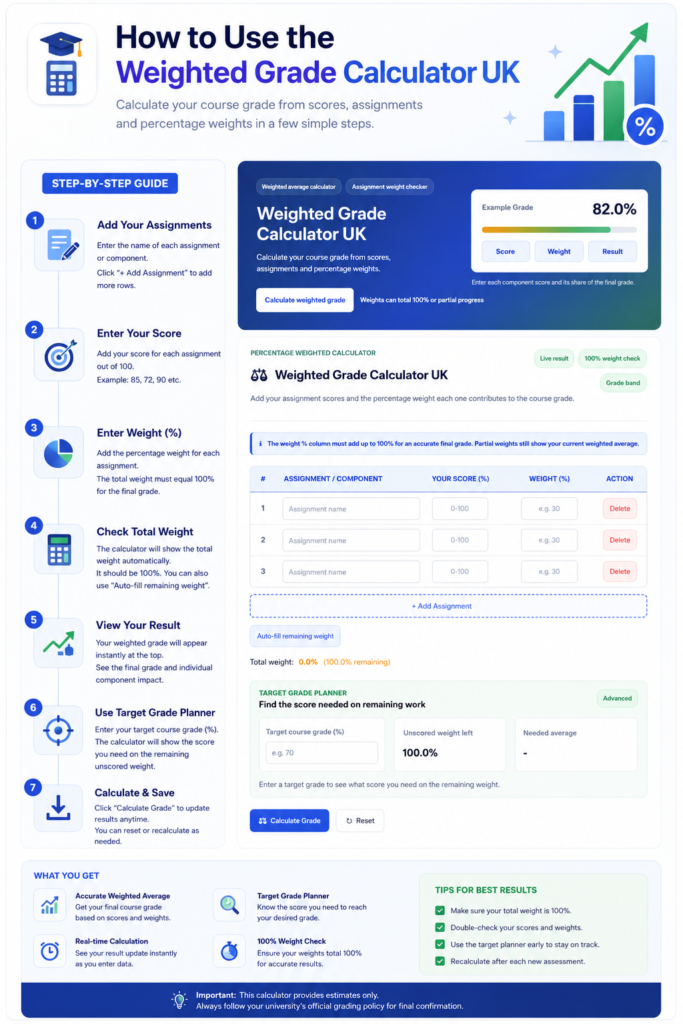
Click Here: Weighted Grade Calculator UK
How to Use the Weighted Grade Calculator UK
What Does “Module Weighting” Actually Mean?
Module weighting is the idea that not every subject you take counts equally toward your final grade. Universities assign each module a number of credits — usually 10, 15, 20, 30, or 40 — based on how much work, teaching time, and assessment it involves.
A module worth 40 credits represents roughly double the workload of a 20-credit module, so it’s only fair that it also carries roughly double the influence on your average. That’s the entire idea behind weighting: your grade should reflect effort and scale, not just a flat headcount of subjects.
Here’s the part that trips people up: if you ignore credits and just average your percentages, you’re silently assuming every module is worth the same. For most degrees, that assumption is wrong.
Read More: taxsal.comWhy Credits Exist in the First Place (Calculate Your Uni Grade )
UK degrees are built around a credit system, most commonly under frameworks like the Credit Accumulation and Transfer Scheme (CATS). A typical undergraduate year adds up to 120 credits, spread across however many modules your course includes. That structure is what allows your university to compare a dissertation module against a smaller elective and still produce one fair overall percentage.
It also means credits aren’t arbitrary numbers a lecturer picked at random. (Calculate Your Uni Grade ) They’re tied to notional learning hours — as a rough guide, one credit is often treated as roughly 10 hours of total study time, including lectures, seminars, independent reading, and assessment preparation. A 20-credit module, then, represents around 200 hours of work across the term, while a 40-credit module represents roughly double that. Once you see credits through that lens, it makes complete sense that a bigger module should have a bigger say in your final average.
Read More: Overall Uni Grade Calculator – Calculate Your Degree Average Step by Step
Credits vs Percentage Weighting (Calculate Your Uni Grade )
Some universities express module importance as a percentage of the year (for example, “this module is worth 16.7% of your year”) rather than a raw credit number. (Calculate Your Uni Grade ) Mathematically, this works out the same way, since percentage weighting is simply the credit value divided by the total credits for that year. If your university uses percentages instead of raw credits, you can plug those percentages directly into the same formula in place of credit values — the calculation logic doesn’t change.
The Formula to Calculate Your Uni Grade
Once you have your marks and credit values, the calculation itself is straightforward. Here’s the formula almost every UK university uses at module level:
Weighted Average = (Mark₁ × Credits₁ + Mark₂ × Credits₂ + Mark₃ × Credits₃ + …) ÷ (Credits₁ + Credits₂ + Credits₃ + …)
In plain terms: multiply each mark by its own credit value, add all those results together, then divide by the total number of credits. That’s it. No advanced maths, just careful multiplication and one division at the end (Calculate Your Uni Grade ).
Breaking the Formula Down Step by Step
- List every module along with its final percentage mark.
- Write down the credit value for each one (check your module handbook or student portal if you’re not sure).
- Multiply each mark by its credits — this gives you a “weighted score” for that module.
- Add up all the weighted scores (Calculate Your Uni Grade ).
- Add up all the credit values.
- Divide the total weighted score by the total credits.
That final number is your credit-weighted average — the figure your university actually uses to work out your classification.
Worked Example: Calculating a Simple Semester Grade
Let’s say you’ve completed four modules this semester with the following marks and credits:
| Module | Mark (%) | Credits | Mark × Credits |
|---|---|---|---|
| Business Strategy | 72 | 20 | 1,440 |
| Financial Accounting | 58 | 20 | 1,160 |
| Marketing Principles | 65 | 10 | 650 |
| Dissertation Prep | 61 | 30 | 1,830 |
| Total | — | 80 | 5,080 |
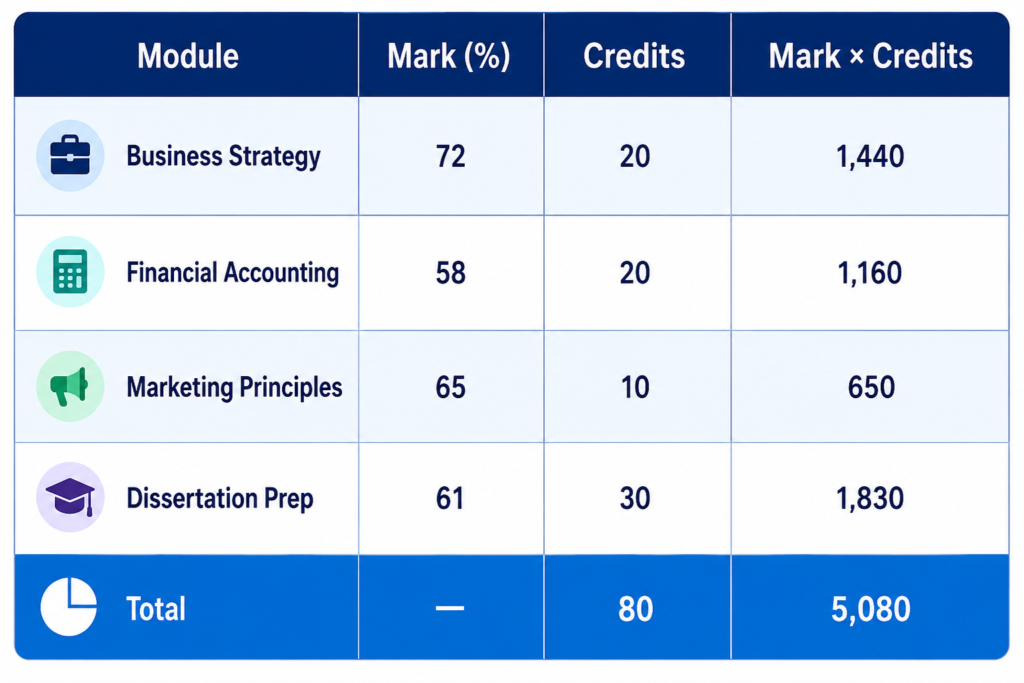
Now apply the formula:
Weighted Average = 5,080 ÷ 80 = 63.5%
Compare that to what you’d get with a naive, unweighted average: (72 + 58 + 65 + 61) ÷ 4 = 64.0%. It’s close, but not identical — and the gap widens considerably once your credit values are more spread out. (Calculate Your Uni Grade ) In this example, the 30-credit Dissertation Prep module and the two 20-credit modules pull more weight than the smaller 10-credit marketing module, which is exactly what should happen.
Why the Weighted Result Is Always More Accurate
A simple average treats every module as though it took the same amount of work to complete. In reality, a 30-credit module might involve triple the assessment, reading, and contact hours of a 10-credit one. (Calculate Your Uni Grade ) Weighting corrects for that imbalance and gives you a number that actually matches what appears on your transcript.
This matters most when your marks vary a lot between modules. (Calculate Your Uni Grade ) If every module happened to score exactly the same percentage, weighting wouldn’t change anything — but that’s rarely how a real semester plays out.
A Case Where the Difference Really Shows
Imagine two modules: one worth 40 credits where you scored 50%, and one worth 10 credits where you scored 90%.
- Simple average: (50 + 90) ÷ 2 = 70%
- Weighted average: (50×40 + 90×10) ÷ 50 = (2,000 + 900) ÷ 50 = 58%
That’s a 12-percentage-point gap — potentially the difference between a 2:2 and a 2:1. This is precisely why relying on a plain average can give you a false sense of security (or unnecessary panic) about where you actually stand.
How to Find Your Module Credit Values
If you’re not sure what credits your modules carry, here’s where to check:
- Your module handbook or course specification, usually available on your student portal.
- Your programme structure document, often issued at the start of the academic year.
- Your university’s academic regulations page, which typically lists standard credit values by module type.
- Your personal tutor or course administrator, if the information isn’t easy to find online.
Most UK undergraduate modules fall into standard bands — 10, 15, 20, 30, or 40 credits — with a full academic year usually totalling 120 credits.
Calculating Your Grade Across an Entire Year
Once you’re comfortable with single-semester calculations, the same formula extends naturally across a full academic year. You simply include every module you’ve taken that year, along with its credit value, in one combined calculation.
Worked Example: Full Year Calculation
| Module | Mark (%) | Credits |
|---|---|---|
| Data Structures | 66 | 20 |
| Databases | 58 | 20 |
| Digital Logic Design | 74 | 20 |
| Web Development | 62 | 20 |
| Group Project | 70 | 20 |
| Statistics for Computing | 55 | 20 |
Total credits = 120 Sum of Mark × Credits = (66×20)+(58×20)+(74×20)+(62×20)+(70×20)+(55×20) = 1,320+1,160+1,480+1,240+1,400+1,100 = 7,700
Weighted Average = 7,700 ÷ 120 = 64.2%
That single percentage becomes your Year 2 (or Year 3) average, which then feeds into your overall degree calculation.
Combining Multiple Years With Year Weighting
Here’s where a lot of students get caught out: your final degree classification usually isn’t just an average of Year 2 and Year 3 module marks lumped together. (Calculate Your Uni Grade ) Most UK universities apply a separate year weighting on top of the module-level credit weighting.
A common structure looks like this:
| Year | Typical Weighting | Notes |
|---|---|---|
| Year 1 | 0% | Usually must be passed, but often doesn’t count toward classification |
| Year 2 | 33% | Some universities use 25% or 30% instead |
| Year 3 (Final Year) | 67% | Some universities use 70–75% instead |
These percentages differ between institutions and even between courses at the same university, so always check your own academic regulations before relying on a generic split.
Read More: University Grade Boundaries Explained – What You Need to Pass
Worked Example: Combining Year 2 and Year 3
Say your Year 2 weighted average worked out to 64.2%, and your Year 3 weighted average came to 73.0%. Using the common 33/67 split:
Overall Grade = (Year 2 × 33%) + (Year 3 × 67%) Overall Grade = (64.2 × 0.33) + (73.0 × 0.67) Overall Grade = 21.19 + 48.91 = 70.1%
That result lands just inside First Class territory — a good illustration of why a strong final year can lift your overall classification even if your second year was more middle-of-the-road.
UK Degree Classification Bands
Once you calculate your uni grade as a final percentage, here’s how it typically maps onto a UK degree classification:
| Grade (%) | Classification | Honours |
|---|---|---|
| 70 – 100% | First Class | 1st |
| 60 – 69% | Upper Second Class | 2:1 |
| 50 – 59% | Lower Second Class | 2:2 |
| 40 – 49% | Third Class | 3rd |
| Below 40% | Fail | — |
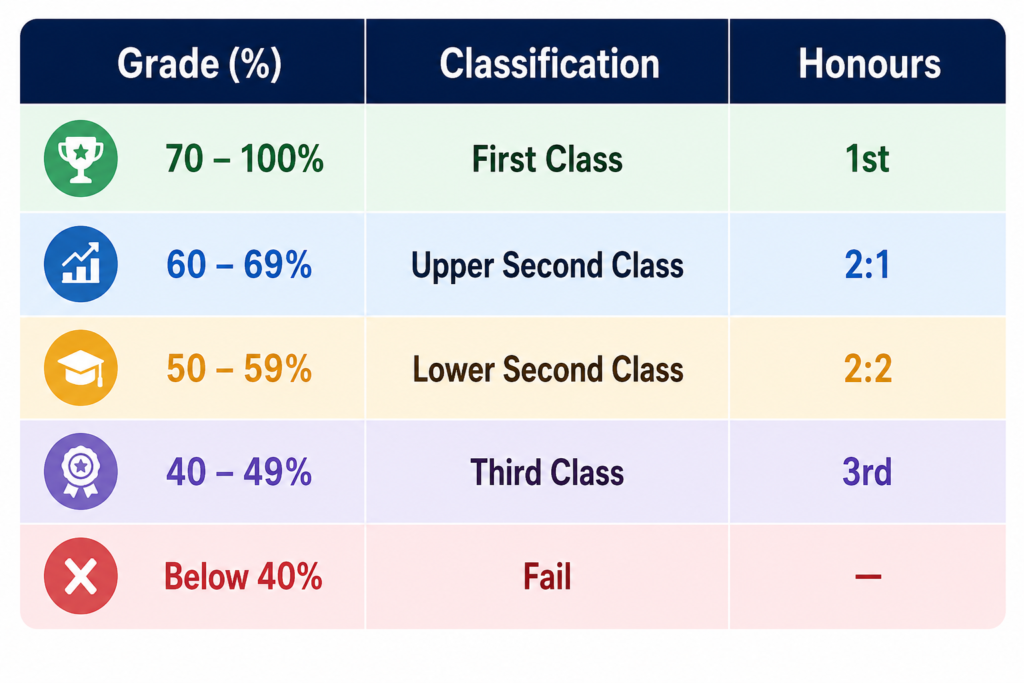
Some universities apply slightly different boundaries, or use a borderline policy that gives extra consideration to students who land just below a threshold. (Calculate Your Uni Grade ) Always confirm the exact rules with your own institution.
Simple Average vs Credit-Weighted Average
| Feature | Simple Average | Credit-Weighted Average |
|---|---|---|
| Accounts for module credit values | No | Yes |
| Matches how UK universities calculate | Rarely | Yes |
| Best used for | Rough mental check | Accurate degree tracking |
| Required information | Marks only | Marks + credits |
| Risk of misleading results | High if credits vary | Low |
If every module you’re taking carries the same number of credits, a simple average and a weighted average will land on the same number. (Calculate Your Uni Grade ) The moment your credits differ — which happens on most courses — you need the weighted version to get an accurate picture (Calculate Your Uni Grade ).
Common Mistakes When You Calculate Your Uni Grade
| Mistake | What Happens | Why It Matters |
|---|---|---|
| Averaging marks without credits | Every module is treated as equal weight | Produces an inaccurate, often misleading average |
| Guessing credit values | Using rounded or remembered numbers instead of checking the handbook | Small errors compound across several modules |
| Forgetting resit caps | Using an original failed mark instead of the capped resit result | Understates your true standing |
| Applying the wrong year weighting | Using a generic 33/67 split without checking your own university’s policy | Can shift you into the wrong classification band |
| Rounding too early | Rounding each module’s contribution before adding them together | Introduces small but avoidable inaccuracies |
| Mixing years into one flat average | Combining every module from every year without applying year weighting | Cancels out the intended emphasis on later years |
Most of these mistakes are easy to avoid once you know they’re common. (Calculate Your Uni Grade ) The biggest one, by far, is skipping the credit values altogether and defaulting to a plain average — it’s the fastest way to end up with a grade that doesn’t match your transcript.
Step-by-Step: How to Use a Uni Grade Calculator With Credits
If doing this by hand feels like a lot of multiplication for every update, a dedicated calculator does the same maths instantly. Here’s how to use one properly:
Step 1 – Enter Your Module Marks (Calculate Your Uni Grade )
Type in the percentage mark for each completed module, exactly as it appears on your results (Calculate Your Uni Grade ).
Step 2 – Add the Credit Value for Each Module
Enter the credit weighting for every module — check your module handbook if you’re unsure. Leave this field blank only if you genuinely want a simple, unweighted average (Calculate Your Uni Grade ).
Step 3 – Group by Year if Needed
If you’re calculating more than one academic year, keep the years separate first, so you can apply year weighting accurately afterward.
Step 4 – Calculate and Review
Run the calculation to get your credit-weighted average, along with your UK degree classification. Many calculators also show you which module had the biggest impact on your result, which is useful for planning where to focus your effort next.
Doing the maths manually once or twice is genuinely worthwhile — it helps you understand exactly how your university reaches your final number. After that, a calculator is simply the faster, more reliable way to keep checking your standing as new results come in.
Tips to Get an Accurate Result Every Time
- Always double-check credit values against your official module handbook rather than relying on memory.
- Use capped resit marks, not original fail marks, once a resit has been completed.
- Keep each year’s modules separate before combining them, so you can apply year weighting correctly.
- Recalculate after every new result so you always know exactly where you stand, rather than waiting until results day.
- If you’re close to a classification boundary, check your university’s borderline policy — some institutions apply additional review criteria in these cases.
How Different Degree Structures Handle Credits
Not every course splits credits the same way, and it’s worth knowing where your degree fits before you calculate your uni grade.
Single Honours Degrees
A standard single honours degree usually runs 120 credits per year across three years (360 credits total for a Bachelor’s), with modules typically sized at 10, 20, or 40 credits. (Calculate Your Uni Grade ) This is the most common structure and the one most calculators are built around.
Joint and Combined Honours Degrees
If you’re studying two subjects together, credits are often split evenly — say 60 credits in each subject per year — though some universities weight one subject slightly more if it’s your “major.” Check your programme specification, since combined honours students sometimes assume an even split when their university actually applies something closer to 70/30.
Placement and Sandwich Years (Calculate Your Uni Grade )
A placement or sandwich year is frequently credit-bearing but excluded from your final classification calculation, similar to how Year 1 is often treated. It still needs to be passed, but it usually won’t pull your overall percentage up or down. Always confirm this with your placement office rather than assuming.
Integrated Master’s Degrees
On a four-year integrated Master’s (such as an MEng or MSci), the final year often carries extra weighting compared to a standard three-year Bachelor’s, sometimes contributing 40% or more to the overall classification on its own. (Calculate Your Uni Grade ) The credit-weighting formula at module level stays the same — only the year-level percentages shift.
Manual Calculation vs Using a Calculator
| Factor | Manual Calculation | Uni Grade Calculator |
|---|---|---|
| Speed | Slow, especially across a full degree | Instant |
| Accuracy | Prone to arithmetic and rounding slips | Consistent, no rounding errors |
| Handles year weighting | Requires you to build the formula yourself | Usually built in |
| Good for “what-if” testing | Time-consuming to redo for each scenario | Quick to re-run with different marks |
| Best for | Understanding exactly how the formula works | Ongoing tracking once you understand it |
There’s genuine value in working through the calculation by hand at least once. It’s the fastest way to understand exactly how your university turns a list of separate percentages into one final classification. After that, a calculator saves time whenever you want to check “what if I get 65% on my next assignment instead of 60%” without redoing the multiplication yourself (Calculate Your Uni Grade ).
How to Use Your Weighted Grade to Set a Target
Once you know how to calculate your uni grade, you can work the formula backward to figure out what you need in your remaining modules.
Say you’ve completed 80 credits this year at a weighted average of 62%, out of a total 120 credits for the year, and you want to finish with an overall 65% average.
- Work out your current weighted total: 62 × 80 = 4,960
- Work out the total needed for your target: 65 × 120 = 7,800
- Subtract to find what’s needed from remaining credits: 7,800 − 4,960 = 2,840
- Divide by the remaining credits: 2,840 ÷ 40 = 71%
That tells you exactly what average you need across your remaining 40 credits to hit a 65% year average — far more useful than a vague sense that you “need to do well” in your last few modules (Calculate Your Uni Grade ).
Double-Checking Your Result Against Your Transcript
Once you calculate your uni grade, it’s worth sanity-checking it against your official transcript or student portal, especially the first time you do this. Here’s a quick way to spot errors:
- Check the total credits add up correctly. If your year should total 120 credits and your numbers only add up to 100, you’re missing a module.
- Compare your weighted average to your simple average. If the two numbers are wildly different, double-check your credit values — a typo (like entering 200 instead of 20) can throw the whole calculation off (Calculate Your Uni Grade ).
- Look for capped resit marks. If a module shows a lower mark than you remember achieving, it may already reflect a resit cap rather than an error.
- Cross-reference with your official grade transcript once results are finalised. Universities occasionally apply small adjustments (such as discounting your worst module in some course structures), so your manual calculation is a strong estimate, not always the absolute final word.
Getting into the habit of checking your own numbers against official records means you’ll catch discrepancies early, rather than being caught off guard on results day.
Read More: University Module Mark Calculator – Find the Score You Need to Pass
Conclusion
Learning to calculate your uni grade properly comes down to one core idea: not every module deserves equal say in your final result. Multiply each mark by its credit value, add everything together, divide by total credits — and if more than one year is involved, apply your university’s year weighting on top (Calculate Your Uni Grade ).
Once you’ve worked through the formula by hand a couple of times, it stops feeling like a mystery and starts feeling like basic arithmetic. From there, checking your standing after every new result becomes second nature, and you’ll always know exactly what you need in your remaining modules to hit the classification you’re aiming for (Calculate Your Uni Grade ).
FAQ’s
What’s the difference between credits and module weighting?
Credits are the numerical value assigned to a module (such as 10, 20, or 40) that represents its workload. Module weighting is what happens when you use those credit values to calculate a weighted average — the higher a module’s credits, the more influence its mark has on your overall grade.
Do I need to include every module when I calculate my uni grade?
Yes, for an accurate overall average you should include every module that counts toward your classification, along with its correct credit value. Leaving modules out, or forgetting smaller credit modules, will skew your result.
What happens if two modules have the same credit value?
If two modules share the same credit value, they contribute equally to your weighted average — exactly as they should, since they represent roughly the same amount of academic work.
Can I calculate my uni grade before finishing all my modules?
Yes. You can calculate a current or “in-progress” average using only the modules you’ve completed so far, then update the figure as new results come in throughout the year.
Does Year 1 count toward my final uni grade?
At most UK universities, Year 1 must be passed but doesn’t count toward your final classification. Some universities do apply a small percentage weighting instead, so it’s worth checking your own institution’s regulations.
Why does my weighted grade look different from my simple average?
This happens because your modules carry different credit values. A 40-credit module will always have a bigger effect on your overall grade than a 10-credit module, even if the percentage marks look similar on paper.
What credit values are most common in UK universities?
Most UK undergraduate modules are worth 10, 15, 20, 30, or 40 credits, with a full academic year typically totalling 120 credits across all modules combined.
How do resits affect my weighted grade calculation?
Most universities record a capped resit mark, often 40%, in place of the original failed result. You should use this capped mark, not the original fail, when you calculate your uni grade.
Is the credit-weighted method the same at every UK university?
The core method — multiplying marks by credits and dividing by total credits — is standard across most UK universities. However, exact year weightings, borderline policies, and classification boundaries can vary, so always confirm the specific rules with your own institution.
Can I use this method for postgraduate degrees too?
Yes, the same credit-weighted approach generally applies to postgraduate courses, though the credit structures and classification boundaries (such as Distinction, Merit, or Pass) often differ from undergraduate degrees.