

Module Mark Calculator
Module mark calculator: There’s a particular kind of dread that hits when you open your student portal and see one module sitting dangerously close to the pass mark. Module Mark Calculator: You know you have one more assignment or exam left, but you have no idea what score you actually need to get through. Do you need 40%? 55%? Is a resit already looking likely?
This is exactly where a module mark calculator earns its place as one of the most useful tools in a student’s toolkit. Instead of guessing or doing rushed maths on the back of a notebook, you can work out precisely what you need to score on your remaining work to hit a pass, a 2:1, or even a First.
In this guide, we’ll walk through how module marks are actually calculated at UK universities, how to use a module mark calculator properly, and how to avoid the small mistakes that throw students’ numbers off every year.
Click Here: UK University Grade Calculator
How to Use the UK Grade Calculator
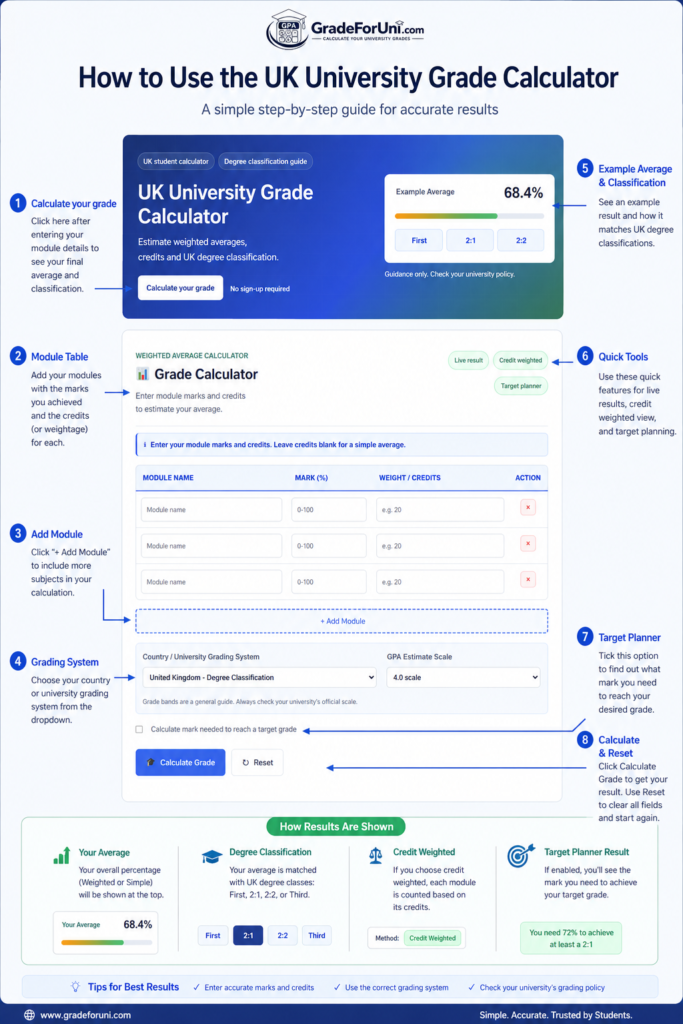
What Is a Module Mark Calculator?
A module mark calculator is a tool that works out your overall mark for a single module by combining the results of everything that counts towards it — coursework, exams, presentations, lab reports, and so on — according to how much weight each one carries.
Most modules aren’t graded on one piece of work alone. A typical structure might look like this:
- Coursework 1 – 20% of the module
- Coursework 2 – 30% of the module
- Final exam – 50% of the module
If you already have marks for the coursework but haven’t sat the exam, a module mark calculator lets you enter what you’ve got and figure out the score you need on the exam to reach a specific overall grade, whether that’s a bare pass at 40% or a target of 70%.
This is different from a general university grade calculator, which usually looks at your average across an entire year or degree. Module Mark Calculator: A module mark calculator zooms in on just one unit of study, which is exactly what you need when one specific module is causing you stress.
Read More: University Academic Regulations Explained – Rules Every Student Should Know
Why Students Use a Module Mark Calculator
Every UK university publishes its own assessment breakdown for each module, but very few students sit down and actually do the maths themselves until results day arrives. A calculator changes that.
Here’s what it actually helps with:
- Working out the mark you need on a final exam to pass or hit a target grade
- Planning your revision time based on which assessment carries the most weight
- Avoiding nasty surprises when results are released
- Deciding whether a resit is realistic before you’ve even sat the last assessment
- Setting a fair target instead of assuming you need 100% effort on everything equally
If 70% of your module mark comes from one final exam, that’s where your energy should go. A calculator makes that obvious in seconds rather than something you figure out too late.
Read More: taxsal.comHow Module Marks Are Calculated in the UK
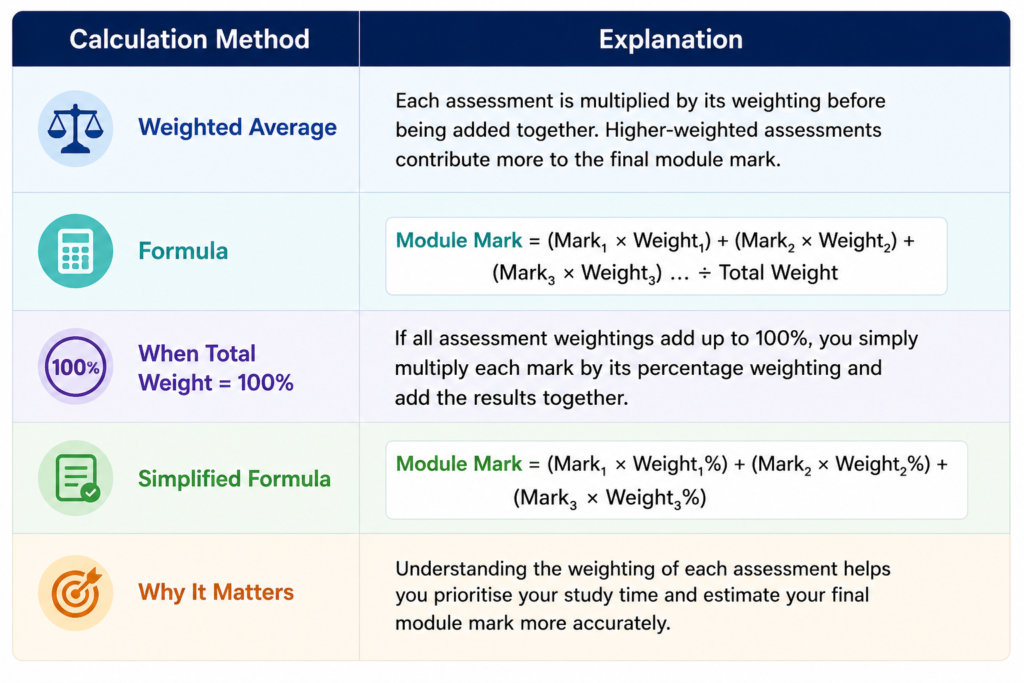
Most UK universities calculate module marks using a weighted average, meaning each assessment contributes to the final module mark according to its assigned weight. Module Mark Calculator: Assessments with higher weightings, such as final exams or major coursework, have a greater impact on your overall module result than smaller assignments or quizzes.
| Calculation Method | Explanation |
|---|---|
| Weighted Average | Each assessment is multiplied by its weighting before being added together. Higher-weighted assessments contribute more to the final module mark. |
| Formula | Module Mark = (Mark₁ × Weight₁) + (Mark₂ × Weight₂) + (Mark₃ × Weight₃) … ÷ Total Weight |
| When Total Weight = 100% | If all assessment weightings add up to 100%, you simply multiply each mark by its percentage weighting and add the results together. |
| Simplified Formula | Module Mark = (Mark₁ × Weight₁%) + (Mark₂ × Weight₂%) + (Mark₃ × Weight₃%) |
| Why It Matters | Understanding the weighting of each assessment helps you prioritise your study time and estimate your final module mark more accurately. |
A Simple Example
Let’s say you’re studying Business Management and one of your modules is split like this:
| Assessment | Weight | Mark |
|---|---|---|
| Coursework 1 | 25% | 62% |
| Coursework 2 | 25% | 58% |
| Final Exam | 50% | ? |
You want to know what you need in the exam to get an overall 60% for the module.
Step 1: Work out what your coursework has already contributed.
- Coursework 1: 62 × 0.25 = 15.5
- Coursework 2: 58 × 0.25 = 14.5
- Combined so far: 30 points out of a possible 50
Step 2: Work out how many points you still need.
- Target overall mark: 60
- Points already secured: 30
- Points still needed: 30
Step 3: Since the exam is worth 50% of the module, divide the points needed by the weight.
- 30 ÷ 0.50 = 60
You need 60% on the final exam to complete the module with an overall grade of 60%.
This is the exact kind of calculation a module mark calculator does instantly, without you needing to rearrange the formula by hand every time your target changes.
Step-by-Step: How to Use a Module Mark Calculator
Using the tool properly makes a real difference to accuracy. Here’s how to do it:
- List every assessment in the module and its official weighting. This is usually in your module handbook or on your course portal.
- Enter the marks you already have for completed assessments.
- Leave the remaining assessment blank or mark it as “pending” if the calculator supports it.
- Set your target overall grade — this could be a pass mark, a 2:1 boundary, or a personal goal.
- Let the calculator work out the required mark for your remaining assessment.
- Sanity check the number. If it asks for more than 100%, your target isn’t achievable through that assessment alone, and it’s worth speaking to your tutor about what other options exist, such as resits or extenuating circumstances.
Read More: What Happens If You Miss a University Exam? Complete Student GuideUK Degree Classification Boundaries
It helps to know what you’re actually aiming for. Most UK universities use these boundaries for undergraduate modules and overall degree classifications:
| Classification | Percentage Range |
|---|---|
| First Class Honours (1st) | 70% and above |
| Upper Second Class (2:1) | 60% – 69% |
| Lower Second Class (2:2) | 50% – 59% |
| Third Class (3rd) | 40% – 49% |
| Fail | Below 40% |
Some universities set the pass mark at a module level slightly differently, and postgraduate courses often use higher boundaries (a Merit might start at 60% and a Distinction at 70%), so it’s always worth checking your own institution’s handbook. Module Mark Calculator: A module mark calculator built around your grading system will already reflect this, but it’s good practice to double-check against your official regulations.
Common Mistakes Students Make When Calculating Module Marks
Even with a calculator, it’s easy to get the wrong answer if you’re not careful about how you enter your data. These are the mistakes that come up again and again. Module Mark Calculator: Avoiding these common errors can help you calculate your module mark more accurately and better understand how your final result is determined.
1. Confusing Weight with Credit Value
A module’s internal assessments are weighted as percentages of that module, not credit hours — credits matter when calculating your overall year average, not your module mark.
Remember:
- Assessment weightings determine how much each assignment contributes to the module mark.
- Module credits are used when calculating your overall degree or yearly average.
- Don’t confuse a 20-credit module with a 20% assessment weighting.
2. Forgetting About Resit Caps
Many UK universities cap resit marks at the pass mark (usually 40%), even if you technically score higher. Don’t assume a resit will boost your overall average the same way an original attempt would.
Before calculating your mark:
- Check your university’s resit regulations.
- Confirm whether your resit mark is capped.
- Understand how the recorded mark differs from the actual score achieved.
3. Rounding Too Early
If you round each mark before combining them, your final result can be slightly off. Keep decimals in your calculations until the very last step.
Best practice:
- Use the full decimal value throughout your calculations.
- Round only after the final weighted average has been calculated.
- This helps avoid small errors that may affect your final percentage.
4. Mixing Up Formative and Summative Work
Formative assessments (practice tasks, low-stakes quizzes) usually don’t count towards your module mark at all, even though they feel important at the time.
Know the difference:
- Formative assessments provide feedback and help you improve.
- Summative assessments contribute to your final module mark.
- Always check whether an assessment is marked for credit before including it.
5. Ignoring the Exact Weighting Split
Some modules split marks unevenly across the year, so a “50-50” assumption between coursework and exam can be wrong. Always check the actual handbook figures.
Always verify:
- Coursework weighting.
- Examination weighting.
- Presentation, practical, or project weightings.
- Any assessment changes announced by your department.
6. Entering the Wrong Marks
A simple typing error can produce an incorrect result, even when using an online calculator.
To avoid mistakes:
- Double-check every percentage before calculating.
- Make sure you’re using the final confirmed marks.
- Review your calculation if the result looks unexpected.
7. Using Outdated Assessment Information
Assessment weightings can sometimes change during the academic year due to approved module updates.
Before calculating:
- Refer to the latest module handbook.
- Check your virtual learning environment for updates.
- Use the most recent assessment breakdown provided by your lecturer.
8. Not Checking University Regulations
Different UK universities may have slightly different rules for calculating module marks, rounding, compensation, and reassessment.
It’s always worth checking:
- Your university’s academic regulations.
- Module handbook guidance.
- Assessment briefs and official marking policies.
By avoiding these common mistakes, you’ll have a much clearer understanding of how your module mark is calculated and can make more accurate predictions about your academic performance.
Module Mark Calculator vs Other Grade Tools
It’s worth knowing where a module mark calculator fits alongside the other calculators you’ll come across as a student.
| Tool | What It Calculates | When to Use It |
|---|---|---|
| Module Mark Calculator | The overall mark for one single module | When you want to know what score you need on a remaining assessment |
| University Average Calculator | Your average across multiple modules or a full year | When tracking overall academic progress |
| Final Grade / Degree Classification Calculator | Your final degree outcome across all years | When you’re in your final year and want to know your likely classification |
| GPA Calculator | A points-based measure often used for international applications | When applying abroad or to postgraduate programmes that ask for a GPA |
If you’re only worried about one specific module right now, the module mark calculator is the right tool. Once that’s sorted, a university average calculator gives you the bigger picture.
Example: Planning Around a Weak Coursework Result
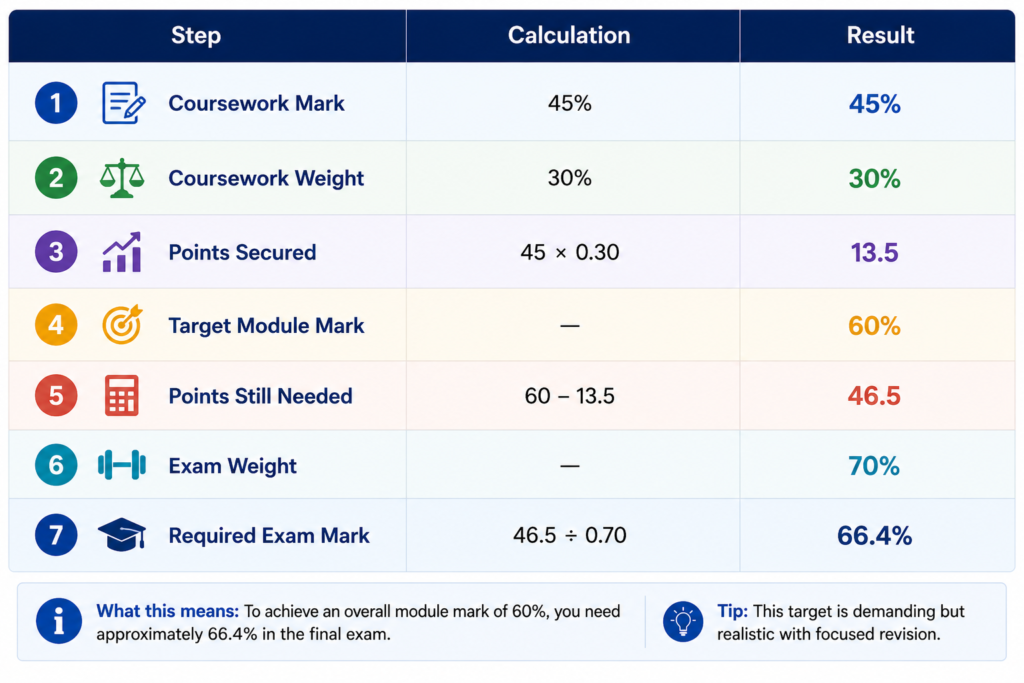
Imagine you received a disappointing 45% on your first coursework, which is worth 30% of the module. Your final exam makes up the remaining 70%, and your goal is to achieve an overall 60% (Upper Second-Class Honours – 2:1) for the module.
Instead of assuming it’s impossible to reach your target, you can calculate exactly what mark you need in the final exam. Breaking the calculation into smaller steps makes it much easier to understand where you stand and how much improvement is required.
Calculation Breakdown
| Step | Calculation | Result |
|---|---|---|
| Coursework Mark | 45% | 45% |
| Coursework Weight | 30% | 30% |
| Points Secured | 45 × 0.30 | 13.5 |
| Target Module Mark | — | 60% |
| Points Still Needed | 60 − 13.5 | 46.5 |
| Exam Weight | — | 70% |
| Required Exam Mark | 46.5 ÷ 0.70 | 66.4% |
What This Means
To finish the module with an overall 60%, you’ll need to score approximately 66.4% in the final exam.
That’s a demanding but realistic target if you focus your revision properly. Seeing the actual number—rather than just feeling anxious about a bad coursework grade—often makes the goal feel more achievable because it turns a vague worry into a specific, workable target.
This approach also helps you plan your revision more effectively. Instead of guessing what score you need, you have a clear target to work towards, allowing you to prioritise the topics that carry the greatest marks and manage your study time more efficiently before the exam.
Tips to Hit Your Target Module, Mark
Reaching your target module mark isn’t just about studying harder—it’s about studying smarter and understanding how each assessment contributes to your final result. By planning and monitoring your progress throughout the semester, you can make informed decisions that improve your chances of achieving your desired grade.
Prioritise the Highest-Weighted Assessment
If an exam is worth 60% of your module, that’s where your study hours should go first.
Why this matters:
- Higher-weighted assessments have the biggest impact on your final mark.
- Spending more time on these assessments can improve your overall module result.
- Create a revision timetable that reflects each assessment’s weighting rather than giving everything equal attention.
Talk to Your Module Leader Early
Talk to your module leader early if a target looks unrealistic. Extensions, extenuating circumstances, and resit options exist for a reason.
A good approach is to:
- Discuss any academic difficulties before deadlines pass.
- Ask questions if you’re unsure about assessment requirements.
- Seek advice from academic support services if needed.
Recalculate After Every Result
Recalculate after every result. Your target for the next assessment will shift each time a new mark comes in, so don’t rely on maths you did months ago.
Benefits of recalculating regularly:
- You always know the mark you need next.
- You can adjust your study plan based on your latest results.
- It helps prevent surprises at the end of the module.
Keep Your Module Handbook Handy
Keep your module handbook handy. Weightings occasionally change between years, so always confirm the current breakdown rather than assuming it matches a previous cohort.
Always check:
- Assessment weightings.
- Coursework deadlines.
- Exam format and marking criteria.
- Any updates announced by your department.
Don’t Average Assessments Incorrectly
Don’t average per assessment type when weights are uneven. A common error is treating two courseworks as automatically 50-50 when the handbook says otherwise.
Instead:
- Use the exact weighting shown in your module guide.
- Calculate each assessment separately.
- Double-check your figures before estimating your final mark.
Keep Track of Your Progress
Recording each assessment mark throughout the semester makes it much easier to monitor your performance and identify areas that need improvement.
Helpful habits include:
- Updating your marks after every assessment.
- Using a module mark calculator to estimate your current average.
- Setting realistic targets for upcoming coursework and exams.
Focus on Continuous Improvement
A lower mark in one assessment doesn’t necessarily prevent you from achieving a strong overall module result. Each new assessment provides another opportunity to improve your weighted average.
Remember:
- One disappointing result doesn’t define your outcome.
- Consistent improvement often has a greater impact than aiming for perfection in every assessment.
- Staying organised and following your study plan can make reaching your target mark much more achievable.
By following these practical tips and regularly reviewing your progress, you’ll have a clearer understanding of where you stand academically and what you need to do to achieve your target module mark.
Read More: University Marking Criteria Explained – How Your Work Is Assessed
FAQ’s
What mark do I need to pass a module in a UK university?
Most UK undergraduate modules require an overall mark of 40% to pass. Postgraduate modules typically require 50%. Always check your specific university’s regulations, as some courses set different thresholds for professional or accredited degrees.
How is a module mark different from a degree classification?
A module mark reflects your performance in one single unit of study. A degree classification is calculated from an average of your module marks across your qualifying years, usually with more weight given to your final year.
Can I use a module mark calculator if my assessments aren’t evenly weighted?
Yes. A good module mark calculator lets you enter the exact weighting for each assessment, whether that’s an even 50-50 split or an uneven breakdown like 20-30-50. Just make sure you’re using the figures from your actual module handbook.
What happens if my required exam mark is higher than 100%?
This means the target grade isn’t achievable through that assessment alone, based on your current marks. At this point, it’s worth speaking to your personal tutor about resit options or how extenuating circumstances might apply.
Do formative assessments count towards my module mark?
No. Formative assessments are designed for practice and feedback, and they don’t usually count towards your final module mark. Only summative assessments, the ones explicitly listed in your assessment weighting, contribute to your grade.
Is a module mark calculator accurate for every UK university?
The underlying maths — weighted averages — is standard across UK universities. However, grading boundaries, resit caps, and rounding rules can differ slightly between institutions, so always cross-check your result against your own university’s academic regulations.
How do resits affect my module mark?
Many UK universities cap a resit mark at the module pass mark, commonly 40%, regardless of the mark you actually achieve. This means resitting can help you pass, but it may limit how much it boosts your overall module average.
Can I calculate my module mark before all assessments are marked?
Yes, and this is one of the main reasons students use a module mark calculator. You can enter completed marks and calculate exactly what you need on the outstanding assessment to reach your goal.
Does coursework weight change between universities?
Yes, significantly. Some modules are 100% exam-based, others are entirely coursework, and many sit somewhere in between. There’s no universal standard, so always check your specific module handbook rather than assuming based on another course.
What’s a realistic target grade to aim for on a module mark calculator?
This depends on your overall goals. If you’re aiming for a 2:1 degree classification, aiming for 60% or above on each module keeps you comfortably on track. If your focus is simply progressing to the next year, aiming just above the 40% pass mark on weaker modules while focusing extra effort on stronger subjects is a common and sensible strategy.
Final Thoughts
A module mark calculator takes the guesswork out of one of the most stressful parts of university life: not knowing where you stand before results are released. Module Mark Calculator: Instead of assuming the worst or hoping for the best, you can work out the exact mark you need and build a study plan around it.
Whether you’re chasing a bare pass or pushing for a First, the maths behind a module mark calculator is straightforward once you understand the weighting behind your assessments. Enter your known marks, set your target, and let the numbers tell you exactly what’s left to do.
Using a module mark calculator regularly throughout the academic year can also help you stay on track rather than waiting until the end of the semester to assess your progress. Module Mark Calculator: After each coursework mark or exam result is released, simply update your calculation to see how your target changes and whether you need to adjust your study strategy.
Remember that the calculator is only as accurate as the information you enter. Module Mark Calculator: Always use the official assessment weightings provided in your module handbook or course guide, and check whether any university-specific rules—such as resit caps or assessment changes—apply to your module.
Ultimately, understanding how your module mark is calculated gives you greater confidence and control over your academic journey. Rather than relying on estimates or assumptions, you can make informed decisions about where to focus your efforts, manage your revision time more effectively, and approach each assessment with a clear goal in mind. With the right planning and consistent effort, even small improvements in high-weighted assessments can make a meaningful difference to your final module mark.