
Degree percentage calculator: You’ve just finished checking your student portal for the third time this week, adding up module marks in your head, and somehow getting a different number every time. One minute it looks like you’re on track for a 2:1. The next, you’re not so sure. If you’ve ever tried to work out your degree percentage from a pile of separate module marks, you already know how confusing it gets when credits, years, and different weightings come into play.
A degree percentage calculator solves exactly this problem. Instead of manually multiplying marks by credits and dividing by totals (and probably making a small error somewhere along the way), you enter your module marks and let the tool convert them into one clear final percentage — the number that actually decides your degree classification.
In this guide, we’ll break down how UK universities convert module marks into a final degree percentage, walk through real worked examples, and show you exactly how to use a degree percentage calculator properly so the number you get back is one you can actually trust.
Click Here: Final Grade Calculator UK
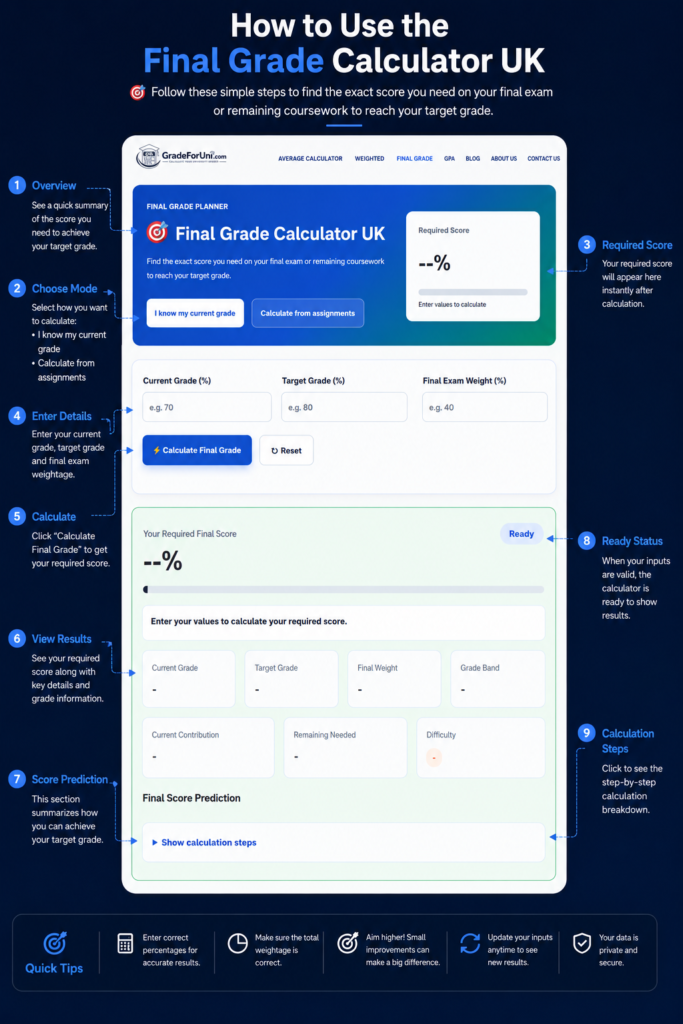
How to use the Final Grade Calculator UK
What Is a Degree Percentage Calculator?
A degree percentage calculator is a tool that takes your individual module marks, along with their credit values and year weightings, and converts them into a single overall percentage — the figure your university uses to decide your final degree classification.
Rather than treating every module mark as equally important, the calculator accounts for two things that genuinely affect your final number:
- Credit value. A 40-credit module counts for more than a 10-credit module.
- Year weighting. Most UK degrees give more weight to your later years than your first year.
Once those two factors are applied properly, module marks that might look scattered and inconsistent on paper turn into one clean, accurate percentage. That’s the number that tells you whether you’re heading for a First, a 2:1, a 2:2, or need to push harder in your remaining modules.
This is different from simply averaging your marks by hand. A quick mental average treats every module as equal, which seldom matches how your university actually calculates things — and that gap is exactly where students misjudge where they stand.
Read More: Taxsal.comWhy Module Marks Don’t Simply Add Up to Your Degree Percentage
It’s tempting to just add up your module percentages and divide by the number of modules. For a lot of students, that’s the first instinct. The problem is that this simple average rarely matches your official degree percentage, for a few reasons:
- Not all modules carry the same credits. A 20-credit module has double the impact of a 10-credit module on your overall percentage.
- Not all years count equally. Many UK universities apply a 0:33:67 or 0:40:60 split across Years 1, 2, and 3, meaning your first year often doesn’t count towards your final classification at all.
- Some modules are compulsory contributors, others aren’t. A small number of courses exclude certain modules (like placement years) from the formal degree calculation.
Because of this, two students with identical simple averages can end up with genuinely different final degree percentages once credits and year weighting are applied properly. A degree percentage calculator removes the guesswork by applying the actual formula your university uses, rather than a rough estimate.
Read More: How to Calculate Your Uni Grade Using Credits and Module Weighting
How UK Universities Convert Module Marks Into a Degree Percentage
Most UK universities calculate a degree percentage using a credit-weighted average. The formula looks like this:
Degree Percentage = (Mark₁ × Credits₁ + Mark₂ × Credits₂ + …) ÷ (Credits₁ + Credits₂ + …)
If your degree also applies year weighting, the same formula is applied within each year first, and then the year averages are combined according to your university’s official split.
A Simple Example
Say you’re a final-year student with these five modules:
| Module | Mark (%) | Credits |
|---|---|---|
| Research Project | 68% | 40 |
| Advanced Statistics | 61% | 20 |
| Marketing Strategy | 74% | 20 |
| Business Ethics | 55% | 20 |
| Applied Economics | 63% | 20 |
Step 1: Multiply each mark by its credit value.
- 68 × 40 = 2,720
- 61 × 20 = 1,220
- 74 × 20 = 1,480
- 55 × 20 = 1,100
- 63 × 20 = 1,260
Step 2: Add up the totals.
- Total points: 2,720 + 1,220 + 1,480 + 1,100 + 1,260 = 7,780
- Total credits: 40 + 20 + 20 + 20 + 20 = 120
Step 3: Divide points by credits.
- 7,780 ÷ 120 = 64.8%
Notice that a plain average of the five module marks would give you 64.2%, which is close but not exact. The 40-credit Research Project pulls the real result up slightly because it carries double the weight of the other modules. That small gap is precisely what a degree percentage calculator accounts for automatically.
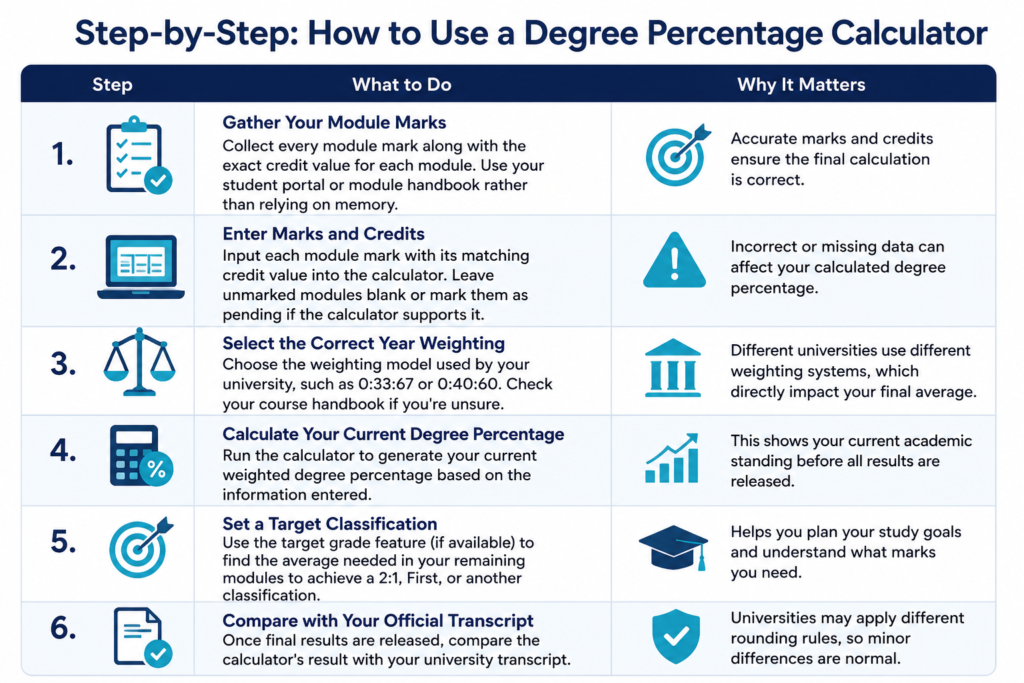
| Step | What to Do | Why It Matters |
|---|---|---|
| 1. Gather Your Module Marks | Collect every module mark along with the exact credit value for each module. Use your student portal or module handbook rather than relying on memory. | Accurate marks and credits ensure the final calculation is correct. |
| 2. Enter Marks and Credits | Input each module mark with its matching credit value into the calculator. Leave unmarked modules blank or mark them as pending if the calculator supports it. | Incorrect or missing data can affect your calculated degree percentage. |
| 3. Select the Correct Year Weighting | Choose the weighting model used by your university, such as 0:33:67 or 0:40:60. Check your course handbook if you’re unsure. | Different universities use different weighting systems, which directly impact your final average. |
| 4. Calculate Your Current Degree Percentage | Run the calculator to generate your current weighted degree percentage based on the information entered. | This shows your current academic standing before all results are released. |
| 5. Set a Target Classification | Use the target grade feature (if available) to find the average needed in your remaining modules to achieve a 2:1, First, or another classification. | Helps you plan your study goals and understand what marks you need. |
| 6. Compare with Your Official Transcript | Once final results are released, compare the calculator’s result with your university transcript. | Universities may apply different rounding rules, so minor differences are normal. |
Read More: Overall Uni Grade Calculator – Calculate Your Degree Average Step by Step
UK Degree Classification Boundaries
Once you have your degree percentage, here’s how UK universities generally classify undergraduate degrees:
| Grade (%) | Classification | Honours |
|---|---|---|
| 70 – 100% | First Class | 1st |
| 60 – 69% | Upper Second Class | 2:1 |
| 50 – 59% | Lower Second Class | 2:2 |
| 40 – 49% | Third Class | 3rd |
| Below 40% | Fail | — |
Some universities set slightly different boundaries, particularly around borderline cases (a 68% might get bumped up to a First under certain discretionary rules), so it’s worth checking your institution’s specific policy. A degree percentage calculator gives you an accurate estimate, but the final classification decision always sits with your university’s exam board.
How Year Weighting Affects Your Final Degree Percentage
Your Year 1 marks rarely count towards your final degree percentage in the UK, though they usually need to be passed to progress. The more common structure looks like this:
- Year 1: 0% weighting (must pass, doesn’t count towards final grade)
- Year 2: 33% weighting
- Year 3 (or final year): 67% weighting
Some universities use a 40:60 split between Years 2 and 3 instead, and integrated master’s courses often add a fourth year into the mix with its own weighting. This matters enormously when you’re converting module marks into a degree percentage, because a strong Year 2 result won’t carry the same weight as an equally strong Year 3 result.
Here’s a quick comparison of how the same module marks produce different outcomes depending on the weighting split used:
| Year | Average Mark | Weighting (33:67 split) | Weighting (40:60 split) |
|---|---|---|---|
| Year 2 | 62% | 33% | 40% |
| Year 3 | 71% | 67% | 60% |
Under the 33:67 split: (62 × 0.33) + (71 × 0.67) = 20.5 + 47.6 = 68.1%
Under the 40:60 split: (62 × 0.40) + (71 × 0.60) = 24.8 + 42.6 = 67.4%
The difference here is small, but for a student sitting right on a classification boundary, it can be the gap between a First and a 2:1. This is exactly why checking your own university’s exact weighting policy matters more than assuming a standard split applies to every course.
Common Mistakes When Converting Module Marks
Even with a calculator doing the maths, students can still end up with inaccurate results if the information they enter isn’t correct. Avoid these common mistakes when converting your module marks into a final degree percentage.
Leaving Out Year 1 Without Checking
Many students assume that Year 1 never counts towards their final degree classification. While this is true for many UK universities, some courses—particularly integrated degrees—do give Year 1 partial weighting. Always check your university’s assessment regulations before excluding it.
Entering Incorrect Credit Values
Using the wrong module credit values is one of the most common errors. Most UK undergraduate years total 120 credits, so if your entered credits don’t add up to that figure, you may have missed a module or entered incorrect information.
Assuming Every Module Has Equal Weight
Not all modules contribute equally to your final classification. Dissertations, placement years, optional modules, or professional practice modules may follow different weighting rules depending on your programme. Always refer to your programme specification before calculating your average.
Rounding Module Marks Too Early
Some students round individual module marks before calculating their weighted average. Even small rounding differences can change your final percentage by a fraction of a mark, which may be important if you’re close to a classification boundary.
Ignoring Resit Mark Caps
If you’ve taken a resit, remember that many universities cap the recorded mark at the pass mark (commonly 40%), even if you scored much higher in the resit. Use the capped mark—not the actual resit score—when calculating your final degree percentage.
Degree Percentage Calculator vs Other Grade Tools
It helps to know where a degree percentage calculator fits compared with the other calculators you’ll likely come across as a student.
| Tool | What It Calculates | When to Use It |
|---|---|---|
| Degree Percentage Calculator | Your overall degree percentage from all module marks | When converting individual module results into one final figure |
| Module Mark Calculator | The mark needed on one remaining assessment | When one specific module is still unfinished |
| Weighted Average Calculator | A credit-weighted average for a single year or term | When tracking progress within one academic year |
| Final Grade / Classification Tool | Your predicted degree classification | When you want to see First, 2:1, 2:2, or 3rd directly |
| GPA Calculator | A points-based score for international applications | When applying abroad or to postgraduate programmes needing a GPA |
If your goal is specifically to turn a set of module percentages into one overall figure, the degree percentage calculator is the right starting point. From there, a classification tool can translate that percentage into the exact honours label your university will use.
Read More: University Grade Boundaries Explained – What You Need to Pass
Practical Example: A Full Three-Year Walkthrough
Let’s put the whole process together with a realistic three-year example, using a standard 0:33:67 weighting.
Year 1 (doesn’t count towards final classification, but must be passed):
| Module | Mark (%) | Credits |
|---|---|---|
| Introduction A | 58% | 20 |
| Introduction B | 63% | 20 |
| Introduction C | 51% | 20 |
| Introduction D | 60% | 20 |
| Introduction E | 55% | 20 |
| Introduction F | 66% | 20 |
Year 1 average (not counted, but useful for progression): 58.8%
Year 2 (33% weighting):
| Module | Mark (%) | Credits |
|---|---|---|
| Core Theory | 64% | 20 |
| Applied Methods | 59% | 20 |
| Group Project | 71% | 20 |
| Elective A | 55% | 20 |
| Elective B | 62% | 20 |
| Statistics | 68% | 20 |
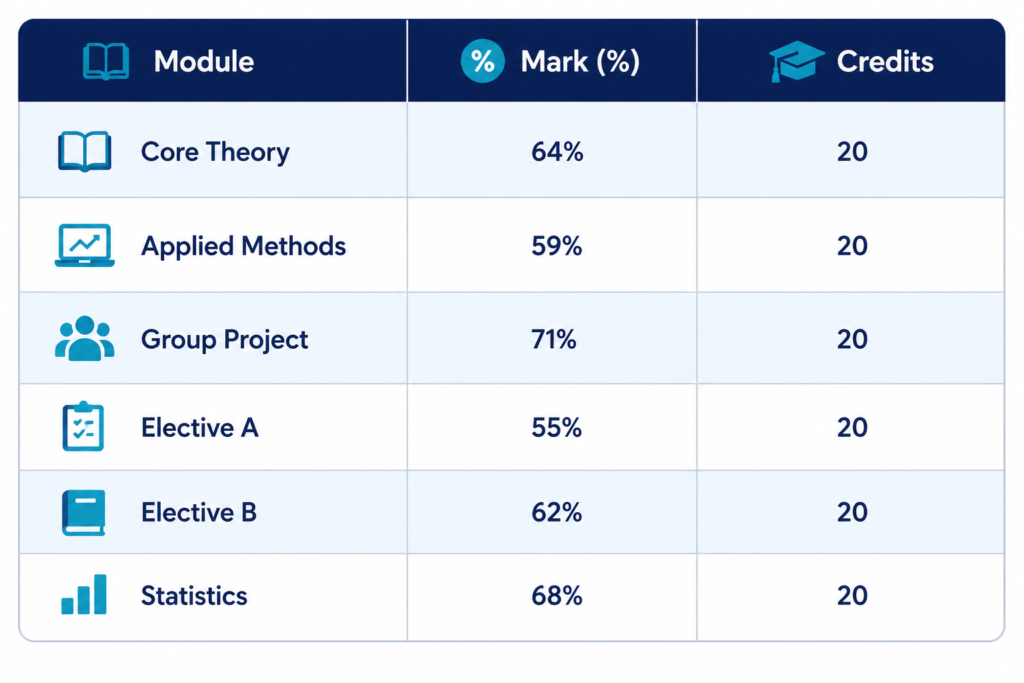
Year 2 weighted average: (64+59+71+55+62+68) × 20 ÷ 120 = 379 × 20 ÷ 120 = 63.2%
Year 3 (67% weighting):
| Module | Mark (%) | Credits |
|---|---|---|
| Dissertation | 72% | 40 |
| Advanced Topic A | 66% | 20 |
| Advanced Topic B | 61% | 20 |
| Capstone Module | 75% | 20 |
| Specialist Elective | 69% | 20 |
Year 3 weighted average: (72×40 + 66×20 + 61×20 + 75×20 + 69×20) ÷ 120 = (2880 + 1320 + 1220 + 1500 + 1380) ÷ 120 = 8,300 ÷ 120 = 69.2%
Final degree percentage:
(63.2 × 0.33) + (69.2 × 0.67) = 20.86 + 46.36 = 67.2%
That final figure of 67.2% places this student firmly in Upper Second Class (2:1) territory, sitting just under the 70% First Class boundary. Seeing the number broken down this way — rather than just a vague sense of “doing okay” — makes it much easier to work out exactly how much stronger Year 3 needs to be to push into First Class range.
Tips to Boost Your Final Degree Percentage
- Focus extra effort on your final year. Since it typically carries the most weight, even small improvements here move your degree percentage more than the same improvement in Year 2.
- Prioritise high-credit modules. A dissertation or major project worth 40 credits deserves proportionally more of your time than a 10-credit elective.
- Recalculate regularly, not just at year-end. Updating your degree percentage calculator after each result keeps your target realistic instead of relying on assumptions made months earlier.
- Know your exact boundary. If you’re sitting at 68% with modules still outstanding, knowing you need an average of 73% across the rest to reach a First gives you a concrete, achievable target rather than a vague hope.
- Speak to your personal tutor if a target looks out of reach. Extenuating circumstances, resits, and academic support are there for a reason, and it’s better to raise concerns early than after results are released.
Read More: University Module Mark Calculator – Find the Score You Need to Pass
FAQS
What is a degree percentage calculator used for?
A degree percentage calculator converts your individual module marks, along with their credit values and year weightings, into one overall percentage. This is the figure UK universities use to determine your final degree classification, such as a First or a 2:1.
Does Year 1 count towards my final degree percentage?
For most UK undergraduate degrees, Year 1 doesn’t count towards your final classification, though you still need to pass it to progress. Some integrated or professional courses do give Year 1 partial weighting, so it’s worth checking your specific programme specification.
How is a degree percentage different from a module mark?
A module mark reflects your result in a single unit of study. A degree percentage is the combined, weighted result of all your module marks across your qualifying years, adjusted for credit values and year weighting.
What’s the standard year weighting used by UK universities?
A common structure is 0% for Year 1, 33% for Year 2, and 67% for the final year, though many universities use a 40:60 split between Years 2 and 3 instead. Integrated master’s courses often add a further year with its own weighting. Always check your official programme specification for the exact figures.
Can I calculate my degree percentage before all my modules are marked?
Yes. You can enter the marks you already have and leave outstanding modules blank, which lets you see your current running percentage and work out what average you’ll need across your remaining modules to reach a specific classification.
Why does a simple average give a different result to my official degree percentage?
A simple average treats every module equally, but most UK universities weight modules by credit value and apply different weightings to each academic year. This means higher-credit modules and later years generally have more influence on your final percentage than a basic average would suggest.
Do resits affect my final degree percentage?
Often, yes. Many UK universities cap resit marks at the standard pass mark, commonly 40%, regardless of the actual score achieved. This means a resit can secure a pass but may limit how much it raises your overall degree percentage compared to passing the module on the first attempt.
Is the degree classification boundary always exactly 70% for a First?
Generally yes, but some universities apply discretionary rules for borderline cases, such as rounding up a 69% average to a First if a student meets certain additional criteria (like scoring 70% or above in the majority of final-year credits). Always check your university’s academic regulations for its specific borderline policy.
How accurate is a degree percentage calculator compared to my official transcript?
The underlying maths — a credit-weighted average combined with year weighting — matches the standard method used across UK universities. However, small differences in rounding rules or discretionary borderline policies can cause minor variations, so always treat the calculator result as a close and reliable estimate rather than a final, official figure.
What should I do if my target degree percentage looks unrealistic?
If the average you’d need across your remaining modules seems out of reach, speak to your personal tutor or academic adviser as early as possible. Options like extenuating circumstances, resits, or adjusted study plans exist specifically for situations like this, and raising it early gives you more options than waiting until after results are published.
Final Thoughts
Converting scattered module marks into one final degree percentage doesn’t need to involve guesswork or a stressful afternoon with a calculator app open in one tab and your student portal in another. Once you understand how credits and year weighting actually combine, the maths behind a degree percentage calculator is straightforward and, more importantly, predictable.
Whether you’re mid-way through Year 2 trying to see where you stand, or heading into your final year wanting to know exactly what average you need for a First, working out your real degree percentage — rather than a rough mental average — gives you a much clearer, more accurate picture of where you actually are.
A reliable degree percentage calculator also helps you make informed academic decisions. Instead of estimating your performance, you can identify how each module contributes to your overall result, understand the impact of future assessments, and set realistic targets for achieving your desired degree classification.
Remember that every university has its own assessment regulations, including year weightings, credit structures, compensation rules, and rounding policies. For the most accurate outcome, always use your institution’s official weighting model and verify your results against your programme handbook or official transcript.
If you’re aiming for a First-Class Honours, a 2:1, or simply want to track your academic progress throughout your degree, regularly calculating your weighted average can help you stay on course. Knowing where you stand early gives you more time to improve your performance before final grades are awarded.
Use the Degree Percentage Calculator whenever new module results are released, update your marks as the academic year progresses, and let the calculator do the complex calculations for you. With accurate inputs and the correct weighting model, you’ll have a clear understanding of your current standing and what you need to achieve your academic goals.