

England’s student finance system is about to change, and the clock is already ticking. Applications for the Lifelong Learning Entitlement — the new £39,160 tuition-loan pot you can draw on across your working life — open at the end of October 2026, roughly two weeks from now, with the first funded courses and modules starting in January 2027. If you are already at university, your current studies will almost certainly stay on the old system — but the LLE rewrites the arithmetic of what a failed module actually costs you.
Here is the grade angle that most coverage misses: the LLE is not an unlimited tap. Under the new system, every failed module has a cash value. Retaking a failed 20-credit module at the maximum fee rate spends roughly £1,632 of your pot. Repeating a failed final year spends £9,790 — a full quarter of everything you will ever get. Pass your degree cleanly and you keep nearly £9,790 of funding in reserve for the modules, short courses or retraining you do later. Fail badly enough and the pot is gone before your career has started.
This guide explains the Lifelong Learning Entitlement the way a grades site should — through numbers. What the pot actually is, the credit arithmetic that decides how far it goes, what prior borrowers under the old system get (residual entitlement), what failure costs you, the retraining lifelines if your pot hits zero, and how repayment works. One warning first, because it matters more here than in most of our guides: this system is England only. If you study in Scotland, Wales or Northern Ireland, the headline figures in this article do not apply to you — and we will explain exactly why below.
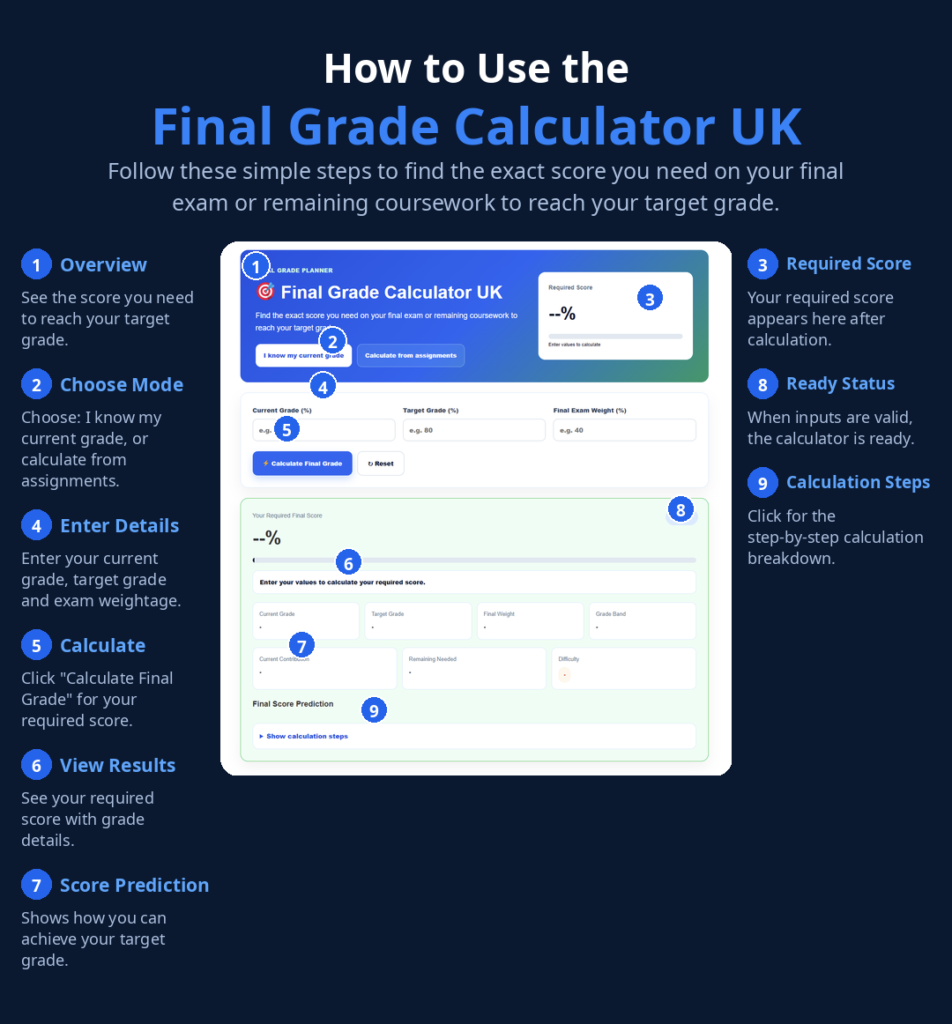
Click Here: Final Grade Calculator UK
What the Lifelong Learning Entitlement Actually Is
The Lifelong Learning Entitlement is England’s replacement for the traditional student-loan model of borrowing year by year for one full degree. Instead, new learners get a lifetime tuition-fee loan pot of £39,160 — what the government calls “a full entitlement equal to 4 years of full-time tuition”, calculated from the 2026/27 maximum fee limit of £9,790 per year. You draw it down in chunks, paying for full degrees, single modules or short courses, across your whole working life up to age 60.
Three things the LLE is not, because the misunderstandings are already circulating:
- It is not a grant. It is a tuition-fee loan, and it is repaid — under the Plan 5 system, which we decode later in this article.
- It is not a hard 480-credit pot. Many commentaries describe it as “480 credits”, and at £9,790 for 120 credits the sums roughly work out that way. But the government’s cap is the money figure: you could spend £39,160 on more than 480 credits if your provider charges less per credit, or fewer if it charges more. Think “roughly 480 credits’ worth at current rates”, never a fixed credit balance.
- It is not open yet. As of mid-October 2026, applications have not launched. The official line is applications from late October 2026 for courses and modules starting on or after 1 January 2027. Even if you already have a Student Finance England account, you will need to create a brand-new LLE account to apply — your old login does not carry over.
The delay is real and documented: the Student Loans Company confirmed in late September 2026 that applications would open at the end of October after “final additional testing”, stressing that the delay would not affect anyone starting in January 2027. Older guides saying applications opened in September 2026 are stale — superseded by the SLC announcement.
| Headline | Figure | Source |
|---|---|---|
| Full tuition-fee loan pot | £39,160 | GOV.UK LLE overview |
| Maximum fee per year (2026/27) | £9,790 | GOV.UK LLE overview |
| Cost per credit at max rate | ≈ £81.58 | £9,790 ÷ 120 |
| Maximum age (tuition loans) | 60 at course start | GOV.UK LLE overview |
| Repayment plan | Plan 5: 9% above £25,000 | GOV.UK LLE overview |
| Applications open | End of October 2026 | GOV.UK apply page |
| First funded starts | January 2027 | GOV.UK apply page |
England Only — and Why That Warning Belongs in a Grades Guide
Eligibility for the LLE “will track existing higher education student finance nationality and residency rules”, and modular funding is only available to students living in England at a provider registered with the Office for Students. In plain terms: this is an English system. Learners in Scotland keep SAAS funding, Welsh learners keep Student Finance Wales, and Northern Ireland learners stay on their own arrangements.
There is one subtle cross-border trap worth knowing. If you studied under another UK nation’s system before — for example SAAS-funded study in Scotland — that prior support still reduces your LLE entitlement if you later move to England (the uplifted deduction covers UK-wide study). The deduction rules are national even though the pot itself is English. Prior borrowers: read the residual-entitlement section below carefully.
The Pot Arithmetic: What Each Credit Is Worth
A UK honours year is 120 credits, so the pot’s anatomy is simple at maximum fee rates. The table below is the one to bookmark — every scenario in the rest of this article is built from it:
| Study block | Credits | Cost at max rate (£81.58/credit) |
|---|---|---|
| One failed 20-credit module, retaken | 20 | ≈ £1,632 |
| Minimum fundable module block | 30 | ≈ £2,447.50 |
| Half a year / large module bundle | 60 | ≈ £4,895 |
| One full year repeated | 120 | £9,790 |
| Standard 3-year degree | 360 | £29,370 |
| Full pot, at max rates | ≈ 480 | £39,160 |
Two rules govern how you can actually spend it. Modules must be at least 30 credits (or bundled to at least 30), form part of an existing designated full course run by the same provider, sit at levels 4 to 6, be assessed with a standardised transcript, and involve no franchising. And you must take at least 30 credits in a course year to qualify for tuition-fee and maintenance loans, with a maximum drawdown of 180 credits per year.
At launch, single modules are only fundable in ten priority subject groups — computing; engineering; architecture, building and planning (excluding the landscape gardening subgroup); physics and astronomy; mathematical sciences; nursing and midwifery; allied health professions; chemistry; economics; and health and social care — plus levels 4–5 Higher Technical Qualification modules. The government says it will offer “a narrower range of modules when the LLE launches, and gradually expand this when it is appropriate”. Full degrees, by contrast, are fundable in any subject.
Failed Modules Have a Cash Value — Two Worked Examples
This is where grades meet money. Under the LLE, marks are no longer just about classification — they are about how much of your lifetime pot survives.
Example A — the fail-and-repeat final year. Take Priya, who starts a 3-year degree in January 2027 at maximum fee rates. Her degree costs 360 credits = £29,370, leaving a residual of £9,790. In her final year she fails badly enough to repeat the whole year (120 credits), with no compelling personal reasons. Government guidance is explicit here: a 3-year BA student who fails a full year uses their standard entitlement to fund the repeat. The repeat costs £9,790 — her entire residual. Balance after graduation: £0. One bad year has spent everything she might have used for a postgraduate certificate, a professional module, or retraining later. (This matches the government’s own published example: a 3-year BA Psychology student failing year 3 funds the repeat from standard entitlement.)
Example B — the clean pass. Daniel completes the same 3-year degree passing everything first time: £29,370 spent, £9,790 kept. That residual covers a full 60-credit postgraduate certificate module (£4,895) with room to spare, or 120 credits of further study at maximum rates — enough for a substantial professional qualification five or ten years into his career.
The single-module version is just as stark: retaking one failed 20-credit module spends 20 more credits — roughly £1,632 at maximum rates. A 68% and a 38% in the same module are no longer just different marks; they are different financial outcomes. If that feels like a reason to take condoned passes and discounting rules more seriously, it should — a borderline fail that your exam board condones or compensates is now worth over a thousand pounds of lifetime funding.
The safety valves. Two, and they are narrow. First, compelling personal reasons — illness, bereavement and similar — mean the cost of the affected study is added back to your LLE balance. If that sounds like extenuating circumstances, it is the funding-system mirror of them: claim EC properly and you protect both your marks and your pot. Second, students on 4- or 6-year full-time-equivalent courses get additional entitlement for repeat study even without compelling reasons: the government’s example is an MEng student who fails two 30-credit modules in year 4 and gets the repeated 60 credits funded on top. There is no lower limit on funded repeat credits, as long as the 30-credits-in-a-year minimum still holds.
One more nuance for the planners: with less than £1,587.50 of tuition entitlement left, maintenance loans are only available if the remaining balance actually pays for the course — any excess tuition above the pot comes out of your own pocket.

Already Have a Degree? Residual Entitlement Explained
Most readers of this site in 2026 are returning learners in the government’s eyes — anyone who previously received government support for higher-level learning does not get a fresh £39,160. Instead you get a residual entitlement: the full pot minus what you already received, with your old support uplifted to today’s fees.
The deduction uses your actual tuition-fee loan or grant, uplifted to the equivalent amount in today’s fees — “regardless of which course someone took or how they studied”, and excluding maintenance loans. The government’s own example: a 3-year degree started in September 2018 at £9,250 a year (£27,750) becomes an uplifted deduction of £29,370, leaving a residual of £9,790. Prior study without government funding — a privately funded course, for instance — leaves the full £39,160 intact.
The deduction net is wide: it covers UK-wide study, SAAS-funded study in Scotland, Advanced Learner Loans, pre-tuition-fees higher-education study, and even the modular acceleration programme (a flat £2,447.50 deduction). You can check your own balance through your student finance account. If you are trying to work out what your old grades bought you in funding terms, the honest answer is: every credit you consumed then is roughly £81.58 you cannot spend now.
Empty Pot? The Retraining Lifelines
Running the pot to zero is not quite the end — the government built two escape hatches for exactly that situation.
The first is the “priority additional entitlement”: if your LLE balance is £0, you can still get tuition-fee loans to complete a course in an eligible subject — and existing graduates who have drawn down all their support can access it to retrain. The eligible subjects are medicine, dentistry, nursing, midwifery, the allied health professions (the full list: chiropody; dental hygiene and dental therapy; dietetics; dietetics and nutrition; occupational therapy; orthoptics; orthotics and prosthetics; physiotherapy; podiatry; radiography; radiotherapy; speech and language therapy), initial teacher training, and social work. The catch is absolute: full courses only — individual modules in these subjects will not be funded.
The second is the “special additional entitlement” for longer or more expensive courses: veterinary surgery, architecture (including Part 2), bachelor’s and integrated master’s degrees in Scotland, foundation years, study abroad, work placements and Turing-scheme activity. If your degree plans include any of these, the standard pot arithmetic understates what you can access.
Repaying the LLE: Plan 5 in Plain English
LLE loans are repaid under the Plan 5 system — the same plan that has applied to new English undergraduates since 2023. You repay 9% of your gross salary above £25,000 a year (about £2,083 a month or £480 a week). Earn £30,000 and you pay 9% of £5,000 — £450 a year, roughly £37.50 a month. Earn £24,999 and you pay nothing.
Two points borrowers often miss. First, the loan is cancelled after 40 years — longer than any previous plan, which matters if you draw the pot down late in your career. Second, if you also hold an old undergraduate loan, you make a single 9% repayment — the two loans do not stack into an 18% deduction. (One age footnote: learners aged 60 and over can still get maintenance support, but not tuition-fee loans — the age-60 cap applies to tuition.)
Your Pre-Launch Pot Audit: 7 Checks Before You Apply
Applications open at the end of this month. Whether you are a school leaver eyeing a January 2027 start or a graduate planning a module in your thirties, run this audit first:
| # | Check | Why it matters |
|---|---|---|
| 1 | Estimate your residual entitlement | Old borrowing is uplifted to today’s fees — a £27,750 degree now deducts £29,370 |
| 2 | Convert the balance to credits | At max rates, £1,000 ≈ 12 credits; know your real budget before choosing modules |
| 3 | Price your repeat risk | A 120-credit repeat year costs £9,790 — your classification calculator is now a finance tool too |
| 4 | Respect the 30-credit minimum | Modules below 30 credits (unbundled) cannot be funded at all |
| 5 | Create a NEW LLE account | Your existing Student Finance England login will not work for LLE applications |
| 6 | Confirm England + OfS-registered provider | Modular funding needs both; check the register, not just the prospectus |
| 7 | Use GOV.UK’s own tools for advice | Loan “advice” belongs with official calculators — not forums or marketing pages |
And if you are currently studying under the old system, the single highest-value habit is the one this site has always preached: know your weighting rules, track your running average on the degree classification calculator, and treat every borderline module as what it now is — a four-figure funding decision. Under the LLE, the difference between scraping a pass and failing a module is not just a classification. It is £1,632 you can never spend again.
When can I apply for the Lifelong Learning Entitlement?
Applications open at the end of October 2026 for courses and modules starting on or after 1 January 2027. Even if you already have a Student Finance England account, you must create a brand-new LLE account to apply — your old login does not carry over.
How much is the Lifelong Learning Entitlement worth?
The full pot is £39,160 of tuition-fee loans, described as four years of full-time tuition at the 2026/27 maximum fee of £9,790 per year. The cap is the money figure, not a fixed 480 credits — cheaper per-credit courses buy you more credits, and vice versa.
Is the Lifelong Learning Entitlement available in Scotland, Wales or Northern Ireland?
No — it is England only. Modular funding requires you to live in England and study with an Office for Students-registered provider. Scotland, Wales and Northern Ireland keep their own student-finance systems.
I already have a degree. Do I get the full £39,160?
No. Returning learners get a residual entitlement: your previous tuition-fee loans or grants are uplifted to today’s fees and deducted. The government’s example: a 3-year degree that cost £27,750 in 2018 deducts £29,370, leaving £9,790. Unfunded prior study leaves the full pot intact.
What happens to my LLE balance if I fail a module?
Retaking a module spends more of your pot — roughly £1,632 for a 20-credit module at maximum rates, and £9,790 for a full repeated year. If you fail for compelling personal reasons such as illness or bereavement, the cost is added back to your balance. Students on 4- or 6-year courses get additional entitlement for repeat study even without compelling reasons.
Can I use the LLE for single modules or short courses?
Yes, with conditions: modules must be at least 30 credits (or bundled to 30), part of an existing designated full course by the same provider, at levels 4–6, assessed with a standardised transcript, with no franchising. At launch, single modules are fundable in ten priority subject groups including computing, engineering, nursing and chemistry, plus HTQ modules.
Do I have to repay the Lifelong Learning Entitlement?
Yes — it is a loan repaid under Plan 5: 9% of gross salary above £25,000 a year (about £2,083 a month), with the balance cancelled after 40 years. If you also hold an old undergraduate loan, you make a single 9% repayment, not two.
My pot is empty. Can I still retrain as a nurse or teacher?
Possibly, through the priority additional entitlement: with a £0 balance you can still get tuition-fee loans for a full course in medicine, dentistry, nursing, midwifery, allied health professions, initial teacher training or social work. Full courses only — individual modules in these subjects are not funded.
Conclusion
The Lifelong Learning Entitlement is the biggest rewrite of English student finance in a generation, and its opening move happens within weeks: applications at the end of October 2026, first courses in January 2027. The headline is £39,160 — but the number that should change how you study is £1,632: the approximate cost of a single failed 20-credit module, drawn from a pot you can never top up. For the first time, your transcript is also a bank statement.
The practical takeaway is unglamorous but valuable. If you are starting in January 2027 or later, budget your pot the way you budget your marks: know your residual balance, price every module against the 30-credit minimum, and treat borderline modules as four-figure decisions — claim extenuating circumstances properly, chase condonement where it exists, and never let a resit you could have avoided eat your future retraining. If you are already funded under the old system, finish cleanly: every credit you pass now is roughly £81.58 of lifetime funding you keep. Run your numbers on the Final Grade Calculator, check your balance on GOV.UK, and let your grades — not your luck — decide what is left of the pot.