
![You are currently viewing Does First Year Count Towards Your Degree? UK Weighting Rules Explained [2026]](https://gradeforuni.com/wp-content/uploads/2026/10/featured-first-year-count.png)
Does First Year Count Towards Your Degree? UK Weighting Rules Explained [2026]
Search any student forum in October and you will find the same question asked a dozen different ways: does first year count towards your degree? Students want to know whether the marks they earn in Year 1 will drag down their final degree classification — or whether they can treat the year as a warm-up and save their best work for later.
The honest answer is that it depends on your university’s weighting scheme — but at most UK universities, first-year marks count for zero of your final degree classification. Plenty of students hear this, relax completely, and then get an unpleasant surprise when they discover the five things first-year marks still decide: progression, resits, references, transfers and your transcript. This guide lays out the actual weighting models UK universities use, works through the arithmetic with real numbers, and shows exactly how much a bad — or brilliant — first year moves your final average under each scheme.
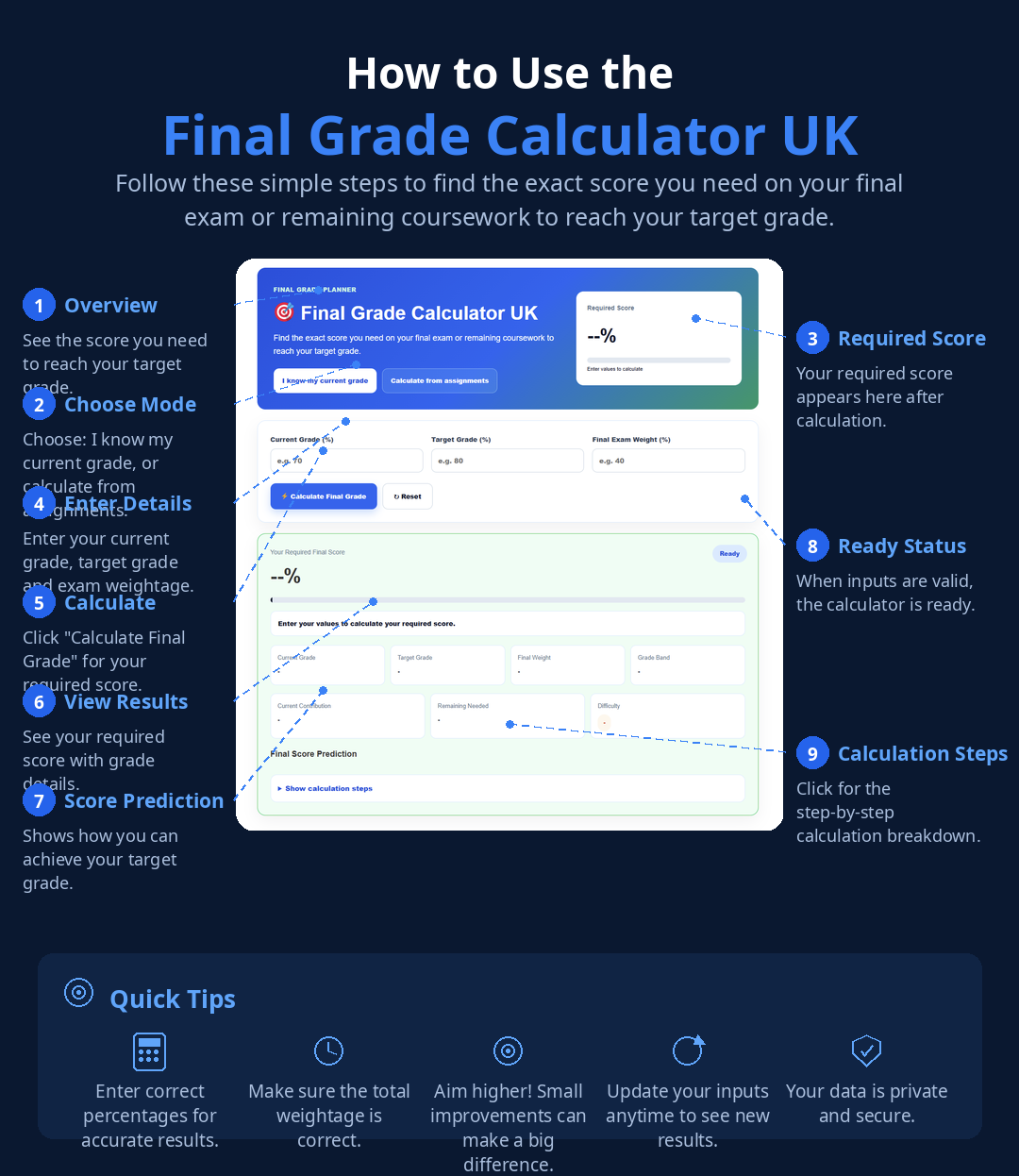
Click Here: Final Grade Calculator UK
The short answer: at most UK universities, Year 1 counts for nothing
UK honours degrees are classified from a weighted average of your module marks — and the weighting deliberately leans toward your later years. As the standard reference puts it, honours degrees are “usually based on a weighted average (with higher weight given to marks in the later years of the course, and often zero weight to those in the first year)” of the marks gained in exams and other assessments.
That “often zero weight” is the key phrase. The most common arrangement in England and Wales is that your degree classification is calculated entirely from Years 2 and 3. Your first year functions as a qualifying year: pass it and you move on, but the marks themselves never enter the classification formula. This is why so many students — and their parents — are told “first year doesn’t count.”
But “most” is not “all.” A meaningful minority of universities give Year 1 a small weight, and a few schemes pull a slice of first-year marks into the formula in ways students don’t expect. The five models below cover essentially every UK arrangement. Find yours, and you’ll know exactly where you stand.
The 5 weighting models UK universities actually use
Every UK university publishes its classification rules in its programme regulations or student assessment handbook — usually under a heading like “classifying your degree” or “scheme of awards.” When you read yours, you will find one of these five patterns:
| Model (Y1 : Y2 : Y3) | Year 1 weight | Year 2 weight | Year 3 weight | Where you see it |
|---|---|---|---|---|
| 0 : 30 : 70 | 0% | 30% | 70% | Leicester student assessment guide (year 2 average × 0.3, year 3 × 0.7); common across newer regulations |
| 0 : 40 : 60 | 0% | 40% | 60% | Nottingham (Part I 40%, Part II 60%); Leicester on some programmes; the classic older split |
| 0 : 25 : 75 | 0% | 25% | 75% | Several Russell Group universities — final year dominates |
| 10 : 30 : 60 | 10% | 30% | 60% | Universities where Year 1 genuinely counts — a tenth of your classification |
| 1 : 3 : 5 | ~11% | ~33% | ~56% | UCL Geography (SHS Scheme of Awards): classification from 270 credits — best 30 credits of Year 1, all 120 of Year 2, all 120 of Year 3 |
Notice the UCL arrangement — it is subtler than the others. Your whole first year doesn’t count; only your best 30 credits of Year 1 feed into a 270-credit calculation. If you had one strong module and the rest were mediocre, the scheme quietly rescues you. If your first year was uniformly weak, it quietly drags you down.
Some universities also apply “predominant class” or borderline rules on top of the weighted average. Leicester’s guide, for example, notes that a First can be awarded for a credit-weighted average of at least 70% — or for 70% in 120 credits (including 30 at level 6) with a 68% average and limited sub-40% credits. These discretionary routes sit alongside the weighting, not instead of it, so the weighting still decides your headline number.
Worked example 1: Priya on a 0:30:70 scheme (Year 1 counts for zero)
Priya studies English at a university using the 0:30:70 model — the scheme published in Leicester’s student assessment guide, where the year 2 credit-weighted average is multiplied by 0.3 and the year 3 average by 0.7. Her year averages:
- Year 1: 52% (a rough year — she coasted)
- Year 2: 64%
- Year 3: 68%
Final average = (0 × 52) + (0.3 × 64) + (0.7 × 68)
= 0 + 19.2 + 47.6 = 66.8% → a comfortable 2:1.
Now the revealing counterfactual: suppose Priya had taken Year 1 seriously and scored 80% instead of 52%. Her final average would be (0 × 80) + 19.2 + 47.6 = 66.8% — identical, to the decimal point. Twenty-eight percentage points of first-year effort, worth exactly nothing in the classification formula. Conversely, a first-year average of 35% would have changed nothing about her 2:1 either — provided she passed enough credits to progress, which is the part students forget.
Worked example 2: James on a 10:30:60 scheme (Year 1 costs him 1.1pp)
James’s university gives Year 1 a 10% weight. His year averages:
- Year 1: 58%
- Year 2: 63%
- Year 3: 69%
Final average = (0.1 × 58) + (0.3 × 63) + (0.6 × 69)
= 5.8 + 18.9 + 41.4 = 66.1% → a 2:1.
Now compare with a 0:30:70 counterfactual at the same marks: (0.3 × 63) + (0.7 × 69) = 18.9 + 48.3 = 67.2%. James’s first year cost him 1.1 percentage points on his final average. At 66.1% he is safe — but imagine he had scored 68.9% on the 0:30:70 scheme and his university ran a borderline uplift rule at 69% for a First. That 1.1pp first-year drag would be the difference between an automatic First and a discretionary borderline decision. This is precisely why the “how much does Year 1 move my average” table below matters more than the headline answer.
How much does one Year 1 percentage point actually move your final average?
This is the question students really mean when they ask whether first year counts. The answer is a simple multiplication — and it makes the stakes concrete:
| Weighting scheme | Year 1 weight | 10pp swing in Year 1 moves your final average by |
|---|---|---|
| 0 : 30 : 70 | 0% | 0.0pp — literally nothing |
| 0 : 40 : 60 | 0% | 0.0pp — literally nothing |
| 0 : 25 : 75 | 0% | 0.0pp — literally nothing |
| 10 : 30 : 60 | 10% | 1.0pp |
| 1 : 3 : 5 (UCL-style) | 1/9 ≈ 11.1% | ≈ 1.1pp |
Read that table twice. Under every zero-weight scheme, the difference between a 45% first year and a 75% first year is zero — thirty percentage points of marks, zero effect on classification. Under a 10%-weight scheme, the same thirty-point swing is worth 3 percentage points of your final average: enough to cross a classification boundary in a borderline year. Plug your own numbers into our Final Grade Calculator with your university’s weighting to see where your first-year marks leave you.
5 reasons first year still matters — even when it “doesn’t count”
Here is where the “first year doesn’t count” mantra misleads people. Your first-year marks may not enter the classification formula, but your first-year record decides a surprising amount of your university life:
1. Progression: you still have to pass to reach Year 2
“Doesn’t count” never means “doesn’t matter.” Most universities require you to pass a minimum number of first-year credits — commonly 100 or 120 of 120 — to progress. Fail badly and you face capped resits (usually capped at the 40% pass mark), repeat-the-year decisions, or in the worst case, required withdrawal. Students who coast on the “it doesn’t count” logic are exactly the ones who discover that a 38% average means a summer of resits rather than a holiday.
2. Module prerequisites: weak Year 1 locks you out of Year 2 choices
Many departments require a minimum mark in a first-year module to take its second-year follow-on — typically 50% or 60% for popular or advanced options. Bomb your first-year statistics module and you may be barred from the econometrics pathway you wanted. Your degree classification won’t show it, but your degree content will be shaped by it.
3. Academic references are written by people who saw your Year 1
When you apply for a master’s, a placement year or a graduate scheme, referees are usually academics who taught you — often in first year, when staff–student contact is highest. A personal tutor who watched you scrape 42% across the board writes a very different reference from one who saw you pull a 68% average with upward momentum. Students on forums regularly report that nobody asked for their transcript; the reference, though, follows you everywhere.
4. Transfers, study abroad and internships read your transcript
Thinking of transferring universities? The receiving institution asks for your full transcript — including Year 1. Competitive year-abroad placements, summer internships and insight weeks increasingly ask for first-year module marks as a filter. And your transcript is permanent: unlike the classification formula, it shows every module mark you ever earned, including the year you “didn’t count.”
5. The study habits you build in Year 1 compound for two years
This is the unglamorous truth behind the statistics: the academic leap from Year 1 to Year 2 is widely described as the hardest transition in a UK degree — harder than Year 2 to Year 3. Students who coasted through Year 1 arrive at weighted Year 2 with underdeveloped essay technique, weak exam timing and no revision system, and their first counted marks reflect it. A strong first year is essentially free training for the years that decide your classification.

When first year DOES count more than you’d expect
A few situations push first-year marks further into the spotlight than the standard models suggest:
- Integrated master’s degrees (MEng, MSci, MMath): the four-year structure means some universities weight all four years, including Year 1, in the final classification. Check your programme regulations — the “first year doesn’t count” rule is really a three-year BSc/BAs rule.
- Four-year Scottish degrees: honours classification is normally calculated from the final two (honours) years only, but the first two years determine whether you reach honours — a gate that fails a surprising number of students.
- Direct entry to Year 2: if you enter in second year (advanced entry, some transfers), your “Year 1” is the previous institution’s — and your classification may be calculated from a different credit base entirely.
- Foundation year confusion: a foundation year (Year 0) is not first year. As our foundation year guide explains, Level 0 marks never count toward classification at any UK university — but progression thresholds from foundation year into Year 1 can be strict.
- Borderline and discretionary rules: some boards look at your full mark profile in borderline cases. A strong first year won’t rescue a weak average, but a consistent upward trajectory across all three years is exactly the narrative boards like to see when exercising discretion at a boundary. (See how universities round marks at borderlines.)
How to find YOUR university’s exact rule (4 steps)
Don’t rely on forum hearsay — or this article — for your specific case. Your university’s rule is published and checkable in about ten minutes:
- Open your programme handbook or assessment regulations. Search for “classifying your degree,” “scheme of awards,” or “degree classification.” The weighting ratio (e.g. 0:30:70) will be stated explicitly — at Leicester it’s phrased as the year 2 average multiplied by 0.3 and year 3 by 0.7.
- Look for the phrases “stage mark” and “overall mark.” Your stage mark is your year average; the overall mark combines them with the published weightings. If the regulations only define stage marks for Levels 5 and 6 (Years 2 and 3), Year 1 isn’t in the formula.
- Check the progression section separately. Even where Year 1 carries zero classification weight, the same document states the minimum credits you must pass to progress — that part always counts.
- Ask your personal tutor or registry if it’s ambiguous. Weighting can vary between programmes at the same university (Leicester, for example, uses different ratios on different programmes), so confirm the rule for your course, not the university’s generic one.
6 myths about first-year marks, busted
| Myth | Reality |
|---|---|
| “Employers will see my bad first year” | Employers see your classification (First, 2:1, 2:2) — they almost never request transcripts. Graduate recruiters consistently confirm this. |
| “First year appears on my degree certificate” | No. Your certificate shows your degree title and classification only. Year 1 marks live on your transcript, which is a separate document. |
| “A bad first year ruins my master’s chances” | Taught master’s offers are based on your predicted or achieved classification. A weak Year 1 followed by strong Years 2–3 is a non-issue at most universities. |
| “I can completely ignore Year 1” | Progression rules, prerequisites, references and resit risk all live in Year 1. “Doesn’t count for classification” ≠ “consequence-free.” |
| “All UK universities work the same way” | Weighting varies by university and by programme — 0:30:70, 0:40:60, 10:30:60 and 1:3:5 all exist. Check your own regulations. |
| “Resits in Year 1 are capped like later years” | Often they are (usually at 40%) — and since Year 1 resits can delay progression into counted years, a failed first year can still cost you a summer and a chunk of momentum. |
Frequently asked questions
Does first year count towards your degree in the UK?
At most UK universities, first-year marks count for zero of your final degree classification. Your classification is usually calculated from Years 2 and 3 only, using a weighting such as 0:30:70 or 0:40:60. A minority of universities give Year 1 a small weight (for example 10:30:60, or UCL Geography’s 1:3:5 scheme) – check your programme regulations for your exact rule.
Do first year marks show on my degree certificate?
No. Your degree certificate shows your degree title and classification (First, 2:1, 2:2, Third) only. Your first-year module marks appear on your academic transcript, which is a separate document that employers rarely request but universities use for transfers and postgraduate applications.
What happens if I fail first year at a UK university?
Failing first year does not directly change your classification, but it blocks progression. Most universities require you to pass a minimum number of first-year credits (often 100-120 of 120) to enter Year 2. Failures usually mean capped resits (typically capped at the 40% pass mark), and in serious cases repeating the year or required withdrawal.
Does first year count at Russell Group universities?
It varies by university and programme. Many Russell Group universities use zero-weight schemes such as 0:25:75 or 0:30:70, but some – such as UCL Geography with its 1:3:5 weighting – do count a portion of first-year marks. Never assume: check your own programme’s assessment regulations.
How much does a bad first year affect my final grade?
Under any zero-weight scheme (0:30:70, 0:40:60, 0:25:75), a bad first year affects your final average by exactly 0 percentage points. Under a 10:30:60 scheme, every 10 percentage points of Year 1 marks moves your final average by 1 percentage point. Use our Final Grade Calculator with your university’s weighting to model your own numbers.
Do first year grades matter for master’s applications?
Taught master’s offers are based on your predicted or achieved degree classification, not your Year 1 marks. A weak first year followed by strong second and third years is not a barrier. However, your full transcript – including Year 1 – is usually submitted with the application, so extreme underperformance can raise questions.
Does first year count in Scotland’s 4-year degrees?
Scottish honours degrees are normally classified from the final two (honours) years only, so Years 1 and 2 do not feed the classification formula. But the first two years determine whether you progress to honours at all – failing to meet the honours-entry threshold means leaving with an ordinary degree instead.
Should I still try hard in first year if it doesn’t count?
Yes. First year decides progression, resit risk, module prerequisites for Year 2, the quality of your academic references, and transfer or internship applications. It is also your training ground: the leap to weighted Year 2 work is the hardest academic transition in most UK degrees, and strong Year 1 habits compound directly into the marks that do count.
Conclusion
So, does first year count towards your degree? For the classification printed on your certificate, the answer at most UK universities is no — the 0:30:70 and 0:40:60 schemes that dominate English and Welsh universities give Year 1 exactly zero weight, and the arithmetic in this guide shows just how literally “zero” that is. If your university is one of the minority using 10:30:60 or UCL-style 1:3:5 weighting, Year 1 moves your final average by roughly one percentage point for every ten points of marks — worth knowing, but rarely decisive on its own.
The smarter way to think about first year is not as a year that “doesn’t count” but as a year that counts differently. It doesn’t feed the classification formula — but it feeds everything around it: whether you progress, which modules you can take next, what your referees write about you, and whether your study habits are ready for the weighted years. Treat it as a free training year with real consequences, model your targets with the final degree classification formula and our Final Grade Calculator, and you’ll arrive at Year 2 with both a clean record and the skills to make the counted years matter.
Sources: University of Leicester student guide to undergraduate assessment and award (year 2 × 0.3, year 3 × 0.7 weighting; predominant-class rules); UCL Faculty of Social & Historical Sciences degree classification page (1:3:5 weighting, best-30-credits Year 1 rule); The Student Room first-year weighting discussions (Nottingham 40:60, 25:75 and 10:30:60 scheme examples).

![Read more about the article ECTS Credits Explained: How ECTS Works and Converts to UK Credits [2026]](https://gradeforuni.com/wp-content/uploads/2026/10/featured-ects-credits-300x192.png)
![Read more about the article Do UK Universities Curve Grades? How Scaling, Moderation & Final Marks Really Work [2026]](https://gradeforuni.com/wp-content/uploads/2026/10/featured-curve-grades-uk-300x192.png)
![Read more about the article Academic Misconduct at UK Universities: Penalties, Hearings & Your Rights [2026]](https://gradeforuni.com/wp-content/uploads/2026/10/featured-academic-misconduct-uk-300x192.png)