
![You are currently viewing Do Foundation Year Grades Count? What Really Counts Toward Your Degree [2026]](https://gradeforuni.com/wp-content/uploads/2026/10/featured-foundation-year-grades.png)
If you are starting a degree with a foundation year, you will probably hear two completely opposite pieces of advice. One camp will tell you the foundation year “doesn’t count,” so you can coast. The other will warn you that every mark follows you forever. The truth is more useful than either: foundation year grades almost never count toward your final degree classification, but they absolutely decide whether you get onto the degree in the first place — and at some universities they decide which degree you are allowed to progress to.
This guide explains exactly how foundation year grades work at UK universities: what “Level 0” means, why your marks are excluded from your classification, the real progression thresholds used by universities including Sheffield Hallam, Nottingham and Harper Adams, what happens if you fail, and the common confusion between a foundation year and a foundation degree that trips up thousands of applicants every year.
A short note on terminology before we begin. A foundation year (Level 0, sometimes Level 3) is an extra preparatory year bolted onto the front of a degree. A foundation degree (FdA/FdSc, Levels 4–5) is a completely different two-year qualification. They share a word and almost nothing else. If you mix them up, every rule below will seem to contradict itself.
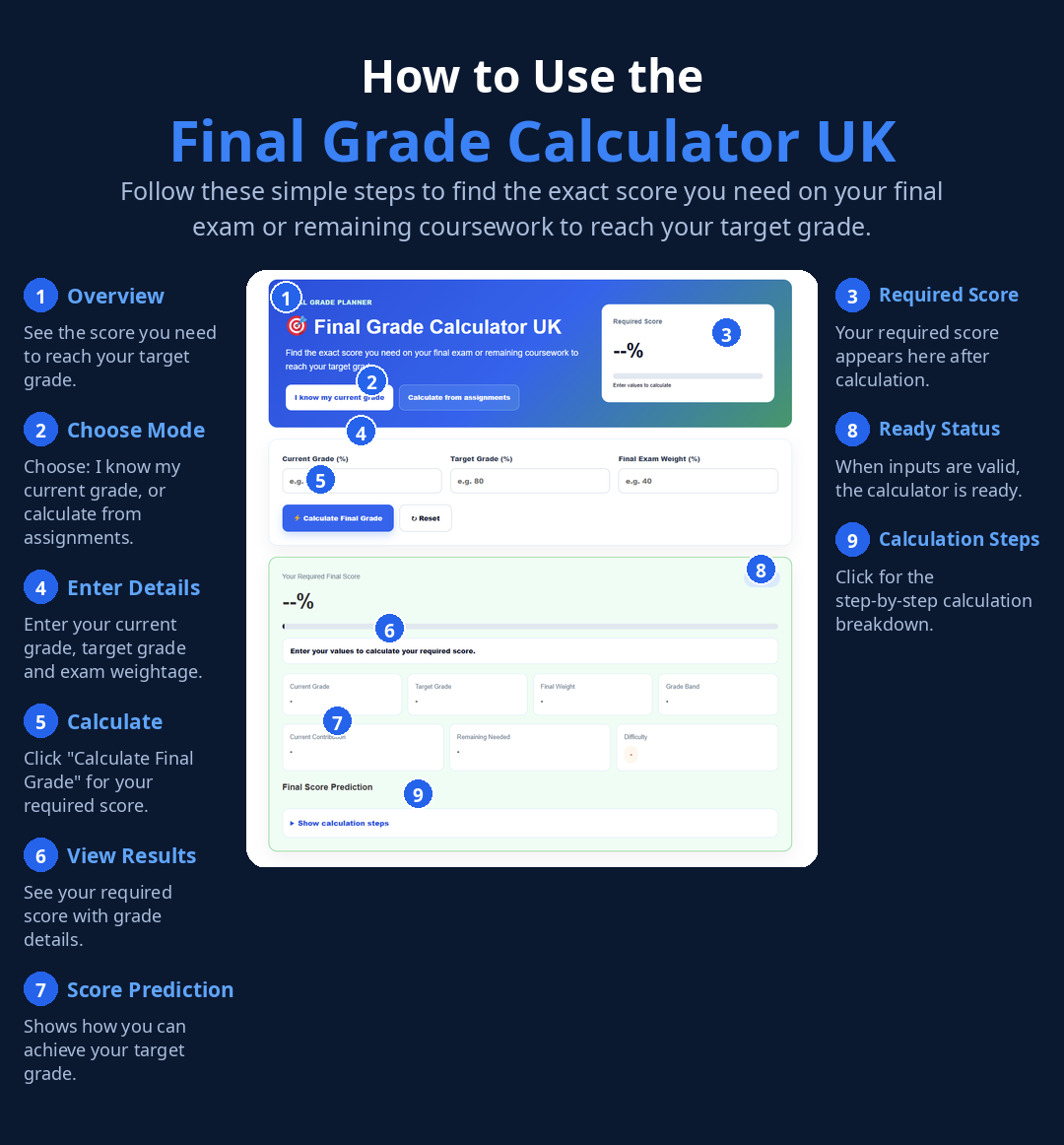
Click Here: Final Grade Calculator UK
What a Foundation Year Actually Is (and Why It’s Called Level 0)
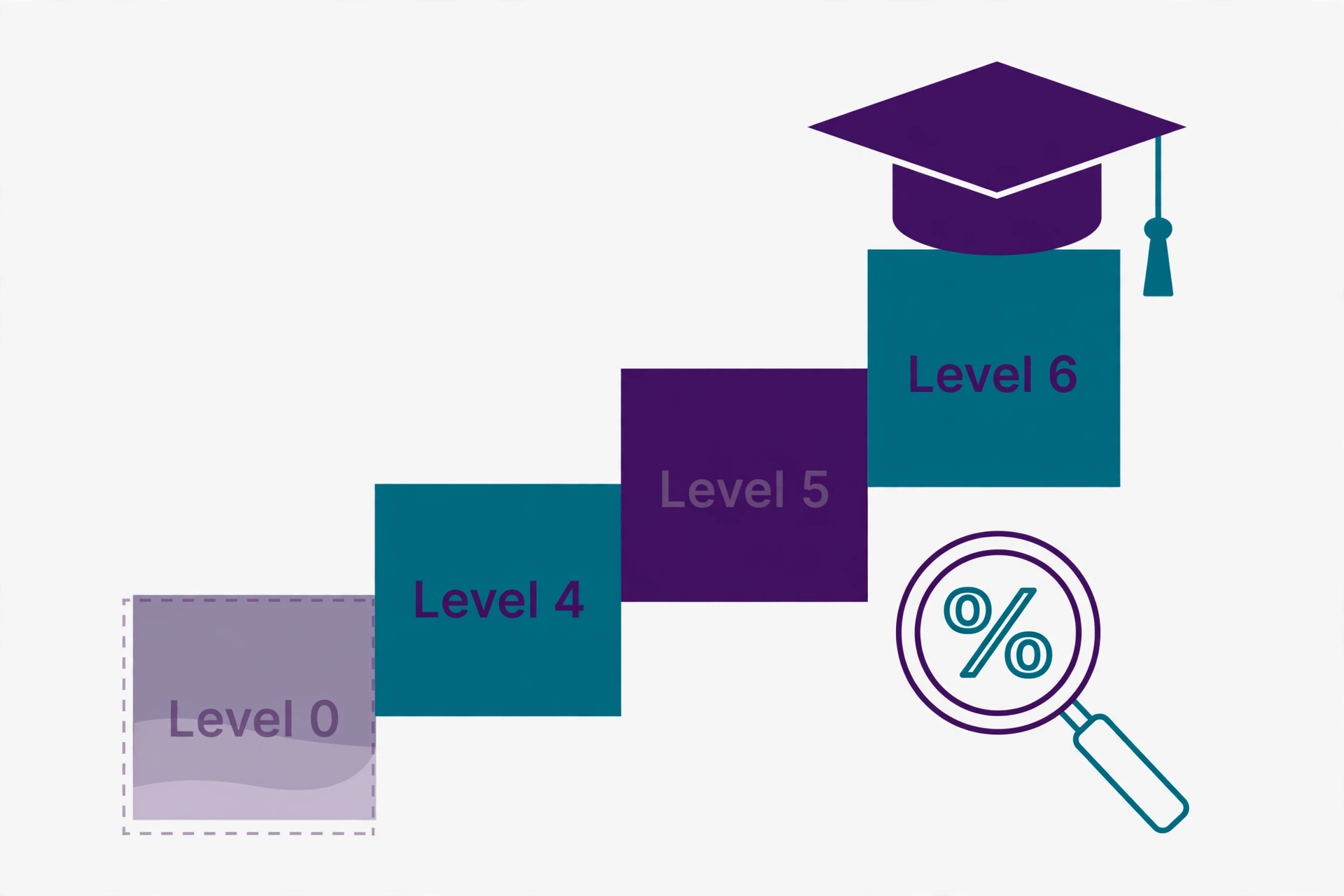
UK degrees are organised into levels. The standard three-year honours degree runs at Level 4 (first year), Level 5 (second year) and Level 6 (final year). A foundation year sits below all of them, at Level 0 — sometimes labelled Level 3. It is designed as a transition year: students who don’t yet meet the entry requirements, who are returning to education after a gap, or who need to build subject-specific skills complete it before starting the degree proper.
The Level 0 designation is the single most important thing to understand, because almost everything else follows from it. Sheffield Hallam University’s grade descriptors put it bluntly: foundation years are “a transitionary year into higher education… distinct from and should not be confused with Level 4 undergraduate study.” Students who complete the foundation year progress to Level 4 “without being awarded any credit or award.” In other words, the year exists to get you onto the degree, not to start scoring for it. That principle — confirmed in the assessment regulations of multiple UK universities — is why your foundation year marks are excluded from your final classification.
| Level | What it is | Counts toward classification? |
|---|---|---|
| Level 0 | Foundation year (the extra preparatory year) | No — almost universally excluded |
| Level 4 | Year 1 of the degree (first year) | Usually no (progression only at most universities) |
| Level 5 | Year 2 of the degree | Yes — typically 25–40% of classification |
| Level 6 | Final year | Yes — typically 60–75% of classification |
Note the common slip: many students talk about “first year grades not counting” when they mean Level 4, the first year of the degree. Royal Holloway’s foundation-year course pages spell out the Level 4 version of the rule clearly: “The results of the first year assessments qualify you to progress to the second year but do not contribute to your final degree award.” Level 0 is one step further removed — it doesn’t even sit on the classification ladder.
Read more: How UK Universities Calculate Degree Classifications — Explained Simply
Do Foundation Year Grades Count Toward Your Degree Classification? The Definitive Answer
No. At the overwhelming majority of UK universities, foundation year (Level 0) marks do not count toward your final degree classification — not at full weight, not at reduced weight, not as a tie-breaker. This isn’t a loophole or an oversight; it is written explicitly into university regulations:
- Sheffield Hallam University — foundation years are “distinct” from Level 4 study; students progress to Level 4 “without being awarded any credit or award” (see SHU Regulation 7 — Progression Rules).
- Hartpury / HSU assessment regulations — for a BA (Hons) with a foundation year, classification is calculated from a formula “based on overall unit grades at FHEQ Level 5 and FHEQ Level 6” only, with Level 6 weighted double. Level 0 doesn’t appear in the calculation at all.
- Oxford Brookes (UCS College Group regulations) — level 3/foundation-year grades “will not contribute to the overall GPA,” even where the university uses a GPA scheme.
- Regent’s University London — “Level 3 credits do not count towards the undergraduate degree credit total,” and there is no exit award at Level 3.
- Aberystwyth University — for schemes with a foundation year, “Part One results… do not contribute to the final degree classification.”
The logic is consistent everywhere: classification is meant to measure your attainment at degree level, and Level 0 is, by definition, pre-degree-level work. Your university cannot fairly rank you against students who entered directly at Level 4 using marks earned on easier, transitional material.
Is there any exception? A handful of institutions run foundation years that feed into a certificated exit award — for example, some colleges offer a standalone Certificate of Higher Education after a foundation-level year. But on a standard “BSc with Foundation Year” route at a UK university, the classification calculation starts at Level 4 or Level 5. If your offer letter or course handbook says otherwise, treat that as unusual and check it twice — but expect the standard position.
What Foundation Year Grades DO Decide: Progression Thresholds
Here is where the “it doesn’t count” advice becomes dangerous. Your foundation year marks don’t touch your classification — but they are the gate between you and the degree. Every university sets a progression rule, and failing to meet it means resits, repeating the year, or losing your place on the degree route. The thresholds vary more than most students expect:
| University | Foundation year progression rule | Source |
|---|---|---|
| Nottingham | 40% or above in all modules; some undergraduate courses require higher grades | University of Nottingham foundation programme pages |
| Sheffield Hallam | Average of 40%+ across all foundation year modules after first attempts; reassessment in failed tasks if below; repeat failed modules the following year if still below | SHU Regulation 7 — Progression Rules |
| Plymouth (Mathematics) | Average mark of at least 50% entitles progression to the first year of the maths degrees | University of Plymouth course page |
| Harper Adams | Overall mean of 40%+ to progress on current route; 60%+ mean to transfer onto any other eligible Honours route; 70%+ mean plus interview for the Harper & Keele Vet School pathway | Harper Adams progression conditions 2025 |
| Lancaster (UA92) | Exam board recommends progression where a student has completed 75%+ of foundation-year assessment | UA92 Foundation Year Assessment Regulations |
Notice the pattern: 40% is the floor, not the ceiling. Forty per cent is the standard undergraduate pass mark, so it is the default progression line. But competitive routes demand much more — Harper Adams’ vet school pathway needs a 70% mean plus an interview, which is first-class territory. And Nottingham explicitly warns that “some undergraduate courses require higher grades to progress,” meaning your offer’s progression condition might say 50% or 60% even though the university’s general rule is 40%.
The practical upshot: your foundation year average is the first number that genuinely matters about you as a university student. Treat the progression threshold the way you’d treat a grade boundary — because that is exactly what it is.
Worked Example: Does Aisha Progress to Year 1?
Let’s make this concrete. Aisha is on a science foundation year at a university that uses the Sheffield Hallam-style rule: an average of 40% or more across all foundation year modules after the first attempts, with reassessment offered in failed tasks for students below the line.
Her first-attempt module marks:
| Module (all 20 credits) | Mark | Pass? |
|---|---|---|
| Academic Skills | 62% | Yes |
| Biology Foundations | 55% | Yes |
| Chemistry Foundations | 44% | Yes |
| Mathematics for Science | 38% | No |
| Laboratory Practice | 47% | Yes |
| Study Project | 51% | Yes |
Her average: (62 + 55 + 44 + 38 + 47 + 51) ÷ 6 = 297 ÷ 6 = 49.5%. She clears the 40% average comfortably — but she has failed one module (Mathematics for Science, 38%), so she cannot simply move on. Under the SHU rule she undertakes reassessment in the failed task. Suppose she resits the maths exam and scores 52%. Her reassessed average becomes (62 + 55 + 44 + 52 + 47 + 51) ÷ 6 = 311 ÷ 6 = 51.8%, and she progresses to Level 4.
Now consider the counterfactual: if Aisha’s original marks had been 62, 55, 34, 28, 37 and 31 — an average of 41.2% but with three failed modules — she would face reassessment in all three, and if the reassessed average still fell below 40% she would have to repeat the failed modules in the following academic year. Same 40%-ish average, completely different outcome: it is the pattern of failures, not just the mean, that decides your fate. A single failed module with a solid average is a resit; multiple failures are a year repeat.
Read more: What Happens If You Fail a University Module? Your Next Options Explained
Five Reasons Good Foundation Year Marks Still Matter
If the marks don’t count toward your classification, why try? Because foundation year grades cast a long shadow in five specific ways:
1. They decide which degree you can progress to. Harper Adams spells this out in black and white: a 40% mean keeps you on your current route, but you need a 60% mean to transfer onto a different Honours route. If you arrive wanting biomedical science and discover you actually want veterinary nursing, your foundation year average is the currency that buys the switch — plus 60% in the relevant modules and approved work experience. Nottingham runs a similar system: automatic enrolment on some pathways, a fresh application on others, with higher grade requirements for the more competitive courses.
2. They are portable. Nottingham notes that its foundation qualifications “are also accepted by many other UK universities.” If you want to move institutions after your foundation year, your foundation year transcript is what the new university assesses. A 68% average opens doors a 41% average does not.
3. Competitive streams have their own bars. The Harper & Keele Vet School pathway requires a 70% foundation-year mean plus an interview. Medicine, dentistry and veterinary-adjacent routes that accept foundation-year entrants routinely set progression bars at 60–70%. The standard 40% rule is the floor for staying on your route — ambition costs extra.
4. Your tutors form their references from them. Foundation year marks are the only university-level evidence your personal tutor has when writing references for placements, internships and (later) postgraduate applications. A tutor who watched you average 72% writes a different reference from one who watched you scrape 41% — and unlike Level 4 marks, these are the marks attached to your name during the year you are most closely supervised.
5. They set your academic baseline. The skills gap between a student who earned 45% on foundation-year academic writing and one who earned 70% does not magically close at Level 4. Foundation year is where you learn referencing, structuring arguments and exam technique under low-stakes conditions. Students who coast through it at the bare pass mark routinely describe Level 4 as a shock; students who worked for high marks describe it as a continuation. The grade doesn’t follow you, but the habits do.
What Happens If You Fail the Foundation Year?
Failing foundation-year assessments is not the end of the road — the whole point of the year is developmental, and the regulations reflect that. But there is a clear escalation ladder, and each rung costs you time:
- Reassessment (resit the failed tasks). At Sheffield Hallam, students below the 40% average after first attempts “undertake the reassessment attempt in all assessment tasks for which they have not achieved a pass mark.” Most universities offer one reassessment opportunity per failed module, usually in the summer resit period.
- Repeat the failed modules next year. If reassessment still leaves you below the progression line, SHU requires you to “repeat any modules failed in the following academic year to remain on programme” — you stay enrolled, but you don’t move to Level 4.
- Lose the degree route. If you cannot meet the progression conditions after repeats, you may be moved to a different course, offered an exit award if one exists, or withdrawn. This is rare but real — and it is why the 40% floor should be treated as a hard boundary, not a soft target.
One important asymmetry: unlike at degree level, where resit marks are typically capped at the pass mark, foundation-year reassessment rules vary — some universities cap, some don’t, and some use the reassessed mark only for the progression calculation. Check your own regulations rather than assuming degree-level capping rules apply.
Read more: University Resit Exams Explained: The Ultimate Guide
Foundation Year vs Foundation Degree vs First Year: Stop Mixing Them Up
This is the single biggest source of confusion in student forums, and it produces confident, completely wrong advice. The three terms describe three different things:
| Foundation year | Foundation degree (FdA/FdSc) | First year (Level 4) | |
|---|---|---|---|
| Level | Level 0 (below degree level) | Levels 4–5 (degree level) | Level 4 (degree level) |
| Duration | 1 extra year before the degree | 2-year standalone qualification | Year 1 of a 3-year degree |
| Qualification | None — it feeds into the degree | FdA or FdSc in its own right | None standalone (progresses to Year 2) |
| Counts toward classification? | No | No — but it has its own classification; a later “top-up” year is graded on Level 6 work only | Usually no at most universities |
| Example | “BSc Biology with Foundation Year” (4 years total) | FdSc Applied Animal Science, then top-up to BSc | Year 1 of BSc Biology (3 years total) |
The forum evidence is vivid. Students regularly ask whether a foundation degree drags down their bachelor’s grade on a top-up — and the answer, confirmed across The Student Room threads, is that top-up classifications are calculated on Level 6 modules only, because “different universities set their own thresholds for grades and so they won’t generally be carried over.” Meanwhile, students on a foundation year ask whether it will appear on their degree certificate — and the consistent answer is no: the certificate shows the degree you graduated with, with the foundation year recorded on your transcript as the route you entered by. Different question, different answer, one shared word.
Read more: University Grade Boundaries Explained: What You Need to Pass
Worked Example: How Aisha’s Classification Is Actually Calculated
Let’s follow Aisha through the full degree to show exactly where her foundation year marks go — which is nowhere. She progresses from her foundation year (average 51.8%) onto a BSc at a university using the Hartpury-style rule: classification from Levels 5 and 6 only, with Level 6 counting double.
| Level | Year average | Weight in classification | Contribution |
|---|---|---|---|
| Level 0 (foundation year) | 51.8% | 0× (excluded) | 0 |
| Level 4 (Year 1) | 58.3% | 0× (excluded) | 0 |
| Level 5 (Year 2) | 63.5% | 1× | 63.5 |
| Level 6 (final year) | 66.0% | 2× | 132.0 |
Total: (63.5 + 132.0) ÷ 3 = 195.5 ÷ 3 = 65.2% — an upper second-class honours (2:1).
Now watch what happens if someone wrongly includes the foundation year at equal weight: (51.8 + 58.3 + 63.5 + 66.0) ÷ 4 = 239.6 ÷ 4 = 59.9% — a 2:2, and a completely fictional one. That five-percentage-point phantom is the difference between a 2:1 and a 2:2 on paper, which is precisely why universities exclude Level 0: it would punish students for marks earned before they were doing degree-level work, and reward the students who never needed the foundation year at all. The exclusion is not a technicality — it is the fairness mechanism.
(If your university weights Level 5 and Level 6 differently — 25:75 and 40:60 are both common — the same principle holds: Level 0 is outside the calculation whatever the split.)
Read more: How to Predict Your Final Degree Classification Before Results Day
Your Foundation Year on Transcripts and Certificates
What paper trail does the foundation year leave? Three documents, three different treatments:
- Degree certificate: shows your degree title and classification only. For an integrated “with Foundation Year” degree, the certificate typically names the degree as awarded (e.g., BSc (Hons) Biology) — the foundation year itself carries no separate award, so there is nothing to print.
- Academic transcript: lists every module you took, including the Level 0 modules and their marks. Employers and postgraduate admissions teams who request a full transcript will see your foundation year results — another reason the “marks don’t matter” advice is only half true.
- HEAR (Higher Education Achievement Report): where your university issues one, the foundation year appears as part of your verified academic record.
For postgraduate applications, the practical effect is small: admissions tutors care overwhelmingly about your Level 5 and 6 marks and your final classification. But a transcript that shows a 38% foundation-year average followed by a 68% final year tells a story of growth — and a transcript that shows the reverse tells a different one. The numbers stop counting, but they don’t stop speaking.
Read more: University Grade Guide UK: Percentages, GPA and Degree Classes Explained
Do foundation year grades count toward my degree classification?
No. At the overwhelming majority of UK universities, foundation year (Level 0) marks are excluded from your final degree classification. Universities including Sheffield Hallam, Aberystwyth and Regent’s state this explicitly in their regulations — classification is calculated from degree-level work (Levels 5 and 6, sometimes Level 4), and Level 0 sits below that ladder.
What mark do I need to pass my foundation year and progress?
The standard progression line is 40% — the undergraduate pass mark. Nottingham requires 40% or above in all modules, and Sheffield Hallam requires a 40% average across all foundation year modules. But individual courses set higher bars: Plymouth’s mathematics degrees require a 50% average, and competitive routes like Harper Adams’ vet school pathway demand a 70% mean plus an interview. Always check your own offer’s progression conditions, not just the university’s general rule.
What happens if I fail a foundation year module?
You will normally be offered reassessment (a resit) in the failed tasks, usually in the summer resit period. At Sheffield Hallam, students below the 40% average must resit every failed task; if the reassessed average is still below 40%, they repeat the failed modules in the following academic year rather than progressing to Level 4. Failing doesn’t usually end your studies, but it does cost you time.
Can I switch degrees after my foundation year?
Often yes — and this is where good foundation year grades really pay off. Harper Adams allows students with a 60% mean to transfer onto any other eligible Honours route, while a 40% mean only guarantees progression on your current route. Nottingham offers automatic enrolment on some pathways and requires a new application on others. If you think you might want to switch, aim well above the 40% floor.
Is a foundation year the same as a foundation degree?
No, and confusing them causes most of the bad advice on this topic. A foundation year (Level 0) is an extra preparatory year before a degree and carries no qualification. A foundation degree (FdA/FdSc, Levels 4-5) is a two-year standalone qualification in its own right. If you ‘top up’ a foundation degree to a bachelor’s, your classification is calculated on the Level 6 top-up work only.
Will my foundation year appear on my degree certificate?
No. Your degree certificate shows your degree title and classification only, and a foundation year carries no separate award. Your foundation year modules and marks do appear on your academic transcript, which employers or postgraduate admissions teams may request — so the marks are visible even though they don’t affect your classification.
Do employers care about foundation year grades?
Rarely directly — most graduate employers filter on your final degree classification (often 2:1 and above) and never see module-level marks. But employers who request a full transcript will see your foundation year results, and your personal tutor’s reference is written largely from what they observed during your foundation year, when supervision is closest.
Does a bad foundation year average affect my final degree?
Not mathematically — Level 0 marks are excluded from the classification calculation, so a 45% foundation year average cannot drag down a 2:1 earned at Levels 5 and 6. What it can affect is your route: a weak average may block transfers to other degrees, close off competitive streams, and signal poor study habits that make Level 4 harder. The grade doesn’t follow you, but the habits do.
Conclusion
So do foundation year grades count? Toward your final classification: almost never. Toward everything else that matters right now — progression onto the degree, your confidence, your study habits, and how your tutors perceive you: enormously. The students who coast because “it doesn’t count” are the same ones scrambling when progression thresholds turn out to be very real.
Aisha’s worked example shows the maths clearly, but the deeper lesson is about momentum. The foundation year is where you learn to write at university level, manage your time across modules, and read marking criteria properly — skills that compound across the next three years. A strong foundation average won’t appear on your degree certificate, but it will show up in your second-year marks.
If you are starting a foundation year this autumn, set one rule for yourself: treat it as Year 1 of your degree, not Year 0. Hit the progression threshold with room to spare, build the habits now, and you’ll walk into first year already knowing how the system works — while everyone else is still figuring it out.

![Read more about the article Oxbridge Admissions Tests Explained: TMUA, ESAT & TARA Scores [2026]](https://gradeforuni.com/wp-content/uploads/2026/10/featured-admissions-tests-uk-300x192.png)
![Read more about the article How Group Project Marks Are Calculated at UK Universities [2026]](https://gradeforuni.com/wp-content/uploads/2026/10/featured-group-project-marks-300x192.png)