

You check your university results and see marks such as 64%, 68%, 72%, and 59%. Now you want to know your actual semester average.
Simply adding the marks and dividing by the number of modules does not always give the correct result. Different module credits and assessment weightings can affect the calculation. Semester Grade Calculator
A semester grade calculator helps you calculate your average using the relevant marks, credits, and weightings, and can also show what you need to reach a target such as 60% or 70%.
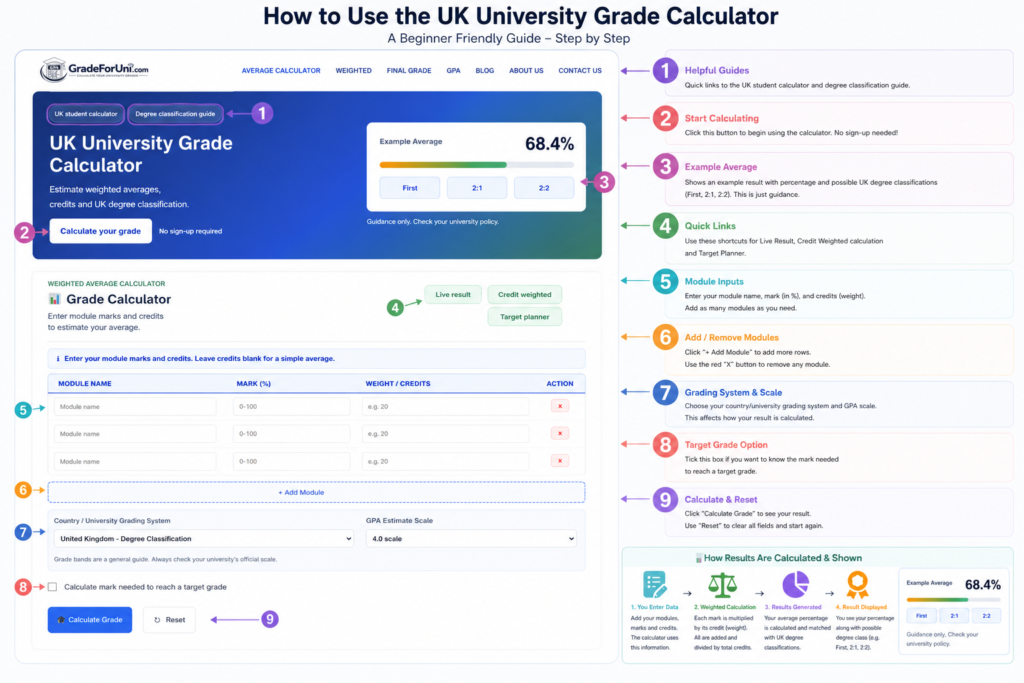
Click Here: UK University Grade Calculator
How to Use the UK University Grade Calculator
What Is a Semester Grade Calculator?
A semester grade calculator is a tool for estimating your average performance across the modules or assessments included in a semester. Semester Grade Calculator
For UK university students, the calculation can involve more than simply averaging percentages. Depending on your course regulations, you may need to consider:
- Module marks
- Module credit values
- Assessment weightings
- Coursework and examination marks
- Pass/fail modules
- Semester weighting
- University-specific calculation rules
The important point is that there is no single calculation method that applies to every UK university. Your programme regulations should always take priority over a generic calculator.
What a Semester Grade Calculator Calculates
A calculator can be used for several different purposes.
Semester average: This shows your average across the relevant modules or assessments.
Weighted semester average: This accounts for different assessment or module weightings.
Credit-weighted semester average: This gives modules influence according to their credit value.
Target average: This lets you see what average you are aiming for.
Required future mark: If some assessments are still outstanding, you can calculate the mark required to reach a target.
For example, if you have completed 70% of a module and want an overall mark of 70%, you can use the completed result and remaining 30% to work out what you need in the final assessment.
Semester Average vs Module Mark vs Year Average
These terms are related, but they are not interchangeable.
A module mark is the result for one module. It may be calculated from several assessments, such as coursework, presentations and exams.
A semester average combines the relevant module results from one semester.
The average for a year covers the results that count towards the academic year. Depending on the university, this may involve credit weighting or specific semester rules.
Your final degree mark is a separate calculation covering the part of your programme that contributes to your final classification.
[Internal Link: University Grade Calculator]
How to Calculate a Semester Average
The right calculation dependSimple Semester Average
| Module | Mark |
|---|---|
| Module 1 | 64% |
| Module 2 | 68% |
| Module 3 | 72% |
| Module 4 | 66% |
| Average | 67.5% |
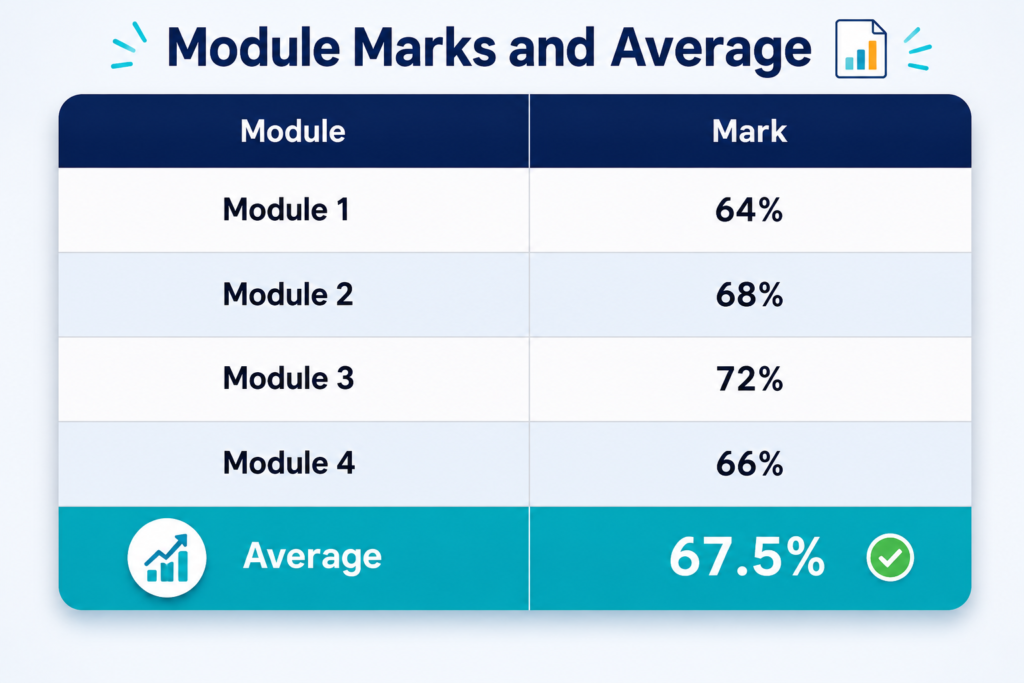
(64 + 68 + 72 + 66) ÷ 4 = 67.5%
[Formula Box: Simple average = Sum of marks ÷ Number of marks]
Weighted Semester Average
| Assessment | Mark | Weight | Contribution |
|---|---|---|---|
| Coursework | 62% | 40% | 24.8% |
| Exam | 74% | 60% | 44.4% |
| Module Mark | 100% | 69.2% |
[Formula Box: Weighted mark = Σ(mark × weight)]
Credit-Weighted Semester Average
| Module | Mark | Credits |
|---|---|---|
| Module 1 | 70% | 20 |
| Module 2 | 62% | 40 |
[Formula Box: Credit-weighted average = Σ(module mark × module credits) ÷ Total credits]
How UK University Semester Grades Are Calculated
UK universities can structure assessment and classification differently, so your course regulations remain the most reliable source for the exact calculation.
A useful way to understand the process is to think of it as a series of stages:
Assessment marks → Module mark → Semester/year average → Final degree calculation
Modules, Assessments and Credits
A university module may contain several assessments.
For example, a module could include:
- Coursework
- Examination
- Presentation
- Practical assessment
- Group project
Each assessment can have its own weighting.
The module itself also has a credit value, such as 10, 20, 30, or 40 credits.
These two types of weighting should not be confused.
A 20-credit module could have an exam worth 70% and coursework worth 30%. The 70/30 split relates to assessments inside that module. The 20 credits describe the module’s contribution to a wider calculation.
How Coursework and Exams Combine Into a Module Mark
Suppose your assessment structure is:
| Assessment | Mark | Weight |
|---|---|---|
| Coursework | 65% | 40% |
| Examination | 72% | 60% |
The weighted contributions are:
- Coursework: 65 × 0.40 = 26
- Examination: 72 × 0.60 = 43.2
Module mark = 69.2%
This approach matters because adding 65% and 72% and dividing by two would produce 68.5%, which is not the same result.
Always check your module specification to find the correct assessment weighting.
Read More: First Class Honours ExplainedDo All UK University Modules Count Equally?
No. They may not.
If all your modules have the same number of credits and your university uses credit weighting, they will have equal influence.
But imagine you have:
- 20-credit module = 70%
- 40-credit module = 60%
The 40-credit module represents twice the credit value of the 20-credit module. Under a credit-weighted calculation, its mark therefore has greater influence.
This is one of the most important reasons not to automatically use a simple average.
[Comparison Table: Module Credit Weighting]
| Module | Mark | Credits | Weighted Points |
|---|---|---|---|
| Module A | 70% | 20 | 1,400 |
| Module B | 60% | 40 | 2,400 |
| Total | 60 | 3,800 |
The credit-weighted average is:
3,800 ÷ 60 = 63.33%
A simple average would be:
(70 + 60) ÷ 2 = 65%
The two answers differ because the modules do not have equal credit values.
How to Calculate Your Semester Average Using Credits
When your modules have different credit values, check whether your university uses a credit-weighted average for the calculation you are making.
The process is:
- List each relevant module.
- Record the final mark for each module.
- Record the credit value.
- Multiply each mark by its credits.
- Add the weighted values.
- Add the total credits.
- Divide the weighted total by the total credits.
This method allows the credit value of each module to influence the result.
When to Use Credit Weighting
Credit weighting becomes particularly useful when your semester contains modules with different credit values.
For example, a semester might include:
- 10-credit module
- 20-credit module
- 30-credit module
Treating all three percentages as equally important would ignore the difference in credits.
However, credit weighting should not automatically be assumed. Your university’s regulations determine whether and how credits are used for the specific calculation.
How a 20-Credit Module Differs From a 40-Credit Module
If your university uses credit weighting, a 40-credit module has twice the weighting of a 20-credit module.
Consider:
- 20-credit module = 74%
- 40-credit module = 62%
The lower mark belongs to the larger module, so it has a greater effect on the combined average.
This can be useful when reviewing your results. A disappointing result in a high-credit module may affect your average more than a similar result in a smaller module.
Suppose you have:
| Module | Mark | Credits |
|---|---|---|
| Business | 74% | 20 |
| Economics | 68% | 20 |
| Finance | 62% | 40 |
Weighted points:
- Business: 74 × 20 = 1,480
- Economics: 68 × 20 = 1,360
- Finance: 62 × 40 = 2,480
Total weighted points = 5,320
Total credits = 80
Credit-weighted semester average:
5,320 ÷ 80 = 66.5%
The simple average would be 68%, so the difference is meaningful.
What If a Module Is Pass/Fail?
A pass/fail module may award credits without contributing a numerical percentage to your average, but this depends on your university’s rules.
Do not automatically enter a pass/fail module into a percentage calculation simply because it appears on your transcript.
Check whether the module is included in the relevant average or classification calculation before entering it.
How Semester 1 and Semester 2 Results Work
Semester structures vary between courses. Some programmes divide teaching and assessment into two semesters, while others use different arrangements.
The important question is not simply whether you have two semesters. It is how your programme uses those results.
Calculating Your Semester 1 Average
If the relevaSimple Semester Average
| Module | Mark |
|---|---|
| Module A | 61% |
| Module B | 66% |
| Module C | 69% |
| Module D | 73% |
| Average | 67.25% |
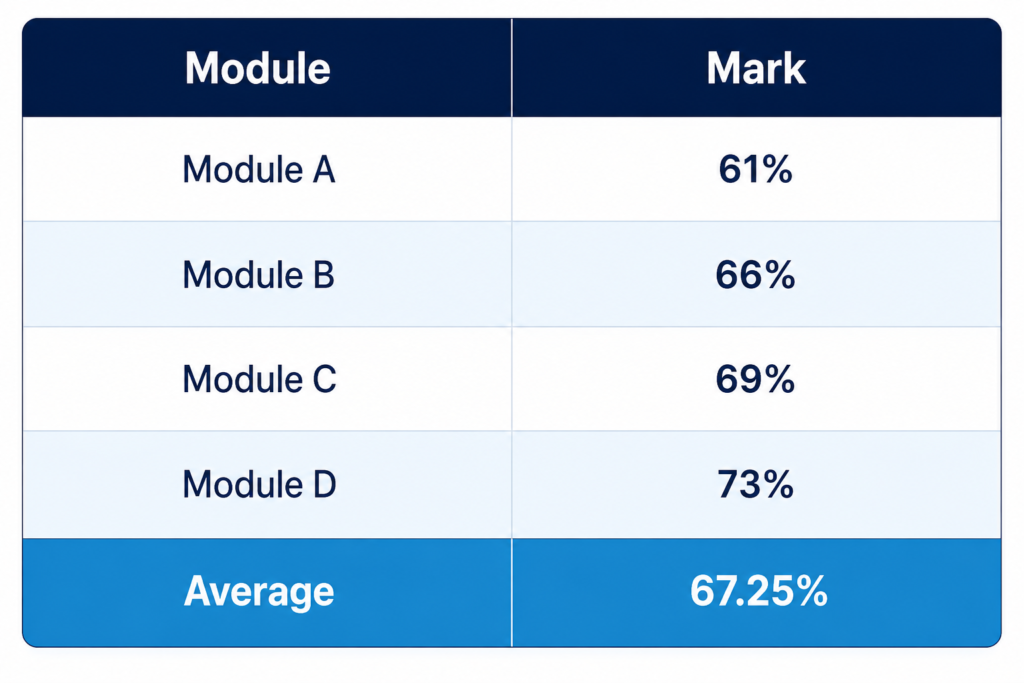
Calculation: (61 + 66 + 69 + 73) ÷ 4 = 67.25%
Calculating Your Semester 2 Average
The same basic principle applies to Semester 2, but the modules and credit structure may differ.
Keep the two semesters separate when tracking your performance. This makes it easier to see whether your results are improving and to identify where your stronger or weaker modules are.
Is a Semester Average the Same as a Year Average?
Not necessarily.
A semester average normally describes performance within one semester. A year average covers the results included in the academic year.
If Semester 1 and Semester 2 contain equal credits and are treated equally, combining them may be straightforward.
But if the credit values or institutional rules differ, you should not assume that simply averaging the two semester percentages gives the official annual result.
| Calculation | Main Purpose | Typical Inputs |
|---|---|---|
| Module mark | Result for one module | Coursework, exam and other assessments |
| Semester average | Performance across a semester | Module marks and relevant weighting |
| Year average | Performance across an academic year | Module/semester results |
| Final degree mark | Final classification calculation | Relevant years/modules and programme rules |
How Your Semester Average Relates to Your UK Degree Classification
A semester average shows your current performance but is not necessarily the same as your final degree classification.
For example, a 68% semester average may indicate 2:1-level performance, but your final classification can depend on:
Borderline rules
Year weighting
Module credits
Rounding rules
Modules included in classification
First-Class Honours
| Semester | Average |
|---|---|
| Semester 1 | 68% |
| Semester 2 | 72% |
| Combined Average | 70% |
(68 + 72) ÷ 2 = 70%
The final degree classification may use different module, credit, or year weightings.
- Semester 1: 68%
- Semester 2: 72%
Upper Second-Class Honours (2:1)
An overall result of 60–69% is commonly associated with an Upper Second-Class Honours degree, or 2:1.
If your semester average is 64%, that can be a useful indication of where your current performance sits, but it should not be interpreted as your guaranteed final classification.
A student with a 59% semester average may still finish with a 2:1 if later results increase the overall weighted average. Similarly, a student currently averaging 65% could finish below 60% if later performance falls significantly.
Lower Second-Class Honours (2:2)
An overall result of 50–59% is commonly associated with a Lower Second-Class Honours degree, or 2:2.
If your semester average is 56% and your target is a 2:1, check:
- Current weighted average
- Completed credits
- Remaining credits
- Required marks
- Year weighting
This helps you estimate what you need to reach your target.
Third-Class Honours
A result between 40% and 49% is commonly associated with a Third-Class Honours degree.
However, the pass and classification rules for individual programmes can contain additional requirements. For this reason, students should avoid treating a general classification table as a substitute for their university regulations.
Why a Semester Average Does Not Guarantee Your Final Degree Classification
The final classification can involveWhy a Semester Average Does Not Guarantee Your Final Degree Classification
Your final degree result can involve several stages:
Module marks → Year average → Year weighting → Final degree average
Universities may use different rules for credit weighting, year weighting, and classification.
[Comparison Table: UK Degree Classification Bands]
| Overall Mark | Common Classification |
|---|---|
| 70%+ | First |
| 60–69% | 2:1 |
| 50–59% | 2:2 |
| 40–49% | Third |
| Below 40% | Fail |
These are common UK classification bands, but your university may use different calculation and rounding rules.
How to Calculate the Mark You Need to Reach a Target Semester Average
Read More: How UK Universities Calculate Degree ClassificationsA useful feature of a semester grade calculator: Finding the Required Mark for a Target
You can calculate the mark needed in your remaining assessment to reach a target.
| Calculation | Result |
|---|---|
| Current average | 64% |
| Completed weighting | 70% |
| Current contribution | 44.8% |
| Target average | 70% |
| Remaining weighting | 30% |
| Required remaining mark | 84% |
64 × 0.70 = 44.8
70 − 44.8 = 25.2
25.2 ÷ 0.30 = 84%
[Formula Box: Required mark = (Target − Current contribution) ÷ Remaining weighting]
How to Target 70% for a First-Class Benchmark
If your target is 70%, enter your compl
| Calculation | Result |
|---|---|
| Current mark | 67% |
| Completed weighting | 60% |
| Current contribution | 40.2% |
| Target | 70% |
| Remaining weighting | 40% |
| Required remaining mark | 74.5% |
67 × 0.60 = 40.2
70 − 40.2 = 29.8
29.8 ÷ 0.40 = 74.5%
How to Target 60% for a 2:1 Benchmark
Suppose a student currently has:
| Calculation | Result |
|---|---|
| Current mark | 57% |
| Completed weighting | 60% |
| Current contribution | 34.2% |
| Target | 60% |
| Remaining weighting | 40% |
| Required remaining mark | 64.5% |
57 × 0.60 = 34.2
60 − 34.2 = 25.8
25.8 ÷ 0.40 = 64.5%
Can a Strong Final Assessment Raise Your Semester Average?
A higher-weighted assessment has a greater impact on your final average.
For example:
| Assessment Weight | Mark Improvement | Impact on Average |
|---|---|---|
| 10% | 60% → 80% | +2 percentage points |
| 50% | 60% → 80% | +10 percentage points |
20 × 0.10 = 2
20 × 0.50 = 10
Semester Grade Calculator Worked Examples
Example 1 — Calculating an Equal-Weight Semester Average
| Module | Mark |
|---|---|
| Business | 64% |
| Marketing | 68% |
| Economics | 72% |
| Finance | 66% |
| Semester Average | 67.5% |
(64 + 68 + 72 + 66) ÷ 4 = 67.5%
Example 2 — Calculating a Credit-Weighted Semester Average
Consider:
| Module | Mark | Credits |
|---|---|---|
| Business | 70% | 20 |
| Economics | 65% | 20 |
| Finance | 68% | 40 |
Weighted marks:
- Business = 70 × 20 = 1,400
- Economics = 65 × 20 = 1,300
- Finance = 68 × 40 = 2,720
Total = 5,420
Total credits = 80
5,420 ÷ 80 = 67.75%
The credit-weighted average is 67.75%.
Example 3 — Combining Coursework and an Exam
A module
| Assessment | Mark | Weight | Weighted Mark |
|---|---|---|---|
| Coursework | 63% | 30% | 18.9% |
| Exam | 71% | 70% | 49.7% |
| Module Mark | 100% | 68.6% |
Module mark = 18.9 + 49.7 = 68.6%
Example 4 — Calculating a Semester With Unequal Credits
A student has:
| Module | Mark | Credits |
|---|---|---|
| Psychology | 72% | 10 |
| Sociology | 65% | 20 |
| Research Methods | 69% | 30 |
Weighted points:
- 72 × 10 = 720
- 65 × 20 = 1,300
- 69 × 30 = 2,070
Total weighted points = 4,090
Total credits = 60
4,090 ÷ 60 = 68.17%
The credit-weighted semester average is approximately 68.17%.
Example 5 — Calculating a Target 70% Average
A
| Calculation | Result |
|---|---|
| Current average | 65% |
| Completed weighting | 75% |
| Current contribution | 48.75% |
| Target average | 70% |
| Remaining weighting | 25% |
| Required remaining mark | 85% |
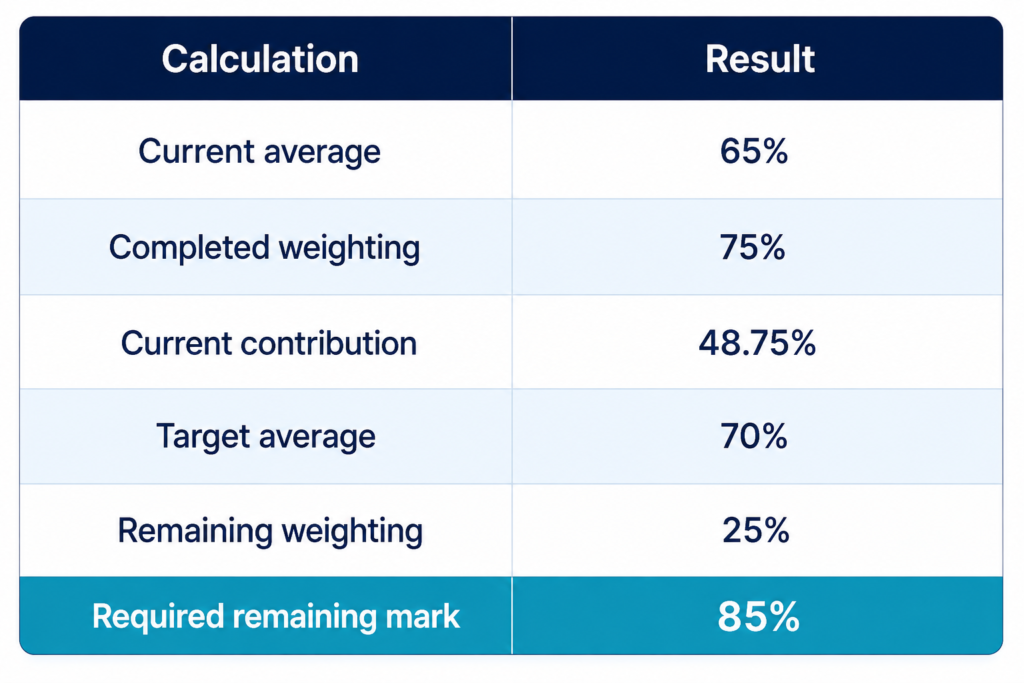
65 × 0.75 = 48.75
70 − 48.75 = 21.25
21.25 ÷ 0.25 = 85%
Example 6 — Moving From 58% Toward a 2:1
| Calculation | Result |
|---|---|
| Current average | 58% |
| Completed weighting | 60% |
| Current contribution | 34.8% |
| Target average | 60% |
| Remaining weighting | 40% |
| Required remaining mark | 63% |
58 × 0.60 = 34.8
60 − 34.8 = 25.2
25.2 ÷ 0.40 = 63%
Remaining weighting = 40%.
25.2 ÷ 0.40 = 63%
The student needs 63% in the remaining work to reach 60%.
Example 7 — Combining Semester 1 and Semester 2
Suppose:
| Semester | Average |
|---|---|
| Semester 1 | 64% |
| Semester 2 | 70% |
| Combined average | 67% |
(64 + 70) ÷ 2 = 67%
Example 8 — Understanding the Impact of a 40-Credit Module
Suppose a student has:
| Module | Mark | Credits | Weighted Points |
|---|---|---|---|
| Module 1 | 74% | 20 | 1,480 |
| Module 2 | 62% | 40 | 2,480 |
| Total | 60 | 3,960 | |
| Credit-weighted average | 66% |
Simple average: 68%
Credit-weighted average: 66%
[Internal Link: Final University Grade Calculator]
Real-Life UK University Semester Grade Scenarios
A Student Checking Their Semester Average
A first-year student has four 20-credit modules and wants to calculate their average. Since all modules have the same credits, a simple average gives the same result as a credit-weighted average.
A Student Trying to Reach a 2:1
A student has 58% and wants to reach 60%. They can enter their completed and remaining weighting to calculate the mark needed to reach their target.
A Student Trying to Reach a First
A student has 67% and wants to reach 70%. The required mark depends on how much assessed work remains.
A Student With Unequal Module Credits
A student has 10-, 20- and 30-credit modules. If credit weighting applies, the 30-credit module has three times the influence of the 10-credit module.
A Student Combining Coursework and Exam Marks
A student receives 66% in coursework and 73% in an exam. If the coursework is worth 40% and the exam 60%, the module mark should be calculated using these weightings.
A Student Checking How a Semester Average Could Affect Their Degree
A student achieves 68% and wants to know whether they are on track for a 2:1. They should check:
- Which years count
- Year weighting
- Module credit weighting
- Classification rules
- Borderline rules
[Internal Link: How UK Universities Calculate Degree Classifications]
A Student With a Resit
A student fails a module and takes a resit. The effect on their average depends on their university’s resit rules, including whether the mark is capped.
[Internal Link: University Resit Exams Explained]
Common Semester Grade Calculation Mistakes
Averaging Modules Without Considering Credits
If modules have different credit values, check whether your university requires credit weighting.
Confusing Assessment Weighting With Credit Weighting
A 70% exam means the exam contributes 70% to the module mark. It does not mean the module is worth 70 credits.
Adding Coursework and Exam Marks Directly
A 60% coursework mark and 70% exam mark should not automatically be averaged. Use their actual assessment weightings.
Assuming Every UK University Uses the Same Formula
Universities can use different rules for weighting, rounding and classification.
Confusing a Semester Average With a Year Average
A semester average covers specific semester results, while a year average may include different modules or weightings.
Treating GPA and UK Percentage Averages as the Same
UK percentage marks and GPA use different grading systems. Do not assume they are directly equivalent.
Including Pass/Fail Modules Automatically
Check whether pass/fail modules contribute to your numerical average.
Ignoring Resit Rules
Resit marks may be capped or treated differently. Always check your university’s regulations.
Ignoring Rounding Rules
Universities can use different rounding methods, which may matter near classification boundaries.
Assuming a Semester Result Guarantees Your Final Classification
A semester average is only an indicator. Your final classification may depend on later results and programme weightings.
Expert Tips for Tracking Your Semester Grades
Check Your Module AssesCheck Assessment Weightings
Check the official weighting for each assessment before calculating your module mark.
Track Module Credits
Record the credit value alongside each module mark so you can apply credit weighting correctly.
Separate Assessment and Credit Weighting
Calculate the module mark using assessment weightings first. Then apply credit weighting to the wider average if required.
Track Semester 1 and Semester 2 Separately
Keep each semester’s results separate to monitor progress and avoid mixing semester and annual calculations.
Calculate Targets Before Major Assessments
Use your current average and remaining weighting to find the mark needed to reach your target.
Check Your Programme Regulations
Always check your university’s rules, especially for:
- Placement years
- Study abroad
- Integrated Master’s degrees
- Pass/fail modules
- Resits
- Optional modules
Check Rounding and Borderline Rules
If your result is close to 60% or 70%, check your university’s rounding and borderline classification rules.
Check Resit Rules
Find out whether resit marks are capped and how they affect your average or classification.
Treat Calculator Results as Estimates
A calculator provides a mathematical estimate. Your university’s regulations determine the official result.
Important UK University Rules to Check Before Using Your Result
Credit-Weighting Rules
Check whether your university uses module credits when calculating averages.
Assessment-Weighting Rules
Check how coursework, exams and other assessments contribute to each module mark.
Rounding Rules
Check when your university rounds assessment, module, year, or final marks.
Pass/Fail Modules
Check whether pass/fail modules contribute to your numerical average.
Resits and Capped Marks
Check how reassessment marks are recorded and whether they are capped.
Modules Included in Classification
Check which modules and credits count towards your final degree classification.
University-Specific Degree Classification Rules
Universities can differ in:
- Year weightings
- Credit weighting
- Rounding
- Borderline rules
- Counting modules
- Placement or study-abroad treatment
[Internal Link: How UK Universities Calculate Degree Classifications]
Semester Average vs GPA and SGPA
What Is a Semester GPA?
A semester GPA measures academic performance using a grade-point system rather than percentage marks.
What Is SGPA?
SGPA means Semester Grade Point Average and measures performance for a particular semester using grade points.
How UK Percentage Averages Differ From GPA Systems
UK universities commonly use percentage marks, while GPA systems use grade points. The two should not be treated as automatically equivalent.
Should UK Students Convert Their Semester Average to GPA?
Only convert your semester average when required for an application or another specific purpose. Use the grading system required by the organisation or institution receiving your results.
Read More: University Grade Conversion CalculatorFrequently Asked Questions
What is a semester grade calculator?
A semester grade calculator helps you calculate or estimate your average performance across the modules or assessments included in a semester. Depending on your university’s rules, it can use equal weighting, assessment weighting, or credit weighting.
How do I calculate my semester average?
Add your relevant marks and divide by the appropriate weighting. If all modules have equal weight, a simple average may work. If module credits differ and your university uses credit weighting, multiply each module mark by its credits, add the results, and divide by total credits.
How is a semester grade calculated?
A semester grade can be calculated by combining the relevant module or assessment marks according to their assigned weights. The exact method depends on the structure and regulations of your programme.
How do I calculate a weighted semester average?
Multiply each mark by its decimal weighting, add the weighted contributions, and divide by the total weighting where necessary.
Can I calculate my semester average using university credits?
Yes, if your university uses credit weighting. Multiply each module mark by its credit value, add the weighted results, and divide by the total relevant credits.
Do university credits affect my semester average?
They can. If your university uses credit weighting, a higher-credit module has greater influence on the overall average than a lower-credit module.
Do all university modules count equally?
Not necessarily. Modules with different credit values may have different influence. Some modules may also be excluded from particular averages under programme regulations.
How do I calculate my Semester 1 average?
List the modules included in Semester 1, record their marks and credits, then apply the calculation method specified by your university. If all relevant modules have equal weighting, a simple average may be sufficient.
How do I calculate my Semester 2 average?
Use the same approach for the modules included in Semester 2. Check whether the modules have equal credits and whether your programme applies any specific semester weighting.
How does a semester grade calculator work in the UK?
It can calculate a semester average from module marks, assessment weights, and credits. The key UK consideration is that university regulations can determine how those marks are weighted and which modules count.
Is a semester average the same as a year average?
No. A semester average covers a semester, while a year average covers the relevant academic year. The two may be related but are not automatically calculated in the same way.
Does my semester average affect my final degree classification?
It may, but this depends on your programme. Your semester results can contribute to module or year averages, which may then feed into the final classification calculation.
How do I calculate the mark I need to reach 70%?
Use your current mark, completed weighting, and remaining weighting. Subtract your current weighted contribution from 70%, then divide the remainder by the outstanding weighting.
How do I calculate my average when modules have different credits?
Use a credit-weighted calculation if your university requires it: multiply each module mark by its credits, add the results, and divide by total credits.
Conclusion
A semester grade calculator helps you calculate your average using your module marks, credits, and assessment weightings.
If modules have equal weighting, a simple average may be enough. When credits or assessment weightings differ, a weighted calculation may be required.
Use the calculator to track your semester performance and work out the marks needed to reach targets such as 60% or 70%.
Always check your university’s regulations for the official calculation, including credit weighting, resits, rounding, and classification rules.


![Read more about the article How to Transfer Universities in the UK: Credits, Grades, Funding & Deadlines [2026]](https://gradeforuni.com/wp-content/uploads/2026/10/featured-transfer-universities-uk-300x192.png)