
![You are currently viewing When Is the UCAS Deadline 2027? January Equal-Consideration Date Explained [2026]](https://gradeforuni.com/wp-content/uploads/2026/10/featured-ucas-deadline-2027.png)
When Is the UCAS Deadline 2027? January Equal-Consideration Date Explained [2026]
The UCAS deadline for 2027 entry is 13 January 2027 at 18:00 UK time. That is the date every UCAS application guide converges on, but almost everything else applicants believe about it — that you should apply as early as possible, that January applicants are “late”, that the deadline belongs to you — is wrong. The 13 January date is an equal-consideration deadline, not a race, and the deadline that will actually decide whether your application gets sent on time was set months earlier by your school, not by UCAS.
This guide explains the UCAS deadline 2027 from the applicant’s side: what equal consideration really promises, the school-internal deadlines that sit behind it, how conditional offers and the UCAS tariff turn your predicted grades into real outcomes, and every route that stays open after 13 January — UCAS Extra, late applications and Clearing. Four days from now, the 15 October early deadline for Oxford, Cambridge and most medicine courses closes; if you are in that cohort, our missed UCAS deadline guide is the one you need. Everyone else: this is your deadline.
All dates below are published on UCAS’s official dates and deadlines page, verified at the time of writing. Dates this important should never come from a forum thread — check the official page yourself before you act on any of them.
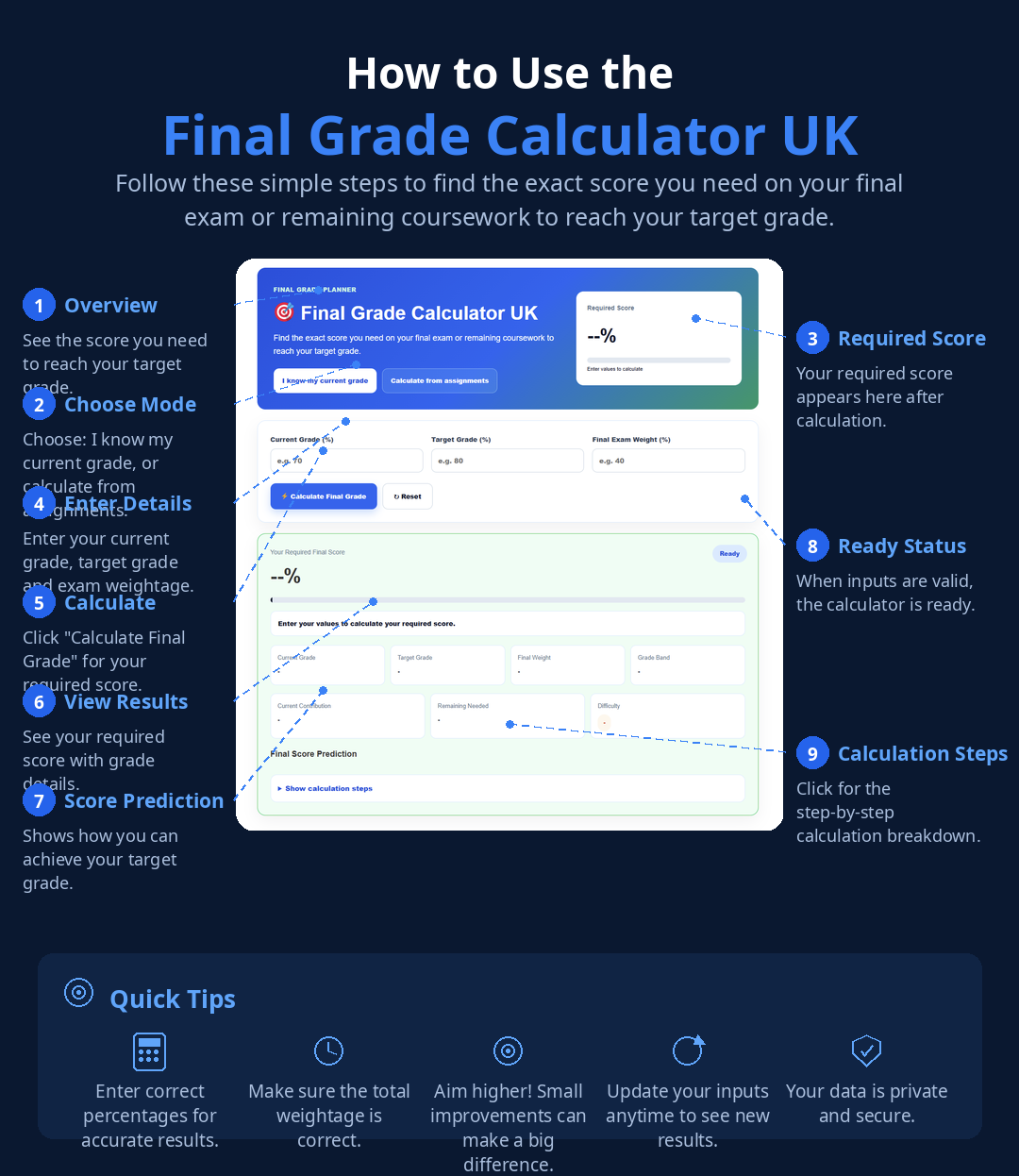
Click Here: Final Grade Calculator UK
The 2027 Cycle at a Glance: Every Date That Matters
The UCAS application cycle is not one deadline — it is a sequence of gates, each of which changes what is possible. Here is the complete 2027-entry timeline, all times UK:
| Milestone | Date | What it means for you |
|---|---|---|
| Early equal-consideration deadline | 15 Oct 2026, 18:00 | Oxford, Cambridge and most medicine, dentistry and veterinary courses — closes Thursday, 4 days from now |
| Main equal-consideration deadline | 13 Jan 2027, 18:00 | Most undergraduate courses — apply by here and universities must consider you equally with every other on-time applicant |
| UCAS Extra opens | 25 Feb 2027 | If you used all five choices and hold no offers, add new choices one at a time |
| University decision deadline | 12 May 2027 | Universities must have replied to applications received by 13 January |
| Late-application cut-off | 30 Jun 2027, 18:00 | Applications received after this go automatically into Clearing — no normal consideration |
| Clearing opens | 2 Jul 2027 | Course vacancies listed; anyone without an offer can apply directly to universities |
Two of these dates do nearly all the work for ordinary applicants: 13 January is the date you must beat to be treated fairly, and 2 July is the date that rescues you if the plan fails. Everything between them is a system for converting your application into offers and your results into places. Understanding that system — rather than just fearing the first date — is what this article is about.
Note the one date that is not UCAS’s at all: your school’s internal deadline. It appears in none of the tables above, but for most applicants it is the only deadline that can actually go wrong. More on that shortly.
Equal Consideration, Decoded: Why Applying in October Buys You Nothing
UCAS’s equal-consideration promise is precise: any completed application received before 18:00 UK time on 13 January 2027 must be considered equally by universities, regardless of whether it arrived in October or on 13 January itself. That single rule demolishes the most widespread piece of UCAS folklore — that applying early improves your chances.
It does not. Universities do not work through applications in arrival order. Admissions teams collect on-time applications and assess them against the same published criteria, which is exactly what the rule requires. An October applicant with AAB predictions and a December applicant with identical AAB predictions, identical references and comparable personal statements face the same bar. The December applicant is not “late” — they are on time, and the rules say so.
There are two narrow exceptions worth knowing, and neither of them contradicts the rule:
First, courses with auditions, interviews or admissions tests run their own schedules. Medicine applicants face the 15 October deadline and UCAT-timed shortlisting; Oxbridge applicants face the October window of the ESAT, TMUA and TARA tests (see our Oxbridge admissions tests guide). For those courses, the effective deadline is genuinely earlier — but that is because of a different UCAS deadline, not because early is better.
Second, some universities send offers on a rolling basis from autumn, which can make an early applicant hear back sooner. Hearing back sooner is not an advantage in the outcome — it is an advantage in anxiety management. The decision, when it comes, is made on the same terms.
The practical consequence is freeing: do not rush a weak application into UCAS in October to chase a queue that does not exist. Use the time to sharpen the personal statement, lock down predicted grades with your teachers, and — the single highest-leverage move — hit your school’s internal deadline with margin. Applying in early January with a polished application beats applying in October with a sloppy one, and the equal-consideration rule means the calendar cannot punish you for choosing quality.
The Deadline Behind the Deadline: Your School’s Internal Gate
Here is the part of the UCAS process that UCAS itself warns you about but cannot control: your application is not submitted when you finish it. It is submitted when your school or college attaches your reference and predicted grades, you pay the fee, and the institution sends the whole package to UCAS. Each of those steps can add days — and schools set their own internal deadlines, typically weeks or months before 13 January, to absorb them.
UCAS’s own guidance is explicit that applicants should follow their school’s deadline. The reason is mechanical, not bureaucratic. A reference has to be written by a teacher who is writing thirty others; predicted grades need sign-off; qualification evidence for independent applicants needs checking. A school that sets a mid-December internal deadline is not being difficult — it is pricing in the queue. The applicants who miss the real deadline are rarely the ones who missed 13 January; they are the ones whose application sat in a school queue, reference-less, while January passed.
What this means in practice:
| Stage | Who controls it | What can go wrong |
|---|---|---|
| Personal statement and choices complete | You | Choices undecided; statement unfinished — both fixable with time |
| Fee paid (£34.50 for the 2027 cycle, one flat fee covering up to five choices) | You | Unpaid fee = incomplete application; UCAS does not forward it |
| Reference attached and predicted grades entered | Your school/college | Teacher workload; predicted-grade sign-off delays — the most common bottleneck |
| Sent to UCAS | Your school/college | School batch-sends on its own schedule; sending to your school is not sending to UCAS |
If you are applying independently — as a gap-year or mature applicant — the mechanics shift but the warning stands: you supply your own referee, and the application still needs a completed reference before UCAS forwards it. Ask your referee early, give them a deadline weeks before 13 January, and chase politely. A referee who has forgotten is indistinguishable, to the system, from an applicant who never applied.
One number to memorise: 18:00. Every UCAS deadline is 18:00 UK time, and UCAS means received-by, not started-by. An application you are still editing at 17:55 on 13 January is an application that has not been submitted. Treat 12 January as your personal deadline and the real one becomes a formality.
Conditional Offers and the UCAS Tariff: The Grades That Actually Decide
Meeting the UCAS deadline 2027 only gets your application read. What gets you an offer is grades — specifically predicted grades first, achieved grades second. Understanding the tariff that translates A-level results into the numbers on offer letters is the difference between choosing five realistic courses and choosing five fantasies.
The UCAS tariff assigns points to A-level grades: A* is 56, A is 48, B is 40, C is 32, D is 24, E is 16. An offer of AAA is therefore 144 tariff points; AAB is 136; ABB is 128; BBB is 120; BBC is 112. Most offer letters express requirements in grades rather than points, but the tariff matters when courses accept combinations — an ABB course, for instance, may accept 128 points from any subject mix, which gives you flexibility your letter grades alone do not show.
| Typical offer | Tariff points | What it usually means in practice |
|---|---|---|
| A*AA | 168 | Most selective courses; several Russell Group flagships |
| AAA | 144 | Standard selective Russell Group offer band |
| AAB | 136 | Common for strong courses; one grade of slack vs AAA |
| ABB | 128 | Wide mid-selective band; our Russell Group guide maps these bands course by course |
| BBB | 120 | Solid mainstream offers; contextual offers can sit below this |
Offers come in three flavours, and the distinction decides your summer. A conditional offer requires specific grades — hit them and your place is confirmed; miss them and the university decides whether to be flexible. An unconditional offer holds your place regardless of results, but you must still meet any non-grade conditions. A contextual offer lowers the bar for applicants meeting widening-participation criteria (low-participation postcode, care experience, first in family); our Russell Group entry-grades guide explains which universities run them and how far the bar drops.
The 2027-cycle application fee is a flat £34.50, covering up to five choices — Extra and Clearing included at no extra cost. Leaving choices empty saves nothing.
When offers arrive, you pick one firm choice and one insurance choice. The strategy is grade arithmetic, not loyalty: your firm should be the course you most want among those whose conditions you can plausibly meet; your insurance should be a course whose conditions sit clearly below your expected results — typically one to two grades lower. The insurance choice is the most undervalued decision in the cycle. A student predicted AAB who firms AAA and insures ABB has built a one-grade safety net; the same student insuring AAB has built none, and discovers it on results day when nets cannot be bought.
The predicted grades behind all of this deserve a cold look. They are the gate: without the right predictions, competitive courses never make the offer at all. And predictions are systematically generous — the data we examined in our predicted-grades guide shows roughly half of accepted students were predicted AAA or better, while only about a quarter actually achieved it. That gap is not a reason to despair; it is a reason to choose your firm and insurance with the achieved-grades version of yourself in mind, not the predicted one.
The Worked Example: Predicted AAA, Achieved AAB
Meet Daniel. Predicted AAA (144 tariff points), he firms a course asking AAA and insures one asking AAB (136). In August he achieves AAB — one grade short of his firm. What happens is not a coin flip; it is a sequence with a clear order of operations.
Step 1: the firm decision. The firm university sees 136 points against a 144-point condition — a shortfall of 8 tariff points, exactly one grade. Universities routinely admit near-miss applicants when the course has space, and an 8-point miss on a 144-point offer is the textbook near-miss. Daniel’s place is not guaranteed, but his odds are genuinely good: the miss is small, the tariff gap is one grade, and universities fill courses they have already marketed.
Step 2: the insurance fallback. If the firm says no, the insurance offer of AAB is met exactly — 136 points against 136 required — and the place is confirmed automatically. This is the moment the insurance choice earns its keep. Daniel goes to university in September either way; the only question was which one.
Step 3: the counterfactual. Suppose Daniel had insured at AAA too — two aspirational choices, no safety net. The same AAB results would leave him with zero confirmed places and one remaining route: Clearing, which opens 2 July 2027, or a gap year. The cost of that missing safety net is not abstract — it is the difference between a confirmed September start and a summer of uncertainty. The lesson is arithmetic: your insurance should sit at or below the grades you would achieve on a bad day, not the grades you hope for on a good one.
Scale Daniel’s story to the national picture and the predicted-grades gap bites: with only about a quarter of AAA-predicted students achieving AAA, the near-miss is not the exception — it is close to the modal outcome. Build your choices for the results you are likely to get, and let the firm choice carry the ambition. That is what the firm/insurance split is for.
After 13 January: Late Applications, UCAS Extra and Clearing
Missing the equal-consideration deadline is not the same as missing the cycle. The system keeps three doors open, in order — and each has a distinct grade reality.
Door one: late applications. UCAS will still accept and forward applications after 18:00 on 13 January, but the equal-consideration guarantee falls away. UCAS’s own position is that providers “cannot guarantee they’ll give it equal consideration.” In practice, competitive courses are often full by February and simply decline late applications; less oversubscribed courses still consider them. A late application is a bet on courses with space — reasonable for some, hopeless for AAA-band flagships.
Door two: UCAS Extra. From 25 February 2027, if you have used all five choices and hold no offers — because you were rejected, or because you declined them — you can add new choices one at a time. Extra runs until early July and the application fee already covers it: the £34.50 you paid in autumn includes Extra and Clearing at no extra cost. The one-at-a-time rule forces focus: each Extra choice gets a 21-day decision window, so choose courses whose grade requirements sit at or below your expected results. Extra is where applicants who aimed too high in January get a second, better-aimed shot.
Door three: Clearing. Clearing opens on 2 July 2027, and any application received after 18:00 on 30 June 2027 is entered into it automatically. This is the route most applicants misunderstand. Clearing is not a punishment tier — it is a matching market. Universities with unfilled places adjust their requirements to fill them, which means the grade reality of Clearing is flexibility: courses that asked AAB in January may take ABB or BBB in July if the seats are empty. The winning strategy is preparation, not panic: have your achieved grades, your UCAS ID and a shortlist of courses ready before results day, and call the universities yourself. Clearing places are allocated by phone, and the applicants who have done their research move first.
| Route | When | Grade reality |
|---|---|---|
| On-time application | By 13 Jan 2027, 18:00 | Full equal consideration; conditional offers at published grades |
| Late application | 14 Jan – 30 Jun 2027 | Considered at universities’ discretion; competitive courses often full |
| UCAS Extra | 25 Feb 2027 onwards | One choice at a time; aim at or below expected grades |
| Clearing | 2 Jul 2027 onwards | Universities flex requirements to fill places; direct phone applications |
One more date in the sequence: universities must have replied to January-deadline applications by 12 May 2027, and applicants who receive their last decision by then reply by 2 June. Mark both — the reply deadline is the one applicants forget, and an unanswered offer lapses.
Six Myths About the UCAS Deadline 2027
| Myth | Reality |
|---|---|
| Apply early for a better chance of an offer | Equal consideration means timing within the window is irrelevant. UCAS’s promise: “If your completed application – including all your personal details and your academic reference – is submitted by the deadline, it is guaranteed to be considered.” October and January applicants face the same bar. |
| 13 January is the only UCAS deadline | 15 October 2026 covers Oxbridge and most medicine/dentistry/vet courses; schools set their own earlier internal deadlines; PGCE and conservatoire routes differ. 13 January is the main deadline, not the only one. |
| Sending my application to my school counts as submitted | No. Until your reference is attached, the fee is paid and your school sends the package to UCAS, nothing has been submitted. The school queue is where deadlines actually get missed. |
| Missing my conditional offer means losing the place | Not necessarily. Near-misses are routinely accepted when courses have space, and your insurance choice exists precisely for this outcome — which is why it should sit below your expected grades, not at them. |
| Clearing is only for applicants who failed | Clearing is a matching market for unfilled places. Universities lower requirements to fill seats, and well-prepared applicants routinely land courses they would have been pleased with in January. |
| UCAS charges per choice, so fewer choices are cheaper | The 2027-cycle fee is a flat £34.50 covering up to five choices, plus UCAS Extra and Clearing at no extra cost. Leaving choices empty saves nothing — and for medicine applicants, an unused fifth choice can block Extra access later. |

When is the UCAS deadline for 2027 entry?
The main UCAS deadline for 2027 entry is 13 January 2027 at 18:00 UK time — the equal-consideration date for most undergraduate courses. An earlier deadline of 15 October 2026 at 18:00 applies to Oxford, Cambridge and most medicine, dentistry and veterinary courses.
Does applying early give me a better chance of an offer?
No. UCAS’s equal-consideration rule requires universities to consider every application received by the deadline equally, whether it arrived in October or January. Applying early does not improve your chances — a polished application submitted in January beats a rushed one submitted in October.
What does equal consideration actually mean?
It means providers must consider all applications for each course on an equal basis if received on or before the relevant deadline. After the deadline, universities are not obliged to consider them equally and competitive courses may be full.
My school’s internal deadline is before Christmas — do I have to follow it?
Yes. UCAS explicitly tells applicants to follow their school’s deadline. Your application is not submitted until your reference is attached, the fee is paid and your school sends it to UCAS — and school queues are the most common reason deadlines are missed.
What happens if my UCAS application arrives after 13 January?
UCAS still forwards late applications, but universities are not obliged to consider them equally and competitive courses may be full. Applications received after 18:00 on 30 June 2027 go automatically into Clearing, which opens on 2 July 2027.
What is UCAS Extra and when does it open for 2027 entry?
UCAS Extra opens on 25 February 2027. If you used all five choices and hold no offers, you can add new choices one at a time. It is covered by your original £34.50 application fee at no extra cost.
How much does a UCAS application cost for 2027 entry?
The 2027-cycle application fee is £34.50 — one flat fee covering up to five choices, plus UCAS Extra and Clearing. Fee waivers exist for free-school-meals recipients and care leavers.
I missed my conditional offer grades — what are my options?
First, your firm university may still accept a near-miss if the course has space. Second, your insurance choice activates if you met its conditions. Third, Clearing opens on 2 July 2027 with universities flexing requirements to fill places. A gap year and reapplication with achieved grades is the fourth route.
Conclusion
The UCAS deadline 2027 rewards the applicants who understand the system rather than the ones who rush it. 13 January 2027 at 18:00 is the date that matters, but the equal-consideration rule means the weeks before it are for improving your application, not for queueing. The deadline that can genuinely hurt you was set by your school, the grades that decide your outcome are the ones on your offer letters, and the safety net that saves most summers is an insurance choice set with honest arithmetic rather than hope.
If you take three actions from this guide, make them these: confirm your school’s internal deadline this week and work backwards from it; set your insurance choice at least one grade below your realistic results, not your predicted ones; and keep the post-January routes — Extra from 25 February, Clearing from 2 July — in mind as planned fallbacks rather than emergencies. Applicants who plan the whole cycle rarely need the rescue routes. Applicants who only plan for 13 January sometimes discover the cycle is longer than they thought.


![Read more about the article How to Interrupt Your Studies at a UK University: Fees, Funding & Visa Rules [2026]](https://gradeforuni.com/wp-content/uploads/2026/10/featured-interrupt-studies-uk-300x192.png)
![Read more about the article Can Turnitin Use Your Essay to Train AI? What UK Students Need to Know [2026]](https://gradeforuni.com/wp-content/uploads/2026/10/featured-turnitin-ai-essays-300x192.png)