
![You are currently viewing Do Predicted Grades Matter for UCAS? How Conditional Offers Work [2026]](https://gradeforuni.com/wp-content/uploads/2026/10/predicted-grades-ucas-featured.png)
There are eight days left until 18:00 on 15 October 2026. If you are applying to Oxford, Cambridge, or for medicine, dentistry or veterinary medicine, that is your equal-consideration deadline — and your predicted grades are already locked into your application. Not typed by you, not negotiable at this point, but sitting there in your academic reference, doing quiet work on every one of your choices.
So the question is no longer whether you can change them. It is what they actually do for you — and the honest answer is: yes, predicted grades matter, but not the way most applicants think. Predicted grades get you considered and they get you offered. They do not get you admitted. The grades that admit you are the ones printed on your results slip in August.
This guide explains exactly how predicted grades work in a UCAS application: who writes them and why you never type them in yourself, the two jobs they perform for admissions teams, what a conditional offer really is (with the tariff arithmetic worked through), how accurate predictions actually are according to the latest data, what happens when your results beat or miss your predictions, and what to do if your predictions sit below the entry requirements.
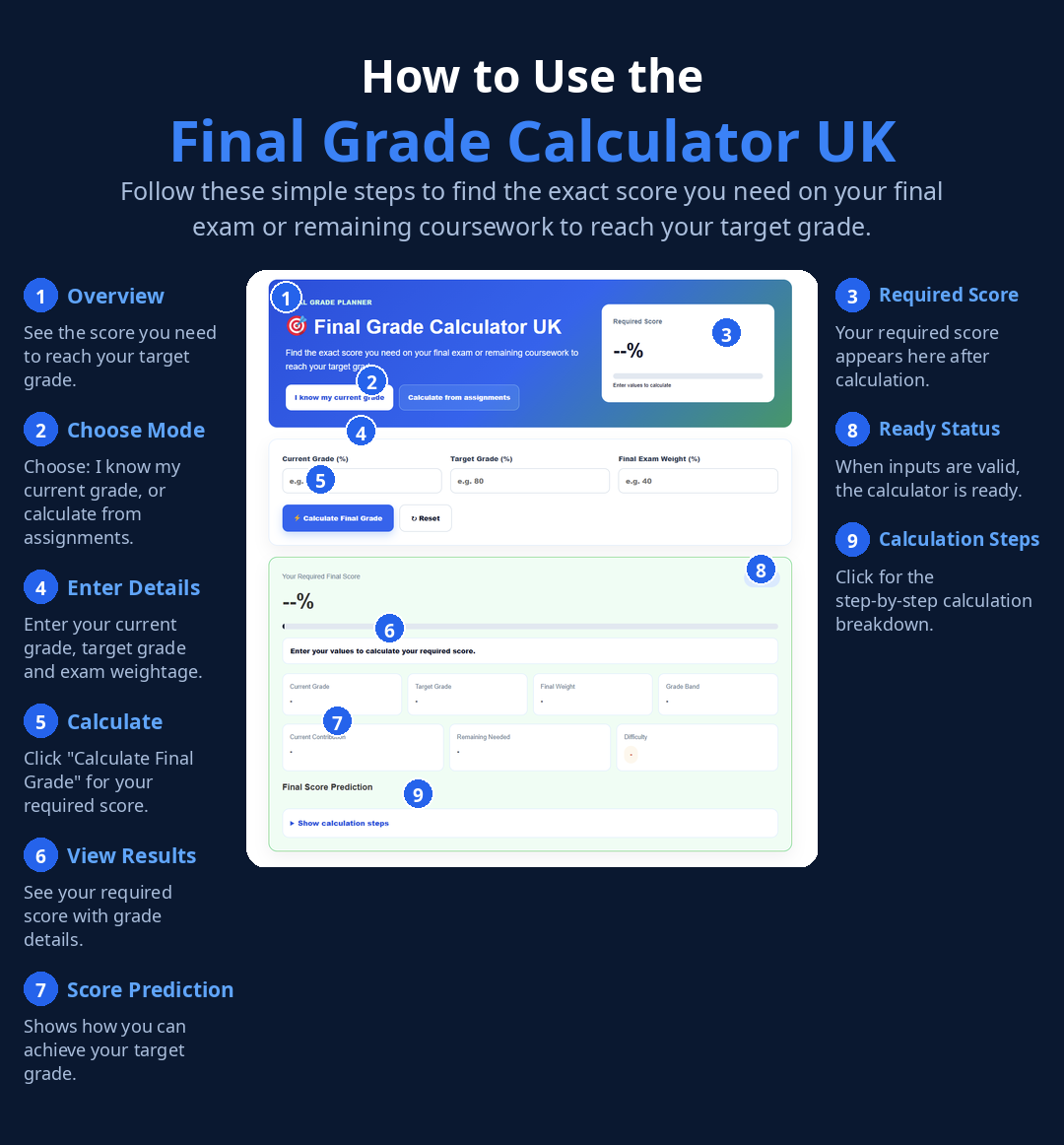
Click Here: Final Grade Calculator UK
What Predicted Grades Actually Are
Predicted grades are your school or college’s professional forecast of the grades you will achieve in your pending qualifications — usually A-levels, BTECs or the International Baccalaureate. They are entered into UCAS by your referee, typically a teacher, tutor or head of year, as part of your academic reference. You do not type them into your own application form, and you cannot edit them: the reference is written and attached by your school, which is also why your school’s internal deadline is always earlier than the UCAS deadline itself. They need time to check, write and attach it.
That pipeline matters because it tells you what predicted grades really are: a professional judgement made by people who have taught you for two years, based on your mock results, coursework trajectory, class performance and — honestly — a degree of institutional habit. They are not a promise, a contract or a measurement. They are a forecast, made by your school, on your behalf, that universities then use as a first-pass sorting tool.
One thing applicants routinely misunderstand: your predictions travel as part of your reference, not your personal statement. Universities see them alongside your actual qualifications already achieved (your GCSEs, for example), your personal statement and your reference text. They form one input among several — important early on, increasingly irrelevant later, as this guide will show.
The Two Jobs Predicted Grades Do in Your Application
Predicted grades perform exactly two functions in an admissions office. Understanding the distinction is the key to using your five UCAS choices well.
Job one: the eligibility gate. Admissions teams use your predictions to check whether you clear the published entry requirements. If a course asks for ABB and you are predicted ABB, you pass the gate and your application gets read properly. If you are predicted BBC, the system may still pass you through — many universities consider near-misses — but you have not cleared it cleanly, and at oversubscribed courses that is often where the journey ends.
Job two: the shortlist signal. Where courses interview — medicine, Oxbridge, and many competitive programmes — predictions help decide who gets invited. They are compared across thousands of applicants to ration a limited number of interview slots. Here your predictions are not a gate so much as a ranking input, weighed alongside admissions tests and GCSEs.
How the two jobs interact in practice:
| Your predicted grades vs the entry requirement | What usually happens |
|---|---|
| Above the requirement (e.g. predicted A*AA for an AAA course) | Clears the eligibility gate comfortably; stronger shortlist signal, but no guarantee of an offer — the rest of the application still has to earn it. |
| Exactly at the requirement (e.g. predicted AAA for an AAA course) | Clears the gate; you are now competing on the strength of your statement, reference and any tests or interviews. |
| Slightly below (one grade short, e.g. predicted AAB for an AAA course) | May still clear a soft gate — many universities routinely consider and offer to near-miss applicants, especially if the course is not oversubscribed. |
| Well below (two grades or more short) | Usually filtered out at the gate for competitive courses; the application is unlikely to be read in full. This is a wasted choice unless there is a contextual or access reason. |
Notice what is absent from this table: at no point do predicted grades admit you. They open doors; they do not walk you through them. That is the conditional offer’s job.
Read more: University Grade Boundaries Explained — What You Need to Pass
Anatomy of a Conditional Offer
A conditional offer is a contract with one clause: achieve these grades, and the place is yours. The grades named in the offer are the achieved grades the university requires — typically mirroring its published entry requirement — and here is the part applicants get wrong: your predictions do not lower or change the condition once the offer is made. If the course asks for AAB and you were predicted AAA, your offer will say AAB. If you were predicted AAB, your offer will also say AAB. The condition mirrors the entry requirement, not your predictions. Predictions got you the offer; they have no say in its terms.
This is why the smartest use of predictions is arithmetic, not aspiration. UCAS tariff points convert grades to numbers — A* = 56, A = 48, B = 40, C = 32, D = 24, E = 16 (AS levels run A = 20 down to E = 6) — and comparing your predicted total against the requirement’s total tells you exactly how much of a stretch each choice is.
Worked Example: Jake’s 16-Point Shortfall
Jake is predicted BCC at A-level. In tariff points that is 40 + 32 + 32 = 104 points. He has his eye on a course asking for 120 points — the equivalent of BBB (40 + 40 + 40).
The gap is 120 − 104 = 16 points — exactly one A-level grade. Could he bridge it? If one subject moved up a grade, say to BBC, he would have 40 + 40 + 32 = 112 points — still 8 short. Even ACC (48 + 32 + 32 = 112) leaves him short. He would need two grades to rise — ABC gives 48 + 40 + 32 = 120, exactly on target — which means this course is a genuine stretch, not a near-miss.
That calculation converts a vague feeling (“it’s a bit of a reach”) into a decision rule. Here is the framework Jake — and you — should apply to every choice where predictions sit below the requirement:
| Predicted total vs required total | What it means | Verdict |
|---|---|---|
| 5–10 points short (less than one grade) | A near-miss bet — one strong paper could close it | Apply if the rest of your profile is strong; a realistic firm or insurance choice |
| 16 points short (exactly one full grade) | An aspiration choice — needs results meaningfully above predictions | Apply only as one of your ambitious picks, paired with a realistic insurance choice well within reach |
| 32+ points short (two grades or more) | Reject territory at any competitive course | Do not waste a UCAS slot; pick a course whose requirement your predictions actually clear |
Jake’s course sits in the middle row: a legitimate aspiration choice, but only if his insurance choice asks for 104 points or fewer — something his predictions clear outright. Two stretch choices and no safety net is how applicants end up in Clearing with no leverage.
How Accurate Are Predicted Grades? The Honest Numbers
Here is the uncomfortable truth that reshapes everything above: predicted grades are systematically, measurably optimistic. The direction of error is not random — it points up.

UCAS’s own analysis, reported by Tes in September 2025, tracked how 18-year-olds in England fared against predictions of three or more A-levels. Excluding the Covid outlier years, the share landing within one grade of their predictions fell from roughly 40% in 2014 to about 30% in 2024 — accuracy has been declining, not improving. And the headline comparison is stark: in 2024, around 50% of UK 18-year-olds were predicted AAA or better, but only about 26% of accepted students actually achieved AAA+.
Research from UCL puts the point even more sharply: only 16% of three-A-level point totals were predicted exactly right, while 75% were over-predicted and just 9% under-predicted. Three out of four applicants walk into results day with predictions above what they achieved. That is not a flaw in the system so much as a feature of how the system is built.
Why do teachers over-predict? The incentives all point one way. A generous prediction keeps a student’s options open and keeps them motivated through the final stretch of revision; a cautious prediction can only narrow choices. There is also a credibility loop: schools know universities discount predictions slightly, so they inflate a little to compensate — and universities, knowing schools inflate, discount a little more. UCAS has recognised the problem and is running a pilot aimed at improving prediction accuracy, reported by Tes — but for this cycle, the numbers above are the reality you are applying into.
The strategic takeaway: plan for the modal outcome, not the optimistic one. If you are predicted AAA, the most likely results-day reality is AAB or ABB. Your insurance choice should be a course you would genuinely be happy attending on ABB — because statistically, that is where a large share of AAA-predicted applicants land.
When Results Beat or Miss the Prediction: Mia’s One-Grade Shortfall
Take Mia. She was predicted AAA — 48 + 48 + 48 = 144 tariff points — applied to a course requiring AAA, and received a conditional offer of AAA. On results day she achieves AAB: 48 + 48 + 40 = 136 points, one grade short of her condition.
Mia is not an edge case. She is the modal outcome: the UCL finding that 75% of predictions overshoot means a one-grade miss is the single most common results-day story in the country. Here is what actually happens next, in order:
- The university sees your results before you do. UCAS passes results to universities ahead of results day, and admissions teams make confirmation decisions in that window. This is the quiet machinery most applicants never see: your fate is often decided hours before you open the envelope.
- Near-misses are frequently still confirmed. If the course has places left after all condition-meets are confirmed, universities routinely accept applicants who missed by one grade — particularly when the missed grade is in a subject less central to the course. Mia’s AAB for an AAA offer is exactly the profile that gets confirmed at hundreds of courses every August.
- Your insurance choice now earns its keep. This is why the insurance choice exists and why it must be a genuine choice, not a throwaway. If Mia’s firm rejects her, her insurance — say, an ABB offer (48 + 40 + 40 = 128 points, which her 136 clears) — becomes her place automatically. No panic, no phone calls.
- If both reject, Clearing opens. Clearing is not failure; it is a second market. Courses with vacancies list them, and applicants without a place phone up and are often accepted on the spot — frequently at grades below the original published requirement, because a filled place is worth more to a university than an empty one.
And the mirror image: if Mia had achieved A*A*A — exceeding her AAA prediction — her firm place would simply be confirmed, and she could also have used Adjustment-style routes in previous cycles to “trade up” (note: UCAS formally ended Adjustment, but universities still handle strong over-performers flexibly — always phone and ask). Exceeding predictions never hurts you; the offer condition is a floor, not a ceiling.
What to Do If Your Predicted Grades Are Below the Entry Requirements
If your predictions already sit below the courses you want, you have five concrete moves — in descending order of how early you should make them:
- Talk to your referee now, not in October. Predictions are a professional judgement, and judgements can be discussed. If your mocks understate your trajectory — a bad exam week, a topic you have since mastered — say so, with evidence. Teachers can and do revise predictions before the reference is submitted. Once it is attached to your UCAS form, the number is final.
- Build an aspiration-to-insurance ladder. Use the tariff framework from Jake’s example: one or two aspiration choices at 16 points above your predictions, two or three realistic choices at or just below them, and at least one insurance-grade choice you would genuinely accept. Five reaches and no safety net is the classic application error.
- Check contextual offers. Many universities make reduced offers — typically one or two grades below the standard requirement — to applicants who meet widening-participation criteria (first in family to attend university, certain postcodes, care experience, disrupted schooling). A contextual offer can turn a “below requirements” prediction into a comfortably achievable condition. Check each university’s published contextual policy; the criteria are public.
- Consider foundation-year routes. An integrated foundation year (a “year zero”) attached to the degree often carries substantially lower entry requirements — sometimes two full grades below the standard offer — and progresses directly into year one on passing. It adds a year and a year’s fees, but it is a structured route into the same degree, not a lesser one.
- Remember the strongest hand: applying with achieved grades. A gap year spent applying with actual A-level results in hand removes predictions from the equation entirely. Universities treat achieved grades as fact, not forecast — and the data is unambiguous that a large share of predicted grades overshoot, so achieved grades are trusted more. If your predictions are badly off where you want to be, a purposeful gap year is often the highest-expected-value move you can make.
Read more: How to Predict Your Final Degree Classification Before Results Day
A quick note on that linked guide, since the titles sound similar: it covers a different question entirely — forecasting your university degree class from your module marks once you are already at university. This article is about A-level predictions for UCAS entry. Related maths, different stage of life.
Predicted Grades at Oxford, Cambridge and for Medicine
At the most competitive end of the system, predictions matter — and simultaneously matter less than applicants assume. Both things are true.
First, the logistics. The equal-consideration deadline for Oxford, Cambridge, and most medicine, dentistry and veterinary medicine/science courses is 18:00 UK time on 15 October 2026 for 2027 entry. Miss it and your application is still considered, but only if places remain — at these courses, they will not. Your school’s internal deadline sits earlier still, because the reference carrying your predictions must be written, checked and attached first. For everything else, the equal-consideration date is 14 January 2027.
Second, the choice structure has hard rules: you may apply to Oxford or Cambridge, not both, in a single cycle, and medicine, dentistry and veterinary applicants may list a maximum of four such courses — the fifth choice must be a non-medical course (often a related science). This is where the tariff ladder matters most: that fifth choice should be your realistic insurance, not a fifth long shot.
Third, the role of predictions themselves. At Oxford, successful applicants typically hold mostly 8s and 9s at GCSE — achieved grades, already in the bank — and Oxford explicitly contextualises GCSE performance against school background. On top of that, admissions tests and interviews carry enormous weight in the final decision. A prediction just above the AAA bar is not the deciding factor at Oxford; it is the ticket that gets your test and interview performance read seriously. The same pattern holds at Cambridge and in medicine: predictions clear the first hurdle, and then achieved GCSEs, test scores and interview performance do the heavy lifting.
Full deadline details are on the official UCAS dates and deadlines page — check it rather than relying on memory, because late applications to these courses are effectively dead applications.
After You Apply: Where Predicted Grades Stop Mattering
There is a precise moment when your predicted grades cease to have any influence on your future: results day in August. From that morning onwards, every decision — confirmation, rejection, Clearing — is made on achieved grades. Your predictions are not consulted, not averaged in, not used as a tiebreaker. They vanish from the decision entirely.
This is worth internalising because it reframes the whole application season. Predictions are a means: they buy you consideration, interviews and conditional offers across the autumn and spring. But the only grades that ever confirm a place are the achieved ones. Every hour of revision between now and your exams moves the number that actually counts; no amount of strategising about predictions changes what happens in August.
If you want to convert predictions into reality with precision, work backwards from the marks you need. Our Final Grade Calculator shows exactly what you need on each remaining paper to hit your target — which is considerably more useful than staring at a prediction you cannot change.
And if your longer-term plan already extends past entry — turning those achieved grades into the strongest possible degree outcome — see our guides on lifting a 2:2 to a 2:1 in final year, doing a Masters with a 2:2, and how to get a first-class degree.
Frequently Asked Questions
Can I change my predicted grades after submitting my UCAS application?
No — not once the application is submitted. Predicted grades are entered by your school or college as part of your academic reference, and you never have direct access to edit them. If you believe a prediction understates your trajectory, you must discuss it with your referee before the reference is attached and the application is sent. After submission, the number is final.
Do universities ever ignore predicted grades?
They never ignore them at the shortlisting stage — predictions are a standard first-pass filter for eligibility and interview selection. But they are ignored at the confirmation stage: on results day, only your achieved grades decide whether your place is confirmed. In that sense predictions have a strict expiry date.
Can I get an offer if my predicted grades are below the entry requirements?
Yes, if you are only slightly below — many universities routinely make offers to near-miss applicants, especially on courses that are not oversubscribed. Being one grade short is a plausible bet; being two or more grades short is usually filtered out at competitive courses. Check whether contextual-offer criteria or foundation-year routes apply to you.
Do predicted grades affect contextual offers?
Indirectly, yes. Contextual offers lower the condition — the achieved grades required — typically by one or two grades for eligible applicants. Your predictions still need to get you considered in the first place, but a contextual offer means the bar your predictions are measured against is lower. Check each university’s published contextual admissions policy for its exact criteria.
Are predicted grades the same as a conditional offer?
No. Predicted grades are your school’s forecast, used to get you considered and offered. A conditional offer is the university’s contract stating the achieved grades you must actually earn — and it mirrors the published entry requirement, not your predictions. Predictions open the door; the conditional offer names the price of walking through it.
What happens if I exceed my predicted grades on results day?
Your firm place is simply confirmed — an offer condition is a floor, not a ceiling, so exceeding it never hurts you. If you significantly outperform your offer, it is also worth phoning universities about trading up to a more competitive course, as institutions handle strong over-performers flexibly even though UCAS formally ended the Adjustment scheme.
Do gap-year applicants with achieved grades have an advantage?
In one important respect, yes: achieved grades are facts, while predicted grades are forecasts that universities know are over-optimistic three-quarters of the time. Applying with grades already in hand removes all prediction risk from your application. It is widely considered the strongest possible academic hand in a UCAS application.
Should I apply to Oxford or Cambridge if my predictions only just meet the minimum?
It can be worth it, because at Oxbridge predictions are only the first hurdle — admissions tests and interviews carry the real weight, and successful applicants are typically holding mostly 8s and 9s at GCSE already. But remember you can only choose one of Oxford or Cambridge per cycle, so spend the choice where your test and interview strengths — not just your predictions — give you the best shot.
Conclusion
Predicted grades matter — but only as a means, never as an end. They are your school’s forecast, entered by your referee, and they do exactly two jobs: they get your application past the eligibility gate and onto the shortlist pile. The moment a conditional offer lands, they have done their work; the offer names achieved grades, the entry requirement sets the bar, and from results day in August your predictions are not even part of the conversation.
The applicants who use predictions well do three things. They convert predictions into tariff arithmetic and build a genuine aspiration-to-insurance ladder instead of five hopeful guesses. They plan for the modal outcome — the data says three-quarters of predictions overshoot, so the insurance choice should be a course you would take happily on results a grade below your predictions. And they put their energy where it counts: into the achieved grades, because those are the only numbers that ever confirm a place.
Eight days to the Oxbridge and medicine deadline, three months to equal consideration for everything else. Your predictions are locked. Your results are not. Work out exactly what you need with the Final Grade Calculator — and go and earn the grades your predictions say you can.

![Read more about the article When Do Uni Results Come Out? UK University Results Day Explained [2026]](https://gradeforuni.com/wp-content/uploads/2026/10/featured-university-results-day-300x192.png)
![Read more about the article Degree Apprenticeship Grading Explained: How EPA, Merit and Distinction Work [2026]](https://gradeforuni.com/wp-content/uploads/2026/10/featured-degree-apprenticeship-grading-300x192.png)