
Can You Do a Masters with a 2:2? UK Entry Requirements Explained [2026]
You open the course page, scroll to “Entry requirements”, and there it is: “a 2:1 honours degree or equivalent.” Your transcript says 58.4. A lower second. A 2:2. And the question that follows — can you do a masters with a 2:2? — is one of the most-asked questions on UK student forums every single admissions cycle, and the honest answer is better than most students fear: yes, you can do a masters with a 2:2 at a large number of UK universities, because the published 2:1 is a starting bid, not a wall.
The UK postgraduate admissions system is not UCAS-undergraduate. There is no tariff, no algorithm, no central clearing. Each university sets its own entry bar, each department applies it with its own discretion, and published requirements routinely bend for the right applicant. UCAS guidance puts the standard minimum for a taught masters at a 2:2 in a relevant degree — the 2:1 you see everywhere is the typical ask of competitive programmes, not the legal floor. That gap between the advertised requirement and the actual practice is where this guide lives.
Below: what the 2:1 norm really means, the four genuine routes open to a 2:2 holder (direct entry, work-experience entry, pre-masters bridging, and the course-leader conversation nobody has), two worked scenarios with the full cost arithmetic, where a 2:2 will still stop you, what funding ignores your classification entirely, and the application moves that actually shift decisions. Every policy claim is drawn from current university entry pages, official guidance, or documented applicant experiences — and where the evidence runs out, that is stated plainly.
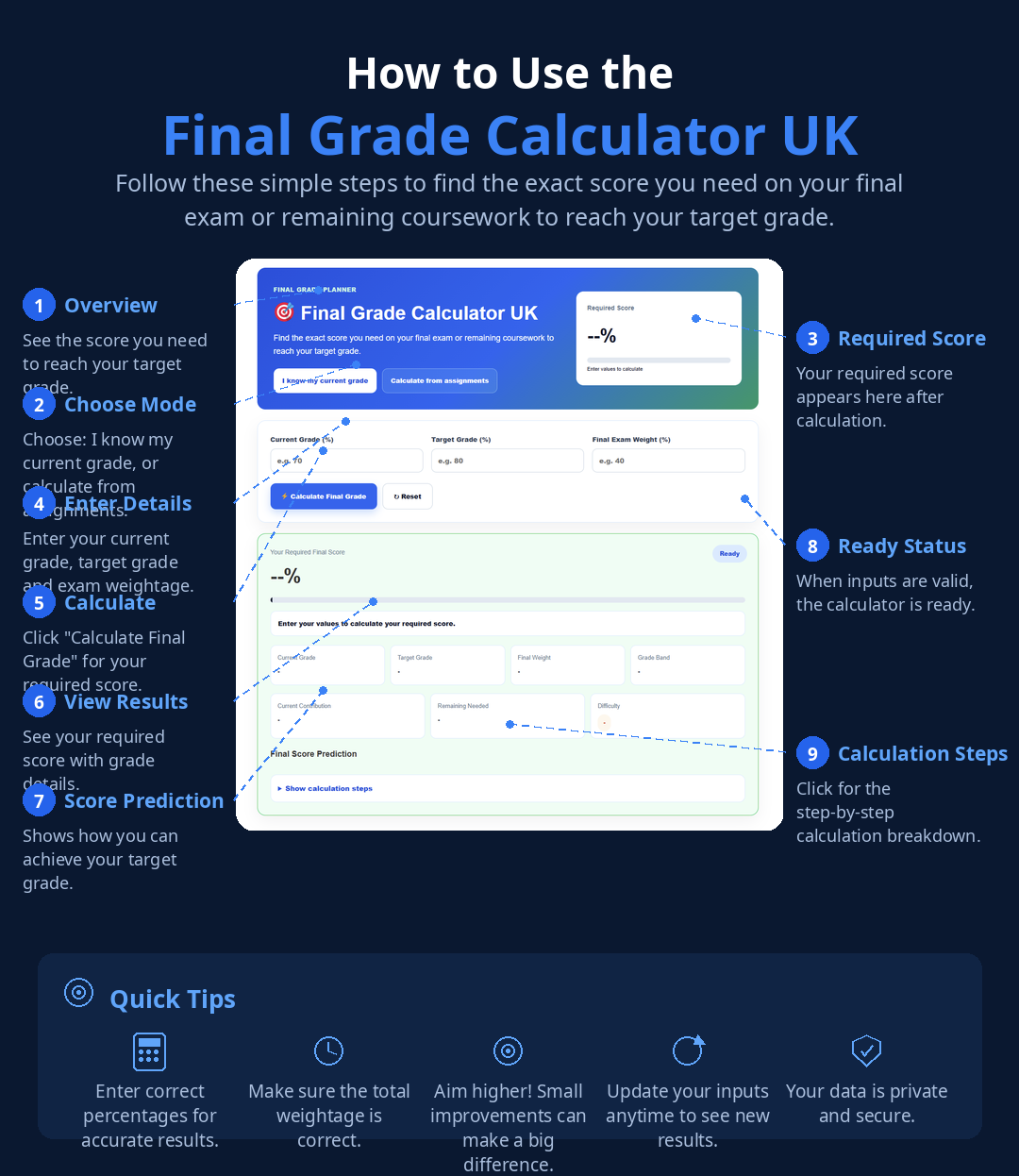
Click Here: Final Grade Calculator UK
The short answer: yes — a 2:2 is the standard floor, not a failure
Start with the official position, because it surprises people. UCAS entry-requirements guidance states that the standard requirement for a taught masters in the UK is at least a 2:2 in a relevant undergraduate degree. That is the baseline the sector works from. Universities then raise the bar for competitive courses — “many competitive programmes expect a 2:1 or above” — but the 2:2 minimum is the default, and plenty of institutions publish it verbatim. The University of Exeter’s masters entry page, for example, states that for postgraduate study you will “normally be required to have obtained, or expect to obtain, a first degree equivalent to at least a UK 2:2 Honours degree.”
Why does the 2:1 feel universal, then? Because the courses students look at first — Russell Group flagships, London programmes, anything with “Data Science”, “Finance” or “Law” in the title — cluster at the competitive end, where 2:1 is the genuine filter. But the UK has well over a hundred universities offering taught masters, and a large share of them list 2:2 as standard entry. Arden University’s MSc Accounting and Finance, for instance, lists “a UK Honours Degree at a minimum of second class (2.2)” as its standard criterion. The 2:1 you keep seeing is selection bias in your browsing, not the market.
There is also a structural reason masters entry is softer than undergraduate entry: demand. Taught masters are expensive for students and — bluntly — revenue for universities. Applicant-to-place ratios are far lower than at undergraduate level, which is why The Student Room’s long-running consensus is that “it’s not very difficult to get accepted onto a Masters course” provided the basics are in place. A 2:2 holder with a coherent application is a customer most departments are happy to have. That does not mean standards are fake; it means the bar is negotiable in a way A-level tariffs never were.
The 2:1 norm: where the line genuinely bites
None of the above means you can ignore the 2:1 requirement wherever it appears. There are four places where it is real, enforced, and worth planning around rather than hoping around:
| Where the 2:1 line bites | Why it holds there | What it means for a 2:2 holder |
|---|---|---|
| Competitive flagship programmes (Oxbridge, LSE, Imperial, UCL popular MScs) | Oversubscription: they can fill every seat several times over with 2:1+ applicants | Apply anyway only with exceptional compensation (experience, publications, references); otherwise target elsewhere |
| Funded places and scholarships | Exeter states you need “at least a 2:1 or its equivalent in order to be considered by any of the main funding bodies” | A 2:2 does not block the loan (see funding section), but most merit scholarships are 2:1-gated |
| Research-track routes (MRes → PhD, funded doctorates) | Supervisors and funders use the 2:1 as a proxy for research aptitude | A taught masters with a Distinction can reset this — see the “reset button” note below |
| Professional doctorates with fixed accreditation bars | Some clinical and legal pathways set non-negotiable academic thresholds | Check the accrediting body’s rules, not just the university’s |
The practical takeaway: the 2:1 line is hardest exactly where demand is highest and money is attached. Everywhere else — the broad middle of UK postgraduate provision — it is a preference wearing a requirement’s clothes. And even at the competitive end, the line has documented exceptions, which is where the routes below come in.
The four routes: how 2:2 holders actually get onto masters courses
There is no single trick. There are four distinct, documented routes, and which one fits depends on your subject, your experience, and how far below (or above) the line you sit. This is the decision framework to work through in order:
| Route | Who it suits | What it costs you | Evidence it works |
|---|---|---|---|
| 1. Direct entry at 2:2-standard courses | Any 2:2 holder (55–59 especially) | Nothing extra — same fees, same one-year course | Exeter (2:2 minimum published); Arden MSc (2:2 standard); many post-92 universities |
| 2. Work-experience / non-standard entry | 2:2 or third, with 2+ years relevant work | Time in industry; a strong professional reference | Arden: 5 years’ experience for non-standard entry; multiple TSR cases of 2:1-minimum courses flexing for experienced applicants |
| 3. Pre-masters / Graduate Diploma bridging | Third-class holders, or 2:2 holders targeting 2:1-minimum courses | An extra 4–12 months and £9k–£25k in pathway fees | QMUL Graduate Diploma (pass in a full first degree accepted); Northumbria QA (third/pass/ordinary accepted); ONCAMPUS Reading (2:2 minimum, age 21+) |
| 4. The course-leader conversation | Borderline 2:2 (57–59), strong final-year or dissertation marks | An email and a well-built case — free | Documented TSR case: 2:2 accepted onto a 2:1-minimum MSc at UCL after direct contact; course leaders confirming requirements “could be lowered to a 2:2” for the right applicant |
Route 1: direct entry — the courses that already say 2:2
The simplest route is also the most overlooked: apply where a 2:2 is the published standard. These are not consolation prizes. They include research-active universities across the sector, and the masters grading system is the same everywhere — a Distinction at a 2:2-entry university is still a Distinction, examined to the same QAA standards as anywhere else. Our guide to masters grading (Merit vs Distinction) explains what those classifications actually demand once you are in.
How to find them: on any course page, read the entry requirements line literally. “2:2 or equivalent” means you meet the academic bar outright — apply with confidence. “2:1 or equivalent” means the course is in the competitive cluster; keep reading, because the same page often adds the magic sentence. Exeter’s page, for instance, follows its requirements with: “For some programmes we also consider evidence of relevant personal, professional and educational experience.” That sentence is an invitation. Treat it as one.
One caution on subject fit: “relevant degree” matters more at 2:2 than at 2:1. A 2:1 in History applying for an MSc in Data Science is already stretching; a 2:2 in History doing the same is asking the admissions tutor to take two leaps at once. Conversion courses (computing, business, some psychology routes) exist precisely for switchers and judge you on motivation and aptitude evidence instead — they are among the most 2:2-friendly options in the sector.
Route 2: work experience as the second currency
When the degree classification is fixed, experience is the variable you can still move. Universities say this explicitly. Arden’s non-standard entry route welcomes applicants who “can demonstrate appropriate work experience”, requiring at least five years, ideally in a business-related discipline. Other universities set the bar lower — two to three years of relevant professional work is a commonly cited threshold — and professional qualifications (ACCA papers, CIMA, CIM, CMI membership) can count alongside or instead of years served.
This route is strongest in vocational subjects: business, management, marketing, HR, project management, social work, education, nursing and allied health. It is weakest where the course is academically sequential — a taught MSc in Mathematics or Theoretical Physics has little use for your sales experience, because the prerequisite is mathematical machinery, not professional maturity. Be honest about which side of that line your target course sits on.
The experience does not have to be glamorous; it has to be relevant and evidenced. Two years as a marketing executive with campaign metrics you can quote beats five years of unrelated admin. And it must be documented: a professional reference from a line manager who can speak to specific competencies carries real weight with admissions tutors, who read hundreds of generic academic references a year. A reference that says “James led a £40k campaign and can already do half of what we teach in semester one” is doing admissions work for you.
Route 3: pre-masters and Graduate Diplomas — the bridging year
If your classification is a third, or your target course genuinely will not flex, the formal bridge is the pre-masters (often called a Graduate Diploma). These are one-to-two-semester programmes that top up academic skills, subject knowledge and — for international students — English, with guaranteed or preferential progression to a linked masters on successful completion.
The entry bars tell you who these are for. Queen Mary University of London’s Graduate Diplomas accept “at least a pass in a full first degree” — a third, in other words, with all final-year modules passed. Northumbria’s QA pre-masters accepts “third class, pass or ordinary degree”. Heriot-Watt’s design pathway takes graduates whose honours degree “falls below standard entry requirement”. ONCAMPUS Reading asks for a 2:2 minimum and age 21+. The pattern is consistent: the pathway sector exists to convert sub-2:1 graduates into masters-ready students, and its entry requirements are set accordingly.
The honest costs, because nobody else will itemise them: pathway fees run roughly £9,000–£25,000 depending on provider and length (QMUL’s Graduate Diploma lists £24,250; ONCAMPUS Reading’s three-semester programme lists £10,030), on top of the masters fees that follow. The Postgraduate Masters Loan does not cover a pre-masters — GOV.UK is explicit that the loan is only for a full standalone masters of at least 180 credits, and “you cannot get a Postgraduate Master’s Loan for a postgraduate certificate or diploma.” So the bridge year is self-funded or employer-funded, which is why Route 3 should be a deliberate choice, not a default. It makes sense when the destination course is worth the toll: a competitive, career-shifting MSc, not a generic MA you could have entered directly elsewhere.

Route 4: the course-leader conversation (the free option nobody uses)
Here is the most underused move in postgraduate admissions: email the course leader before you apply. Not admissions — the academic who runs the programme. The Student Room threads are full of these stories because they keep working. One applicant with a 2:2 in Microbiology contacted course leaders directly, explained strong coursework marks and relevant lab experience, and received an MSc offer from UCL despite a published 2:1 minimum — plus acceptances at Imperial and Liverpool. Another was told outright that “for the ‘right’ applicant, the entry requirement could be lowered to a 2:2” where the applicant had strong relevant coursework marks and a coursework-assessed masters.
Why does this work? Because published requirements are set by marketing and registry; offers are made by academics. The course leader knows exactly how full the course is, how the cohort is shaping up, and whether your particular profile (strong dissertation, relevant final-year modules, professional experience) compensates for the headline number. An 8:1 application-to-offer ratio, as one TSR poster reported, is precisely when the legwork pays — you are competing against people who just clicked “apply”.
How to do it well: a short email, not a life story. Your degree, your classification, the two or three strongest pieces of evidence (dissertation mark, relevant module marks, experience), and one specific question — “given my profile, would you encourage an application?” Attach nothing; offer the transcript. If the answer is no, you have saved an application fee and learned something. If it is yes, name-drop the conversation in your personal statement. Admissions tutors remember encouraged applicants.
Two worked scenarios: the arithmetic of each route
Scenario 1 — Amara: 58.6% (2:2), BSc Computer Science, wants MSc Data Science. Her target course publishes “2:1 minimum”. She has three options. Option A: apply direct to the 2:1 course anyway after a course-leader conversation — cost £0 extra, odds uncertain but documented. Option B: apply to a 2:2-standard Data Science MSc — cost £0 extra, near-certain academic eligibility. Option C: a one-year pre-masters at ~£10,030, then the 2:1-minimum MSc at ~£11,000 average masters tuition. Full arithmetic of Option C: £10,030 + £11,000 = £21,030 total tuition, of which the Postgraduate Masters Loan (£13,206 for 2026–27 starters) can cover only the masters year — the loan covers the £11,000 masters fees in full with ~£2,206 left toward living costs — so the true extra cost of the bridge is the ~£10,030 pathway year, self-funded. Versus Option B: £11,000 masters fees, loan covers all of it, £2,206 left for living costs. The bridge only makes sense if the specific 2:1-minimum course is worth £10,000 more to her career than the 2:2-standard alternative. For most applicants, it is not — which is why Route 1 deserves first look, not last.
Scenario 2 — James: 54.8% (2:2), BSc Business, four years in marketing roles, wants an MSc Marketing that publishes 2:1 minimum. The course’s non-standard entry asks for five years’ experience (the Arden-style threshold). James has four — 80% of the bar, with a line manager willing to write a detailed reference and campaign metrics to evidence. His play: apply now via the work-experience route, leading the application with the reference and metrics, and simultaneously line up the course-leader conversation. If refused, the fallback is not despair but sequencing — one more year of experience clears the five-year threshold outright, and a Graduate Diploma remains the safety net. Note what James does not do: pay for a pre-masters he does not need, or assume the published 2:1 is final. The counterfactual matters: had James applied with no experience and no conversation, the same 54.8% would likely have been filtered. The classification did not change; the application around it did.
Where a 2:2 will still stop you — the honest limits
Three hard limits deserve plain statement. First, funded academia: research council studentships and most PhD programmes treat a 2:1 as the entry ticket. The reset button exists — a taught masters with a Distinction demonstrably erases a 2:2 in the eyes of PhD supervisors — but the direct 2:2-to-funded-PhD path is narrow. Second, elite professional pipelines: some magic-circle, investment-banking and strategy-consulting filters still screen on undergraduate classification, and a masters does not always override the filter. TSR’s blunt consensus is worth quoting in spirit: graduates who do a masters “thinking it will make up for missing out on a 2:1 at undergrad level when it comes to applying for jobs” often end up disappointed, because “most grad schemes that want a 2:1 will filter you out even with a Masters.” Our guide to whether your degree classification matters to employers works through the data behind that warning.
Third, the masters itself is harder than the degree. This is the warning inside the TSR thread that every 2:2 holder should read twice: students who scraped a 2:2 at undergraduate level disproportionately end up with a bare Pass or a Postgraduate Diploma at masters level, because masters assessment assumes the academic habits a 2:1 implies. A masters does not fix weak study skills; it punishes them faster, in twelve months, at £11,000 a year. Go in for the subject, with a plan for the workload — our masters grading guide shows exactly what Merit and Distinction demand. If the motivation is “escape a 2:2”, fix the habits first or pick the 2:2-standard course where the cohort pace matches.
Funding: your classification is irrelevant to the loan
Here is the part of the system that genuinely does not care about your 2:2. The UK Postgraduate Masters Loan — up to £13,206 for courses starting in 2026–27 — has no degree-classification requirement at all. GOV.UK’s eligibility page lists the conditions: your course (a full standalone masters of at least 180 credits at an eligible provider), your age (under 60), and your nationality/residency. Your undergraduate classification appears nowhere in it. A 2:2, a third, a pass — the loan treats them identically, paid directly to you to split between fees and living costs as you choose.
The caveat is everything the loan is not. It will not cover a pre-masters or Graduate Diploma (certificates and diplomas are excluded). It is one per lifetime — “you’ve received a loan or grant for a master’s course before” disqualifies you. And £13,206 against average masters fees of ~£11,000 leaves thin living-cost coverage, which is why part-time study (two years, loan spread the same) is the realistic funding model for many 2:2 holders combining study with work. Merit scholarships are the other funding source — and those, unlike the loan, usually do want a 2:1. Budget on the loan, not the scholarship.
Making the application count: seven moves that shift decisions
Admissions tutors deciding on a 2:2 application are asking one question: is this applicant’s 2:2 the real measure of them? Everything below is evidence aimed at that question.
1. Lead with trajectory, not the headline number. A 2:2 built as 52 → 58 → 64 across the three years tells a different story from 62 → 58 → 54. If your final year or dissertation is strong, put those marks in the personal statement’s first paragraph. Tutors read for momentum.
2. Get references from people who know your work. The TSR applicant who reached UCL used their dissertation supervisor and course leader — people who could testify to subject ability, not pastoral acquaintances. Brief your referees: ask them to address your capacity for postgraduate-level work specifically.
3. Evidence relevant experience concretely. “Two years in marketing” is a line; “two years in marketing, owning a £40k annual campaign budget with a 3.1x ROAS” is an argument. Quantify everything.
4. Have the course-leader conversation early. September–November for the following autumn intake. Late applications from 2:2 holders compete for leftover seats; early ones get full consideration.
5. Explain, don’t excuse. If extenuating circumstances depressed your classification, say so once, factually, with evidence — then move on to what you have done since. Our guide to extenuating circumstances covers how universities formalise this. A paragraph of context helps; a page of apology hurts.
6. Apply to a spread, not a single dream course. Two 2:2-standard courses, two 2:1-minimum courses where you have had the conversation, one stretch. Five applications is normal at postgraduate level.
7. Know your borderline. If you are sitting at 58–59 now and still studying, every mark matters enormously — the difference between a high 2:2 and a 2:1 rewrites this entire guide for you. Our 2:2-to-2:1 recovery guide and grade appeal guide are the tools for that fight. A 2:2 holder reading this in final year should be fighting for the 2:1 first and planning the masters second.
Six myths about masters entry with a 2:2
| Myth | Reality |
|---|---|
| “No good university accepts a 2:2” | UCAS guidance sets 2:2 as the standard minimum for taught masters; universities including Exeter publish 2:2 as their baseline. “Good” was never defined by the entry tariff. |
| “A published 2:1 is non-negotiable” | Documented cases (including UCL) show 2:1-minimum courses admitting 2:2 holders with strong compensating evidence — especially after direct contact with the course leader. |
| “A masters erases my 2:2 for employers” | Often it does not: many graduate schemes still filter on undergraduate classification. Do the masters for the subject and the skills, not as classification laundry. |
| “I need a pre-masters because of my 2:2” | Pre-masters exist mainly for third-class holders, subject-switchers and international students. Most 2:2 holders can enter directly somewhere — check Route 1 before paying £10k+. |
| “Funding requires a 2:1” | The Postgraduate Masters Loan (£13,206 for 2026–27) has no classification requirement. Only merit scholarships and research-council funding typically demand 2:1+. |
| “My university’s ranking decides everything” | At postgraduate level, tutors assess individual ability and potential over institutional pedigree — a documented move from a lower-ranked university to a Russell Group MSc on a 2:2 exists in the forums. |
Can I do a masters with a 2:2 in the UK?
Yes. UCAS guidance sets a 2:2 as the standard minimum entry requirement for a taught masters in the UK, and many universities — including the University of Exeter — publish a 2:2 as their baseline. Competitive programmes often ask for a 2:1, but a 2:2 holder can apply directly to 2:2-standard courses, use work experience for non-standard entry, take a pre-masters bridging course, or discuss flexibility directly with the course leader.
Which UK universities accept a 2:2 for masters degrees?
Many do. The University of Exeter states that postgraduate applicants will normally need at least a UK 2:2 Honours degree, and providers such as Arden University list a 2:2 as standard entry for courses like MSc Accounting and Finance. Across the sector, a large share of taught masters outside the most competitive flagship programmes accept 2:2 holders — always check the individual course page, since requirements are set per programme, not per university.
Can I do a masters with a third-class degree?
It is harder but possible. Direct entry to most taught masters with a third is unlikely, but pre-masters and Graduate Diploma pathways are designed for exactly this case: Queen Mary University of London accepts a pass in a full first degree for its Graduate Diplomas, and Northumbria’s QA pre-masters accepts third-class, pass or ordinary degrees. Relevant professional experience can also open non-standard entry routes.
Does work experience make up for a 2:2 when applying for a masters?
Often, yes — particularly for vocational subjects like business, marketing, HR and management. Universities publish non-standard entry routes for experienced applicants; Arden, for example, considers applicants with at least five years of relevant work experience. A detailed professional reference and quantified achievements strengthen the case considerably, and contacting the course leader directly to discuss your profile is strongly recommended.
What is a pre-masters course and who needs one?
A pre-masters (often called a Graduate Diploma) is a one-to-two-semester bridging programme that prepares you for masters-level study, with progression to a linked masters on successful completion. It suits third-class holders, 2:2 holders targeting 2:1-minimum courses, subject-switchers and international students. Costs range roughly from £9,000 to £25,000, and the Postgraduate Masters Loan does not cover pre-masters courses, so it should be a deliberate choice rather than a default.
Will a masters fix my 2:2 for graduate jobs?
Not reliably. Many graduate schemes still filter applicants on undergraduate degree classification, and a masters does not always override that filter. A masters is worth doing for the subject knowledge, skills and career change — not as a way of laundering a 2:2. Be aware too that masters study is a step up in intensity, and students who struggled at undergraduate level need a genuine plan for the workload.
Can I get a postgraduate loan with a 2:2?
Yes. The UK Postgraduate Masters Loan — up to £13,206 for courses starting in 2026–27 — has no degree-classification requirement. GOV.UK eligibility depends on your course (a full standalone masters of at least 180 credits), your age (under 60) and your residency status. Note the loan cannot be used for pre-masters courses, postgraduate diplomas or certificates, and you can only receive it once.
Should I contact the course leader before applying with a 2:2?
Yes — it is the highest-value free move available. Published 2:1 requirements are often flexible for strong applicants, and there are documented cases of 2:2 holders receiving offers from 2:1-minimum courses (including at UCL) after direct contact. Send a short email with your classification, your strongest evidence (dissertation mark, relevant modules, experience) and one question: given your profile, would they encourage an application?
Conclusion
So: can you do a masters with a 2:2? Yes — and not as an exception, a loophole, or a favour. A 2:2 is the sector’s standard minimum for taught postgraduate study, a large share of courses publish it outright, work experience opens a second door at many more, pre-masters bridging exists for the cases that need it, and the course-leader conversation costs nothing and works more often than applicants expect. The funding system backs you too: the Postgraduate Masters Loan does not ask about your classification. The obstacles are real but specific — competitive flagships, funded research tracks, and the workload step-up of masters study itself — and each has a named workaround in this guide.
The single most valuable thing you can do this week is also the simplest: shortlist five courses, read their entry pages literally, and email two course leaders. You will learn more about your actual chances from those two replies than from a month of forum-scrolling. And if you are still in final year sitting on a 58 or 59, fight for the 2:1 first — it rewrites every option above. Either way, a 2:2 is a starting position, not a verdict.

![Read more about the article Can You See Your Marked Exam Scripts? UK Student Rights Explained [2026]](https://gradeforuni.com/wp-content/uploads/2026/10/featured-exam-scripts-uk-300x192.png)
![Read more about the article When Do Uni Results Come Out? UK University Results Day Explained [2026]](https://gradeforuni.com/wp-content/uploads/2026/10/featured-university-results-day-300x192.png)
![Read more about the article How Do University Marking Criteria Work? Rubrics Explained [2026]](https://gradeforuni.com/wp-content/uploads/2026/10/featured-marking-criteria-300x192.png)