
![You are currently viewing Can You See Your Marked Exam Scripts? UK Student Rights Explained [2026]](https://gradeforuni.com/wp-content/uploads/2026/10/featured-exam-scripts-uk.png)
If you are asking whether you can see your marked exam scripts at a UK university, you are asking one of the most common questions students have after results day.
You sat the exam, you waited weeks for the result, and then the number lands in your inbox — 52%. It feels wrong. You remember writing solid answers. Your first instinct is the obvious one: show me the script — let me see where I lost the marks.
At a UK university, that simple request turns out to be surprisingly complicated. Some universities will sit you down with your marked script under supervision. Some will flatly refuse. And data protection law — the thing students most often quote in this argument — gives you less than you think, and slightly more than universities admit.
This guide explains exactly where you stand: what the law (the Data Protection Act 2018’s exam-script rules) actually entitles you to, what UK universities really do in practice — including a five-university policy comparison — how to request a supervised viewing of your script, and when seeing it can genuinely change your outcome versus when you are better off going straight to an administrative check or an appeal.
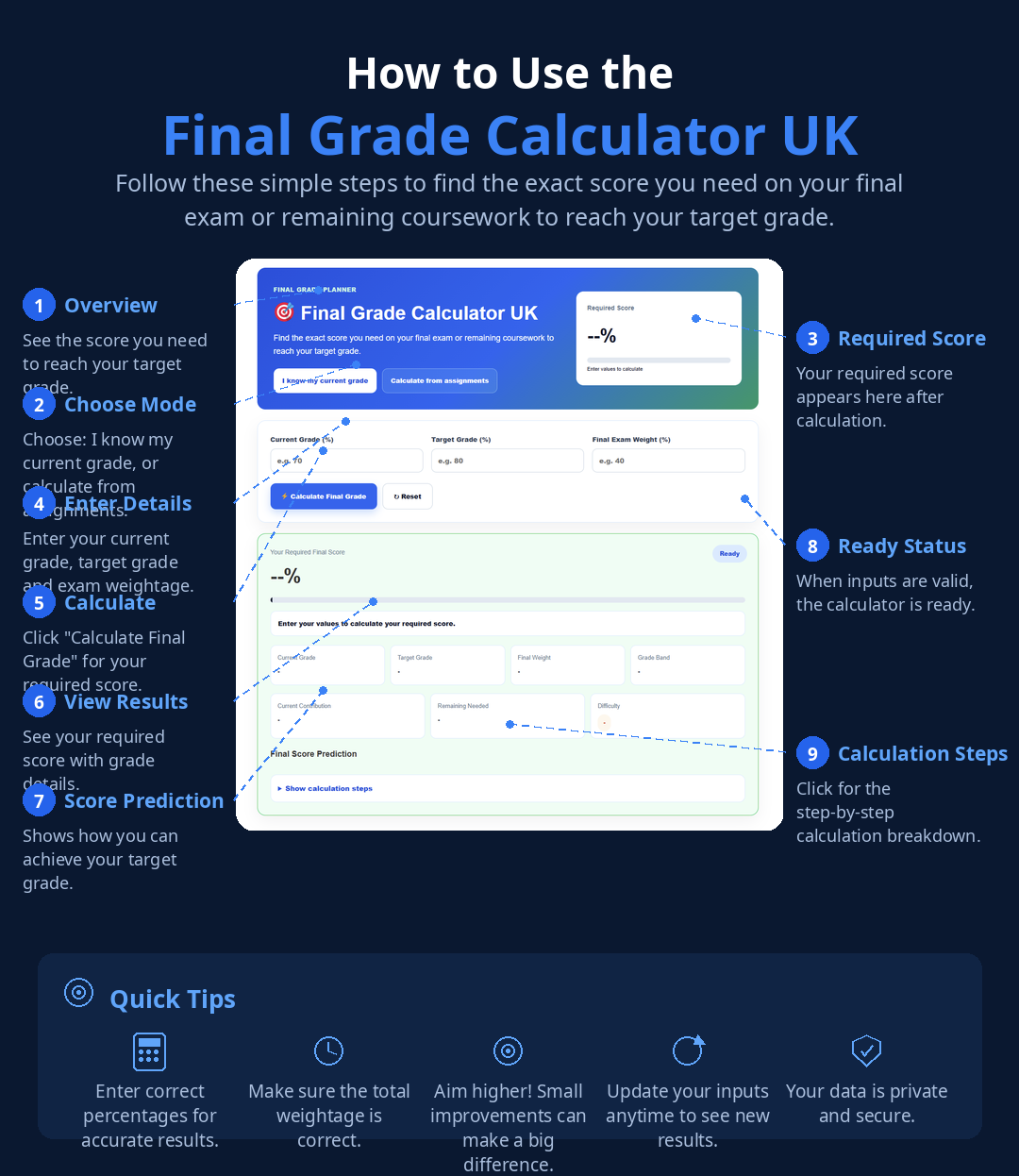
Click Here: Final Grade Calculator UK
The Short Answer: You Are Asking Three Different Questions
Most students bundle their request into one sentence — “I want to see my exam script” — but universities and the law treat it as three separate asks, and the answer to each is different:
| What you are really asking | Typical answer |
|---|---|
| Can I view my marked script? (look at it, supervised) | Often yes — but only under supervision, and only at universities with a viewing policy. About a third of UK universities give students an explicit right to view. |
| Can I get a copy to take away? | Almost never. Universities guard scripts to protect question banks and academic integrity; most policies prohibit copies leaving the building. |
| Can I get my mark changed because of what I see? | No — not on the strength of viewing alone. Seeing the script is information, not a remedy. Mark changes need an administrative check or a formal appeal. |
Understanding that split is the key to the whole topic. Students who demand “my script, now, under GDPR” usually get refused, because that framing collapses three different rights into one. Students who ask the right question of the right process — a supervised viewing under the department’s policy, or a subject access request for the examiner’s comments — very often get what they need.
What the Law Actually Says: The DPA 2018 Exam-Script Rules
The legal position sits in the Data Protection Act 2018, Schedule 2, Part 4, paragraph 25 — the exam scripts and exam marks exemption. It has two distinct parts, and the distinction between them is the single most misunderstood point in this whole debate.
Part one: your own written answers
The exemption says you do not have a subject-access right to the information you yourself recorded during the exam — your answers, in other words. The ICO’s guidance puts it plainly: students do not have a right to get copies of their answers from exams or assessments via a data protection request. The purpose is practical: if students could SAR their scripts before results day, they would effectively get their results early, and the whole results-publication timetable would collapse.
This is also why making the request after results are published matters. The exam-marks part of the exemption does not block access forever — it delays it. If you request your marks before results are announced, the university gets an extended deadline: it must respond within five months of your request, or within 40 days of the results being published, whichever date comes first. The ICO confirms that requests made after results are announced are handled as normal subject access requests, with the standard one-month response time.
Part two: what the examiner wrote about you
Here is the part universities would rather you did not know: the examiner’s comments on your performance are not covered by the exemption. Comments recorded by an examiner — whether scribbled in the margin of your script or written on a separate marking sheet — are your personal data, and you can request them through a subject access request. The ICO has said this explicitly, noting that a breakdown of your overall mark and the examiners’ comments can help you decide whether to resit or change direction, even though it will not by itself alter your grade.
There is even European case law behind the broader principle: in Nowak (2017), the European Court of Justice ruled that a candidate’s exam script — including the examiner’s annotations — constitutes the candidate’s personal data. UK law keeps the statutory exemption for the script itself, but the direction of travel is clear: the information about your performance belongs to you in a way the physical script does not.
One more legal dead end to close off: a Freedom of Information request will not get you your own script. Your own personal data is exempt from FOI disclosure (section 40 of the FOIA). FOI is for institutional information, not your personal records — use a subject access request or your university’s own policy instead.
Read more: Can You Ask for a Remark? How Re-marking and Mark Reviews Work at UK Universities [2026]
What Universities Actually Do: Five Policies Compared
The law sets the floor. What universities actually do sits well above it — or well below it, depending on the institution. A Higher Education Policy Institute report, which surveyed the approaches of the 140 members of Universities UK, found the sector strikingly inconsistent: only about half of the universities that run written exams even have a published policy on student access to marked scripts. Of the institutions whose practice was made available to the researchers, roughly 34% give students the right to view their marked scripts, 19% prohibit viewing outright, and 47% leave the decision to individual schools or faculties — meaning two students at the same university can get different answers.
The report’s verdict was blunt: restrictive access policies harm students by reducing their opportunities to learn from past work and by undermining confidence in the exam system — one area, it said, where universities have fallen behind schools, since GCSE and A-level boards now offer script access as standard. The typical justifications universities gave were administrative burden, question-bank security, and a belief that students would not benefit.
Here is how five real UK university policies compare — the full spectrum, from open to closed:
| University | Policy on marked exam scripts | How you get access |
|---|---|---|
| University of Surrey | Students may be shown their marked scripts, but scripts are never returned permanently. Module leaders also publish written exam solutions after marks are ratified, plus generic cohort feedback on common errors. | Ask your module leader; solutions appear on SurreyLearn after ratification. |
| University of Essex | The department must either let you see your script in the presence of academic staff, or supply you with a copy or summary of the examiners’ comments, including per-question marks. | Apply to the responsible department, normally within four weeks of marks being published. |
| Health Sciences University (HSU) | Full supervised-viewing policy: you review the script in an appointment with your unit leader, with ID. You may not take the script away, bring anyone with you, or have extra scans made. Students resitting failed exams get dedicated arrangements to review the failed script. | Request an appointment via Registry; the unit leader collects and returns the script. |
| UCL | Examination scripts are not routinely returned to students. However, to comply with data protection law, students may request to see examiner comments on scripts in a legible form — though the original scripts themselves do not have to be made available. | Queries go to UCL Legal Services. |
| Cambridge (Engineering) | Does not release examination scripts to students at all. Examiners are expressly instructed not to write comments on scripts. A broad sample of scripts is retained for five years for teaching evaluation and accreditation. | Effectively no route — the closed end of the spectrum. |
Notice the pattern: the more open universities separate viewing (supervised, no copies) from feedback (model answers, cohort commentary, per-question marks). Surrey’s approach is arguably the most useful in practice — a published set of model solutions tells you exactly what a full-mark answer looked like, which is often more instructive than staring at your own script.

Worked Example: When Seeing Your Script Actually Matters
Before you spend weeks trying to see your marked exam scripts, do the arithmetic. A script viewing is worth pursuing when the plausible upside is large enough to move something real — a module band, a year average, a classification. Here is a concrete case.
Daniel is a second-year Economics student. His Microeconomics exam was four essay questions at 25 marks each (100 marks total), worth 60% of the module; his coursework (40%) scored 64%. His exam result: 52/100. His module mark is therefore (52 × 0.6) + (64 × 0.4) = 31.2 + 25.6 = 56.8% — a 2:2.
Daniel does what we call a missing-marks audit — a reconstruction you can do without the script. Within a day of the exam, while memory is fresh, he writes down his honest estimate of each answer: Q1 ~16/25 (confident), Q2 ~14/25 (decent), Q3 ~9/25 (ran out of time, rushed the final paragraph), Q4 ~13/25 (okay). Total: 52. His estimate matches the awarded mark exactly — which tells him the marking is probably accurate, and a viewing would likely just confirm it.
But consider the counterfactual that makes a viewing worthwhile. Suppose Daniel’s audit had instead estimated Q3 at ~17/25 — he actually wrote two strong pages but the result implies ~9. An 8-mark gap on one question is a red flag: it suggests a page may have gone unmarked, or a continuation booklet was missed. If a supervised viewing confirmed Q3’s final page was unmarked and it was re-marked at 17, his exam becomes 60/100 and his module mark becomes (60 × 0.6) + 25.6 = 36 + 25.6 = 61.6% — a 2:1.
On a 20-credit module in a 120-credit year, that is +0.8 percentage points on his year average, and roughly +0.3 points on his final degree average at 40:60 weighting — small in isolation, but exactly the kind of margin that decides borderline classifications.
The rule of thumb: if your reconstruction gap exceeds about 10% of the paper’s total marks, request the viewing. Below that, you are most likely looking at legitimate academic judgement — harsh but lawful — and your energy is better spent on the options in the next section. And here is the honest caveat Daniel’s case also shows: even when you are right about the missing marks, the viewing itself changes nothing. It only gives you the evidence to trigger an administrative check, which corrects process errors (unmarked pages, addition mistakes) — never a disagreement about quality.
Read more: How to Appeal a University Grade in the UK: Grounds, Evidence and Deadlines [2026]
Your Four Options: A Decision Framework
Students usually arrive at this topic with one of four underlying goals. Match your goal to the right process — they have different rules, different deadlines, and different chances of changing anything:
| Your goal | Right process | What it can change | Typical deadline |
|---|---|---|---|
| “I want to learn from my mistakes” | Supervised script viewing, or published model solutions / cohort feedback | Nothing about the mark — but genuinely useful for resits and future exams | Soon after results; Essex-style policies say within ~4 weeks |
| “I think a page went unmarked / marks were added up wrong” | Administrative check (sometimes called a mark review) | Corrects process errors only — unmarked sections, transcription and addition mistakes | Short — often 10–20 working days from results (UCL 10, Manchester 20) |
| “The process was unfair” (bias, procedural error, EC ignored) | Formal academic appeal | Can order a re-mark or void the attempt in proven procedural cases — never a re-judgement of quality | Strict and short — check your regulations immediately |
| “Something serious affected my performance” | Extenuating circumstances claim | Can grant an uncapped resit or void the attempt — but only with evidence and within the claim window | Usually within days of the exam or results |
The most common mistake is using the wrong door: filing a full academic appeal when you only wanted feedback (slow, adversarial, likely rejected on “academic judgement” grounds), or demanding a script viewing when you actually suspect an unmarked page (a viewing gives you information; only the administrative check fixes the mark). Work out which row you are in before you write a single email.
Read more: What Is Extenuating Circumstances: How UK Universities Protect Your Grades [2026]
How to Actually Get to See Your Script: Four Steps
Step 1 — Find your university’s policy first. Remember the HEPI finding: only about half of universities publish one, and nearly half of those that do leave it to faculties. Search your university’s site for “access to examination scripts” or “release of examination scripts” plus your department name. If there is no published policy, email your department’s teaching office — not your lecturer — and ask what the local arrangement is. Departmental administrators handle these requests routinely; lecturers often do not know the policy exists.
Step 2 — Request a supervised viewing, not the script. Frame the request the way policies are written: “I would like to arrange a supervised viewing of my marked script for [module code], please.” Do not invoke GDPR in the first email — it signals a dispute and routes you to legal services instead of the teaching office. The Essex model (viewing in the presence of academic staff, or examiner comments plus per-question marks) is a reasonable thing to cite if your own university’s policy is silent: it shows you are asking for something the sector already does.
Step 3 — If viewing is refused, SAR the examiner’s comments. This is your legal backstop. A subject access request for “all examiner comments, annotations and per-question marks relating to my performance in [module]” must be answered within one month (post-results), and the exam-script exemption does not cover comments. At universities like Cambridge Engineering — where examiners are instructed not to write comments on scripts — this route yields little, which is worth knowing before you spend a month waiting.
Step 4 — Watch the clock. Viewing windows are short, and they are separate from appeal deadlines:
| Route | Typical time limit | Notes |
|---|---|---|
| Supervised viewing request | ~4 weeks from marks publication | Essex’s stated window; many departments use similar informal limits |
| Subject access request (comments) | No deadline — but request promptly | One-month response time once results are published |
| Administrative check | 10–20 working days from results | UCL: 10 working days; Manchester: 20 — miss it and the door closes |
| Published model solutions | After ratification | Surrey model: solutions appear once marks are confirmed by the board |
What You Cannot Get (Read This Before You Argue)
To save you a futile fight, here are the requests that will be refused — lawfully — at virtually every UK university:
- The script to take home, or a photocopy. Supervised viewing is the ceiling at open universities; UCL states the originals do not have to be made available at all, and HSU expressly prohibits extra scans.
- Pre-results access via data protection law. The whole point of the exam-script exemption is to stop results leaking early. Request before publication and you will wait — up to five months or 40 days post-publication.
- Your script via Freedom of Information. Your own personal data is exempt from FOI. This route is a dead end by statute, not by university choice.
- Scripts kept indefinitely. Universities retain scripts under data-retention schedules (Cambridge Engineering keeps a sample for five years), then destroy them. A SAR for a three-year-old script will very likely find nothing left to disclose.
- A mark change from viewing alone. Viewing is information. If what you find is a process error, you still need the administrative check; if it is a judgement you disagree with, no process at any UK university will re-mark on that basis — academic judgement is the immovable wall behind appeals, re-marks and viewings alike.
Six Myths About Exam Scripts, Corrected
| Myth | Reality |
|---|---|
| “GDPR gives me the right to see my marked script.” | Partly true at best. The DPA 2018 exam-script exemption blocks access to your own written answers; it does not block access to the examiner’s comments about them. |
| “I can FOI my script if the university refuses.” | No. Your own personal data is exempt from Freedom of Information requests. Use a subject access request instead. |
| “Universities that refuse are breaking the law.” | No. Refusal policies are generally lawful — the HEPI report criticises them as harmful to learning, not as illegal. |
| “If I spot an error, they have to change my mark.” | No. Spotting it is step one; an administrative check is the mechanism, and it only corrects process errors — never academic judgement. |
| “Coursework works the same way.” | No. Coursework is normally returned with feedback as standard. The restrictive script rules exist because exams reuse question banks and are marked anonymously at scale. |
| “Anonymous marking means they can’t find my script.” | No. Anonymity applies during marking. After marks are confirmed, scripts are matched back to student records — that is how transcripts get written. |
Read more: University Transcript UK: How to Read Yours and Fix Issues [2026] — and Borderline Grades: How UK Universities Decide borderline Degree Classifications [2026]
Can I see my marked university exam script?
Sometimes. Around a third of UK universities give students an explicit right to view marked scripts under supervision; about a fifth prohibit it; the rest leave it to faculties. Check your university’s examination-script policy or ask your department’s teaching office.
Does GDPR give me the right to my exam script?
Not to the script itself. The Data Protection Act 2018 exam-script exemption means you cannot use a subject access request to obtain your own written answers. It does not cover the examiner’s comments, which you can request.
Can I get the examiner’s comments on my exam?
Yes. Comments recorded by an examiner about your performance are your personal data and are not covered by the exam-script exemption. Make a subject access request to your university; after results are published it must normally be answered within one month.
Can I take my exam script home or get a photocopy?
Almost never. Universities that allow viewing do so under supervision only, and most policies prohibit copies leaving the building, to protect question banks and academic integrity.
How soon after results do I need to ask?
Quickly. Supervised-viewing windows are often around four weeks from marks publication, and administrative checks can be as short as 10 working days. Subject access requests have no request deadline, but delays weaken your position.
What if my university refuses to show me my script?
Refusal is generally lawful. Your backstop is a subject access request for the examiner’s comments and per-question marks, which the exam-script exemption does not cover. You can also ask for published model solutions or cohort feedback.
Will seeing my script change my mark?
No, not by itself. Viewing gives you information; only an administrative check can correct process errors such as unmarked pages or addition mistakes. No UK university will re-mark work because you disagree with the academic judgement.
Do the same rules apply to coursework?
No. Coursework is normally returned with feedback as standard. The restrictive script rules exist because exams reuse question banks and are marked anonymously at scale.
Conclusion
The question “can I see my marked exam script?” has no single UK-wide answer — and that is the real story. The law gives you less than the slogans promise: the Data Protection Act 2018 deliberately withholds your own written answers while protecting your right to everything the examiner wrote about them. Universities then fill the space the law leaves open with policies ranging from Surrey’s published model solutions to Cambridge Engineering’s total refusal, with most of the sector sitting somewhere uncomfortably in between.
The practical path is therefore not to argue about rights in the abstract but to work the system as it exists: do your missing-marks audit within days of results, ask your department for a supervised viewing in the language its policy uses, and keep the administrative-check deadline — often just 10 to 20 working days — firmly in view. Where viewing is refused, the subject access request for examiner comments is a genuine legal backstop, not a bluff.
And when the numbers show the marking was simply harsh rather than wrong, accept the information for what it is — feedback for the next exam — instead of burning weeks on a process that cannot overrule academic judgement. The students who get the most out of this system are not the ones who shout loudest about GDPR; they are the ones who ask the right question, of the right office, before the deadline passes.

![Read more about the article When Is the UCAS Deadline 2027? January Equal-Consideration Date Explained [2026]](https://gradeforuni.com/wp-content/uploads/2026/10/featured-ucas-deadline-2027-300x192.png)

![Read more about the article Degree Apprenticeship Grading Explained: How EPA, Merit and Distinction Work [2026]](https://gradeforuni.com/wp-content/uploads/2026/10/featured-degree-apprenticeship-grading-300x192.png)