university grade conversion calculator Picture this: you’ve just logged into your student portal and seen a percentage staring back at you. Maybe it’s 64%. Maybe it’s 71%. Either way, you have no real sense of what that number actually means once you leave the UK system.
Is 64% a good GPA? Does 71% count as a First everywhere, or just here? If you’re applying for a scholarship in the US, a graduate scheme in Canada, or a Masters programme in Germany, someone is going to ask you to convert that mark into a format they understand — and “roughly a B, I think” isn’t going to cut it.
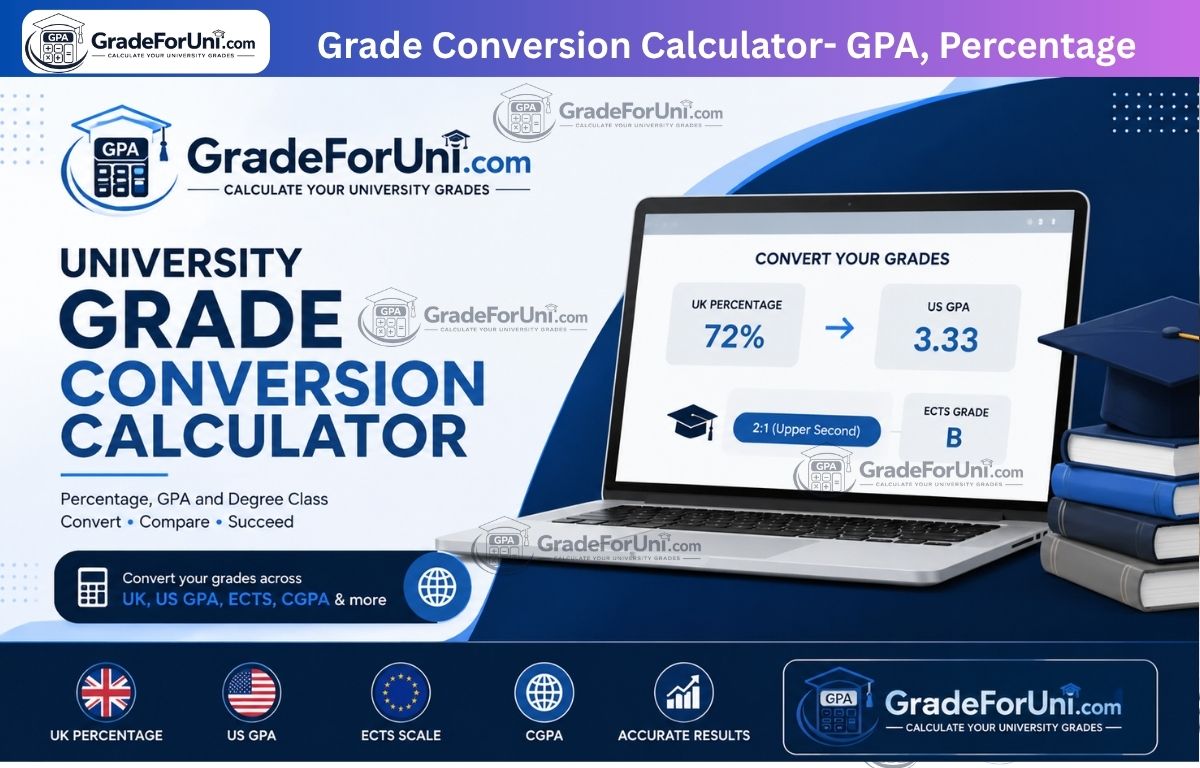
That’s exactly the gap a university grade conversion calculator fills. It takes the mark your university gave you and translates it into the systems other countries and institutions actually use, so you’re not left guessing whether your degree classification “translates well” or not.
This guide walks through exactly how grade conversion works, the systems you’re most likely to be converting between, the step-by-step process, and the details most guides leave out.
Click Here: UK University Grade Calculator
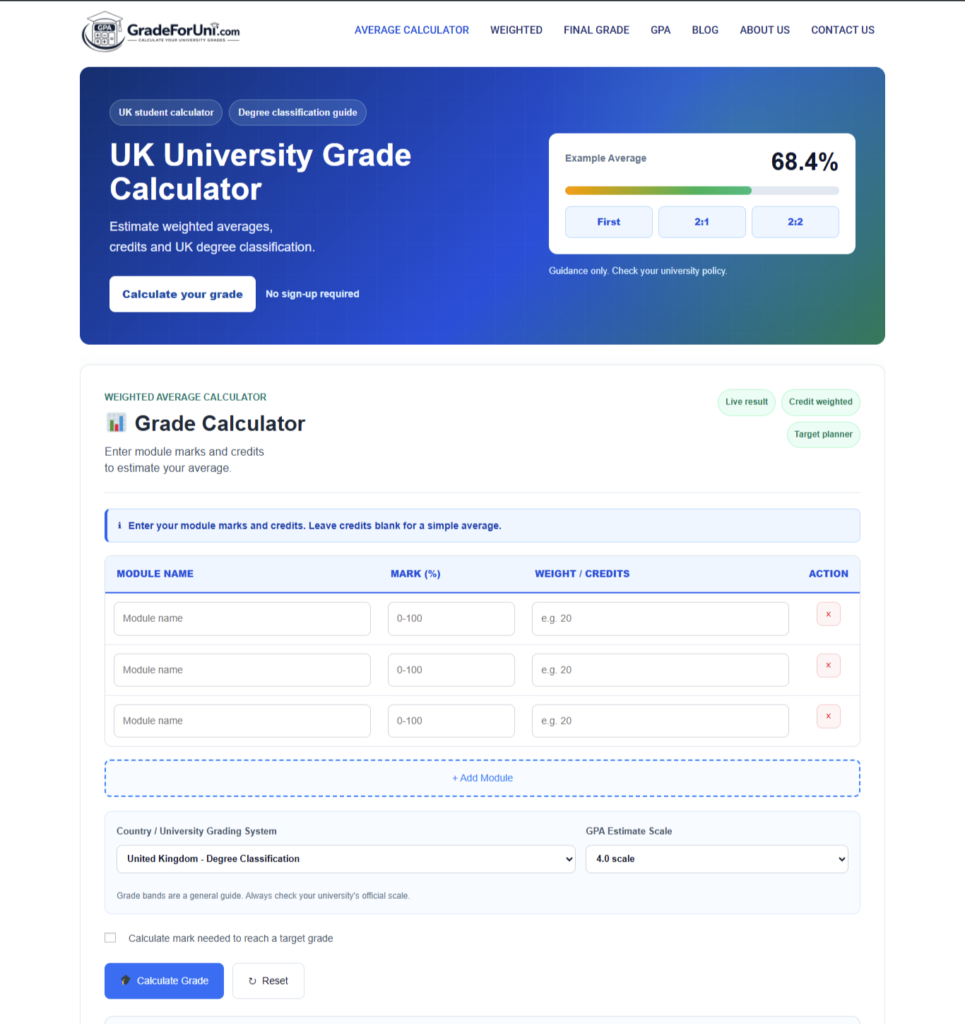
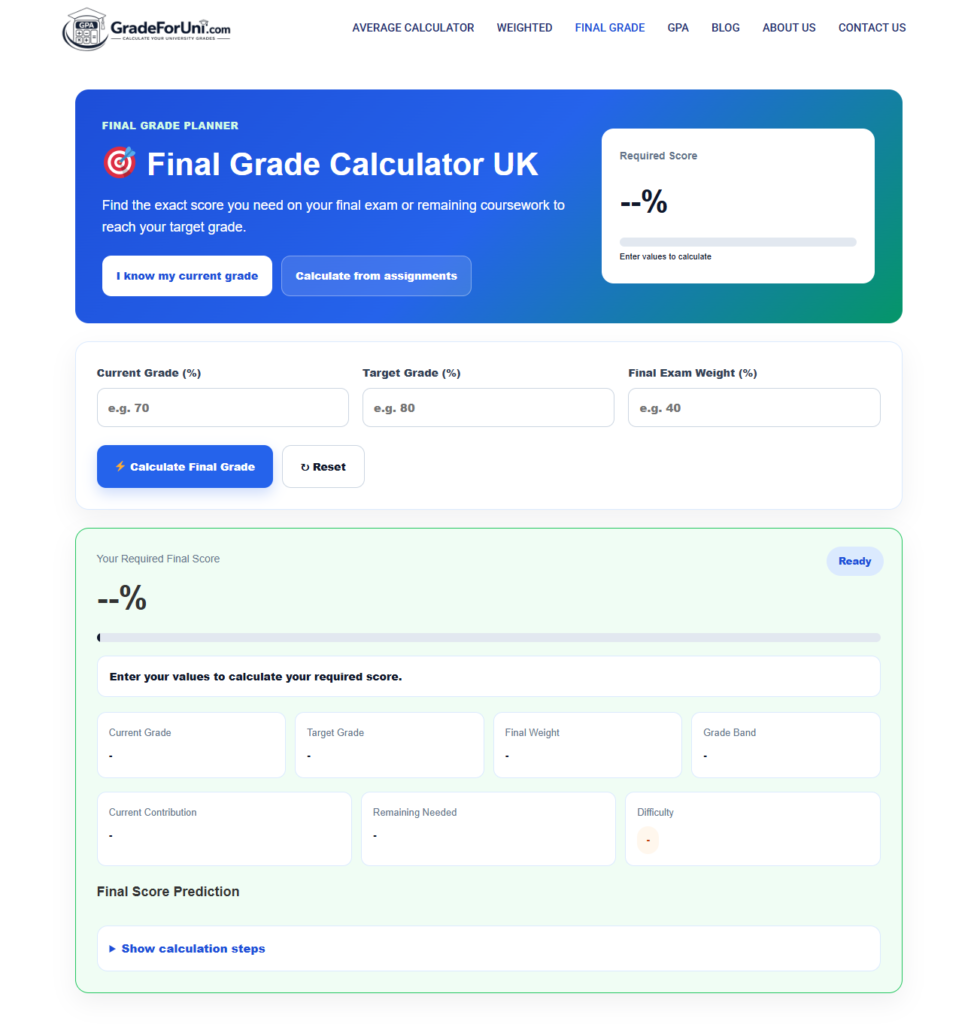
How to use the UK University Grade Calculator
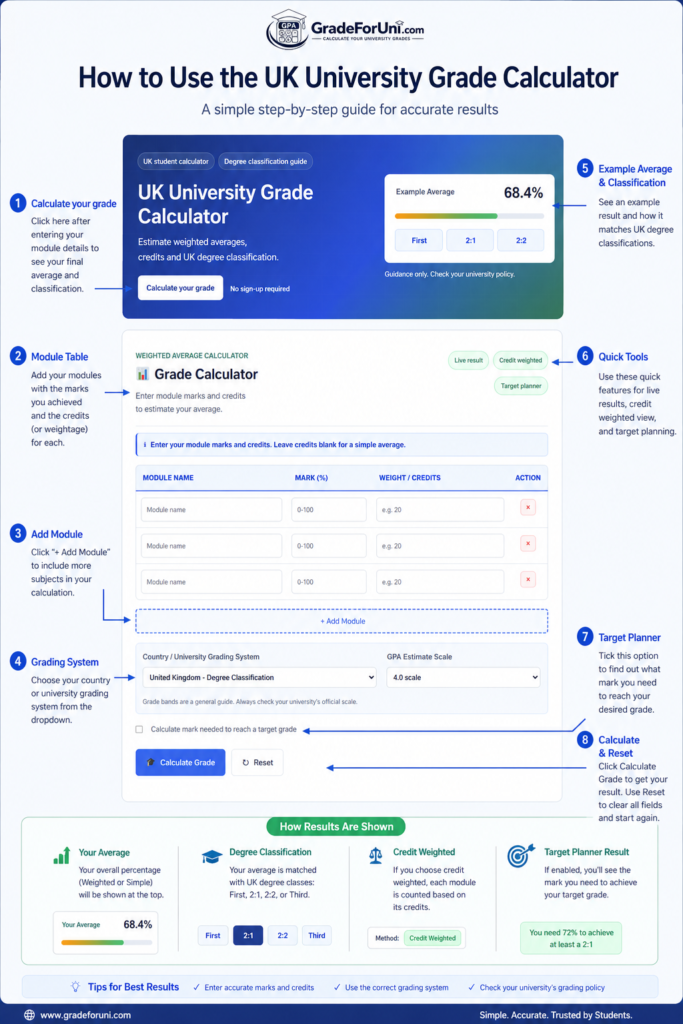
Quick Answer
A university grade conversion calculator turns one grading format into another — typically converting a UK percentage into a US-style GPA, a degree classification (First, 2:1, 2:2, Third) into a letter grade, or vice versa. It works by matching your percentage or classification against standard conversion bands, then returning the equivalent grade on the target scale. Because conversion scales vary between institutions and countries, most calculators give a close estimate rather than an official figure, so it’s worth checking the receiving university’s own published conversion table for anything that matters, like an application or transcript submission.
Why Grade Conversion Matters
Every year, thousands of UK students apply abroad for postgraduate study, exchange programmes, scholarships, or graduate jobs. Nearly all of them hit the same wall: the receiving institution doesn’t use percentages or degree classifications. It wants a GPA.
The reverse is just as common. (university grade conversion calculator) International students arriving in the UK need to know how their home country’s grading system lines up against British degree bands, so they can understand entry requirements or explain their previous results to a UK admissions tutor.
Grade conversion isn’t just an academic curiosity. It directly affects:
- Scholarship eligibility — many scholarships set a minimum GPA (commonly 3.0 or 3.5), and you need to know where your UK mark actually falls
- Postgraduate applications — Masters and PhD programmes abroad often ask for GPA equivalents alongside your transcript
- Visa and immigration points systems — some countries score academic qualifications using GPA-style bands
- Graduate job applications — international employers sometimes standardise applicant marks onto a single scale for comparison
Getting the conversion wrong, or relying on a rough guess, can genuinely cost you an opportunity you were otherwise qualified for.
Important Concepts to Understand First
Before you plug a number into any calculator, it helps to understand what you’re actually converting — because “grade conversion” covers a few different things depending on what you’re starting with.
Percentage vs Classification vs GPA
These are three different ways of describing the same underlying performance, and they don’t map onto each other in a perfectly clean line.
- Percentage is the raw mark out of 100 that UK universities use for individual modules and overall averages.
- Degree classification is the banded label — First, 2:1, 2:2, Third — that your percentage falls into once your degree is complete.
- GPA is a points-based average, typically on a 0.0–4.0 scale, used across the US and several other countries, where each grade band earns a fixed number of points that get averaged across your modules.
A percentage tells you precisely where you sit. A classification groups you into a band. (university grade conversion calculator) A GPA converts that band, or the percentage itself, into a points system that’s easier to compare internationally. None of these is “more accurate” than the others — they’re simply built for different purposes.
Visit Now: Mauricette-calculette
Why There’s No Single Official Conversion Table
This is the part that catches people out. (university grade conversion calculator) There is no single, universally agreed conversion between UK percentages and US GPA, or between any two national systems. Conversion tables exist because individual universities, scholarship bodies, and credential evaluation services each publish their own, and these don’t always agree with each other.
For example, a 68% might convert to a 3.5 GPA under one university’s table and a 3.3 under another’s. (university grade conversion calculator) Neither is wrong — they’re simply using different internal benchmarks. This is why a conversion calculator gives you a strong estimate to work from, while the receiving institution’s own published scale should be treated as the final word whenever the conversion affects a real decision, such as an offer or a scholarship award.
Grading Scales You’re Likely to Convert Between
| System | Scale Used | Common Region |
|---|---|---|
| UK Percentage & Classification | 0–100%, First/2:1/2:2/Third | United Kingdom |
| US GPA | 0.0 – 4.0 | United States, Canada |
| ECTS Grading Scale | A–F | European Union (Erasmus, EU universities) |
| CGPA | 0.0 – 10.0 | India, Pakistan, parts of Asia |
| Percentage Systems | 0–100% (different bands) | Australia, many Asian countries |
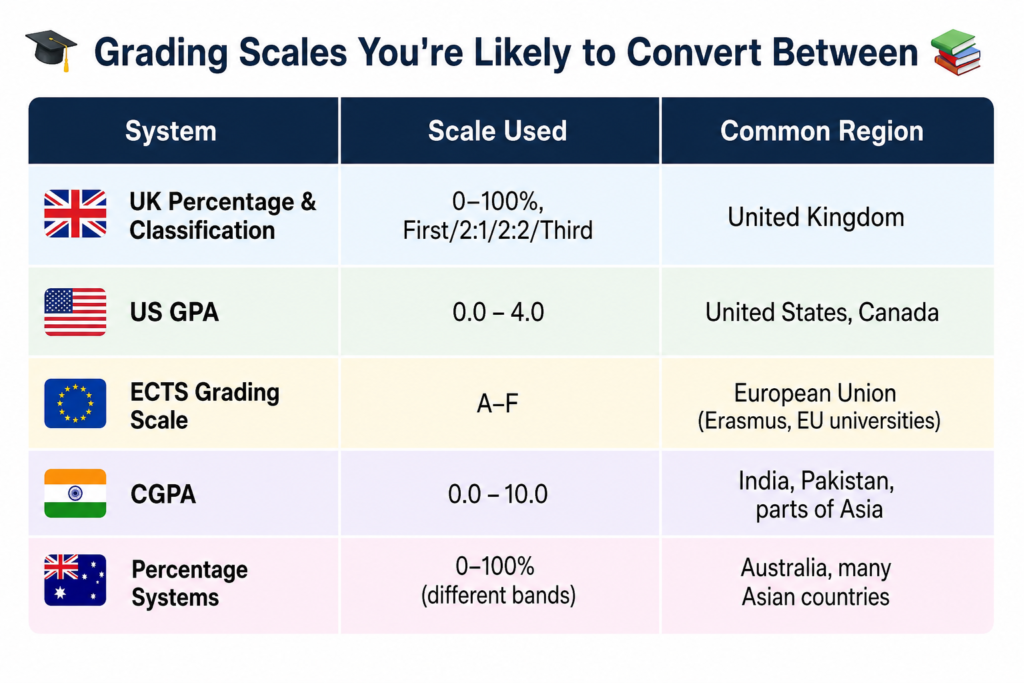
Each of these scales was designed around how that country’s universities structure assessment, which is exactly why a direct one-to-one conversion doesn’t exist.
Common Misconceptions About Grade Conversion
- “A 2:1 is always a 3.5 GPA.” It isn’t. Depending on the conversion table used, a 2:1 (60–69%) typically lands somewhere between roughly 3.3 and 3.6, and the exact figure shifts depending on where in that range your actual percentage sits.
- “GPA conversion is an exact science.” It’s an estimate built on published conversion bands, not a mathematical certainty. Two credential evaluation services can legitimately produce slightly different GPA figures from the same UK transcript.
- “My university will handle the conversion for me.” Sometimes, but not always. Many scholarship and visa applications expect you to submit a self-calculated GPA alongside your original transcript, which is exactly where a reliable calculator becomes useful.
- “Converting my degree classification is the same as converting my final percentage.” These can produce different results. Your classification is a band (2:1 = 60–69%), while your actual percentage might sit at the very top or bottom of that band — and where you fall inside the band can meaningfully shift your converted GPA.
How Grade Conversion Works: Step-by-Step
Converting a UK mark into another grading system isn’t complicated once you understand the process.
Confirm Your Exact Percentage
Start with your precise mark, not a rounded-off version. A 69% and a 70% might both feel like “roughly a First,” but they sit in different classification bands and can produce noticeably different converted GPAs. (university grade conversion calculator) If you’re converting a full degree result, use your final weighted average rather than a single module mark.
Identify the Target Scale
Check what the receiving institution, scholarship body, or employer actually asks for. Some want a straight GPA on a 4.0 scale. Others ask for a CGPA out of 10 or an ECTS grade letter. (university grade conversion calculator) Each scale uses different conversion logic, so converting to the wrong one wastes time.
Read More: Uni Calculator – Free UK University Grade Calculator in 5…
Match Your Percentage to the Correct Band
Every conversion table works on bands, not exact one-to-one maths. (university grade conversion calculator) Your percentage falls into a range, and that range corresponds to a value, or narrow range of values, on the target scale.
Apply the Conversion Formula or Table
Depending on the scale, you’ll either use a simple formula or a published lookup table. GPA conversion commonly uses this simplified approach:
GPA Estimate Formula
GPA = (UK Percentage ÷ 100) × 4.0
This gives a rough working figure, though most credential evaluators use banded tables instead, since a pure linear formula doesn’t always reflect how grade boundaries behave at the top and bottom of the scale.
Step 5: Cross-Check Against the Institution’s Own Table
This is the step people skip, and it’s the one that matters most. If a specific scholarship or university is involved, search for their published conversion policy before submitting anything. (university grade conversion calculator) Many UK universities and international credential services, such as WES or ECCTIS, publish their own tables, and these are what actually get used in official decisions.
Detailed Conversion Tables
UK Percentage to US GPA
| UK Percentage | Classification | Approximate GPA |
|---|---|---|
| 70% – 100% | First Class | 3.7 – 4.0 |
| 60% – 69% | Upper Second (2:1) | 3.3 – 3.6 |
| 50% – 59% | Lower Second (2:2) | 2.7 – 3.2 |
| 40% – 49% | Third Class | 2.0 – 2.6 |
| Below 40% | Fail | Below 2.0 |
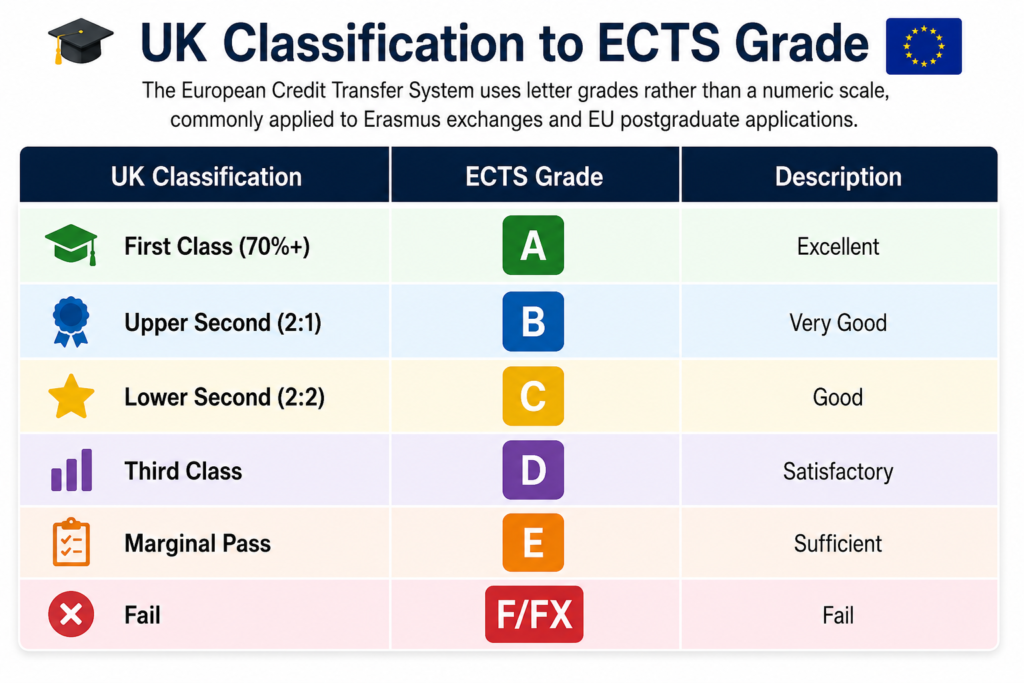
UK Classification to ECTS Grade
The European Credit Transfer System uses letter grades rather than a numeric scale, commonly applied to Erasmus exchanges and EU postgraduate applications.
| UK Classification | ECTS Grade | Description |
|---|---|---|
| First Class (70%+) | A | Excellent |
| Upper Second (2:1) | B | Very Good |
| Lower Second (2:2) | C | Good |
| Third Class | D | Satisfactory |
| Marginal Pass | E | Sufficient |
| Fail | F/FX | Fail |
UK Percentage to CGPA (10-Point Scale)
Common across India, Pakistan, and several other South Asian systems.
| UK Percentage | Approximate CGPA |
|---|---|
| 70%+ | 8.5 – 10.0 |
| 60% – 69% | 7.0 – 8.4 |
| 50% – 59% | 5.5 – 6.9 |
| 40% – 49% | 4.0 – 5.4 |
These figures are working estimates. (university grade conversion calculator) Institutions that use CGPA often apply their own conversion multiplier, so check the receiving university’s stated method if the number needs to be exact.
Worked Examples
Postgraduate application. A student finishes their UK degree with a final average of 72%, placing them in the First Class band. Applying the standard GPA table, that converts to roughly a 3.8–3.9 GPA. If the target Masters programme requires a minimum GPA of 3.5, this student comfortably clears the bar — useful to confirm before spending time on an application.
Scholarship threshold. A student with a 63% average (Upper Second, 2:1) is applying for a scholarship with a stated GPA minimum of 3.0. Using the conversion table, 63% typically sits around 3.3–3.4 GPA, safely above the threshold. Without converting the mark first, this student might have assumed a 2:1 wasn’t competitive enough, when it actually clears the requirement comfortably.
Module-level conversion. Sometimes conversion is needed at module level rather than for a full degree, for example when applying for a year-abroad exchange partway through a degree. (university grade conversion calculator) A student converting a single 20-credit module marked at 58% (Lower Second range) would see that convert to approximately 2.9–3.1 GPA on that module alone, separate from their overall degree average.
Real-Life Scenario: Comparing Systems Across a Degree
Consider a student who completed their first two years of study in Pakistan on a CGPA scale, then transferred into a UK university for their final year. (university grade conversion calculator) Their CGPA needs converting into an equivalent UK percentage for admissions purposes, and later, their final UK percentage needs converting back into a CGPA or GPA for a graduate job application in a country that uses that scale.
This kind of two-way conversion is common among international students and highlights why understanding the underlying bands, not just a single formula, matters. (university grade conversion calculator) Each conversion step introduces a small amount of estimation, so working from precise percentages at every stage, rather than rounding early, keeps the final figure as accurate as possible.
Read More: Degree Grade Calculator: 5 Best Ways to Calculate Your Final…
Common Mistakes to Avoid
Rounding too early. Converting a rounded 70% instead of your actual 69.6% can push you into a different classification band, and therefore a different GPA range, than you actually earned.
Using classification instead of percentage. Two students with a 2:1 can have genuinely different converted GPAs depending on whether they scored 60% or 69%. Always convert from the precise percentage where possible.
Ignoring the receiving institution’s own table. Generic conversion tables are useful for a quick estimate, but they’re not guaranteed to match what a specific university or scholarship body will actually use.
Assuming GPA conversion is linear. A straight percentage-to-4.0 formula doesn’t always reflect how real conversion tables behave, particularly near classification boundaries. (university grade conversion calculator) Banded tables tend to be more reliable than a single formula.
Forgetting that Year 1 might not count. If your UK degree excludes Year 1 from your final classification, as most do, make sure you’re converting your final weighted average, not an average that accidentally includes a year that doesn’t count towards your degree result.
Mixing up CGPA and GPA scales. A CGPA out of 10 and a GPA out of 4.0 look similar but aren’t interchangeable — converting a 7.5 CGPA as if it were a 7.5 GPA produces a meaningless result.
Best Practices and Expert Tips
- Always work from your most precise percentage, ideally to one decimal place, rather than a rounded classification
- Check whether the organisation requesting your GPA has published its own conversion policy before relying on a generic table
- Keep a copy of your official transcript alongside any converted figure, since some institutions want to see the original percentage as well as the converted GPA
- If your conversion sits right on a boundary, for example exactly 70% or exactly 60%, double-check which side of the boundary counts, since policies differ on whether boundary marks round up or down
- For scholarship or visa applications with hard GPA cut-offs, convert early in the process, not the week before a deadline, in case you need an official conversion letter from your university
Advanced Tips for More Accurate Conversion
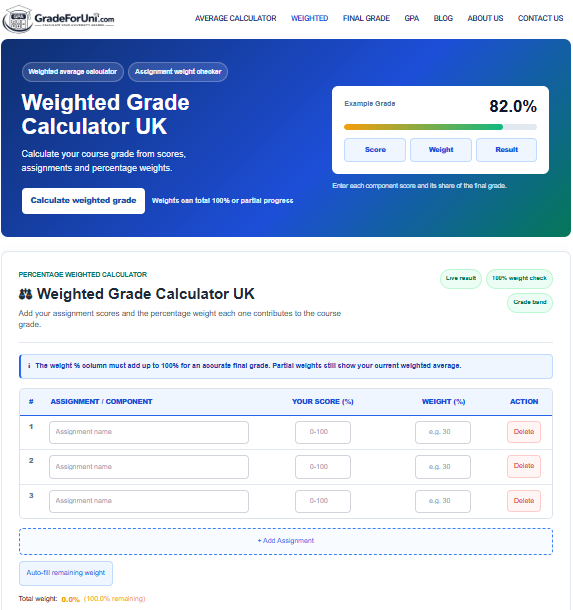
Use weighted averages, not module averages. If you’re converting a full degree result, always convert your final weighted average rather than an unweighted average of your module marks. (university grade conversion calculator) Since your weighted average already accounts for credit values and year weighting, it reflects your actual degree outcome far more accurately than a simple mean of your module percentages ever could.
Account for grade inflation differences between institutions. Some universities mark more generously than others, particularly at the top end of the scale. A 68% from one institution and a 68% from another can represent genuinely different levels of achievement, even though they convert to the same GPA on paper. Credential evaluators are aware of this, which is partly why they weigh your institution’s reputation and published data alongside the raw percentage.
Check whether you need a cumulative or final-year conversion. Some applications ask for a GPA based on your entire degree, others want only your final year, and some integrated Masters programmes want a combined Years 3–4 figure. (university grade conversion calculator) Converting the wrong data set is a common and easily avoidable mistake, so re-read exactly what the receiving institution has requested before submitting a figure.
Know that some countries use reverse scales. Not every system runs from low to high the way percentages and GPA do. Some countries score academic performance on scales where a lower number represents a better result, similar to how golf scoring works. (university grade conversion calculator) If you’re converting into or out of one of these systems, double-check which direction the scale runs before assuming a higher number is better.
Read More: How to Predict Your Final Degree Classification Before Results Day
Details Most Guides Leave Out
- Honours vs Ordinary degrees convert differently. An Ordinary (non-Honours) degree, sometimes awarded when a student narrowly misses classification requirements, doesn’t map onto the same conversion bands as an Honours degree and should be flagged as such on any application.
- Some scholarship bodies require official conversion letters, not self-calculated figures. A calculator gives you a working estimate for planning purposes, but formal applications sometimes require your university’s registry to issue an official GPA conversion letter.
- Postgraduate conversions use different boundaries than undergraduate ones. A Masters Distinction (70%+) and an undergraduate First (70%+) share the same percentage boundary, but some conversion tables still treat them as separate categories, since they represent different types of qualification.
- Conversion tables get updated. Universities and credential services occasionally revise their published conversion bands, so a table used two years ago isn’t guaranteed to still be current.
UK Grading System vs International Systems: Quick Comparison
| Feature | UK System | US GPA | ECTS | CGPA |
|---|---|---|---|---|
| Scale type | Percentage / Classification | 0.0 – 4.0 | Letter grade (A–F) | 0.0 – 10.0 |
| Best result | 70%+ / First Class | 3.7 – 4.0 | A | 8.5 – 10.0 |
| Passing threshold | 40% | Typically 2.0 | E | Typically 4.0 |
| Calculated from | Credit-weighted module marks | Grade points per course | Percentage rank within cohort | Credit-weighted grade points |
| Common region | UK | US, Canada | EU (Erasmus) | India, Pakistan, South Asia |
Key Takeaways
- When a conversion genuinely matters, such as for an official application, check the receiving institution’s own published conversion table or request an official letter from your university registry
- A university grade conversion calculator estimates the equivalent of your UK percentage or classification on another country’s grading scale, most commonly US GPA
- There’s no single universal conversion table — different institutions and scholarship bodies use slightly different bands, so results are close estimates rather than exact figures
- Always convert from your precise percentage rather than your rounded classification, since two students in the same band can convert to noticeably different GPAs
- Weighted, final degree averages give the most accurate conversion, particularly for postgraduate and scholarship applications
Final Thoughts
FAQ’s
What is a university grade conversion calculator?
It’s a tool that converts your UK percentage or degree classification into an equivalent grade on another scale, most commonly a US-style GPA, an ECTS letter grade, or a CGPA. (university grade conversion calculator) It works by matching your mark against standard conversion bands used across institutions.
How do I convert my UK degree to GPA?
Take your final weighted percentage average and match it against a standard conversion table. (university grade conversion calculator) As a rough guide, 70%+ (First Class) converts to approximately 3.7–4.0 GPA, while 60–69% (2:1) converts to roughly 3.3–3.6 GPA on a standard 4.0 scale.
Is a 2:1 a good GPA?
Yes. (university grade conversion calculator) A UK Upper Second Class (2:1) typically converts to somewhere between 3.3 and 3.6 GPA, which meets or exceeds (university grade conversion calculator) the minimum requirement for most international Masters programmes and many scholarships.
Why do different calculators give different GPA results for the same mark?
Because there’s no single official conversion table between UK percentages and GPA. (university grade conversion calculator) Different universities, credential evaluators, and scholarship bodies each publish their own conversion bands, so results vary slightly depending on which table is used.
Should I convert my classification or my exact percentage?
Always use your exact percentage where possible. (university grade conversion calculator) Your classification only tells you the band you fall into, (university grade conversion calculator) while your precise mark determines exactly where within that band your converted GPA sits.
Does my Year 1 mark count towards my converted GPA?
Usually not, since most UK universities exclude Year 1 from the final degree classification. (university grade conversion calculator) Convert your final weighted average, which typically only includes Year 2 and Year 3, or Years 2–4 for integrated Masters.
Can I use a grade conversion calculator for a Masters degree application?
Yes, though master’s programmes sometimes use slightly different conversion boundaries than undergraduate degrees, since distinction and merit bands don’t always align with First and 2:1 bands in the same way. (university grade conversion calculator) Check the specific programme’s requirements.
How accurate is a GPA conversion calculator?
It gives a reliable working estimate based on standard, widely used conversion tables, not an official or legally binding figure. (university grade conversion calculator) For formal applications where the exact GPA matters, confirm the number with the receiving institution or request an official conversion letter.
What’s the difference between GPA and CGPA?
GPA is typically measured on a 0.0–4.0 scale and is standard in the US and Canada. (university grade conversion calculator) CGPA (Cumulative GPA) is commonly measured on a 0.0–10.0 scale and is more widely used in India, Pakistan, and other South Asian countries. (university grade conversion calculator) They aren’t interchangeable without proper conversion.
Can international students convert their home country grades into UK equivalents?
Yes. (university grade conversion calculator) International students commonly need to convert a CGPA, percentage, or GPA from their home country into an equivalent UK classification for university admissions, (university grade conversion calculator) and many UK universities publish their own comparison tables for exactly this purpose.
Conclusion
Grade conversion isn’t about finding one perfect number — it’s about understanding how your UK result compares across systems that were each built around different assessment structures. (university grade conversion calculator) Once you understand how percentages, classifications, and GPA scales relate to each other, converting your own results becomes far less confusing.
A university grade conversion calculator gives you a fast, reliable way to see where your UK percentage or classification stands on another country’s scale, whether you’re applying for a scholarship, a postgraduate course, or a graduate job abroad. (university grade conversion calculator) Use it as your starting point for planning, and lean on your university’s official transcript or a formal conversion letter whenever an application genuinely depends on the exact figure.