
![You are currently viewing How Are Scottish Degrees Classified? Grades, Credits & Honours Explained [2026]](https://gradeforuni.com/wp-content/uploads/2026/10/featured-scottish-classification.png)
How Are Scottish Degrees Classified? Grades, Credits & Honours Explained [2026]
A First at Glasgow needs a 17.5. A First at Aberdeen needs an 18.0. A First at St Andrews needs a 16.5 on a scale of 20. Same country, same letters on the degree certificate — three different bars. If you study north of the border, your marks may arrive as letters like B3 and C1 rather than percentages, your first two years may count for nothing, and your degree may be decided by a median as well as a mean. None of this matches the English system most UK grade guides describe.
Scotland runs its own higher education universe. Honours degrees take four years, not three. Universities award 480 credits on the Scottish Credit and Qualifications Framework (SCQF) instead of 360. The four ancient universities still grant the MA as an undergraduate degree. And each university marks to its own scale: Glasgow’s 22-point letter scale, Edinburgh’s percentage Common Marking Scheme, St Andrews’ 20-point scale with a mean-and-median classification algorithm that explicitly refuses to entertain borderline begging.
This guide decodes Scottish degree classification university by university: the credit structure that underpins everything, Glasgow’s A1-to-H letter grades and how they convert to a final class, Edinburgh’s credit-weighted mean and its no-rounding rule, St Andrews’ mean-plus-median algorithm, Aberdeen’s stricter First threshold, and what Strathclyde and Dundee do differently. Two fully worked borderline examples show exactly where classifications are won and lost. Every number below comes from the universities’ own published regulations.
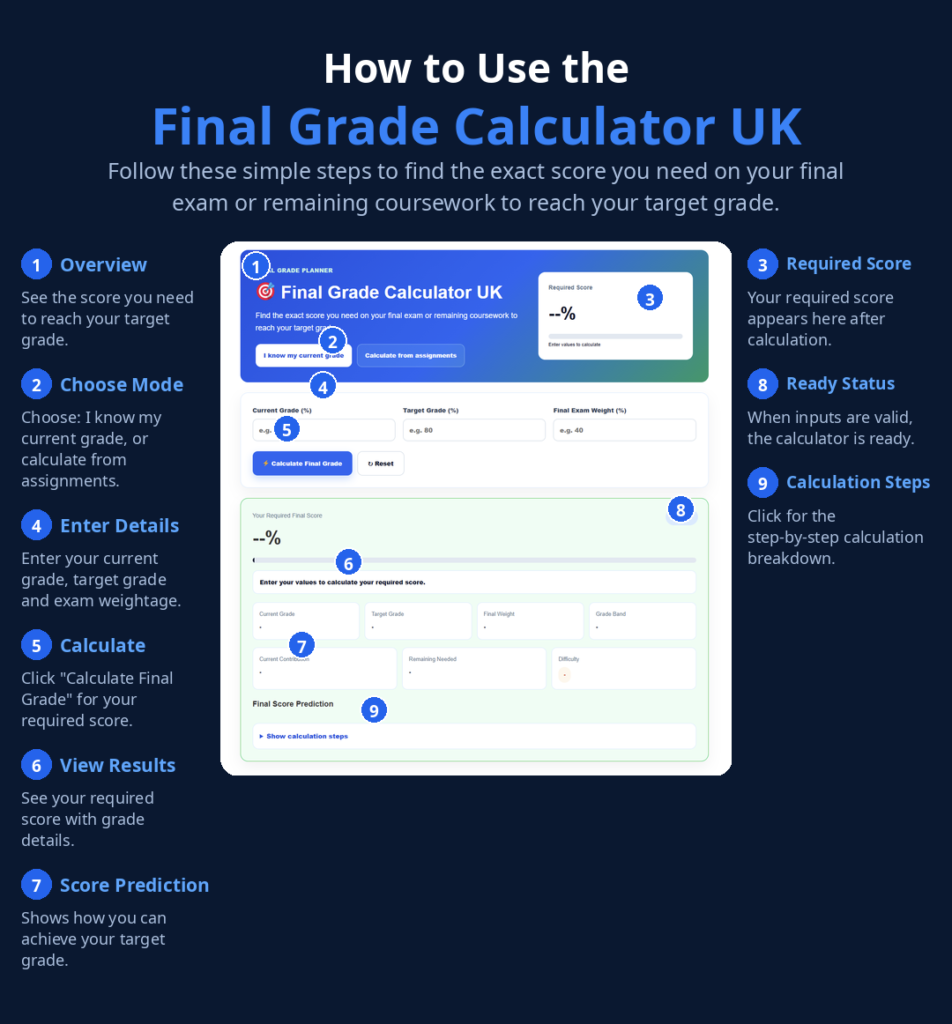
Click Here: Final Grade Calculator UK
The Scottish honours degree in one picture
Before the university-by-university detail, here is the shared scaffolding that makes Scotland different. A Scottish honours degree runs for four years and carries 480 SCQF credits — 120 per year — with at least 180 credits at SCQF levels 9 and 10, including at least 90 at level 10. Year 1 maps to SCQF level 7, year 2 to level 8, year 3 to level 9 and year 4 to level 10. England’s honours degree, by contrast, is three years and 360 credits. That extra year is not decoration: it is built into every classification rule below.
Years 3 and 4 are called Junior Honours and Senior Honours almost everywhere in Scotland. This is the detail that matters most for your marks: at Edinburgh, Glasgow and Dundee, years 1 and 2 do not count toward your honours classification at all. Edinburgh puts it as plainly as any university in the UK: it encourages students to take a broad range of courses in their first two years “in the knowledge that they will not be penalised in their final degree outcome.” A 45% average in second year is not an academic catastrophe in Scotland — it is a training exercise.
Two more structural quirks shape the Scottish system. First, the four ancient universities — St Andrews, Glasgow, Aberdeen and Edinburgh — still award the MA as an undergraduate degree in arts, humanities and social sciences: a three-year general route or a four-year honours route. Glasgow’s own regulations title it the “Degree of Master of Arts (Social Sciences) with Honours.” Second, Scotland offers a three-year exit: the ordinary or general degree, worth 360 credits (St Andrews specifies at least 80 credits at 2000-level and 60 at 3000-level or above, awarded as Pass, Merit or Distinction). Glasgow’s regulations confirm the general degree may be awarded to honours-programme candidates who fail to meet honours requirements — a genuine safety net, not a rumour.
University of Glasgow: the 22-point letter scale
Glasgow is the system that confuses newcomers most, because it barely uses percentages. Undergraduate work is marked against Schedule A of the university’s Code of Assessment: eight letter bands, each subdivided, mapped to grade points from 22 down to 0. The full ladder runs A1 (22 points) through A5 (18), B1 (17) to B3 (15), C1 (14) to C3 (12), D1 (11) to D3 (9), then E, F, G and H (0). The lowest satisfactory grade — the honours pass threshold — is D3, worth 9 points.
Your final classification comes from a single number: the grade point average, computed as the sum of (credits × grade point) for every contributing course, divided by the total contributing credits. The bands are exact and published in the Code of Assessment: 17.5–22.0 is First class honours, 14.5–17.4 is upper second, 11.5–14.4 is lower second, 8.5–11.4 is third class, and 0.0–8.4 is a fail. Glasgow’s own official worked example runs (80 credits × B1 17) plus (40 credits × A1 22) = 2,240 ÷ 120 = 18.7, a First.
| Letter band | Grade points | Descriptor | Degree class |
|---|---|---|---|
| A1–A5 | 22–18 | Excellent | First |
| B1–B3 | 17–15 | Very good | Upper second |
| C1–C3 | 14–12 | Good | Lower second |
| D1–D3 | 11–9 | Satisfactory | Third |
| E1–E3 | 8–6 | Weak | Fail |
| F1–F3 | 5–3 | Poor | Fail |
| G1–G2, H | 2–0 | Very poor / no convincing evidence | Fail |
Two Glasgow rules deserve attention. First, the Junior Honours to Senior Honours weighting is normally 50:50 where courses carry equal credit — but “normally” is doing real work. Glasgow’s College of Science & Engineering publishes verified exceptions for BSc programmes: Chemistry and Life Sciences weight third-to-final year at 25:75, while Archaeology, Computing Science, Geographical & Earth Sciences and Mathematics use 40:60. Never assume 50:50 without checking your school’s regulations.
Second, Glasgow has published borderline zones: GPAs of 17.1–17.4, 14.1–14.4, 11.1–11.4 and 8.1–8.4 are decided by the weighted profile of course grades. A 17.1–17.4 GPA earns a First only if at least 50% of the weighted course grade profile comprises A grades; a 2:1 requires at least 50% at B or above. This is a profile test, not a committee’s mercy — and the arithmetic below shows how thin the margin can be.
University of Edinburgh: percentages and the no-rounding rule
Edinburgh is the most familiar system for students who grew up with percentages. Its Common Marking Scheme runs A1 (90–100) and A2 (80–89) and A3 (70–79) at First class level, B (60–69) at 2:1, C (50–59) at 2:2, and D (40–49) at third class / pass, with E through H covering marginal to bad fails. Marks are percentages, so the translation to the familiar English bands is direct.
Classification is derived under Regulation 55: the mean of the marks of the individual courses, weighted by credit points, across both honours years. A student taking equal-credit courses across years 3 and 4 simply computes a credit-weighted average of every honours mark. There are verified exceptions: BSc Biological Sciences, Biomedical Sciences and Chemistry weight Senior Honours against Junior Honours at 2:1, and integrated masters programmes weight three honours years at 20:40:40.
Edinburgh’s rule with the sharpest teeth is that the overall mean is not rounded up or down — the School of Social and Political Science handbook gives the canonical example: a final mean of 57.9 is a 2:2, full stop. Some schools add a borderline provision — the SPS handbook treats a mean of 58 or 59 as borderline and promotes the student if 50% or more of marks (by credit) sit in the class above — but this is school-level practice, not a university-wide right. The worked example below shows the 50%-in-class-above rule saving a classification at exactly 50.0%.
University of St Andrews: the mean-and-median algorithm
St Andrews marks on a 20-point Common Reporting Scale. Pass starts at 7.0; an F of 4.0–6.9 carries a right to reassessment, while 0.0–3.9 does not. So far, so distinctive — but the classification machinery is the real outlier in Scotland. St Andrews determines every honours classification using a common algorithm that computes both a credit-weighted mean and a credit-weighted median for grades achieved in honours-level modules (3000 level or above). Dip-down modules are excluded, and you cannot volunteer extra modules to dilute a bad grade.
The algorithm’s headline thresholds: a First sits at 16.5–20, upper second at 13.5–16.4, lower second at 10.5–13.4 and third at 7.0–10.4 on the 20-point scale. The university’s published assessment policy labels that table as illustrative for single grades — the algorithm itself is the rule — but the outline is confirmed by the university’s own classification guide: the mean places you, and the median acts as a tiebreak in defined bands (for example, a mean of 16.0–16.4 with a median of 16.5 or above still lands a First).
The sentence that matters most to anxious students is this: St Andrews classifications “do not use discretionary classification border zones.” The algorithm decides; there is no examiner-board meeting where 59.9% gets a sympathetic nudge. Final classifications are academic decisions calculated by the Academic Registry. It is the most mechanical classification system in Scottish higher education — and in a strange way, the most transparent.
University of Aberdeen: the same scale family, a stricter First
Aberdeen marks on a Common Grading Scale that will look familiar to anyone who has seen Glasgow’s: an alpha-numeric letter scale running on the same 22-point family (A1 = 22 through to H = 0, with A5 = 18, B3 = 15, C3 = 12 and D3 = 9 as the verified anchor points). Students entering honours from 2021/22 onwards are classified solely on the GPA system. The machinery is the same; the bar is not.
Aberdeen’s First threshold is 18.0 — a full half-point above Glasgow’s 17.5. An average of A5s is the minimum for a First at Aberdeen; at Glasgow it would clear the bar with room to spare. The full published ladder: 18.0–22.0 First, 17.5–17.99 borderline 2:1/1st, 15.0–17.49 upper second, 14.5–14.99 borderline 2:2/2:1, 12.0–14.49 lower second, 11.5–11.99 borderline 3rd/2:2, 9.0–11.49 third, 8.5–8.99 borderline fail/3rd, 0–8.49 fail. The university publishes explicit borderline bands rather than Glasgow-style profile tests.
Aberdeen’s honours-year weighting is set by Senate but chosen by schools: four-year programmes use 50:50 or 30:70 for levels 3 to 4, and the weighting follows the level of the course rather than the year you took it. If you are an Aberdeen student, the single most important document for your degree is not this guide — it is your school’s published weighting choice.
| University | Scale | First threshold | Borderline mechanism |
|---|---|---|---|
| Glasgow | 22-point letter scale | GPA 17.5 | 14.1–14.4 etc.: weighted course-profile test (50% rule) |
| Aberdeen | 22-point letter scale | GPA 18.0 (stricter) | Published borderline bands (e.g. 17.5–17.99) |
| St Andrews | 20-point scale | Mean 16.5 | None — algorithm decides, no discretionary zones |
| Edinburgh | Percentages | Mean 70 | School-level only (e.g. 58–59 + 50%-in-class-above) |
| Strathclyde | Percentages | Average 70 | Programme-level guidance |
| Dundee | Alpha-numeric | A-band level (unofficial mapping) | Grade preponderance (secondary measure) |
Strathclyde and Dundee: percentage averages and stage weighting
Strathclyde keeps it recognisably simple: a percentage framework of 70–100 for a First, 60–69 for an upper second and 50–59 for a lower second, with third class awarded at the pass threshold, applied as a credit-weighted average mark across honours levels. Programme-level guidance (for example, Software Engineering) states the classification is normally based on the first assessed attempt at modules taken at levels 3 and 4 — a stricter reading than most universities’ resit-inclusive averages, so check your own programme document.
Dundee weights its two honours stages explicitly at 40:60 — stage 3 contributes 40% of the classification, stage 4 contributes 60% — with SHE levels 1 and 2 excluded entirely and grade preponderance used as a secondary measure for borderline cases. Dundee also replaced percentage marking with an alpha-numeric literal scale around 2005, roughly mapping A1–A3 to First-level work, B grades to 2:1, C to 2:2 and D3 to third. The exact letter-to-class mapping could not be verified on an official Dundee page at the time of writing, so treat any circulating version as unofficial.

Worked example 1: Glasgow’s borderline — where a 2:2 lives or dies
Take a Glasgow student, Sophie, on a programme with a 50:50 Junior-to-Senior Honours weighting. Her Junior Honours year of 120 credits averages a GPA of 14.0 — a mid-range 2:2 start. Her Senior Honours year comprises six 20-credit courses: B1 (17 points), B3 (15), B3 (15), C1 (14), C2 (13) and C3 (12).
Step one: convert Senior Honours to a GPA. Sum the grade points: 17 + 15 + 15 + 14 + 13 + 12 = 86. Multiply by 20 credits each: 86 × 20 = 1,720 grade points. Step two: add Junior Honours, 120 credits × 14.0 = 1,680. Step three: the final GPA is (1,680 + 1,720) ÷ 240 = 3,400 ÷ 240 = 14.166…, rounded in Glasgow’s published convention to 14.17. Step four: read the bands. A 2:1 needs 14.5, so 14.17 falls in the borderline zone 14.1–14.4 — the weighted-profile test applies.
Step five: the profile test. A 2:1 in this zone requires at least 50% of the weighted course profile at B (15 points) or above. Sophie’s B-or-better credits: the B1, B3 and B3 courses — 60 of her 240 contributing credits, exactly 25%. That is below the 50% bar, so Sophie graduates with a lower second. Had one more of her C-grade courses been a B3, her profile would have reached 37.5% — still short. She would have needed two more B grades across the two years to flip it. The Glasgow borderline rewards consistency across courses, not one heroic module.
Worked example 2: Edinburgh’s no-rounding rule — saved at exactly 50%
Now an Edinburgh student, Callum. Edinburgh classifies on the credit-weighted mean of all honours-year marks — no rounding, with his school’s borderline provision promoting a 58–59 mean if at least 50% of marks by credit sit at 60 or above. His Junior Honours year: six 20-credit courses marked 55, 57, 60, 58, 59, 56. His Senior Honours year: four 20-credit courses marked 60, 58, 61, 59, plus a 40-credit dissertation marked 60.
Step one: total the weighted marks. Junior Honours: (55 + 57 + 60 + 58 + 59 + 56) = 345 grade units × 20 credits = 6,900. Senior Honours courses: (60 + 58 + 61 + 59) = 238 × 20 = 4,760. Dissertation: 60 × 40 = 2,400. Step two: total = 6,900 + 4,760 + 2,400 = 14,060 ÷ 240 credits = 58.583…, conventionally stated as 58.58. Step three: 58.58 is a borderline mean — below 60 but inside the school’s 58–59 promotion zone. Without the borderline provision it would be a 2:2, and the no-rounding rule means 58.58 cannot be treated as 59 for any other purpose.
Step four: the profile test. Marks at 60 or above: one 60 in Junior Honours (20 credits), two 60s and a 61 in Senior Honours courses (60 credits), plus the 40-credit dissertation at 60 — totalling 20 + 60 + 40 = 120 credits of 240, exactly 50.0%. The promotion rule requires at least 50% — Callum meets it to the decimal. He graduates with an upper second. Had the dissertation been a 59, his profile would have fallen to 100 of 240 (41.7%) and he would have kept a 2:2. In Edinburgh’s borderline zone, a double-weighted dissertation at 60 is worth two courses at 60 — credit weighting decides, not the number of modules.
The letter-grade trap: translating Scottish marks for employers
The most practical pain point in the whole Scottish system is not the classification arithmetic — it is the translation. Glasgow, Aberdeen and Dundee graduates receive letters, not percentages. Employers south of the border, and especially outside the UK, routinely ask what a B3 “really is.” The honest answer from Glasgow’s Schedule A: B3 is 15 grade points on a 22-point scale, a mid-2:1 band — and the TSR threads confirm students spend real effort explaining exactly this on applications and at pupillage interviews.
Two translation facts are worth keeping. First, St Andrews explicitly does not offer a formal conversion of its GPA to other grading scales — its own guide directs students to a credential evaluation agency rather than a formula. Second, percentage systems need no translation at all: Edinburgh’s Common Marking Scheme and Strathclyde’s percentage framework read exactly like English marks. If your degree is letter-marked and you are applying to employers who think in percentages, put the band translation in your application yourself — do not assume the recruiter will look it up.
Scotland vs England: the five differences that matter
| Feature | Scotland (typical) | England (typical) |
|---|---|---|
| Honours degree length | 4 years, 480 SCQF credits | 3 years, 360 credits |
| Years counting toward class | Years 3 & 4 (Junior/Senior Honours); years 1–2 excluded | Years 2 & 3; year 1 usually excluded |
| Marking scales | Letter scales (Glasgow, Aberdeen, Dundee), 20-point (St Andrews), percentages (Edinburgh, Strathclyde) | Overwhelmingly percentage marks |
| Regulator | Scottish Funding Council funds universities; OfS regulates England only | Office for Students |
| Undergraduate MA | MA (Hons) is an undergraduate arts degree at the ancients | MA is postgraduate |
One naming trap deserves its own sentence: Scotland’s work-based route is called Graduate Apprenticeships, funded by the Scottish Funding Council (at least 1,378 new places were expected for academic year 2026-27), combining academic knowledge with skills development. England’s equivalent is called degree apprenticeships. The names are not interchangeable, and searching for one will not find the other.
Five mistakes Scottish students keep making
First, assuming Glasgow’s 50:50 Junior-to-Senior weighting is universal — the College of Science & Engineering’s published exceptions (Chemistry 25:75, Mathematics 40:60 and others) can move a classification by a full class for students whose strongest year is their final one. Second, treating St Andrews’ illustrative band table as the classification rule — the mean-and-median algorithm is the rule, and there are no discretionary borderline zones to appeal to. Third, assuming borderline begging works everywhere — Edinburgh’s SPS-style 50%-profile promotion is school-level practice, not a sector norm. Fourth, counting years 1 and 2 in your averages — at Glasgow, Edinburgh and Dundee they do not count, so a weak second year is not the disaster English-university forums might suggest. Fifth, presenting Dundee’s circulating letter-to-class mapping as official — it could not be verified on a Dundee page, so use the 40:60 stage weighting (which is official) and treat letter translations as unofficial.
If you want to sanity-check your own position, work backwards from your honours years only: list every honours-year course with its credit value, convert each mark to your university’s scale, apply your school’s published JH:SH weighting, and compare the result against the exact published bands — 17.5, 14.5, 11.5 and 8.5 at Glasgow; 70, 60, 50 and 40 at Edinburgh and Strathclyde; 18.0, 15.0, 12.0 and 9.0 at Aberdeen. The Final Grade Calculator handles the credit-weighted arithmetic once you know your inputs. Related reading: our guides to degree classification algorithm changes, the OfS algorithm ruling, how to check your university calculated your marks correctly, how university marking is moderated, and dropping your lowest module marks. Official sources for the figures above: Glasgow’s Schedule A (Code of Assessment), Edinburgh’s Taught Assessment Regulations, Section E, and St Andrews’ degree classification guide.
Are Scottish honours degrees 3 or 4 years long?
Scottish honours degrees are 4 years long and carry 480 SCQF credits (120 per year), with at least 180 credits at SCQF levels 9 and 10. This compares with 3 years and 360 credits for a typical English honours degree. A 3-year ordinary or general degree (360 credits) is also available as an exit award.
Do my first two years count toward my Scottish degree classification?
At most Scottish universities, no. At Glasgow, Edinburgh and Dundee, years 1 and 2 do not count toward the honours classification — it is calculated from Junior Honours (year 3) and Senior Honours (year 4) courses only. Edinburgh states explicitly that students can explore broadly in their first two years without being penalised in their final degree outcome.
What is a D3 at the University of Glasgow?
D3 is the lowest satisfactory grade on Glasgow’s 22-point Schedule A scale, worth 9 grade points. It sits at the bottom of the D band (D1 = 11, D2 = 10, D3 = 9) and marks the honours pass threshold. For context, a First at Glasgow requires a grade point average of 17.5 or above.
What GPA do I need for a First at Glasgow vs Aberdeen?
A First at Glasgow requires a grade point average of 17.5 to 22.0 on the 22-point scale. At Aberdeen, the bar is higher: a First requires 18.0 to 22.0 — an average of A5 grades. Both universities mark on the same 22-point letter-grade family, but Aberdeen’s First threshold is a full half-point stricter.
How does Edinburgh classify honours degrees?
Edinburgh classifies honours degrees using the credit-weighted mean of marks across both honours years (Junior and Senior Honours), under its Common Marking Scheme: 70-100 is First class, 60-69 is 2:1, 50-59 is 2:2 and 40-49 is third class. Crucially, the mean is not rounded — a final mean of 57.9 is a 2:2. Some schools add a borderline provision (for example promoting a 58-59 mean where at least half of marks by credit are in the class above), but this is school-level practice, not a university-wide rule.
Can St Andrews bump up my classification if I am just below a boundary?
No. St Andrews determines every honours classification with a published algorithm using the credit-weighted mean and median of honours-level (3000 level or above) module grades, and its own guide states that classifications do not use discretionary classification border zones. There is no examiner-board discretion to nudge a near-miss up — the algorithm decides.
Is a Scottish MA a postgraduate degree?
No — at Scotland’s ancient universities (St Andrews, Glasgow, Aberdeen and Edinburgh), the MA is an undergraduate degree awarded in arts, humanities and social sciences, either as a 3-year general degree or a 4-year honours degree (MA Hons). It is distinct from the postgraduate MA awarded in England.
How do I explain a letter-graded Scottish degree to employers?
Translate the band yourself using your university’s published scale: at Glasgow, for example, B bands (15-17 points) correspond to upper second-class work and C bands (12-14) to lower second. St Andrews does not offer a formal conversion of its GPA to other grading scales and directs students to a credential evaluation agency. Percentage-marked degrees (Edinburgh, Strathclyde) need no translation.
Conclusion
Scottish degree classification is not a regional flavour of the English system — it is a separate machinery. The 480-credit, four-year honours degree, the Junior and Senior Honours years that actually count, the letter scales at Glasgow and Aberdeen that demand translation for employers, Edinburgh’s percentage mean with its unforgiving no-rounding rule, and St Andrews’ mean-and-median algorithm that refuses discretionary borderline zones: each of these changes what you should be tracking, and when.
The single most useful habit for a Scottish student is also the simplest: ignore everything before year 3 when you forecast your class, learn your own school’s published Junior-to-Senior weighting (the exceptions, like Glasgow Chemistry’s 25:75, are where surprises live), and read your university’s exact published bands rather than assuming the English 70/60/50/40 template applies. In a system where a 17.4 at Glasgow is a 2:1, an 18.0 at Aberdeen is a First, and a 16.5 at St Andrews is a First on a scale of 20, precision beats optimism every time.
![Read more about the article Oxbridge Admissions Tests Explained: TMUA, ESAT & TARA Scores [2026]](https://gradeforuni.com/wp-content/uploads/2026/10/featured-admissions-tests-uk-300x192.png)
![Read more about the article What Is a Good LNAT Score? UK Law Admissions Test Explained [2026]](https://gradeforuni.com/wp-content/uploads/2026/10/featured-lnat-score-uk-300x192.png)
![Read more about the article Degree Apprenticeship Grading Explained: How EPA, Merit and Distinction Work [2026]](https://gradeforuni.com/wp-content/uploads/2026/10/featured-degree-apprenticeship-grading-300x192.png)