
![You are currently viewing How to Check Your University Calculated Your Marks Correctly [2026]](https://gradeforuni.com/wp-content/uploads/2026/10/featured-check-marks-uk.png)
How to Check Your University Calculated Your Marks Correctly [2026]
On 6 October 2026, the family of University of Glasgow student Ethan Scott Brown announced they had settled their civil action against the university. In September 2024 he had been told he had not been awarded a grade for one course and was therefore ineligible to graduate with Honours. The university’s own investigation later established he had been incorrectly graded all along — he should have graduated with a 2:1. The error was missed by university staff, two internal examination boards and an external examination board. It was reported by Classic FM and The Times, and the Quality Assurance Agency has carried out a targeted peer review of the university’s processes.
This article is not about that case beyond the one lesson it proves: marks go through a long chain of human hands — markers, module leaders, data entry, exam boards — and every hand in that chain can introduce an error. What follows is the practical version of that lesson: how to check your marks, step by step, before a mistake quietly costs you a classification. If anything in this article affects you, Samaritans is available 24 hours a day on 116 123, free from any phone.
Most students never check the arithmetic behind their degree. The university publishes your marks, the exam board confirms your classification, and you trust the system worked. Usually it does. But the arithmetic is yours to verify when you check your marks: credit values, year weightings, resit caps, condonement decisions and transcription between systems are all points where the wrong number can enter your record. This guide walks you through a full marks audit — what documents to get, how to recompute your own average, the six error points to hunt for, and what to do when your numbers disagree with the university’s.
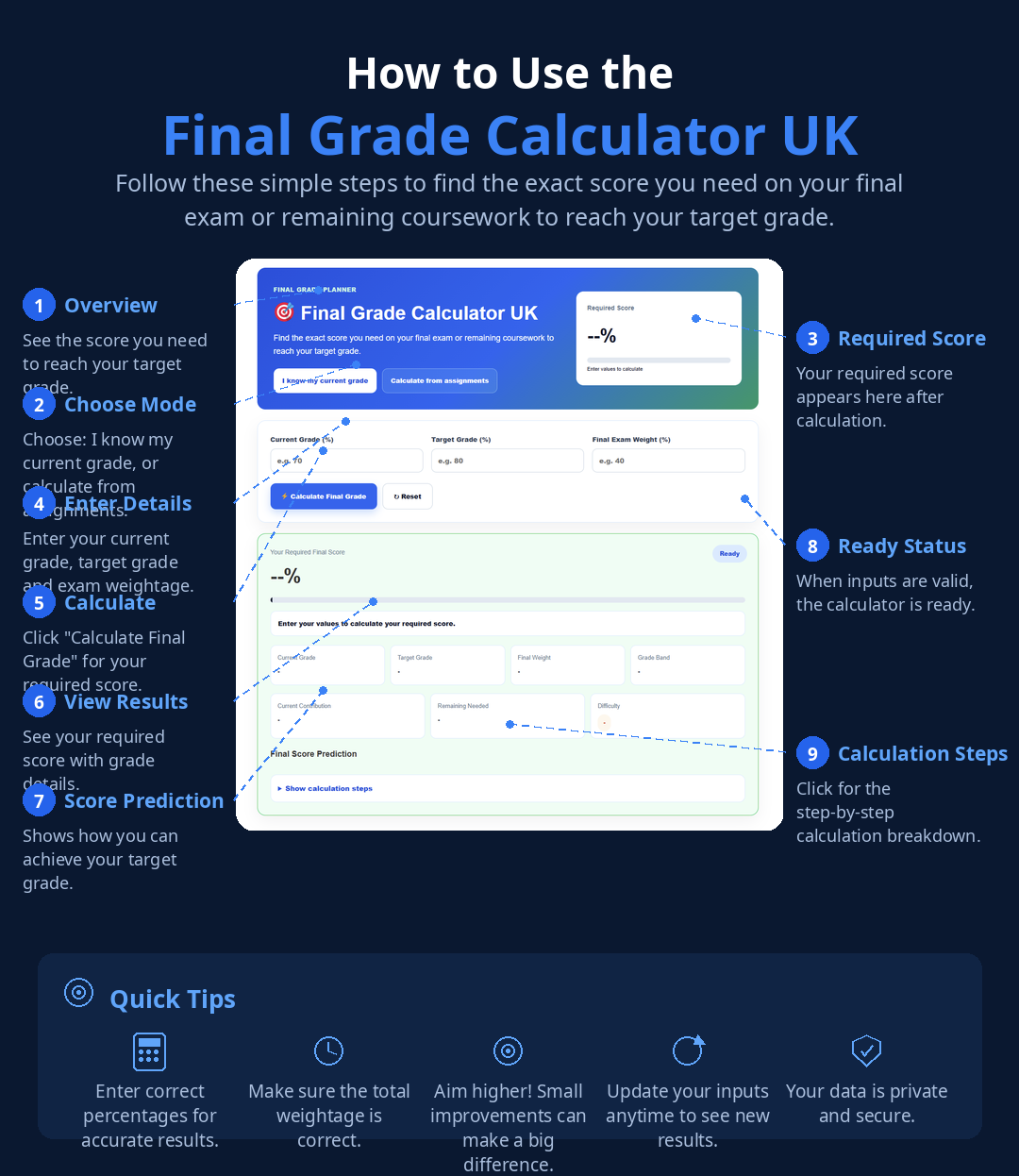
Click Here: Final Grade Calculator UK
Why Even Checked Marks Can Be Wrong
It feels safe to assume that several layers of checking make errors impossible. A marker awards your mark. A second marker moderates it. The module leader enters it. The exam board confirms it. An external examiner reviews a sample. In practice, each of those layers checks something different, and arithmetic errors are the thing almost nobody checks. External examiners review academic judgement on a sample of work; they do not recompute every student’s weighted average. Exam boards see the final numbers, not the spreadsheet formulas behind them. The Glasgow case is the extreme proof: an incorrect grade survived staff, two internal boards and an external board.
The errors that survive are almost never about academic judgement. They are administrative: a 40-credit dissertation entered as 20 credits, a resit mark recorded uncapped when it should have been capped at 40 (or capped when it should not have been), a year weighting applied from the wrong year’s regulations, a module that never made it into the average at all. These are exactly the errors a student with a calculator and an hour of patience can catch — and university regulations actively provide for correcting them, as we will see in Step 4.
Step 1: Get Your Full Marks Breakdown
You cannot check your marks without seeing them. Before you touch a calculator, you need the raw material: every module mark, every credit value, and the exact rules your university applied. Start with the two documents every UK university produces, and know the difference between them. The University of Edinburgh’s Registry Services puts it plainly: if you need a breakdown of the marks you received for the courses you took, you want an Academic Transcript — the degree-confirmation statement is a different document. Warwick’s academic office defines the transcript as “an official summary of academic performance, including qualification obtained, modules taken and marks achieved” which “cannot be altered”, and notes that current undergraduates can usually see their formative record in the HEAR before the award is conferred.
In practice, most students can get everything they need without ordering anything. The University of Westminster’s Handbook of Academic Regulations (Section 15, Publication of Results) confirms that confirmed results are normally available through the SRS Web student records portal — and most universities have an equivalent self-service portal showing module-by-module marks. What you are assembling is a table with, for every module: the module code and title, the credit value, the mark as recorded, and any flags next to it (resit, capped, condoned, compensated, deferred). If any module you sat is missing from that table, that is already finding number one — stop and ask your registry about it before doing anything else.
You also need your university’s classification rules for your cohort — not last year’s, not the general guidance, but the regulations that applied to your year of study. Year weightings change, borderline rules change, and discounting rules change. Your university’s assessment regulations or degree-classification guide will state the year weighting (for example 40:60), how modules are weighted within a year (almost always by credit value), and how the final mark is rounded. Save the PDF. You will need it again in Step 3.
Step 2: Recompute Your Weighted Average
This is the heart of how to check your marks, and it is pure arithmetic. UK universities weight modules by credit value within each year, then weight the years against each other. The University of Leicester’s classification guide gives a clean example: on a three-year programme, the Year 2 course weighted average is multiplied by 0.4 and the Year 3 average by 0.6. Biological Sciences students use 30:70 instead. The University of Bristol publishes the same idea as a table — Arts, Law and Social Sciences programmes use 0:40:60, Science and Engineering 0:25:75 — and spells out the within-year rule: the mark for a 20-credit unit counts as one-sixth of a 120-credit year, with the final programme mark rounded to the nearest integer before the classification boundary is applied.
Recompute it yourself in two stages. First, each year’s average: multiply each module mark by its credits, add them up, and divide by the total credits for the year (usually 120). Second, the degree average: multiply each year’s average by its weighting and add the results. Then compare your number with the university’s. A difference of a fraction of a mark at this stage is usually rounding — Bristol rounds the final programme mark to the nearest integer before checking boundaries, and other universities have their own rounding rules. A difference of a whole mark or more means something structural is wrong, and Step 3 tells you where to look.
Worked example: Amara checks her Year 3 average. Amara’s final-year modules are a 40-credit dissertation at 71, and four 20-credit modules at 62, 68, 58 and 65. Her recomputation: (71 × 40) + (62 × 20) + (68 × 20) + (58 × 20) + (65 × 20) = 2,840 + 1,240 + 1,360 + 1,160 + 1,300 = 7,900. Divided by 120 credits, that is 65.83. Her university, however, recorded her Year 3 average as 64.8 — exactly the simple unweighted mean of the five marks (324 ÷ 5). Someone had averaged the marks without weighting by credits. With her Year 2 average of 57.4 on a 40:60 weighting, the correct degree average is (57.4 × 0.4) + (65.83 × 0.6) = 22.96 + 39.50 = 62.46, while the university’s figure gives (57.4 × 0.4) + (64.8 × 0.6) = 22.96 + 38.88 = 61.84. Amara kept her 2:1 either way — but 0.6 percentage points at a real borderline is the difference between degree classes, and she found it with ten minutes of arithmetic.
Step 3: Hunt the Six Most Common Error Points
When you check your marks and your recomputed average disagrees with the university’s, the cause is almost always one of these six. Work through them in order, because the first three account for the overwhelming majority of real errors students find.
| Error point | What goes wrong | How to spot it |
|---|---|---|
| Wrong credit value | A module is recorded with the wrong credit weighting — e.g. a 40-credit dissertation entered as 20 credits | Compare the credits column on your marks record against your module handbook; recompute the year average both ways |
| Missing module | A module you completed never enters the average, so its credits contribute zero | Count your modules and credits: every year of a standard degree must total 120 credits |
| Resit cap wrongly applied | A resit-as-first-attempt (uncapped, marked on merit) is capped at 40 — or a capped resit is recorded at its raw mark | Check the flag next to any reassessed module; Birkbeck’s regulations cap reassessment at 40% UG / 50% PG unless it was a deferred first attempt |
| Wrong year weighting | Your cohort’s weighting is applied from the wrong year’s regulations — e.g. 30:70 used instead of 40:60 | Recompute with the weighting stated in your own cohort’s classification guide (Leicester: 40:60 standard, 30:70 Biological Sciences) |
| Unweighted averaging | Marks are averaged as a simple mean instead of credit-weighted (Amara’s case above) | If your recomputed weighted average differs from the record by a small, consistent amount, test the simple-mean hypothesis |
| Condonement or compensation misapplied | A failed module that should have been condoned counts as zero, or vice versa | Check your university’s condonement rules against each failed module — see our condoned pass guide |

Worked example: the wrongly capped resit that cost Daniel his 2:1. Daniel’s Year 2 average is 60.8. His Year 3 modules: a 30-credit project at 55, plus six 15-credit modules at 68, 62, 70, 66, 64 and 58. The project was a resit-as-first-attempt following accepted extenuating circumstances — under his university’s rules (the same principle as University College Birmingham’s regulations) it is marked on merit and not capped. His recomputation: (55 × 30) + (68 + 62 + 70 + 66 + 64 + 58) × 15 = 1,650 + 5,820 = 7,470, divided by 120 = 62.25. Degree average on a 40:60 weighting: (60.8 × 0.4) + (62.25 × 0.6) = 24.32 + 37.35 = 61.67 — a 2:1. The university, however, had capped the project at 40: (40 × 30) + 5,820 = 7,020 ÷ 120 = 58.5, giving (60.8 × 0.4) + (58.5 × 0.6) = 24.32 + 35.10 = 59.42 — below the 60 boundary, a 2:2. One wrongly applied cap moved his final average by 2.25 percentage points and changed his degree class. Manchester’s degree-regulations tables show how this should be recorded: referred assessment passes are capped and carry an R suffix (for example 30R at undergraduate level), so a capped mark without the flag — or a flag on a mark that should be uncapped — is exactly the discrepancy to query.
Step 4: Ask for an Administrative Check
If you check your marks and find a discrepancy, you are not asking for a favour — you are asking for a correction, and the regulations are on your side. The University of Westminster’s regulations (Section 15.12) state that if a student identifies a demonstrable error in any module or component mark, they must raise it in writing with the relevant Campus Registry. Newcastle University’s Rules for Boards of Examiners are equally clear in the other direction: once marks go to the Board they “shall not be adjusted, except that the correction of errors in the transcribing of marks is permitted” — transcription errors are the explicit exception. And UCL’s Academic Manual states the principle outright: “If an error in calculating a result is discovered, the actual result achieved (not the one erroneously calculated) will prevail.”
There are limits worth knowing before you write. Canterbury Christ Church’s Assessment Procedures Manual requires that where an appeal leads to a change of classification, there must be evidence of administrative error and at least one external examiner must agree with the change — so classification changes after the fact need corroboration, not just your spreadsheet. The University of Reading’s procedures allow a review of a mark where a student considers an incorrect mark was awarded on the grounds of an assessment irregularity. In other words: when you check your marks and find an error, bring evidence, not feelings. Your email to the registry should contain your recomputation, the exact module and the rule you believe was misapplied, and a copy of the regulation you are relying on. A one-line “I think my average is wrong” gets a one-line reply; a worked calculation gets investigated.
Act quickly. Marks can be corrected far more easily before your award is conferred and your transcript is finalised. Once you have graduated, corrections are still possible — Cranfield’s assessment rules even provide for an additional assessment opportunity where the university itself is liable for an assessment error — but every week that passes makes the administrative route harder and pushes you toward the formal appeal process instead.
Check vs Remark vs Appeal: Which Door to Knock On
Students often confuse three different processes, and knocking on the wrong door wastes the short window you have. They differ in what they challenge, what evidence they need, and what they can change.
| Process | What it challenges | Evidence needed | What it can change |
|---|---|---|---|
| Administrative check | Arithmetic and recording errors — wrong credits, wrong caps, missing modules | Your recomputation plus the regulation that was misapplied | The mark or average itself |
| Re-marking review | Whether your work was marked correctly — marking errors, unmarked pages | Specific grounds such as an unmarked section or procedural irregularity | The mark for that piece of work |
| Formal appeal | The board’s decision — procedural error, bias, or new extenuating circumstances | Documented grounds under your university’s appeal regulations | The decision, which can include a re-mark or a fresh attempt |
Start with the administrative check: it is the fastest, it needs no formal grounds beyond arithmetic, and it is the one most students skip. If your issue is with how the work itself was marked rather than how the marks were added up, read our guide on how to ask for a remark at a UK university. If the board’s decision itself was procedurally flawed, our university grade appeal guide covers grounds, evidence and deadlines. And if your audit turns up a failed module the board might have condoned, our condoned pass explainer shows how that decision should have been made.
Your 7-Step Checklist to Check Your Marks
Do this the week your confirmed marks are published — not after graduation, when every correction gets harder. The whole process to check your marks takes about an hour.
- Pull your full marks record. Download your module-by-module marks from your student portal (Westminster-style SRS records) or order a transcript if the portal lacks detail. Confirm every module you sat appears.
- Count the credits. Every standard year must total 120 credits. A missing module is the single most damaging error — it contributes zero to your average.
- Check every credit value. Match the credits column against your module handbook, especially for dissertations and projects worth 30 or 40 credits.
- Recompute each year’s average. Multiply each mark by its credits, sum, divide by 120. Use our Final Grade Calculator UK to cross-check your arithmetic.
- Apply your cohort’s year weighting. Use the weighting in your own year’s classification guide (Leicester 40:60, Bristol 0:40:60 or 0:25:75 depending on faculty). Then compare with the university’s figure; anything beyond rounding needs explaining.
- Audit every flag. Resit, capped, condoned, deferred — each flag changes how the mark feeds your average. A resit-as-first-attempt should be uncapped; a standard resit should be capped at 40 (undergraduate) and carry its flag.
- Write to the registry with your working. If anything disagrees, raise it in writing with your recomputation and the regulation you are relying on. Keep copies of everything you send.
If your audit lands you just below a boundary — 59.4, 69.6 — read our guide to borderline grades and discretionary uplift rules before you decide anything is settled. Borderline policies are a separate safety net, and they interact with corrected marks in ways that can move a 59.42 into a 2:1.
Frequently Asked Questions
Can universities actually make mistakes when calculating marks?
Yes. Marks pass through markers, module leaders, data entry and exam boards, and administrative errors — wrong credit values, misapplied resit caps, missing modules — can survive every layer of checking. In October 2026 the University of Glasgow settled a civil action after its own investigation found a student had been incorrectly graded and should have received a 2:1, an error missed by staff, two internal exam boards and an external exam board. Universities’ own regulations, such as Westminster’s Section 15.12 on alleged errors, exist precisely because mistakes happen.
How do I get a full breakdown of my marks?
Start with your university’s student records portal, where confirmed module-by-module results are normally published. If the portal lacks detail, order an Academic Transcript — the University of Edinburgh’s Registry Services confirms the transcript, not the degree-confirmation statement, is the document that carries your full marks breakdown. Current undergraduates can usually also see their formative record in the HEAR before the award is conferred.
What is the most common marks error students find?
Credit-value and weighting errors are the most common: a 40-credit dissertation entered as 20 credits, marks averaged as a simple mean instead of credit-weighted, or the wrong year’s year-weighting applied. Resit capping errors are next — a resit-as-first-attempt wrongly capped at 40, or a capped resit recorded at its raw mark. All of these surface when you check your marks against your own recomputation.
My resit mark looks lower than I expected — was it capped?
Probably. Standard UK practice caps reassessment at 40% for undergraduates and 50% for postgraduates, and the capped mark — not your raw resit mark — feeds your classification. Manchester’s regulations record capped passes with an R suffix, so check for that flag. The exception is a resit-as-first-attempt following accepted extenuating circumstances, which is marked on merit and should not be capped.
Can an exam board change a mark after it has been confirmed?
For genuine errors, yes. Newcastle’s Rules for Boards of Examiners state that confirmed marks shall not be adjusted except for the correction of errors in transcribing marks, and UCL’s Academic Manual states that if an error in calculating a result is discovered, the actual result achieved will prevail. Academic judgement cannot be revisited this way — only administrative and arithmetic errors.
Do I need evidence to ask for an administrative check of my marks?
Yes — bring arithmetic, not just a feeling. Westminster’s regulations require students to raise alleged errors in writing with the Campus Registry. Your email should include your recomputed average, the exact module affected, the rule you believe was misapplied, and a copy of the regulation you are relying on. A worked calculation gets investigated; a vague complaint gets a vague reply.
What is the difference between a marks check, a remark and an appeal?
A marks check challenges arithmetic and recording errors and is the fastest route. A remark challenges how the work itself was marked — see our guide on asking for a remark. An appeal challenges the exam board’s decision on procedural grounds, bias or new extenuating circumstances — see our university grade appeal guide. Start with the check; it is the door most students never knock on.
How long does a marks correction take?
It varies by university and by timing. Simple transcription errors raised before your award is conferred can be corrected quickly by the registry. Changes that alter a classification need more corroboration — Canterbury Christ Church requires evidence of administrative error plus agreement from at least one external examiner — so act the week your marks are published, not after graduation.
Conclusion
Your degree classification is the product of a long chain of arithmetic, and nobody in that chain has more at stake in its accuracy than you. Working through this guide to check your marks takes about an hour: pull your marks breakdown, count the credits, recompute each year’s credit-weighted average, apply your cohort’s year weighting, check every resit and condonement flag, and put any discrepancy to the registry in writing with your working attached. Most audits will confirm the university got it right — and that confirmation is itself worth having. But some will find a wrong credit value, a misapplied cap or a missing module, and at a classification borderline, a single corrected number can change the class of degree printed on your certificate.
The deeper lesson is about where you spend your energy. Students pour weeks into appealing academic judgement — the one thing universities are explicitly designed not to revisit — while ignoring the arithmetic the regulations openly invite you to check. Westminster tells students to raise demonstrable errors in writing. UCL says the actual result achieved will prevail over the erroneously calculated one. Newcastle permits the correction of transcription errors even after the board has confirmed the marks. These are not loopholes; they are the system’s own quality control, and they only work if someone uses them. That someone is you.
So check your marks. Do it the week your confirmed results land, keep your recomputation and the regulations you relied on, and escalate from an administrative check to a remark request or a formal appeal only when the evidence points that way. Universities are large, careful institutions — and even large, careful institutions mistype numbers. An hour with a calculator is the cheapest insurance your degree will ever have.
![Read more about the article Missed the 15 October UCAS Deadline? What Still Works for Medicine & Oxbridge [2026]](https://gradeforuni.com/wp-content/uploads/2026/10/featured-missed-ucas-deadline-300x192.png)
![Read more about the article Can Turnitin Use Your Essay to Train AI? What UK Students Need to Know [2026]](https://gradeforuni.com/wp-content/uploads/2026/10/featured-turnitin-ai-essays-300x192.png)
![Read more about the article When Do Uni Results Come Out? UK University Results Day Explained [2026]](https://gradeforuni.com/wp-content/uploads/2026/10/featured-university-results-day-300x192.png)