
![You are currently viewing Do UK Universities Drop Your Lowest Module Marks? Discounting Rules Explained [2026]](https://gradeforuni.com/wp-content/uploads/2026/10/featured-drop-lowest-marks.png)
Do UK Universities Drop Your Lowest Module Marks? Discounting Rules Explained [2026]
Every exam season, the same question surfaces on The Student Room, usually in a panic, usually at 2am: “Does my worst module just… not count?” One University of Greenwich final-year student put it plainly — they wanted to know whether their worst 30 credits would simply vanish from the degree classification calculation, or whether the bad marks would drag their average down. It is one of the most misunderstood mechanics in UK higher education, and the confusion is understandable, because the honest answer is genuinely surprising.
Yes — some UK universities really do drop your lowest module marks. The official name for it is “discounting” (some universities call it “best credits” or “excluded credits”): when your degree classification is calculated, your worst-performing credits are quietly left out of the maths. At the University of Greenwich, only your best 90 credits of final-stage modules feed the classification. At UWE Bristol, your worst 20 credits at Level 5 are discounted. At Buckinghamshire New University, the worst 20 credits at each of Levels 5 and 6 never touch your final average.
But here is what most students get wrong: discounting is not universal, it is not a choice, and it can occasionally backfire — there is a 60-credit trap that has caught out real students. This guide sets out the exact rules at the universities that discount marks, with full worked calculations, the fine print that decides whether your worst module helps or hurts you, and the rules that look like discounting but are something else entirely.
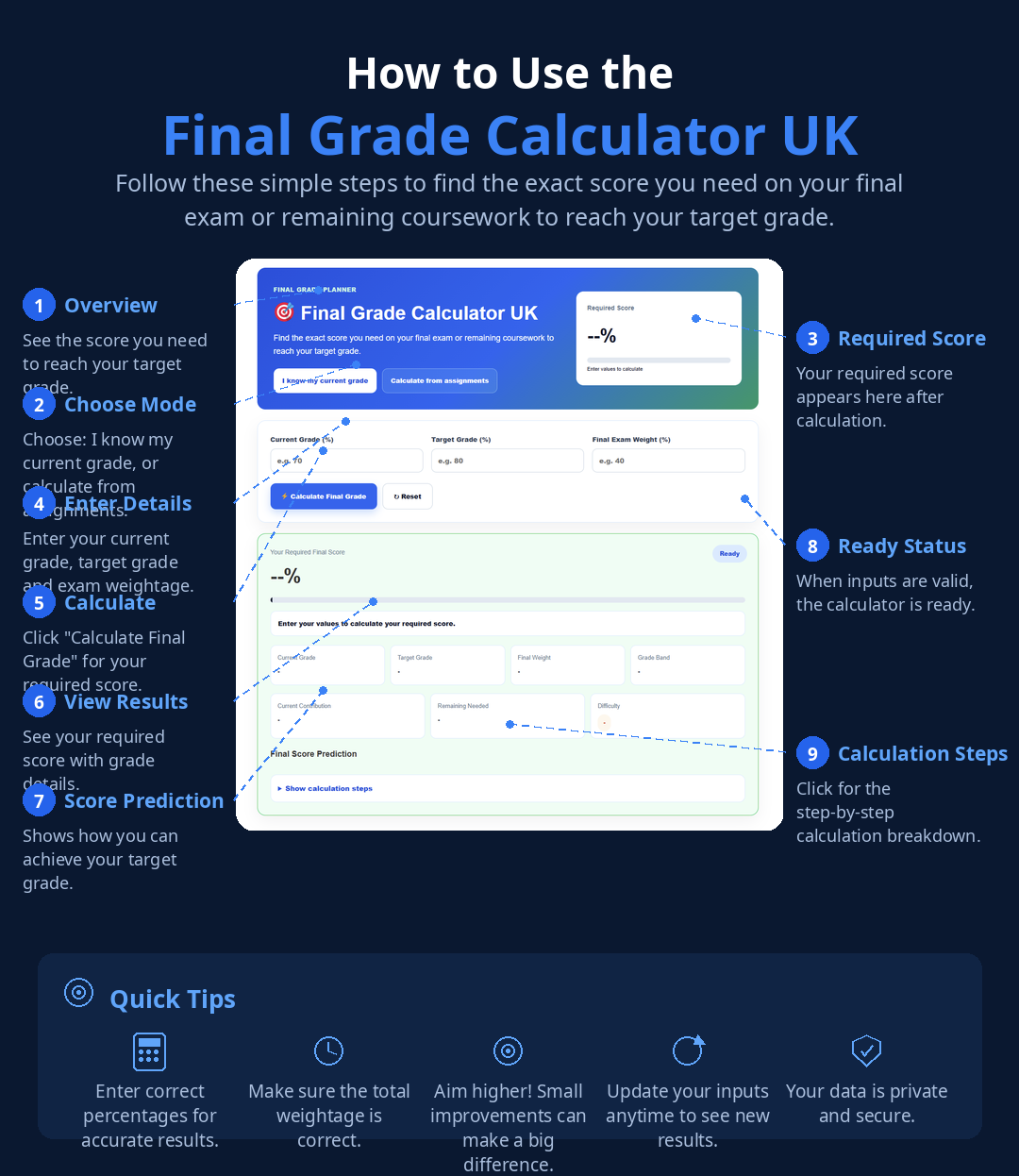
Click Here: Final Grade Calculator UK
The short answer: some do — but only where the rules say so
If you want the one-paragraph version: a minority of UK universities build discounting into their classification algorithms. The University of Greenwich calculates most of your classification from the best 90 credits of your final stage. UWE Bristol counts all of your Level 6 credits but only the best 100 credits at Level 5. Buckinghamshire New University calculates honours degrees from the best 100 credits at both the final and penultimate levels, and its regulations state plainly that the remaining credit “will not contribute to the calculation and will be discounted”. The University of Nottingham’s exam boards may discount up to 20 credits of below-average marks in exceptional circumstances.
Everywhere else — the large majority of UK universities — every credit counts. Your 42 in that second-year elective you hated counts exactly as much per credit as your 72 in the module you loved. There is no universal “drop your worst module” safety net in UK higher education, and assuming one exists is one of the costliest mistakes a final-year student can make.
Three things are true at every university that discounts marks. First, it is automatic: the algorithm picks your best credits, you never choose. Second, the discounted modules must still be passed — discounting is not permission to fail. Third, the marks never leave your transcript; they are excluded from one specific calculation, not erased from your record.
What “discounting” actually means (and what it is not)
Discounting is a classification-stage mechanism. After you have passed everything you need to pass, the exam board runs the classification algorithm — and that algorithm is instructed to ignore your worst credits. Think of it as the university saying: we know one bad module does not define you, so we will not let it define your degree class.
Students constantly confuse discounting with three neighbouring concepts. They are different tools, decided by different people, with different consequences:
| Mechanism | What happens | Decided by | Does the mark disappear? |
|---|---|---|---|
| Discounting | Worst credits excluded from the classification average | Automatic algorithm | From the classification calculation only — stays on transcript |
| Condonement | A failed module (usually 30–39%) is forgiven so you can progress | Exam board discretion | No — the fail mark stays and usually still counts |
| Compensation | Strong performance elsewhere offsets a marginal fail | Exam board, against criteria | No — the compensated mark remains in the average |
| Resit (capped) | You retake the failed assessment; mark capped at 40% | Automatic entitlement | The original fail is replaced by the capped mark |
| Borderline uplift | A near-miss average (e.g. 59.5%) is raised to the higher class | Exam board, against criteria | No — it changes the class, not the marks |
The practical difference matters. Condonement and compensation rescue you from failing; discounting rescues you from underperforming. A student with a 52 in an elective needs discounting, not condonement — they passed, so there is nothing to forgive, but the 52 still drags the average at universities that count everything. If you want the full picture on the failure side, our guides to condoned passes, referrals and borderline uplift rules cover those mechanisms in detail.
The universities that discount your worst marks
These are the verified discounting schemes in current UK university regulations. If your university is not on this list, assume every credit counts — and check your own regulations rather than hoping.
| University | The rule | What gets dropped | Weighting |
|---|---|---|---|
| University of Greenwich | Classification = average of Stage 2 grades (10%) + average of the best 90 credits of overall module grades in Stage 3 (90%) | Worst 30 credits of final stage | 10:90 (Stage 2 : Stage 3) |
| UWE Bristol | Classification from all Level 6 credits + best 100 credits at Level 5 | Worst 20 credits at Level 5 | Level 6 marks weighted 3× Level 5 |
| Buckinghamshire New University | Honours calculated on the best 100 credits at the level and penultimate level; remaining credit “will not contribute to the calculation and will be discounted” | Worst 20 credits at each of Levels 5 and 6 | Final level double-weighted |
| University of Nottingham | Exam board may discount up to 20 credits of below-average part-for-whole marks for the classification decision | Up to 20 credits of below-average marks | Discretionary, exceptional basis |
A few notes on what the table does not show. Greenwich’s rule applies to students who undertook 60 credits at Stage 2 and 120 credits at Stage 3 — students who completed only the final stage at Greenwich are classified on the average of their best 90 credits of Level 6 modules. At UWE Bristol, only the Level 5 discount exists: every one of your final-year credits counts, which makes final year disproportionately important there. Nottingham’s provision sits in its contingency regulations and is applied by the school on an exceptional basis — it is a discretionary safety valve, not an automatic algorithm. And critically, Buckinghamshire’s regulations require that the discounted credit must still be passed: you cannot fail a module and have it discounted away.
Notice the pattern: nobody discounts more than 30 credits, and nobody discounts final-year credits except Greenwich (which discounts 30 of them) and Buckinghamshire New (20 at each level). The sector’s default position is that your final year is the truest measure of your ability, and most universities protect that principle by counting all of it.
Worked example 1 — Greenwich, and the 60-credit project trap
Amara (a fictional student) is in her final year at Greenwich. Her Stage 2 average was 61.0% across 60 credits. Her Stage 3 modules are a 60-credit dissertation at 55%, plus four 15-credit modules at 60%, 65%, 70% and 70%. She assumes discounting will erase her worst 30 credits — the 60% and 65% modules — and lift her average. She is wrong, and the reason is the single most misunderstood detail in discounting rules.
Greenwich discounts the best 90 credits of overall module grades — whole modules, not slices of modules. You cannot take half of a 60-credit dissertation. So the only way to assemble 90 credits is the dissertation (60) plus the two best 15-credit modules (70 and 70):
Best-90 average = (55 × 60 + 70 × 15 + 70 × 15) ÷ 90 = (3,300 + 1,050 + 1,050) ÷ 90 = 5,400 ÷ 90 = 60.0%
Classification = 0.10 × 61.0 + 0.90 × 60.0 = 6.10 + 54.00 = 60.10% → 2:1
Now compare with what her average would have been if Greenwich counted everything:
Full-120 average = (55 × 60 + 60 × 15 + 65 × 15 + 70 × 15 + 70 × 15) ÷ 120 = 7,275 ÷ 120 = 60.625%
Classification without discounting = 6.10 + 54.5625 = 60.66% → 2:1
Discounting cost Amara 0.56 percentage points. Because her worst mark sat inside the 60-credit dissertation — too big to drop — the algorithm discarded two decent 15-credit modules (60% and 65%) instead of anything bad. She still gets her 2:1, but the “safety net” quietly worked against her. This is the 60-credit project trap, and it is exactly the scenario Greenwich students argue about on The Student Room: if your dissertation is your worst mark, discounting cannot save you, because the maths cannot assemble 90 credits without it.
Now flip it. Imagine Amara’s dissertation had gone well — 68% — but two small modules had gone badly at 50% and 55%, with the others at 70% and 70%:
Best-90 average = (68 × 60 + 70 × 15 + 70 × 15) ÷ 90 = 6,180 ÷ 90 = 68.67%
Full-120 average = (68 × 60 + 50 × 15 + 55 × 15 + 70 × 15 + 70 × 15) ÷ 120 = 7,755 ÷ 120 = 64.625%
With discounting: 6.10 + 61.80 = 67.90% — a high 2:1, nearly a First.
Without discounting: 6.10 + 58.16 = 64.26% — a mid 2:1.
Same rule, same student, opposite outcomes: +3.64 percentage points when the bad marks sit in small droppable modules, −0.56 when the bad mark sits in the big one. Discounting rewards you only when your worst performances are packaged in modules small enough to leave behind. Before you celebrate your university’s discounting rule, check where your weak marks actually are.
Worked example 2 — Buckinghamshire New: 20 discounted credits flip a 2:2 into a 2:1
Daniel (fictional) studies at Buckinghamshire New University, which discounts the worst 20 credits at each of Levels 5 and 6 and double-weights the final level. His six 20-credit Level 5 modules came in at 48, 55, 58, 60, 62 and 65. His six 20-credit Level 6 modules came in at 50, 58, 60, 62, 64 and 68. Every module is passed (all above 40%), so the discounting rule applies cleanly.
Level 5, best 100 credits (drop the 48): (55 + 58 + 60 + 62 + 65) ÷ 5 = 300 ÷ 5 = 60.0%
Level 6, best 100 credits (drop the 50): (58 + 60 + 62 + 64 + 68) ÷ 5 = 312 ÷ 5 = 62.4%
Classification = (2 × 62.4 + 60.0) ÷ 3 = 184.8 ÷ 3 = 61.6% → 2:1
Without discounting, the picture is bleaker. Level 5 would average 58.0% and Level 6 would average 60.33%, giving (2 × 60.33 + 58.0) ÷ 3 = 59.56% → 2:2. Two discounted modules — one at each level — moved Daniel 2.04 percentage points and an entire degree class. This is discounting working exactly as designed: the student’s representative performance, not two bad days, determines the outcome.
Notice something else: Daniel’s discounted marks (48 and 50) were passes, not fails. If either had been a 38, discounting would not have applied at all — he would have needed a resit or condonement first, and our guide to improving a 2:2 to a 2:1 in final year shows how capped resit marks then feed into the same calculation.
The fine print: what still counts
Discounting rules are precise instruments, and the details decide real outcomes. These are the five clauses students most often miss:
1. Whole modules only — no splitting. As Amara discovered, “best 90 credits” means the best 90 credits of module results. A 60-credit dissertation counts as one indivisible block. If your worst mark is trapped inside a large module, the algorithm routes around it by dropping your smaller modules instead, which can perversely lower your average.
2. Discounted does not mean exempt. Buckinghamshire New University’s regulations are explicit: the remaining credit must still be passed. Discounting applies at the classification stage, after progression is secured. A failed module must be resat, repeated or condoned through the normal channels first — discounting never rescues a fail.
3. Accredited courses often opt out. Programmes governed by professional, statutory or regulatory bodies — nursing, teaching, engineering accreditation, law — frequently run modified classification schemes where discounting does not apply, because the accreditor requires every competency to be demonstrated. If your course has PSRB accreditation, check the programme-specific regulations, not just the university-wide ones.
4. The algorithm is automatic — you cannot choose. No university lets students nominate which modules to discount. The calculation takes the best-scoring credits by the published rule, every time, for every student. This is a fairness feature: it also means you cannot strategically “spend” your discount on a module where you plan to coast.
5. Dropped marks stay on your transcript. Your transcript records every module and every mark. Discounting removes marks from one calculation — the classification average — not from your academic record. Employers and postgraduate admissions tutors who look at transcripts will still see the 52. (For how to read the document itself, see our guide to understanding your university transcript.)
Rules that look like discounting but aren’t
Several common mechanisms get mistaken for discounting. Knowing the difference stops you relying on a safety net that was never there:
Leicester’s “predominant class” route. The University of Leicester lets you earn a First with a 68% average if you achieved 70% or better in 120 credits (including 30 at Level 6) — and a 2:1 with a 58% average if you hit 60% in 120 credits. This rewards your best modules without deleting your worst: every mark still counts in the average, but a strong spread of high marks can pull you up a class. It feels like discounting; mathematically, it is the opposite direction of travel.
Scaling and moderation. When a university adjusts marks after exam boards — shifting a harshly-marked module up a few points — the marks change but nothing is removed. Our guide to whether UK universities curve grades explains how scaling differs from discounting in full.
Borderline uplift. Being raised from 59.5% to a 2:1 changes your class, not your marks. Every module still counted; the board simply exercised discretion at the boundary. See borderline grades and discretionary uplift rules.
First-year zero weighting. Many universities exclude the entire first year from classification. That is a whole year excluded by level, not your worst modules excluded by performance — the distinction matters because a bad first year helps you not at all at a university that discounts selectively. Our guide to whether first year counts maps the five weighting models UK universities actually use.
6 myths about dropping module marks
| Myth | Reality |
|---|---|
| “Every UK university drops your worst module” | Only a minority do. Most count every credit. Check your regulations — never assume. |
| “Dropped means I can fail the module” | No. Discounted modules must still be passed; fails go through resits or condonement first. |
| “I can choose which modules to drop” | No. The algorithm automatically selects your best credits under the published rule. |
| “Discounting is the same as condonement” | No. Condonement forgives fails so you can progress; discounting excludes passes from the classification average. |
| “My dissertation is safe because it’s big” | The opposite: a 60-credit dissertation usually cannot be split, so a bad dissertation mark cannot be discounted away. |
| “Discounting erases the mark completely” | No. The mark stays on your transcript; it is only excluded from the classification calculation. |
How to find your university’s exact rule in 10 minutes
Step 1 — search the regulations, not the marketing pages. Search “[your university] academic regulations degree classification” and look for the PDF or regulations site. Course pages and prospectuses almost never mention discounting; the classification algorithm section of the academic regulations is the only authoritative source.
Step 2 — read the classification section, not progression. Discounting lives in the degree classification algorithm (often headed “Aggregation”, “Classification” or “Award”). Progression rules — what you need to move to the next year — are a different section with different logic. Students routinely read one and assume the other.
Step 3 — check the version for your year of entry. Universities revise regulations annually, and classification schemes are almost always locked to your cohort’s year of entry. A 2025-26 regulation PDF may not describe the scheme you are actually on if you started in 2023.
Step 4 — ask the registry with the exact phrase. If the regulations are ambiguous, email academic registry asking: “Does the classification algorithm discount or exclude any credits, and if so, how many credits at which levels?” That precise question gets a precise answer; “do my worst modules count?” gets a vague one.

Do UK universities drop your lowest module marks?
Some do, but most do not. The University of Greenwich classifies degrees using the best 90 credits of final-stage modules, UWE Bristol uses the best 100 credits at Level 5, and Buckinghamshire New University uses the best 100 credits at Levels 5 and 6. The majority of UK universities count every credit, so check your own academic regulations rather than assuming a discounting rule exists.
Is discounting the same as condonement?
No. Condonement forgives a failed module (usually 30-39%) so you can progress without resitting; the fail mark normally stays in your average. Discounting excludes your worst passed modules from the classification average. Condonement rescues you from failing, while discounting rescues you from underperforming.
Can my dissertation mark be discounted?
Usually not. Discounting works on whole modules, and a 60-credit dissertation is too large to drop under rules like Greenwich’s best-90-credits scheme, because the algorithm cannot assemble the required credits without it. If your dissertation is your worst mark, discounting may even lower your average by discarding smaller, better modules instead.
Does a discounted module still need to be passed?
Yes. Discounting applies at the classification stage, after you have secured progression. Failed modules must still be resat, repeated or condoned through the normal channels. No UK university lets you fail a module and have it discounted away.
Which UK universities discount module marks?
Verified examples include the University of Greenwich (best 90 credits of final-stage modules), UWE Bristol (best 100 credits at Level 5, with Level 6 weighted three times), Buckinghamshire New University (best 100 credits at Levels 5 and 6), and the University of Nottingham (up to 20 credits of below-average marks at the exam board’s discretion). Schemes change by year of entry, so confirm against your cohort’s regulations.
Can I choose which modules get discounted?
No. Discounting is automatic: the classification algorithm selects your best-scoring credits according to the published rule, for every student, every time. You cannot nominate modules or strategically plan around the discount.
Do discounted marks appear on my transcript?
Yes. Your transcript records every module and every mark you achieved. Discounting removes marks from one specific calculation – the classification average – not from your academic record. Employers and postgraduate admissions tutors can still see them.
Does discounting apply to resit marks?
Discounting algorithms generally operate on your final recorded module marks, which include any capped resit marks (usually capped at 40%). A capped resit mark can therefore end up being one of the marks the algorithm discards – but you must pass the resit first, because failed modules cannot be discounted.
Conclusion
So, do UK universities drop your lowest module marks? At Greenwich, UWE Bristol and Buckinghamshire New University, the answer is a genuine yes — discounting is a real, published mechanism that can move a classification by two or more percentage points, as Daniel’s 2:2-to-2:1 flip shows. But it is the exception, not the rule: most universities count every credit you earn, and even where discounting exists, it is automatic, it demands that every module is passed, and it cannot split a 60-credit dissertation.
The students who benefit most from discounting are not the ones who hope for it — they are the ones who read their regulations early enough to know exactly which credits count. Spend ten minutes finding your university’s classification algorithm using the steps above. If your worst marks sit in small, droppable modules, you have a cushion you may not have known about. If they sit in your dissertation or your university counts everything, you now know exactly how much each remaining assessment is worth — and our Final Grade Calculator will tell you precisely what you need to score to get the class you want.

![Read more about the article Can You Do a Masters with a 2:2? UK Entry Requirements Explained [2026]](https://gradeforuni.com/wp-content/uploads/2026/10/featured-masters-2-2-uk-300x192.png)