
![You are currently viewing Has Your University Changed Its Degree Algorithm? What New Classification Rules Mean for Your Grade [2026]](https://gradeforuni.com/wp-content/uploads/2026/10/featured-degree-algorithm-changes.png)
Has Your University Changed Its Degree Algorithm? What New Classification Rules Mean for Your Grade [2026]
Here is a question most UK students have never asked themselves: are you being classified under the same rules as last year’s graduates? At a growing number of universities, the answer this autumn is no. York St John University has scrapped its “best of two calculations” degree algorithm from academic year 2026-27, moving every new starter onto a single calculation — which means two students in the same lecture theatre this October can graduate with different degree classes for identical marks, depending purely on when they started.
This is not an isolated quirk. England’s regulator, the Office for Students, concluded in November 2025 that two of the most common algorithm features — discounting your lowest-marked credit and giving you the better result of multiple calculations — are “inherently inflationary”. Providers that still used either step had to declare it by 31 July 2026, and new reporting duties are live now. Universities across the sector have been reviewing their algorithms in response — and where a review finds a feature the OfS dislikes, the algorithm changes. Your marks stay the same; the maths applied to them does not.
This guide is the practical follow-up to the regulator story (covered in full in our breakdown of the OfS degree algorithm ruling). It explains in plain terms what a degree classification algorithm actually is, shows with worked arithmetic exactly how the two features under fire move your marks, sets out York St John’s verified who-moves-and-who-stays rules as a real-world example of how universities handle the switchover, and — most importantly — gives you a step-by-step method for finding out which algorithm your university is applying to you. Nothing already awarded is being retrospectively reclassified; this is about the rules that apply from here.
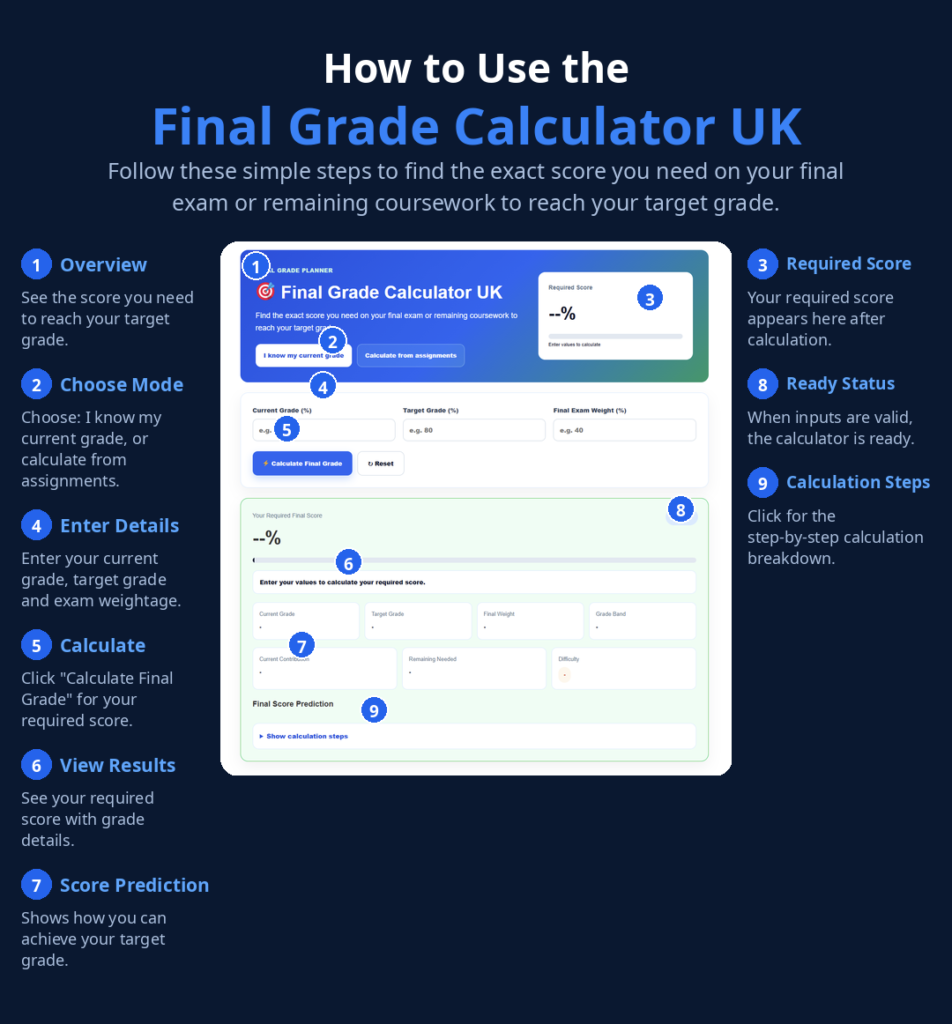
Click Here: Final Grade Calculator UK
What a Degree Classification Algorithm Actually Is
Your degree class — First, 2:1, 2:2 or Third — is not simply your average mark. Almost every UK university runs your marks through a small machine of rules called the degree algorithm (sometimes called the award scheme or classification calculation). It answers three questions: which marks count, how much each is worth, and what happens near a boundary.
| The ingredient | What it means in practice |
|---|---|
| Which years count | Usually only your final two years (Levels 5 and 6). First-year (Level 4) marks almost never count toward the class — they get you into year two, not onto the honours ladder. |
| How the years are weighted | Common patterns include equal weighting of the two counted years, or double weighting of the final year — for example (2 × final-year average + second-year average) ÷ 3. |
| How modules are weighted | Each module counts in proportion to its credit value: a 40-credit dissertation moves your average twice as far as a 20-credit module. |
| Boundary rules | What happens at 59.5 or 69.9 — some universities round, some allow exam-board discretion near a boundary, some apply the band strictly. |
| Extra steps | The features now under fire: discounting your lowest-marked credit, or running two calculations and awarding you the better result. |
Where do these rules live? In your university’s academic regulations — documents with names like “Code of Practice for Assessment”, “Academic Regulations” or “Assessment and Awards” — published on the university registry website. Your programme specification (the document describing your course) can add course-specific rules on top. Few students ever read them; this autumn, there is finally a reason to.
The Two Features the OfS Put Under Fire
On 6 November 2025 the Office for Students published its report on bachelor’s degree classification algorithms after investigating how three providers calculated degrees. Its verdict on two common algorithm features was blunt: “Our view is that such steps are inherently inflationary, and that providers should move away from the use both of steps that discount students’ credit with the lowest marks and of steps that take the best result from a choice of multiple algorithms.”
In plain terms, the two features are: discounting — an algorithm step that quietly deletes your worst-performing credits before the average is calculated, so your bad modules never happened; and best-of-multiple — running two or more different calculations and handing you the highest class any of them produces. The OfS’s argument is arithmetic, not moral: both steps can only ever move your award mark up, never down, so they systematically inflate classifications across the sector.
What changed in practice: providers that intended to keep either step in their algorithm from September 2026 had to tell the OfS by 31 July 2026, and new ongoing reportable events are live now — providers with degree-awarding powers must report algorithm changes that their own modelling shows will increase the share of firsts and 2:1s. The full regulator story, including what the OfS found at each of the three investigated universities, is in our guide to the OfS degree algorithm ruling; what follows here is what it means for your marks.
One jurisdiction note before the examples: the OfS regulates higher education in England only. Universities in Scotland, Wales and Northern Ireland answer to different regulators, but the classification conventions — and the pressure from the same national conversation about grade inflation — travel. The student-facing advice in this guide works wherever you study.
Worked Example: What Discounting Your Lowest Marks Does to Your Average
To see why the OfS calls discounting “inherently inflationary”, take a fictional final-year student with six 20-credit modules. These are illustrative numbers, not real student data — the arithmetic is what matters.
| Module | Mark |
|---|---|
| Dissertation | 68% |
| Core module A | 64% |
| Core module B | 62% |
| Option module A | 58% |
| Option module B | 52% |
| Option module C | 48% |
Straight credit-weighted average, all six modules counting: (68 + 64 + 62 + 58 + 52 + 48) ÷ 6 = 352 ÷ 6 = 58.67% — a 2:2. Now apply a “discount your lowest 20 credits” step, the kind the OfS flagged: the 48 disappears, and the average is recalculated over the remaining five modules: (68 + 64 + 62 + 58 + 52) ÷ 5 = 304 ÷ 5 = 60.80% — a 2:1.
Same student, same work, same marks. One algorithm step moved the average up by 2.13 percentage points and across a classification boundary — from a 2:2 to a 2:1. Notice the asymmetry the OfS is pointing at: discounting can only ever raise the average, because only the lowest marks are removed. Nobody’s average ever falls because of it. Multiply that across thousands of students and the share of firsts and 2:1s creeps upward without any change in what students actually achieved. If your university’s algorithm includes a discounting step, expect it to be under review right now — and expect that it possibly will not be there when you graduate. (For the student-side view of how these tactics used to work, see our guide to dropping your lowest module marks.)
York St John Scrapped “Best of Two” — A Real-World Example
The first verified case of a university changing its algorithm in this regulatory climate is York St John University. Its Code of Practice for Assessment and Academic-related Matters 2026-27 confirms that from academic year 2026-27, the university changed its degree classification algorithm from a “best of two calculations” (Award Scheme B) to a “single calculation” (Award Scheme A). The best-of-two step — the student getting the better result of two different calculations — is exactly one of the two features the OfS said providers should move away from.
The mechanics, for bachelor’s degrees, as published in the university’s own regulations. Award Scheme A (the new single calculation): double weighting of the final level (Level 6) and single weighting of the second level (Level 5) — that is, (2 × Level 6 average + Level 5 average) ÷ 3. Award Scheme B (the old scheme): two calculations — Calculation 1 uses equal weightings of Levels 5 and 6, Calculation 2 uses double weighting of Level 6 and single weighting of Level 5 — and the student is entitled to the better of the two results. First-year (Level 4) marks are excluded from the classification calculation under both schemes, and level averages are rounded to two decimal places. The class bands are the standard ones: 70+ First, 60–69 2:1, 50–59 2:2, 40–49 Third.
Who Moves to the New Scheme — and Who Stays on the Old One
This is the part that matters most if you study at York St John — and the pattern to look for at any university that changes its algorithm, because almost all of them “grandfather” existing students rather than moving everyone at once. Under York St John’s published rules:
| If you are… | Your scheme |
|---|---|
| Starting Levels 3 or 4 on or after 1 August 2026 | Scheme A (new single calculation) |
| Started Level 3 before 1 August 2026 but progress to Level 4 in or after 2026-27 | Scheme A |
| Restarting Level 3 or 4 in 2026-27 onwards | Scheme A |
| Already at Levels 5 or 6 in 2026-27 | Scheme B (old best-of-two) |
| Direct entrant to Level 5 or 6 in 2026-27 | Scheme B |
| Direct entrant to Level 6 in 2027-28 | Scheme B |
| Part-time, or returning from suspended studies | Aligned with the cohort you graduate with |
The consequence: two students sitting side by side in the same second-year lecture this autumn can be classified under different algorithms. A finalist who started in 2024 keeps best-of-two; the first-year sitting next to them gets the single calculation. Universities handle this transition in published rules — which is exactly why the “how to check” section below starts with finding your university’s current regulations, not last year’s student handbook.
Two Worked Examples: What Losing Best-of-Two Actually Costs
Both examples below are illustrative, built from York St John’s published weightings — not real student data. They show who the change hurts and who it barely touches.
Example A — final year is the weaker year. Level 5 average 62, Level 6 average 58. Under Scheme A (new): (2 × 58 + 62) ÷ 3 = 178 ÷ 3 = 59.33% → 2:2. Under Scheme B (old): Calculation 1 gives (62 + 58) ÷ 2 = 60.00% → 2:1, Calculation 2 gives 59.33% → 2:2, and the student takes the better — 2:1. Net effect: the same student gets a 2:2 under the single calculation but a 2:1 under best-of-two. Removing the safety net costs a full degree class when your final year is your weaker year.
Example B — final year is the stronger year. Level 5 average 58, Level 6 average 68. Under Scheme A: (2 × 68 + 58) ÷ 3 = 194 ÷ 3 = 64.67% → 2:1. Under Scheme B: Calculation 1 gives (58 + 68) ÷ 2 = 63.00%, Calculation 2 gives 64.67%, and the better result — 64.67% → 2:1 — stands. Net effect: the same class either way. Students who peak in final year barely feel the change, because the single calculation already favours them.
The pattern is the point. Best-of-two was a safety net for students whose final year dipped; the single calculation rewards a strong finish and punishes a weak one. Neither is “fair” or “unfair” in the abstract — but if your final-year strategy assumed the safety net was there, you need to know it has gone. This is also where a tool like the Final Grade Calculator earns its keep: model your own marks under your own university’s actual weightings, not last year’s assumptions.

How to Check Which Algorithm Applies to You (5-Minute Method)
Whatever university you attend, your algorithm is written down somewhere public. Here is the fastest route to it:
| Step | What to do |
|---|---|
| 1 | Search “[your university] academic regulations assessment” — you want the registry’s regulations page, not a student blog. The documents are often called “Academic Regulations”, “Code of Practice for Assessment” or “Assessment and Awards”. |
| 2 | Open the current academic year’s version — 2026-27, not 2024-25. Universities republish these every year, and algorithm changes appear in the new version. |
| 3 | Search inside the document for “classification” — then “award scheme”, “algorithm”, “weighting” and “discount”. The algorithm is usually one section of two to four pages. |
| 4 | Check the effective date and any transition rules — look for wording like “applies to students commencing from”, cohort tables, or a named award scheme (Scheme A/B, or a “pre-2026 scheme”). |
| 5 | Cross-check your programme specification — your course can add rules (for example, a dissertation that must be passed, or a specific module that is double-weighted) on top of the university algorithm. |
| 6 | Read your university’s degree outcomes statement — most universities publish one annually, and it sometimes explains recent algorithm changes in plain English. |
Still unclear after that? Email your departmental registry or ask your personal tutor: “Which award scheme applies to my cohort, and where is it published?” It is a normal question — registries answer it every results season. And if the numbers your university hands you ever look wrong, our guide to checking your university calculated your marks correctly shows how to audit them before you escalate.
What If My University Hasn’t Announced Any Change?
York St John is the first verified mover, not necessarily the last. The OfS reporting duties mean that by now every English provider with degree-awarding powers has had to declare whether its algorithm still contains either flagged step — and providers that keep them are on the regulator’s radar. Algorithm changes, when they happen, appear in the published regulations for the relevant academic year; they are not sprung on students at results time. (Do not assume your university has changed anything on the basis of this article alone — York St John is the verified example; every other university needs its own regulations check.)
Two reassurances that matter. First: nothing already awarded is being retrospectively reclassified. The OfS did not dispute any individual student’s classification, and York St John’s change applies to algorithms going forward — existing students at Levels 5 and 6 stay on the old scheme. Second: a changed algorithm is not a conspiracy against you. The regulatory framing is about keeping degree standards credible across the sector, and the worked examples above show the change cuts both ways depending on your marks profile. How universities moderate and check all of this behind the scenes is covered in our guide to university marking and moderation.
The practical habit: check your university’s assessment regulations once a year, the way you would check a tenancy agreement. It takes five minutes — and this is the year it might actually say something different.
Scotland, Wales and Northern Ireland
The OfS regulates higher education in England only. If you study in Scotland, Wales or Northern Ireland, the OfS report and its reporting duties do not apply to your university — but the classification conventions are broadly the same across the UK, and the sector-wide principles on degree standards are national. The same five-minute check works: find your university’s academic regulations for the current year and read the classification section. And if you are weighing how marks translate across borders — exchange years, transfers — our guide to ECTS and UK credit conversion covers that side.
The Borderline Question
One thing the York St John example makes visible: under the published rules, 59.33 is a 2:2, full stop. The class bands are fixed — 70, 60, 50, 40 — and the section of the regulations covering the award-mark calculation includes no automatic uplift for near-misses. Whether your university treats 59.9 differently is a separate rule, found in a separate section of the regulations — and many universities handle it through exam-board discretion rather than a published formula. If you are sitting near a boundary, our guide to borderline grades and discretionary uplift rules walks through how that actually works.
What is a degree classification algorithm?
A degree classification algorithm is the set of rules your university uses to turn your module marks into a final degree class (First, 2:1, 2:2 or Third). It covers which years count (usually Levels 5 and 6), how those years are weighted, how modules are weighted by credit value, what happens near a classification boundary, and any extra steps such as discounting your lowest-marked credit or running multiple calculations and awarding the better result.
Has my university changed its degree algorithm for 2026?
York St John University is the first verified case, scrapping its best-of-two scheme from 2026-27. For your own university, check its 2026-27 academic regulations (Code of Practice for Assessment or equivalent) on the registry website and search for the classification section. Most English providers reviewed their algorithms in 2026 after the OfS introduced new reporting duties.
Why are universities changing their degree algorithms now?
In November 2025 the Office for Students concluded that two common algorithm features — discounting students’ lowest-marked credit and taking the best result from multiple algorithms — are inherently inflationary. Providers that kept either step had to declare it by 31 July 2026, and new ongoing reportable events are live from September 2026, so universities are reviewing and in some cases rebuilding their algorithms.
Can my university change the algorithm while I am mid-degree?

Usually the change is grandfathered: new starters move to the new scheme while existing students stay on the old one. At York St John, for example, students already at Levels 5 and 6 in 2026-27 keep the old best-of-two scheme, while students commencing Levels 3 and 4 from 1 August 2026 move to the single calculation. Nothing already awarded is retrospectively reclassified.
Will a changed algorithm lower my degree class?
It depends on your marks profile. Losing a best-of-two safety net costs a full class when your final year is your weaker year (59.33% becomes a 2:2 instead of a 2:1), but barely matters if you peak in final year. Losing a discounting step removes a small upward lift. Model your own marks under your university’s actual published weightings to see where you stand.
Does the OfS ruling apply in Scotland, Wales and Northern Ireland?
No — the OfS regulates higher education in England only. But the underlying classification conventions are broadly the same across the UK, and the sector-wide principles on degree standards are national. Students in Scotland, Wales and Northern Ireland should still check their own university’s current academic regulations for the classification rules that apply to them.
What does discounting your lowest marks mean?
It is an algorithm step that deletes your worst-performing credits before your average is calculated — for example, dropping your lowest 20 credits and averaging the rest. Because only the lowest marks are removed, it can only ever raise your average: one worked example moved a student from 58.67% (2:2) to 60.80% (2:1). The OfS views this as inherently inflationary.
Where do I find my university’s degree algorithm?
On your university registry’s website, open the current academic year’s academic regulations (often called the Code of Practice for Assessment or Assessment and Awards) and search inside for classification, award scheme, algorithm or weighting. Cross-check your programme specification for course-specific rules, and ask your personal tutor or departmental registry if anything is unclear.
Conclusion
The machinery that turns your marks into a degree class is having its most significant overhaul in years. A regulator has named the algorithm features it considers inflationary, new reporting duties are live, and at least one university has already rebuilt its algorithm in response — with reviews under way across the sector.
For you, the student, the takeaway is refreshingly concrete: find your university’s current assessment regulations, confirm which award scheme applies to your cohort, and run your own numbers through it. The worked examples in this guide show that the same marks can mean different classes under different algorithms — which makes knowing your algorithm as important as knowing your marks.
None of this changes what you have already earned, and none of it is a reason to panic. But it is a reason to read the few pages of regulations that decide your degree class — this year, of all years, they might say something new.
![Read more about the article How Do University Marking Criteria Work? Rubrics Explained [2026]](https://gradeforuni.com/wp-content/uploads/2026/10/featured-marking-criteria-300x192.png)
![Read more about the article How Are Scottish Degrees Classified? Grades, Credits & Honours Explained [2026]](https://gradeforuni.com/wp-content/uploads/2026/10/featured-scottish-classification-300x192.png)