

You open your university results expecting one simple number. Instead, you see an exam mark, coursework mark, module result, and perhaps a year average — and they do not always match.
For example, you might score 68% in an exam but receive 63% for the module. Or you might score 38% in an exam and still receive a module mark above 40%.
This happens because universities may use different assessment weightings, credit values, and pass requirements. Your exam percentage is often only one part of your overall module result.
Understanding how university exam marks are calculated helps you check your results, work out what mark you need in an upcoming assessment, and see how individual modules affect your overall degree.
If you want to check your result quickly, use a university grade calculator instead of calculating everything manually.
Click Here: UK University Grade Calculator
How to Use the UK University Grade Calculator
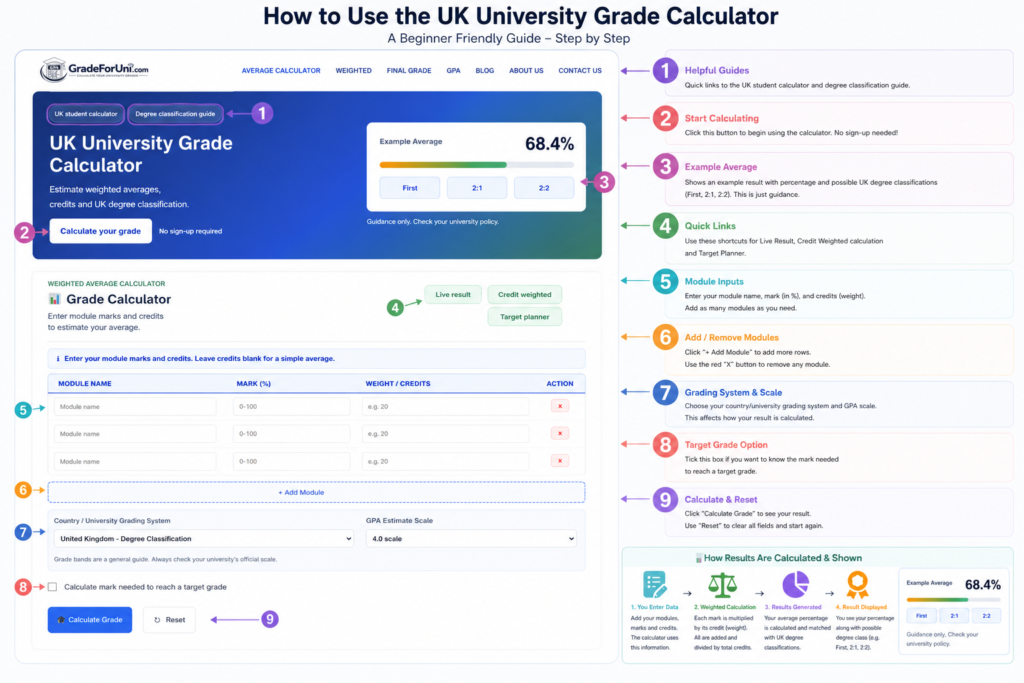
University exam marks are usually calculated by taking the percentage you achieved in the exam and applying the exam’s weighting within the module. The weighted exam contribution is then combined with coursework or other assessment contributions to produce the module mark. That module mark may later be combined with other modules using credit or year weightings. Exact rules vary by university and course.
How Are University Exam Marks Calculated?
A university exam mark is the percentage score you receive for an examination or exam assessment.
For example, if your exam is marked at 68%, your exam mark is 68%.
However, your exam mark is not necessarily your final module mark because a module may include multiple assessments with different weightings.
For example:
- Exam: 50%
- Coursework: 30%
- Presentation: 20%
So, your exam mark contributes only part of your final module result.
What Is the Difference Between an Exam Mark and a Module Mark?
The exam mark is the result of the exam itself.
The module mark is the combined result after all required assessments have been given their appropriate weightings.
For example:
| Assessment | Mark | Weighting | Contribution |
|---|---|---|---|
| Exam | 68% | 60% | 40.8% |
| Coursework | 72% | 40% | 28.8% |
| Module mark | 100% | 69.6% |
The student achieved 68% in the exam, but their final module mark is 69.6%.
That difference is important when interpreting university exam marks.
How Does an Exam Mark Contribute to Your Module Grade?
| Exam Weighting | Exam Mark | Exam Contribution |
|---|---|---|
| 70% | 60% | 42% |
Calculation: 60 × 0.70 = 42%
The remaining 30% comes from the other assessments. Check your module specification for the exact assessment weightings.
Read More: Semester Grade Calculator UKHow Does University Exam Weighting Work?
| Exam Weighting | Exam Mark | Contribution to Module |
|---|---|---|
| 50% | 70% | 35% |
Calculation: 70 × 0.50 = 35%
What Does 100% Exam Weighting Mean?
A module with 100% exam weighting is assessed entirely through the examination.
If you achieve 67% in that exam, the module mark is 67%, assuming there are no separate requirements that affect the result.
Calculation:
67 × 1.00 = 67%
This is the simplest university exam calculation because there are no other assessment contributions.
How Does a 70% Exam and 30% Coursework Weighting Work?
Supp
| Assessment | Weighting | Mark | Weighted Contribution |
|---|---|---|---|
| Exam | 70% | 64% | 44.8% |
| Coursework | 30% | 72% | 21.6% |
| Module Mark | 100% | — | 66.4% |
Calculation: 44.8 + 21.6 = 66.4%
How Does a 50:50 Exam and Coursework Weighting Work?
| Assessment | Weighting | Mark | Contribution |
|---|---|---|---|
| Exam | 50% | 58% | 29% |
| Coursework | 50% | 74% | 37% |
| Module Mark | 100% | — | 66% |
How Do Modules With Three or More Assessments Work?
The same principle applies when there are more than two assessments.
For example:
| Assessment | Mark | Weighting |
|---|---|---|
| Exam | 61% | 50% |
| Coursework | 69% | 30% |
| Presentation | 78% | 20% |
Calculate each contribution:
- Exam: 61 × 0.50 = 30.5
- Coursework: 69 × 0.30 = 20.7
- Presentation: 78 × 0.20 = 15.6
Total:
30.5 + 20.7 + 15.6 = 66.8%
The module mark is 66.8%.
Comparison Table: Common University Assessment Weightings
| Exam weighting | Other assessment weighting | What it means |
|---|---|---|
| 100% | 0% | The exam determines the module mark |
| 70% | 30% | The exam has the larger influence |
| 60% | 40% | Exam carries slightly more weight |
| 50% | 50% | Both assessments contribute equally |
| 40% | 60% | Other assessments have greater influence |
These are examples of common structures, not a universal UK assessment system. Your module specification takes priority.
How Do You Calculate a University Module Mark?
Once you know each assessment mark and its weighting, you can calculate the module mark using a weighted average.
| Step | What to Do | Example |
|---|---|---|
| 1. Identify marks | Write down the percentage for each assessment. | Exam = 66%, Coursework = 71%, Presentation = 75% |
| 2. Identify weightings | Check how much each assessment is worth. | Exam = 50%, Coursework = 30%, Presentation = 20% |
| 3. Calculate contributions | Multiply each mark by its weighting. | 66 × 0.50 = 33; 71 × 0.30 = 21.3; 75 × 0.20 = 15 |
| 4. Add contributions | Add the weighted contributions together. | 33 + 21.3 + 15 = 69.3% |
| 5. Apply rounding rules | Check your university’s rules before rounding. | Module mark = 69.3% before rounding |
Formula:
Module mark = (Assessment mark × weighting) + (Assessment mark × weighting) + …
For the example:
(66 × 0.50) + (71 × 0.30) + (75 × 0.20) = 69.3%
The module mark is 69.3% before any institutional rounding.
Does Your University Exam Have to Be Passed Separately?
Not always.
A university can calculate an overall module mark while also requiring you to achieve a minimum mark in a particular assessment.
This is why you should not assume that an overall mark above the usual pass threshold automatically means you have passed every requirement.
What Is an Exam Hurdle or Qualifying Mark?
An exam hurdle is a minimum mark you must achieve in an exam or assessment, even if your overall module mark is high enough to pass.
For example, imagine a module requires:
- Overall module mark: at least 40%
- Exam mark: at least 35%
A student might achieve a strong coursework result and finish with an overall module mark above 40%, but still need to meet the separate exam requirement.
Whether a hurdle exists depends on the module and university.
Can You Pass a Module if You Fail the Exam?
Possibly.
| Assessment | Weighting | Mark | Contribution |
|---|---|---|---|
| Exam | 50% | 35% | 17.5% |
| Coursework | 50% | 70% | 35% |
| Module Mark | 100% | — | 52.5% |
Can You Fail a Module Even If You Pass the Exam?
Yes.
Consider:
- Exam = 42%
- Coursework = 30%
- Weighting = 50:50
The calculation is:
42 × 0.50 = 21
30 × 0.50 = 15
21 + 15 = 36%
The exam mark is above 40%, but the overall module mark is 36%.
If the module uses a 40% overall pass threshold and no compensation applies, the student could fail the module.
Why Do Pass Requirements Differ Between Universities?
Universities set their own academic regulations, and individual programmes can have additional requirements.
Some courses can also have professional or accreditation requirements.
Before deciding whether an exam result is a pass, check:
- Module specification
- Programme specification
- Assessment regulations
- Student handbook
- Student portal
Comparison Table: Overall Pass Mark vs Exam Hurdle
| Situation | Possible outcome |
|---|---|
| Overall mark reaches pass threshold | Usually passes the module |
| Overall mark reaches pass threshold, but exam is below a hurdle | May fail |
| Exam passes, but overall module mark is below threshold | May fail |
| Overall, assessment requirements are met | Usually passes |
| Professional requirement is not met | Additional rules may apply |
What Is the Pass Mark for a University Exam in the UK?
There is no single rule that applies identically to every UK university and every course.
A common undergraduate framework uses 40% as the pass level, but individual assessment and programme regulations can introduce additional requirements.
Is 40% a Pass at a UK University?
For many UK undergraduate programmes, 40% is the commonly recognised pass level.
A typical honours classification framework is:
| Mark | Typical classification |
|---|---|
| 70%+ | First Class Honours |
| 60–69% | Upper Second-Class Honours (2:1) |
| 50–59% | Lower Second-Class Honours (2:2) |
| 40–49% | Third Class Honours |
| Below 40% | Usually fail |
These boundaries should be treated as a general framework rather than a guarantee. Universities can apply different algorithms, borderline rules, and assessment requirements.
Are Undergraduate and Master’s Pass Marks Different?
Master’s degrees commonly use a different grading structure.
A common framework is:
- Pass
- Merit
- Distinction
A Master’s pass threshold is commonly 50%, although exact rules vary between institutions and programmes.
| Feature | Undergraduate | Taught Master’s |
|---|---|---|
| Common classification | First, 2:1, 2:2, Third | Pass, Merit, Distinction |
| Common pass level | 40% | 50% |
| Final calculation | Institution-specific | Institution-specific |
Why Is the Pass Mark Not the Only Requirement?
A student can be above the usual pass threshold and still need to satisfy other conditions.
For example, a module may have:
- A minimum exam mark
- A minimum practical mark
- A professional competency requirement
- Attendance or completion requirements
- Specific reassessment rules
Always check your own programme regulations before treating a generic pass mark as definitive.
How Do University Credits Affect Your Marks?
Assessment weighting and credit weighting happen at different stages.
Assessment weighting determines how individual assessments create a module mark.
Credit weighting can determine how that module mark contributes to a wider average.
What Is a Credit-Weighted Average?
A credit-weighted average gives greater influence to modules carrying more credits.
For example, a 40-credit module should generally have twice the influence of a 20-credit module when calculating a credit-weighted average.
The calculation is based on both the mark and the credit value.
How Is a Module Mark Weighted by Credits?
| Module | Mark | Credits | Weighted Mark |
|---|---|---|---|
| Module A | 60% | 20 | 1,200 |
| Module B | 68% | 20 | 1,360 |
| Module C | 72% | 40 | 2,880 |
| Total | — | 80 | 5,440 |
| Credit-weighted average | — | — | 68% |
Why Do Higher-Credit Modules Have More Impact?
A higher-credit module represents a larger portion of your programme’s academic workload.
If one module is worth 40 credits and another is worth 20, treating them as equal would ignore the credit structure.
This is why simply adding module marks and dividing by the number of modules can produce the wrong result when credits differ.
What Is the Difference Between Assessment Weighting and Credit Weighting?
| Type of weighting | What it determines |
|---|---|
| Exam weighting | Exam’s contribution to the module |
| Coursework weighting | Coursework’s contribution to the module |
| Assessment weighting | How assessment components combine |
| Credit weighting | How modules contribute to an average |
| Year weighting | How academic years contribute to a final result |
For example, your exam might be worth 60% of a 20-credit module. The 60% controls the exam’s contribution within the module. The 20 credits can then affect how the resulting module mark contributes to your wider average.
Read More: How University Credits and Grades Work TogetherHow Do Exam Marks Affect Your Overall University Grade?
Your exam mark normally influences your final degree indirectly through the module calculation.
The pathway can look like this:
Exam mark → module mark → credit-weighted average → year average → final degree mark
The exact route depends on your university’s classification algorithm.
How Do Module Marks Become a Year Average?
Once individual module marks have been calculated, the university can combine them according to the relevant credit weighting.
A 20-credit module and a 40-credit module should not automatically be treated as equal if the university uses a credit-weighted calculation.
How Do Year Averages Contribute to a Final Degree Mark?
Some universities use different weightings for different years.
For example, a programme could place more emphasis on later study.
The exact weighting might depend on the programme and university, so you should not apply a generic 30:70 or similar formula unless your course regulations specify it.
Do First-Year Exam Marks Count Towards Your Final Degree?
There is no single UK-wide answer.
Some universities or programmes may exclude first-year results from the final classification, while others may use first-year performance in specific ways.
Check your programme’s classification rules rather than relying on a general assumption.
Why Do Final-Degree Calculation Rules Vary Between Universities?
Universities can use different:
- Module weighting systems
- Credit requirements
- Year weightings
- Classification algorithms
- Borderline rules
- Rounding procedures
That is why two students with similar individual marks can have different final-degree calculations under different university regulations.
How Are University Marks Rounded?
Rounding can affect the final number displayed in your results, particularly when you are close to a classification boundary.
When Are Assessment Marks Rounded?
The university may calculate an assessment or component result using its own marking and recording rules.
You should not assume that every intermediate figure is rounded to a whole number.
When Is a Module Mark Rounded?
Some universities calculate the complete weighted module result and then apply their specified rounding procedure.
For example, if your unrounded calculation is 69.6%, you should not automatically assume the official result will be 70%.
How Are Year and Final-Degree Averages Rounded?
The same principle applies to year averages and final degree results.
Classification calculations can have specific rules for rounding and borderline outcomes.
Why Should You Avoid Rounding Too Early?
Suppose your actual calculation produces:
69.46
If you round that to 69 before using it in another calculation, you can create a different final result.
The safer approach is to keep the full value during your own calculations and apply rounding only where the university’s rules require it.
What Happens If You Fail a University Exam?
Failing an exam does not automatically tell you what happens next.
Your outcome can depend on the overall module mark, assessment requirements, and reassessment regulations.
What Is a Resit or Reassessment?
A resit or reassessment gives a student another opportunity to complete an assessment after an unsuccessful result, subject to the university’s rules.
The replacement result may not always be treated in the same way as the original attempt.
How Can a Resit Mark Affect Your Module Grade?
The university may use the reassessment result alongside other existing assessment marks.
The exact calculation depends on the module and reassessment rules.
Can Resit Marks Be Capped?
Yes, some universities cap marks achieved through certain reassessment routes.
A capped mark means the recorded result may be limited to a specified level even if the student performs better in the reassessment.
Do not assume every university uses the same cap.
Does the Original Coursework Mark Still Count?
It can.
A reassessment might replace only the failed component rather than requiring every assessment to be repeated.
The exact treatment should be confirmed in your university’s regulations.
Why Do Resit Rules Differ Between Universities?
Resit policies can specify:
- Which assessment is repeated
- Whether marks are capped
- Whether previous marks are retained
- Whether compensation is available
- How reassessment contributes to the module
- Whether professional requirements affect eligibility
What Are the Most Common University Exam Marking Mistakes?
Confusing an Exam Mark With a Module Mark
A 65% exam does not necessarily mean a 65% module result.
The exam’s weighting must be considered.
Ignoring Assessment Weightings
A 70% exam and a 30% coursework assessment cannot be combined by simply averaging the two percentages.
Using a Simple Average for Weighted Assessments
For a 70:30 module, adding the two marks and dividing by two gives the wrong result.
Always apply the stated weightings.
Confusing Assessment Weighting With Credit Weighting
The exam’s weighting determines its contribution to the module.
Module credits can determine their contribution to a wider average.
Assuming 40% Always Means You Have Passed
A 40% result is commonly associated with an undergraduate pass, but a module may have additional requirements.
Ignoring Exam Hurdles and Qualifying Marks
An assessment can have a minimum required mark even when the overall module calculation looks satisfactory.
Rounding Marks Too Early
Premature rounding can change later calculations.
Assuming Every UK University Uses the Same Rules
University regulations are not identical.
Forgetting Different Modules Can Have Different Credit Values
A 10-credit and 30-credit module should not automatically receive equal influence in a credit-weighted average.
Assuming Resit Marks Are Always Uncapped
Reassessment results can be subject to specific institutional rules.
How Can You Calculate Your University Exam Mark More Accurately?
[Expert Tips Place Check Your Module Specification First
Find the exact assessment weighting before calculating your mark.
- Exams
- Coursework
- Presentations
- Practical assessments
- Other components
Keep Assessment and Credit Weightings Separate
Calculate the module mark first, then consider how it contributes to your overall average.
Calculate Weighted Contributions Separately
Multiply each assessment mark by its weighting, then add the contributions together.
Check Hurdle Requirements
Some modules require a minimum mark in a specific exam or assessment, even if the overall module mark is a pass.
Keep Full Precision
Avoid rounding intermediate results until the required rounding stage.
Check Your University’s Regulations
Use your university’s official assessment regulations to confirm grading, resits, reassessment, borderline and classification rules.
What Should You Check in Your University’s Assessment Regulations?
Your university’s official documents can answer questions that a general guide cannot.
Module Assessment Weightings
Confirm exactly how much each assessment contributes.
A module handbook might specify a 60% exam and 40% coursework structure, for example.
Pass and Qualifying Requirements
Check whether you need to achieve a minimum mark in an individual assessment.
Credit Requirements
Confirm how many credits each module carries and how those credits are used in the calculation.
Rounding Rules
Check whether your university rounds:
- Assessment marks
- Module marks
- Year averages
- Final degree averages
Resit and Reassessment Rules
Look for information about:
- Capped marks
- Replacement assessments
- Retained marks
- Compensation
- Referral or reassessment
Final Degree Classification Rules
Your programme’s classification algorithm is particularly important if you are calculating your final degree result.
Expert Tip: The most reliable places to check are your module handbook, programme specification, official academic regulations and student portal. If an online guide conflicts with your university’s current regulations, use the official university information for your course.
Worked Examples of University Exam Mark Calculations
Worked Examples
Example 1: 70% Exam and 30% Coursework
| Assessment | Mark | Weighting | Contribution |
|---|---|---|---|
| Exam | 65% | 70% | 45.5% |
| Coursework | 70% | 30% | 21% |
| Module Mark | — | 100% | 66.5% |
Example 2: 50:50 Exam and Coursework
| Assessment | Mark | Weighting | Contribution |
|---|---|---|---|
| Exam | 58% | 50% | 29% |
| Coursework | 72% | 50% | 36% |
| Module Mark | — | 100% | 65% |
Example 3: 100% Exam Module
| Assessment | Mark | Weighting | Contribution |
|---|---|---|---|
| Exam | 67% | 100% | 67% |
| Module Mark | — | 100% | 67% |
Example 4: Exam, Coursework and Presentation
| Assessment | Mark | Weighting | Contribution |
|---|---|---|---|
| Exam | 60% | 50% | 30% |
| Coursework | 70% | 30% | 21% |
| Presentation | 80% | 20% | 16% |
| Module Mark | — | 100% | 67% |
Example 5: Exam Hurdle
| Assessment | Mark | Weighting | Contribution |
|---|---|---|---|
| Exam | 38% | 50% | 19% |
| Coursework | 70% | 50% | 35% |
| Module Mark | — | 100% | 54% |
Example 6: Credit-Weighted Average
| Module | Mark | Credits | Weighted Mark |
|---|---|---|---|
| Module A | 62% | 20 | 1,240 |
| Module B | 68% | 20 | 1,360 |
| Module C | 72% | 40 | 2,880 |
| Total | — | 80 | 5,480 |
| Credit-weighted average | — | — | 68.5% |
Example 7: Different Module Credit Values
| Module | Mark | Credits | Weighted Mark |
|---|---|---|---|
| Module A | 58% | 10 | 580 |
| Module B | 65% | 20 | 1,300 |
| Module C | 70% | 30 | 2,100 |
| Total | — | 60 | 3,980 |
| Credit-weighted average | — | — | 66.33% |
Example 8: Exam Mark Needed for a Target Module Grade
| Calculation | Result |
|---|---|
| Coursework mark | 68% |
| Coursework weighting | 40% |
| Coursework contribution | 27.2% |
| Target module mark | 65% |
| Remaining contribution needed | 37.8% |
| Exam weighting | 60% |
| Required exam mark | 63% |
Real-Life University Exam Mark Scenarios
You got 65% in Your University Exam
A 65% exam result does not automatically mean your module result is 65%.
Check the exam weighting first.
If the exam is worth 70%, for example:
65 × 0.70 = 45.5
The remaining assessment components determine the rest of the module mark.
You got 35% in the Exam but 55% Overall
This can happen when other assessments carry substantial weight.
For example, a 35% exam combined with a strong coursework result can produce an overall module mark above 40%.
However, check whether the module has an exam hurdle.
You got 70% in the Exam but 62% Overall
This usually means the exam is not worth 100% of the module, and the other assessment components produce a lower-weighted contribution.
Your exam result can be strong while the overall module mark is lower.
You got 39% on the Exam
Do not immediately assume that you have failed the module.
Check:
- The exam weighting.
- The overall module calculation.
- Any exam hurdle.
- Compensation rules.
- Reassessment rules.
You need 70% overall in the Module
Start with the marks you already have.
If your coursework contributes 27.2 percentage points and your target is 70%, you need:
70 − 27.2 = 42.8
If the exam is worth 60%:
42.8 ÷ 0.60 = 71.33%
You would need approximately 71.33% in the exam, subject to your university’s rules.
Your Module Is Worth 20 Credits
The 20-credit value does not change how the exam itself is weighted.
If the exam is worth 60% of the module, it remains a 60% assessment regardless of whether the module carries 10, 20 or 40 credits.
The credits become relevant when the module mark is used in a wider credit-weighted average.
Frequently Asked Questions
How are university exam marks calculated in the UK?
Your exam mark is usually combined with other assessment marks according to the weightings stated for your module. For example, a 60% exam mark in a module where the exam is worth 70% contributes 42 percentage points to the module result. Exact rules vary by university and programme.
How is an exam mark converted into a university module mark?
Multiply the exam percentage by its weighting, then calculate the weighted contribution of every other assessment and add them together.
What is a weighted exam mark?
A weighted exam mark is the portion of your exam result that contributes to the module. For example, a 70% on an assessment worth 50% contributes 35 percentage points.
How does university exam weighting work?
Exam weighting determines how much influence the exam has on the module result. A 70% exam weighting means the exam contributes 70% of the module calculation, with the remaining 30% coming from other assessments.
How do I calculate my university exam contribution?
Use:
Exam contribution = Exam mark × Exam weighting
For example:
64 × 0.60 = 38.4
So a 64% exam worth 60% contributes 38.4 percentage points.
How do exam and coursework marks combine?
Multiply each mark by its weighting and add the contributions.
For a 60:40 split:
(Exam × 0.60) + (Coursework × 0.40)
What is the pass mark for university exams in the UK?
A 40% pass level is common for undergraduate study, but it is not a universal rule for every assessment or programme. Individual courses can have minimum assessment marks and other requirements.
Is 40% a pass in a UK university exam?
It is commonly associated with an undergraduate pass, but whether you have passed depends on your university and module regulations. An individual exam may also have a separate hurdle.
Can I pass a module if I fail the exam?
Possibly. A strong performance in other assessments can raise your overall module mark. However, if the module requires a minimum exam mark, you may still fail or require reassessment.
Can I fail a module if I pass the exam?
Yes. Passing the exam does not necessarily mean that your overall module mark reaches the required pass level.
Do university exams need to be passed separately?
Not always. Some modules use only the overall weighted module mark, while others have minimum marks for particular assessments. Check your module regulations.
What is an exam hurdle at university?
An exam hurdle is a minimum mark that must be achieved in an exam, even if your overall module result reaches the usual pass threshold.
Conclusion
University exam marks are part of a wider grading process. Your exam percentage may be combined with coursework or other assessments to calculate your module mark. The module mark can then contribute to your overall average or final degree classification.
Exam mark → Weighted contribution → Module mark → Overall average → Degree result
If your result seems unexpected, check your university’s assessment weightings, credit values, pass requirements, and rounding rules.

![Read more about the article Oxbridge Admissions Tests Explained: TMUA, ESAT & TARA Scores [2026]](https://gradeforuni.com/wp-content/uploads/2026/10/featured-admissions-tests-uk-300x192.png)
![Read more about the article Placement Year Grading: How Sandwich Years Are Marked [2026 Guide]](https://gradeforuni.com/wp-content/uploads/2026/10/featured-placement-year-grading-300x192.png)