
![You are currently viewing Placement Year Grading: How Sandwich Years Are Marked [2026 Guide]](https://gradeforuni.com/wp-content/uploads/2026/10/featured-placement-year-grading.png)
Placement Year Grading: How Sandwich Years Are Marked [2026 Guide]
You have landed the placement — a year at a real employer, a real salary, real work. Then the nagging question arrives: how is any of this actually graded? Placement year grading is one of the least understood parts of UK higher education, and the honest answer is less uniform than most students expect. At most universities your placement year is assessed on a pass-or-fail basis and contributes precisely nothing to your degree classification. At Aston University it counts for a full 10% of your final mark. At Loughborough it earns you an entirely separate diploma.
The difference matters more than it looks. Whether your year is graded or merely passed changes how much effort belongs in the reflective report versus the job itself, whether the presentation mark is worth sweating over, and — critically — what happens if the placement goes wrong. This guide breaks down the five grading models UK universities actually use, compares the published rules at seven named universities, works through the classification arithmetic of a counted placement year with real numbers, and lays out the money side: fees, student finance and pay.
One warning before we start. Placement-year rules live in your university’s academic regulations and vary by course, not just by institution. Everything below is verified against published university documents — where two sources disagreed or a rule was course-specific, I say so — but always check your own course handbook before making decisions that affect your degree.
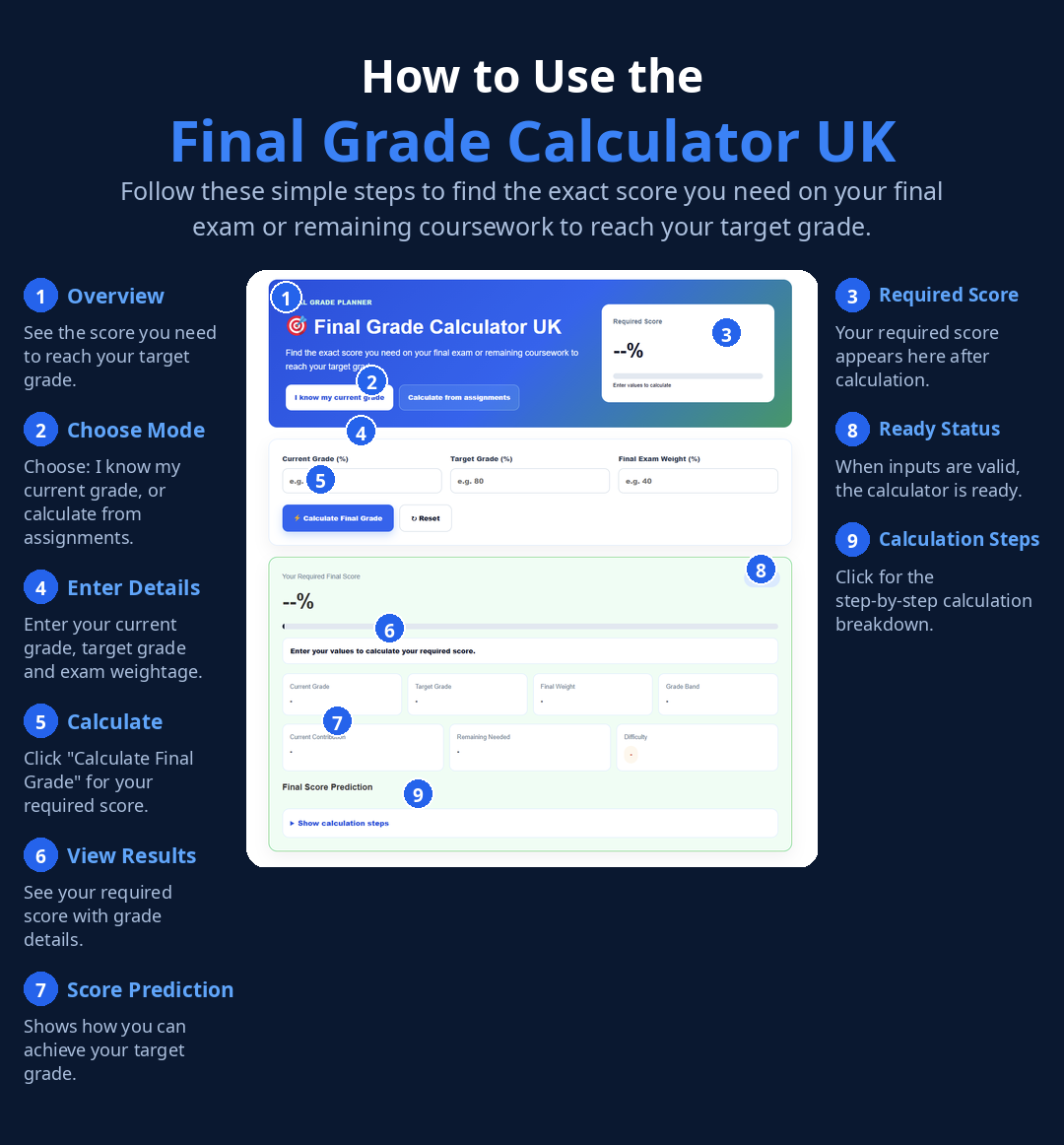
Click Here: Final Grade Calculator UK
How Placement Year Grading Actually Works
Strip away the branding — “sandwich year”, “year in industry”, “professional placement”, “professional training year” — and UK universities grade placement years in five distinct ways. The model your university uses determines three things: whether you receive a percentage mark or a simple pass, whether that mark feeds into your degree classification, and what ends up printed on your certificate.
Model 1 — Pass/fail, zero classification weight. The most common arrangement by far. You complete the year, submit the required assessments (usually a report and a reflective piece), and the university records a pass. Your classification is calculated from your taught years exactly as if the placement year did not exist. Nottingham, Northumbria and Newcastle all work this way.
Model 2 — Counted numerically. The placement year carries real percentage marks that feed into the classification algorithm. Aston University is the clearest example: its placement year contributes 10% of the final degree calculation.
Model 3 — The diploma model. The year is assessed separately and earns you an additional qualification alongside your degree. Loughborough awards a Diploma in Professional Studies (or a Diploma in Professional/Study Abroad) for a satisfactory placement year.
Model 4 — The credit-bearing module. The year sits inside your degree as a large module — Bath lists a 60-credit “Professional placement” module in its sandwich degrees — while the classification itself is still driven by the taught years.
Model 5 — The professional-training level. Surrey runs its placement year at its own “P level”: you must bank 120 P-level credits for an honours degree that includes professional training, but classification remains driven by Level 5 and Level 6 marks.
The Five Models Compared: How 7 UK Universities Grade the Placement Year
This is the table students actually need. Every entry below comes from the university’s own published regulations or course pages.
| University | What the year is called | How it is assessed | Counts toward classification? | What appears on your certificate |
|---|---|---|---|---|
| Aston | Placement year (Stage P) | Personal development plan + portfolio of blogs (40%) + recorded presentation (60%) | Yes — 10% of the final degree calculation | Standard degree title; the 10% weighting is built into the algorithm |
| Bath | Professional placement (thick or thin sandwich) | 60-credit professional placement module | No — classification is calculated from the taught years | Sandwich degree title |
| Loughborough | Professional training / study abroad year | Satisfactory assessment in each part of the training; unsatisfactory work can be remedied before final exams | No — but earns a separate Diploma in Professional Studies | Degree + Diploma in Professional Studies |
| Nottingham | Optional placement year | Pass/fail: reflective journal + 3,000-word report + pre-recorded presentation (presentation not assessed) | No — not credit-bearing | Fail the assessment and you transfer back to the non-placement version of the degree |
| Northumbria | Work placement year (module AD5001) | 120-credit year-long module, assessed pass/fail; minimum 30 weeks | No | “Degree title (with Work Placement Year)” on both transcript and certificate |
| Surrey | Professional training year (P level) | 120 P-level credits; one reassessment right within a year if P credits are not awarded | No — classification uses Level 5 (35%) and Level 6 (65%) marks | Degree including professional training |
| Newcastle | Placement year (e.g. 1919U Modern Languages) | Pass/fail | No | Degree with placement year |
The pattern is unmistakable: six of the seven universities keep the placement year out of the classification entirely. Aston is the outlier — and because it is the outlier, its rules deserve a closer look.
Aston’s Counted Year: What a 10% Placement Year Really Means
Aston University’s published award-calculation rules spell out the arithmetic precisely. Stage 1 (first year) contributes 0% to the final degree calculation. Stage 2 contributes 15% on sandwich degrees — or 25% on degrees without a placement year. The placement year, designated Stage P, carries 120 credits and contributes 10%. The final stage contributes 75%. Compare that with the non-placement version of the same degree, where Stage 2 takes 25% and the final stage 75%:
| Stage | With placement year | Without placement year | |
|---|---|---|---|
| Stage 1 (first year) | 0% | 0% | 0% |
| Stage 2 | 15% | 25% | |
| Stage P (placement year) | 10% | — | |
| Final stage | 75% | 75% | |
| Total | 100% | 100% |
Notice the trade: choosing the placement route does not add 10% on top of everything else. It redistributes weight away from Stage 2. Your second-year marks matter less (15% instead of 25%), and the placement year fills the gap. If you are weighing up whether your second-year average is an asset or a liability, that redistribution is the single most important number in this article.
How is the 10% actually earned? Aston’s placement assessment, documented in the university’s employability showcase, has two components: a personal development plan plus a portfolio of blogs reflecting on the placement experience (40%), and a recorded presentation — with a written plan and outline — critically evaluating an issue or process in the host organisation or its sector (60%). Your employer’s opinion of you feeds into the process, but the university awards the mark against academic criteria. That distinction matters: being a brilliant employee and being a strong reflective writer are different skills, and the mark rewards the second. For more on how universities set and apply marking criteria, see our guide to how university marking criteria work.
Worked Example: What a 10% Placement Year Does to a Real Classification
Theory is cheap; arithmetic is not. Meet Priya, a fictional Aston business student on a sandwich degree. Her numbers are realistic for a strong-but-not-stellar student:
- Stage 2 average: 62%
- Stage P (placement year) mark: 74% — she wrote a sharp critical presentation on her employer’s supply chain
- Final stage average: 66%
With the placement year counted:
0.15 × 62 + 0.10 × 74 + 0.75 × 66 = 9.30 + 7.40 + 49.50 = 66.2% → Upper Second (2:1)
Now the counterfactual — the same student on the three-year, non-placement version of the degree:
0.25 × 62 + 0.75 × 66 = 15.50 + 49.50 = 65.0% → Upper Second (2:1)
Same classification, but the placement year lifted her final mark by 1.2 percentage points. A 10% weight on a strong placement mark is a quiet but real boost — roughly equivalent to raising every final-year module by more than a mark and a half. To see how your own numbers play out, run them through the Final Grade Calculator UK.
Now flip it. Suppose Priya’s placement year had gone badly — a 55% for a rushed portfolio:
0.15 × 62 + 0.10 × 55 + 0.75 × 66 = 9.30 + 5.50 + 49.50 = 64.3% → 2:1
That is 0.7 points below the non-placement counterfactual. The 10% weight cuts both ways, and because it is only 10%, a single bad year cannot sink a degree — but it can sting.
Where the 10% truly bites is at a classification borderline. Take a second student, Daniel: Stage 2 average 68%, final stage 69.2%, placement year 78%.
With placement: 0.15 × 68 + 0.10 × 78 + 0.75 × 69.2 = 10.20 + 7.80 + 51.90 = 69.9%
Without placement: 0.25 × 68 + 0.75 × 69.2 = 17.00 + 51.90 = 68.9%
At many universities 69.9% rounds to 70% — a First — while 68.9% stays a 2:1. One strong placement year, one degree classification apart. (Rounding rules differ by institution, so check yours; our guide to how UK universities round marks covers the common systems.) If you want to understand exactly how classifications are computed from module marks, see how to calculate your final degree classification.
The Money: Fees, Student Finance and Pay on a Placement Year
Placement year grading is only half the financial story; the other half is what the year costs and what it pays. Here the rules are national, not institutional. Under the government’s fee regulations, students on a sandwich work-placement year can be charged up to 20% of the maximum standard tuition fee, while students on an overseas study year or Turing Scheme year can be charged up to 15%. With the maximum fee at £9,535, that caps the sandwich-year fee at around £1,907.
Bath’s published fee tables show what this looks like in practice for 2025/26 on a thick sandwich placement (a full continuous year away from the university):
| Type of placement year | 2025/26 tuition fee |
|---|---|
| Paid or unpaid work placement (non-Turing) | £1,905 |
| Turing Scheme study or work placement | £1,430 |
| Non-Turing study combined with non-Turing work | £1,430 |
| Full campus-based year (for comparison) | £9,535 |
GOV.UK confirms the student-finance side: you can get a lower Tuition Fee Loan amount for sandwich placements, study abroad and Turing Scheme placements — the loan follows the reduced fee, so you are not borrowing £9,535 for a £1,905 year. If your placement is overseas under the Turing Scheme rather than a work placement, the ECTS and conversion rules in our ECTS to UK credits guide are worth reading alongside this.
Now the worked money example. Take Ahmed, starting a four-year sandwich degree in 2025/26 at standard fees:
- Total tuition, sandwich route: 3 × £9,535 + £1,905 = £30,510
- Total tuition, four full-fee years: 4 × £9,535 = £38,140
- Tuition saved by the sandwich route: £7,630
Then the salary. Placement pay varies wildly by sector and city, but reported figures cluster in a clear band: students on The Student Room report an average of around £18,000 a year, with the top end in big-city law and finance reaching £27,000; Bath’s own published data for 2024/25 shows an average UK placement salary of £23,407 across 61 students, with the highest at £30,000. Take a middle figure of £20,000 for Ahmed’s year: he pays a £1,905 fee and earns £20,000 — roughly £18,000 ahead of where he would be paying full fees on campus.
The honest counterpoint: the non-sandwich student graduates a year earlier and can be earning a graduate salary while Ahmed is still on placement pay. The placement year’s financial case rests on what it buys — experience, contacts, and very often a graduate job offer from the placement employer — not on a single year’s cash flow. None of this changes the grading, but it explains why students accept a year of assessments that, at most universities, cannot move their classification a single mark.
What You Are Actually Marked On
One of the most persistent myths is that your employer grades your placement year. In almost every UK model, the employer contributes evidence — a report, a sign-off, sometimes a formal appraisal — but the university awards the mark or the pass. Understanding that split tells you where to put your effort: the job gets you the material; the write-up gets you the grade.
The assessment bundle varies, but the ingredients repeat across universities:
- Reflective writing. Nottingham’s optional placement year requires a reflective journal kept throughout the placement plus a 3,000-word end-of-placement report. UWE’s sandwich-year module is assessed 100% on a reflective portfolio covering normally 40 weeks of work with a pre-approved provider.
- An employer report. UWE requires a 2,000-word employer’s report as part of the portfolio. The employer describes what you did and how you performed; the academic marker judges it against the module’s learning outcomes.
- A presentation. Aston requires a recorded presentation critically evaluating an issue or process in the host organisation (60% of the placement mark). Nottingham requires a pre-recorded end-of-placement presentation — but notably, it is not assessed; you simply have to complete it.
- A personal development plan. Aston asks for a PDP setting out a framework for your learning during the placement, plus a portfolio of blogs reflecting on the experience (40% of the mark).
- Satisfactory completion. Loughborough’s Regulation XI requires a satisfactory assessment in each part of the professional training or study abroad — dissertation, project report, progress assessment, placement review or other assessment — to earn the Diploma.
The through-line: universities are not marking your job performance. They are marking your ability to connect the work back to academic learning — reflection, critical evaluation, evidence. A student who does competent work and writes a superb critical report will outscore a star employee who submits a thin portfolio. If you only remember one sentence from this section, make it that one.
What Happens If You Fail Your Placement Year
This is the question students are afraid to ask, and the answer is less scary than the question. Because placement year grading is a pass/fail hurdle rather than classified marks at most universities, failing one does not normally mean failing your degree. What you lose is the placement designation.
Nottingham states it most bluntly: if you do not pass the assessment element of the optional placement year, you are transferred back to the original three- (or four-) year non-placement version of your degree programme. You still graduate; the degree simply does not carry the placement title.
Loughborough builds in a safety net. Its regulations give students who receive an unsatisfactory assessment the opportunity to remedy it — amending the dissertation, project report or placement review by a deadline set by the school, no later than the start of the final degree examinations. Flexible arrangements also exist for students who cannot complete the full 45 weeks: you can still qualify for the Diploma with at least 35 weeks of total activity, including a minimum of 25 weeks of substantive placement work.
Surrey’s regulations grant a student who fails to be awarded P credits for professional training the right to submit for reassessment on one subsequent occasion, within a year of the first attempt. The pattern across all three: one structured second chance, then the placement element drops away and the degree continues without it.
Two practical implications. First, the stakes of the placement assessment are asymmetric — passing changes little (at most universities it cannot raise your classification), but failing costs you the sandwich title and the diploma or certificate wording that goes with it. Second, because the assessments are reflective and portfolio-based rather than exam-based, failures are rare and usually come from non-submission rather than poor quality. Keep the journal current as you go; reconstructing a year’s reflections in a fortnight is where students actually get into trouble.
Placement Year, Sandwich Year, Year in Industry: What the Terms Mean
Universities use these terms almost interchangeably, but the small differences are worth knowing — especially “thick” versus “thin” sandwich, which changes both the fee and the shape of the year. Prospects’ guide to work placements is a useful neutral overview of the landscape alongside the university-specific rules below.
| Term | What it means | Typical grading |
|---|---|---|
| Placement year / year in industry | A year of work with an employer, usually between second and final year | Pass/fail at most universities; counted at Aston |
| Sandwich year | The same thing — the “sandwich” is the placement between academic years | Same as above; the term is traditional, not regulatory |
| Thick sandwich | At least one continuous academic year away from the university, working or studying (Bath’s definition) | Reduced fee (£1,905 at Bath, 2025/26) |
| Thin sandwich | One semester of placement or study abroad, the other semester on campus (Bath runs these on only two courses: BSc Business and BSc Architecture) | Full fee for the campus year; reduced fee for the placement year |
| Year abroad / Turing year | Study or work overseas, often under the Turing Scheme | Often pass/fail or converted marks; reduced fee (£1,430 at Bath, 2025/26) |
| Professional training year | Surrey’s term for its placement year, run at its own “P level” | 120 P credits; classification still from Level 5/6 marks |
A note on the transcript, since this confuses students every year: even where the placement year does not count toward classification, it is still recorded. Northumbria shows the 120-credit work placement module on the transcript, and the degree certificate reads “Degree title (with Work Placement Year)”. Our guide to understanding your university transcript explains how these entries appear alongside your module marks.
Does a Placement Year Actually Improve Your Final-Year Marks?
Here is an uncomfortable question for a site about grading: if the placement year barely counts toward your classification at most universities, does it do anything for your marks at all? The research says yes — indirectly, and through your final year rather than the placement itself.
The most cited finding comes from Jones et al. (2015), studying students at Aston and Ulster universities: controlling for self-selection — that is, accounting for the fact that stronger students are more likely to choose placements — students who went on placement scored 2 to 4 percentage points higher in their final year than comparable students who did not. That is not a small effect. Two to four points is the difference between a comfortable 2:1 and a borderline First, and it dwarfs the direct 10% weighting effect we calculated for Priya.
A second data point comes from Prospects’ Luminate analysis of bioscience and chemistry students: the proportion going into highly skilled employment or postgraduate study was approximately 25% higher among those who completed a sandwich placement. The same analysis found that 67.5% of those students either chose not to do a placement or could not secure one — so the benefit is real but far from universally captured.
Treat both findings with the usual caution: they describe averages across cohorts, not guarantees for individuals, and motivated students self-select into placements in ways statistics can only partly adjust for. But the mechanism is plausible and widely reported by students themselves — a year of professional writing, deadlines and feedback makes final-year academic work feel easier, and returning students consistently describe greater confidence. If your goal is lifting a 2:2 toward a 2:1, our guide to improving a 2:2 to a 2:1 in final year pairs naturally with this one: the placement year is one of the few interventions with published evidence behind it.
Should You Do a Placement Year? A Decision Framework
Grading should inform — not dictate — the decision, but it is a legitimate input. Use this framework honestly; the wrong answer for your situation is a wasted year.
| Do the placement year if… | Think twice if… | Ask your tutor first if… |
|---|---|---|
| Your university counts it (Aston’s 10%) and you write strong reflective work — it is genuinely “cheap marks” | You need the degree finished fast for financial or visa reasons — a sandwich year delays graduation by a year | Your course is accredited by a professional body — check the placement meets accreditation requirements |
| You are on a 2:2 trajectory and want the documented 2–4 point final-year lift | You already have strong industry experience or a graduate offer lined up | You are considering a year abroad instead — the fee, grading and conversion rules differ |
| Your target industry hires heavily from placement cohorts (engineering, tech, finance, marketing) | Your final-year modules are the classification battleground and you would rather protect study momentum | You are worried about failing — ask exactly what the remedy and transfer-back rules are on your course |
| You want the certificate wording — “(with Work Placement Year)” signals experience to employers skimming CVs | The placements on offer in your field are mostly unpaid and you cannot afford a low-income year | Your placement might be overseas — Turing funding, visas and fee levels all change |
The grading angle, distilled: at a pass/fail university, the placement year is a CV investment with a small academic cost (the reflective assessments) and no direct classification reward — judge it on careers, not marks. At Aston, it is both: a CV investment and up to a tenth of your degree, so a strong placement mark is one of the highest-leverage things you can do. And everywhere, the indirect effect — returning sharper for final year — is where the real grade value usually hides. For context on how much of your degree actually counts, see how many credits count toward your final degree classification.
Six Questions to Ask Your Placement Tutor About Grading
University web pages describe placements in marketing language; your placement tutor knows the regulations. Ask these six questions about placement year grading in your first meeting and you will know more about your own position than most final-year students:
- Does my placement year carry percentage marks, or is it pass/fail? — and if it carries marks, exactly what weight do they have in the classification algorithm?
- What are the assessment components and their weightings? — report, portfolio, presentation, employer report: get the percentages in writing.
- Who marks the work — the university, the employer, or both? — and what happens if the employer’s view and the academic criteria disagree?
- What is the remedy if I fail or my placement collapses mid-year? — resubmission rights, deadlines, and the transfer-back rule.
- How does the year appear on my transcript and certificate? — exact wording matters for CVs and background checks.
- What fee will I pay, and what student finance am I entitled to? — sandwich, Turing and overseas rates all differ.
The Bottom Line on Placement Year Grading
Placement year grading in the UK is a patchwork, but the patchwork has a pattern. Most universities assess the year on a pass/fail basis and keep it out of the classification; Aston counts it at 10%; Loughborough turns it into a separate diploma; Bath and Surrey give it credit structures of their own. The assessments everywhere reward the same thing — not how well you did the job, but how well you can evidence and critically reflect on it. Fail the year and you almost always keep the degree while losing the sandwich title. And the best-supported grade benefit of all is not the year’s own mark but the 2–4 point lift it appears to give your final year.
So check your own regulations, keep the reflective journal current from week one, and run your numbers — with or without the placement weight — through the Final Grade Calculator UK before you decide how much the year is worth to you.
Does a placement year count towards my degree classification?
At most UK universities, no. The placement year is assessed on a pass/fail basis and your classification is calculated from your taught years exactly as if the placement year did not exist. The major exception is Aston University, where the placement year (Stage P) contributes 10% of the final degree calculation. Loughborough takes a third route: the year does not affect classification but earns you a separate Diploma in Professional Studies.
Is placement year grading pass or fail?
Usually, yes. Nottingham, Northumbria, Newcastle, Bath and Surrey all assess the placement year on a pass/fail (or satisfactory-completion) basis rather than awarding percentage marks that feed into classification. Aston is the exception: its placement year carries real percentage marks worth 10% of the degree. Always check your own course handbook, because rules can vary between courses at the same university.
Does my employer’s opinion affect my placement year grade?
Indirectly. Employers typically contribute evidence — a written report, a sign-off or an appraisal — but the university awards the mark or the pass against academic criteria. Universities mark your ability to connect the work back to academic learning through reflection and critical evaluation, not your raw job performance. A brilliant employee with a thin portfolio can be outscored by a competent one with a superb reflective report.
Do I pay full tuition fees during my placement year?
No. Under government fee regulations, universities can charge up to 20% of the maximum tuition fee for a sandwich work-placement year and up to 15% for an overseas or Turing Scheme year. In practice, Bath charges £1,905 for a 2025/26 thick-sandwich work placement year and £1,430 for a Turing year, against £9,535 for a full campus year. Your Tuition Fee Loan is reduced to match the lower fee.
What happens if I fail my placement year?
You do not normally lose your degree. At Nottingham, failing the placement assessment means transferring back to the non-placement version of your degree. Loughborough lets you remedy an unsatisfactory assessment before the final degree examinations, and Surrey grants one reassessment within a year. What you lose is the placement designation — the “with placement year” wording on your certificate.
Will “with placement year” appear on my degree certificate?
At most universities, yes, provided you pass the year’s assessments. Northumbria is explicit: the 120-credit work placement module appears on your transcript and your certificate reads “Degree title (with Work Placement Year)”. Loughborough goes further and awards a separate Diploma in Professional Studies. Even where the year does not count toward classification, it is still recorded.
Can a placement year improve my final-year marks?
Research suggests it can, indirectly. Jones et al. (2015), studying Aston and Ulster students and controlling for self-selection, found placement students scored 2 to 4 percentage points higher in their final year than comparable non-placement students. A Prospects analysis found bioscience and chemistry sandwich-placement students were about 25% more likely to reach highly skilled employment or postgraduate study. These are cohort averages, not guarantees.
Is a placement year the same as a sandwich year?
Essentially, yes — “sandwich year” is the traditional term for a placement year sandwiched between academic years. Bath distinguishes “thick” sandwich (at least one continuous academic year away) from “thin” sandwich (one semester of placement, one on campus). A year abroad or Turing year is a different category with different fee and grading rules.
How is placement year grading different from normal module marking?
Normal modules award percentage marks that feed directly into your classification through credit weighting. Placement year grading usually skips that entirely: most universities record a pass or fail, so the year affects your transcript and certificate wording but not your final average. Aston is the exception, where the year is marked like a normal module and weighted at 10%. Assessment is also different in kind – reflective portfolios and presentations rather than exams.
Conclusion
The single biggest mistake students make with placement years is assuming the grading doesn’t matter because “it’s just a year in industry.” As you’ve seen, the five models range from pure pass/fail to a fully counted year worth 10% or more of your classification — and at universities like Aston, that counted year can move your average by several percentage points in either direction.
Before you sign anything, get your university’s model in writing and ask your placement tutor the six questions from this guide. Know what you are actually marked on (usually a report, a presentation, and employer feedback — not just “showing up”), what happens if you fail, and exactly how the fees and student finance work. Surprises in any of these areas are expensive.
Then treat the year as what it is: the only part of your degree where you are paid to learn. Students who engage deliberately — keeping a reflective log, building relationships, understanding the marking criteria early — consistently say the placement year was the making of their final-year grades. The marks are only part of the return.

![Read more about the article How Are Medical Degrees Graded in the UK? Marks, Deciles & the MLA [2026]](https://gradeforuni.com/wp-content/uploads/2026/10/featured-medical-degrees-grading-300x192.png)

![Read more about the article Do Foundation Year Grades Count? What Really Counts Toward Your Degree [2026]](https://gradeforuni.com/wp-content/uploads/2026/10/featured-foundation-year-grades-300x192.png)