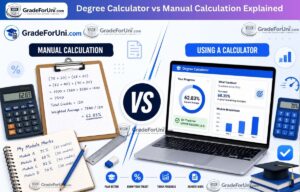

Imagine it’s the night before your assignment deadline. You have one coursework mark back, another exam result is due next week, and your Imagine it’s the night before an important assessment. Uni Calculator: You’ve received some results, others are still to come, and you’re trying to work out whether you’re on track for your target degree classification. Instead of clear answers, you find different calculation methods and conflicting information online.
Many UK university students face this situation. Uni Calculator: Whether you’re checking your current average or calculating the marks needed in your next assessment, understanding your academic progress can help you plan more effectively.
That’s where a Uni Calculator can help. By entering your module marks, credits and assessment weightings, you can quickly estimate your overall average and potential degree classification.
Calculate Your University Grade Online
Use our free Uni Calculator to calculate:
- Module grades
- Coursework and exam averages
- Credit-weighted averages
- Estimated degree classifications
- Target marks for future assessments
Whether you’re at the start of your course or preparing to graduate, the calculator provides a quick and easy way to track your academic progress.
Click Here: UK University Grade Calculator
How to Use UK University Grade Calculator
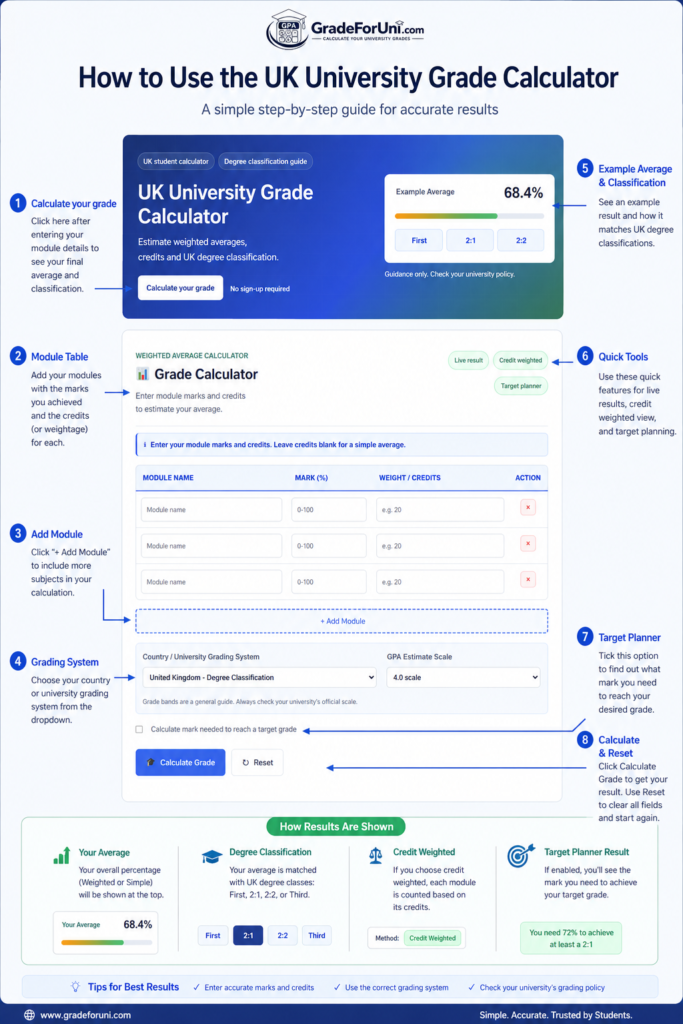
A Uni Calculator is an online tool that estimates your university grades using your assessment marks, module credits and weighting percentages. Most UK universities use weighted averages rather than simple averages, meaning larger-credit modules and higher-weighted assessments contribute more to your final result. Uni Calculator: By entering accurate information, you can estimate your module average, overall year average and potential degree classification.
What Is a Uni Calculator?
A Uni Calculator is designed to help students estimate their academic performance without having to complete lengthy calculations by hand.
Rather than averaging every mark equally, it considers how UK university assessments are commonly weighted. Uni Calculator. This produces a much more realistic estimate of your overall grade.
Although every university has its own academic regulations, many follow similar principles based on module credits and weighted averages.
A university calculator can be useful throughout your degree—not just at the end.
Read More: Taxsal.comHow a University Grade Calculator Works
Most calculators ask you to enter information such as:
- Module marks
- Module credit values
- Coursework percentages
- Exam percentages
- Assessment weightings
The calculator then applies the appropriate weighting to each assessment before combining the results into an overall average.
For example, a 40-credit dissertation normally contributes more to your overall average than a standard 20-credit module because it carries greater academic weight.
This approach reflects how universities generally assess student performance.
What Can You Calculate?
Depending on the calculator, you may be able to estimate:
- Individual module grades
- Coursework averages
- Exam averages
- Credit-weighted averages
- Year averages
- Final degree classifications
- Target marks required in upcoming assessments
Having all these calculations in one place helps you make informed decisions about where to focus your study time.
Who Should Use This Calculator?
A Uni Calculator can be helpful if you are:
- Starting your first university year
- Monitoring your progress throughout the semester
- Preparing for final examinations
- Completing coursework assignments
- Calculating dissertation impact
- Planning the grades needed for a First or 2:1
- Comparing different assessment outcomes
It is particularly useful for students who have multiple modules with different credit values.
Helpful Tip: Always compare calculator estimates with your university’s official assessment regulations.
Read More: University Grade CalculatorWhat Information Do You Need Before Using the Calculator?
The accuracy of your results depends on the information you enter. Spending a few minutes collecting the correct details will produce a much more reliable estimate.
Module Marks
Start by gathering the percentage mark for each completed assessment or module. Uni Calculator
These are usually available through your university’s student portal or virtual learning environment.
Avoid estimating marks if official results have already been published.
Module Credits
Every module has a credit value.
Common examples include:
| Module | Credits |
|---|---|
| Introduction to Marketing | 20 |
| Business Economics | 20 |
| Research Methods | 20 |
| Dissertation | 40 |
Credit values determine how much each module contributes to your overall average.
A higher-credit module carries more influence than a lower-credit module.
Coursework and Exam Weightings
Many university modules contain several assessments.
For example:
| Assessment | Weight |
|---|---|
| Coursework | 40% |
| Final Exam | 60% |
Your overall module mark depends on both your scores and these weightings.
Ignoring assessment weightings is one of the most common causes of inaccurate calculations.
Current University Year
Some universities calculate classifications using only later years, while others include earlier years with lower weightings.
Typical examples include:
- Year 1: Progression only
- Year 2: 30%
- Final Year: 70%
Always check your university handbook before interpreting your calculator results.
University Assessment Regulations
No online calculator can replace your institution’s official academic regulations.
Universities may differ in areas such as:
- Borderline classifications
- Resit policies
- Compensation rules
- Credit requirements
- Integrated master’s programmes
Understanding these rules helps explain why two students with similar averages may receive different final classifications.
How UK Universities Calculate Final Grades
Although assessment methods vary slightly, most UK universities calculate final grades using weighted averages rather than treating every assessment equally. Uni Calculator
This rewards performance in larger modules and reflects the academic importance of different stages of a degree.
Rewards performance module stages degree weighting degree
Understanding Credit Weighting
Each module contributes according to its credit value.
Consider this example:
| Module | Mark | Credits |
|---|---|---|
| Marketing | 70% | 20 |
| Accounting | 62% | 20 |
| Dissertation | 74% | 40 |
Even though there are only three modules, the dissertation contributes twice as much as either 20-credit module.
This prevents small modules from having the same influence as major pieces of academic work.
How Weighted Averages Are Calculated
The basic process is:
- Multiply each module mark by its credit value.
- Add all weighted scores together.
- Add all credits together.
- Divide total weighted marks by total credits.
Formula
Weighted Average = Σ(Mark × Credits) ÷ Total Credits
Worked Example
| Module | Mark | Credits | Weighted Score |
|---|---|---|---|
| Business Strategy | 72 | 20 | 1,440 |
| Marketing | 65 | 20 | 1,300 |
| Economics | 68 | 20 | 1,360 |
| Dissertation | 74 | 40 | 2,960 |
Total weighted marks = 7,060
Total credits = 100
Weighted average = 70.6%
Estimated classification: First Class Honours
This example demonstrates why calculating a simple average would produce a less accurate result.
Why Different Universities May Use Different Methods
Although many institutions follow similar grading principles, differences can include:
- Year weighting
- Credit structures
- Assessment regulations
- Borderline rules
- Compensation policies
- Resit treatment
As a result, your calculated estimate should always be viewed as a planning tool rather than an official transcript.
Read More: How to Calculate Your Uni Grade Using Credits and Module WeightingUK Degree Classification Boundaries
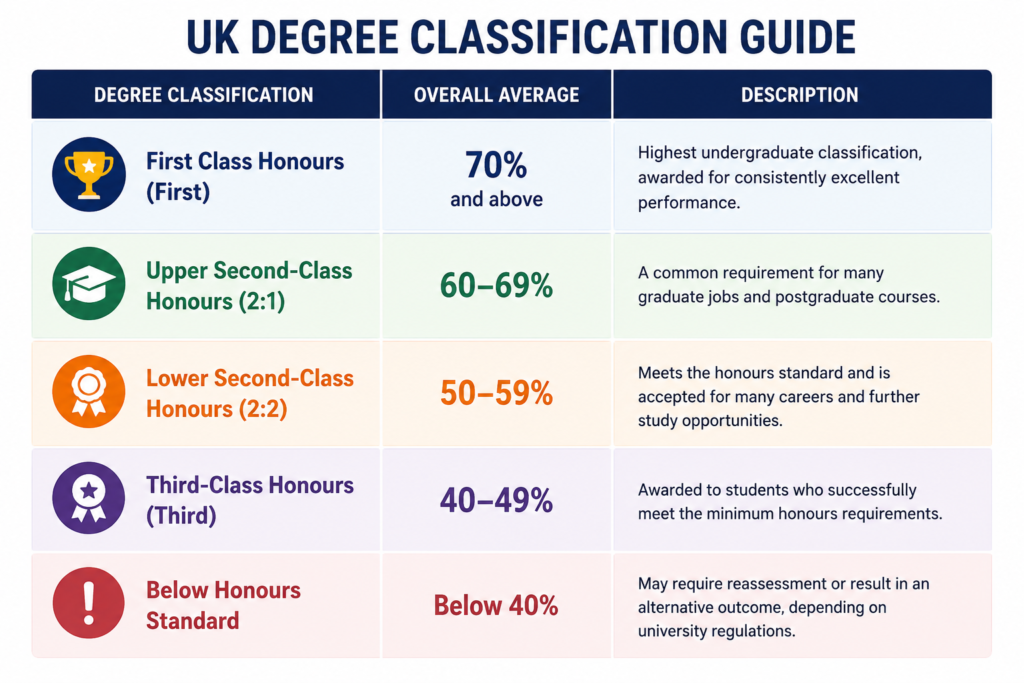
The table below shows the typical undergraduate honours degree classifications used by UK universities. Individual universities may apply different borderline or progression rules, so always check your institution’s academic regulations.
| Degree Classification | Overall Average | Description |
|---|---|---|
| First Class Honours (First) | 70% and above | Highest undergraduate classification, awarded for consistently excellent performance. |
| Upper Second-Class Honours (2:1) | 60–69% | A common requirement for many graduate jobs and postgraduate courses. |
| Lower Second-Class Honours (2:2) | 50–59% | Meets the honours standard and is accepted for many careers and further study opportunities. |
| Third-Class Honours (Third) | 40–49% | Awarded to students who successfully meet the minimum honours requirements. |
| Below Honours Standard | Below 40% | May require reassessment or result in an alternative outcome, depending on university regulations. |
What Can This Uni Calculator Help You Calculate?
A good Uni Calculator is more than a simple average calculator. It can estimate different aspects of your academic performance, helping you make informed decisions throughout the year rather than waiting until your final results are released.
Understanding what each calculation means also helps you identify where improving your marks will have the greatest impact.
Module Grade Calculator
A module grade calculator estimates your overall mark for an individual module by combining the scores from each assessment according to their weighting.
For example, a module may include:
| Assessment | Weight | Mark |
|---|---|---|
| Coursework | 40% | 68% |
| Final Exam | 60% | 72% |
The calculation would be:
- Coursework: 68 × 40% = 27.2
- Exam: 72 × 60% = 43.2
Overall Module Mark = 70.4%
This allows you to see how different assessments contribute to the final module result and identify where future improvements could make the biggest difference.
Coursework and Exam Calculator
Many students receive coursework results weeks before sitting their exams.
A coursework and exam calculator helps answer questions such as:
- What exam mark do I need to achieve 65% overall?
- Can my coursework compensate for a weaker exam?
- How much will my final exam affect the module?
Example
Suppose your module is assessed as follows:
| Assessment | Weight |
|---|---|
| Coursework | 30% |
| Exam | 70% |
You score 78% in your coursework.
Your coursework contributes:
78 × 30% = 23.4 marks
If your target module mark is 65%, you still need:
65 − 23.4 = 41.6 marks
Since the exam is worth 70%:
41.6 ÷ 0.70 = 59.4%
This means you would need approximately 60% in the exam to finish the module with 65%.
Calculations like this are particularly useful before revision begins, allowing you to prioritise your effort realistically.
Read More: How University Coursework Affects Your Final GradeCredit-Weighted Average Calculator
Not every module contributes equally to your degree.
A credit-weighted calculator ensures that larger modules have a proportionately greater influence on your overall average.
Example
| Module | Credits | Mark |
|---|---|---|
| Business Law | 20 | 64% |
| Human Resources | 20 | 69% |
| Dissertation | 40 | 73% |
Although there are three modules, the dissertation contributes twice as much because it carries 40 credits.
Using a simple average would underestimate its impact.
A weighted calculator produces a result that more closely reflects how UK universities calculate academic performance.
Read More: Credit Weighted Average CalculatorFinal Degree Classification Calculator
As you progress through your course, you may want to estimate your final degree classification. Uni Calculator
A degree classification calculator combines your weighted year averages and compares the result with the standard honours boundaries.
For example:
| Academic Year | Average | Weight |
|---|---|---|
| Year 2 | 65% | 30% |
| Final Year | 72% | 70% |
Calculation:
- Year 2: 65 × 30% = 19.5
- Final Year: 72 × 70% = 50.4
Estimated overall average:
69.9%
Depending on your university’s regulations, this may be considered for a borderline First Class classification.
Remember that borderline decisions vary between institutions, so always check your university’s academic handbook. Uni Calculator
Read More: How UK Universities Calculate Degree ClassificationsTarget Grade Calculator
One of the most practical uses of a Uni Calculator is setting realistic academic goals.
Instead of simply viewing your current average, a target grade calculator works backwards to estimate the marks needed in future assessments.
For example, imagine:
- Current weighted average: 66%
- Remaining assessment weighting: 40%
- Desired final average: 70%
The calculator estimates the score required in your remaining assessments to reach that target.
This can help you:
- Set achievable revision goals.
- Focus on high-impact assessments.
- Plan study time effectively.
- Reduce unnecessary stress by understanding what is realistically possible.
Rather than guessing, you can base your revision strategy on accurate calculations. Uni Calculator
Read More: How to Calculate Your Final Degree Classification in the UKHow to Calculate Your University Grade Manually
While an online calculator saves time, understanding the calculation process helps you verify your results and better understand how your university measures academic performance. Uni Calculator
The process is straightforward once you know the key information.
Step 1 – Collect Your Module Marks
Begin by gathering every completed assessment.
Include:
- Coursework marks
- Exam results
- Presentation marks
- Practical assessments
- Dissertation grades (if available)
Use official results wherever possible rather than estimates.
Step 2 – Add Module Credits
Next, note the credit value of every completed module.
Example:
| Module | Credits |
|---|---|
| Marketing | 20 |
| Economics | 20 |
| Finance | 20 |
| Dissertation | 40 |
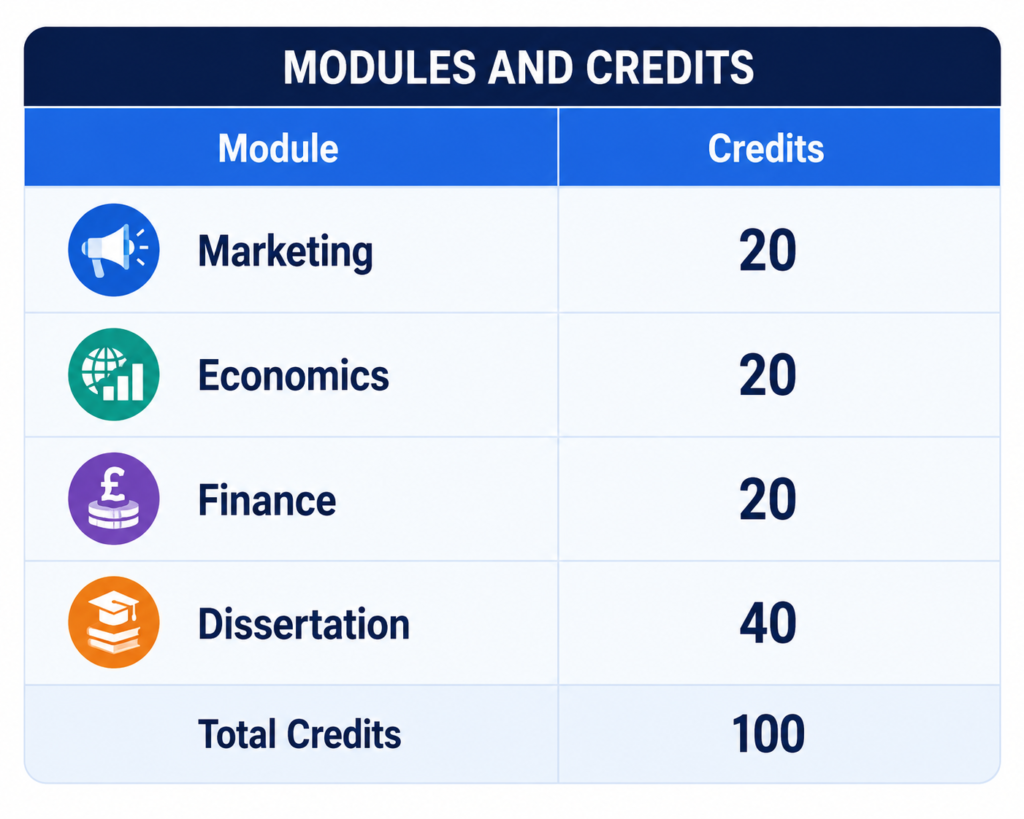
These credits determine how much each module contributes to your overall average.
Step 3 – Apply Assessment Weightings
Within each module, calculate the weighted contribution of every assessment.
Formula
Assessment Contribution = Assessment Mark × Assessment Weight
Example:
| Assessment | Mark | Weight |
|---|---|---|
| Coursework | 74% | 40% |
| Exam | 66% | 60% |
Calculation:
74 × 0.40 = 29.6
66 × 0.60 = 39.6
Overall module mark:
69.2%
Step 4 – Calculate Weighted Module Scores
Multiply each module mark by its credit value.
Formula
Weighted Score = Module Mark × Credits
Example:
| Module | Mark | Credits | Weighted Score |
|---|---|---|---|
| Marketing | 69 | 20 | 1,380 |
| Finance | 71 | 20 | 1,420 |
| Dissertation | 74 | 40 | 2,960 |
Total weighted score:
5,760
Step 5 – Calculate Your Overall Average
Finally:
- Add all weighted scores.
- Add all module credits.
- Divide weighted marks by total credits.
Formula
Overall Average = Total Weighted Scores ÷ Total Credits
Example:
5,760 ÷ 80
= 72%
This would normally place the student within the First Class Honours boundary.
Understanding these steps makes it much easier to interpret the results produced by any Uni Calculator. Uni Calculator
Worked Examples
The following examples demonstrate how different situations can affect your university grades. They are designed to reflect realistic scenarios commonly faced by UK students.
Example 1 – Calculating a Single Module Grade
Olivia completes a module assessed by coursework and an exam.
| Assessment | Weight | Mark |
|---|---|---|
| Coursework | 50% | 70% |
| Exam | 50% | 66% |
Calculation:
70 × 0.50 = 35
66 × 0.50 = 33
Final Module Grade = 68%
Although Olivia scored differently in each assessment, the equal weighting means both contribute the same amount.
Example 2 – Coursework and Exam Weighting Example
Daniel receives 82% for coursework, which is worth 25% of the module.
His final exam counts for 75%.
He scores 60% in the exam.
Calculation:
Coursework:
82 × 25% = 20.5
Exam:
60 × 75% = 45
Overall module grade:
65.5%
This example shows how strong coursework can help offset a more modest exam result.
Example 3 – Calculating a Credit-Weighted Average
Sophie’s modules have different credit values.
| Module | Credits | Mark |
|---|---|---|
| Marketing | 20 | 67% |
| Accounting | 20 | 63% |
| Dissertation | 40 | 74% |
Weighted scores:
- Marketing: 1,340
- Accounting: 1,260
- Dissertation: 2,960
Total weighted score:
5,560
Total credits:
80
Weighted average:
69.5%
Without credit weighting, Sophie would underestimate the influence of her dissertation.
Example 4 – Predicting a Final Degree Classification
James has completed Year 2 with an average of 64%.
His university uses:
- Year 2: 30%
- Final Year: 70%
If James finishes Final Year with 71%, his estimated overall average becomes:
(64 × 30%) + (71 × 70%)
= 19.2 + 49.7
= 68.9%
James remains close to the First-Class boundary, giving him a clear target to work towards in his remaining assessments.
5 – Calculating the Mark Needed for a Target Grade
| Step | Calculation | Result |
|---|
| Coursework Mark | 72% | 72% |
| Coursework Weight | 35% | 35% |
| Coursework Contribution | 72 × 0.35 | 25.2 |
| Target Overall Module Mark | — | 68% |
| Marks Still Needed | 68 − 25.2 | 42.8 |
| Exam Weight | — | 65% |
| Required Exam Mark | 42.8 ÷ 0.65 | 65.8% (≈ 66%) |
Practical Student Scenarios
Every student’s academic journey is different. A Uni Calculator helps you understand how specific situations can affect your grades and supports better planning throughout your degree.
You Want to Achieve a First-Class Degree
Aisha has completed most of her second year with an average of 68% and wants to graduate with a First-Class Honours degree.
Using a Uni Calculator, she estimates that consistently achieving 73–75% in her remaining assessments would keep her on track, depending on her university’s weighting rules. Uni Calculator
This helps her:
- Prioritise higher-credit modules.
- Focus revision where it will have the greatest impact.
- Set realistic academic targets.
You Failed One Module
Ben has passed five modules but scored 36% in one 20-credit module.
A Uni Calculator helps him estimate:
- His current weighted average.
- The impact of the failed module on his overall grade.
- How a successful resit could improve his results.
Your Coursework Is Strong, but Exam Marks Are Low
Chloe performs well in coursework but finds exams more challenging.
By entering both assessment weightings into the calculator, she can see how different exam scores affect her overall module mark and identify the score needed to reach her target. Uni Calculator
You Want to Predict Your Final Classification
Ryan enters his completed module marks, remaining assessments and credit values to estimate whether he is on track for a First or a 2:1.
This helps him identify which remaining assessments deserve the most attention.
You Need to Plan Grades for Your Remaining Modules
Lucy has completed half of her assessments and wants to know what marks she needs in the rest. Uni Calculator
Using a Uni Calculator, she tests different grade combinations to see how they affect her final average, helping her set realistic goals for the remainder of the academic year.
Read More: University Resit Exams ExplainedYour Coursework Is Strong, but Exam Marks Are Low
Chloe regularly performs well in coursework but struggles during written examinations.
She enters both assessment weightings into the calculator to compare different outcomes. Uni Calculator
This helps answer practical questions such as:
- Can excellent coursework compensate for a weaker exam?
- What is the minimum exam mark needed to pass?
- How much would improving the exam by five marks increase the overall module grade?
Having these answers allows Chloe to revise strategically instead of relying on assumptions.
You Want to Predict Your Final Classification
During the final semester, Ryan wants to know whether he is likely to graduate with a First or a 2:1.
By entering:
- Current module marks
- Remaining assessments
- Credit values
- Expected grades
the calculator estimates his likely degree classification.
Although the result is only an estimate, it helps Ryan understand which assessments deserve the greatest attention before final exams. Uni Calculator
You Need to Plan Grades for Your Remaining Modules
Lucy has already completed half of her assessments.
Rather than calculating every possible outcome manually, she enters her current results and tests different future scenarios.
For example:
- What happens if she scores 65% in every remaining module?
- What if one assessment goes poorly?
- How much difference would an additional five marks make?
This planning approach helps reduce uncertainty and supports better academic decision-making.
Common Mistakes When Calculating University Grades
Small calculation errors can lead to inaccurate results. Avoid these common mistakes when using a Uni Calculator.
Ignoring Module Credits
Not all modules carry the same weight. Higher-credit modules, such as a 40-credit dissertation, have a greater impact on your overall average than a standard 20-credit module.
Using a Simple Average Instead of a Weighted Average
A simple average rarely reflects how UK universities calculate final grades. Always use a credit-weighted average where applicable.
Forgetting Assessment Weightings
If a module includes coursework, exams or presentations with different weightings, each assessment must be included correctly in the calculation.
Misunderstanding Degree Classification Boundaries
Degree classifications and borderline rules can vary between universities. Always check your institution’s official grading policy.
Assuming Every University Uses the Same Rules
Universities may use different methods for year weightings, resits, compensation and progression, so calculator results should be treated as estimates.
Ignoring Dissertation Weighting
Because dissertations often carry more credits, they usually have a greater influence on your final average than standard modules.
Counting Resit Marks Incorrectly
Before including resit results, check whether your university caps reassessment marks or applies different calculation rules.
Overlooking Optional Modules
Optional modules usually contribute to your final average if they carry academic credit, so they should not be excluded.
Using Incomplete Results
Calculations based on predicted or missing marks may not reflect your outcome. Update your results as new grades are released.
Not Checking University Regulations
A Uni Calculator is a useful planning tool, but your university’s official regulations always determine your final grades and degree classification.
Expert Tips for Getting More Accurate Results
Using a Uni Calculator regularly can help you track your progress and make better academic decisions. These practical tips will help you get the most accurate results.
Keep Your Marks Updated
Enter new assessment results as soon as they are released so your calculations reflect your current academic performance.
Prioritise High-Credit Modules
Higher-credit modules have a greater impact on your overall average, so they should receive more of your study time.
Monitor Your Target Classification
Check your projected degree classification after each set of results to see whether you’re on track for your target.
Check Your University’s Assessment Handbook
Review your university’s regulations on credit weightings, classification boundaries, resits and borderline decisions to interpret your results correctly.
Plan Before Final Assessments
Use your current grades to calculate the marks needed in upcoming exams or coursework and set realistic revision goals.
Track Coursework and Exam Performance Separately
Comparing coursework and exam results can help you identify strengths and areas that need improvement.
Understand Resit Rules
Before estimating your final grade, check whether resit marks are capped or treated differently by your university.
Focus on Final-Year Modules
If your university gives greater weighting to later years, strong final-year performance can have the biggest impact on your overall classification.
Save Your Calculations
Keep a record of your results to monitor your progress and compare different grade scenarios throughout your degree.
Frequently Asked Questions
What is a Uni Calculator?
A Uni Calculator is an online tool that estimates university grades using module marks, assessment weightings and credit values. It helps students understand their current academic performance and predict possible degree outcomes.
How do I calculate my university grade?
Collect your module marks, apply the correct assessment weightings, multiply module marks by their credit values where required, and calculate the weighted average. A Uni Calculator automates this process and reduces the risk of manual errors.
Are university grades credit weighted?
In many UK universities, yes. Modules with more credits usually contribute more to your final average than modules with fewer credits. Always check your university’s assessment regulations.
Does first year count towards my final degree?
It depends on your university. Some institutions use the first year only for progression, while others include it with a smaller weighting in the final classification.
What percentage is needed for a 2:1?
At many UK universities, an overall average between 60% and 69% is typically classified as an Upper Second-Class Honours (2:1).
Can coursework improve my overall grade?
Yes. Strong coursework can significantly increase your module mark, particularly when coursework carries a high weighting within the assessment.
How is a dissertation weighted?
Dissertations often carry more credits than standard modules, meaning they usually have a greater influence on your overall average.
Do resits affect my final classification?
This depends on your university’s reassessment policy. Some institutions cap resit marks, while others use different rules. Always refer to your university’s regulations.
Can I predict my final degree before graduation?
Yes. A Uni Calculator can estimate your likely degree classification based on completed marks and predicted results for remaining assessments. However, the estimate is not an official university result.
Is this calculator suitable for every UK university?
The calculator follows the grading principles commonly used by UK universities, but individual institutions may apply different regulations, credit structures and classification rules.
Conclusion
Understanding how your university grades are calculated can make planning your studies much easier. Rather than relying on rough estimates or simple averages, a Uni Calculator helps you account for module credits, assessment weightings and weighted averages to produce a more realistic estimate of your academic performance.
Whether you’re aiming for a First-Class Honours degree, trying to secure a 2:1, or simply tracking your progress throughout the year, using a calculator regularly allows you to make informed decisions about where to focus your efforts. Uni Calculator
Remember that no online calculator replaces your university’s official assessment regulations. Use it as a practical planning tool alongside your institution’s academic handbook to monitor your progress, set achievable targets and approach each assessment with greater confidence.