

Imagine opening your university results portal and discovering you’ve failed a module. It’s natural to wonder: Will I still graduate? Can I keep my honours degree? Do I need to repeat the year?
For many students, this can feel overwhelming. However, most UK universities offer university resit exams, giving eligible students another chance to pass failed assessments. The exact rules vary between institutions, so understanding how resits work is essential.
In this guide, you’ll learn what university resit exams are, how they affect your degree classification, whether you can still graduate with honours, what happens if you fail a resit, and the key university policies you should know before making your next academic decision.
Find Out How a Resit Could Affect Your Degree Classification
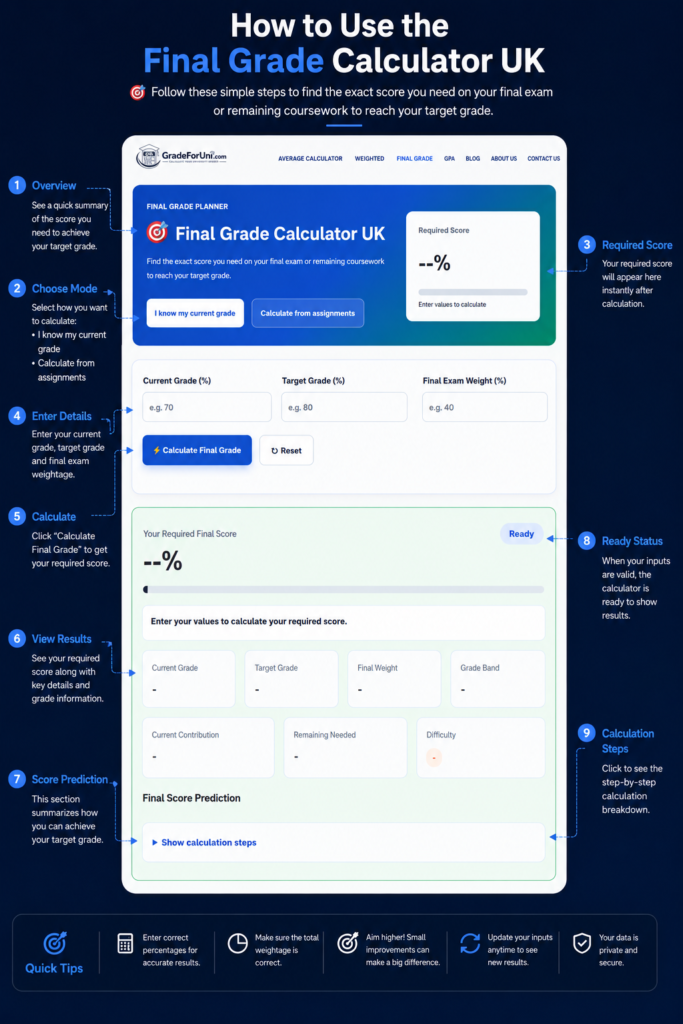
If you’re unsure how a failed module or university resit exam could affect your final degree, use our calculator to estimate different outcomes before making academic decisions.
Click Here: Final Grade Calculator UK
Quick Answer
A university resit exam gives eligible students another opportunity to pass a failed assessment. Most UK universities offer resits, although marks may be capped depending on institutional regulations. Taking a resit does not automatically prevent you from graduating with honours, but it can affect your final classification based on your marks, credits, and university policies.
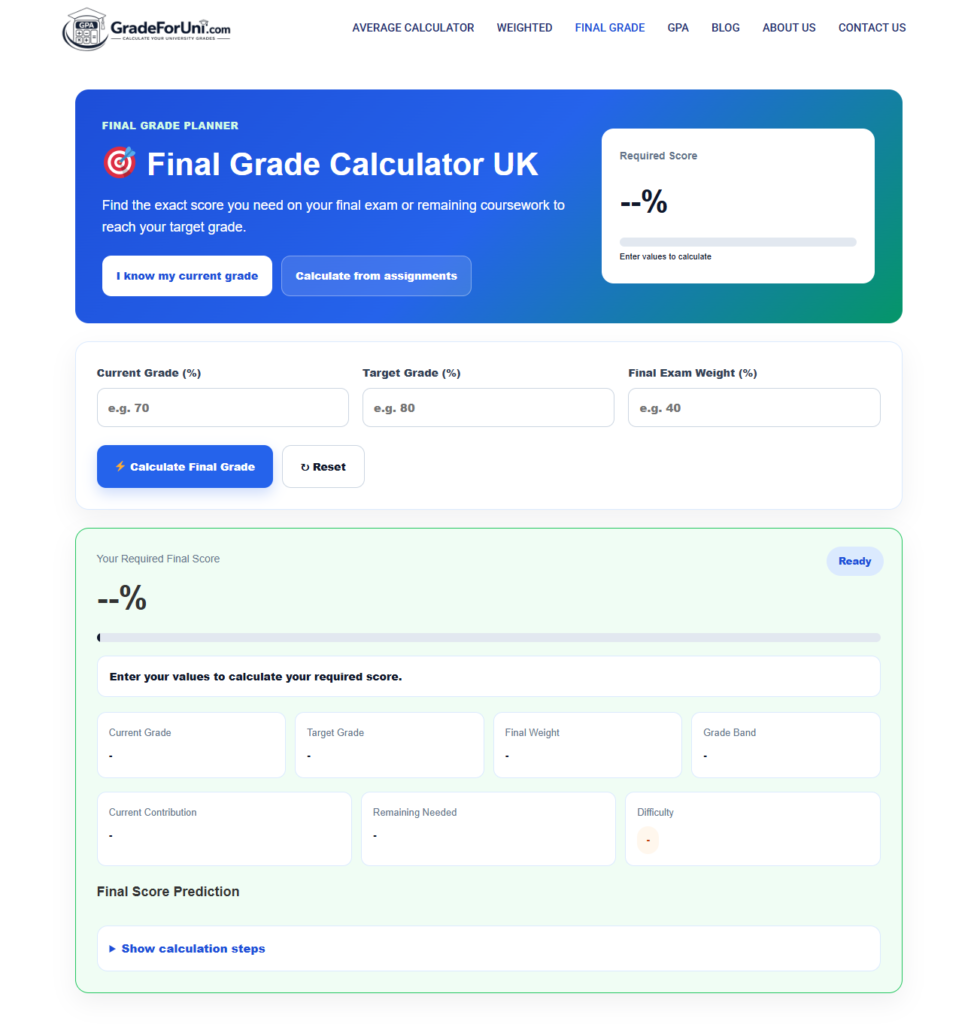
How to Use The Final Grade Calculator
What Are University Resit Exams?
A university resit exam is a second chance to pass an assessment after failing your first attempt. Instead of repeating an entire academic year, eligible students usually retake the failed exam or assessment during a scheduled reassessment period.
A resit may involve:
- A written exam
- Coursework resubmission
- A practical assessment
- An online assessment
- A presentation or viva (where permitted)
The assessment format depends on the module and your university’s regulations.
Why Universities Offer Resits
Universities recognise that one assessment may not accurately reflect a student’s ability. Illness, personal circumstances, exam anxiety, or other unexpected events can affect performance.
Resits give eligible students another opportunity to meet the required learning outcomes while maintaining academic standards.
Who Is Eligible?
Eligibility varies by university, but students are commonly offered a resit if they:
- Fail one or more modules
- Meet progression requirements
- Have remaining assessment attempts
- Stay enrolled on their programme
Some universities register students automatically, while others require an application before a deadline.
Resit vs Reassessment vs Deferred Assessment
| Term | Meaning |
|---|---|
| Resit | A second attempt after failing an assessment. |
| Reassessment | Any additional assessment opportunity, including resits and deferred assessments. |
| Deferred Assessment | An assessment postponed due to approved mitigating circumstances rather than failure. |
A deferred assessment is often treated as a first attempt, so the mark may not be capped.
How Do University Resit Exams Work in the UK?
What Happens After You Fail a Module?
Failing one module does not automatically mean repeating the academic year. After results are released, the university reviews your:
- Credits earned
- Module marks
- Programme requirements
- Compensation eligibility
- Progression regulations
Depending on the outcome, you may:
- Take a resit
- Receive compensation (where permitted)
- Repeat the module
- Repeat the academic year
- Receive an alternative qualification in limited circumstances
The Typical Resit Process
| Step | What You Need to Do |
|---|---|
| Step 1: Receive Your Results | Check your module results through the university portal. |
| Step 2: Review University Guidance | Confirm: • Resit eligibility • Registration deadlines • Assessment dates • Fees (if applicable) • Mark capping rules |
| Step 3: Register | Some universities enrol students automatically, while others require registration before the deadline. |
| Step 4: Prepare | Use examiner feedback to improve your weakest areas rather than revising everything again. Meeting your module tutor can also help. |
| Step 5: Complete the Resit | Resits are commonly held during the summer or early autumn reassessment period. |
| Step 6: Receive Your Outcome | After the reassessment, the university confirms whether you have: • Passed the module • Progressed to the next stage • Qualified for graduation • Need further academic action |
When Do Universities Hold Resit Exams?
Most UK universities schedule university resit exams after the main exam period, typically during the summer.
| Assessment Period | Typical Timing |
|---|---|
| Summer Resits | July–August |
| Late Summer Resits | August–September |
| Early Autumn Resits | September |
Exact dates vary by university, so always check your academic calendar.
How to Register for a Resit
Registration procedures differ between universities, but generally involve:
- Checking your assessment results.
- Reading your university’s reassessment guidance.
- Accepting the resit offer (if required).
- Paying any applicable fee.
- Confirming your exam timetable.
Register before the published deadline to avoid losing your reassessment opportunity.
Do You Need to Pay for Resits?
Many universities offer one standard reassessment without additional tuition fees. However, extra costs may apply if you:
- Repeat a module
- Repeat an academic year
- Take additional reassessment attempts
- Require extended registration
Always check your university’s fee policy before assuming resits are free.
Helpful Tip: Even if the reassessment itself is free, repeating a module or year can increase tuition and living costs.
Read More: University Credits ExplainedDo University Resits Affect Your Degree Classification?
Yes, but the impact depends on your university’s regulations rather than the resit alone. Key factors include:
- Whether resit marks are capped
- The module’s credit weighting
- Your year of study
- Your overall academic performance
- Your university’s assessment policy
One resit rarely determines your final degree classification by itself.
How Degree Classifications Are Calculated
Most UK honours degrees are calculated using your Level 5 (Year 2) and Level 6 (Final Year) results, with each module contributing credits to your weighted average.
| Final Average | Typical Classification |
|---|---|
| 70%+ | First-Class Honours |
| 60–69% | Upper Second-Class (2:1) |
| 50–59% | Lower Second-Class (2:2) |
| 40–49% | Third-Class Honours |
Some universities also apply borderline classification rules.
What Is a Capped Mark?
A capped mark means your recorded resit mark is limited to the pass mark, even if you achieve a much higher score.
| Original Mark | Resit Score | Recorded Mark |
|---|---|---|
| 34% | 67% | 40% (Pass) |
This allows students to progress while encouraging strong performance on the first attempt.
When Can Resit Marks Be Uncapped?
Some universities record the actual resit mark instead of a capped mark, usually when the reassessment is treated as a first attempt.
This commonly applies if:
- Approved mitigating or extenuating circumstances affected the original assessment.
- You missed the exam because of illness or another serious event supported by evidence.
- You were granted a deferred assessment.
- Your programme specifically allows uncapped reassessments.
Example: A student who misses an exam due to hospitalisation may receive a deferred first attempt. If they later score 72%, the full 72% is normally recorded instead of a capped pass mark.
Always check your university’s assessment regulations, as two students taking the same reassessment may have different marking rules.
How Different Universities Apply Resit Policies
There is no single UK-wide policy for university resit exams. Each university sets its own academic regulations, so reassessment rules can differ significantly.
Common differences include:
- Number of resit attempts allowed
- Whether resit marks are capped
- Compensation policies
- Progression requirements
- Appeals process
- Repeat-year rules
- Professional accreditation requirements
Always refer to your university’s academic regulations rather than advice from other students.
Comparison: Capped vs Uncapped Resit Marks
| Feature | Capped Resit | Uncapped Resit |
|---|---|---|
| Recorded mark | Pass mark only | Actual mark achieved |
| Usually applies to | Failed first attempt | Deferred first attempt or approved mitigating circumstances |
| Effect on degree | May reduce final average | Full mark counts towards classification |
| Common in UK universities | Yes | Less common |
Example
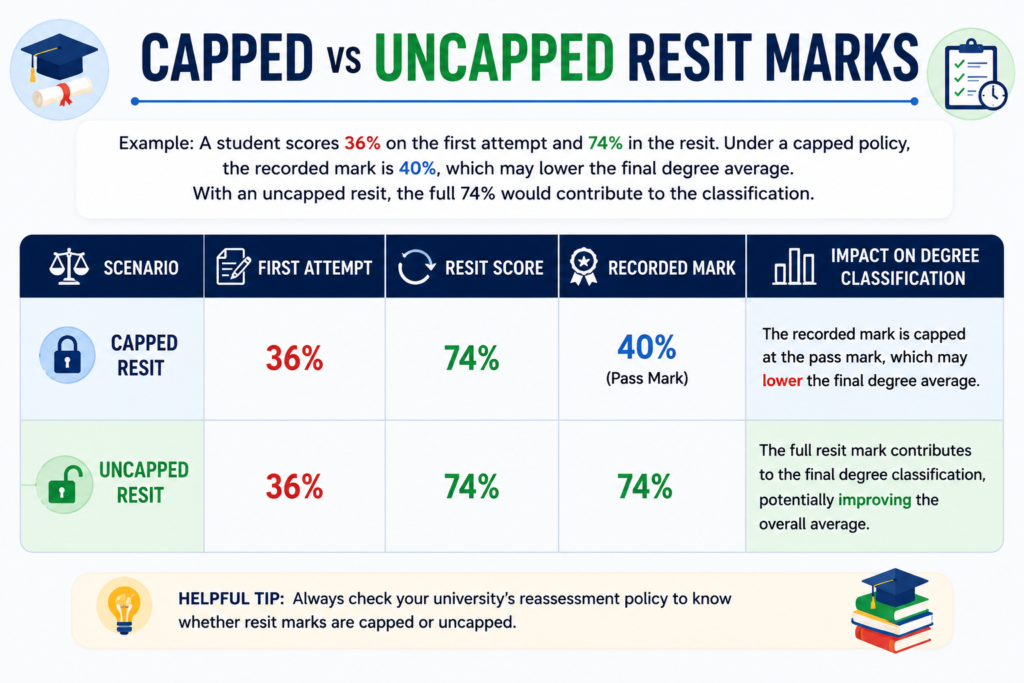
| Scenario | First Attempt | Resit Score | Recorded Mark | Impact on Degree Classification |
|---|---|---|---|---|
| Capped Resit | 36% | 74% | 40% (Pass Mark) | The recorded mark is capped at the pass mark, which may lower the final degree average. |
| Uncapped Resit | 36% | 74% | 74% | The full resit mark contributes to the final degree classification, potentially improving the overall average. |
Can You Still Graduate with Honours After a Resit?
Yes. Completing a university resit exam does not automatically prevent you from graduating with honours.
Your final classification depends on factors such as:
- Overall weighted average
- Number of failed modules
- Credit requirements
- University regulations
- Whether resit marks are capped
- Completion of compulsory modules
A resit is an opportunity to recover, not an automatic barrier to earning an honours degree.
Can You Still Achieve a First-Class Degree?
Yes, although it can become more difficult if resit marks are capped.
You may still achieve a First if:
- Your weighted average remains above the required threshold.
- The university records uncapped marks.
- Strong performance in other modules offsets the resit.
- Borderline classification rules apply.
Use a degree calculator to estimate how different resit outcomes could affect your final classification.
Read More: How to Improve Your University GradesCan You Still Graduate with a 2:1?
In many cases, yes.
Because a 2:1 begins at 60%, students often have more flexibility than those aiming for a First.
For example, a student with an average of 63.5% who passes a capped resit may still finish above the 2:1 boundary and graduate with Upper Second-Class Honours.
When Can Resits Delay Graduation?
Graduation may be delayed if:
- Resits take place after the main assessment period.
- Final results are unavailable before graduation.
- Professional accreditation requires all modules to be passed.
- You need to repeat a compulsory module.
Once all academic requirements are met, the university will normally award your degree at the next available opportunity.
When Might an Ordinary Degree Be Awarded?
If you complete enough credits but do not meet the requirements for an honours degree, your university may award an Ordinary Degree instead.
This may happen if:
- Honours credit requirements are not met.
- A compulsory module remains incomplete.
- Failed assessments are not repeated.
- Progression requirements cannot be satisfied.
An Ordinary Degree is a recognised qualification but differs from an Honours Degree and may affect some postgraduate courses or graduate roles.
What Happens If You Fail a University Resit?
Failing a university resit exam does not always mean your studies come to an end. Your next steps depend on your university’s regulations, completed credits, compulsory modules, previous assessment attempts, and programme requirements.
Possible outcomes include:
- Repeating the failed module
- Repeating the academic year
- Submitting an academic appeal (where eligible)
- Receiving an exit award if you have enough completed credits
Repeating a Module
If you fail a resit, your university may allow you to repeat the failed module instead of the entire year.
This usually involves:
- Re-enrolling on the module
- Attending classes again (if required)
- Completing all assessments
- Paying any applicable tuition or module fees
Repeating a module is generally less disruptive than repeating a full academic year.
Repeating a Year
If you fail multiple core modules or do not meet progression requirements, you may need to repeat the academic year.
This gives you another opportunity to complete the required teaching and assessments but usually means extra tuition fees, living costs, and a delayed graduation.
Resit vs Repeat Year
| Feature | Resit | Repeat Year |
|---|---|---|
| Study time | Weeks or months | Around one academic year |
| Teaching repeated | Usually no | Yes |
| Tuition fees | Often none or limited | Usually payable |
| Graduation | May stay on schedule | Usually delayed |
| Best suited for | One or two failed modules | Multiple failed modules |
In most cases, a resit is the quicker and less expensive option if you’re eligible.
Academic Appeals
If your result was affected by a procedural error or approved mitigating circumstances, you may be able to submit an academic appeal.
Valid grounds commonly include:
- Administrative mistakes
- Procedural irregularities
- Approved mitigating circumstances
- New evidence that was unavailable earlier
An appeal cannot be made simply because you disagree with your mark, and universities usually set strict submission deadlines.
Extenuating Circumstances
Extenuating circumstances are unexpected events that significantly affect academic performance, such as:
- Serious illness
- Bereavement
- Hospitalisation
- Family emergencies
Supporting evidence is normally required, so notify your university as soon as possible if your studies are affected.
Exit Awards
If you cannot complete your degree but have earned enough academic credits, your university may award an alternative qualification, such as:
- Certificate of Higher Education
- Diploma of Higher Education
- Ordinary Degree (where applicable)
The qualification awarded depends on your completed credits and university regulations.
Compensation, Condoned Passes, and Credit Requirements
Not every failed module results in a university resit exam. Some universities allow students to progress through compensation or condonement if they narrowly fail a module but perform strongly overall.
This usually depends on:
- Your overall average
- The failed module mark
- Whether the module is compulsory
- University regulations
Because these policies vary widely between institutions, always check your programme handbook before assuming a failed module requires a resit.
Visit Now: Taxsal.comCompensation, Condoned Passes, and Credit Requirements
Not every failed module requires a university resit exam. Some UK universities allow students to progress through academic compensation (or condonement) if they narrowly fail a module but perform well overall.
What Is Academic Compensation?
Academic compensation allows a university to award credit for a marginally failed module when specific academic criteria are met. It is usually considered only if:
- The failed mark falls within an approved range.
- Your overall average is sufficiently high.
- The module is not compulsory for professional competence.
- University regulations permit compensation.
For example, a student who scores 38% in one optional module but averages 67% overall may receive compensation instead of taking a resit.
Credit Requirements
Progression depends on more than your marks. Most universities also require students to complete a minimum number of academic credits.
If you do not meet the required credits, you may need to:
- Take a resit
- Repeat a module
- Repeat the academic year
Read More: University Credits ExplainedModules That Usually Cannot Be Compensated
Compensation is often unavailable for compulsory or professionally accredited modules, including:
- Clinical placements
- Laboratory modules
- Final-year dissertations
- Professional practice assessments
- Other core programme modules
Compensation vs Resit vs Repeat Module
| Feature | Compensation | Resit | Repeat Module |
|---|---|---|---|
| Extra assessment | No | Yes | Yes |
| Extra teaching | No | Usually no | Yes |
| Suitable for marginal fails | Yes | Yes | Sometimes |
| Common for compulsory modules | Usually no | Yes | Yes |
Special Cases You Should Know About
Some university resit exams follow different rules depending on the type of assessment or programme.
Coursework Resits
A reassessment may involve resubmitting coursework, completing a project, improving an existing report, or delivering another presentation, depending on the module requirements.
Dissertation Resits
If you fail your dissertation, your university may allow corrections, a full resubmission, or another approved reassessment. Because dissertations carry significant credit, follow your supervisor’s guidance carefully.
Professionally Accredited Courses
Courses such as Medicine, Nursing, Engineering, Pharmacy, Teaching, and Veterinary Science often have stricter reassessment rules. Compensation may not be available, and every compulsory module usually must be passed.
Final-Year Students
Final-year resits can affect:
- Degree classification
- Graduation timing
- Academic transcripts
- Award confirmation
Check your university’s reassessment timetable to understand how resits could affect your graduation.
International Students
If you’re studying in the UK on a student visa, failing a module or repeating part of your course may affect your immigration status or course completion date. Contact your university’s international student support team as soon as possible for guidance.
How University Resits Affect Future Opportunities
A university resit exam rarely determines your future on its own. Most employers and postgraduate universities focus on your overall degree classification rather than a single failed assessment.
Master’s Applications
Many postgraduate programmes assess:
- Final degree classification
- Overall academic performance
- Subject relevance
- Personal statement
- References
Graduating with a strong honours degree after a resit is unlikely to prevent admission, although highly competitive courses may review your academic transcript in more detail.
Read More: University Marking CriteriaGraduate Jobs
Most graduate employers focus on your final degree classification rather than individual assessment results. They are generally more interested in your:
- Skills
- Relevant experience
- Internships
- Communication
- Problem-solving ability
A single university resit exam is unlikely to affect your job prospects unless an employer specifically requests your full academic transcript.
Employer Perspective
Many employers recognise that university can be challenging and that setbacks are part of the learning process. They often value candidates who demonstrate:
- Resilience
- Responsibility
- Time management
- Continuous improvement
If discussed honestly, successfully overcoming academic challenges can even be viewed as a positive example during interviews.
Academic Transcript and Records
Your academic transcript records your university performance, although the information included varies by institution. It may show:
- Module marks
- Resit attempts
- Final recorded marks
- Credits earned
- Degree classification
If you plan to apply for postgraduate study or graduate roles, check your university’s transcript policy to understand what information will be recorded.
Common Mistakes Students Make During University Resit Exams
Avoid these common mistakes to improve your chances of passing a university resit exam and progressing with your degree.
- Assuming every university follows the same resit policy.
- Ignoring examiner feedback instead of focusing on weak areas.
- Missing resit registration deadlines.
- Forgetting to check whether resit marks are capped.
- Leaving revision until the last minute.
- Not seeking support from module tutors or academic advisers.
- Overlooking important university emails and announcements.
- Assuming a passed resit automatically guarantees graduation.
- Failing to report mitigating circumstances with supporting evidence.
- Relying on online rumours instead of official university regulations.
Expert Tips for Passing University Resit Exams
Improve your chances of success with these practical tips:
- Read your university’s assessment regulations before preparing.
- Check whether your resit mark will be capped or uncapped.
- Use examiner feedback to target your weakest topics.
- Speak to your module tutor if you need clarification.
- Create a realistic revision timetable and stick to it.
- Practise past papers under timed conditions.
- Prioritise compulsory modules if you have multiple resits.
- Keep copies of medical or supporting evidence.
- Estimate how different resit outcomes could affect your final classification.
- Make use of university support services if you need academic or wellbeing support.
Helpful Tip: Treat a resit as a second opportunity to improve, not simply another exam. Learning from your first attempt is often the key to achieving a better result.
Read More: Final Grade CalculatorWhat is a university resit exam?
A university resit exam is another opportunity to pass a failed assessment. Depending on your university’s regulations, it may involve retaking an exam, resubmitting coursework, or completing another reassessment.
Can I still graduate with honours after a resit?
Yes. A resit does not automatically prevent you from graduating with honours. Your final classification depends on your overall average, completed credits, compulsory modules, and university regulations.
Are university resit marks always capped?
No. Many universities cap resit marks at the pass mark, but deferred first attempts approved through mitigating circumstances are often recorded without a cap.
What happens if I fail a resit?
Depending on your university’s regulations, you may need to repeat the module, repeat the academic year, submit an appeal where appropriate, or receive an alternative qualification if eligible.
Can I resit more than one module?
Yes. Most universities allow eligible students to resit multiple failed modules, although progression rules vary between institutions.
Do I have to pay for a university resit?
Many universities do not charge for a standard reassessment, but fees may apply if you repeat a module or an academic year.
Can I still achieve a First-Class degree after a resit?
Possibly. If your overall weighted average remains high enough—or your university applies borderline rules—you may still graduate with First-Class Honours.
Do resits appear on academic transcripts?
Transcript policies differ between universities. Some record every assessment attempt, while others show only the final recorded module mark.
Can international students take resits?
Yes, but a delayed progression may affect student visa conditions or course completion dates. International students should seek advice from their university’s support team.
What is the difference between a resit and repeating a year?
A resit is a reassessment for failed modules, whereas repeating a year requires studying that academic stage again. Repeating a year usually takes longer and costs more.
What are compensation credits?
Compensation allows some universities to award credit for a narrowly failed module when the student’s overall academic performance meets specific criteria.
Can I resit my dissertation?
Many universities allow one dissertation resubmission, although the exact requirements depend on programme regulations.
Conclusion
Failing a module can be disappointing, but it does not automatically put your degree at risk. University resit exams give eligible students another opportunity to meet academic requirements and continue progressing towards graduation.
Whether a resit affects your final degree classification depends on your university’s regulations, credit requirements, assessment policy, and overall academic performance. Understanding these rules early allows you to make informed decisions and prepare effectively.
If you’ve been offered a resit, review your assessment feedback, check your university’s regulations, and confirm all important deadlines. With the right preparation, many students successfully pass their reassessments, graduate with honours, and move on to postgraduate study or graduate careers.