
1 Degree Calculator You’ve just checked your student portal and your average is sitting somewhere in the high 60s. Not bad. But is it good enough? Are you actually on track for a First, or is that 2:1 boundary about to become your ceiling for the rest of the year?
This is exactly the moment most students reach for a 1 Degree Calculator — not because they enjoy maths, but because guessing your own classification from memory is a genuinely unreliable way to plan the rest of your degree. One missed credit value or one wrongly remembered year weighting, and your mental estimate can end up several percentage points off from where you actually stand.
This guide walks through exactly how UK universities work out degree classifications, what a degree classification calculator actually does behind the scenes, and how to use your own numbers to plan ahead — whether you’re tracking towards a First, checking if a 2:1 is realistic, or working out precisely what your remaining modules need to deliver.
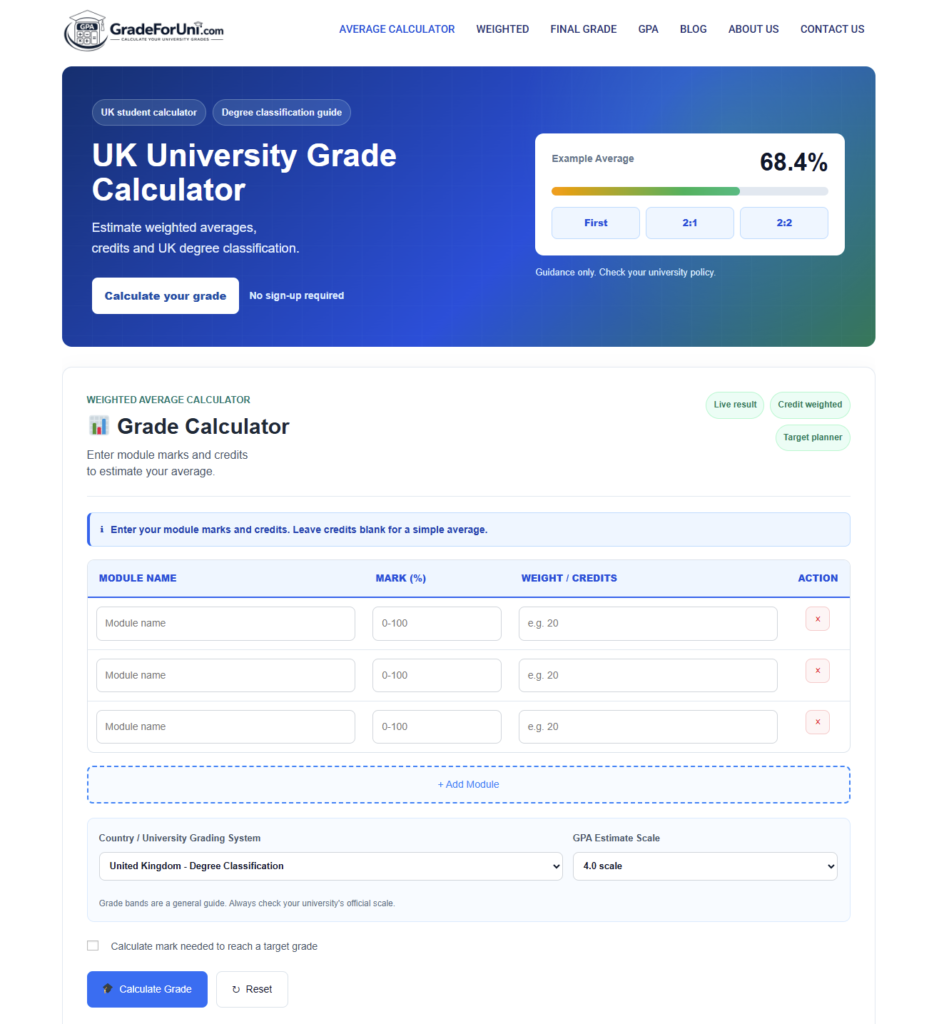
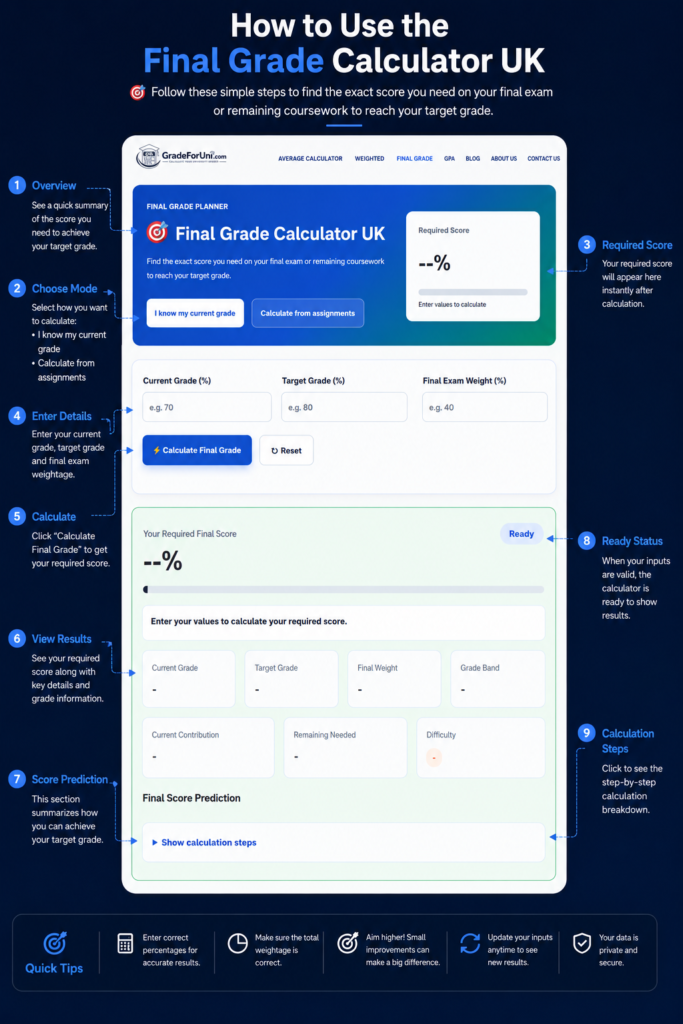
Click Here: UK University Grade Calculator
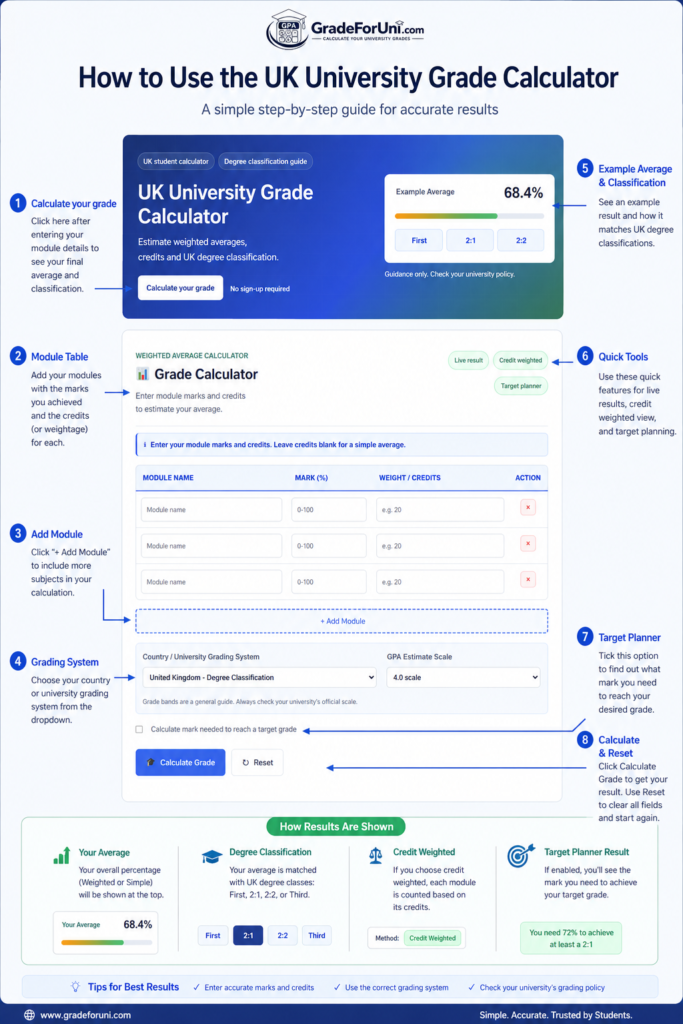
How to Use the UK University Grade Calculator
Quick Answer
A 1 Degree Calculator is a tool that works out your overall weighted average using your module marks and their credit values, then matches that average against UK degree classification boundaries — First Class (70%+), Upper Second (60–69%), Lower Second (50–59%), and Third Class (40–49%). Rather than treating every module as equally important, it multiplies each mark by its credit value first, since a 40-credit dissertation should count for far more than a 10-credit elective. The result shows not just your current average, but which classification band you’re realistically tracking towards — and what you’d need in any remaining modules to change it.
What This Guide Covers
By the end of this guide, you’ll understand exactly how a grade classification calculator arrives at your result, not just the number it produces. That matters, because a tool is only genuinely useful once you know what it’s doing with your marks and why.
Here’s what’s ahead:
- The building blocks — credits, weighted averages, and classification bands
- How Year 2 and Year 3 combine to form your final result
- A full step-by-step walkthrough of calculating your own average by hand
- The most common reasons students misjudge their own progress
- How to work out exactly what you need in your remaining modules to secure a First or protect a 2:1
Why Your Classification Isn’t Just Your Average Mark
Here’s something that catches a lot of students out: your degree classification isn’t simply “the average of everything I’ve ever been marked on.” It’s built in layers.
First, your individual module marks get weighted by credits, so a 40-credit dissertation pulls far more than a 10-credit option module. Then, those credit-weighted module averages get combined across years, usually with Year 2 and Year 3 (or Years 2–4 on integrated Masters courses) carrying different weights. Year 1, at most UK universities, doesn’t count towards your final classification at all.
Only once all three layers have been worked through does your final percentage get checked against the classification bands. (1 Degree Calculator) Skip any one of them, and the number you calculate in your head is unlikely to match what actually appears on your transcript.
Visit Now: Mauricette Calculette
Key Terms You Need to Understand First
A few terms come up constantly once you start trying to work out your own classification. Getting these clear now will save confusion later.
- Module mark — Your final percentage result for a single module, usually built from a mix of coursework, exams, and other assessments.
- Credit value — A number, commonly 10, 15, 20, 30, or 40, assigned to each module based on how much study time and assessment it represents. Most UK undergraduate years total 120 credits.
- Weighted average — An average calculated using credit values, so bigger modules have proportionally more influence on your final result.
- Year weighting — The split applied when combining multiple years into one final degree average. A common structure is 33% Year 2 and 67% Year 3, though some universities use 40:60 instead.
- Degree classification — The banding your final weighted average falls into: First, Upper Second (2:1), Lower Second (2:2), or Third.
Quick Reference
| Term | What It Means | Where You’ll See It |
| Module mark | Your % result for one module | Student portal, module handbook |
| Credit value | Weighting assigned to a module | Module handbook |
| Weighted average | Marks combined using credit values | Year and degree results |
| Year weighting | How Year 2 and Year 3 combine | Degree regulations |
| Classification | Final banding based on your average | Final transcript |
How Degree Classifications Are Actually Calculated
Most UK universities follow the same general logic, even if the exact figures vary slightly between institutions.
- Step one: credit-weighted module average. Every mark is multiplied by its credit value, those totals are added together, then divided by the total credits for that year. This produces a single, fair average for a given academic year.
- Step two: year weighting. Once you have a Year 2 average and a Year 3 average, they’re combined using your university’s specific split. This is where a strong Year 3 performance genuinely starts to matter more than an average Year 2.
- Step three: classification banding. The final combined percentage is checked against the standard UK boundaries:
| Classification | Percentage Range | Honours Abbreviation |
| First Class | 70% – 100% | 1st |
| Upper Second Class | 60% – 69% | 2:1 |
| Lower Second Class | 50% – 59% | 2:2 |
| Third Class | 40% – 49% | 3rd |
This three-step process is exactly what a 1 Degree Calculator automates. Instead of working through each layer manually, you enter your marks and credits and let the tool apply the weighting and banding logic for you.
Why This Matters More Than Students Realise
It’s tempting to treat classification tracking as something to worry about closer to final exams. (1 Degree Calculator) In practice, the earlier you understand where you stand, the more useful that information becomes.
A student sitting at 68% going into their final semester is in a genuinely different position from one sitting at 61%, even though both currently land in the same 2:1 band. (1 Degree Calculator) One is realistically within reach of a First with a strong final push. The other needs a much bigger jump, and knowing that early changes how you might prioritise revision time, choose optional modules, or decide whether resubmitting a weaker piece of coursework is worth the effort.
Graduate employers and postgraduate courses also frequently draw a hard line at 2:1, so understanding whether you’re comfortably above that boundary or sitting right on it is worth knowing well before results day.
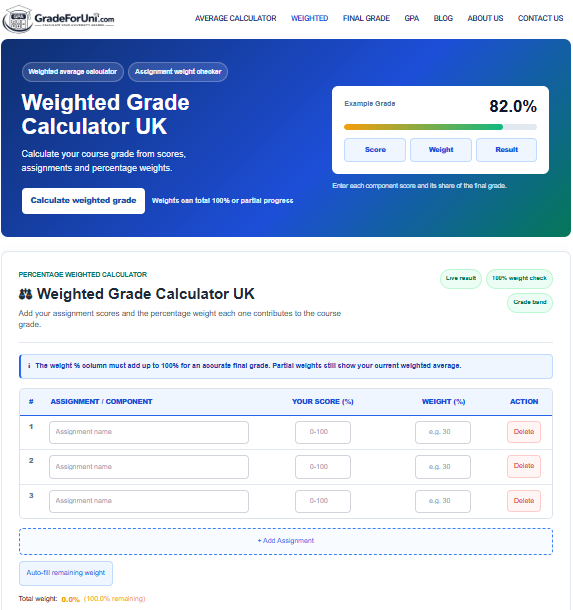
Common Misconceptions About Being “On Track”
A few assumptions catch students out again and again:
- “My average now is basically my final classification.” Not quite — your average will keep shifting as new marks come in, and Year 3 typically carries more weight than earlier years, so late results matter more than early ones.
- “If I’m at 65%, I need 75% everywhere else to get a First.” Not necessarily true. It depends heavily on how many credits remain and how much weight your remaining modules actually carry.
- “Year 1 marks still count a bit.” At most UK universities, they don’t count towards classification at all, even though you need to pass the year to progress.
- “A 2:1 average and a 2:1 classification are guaranteed to match.” Borderline cases can sometimes be reviewed by exam boards, particularly close to a boundary, so a calculated average is a strong estimate rather than an absolute guarantee.
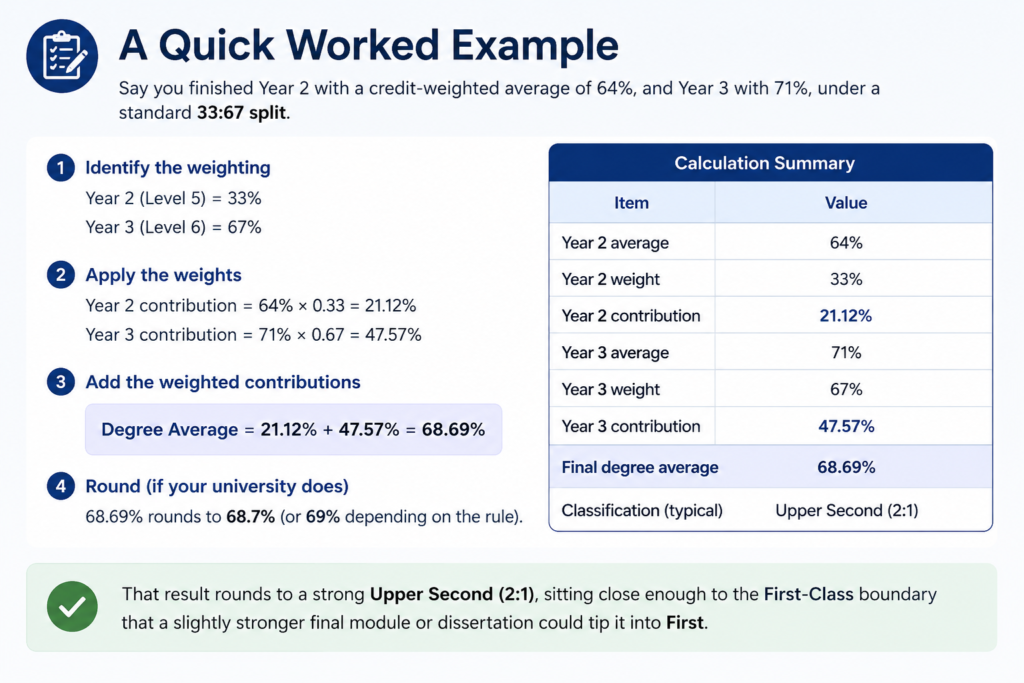
A Quick Worked Example
Take a student with a Year 2 average of 62% and a Year 3 average of 71%, under a standard 33:67 split.
Final Average = (62 × 0.33) + (71 × 0.67) = 20.46 + 47.57 = 68.03%
That lands comfortably in Upper Second Class territory, close enough to 70% that a strong final module or two could realistically push it into First Class range. This is exactly the kind of margin a 1 Degree Calculator makes easy to see at a glance, rather than working it out by hand every time a new mark comes in.
Step-by-Step: Calculating Your Own Classification by Hand
It’s worth working through your own numbers manually at least once. It’s the fastest way to understand exactly what a degree calculator is doing with your marks, rather than trusting a result you can’t explain.
1. Gather every module mark and its credit value. Pull these directly from your student portal or module handbook — not from memory. A single wrong credit value can shift your entire average.
2. Multiply each mark by its credit value. This gives you a weighted score for that module (1 Degree Calculator). It isn’t a percentage yet, just a running number you’ll use in the next step.
3. Add all the weighted scores together for the year. This total represents your combined performance, scaled by how much each module was meant to count.
4. Divide by the total credits for that year. This gives you your credit-weighted average for Year 2 or Year 3 individually.
5. Repeat for each year that counts towards your final classification. Year 1 typically doesn’t count at most UK universities.
6. Apply your university’s year-weighting split. Multiply each year’s average by its weighting percentage, then add the results together.
7. Check the combined percentage against the classification bands. First, 2:1, 2:2, or Third — whichever range your final number falls into.
A Full Worked Example: Tracking Towards a First
Take a student partway through Year 3, with two modules confirmed and one dissertation still outstanding.
Year 2 (already completed):
| Module | Mark (%) | Credits | Weighted Score |
| Consumer Behaviour | 64% | 20 | 1,280 |
| Digital Marketing | 71% | 20 | 1,420 |
| Market Research Methods | 66% | 20 | 1,320 |
Year 2 Average = (1,280 + 1,420 + 1,320) ÷ 60 = 67.0%
Year 3 (in progress):
| Module | Mark (%) | Credits | Status |
| Strategic Brand Management | 73% | 20 | Completed |
| International Marketing | 69% | 20 | Completed |
| Dissertation | Pending | 40 | Remaining |
Confirmed Year 3 average so far (excluding the dissertation) = (73×20 + 69×20) ÷ 40 = 71.0%
If the student assumes their dissertation lands around the same standard, roughly 71%, their projected Year 3 average stays at 71%. Combining both years under a 33:67 split:
Final Average = (67.0 × 0.33) + (71.0 × 0.67) = 22.11 + 47.57 = 69.68%
That’s frustratingly close to First Class territory without quite reaching it. (1 Degree Calculator) This is exactly the kind of margin worth knowing early — because it shows the dissertation doesn’t just need to be “solid,” it realistically needs to land closer to 75–78% to nudge the overall average over the 70% line.
Real-Life Scenario: Two Students, Same Average, Different Outcomes
- Consider two students who both currently sit at exactly 67% going into their final semester.
- Student A has 80 credits remaining, all in modules they’ve historically performed well in, averaging around 72% across similar past assessments.
- Student B also has 80 credits remaining, but their strongest subject area is already finished, and their remaining modules are ones they’ve historically scored closer to 63% in.
Even with an identical starting average, Student A is realistically tracking towards a First, while Student B is more likely to finish comfortably within the 2:1 band. The number on the portal today tells you almost nothing on its own — what matters is which modules are still outstanding, how much weight they carry, and how realistic your projected performance in them actually is.
This is precisely why “on track” is a more useful question than “what’s my average right now.”
Common Mistakes When Estimating Your Classification
A handful of errors show up again and again when students try to project their own final result:
- Assuming remaining modules will match your overall average. If your strongest subjects are already finished, projecting your usual average onto weaker remaining modules will overestimate your final result.
- Forgetting resit caps. Many universities cap resit marks at the pass boundary, commonly 40%, regardless of the actual mark achieved. Using the uncapped mark in your projection will inflate your estimate.
- Mixing up module-level weighting with year-level weighting. Credit weighting within a single year is a separate calculation from how Year 2 and Year 3 combine — don’t fold both into one step.
- Ignoring compensation and discounting rules. Some universities exclude your lowest-scoring module, or a small number of credits, from the final average. If your university applies this and you don’t account for it, your manual calculation can be noticeably off.
- Rounding too early. Rounding each year’s average before combining them introduces small errors that can shift a borderline result across a classification boundary.
Best Practices for Accurate Tracking (1 Degree Calculator)
A few habits make a genuine difference to how reliable your own projections are:
- Separate confirmed marks from predicted ones. Keep a clear line between what’s actually been marked and what you’re estimating, so you don’t lose track of how solid your projection really is.
- Recalculate after every new result. A single strong or weak mark in a high-credit module, like a dissertation, can shift your projected classification more than you’d expect.
- Use your actual module-level performance history when projecting outstanding marks, rather than a flat average. If you consistently score higher in essay-based modules than exam-based ones, factor that in.
- Confirm your university’s exact year-weighting split. Don’t assume 33:67 — some institutions use 40:60, and integrated Masters courses often bring a fourth year into the calculation entirely.
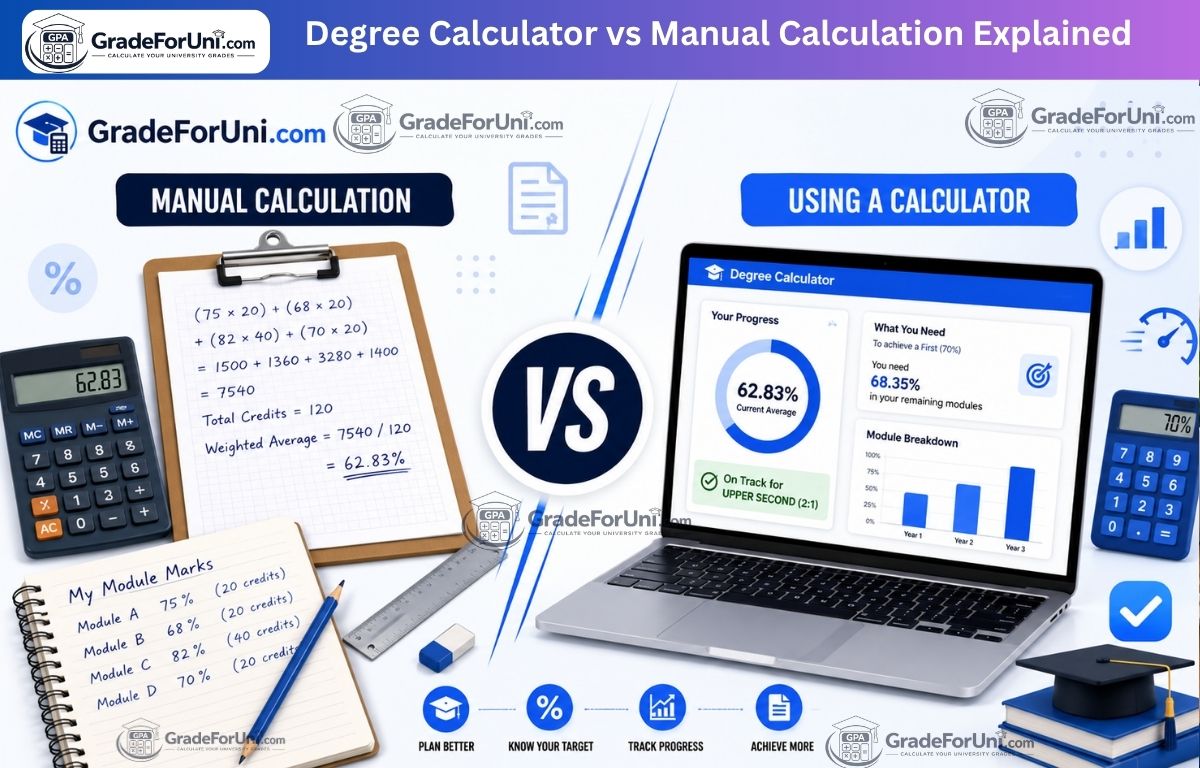
Manual Calculation vs Using a Calculator
| Aspect | Manual Calculation | 1 Degree Calculator |
| Best for | Understanding exactly how your result is built | Speed and accuracy across multiple years |
| Risk of error | Higher, especially with rounding or year-weighting mix-ups | Low, assuming correct data entry |
| Handles target planning | Slow, needs recalculating from scratch each time | Instant — shows the mark needed in remaining modules |
| Good for tracking progress through the year | Time-consuming as new results come in | Straightforward — just update and recalculate |
| Recommended when | You want to understand the mechanics fully | You’re actively tracking towards a specific classification |
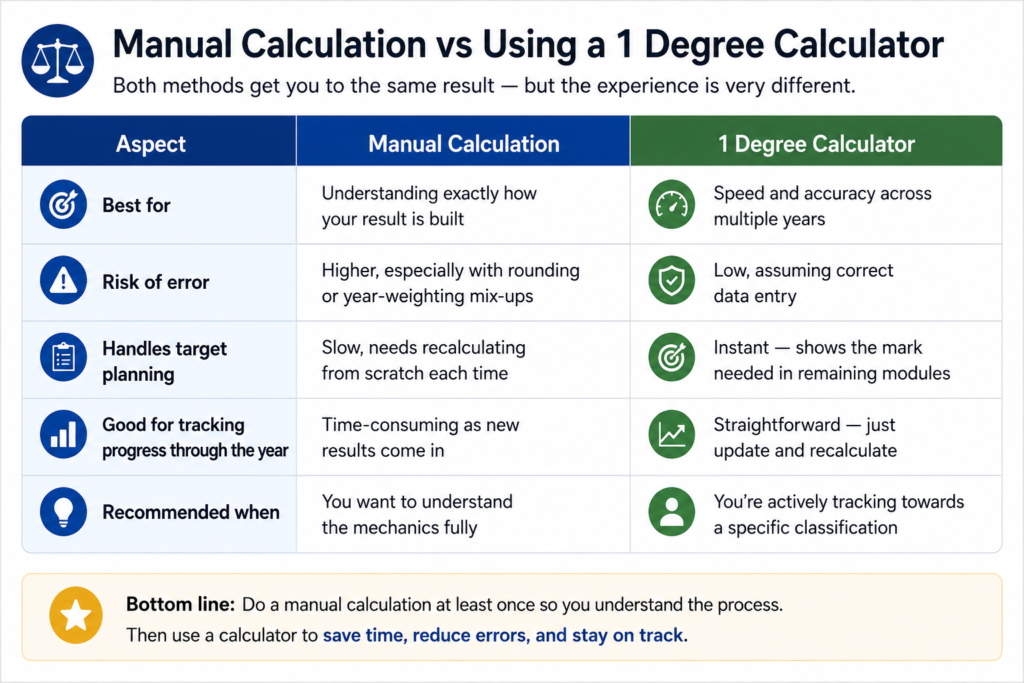
Working through the calculation manually at least once is genuinely worth doing — it means you understand why your number looks the way it does, rather than trusting a result you can’t explain. But once you’re combining multiple years, tracking outstanding modules, and working out exactly what you need going forward, a calculator removes the risk of a small arithmetic error changing your entire projection (1 Degree Calculator).
Target Grade Planning: Working Out What You Actually Need
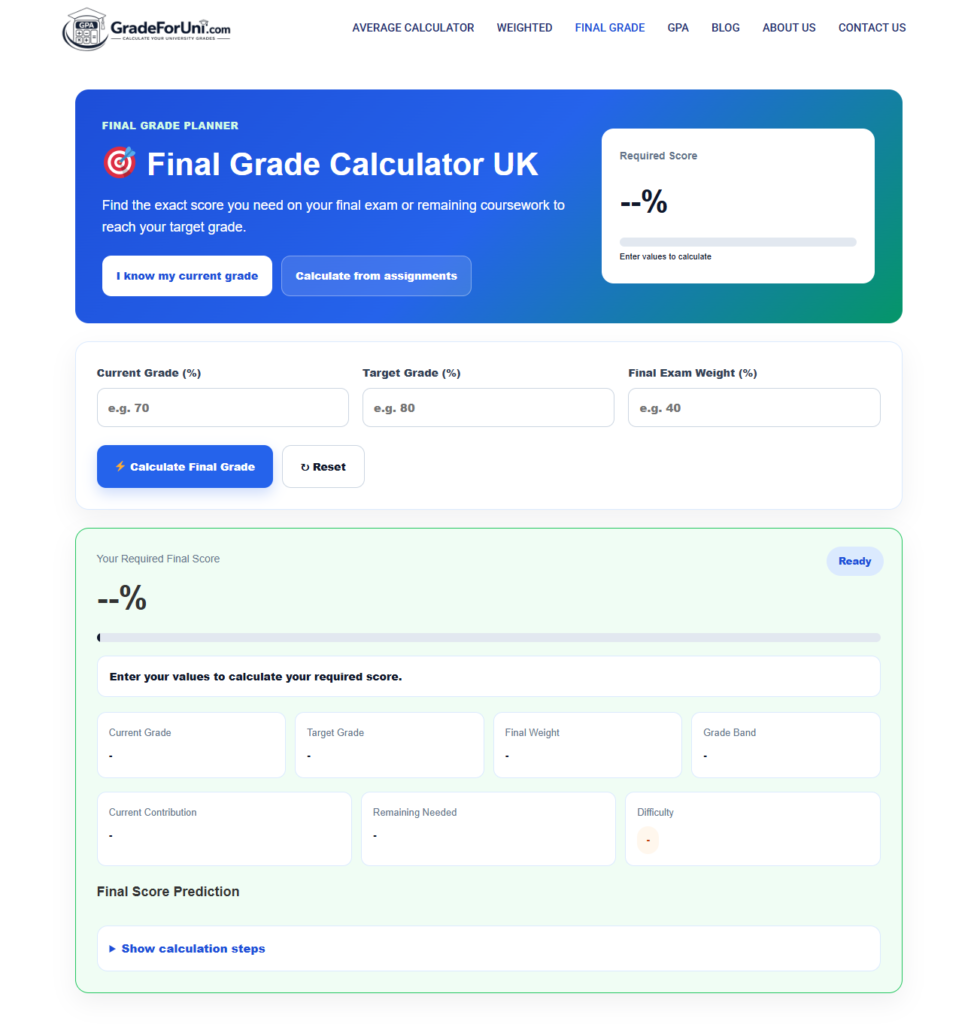
Once you know your current position, the next useful question isn’t “what’s my average,” it’s “what do I need from here.” This is the single most practical thing a 1 Degree Calculator does beyond simply reporting a current percentage.
The formula rearranges the standard weighted average calculation to solve for the unknown mark instead:
Mark Needed = [(Target Average × Total Credits) − Sum of (Completed Marks × Credits)] ÷ Remaining Credits
Worked example: A student has completed 80 credits of their final year at an average of 66%, with 40 credits remaining in their dissertation. They want to know what’s needed for a First (70% overall).
Mark Needed = [(70 × 120) − (66 × 80)] ÷ 40
Mark Needed = [8,400 − 5,280] ÷ 40
Mark Needed = 3,120 ÷ 40 = 78%
That’s a demanding but realistic target if the student has scored in that range before. (1 Degree Calculator) If their strongest previous mark was closer to 68%, it’s a useful early warning that a First may not be realistic this year, and that securing a strong 2:1 might be the more sensible focus.
This is exactly the kind of number worth knowing weeks or months before a deadline, not the night before submission.
Handling Multiple Outstanding Modules at Once
Target planning gets slightly more involved when several modules are still outstanding rather than just one, which is common earlier in a final year.
The approach stays the same, but instead of solving for a single unknown mark, you’re solving for an average across the remaining credits combined. From there, you can distribute that target sensibly based on which modules you’re realistically stronger or weaker in — a dissertation you’ve prepared for extensively might reasonably carry a higher target than an exam-based module you find more difficult.
A practical way to handle this: (1 Degree Calculator)
- Calculate the combined average needed across all remaining credits using the formula above.
- Split that target unevenly across remaining modules based on your genuine strengths, rather than assuming an identical mark in each.
- Recalculate after each new result comes in, since the target for what’s left will shift every time (1 Degree Calculator).
Advanced Tips and Frequently Overlooked Details
A few details rarely get mentioned in module handbooks but make a real difference to how accurately you can plan ahead.
- Capped resits change your target, not just your current mark. If a resit is capped at 40%, that module effectively becomes a fixed number in your calculation rather than a variable — factor this in before setting targets for other modules.
- Some universities discount your lowest module or a fixed number of credits. If this applies to you, your actual required average may be slightly more forgiving than a straightforward calculation suggests. Check your specific academic regulations rather than assuming.
- Predicted grades aren’t official marks. If you’re using predicted or provisional marks to plan ahead, keep them clearly separated from confirmed results so a projection never gets mistaken for your actual standing.
- Postgraduate and integrated Masters targets work differently. Distinction boundaries usually start at 70%, similar to a First, but dissertation modules on Masters courses often carry disproportionately heavy weighting, sometimes a third of the entire course from one piece of work.
- A target that looks small on paper can be harder in practice. Needing “just 3% more” sounds minor, but if that gap sits between a 2:1 and a First on a heavily weighted final module, it can represent a meaningfully different standard of work than your average so far.
- Borderline classifications sometimes get reviewed by exam boards. If your calculated average lands within a percentage point or two of a boundary and you’ve shown consistent higher-band performance across your final year, some universities apply discretion. This isn’t guaranteed, and policies vary between institutions, but it’s a genuine factor a pure percentage calculation won’t capture.
Key Takeaways
- Recalculating regularly, rather than relying on one estimate made early in the year, gives a far more accurate picture as results come in.
- A 1 Degree Calculator works out your classification by combining credit-weighted module averages across your relevant years, then checking that figure against the standard UK boundaries.
- Your current average alone doesn’t tell you whether you’re “on track” — what matters is how much credit weight remains and how realistic your projected performance in those modules is.
- Year 3 typically carries more weight than Year 2, so late results matter more than early ones in most UK degree structures.
- Target grade planning rearranges the weighted average formula to show exactly what mark you need in remaining modules to hit a specific classification.
- Resit caps, discounting rules, and borderline exam board discretion can all shift your real position slightly away from a pure percentage calculation.
Final Thoughts
Working out whether you’re genuinely on track for a First, or comfortably inside 2:1 territory, takes more than glancing at a single percentage on your student portal. Credit values, year weighting, resit caps, and how much of your degree is still outstanding all shape the real picture — and a rough mental estimate rarely accounts for all of it.
A reliable 1 Degree Calculator brings all of that together in one place, turning your module marks and credits into a clear, classification-ready result, along with exactly what you need from your remaining work to reach the outcome you’re aiming for. (1 Degree Calculator) Whether you’re tracking a strong Year 2 performance into final year, planning around a heavily weighted dissertation, or simply trying to understand why your own maths never quite matches your transcript, working through the numbers properly puts you back in control of your progress, rather than waiting anxiously for results day to tell you where you landed.
FAQ’s
What is a 1 Degree Calculator used for?
(1 Degree Calculator) It’s used to work out your overall weighted average from module marks and credits, then match that figure against UK degree classification boundaries to show whether you’re tracking towards a First, 2:1, 2:2, or Third.
How do I know if I’m on track for a First?
Calculate your credit-weighted average so far, then work out what mark you’d need in your remaining modules to reach 70% overall. If that required mark is close to marks you’ve already achieved in similar modules, a First is realistically within reach (1 Degree Calculator).
Does Year (1 Degree Calculator) 1 count towards my final classification?
At most UK universities, Year 1 doesn’t count towards your final degree classification, though you usually still need to pass it to progress into Year 2 (1 Degree Calculator).
What’s the difference between a (1 Degree Calculator) weighted average and a simple average?
A weighted average multiplies each mark by its credit value before dividing by total credits, so larger modules count more. A simple average treats every module equally, (1 Degree Calculator) which rarely reflects how universities actually calculate results.
How much does my dissertation affect my final classification (1 Degree Calculator)?
Significantly, since dissertations typically carry 30 to 40 credits or more, meaning they influence your average considerably more than a standard 10 or 20-credit module (1 Degree Calculator).
Can I (1 Degree Calculator) estimate my final classification before all my results are confirmed?
Yes. Combine your confirmed credit-weighted average with realistic projected marks for outstanding modules, based on your genuine performance history, (1 Degree Calculator) then apply your university’s year-weighting split.
What mark do I need to move from a 2:1 to a first (1 Degree Calculator)?
This depends entirely on your current average and how many credits remain. (1 Degree Calculator) Use the target grade formula to work out the exact mark needed in your remaining modules, since a small overall gap can require a significantly higher mark in a heavily weighted module.
Are resit marks capped when calculating my classification (1 Degree Calculator)?
Many (1 Degree Calculator) UK universities cap resit marks at the standard pass boundary, commonly 40%, regardless of the mark actually achieved. Always use the capped figure your university has officially recorded, not the uncapped result.
Do all UK universities use (1 Degree Calculator) the same year-weighting split?
No. (1 Degree Calculator) A 33:67 split between Year 2 and Year 3 is common, but many universities use 40:60 instead, and integrated Masters courses often include a fourth year. Always confirm your own course’s exact structure.
Is a 2:1 good enough for most graduate jobs and master’s courses (1 Degree Calculator)?
Yes, a 2:1 meets the minimum requirement for the majority of UK graduate schemes and postgraduate courses, (1 Degree Calculator) though some competitive employers and courses ask specifically for a First.