

You get your latest university result and see 68% on your screen. It feels good until you start wondering what it means for your final degree. University Grade Tracker
Is 68% enough to stay on track for a First? Does a 40-credit module affect your average more than a 20-credit module? What marks will you need in your remaining modules to finish with a 2:1?
A university grade tracker helps you monitor your marks, credits, and academic progress in one place. It can show your current average, remaining credits, and the marks you may need to reach your target classification.
Use our University Grade Calculator to track your marks and estimate your overall degree result.
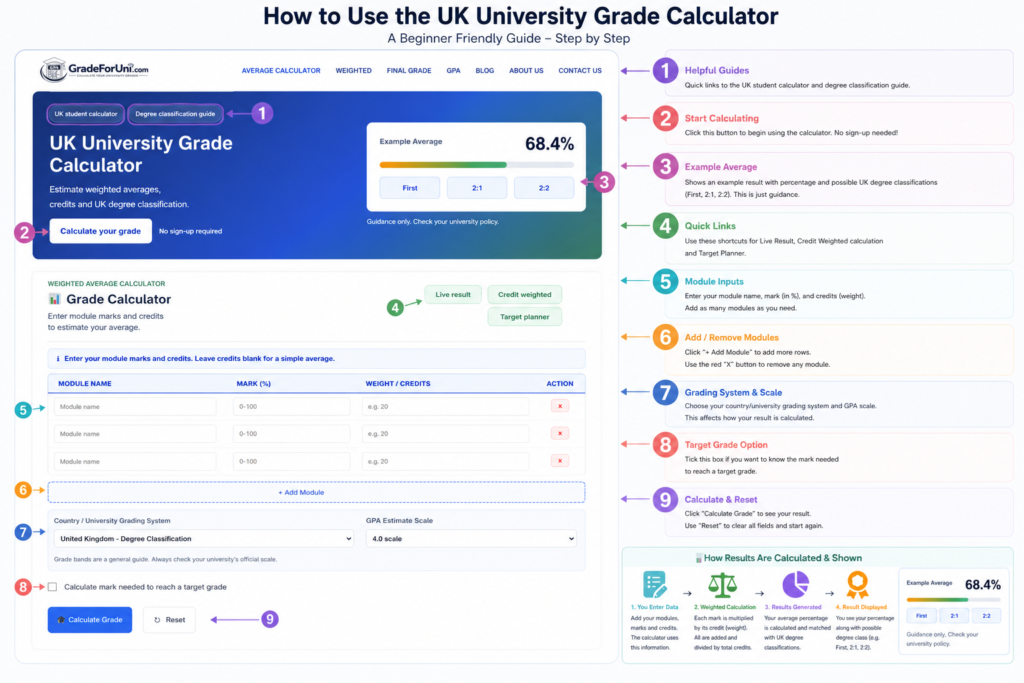
A university grade tracker records your module marks, assessment results, credits, and weightings to calculate your current average and help you estimate your final degree classification. University Grade Tracker: For UK students, the calculation should be based on the rules used by their own university because classification weightings, borderline rules, and other requirements can vary.
What Is a University Grade Tracker?
A university grade tracker is a system for recording your academic results and monitoring how they affect your overall degree performance.
Instead of keeping marks in different emails, spreadsheets, or university portals, you can record them together and see your progress in one place. University Grade Tracker
A useful tracker can include:
- Module names
- Individual assessment marks
- Assessment weightings
- Module credits
- Academic year
- Completed credits
- Remaining credits
- Predicted marks
- Confirmed marks
- Target classification
- Required future marks
The important point is that a tracker is more than a list of percentages. It should help you understand how those percentages affect your degree.
What You Can Track
| Level | Example Marks | What Happens |
|---|---|---|
| Assessment | Coursework: 72%Exam: 64%Presentation: 70% | Individual assessment marks are recorded separately. |
| Module | Coursework, exam and presentation combined using their assessment weightings | Produces the final module mark. |
| Academic Year | Several module marks combined using credit/year weightings | Produces the year average. |
| Final Degree | Academic years/modules combined according to university rules | Determines the final degree classification. |
| Mark Status | Official: 68%Estimated: 68% | Official results are confirmed marks; estimated marks are projections until results are released. |
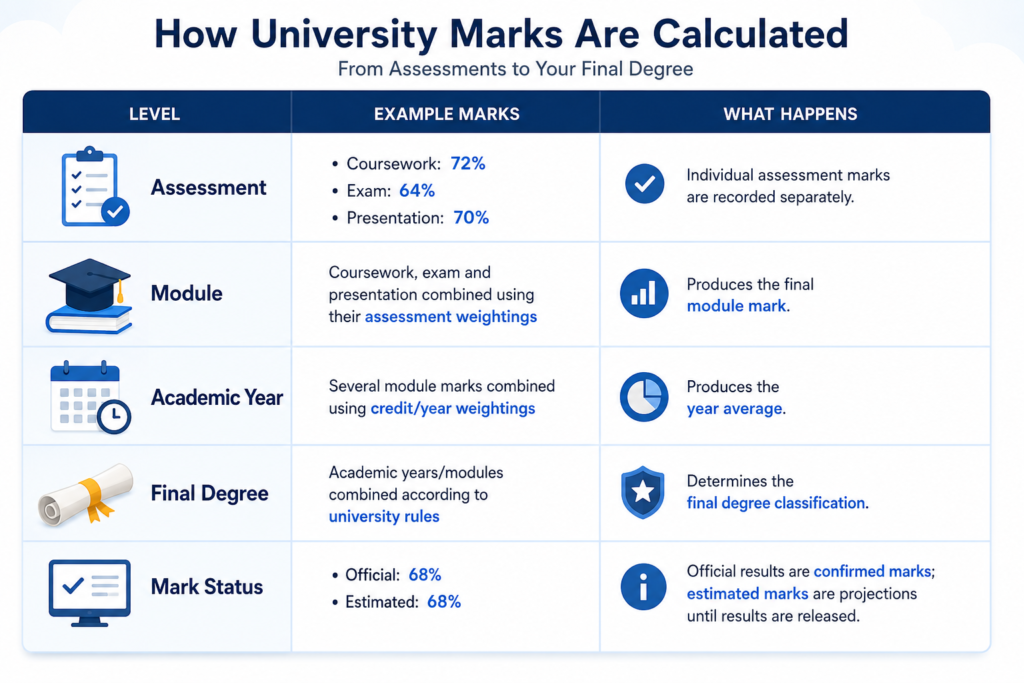
How a Grade Tracker Fits Into Your Degree
There are several different calculations involved in a degree.
Your individual assessment marks may determine a module mark. Your module marks may contribute to an academic-year average. Your relevant academic years may then contribute to your final degree classification. University Grade Tracker
That distinction matters because a module average is not necessarily the same thing as your final degree average.
A grade tracker helps you follow each stage rather than jumping straight from one assignment mark to a predicted classification.
How Does a University Grade Tracker Calculate Your Average?
The calculation depends on what you are trying to measure.
You might calculate the final mark for one module, the average across a year, or an estimated final degree result.
How Assessment Marks Become a Module Mark
Suppose a module is assessed through:
- Coursework: 40%
- Exam: 60%
You receive:
| Assessment | Mark | Weighting | Contribution |
|---|---|---|---|
| Coursework | 70% | 40% | 28.0% |
| Exam | 64% | 60% | 38.4% |
| Final Module Mark | — | 100% | 66.4% |
Formula:
Module Mark = (70 × 0.40) + (64 × 0.60) = 66.4%
This is why entering the assessment marks alone is not enough. The tracker also needs to know how much each assessment contributes.
A student has three assessments:
| Assessment | Mark | Weight | Contribution |
|---|---|---|---|
| Coursework | 72% | 30% | 21.6 |
| Presentation | 68% | 20% | 13.6 |
| Exam | 65% | 50% | 32.5 |
| Final module mark | 100% | 67.7% |
The student therefore finishes the module with 67.7% before any university-specific rounding or classification rules are considered.
How Module Credits Affect Your Overall Average
Once you have module marks, credits can become important.
If all your modules carry the same number of credits, calculating the average is relatively straightforward. But when modules have different credit values, a simple average can give the wrong impression. University Grade Tracker
For example, consider:
- Module A: 70%, 20 credits
- Module B: 62%, 20 credits
- Module C: 68%, 40 credits
Module C carries twice as many credits as either Module A or B. Where the relevant university calculation is credit-weighted, its mark therefore has greater influence.
Credit
| Module | Mark | Credits | Mark × Credits |
|---|---|---|---|
| Module A | 70% | 20 | 1,400 |
| Module B | 62% | 20 | 1,240 |
| Module C | 68% | 40 | 2,720 |
| Total | — | 80 | 5,360 |
| Credit-weighted average | 67.00% |
Simple Average Comparison
| Calculation Method | Formula | Result |
|---|---|---|
| Credit-weighted average | 5,360 ÷ 80 | 67.00% |
| Simple average | (70 + 62 + 68) ÷ 3 | 66.67% |
The difference is small here, but it can become much more significant when credit values or marks vary substantially.
The safest approach is to check whether your university uses credit weighting for the calculation you are making.
How Your Academic-Year Average Is Calculated
If your modules within an academic year all have equal credits, you can generally average their marks.
For example, imagine six 20-credit modules with marks of:
| Module | Mark |
|---|---|
| Module 1 | 72% |
| Module 2 | 68% |
| Module 3 | 65% |
| Module 4 | 63% |
| Module 5 | 70% |
| Module 6 | 66% |
| Total | 404% |
| Academic-Year Average | 67.33% |
Calculation: 404 ÷ 6 = 67.33%
If the credits differ, use the appropriate credit-weighted method instead.
A tracker should also distinguish between completed and pending modules. A current average based on four completed modules is not necessarily the same as the projected average after two outstanding results arrive. University Grade Tracker
How to Track Your University Grades Across Every Year
A useful tracker should develop with you throughout your degree rather than being used only when final results are approaching.
Tracking Year 1
Record each module, its credits, and final mark once available.
Even if Year 1 does not count towards your final classification, tracking your results can help you monitor your performance.
Keep Year 1 separate from your final degree calculation unless your university confirms that it should be included.
Tracking Year 2
Year 2 can be important when calculating your final degree classification. Your tracker should record:
- Year 2 average
- Completed credits
- Remaining credits
- Target classification
- Year 2 weighting
Check your university’s rules to confirm how much Year 2 contributes to your final grade.
Tracking Year 3
Final-year tracking helps you monitor how your remaining modules may affect your overall result.
Pay particular attention to high-credit modules, such as a 40-credit dissertation, because they may have more influence than a 20-credit module.
Tracking an Integrated Master’s or Other Degree Structure
Integrated Master’s degrees, foundation years, and placement years may have different classification rules. University Grade Tracker
A UK university grade tracker can provide an estimate, but your final calculation should follow your university’s course regulations.
How Do University Credits Affect Your Degree Grade?
Credits represent the amount of study associated with a module and can affect how strongly that module contributes to a credit-weighted calculation. University Grade Tracker
Why Credit Weighting Matters
| Module | Mark | Credits | Weighted Mark (Mark × Credits) | Influence |
|---|---|---|---|---|
| Module A | 65% | 20 | 1,300 | Lower |
| Module B | 72% | 40 | 2,880 | Higher |
| Total | — | 60 | 4,180 | — |
| Credit-Weighted Average | 69.67% | — | — | — |
How to Track Completed and Remaining Credits
A tracker should make it easy to see:
Total degree credits − completed credits = remaining credits
For example:
- Degree requirement: 360 credits
- Completed: 240 credits
- Remaining: 120 credits
The student therefore has 120 credits remaining.
This information is useful when calculating what marks are needed to reach a target. University Grade Tracker
[Comparison Table: 10-, 20-, 30-, 40- and 60-credit modules and their relative influence]
How a High-Credit Dissertation Can Affect Your Average
A dissertation can have a noticeable effect when it carries more credits than a standard module.
Suppose a student has several 20-credit modules but a 40-credit dissertation remains.
A tracker can model several possibilities:
- Dissertation at 60%
- Dissertation at 70%
- Dissertation at 80%
This allows the student to see how different outcomes could affect the overall average.
The important lesson is not simply that a dissertation is “more important”. Its effect depends on the exact credit value and classification method used by the university.
How to Track Progress Towards a First or 2:1
Tracking becomes particularly useful when you have a target classification in mind.
Understanding Common UK Degree Classification Bands
A typical UK honours classification is:
| Classification | Typical Mark Range |
|---|---|
| First Class Honours | 70%+ |
| Upper Second Class Honours (2:1) | 60–69% |
| Lower Second Class Honours (2:2) | 50–59% |
| Third Class Honours | 40–49% |
These ranges are useful as a general guide, but they should not be treated as a universal calculation rule.
Universities can apply their own classification algorithms, rounding arrangements and borderline criteria.
How to Track Your Current Classification Position
Your tracker should bring together four important pieces of information:
- Current average
- Completed credits
- Remaining credits
- Target classification
For example, a student with a current average of 67% and 120 credits remaining can ask a much more useful question than simply “What grade am I getting?”
They can ask:
“What average do I need across my remaining credits to reach my target?”
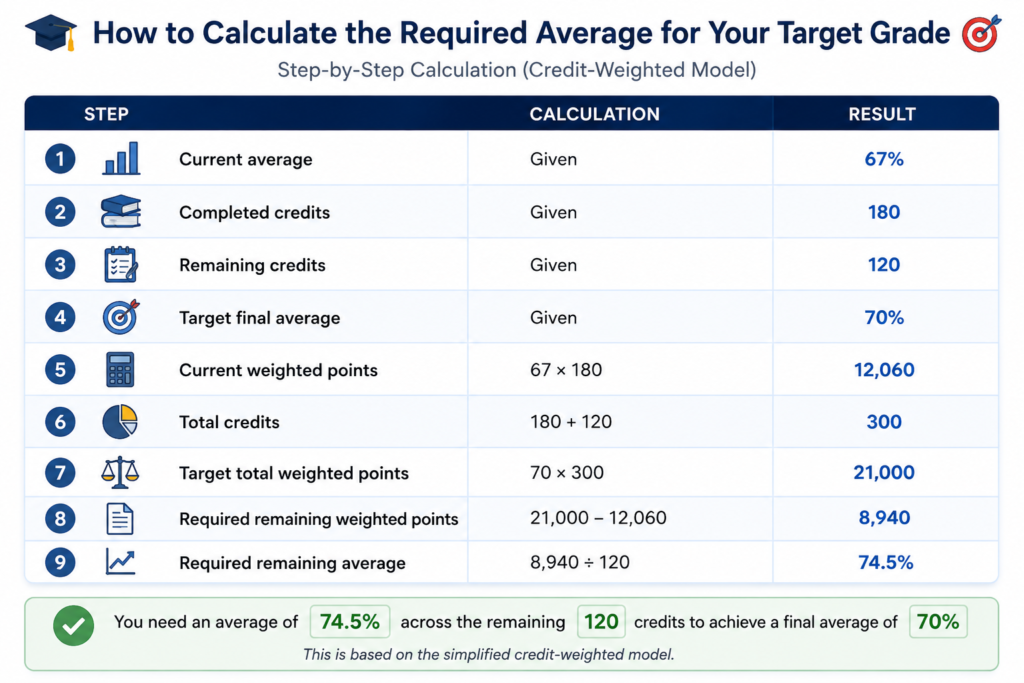
How to Calculate the Marks You Need in Remaining Modules
A simplified target calculation can be exp
| Step | Calculation | Result |
|---|---|---|
| Current average | Given | 67% |
| Completed credits | Given | 180 |
| Remaining credits | Given | 120 |
| Target final average | Given | 70% |
| Current weighted points | 67 × 180 | 12,060 |
| Total credits | 180 + 120 | 300 |
| Target total weighted points | 70 × 300 | 21,000 |
| Required remaining weighted points | 21,000 − 12,060 | 8,940 |
| Required remaining average | 8,940 ÷ 120 | 74.5% |
How to Test Whether Your Target Is Achievable
Do not rely on a single prediction.
Test three scenarios:
- Conservative outcome
- Realistic outcome
- Strong outcome
For example, if you need 74.5% across your remaining credits, compare that requirement with your recent module performance. University Grade Tracker
If you have been averaging around 65%, a 74.5% target may require a significant improvement. That does not make it impossible, but it gives you useful information for planning.
A similar approach works for a student sitting at 58% who wants to reach 60%.
How Are Final Degree Classifications Calculated in the UK?
Why There Is No Single UK-Wide Classification Formula
This is one of the most important points when using a university grade calculator.
There are common classification bands across UK higher education, but universities can use different algorithms for calculating the final award.
Differences can include:
- Year weighting
- Credit weighting
- Which levels count
- Borderline rules
- Best-credit arrangements
- Rounding
- Course-specific regulations
For that reason, a generic university grade tracker should be treated as an estimate unless it is configured to match your institution’s rules. University Grade Tracker
How Year Weightings Can Differ Between Universities
Consider a simple 1:2 weighting model:
- Year 2 = one part
- Year 3 = two parts
If Year 2 is 64% and Year 3 is 72%:
(64 × 1 + 72 × 2) ÷ 3 = 69.33%
That produces an estimated combined average of 69.33%.
However, another university may use a different weighting structure.
Some institutions may exclude Year 1, while others may use different proportions for later years. Integrated Master’s programmes can also have their own rules. University Grade Tracker
The practical lesson is simple: do not copy another student’s formula just because they attend a UK university.
How Borderline Classification Rules Can Affect Your Result
Students close to a classification boundary need to be particularly careful.
A student with an estimated 69% may assume they have missed a First. But their university may have a borderline rule that considers additional criteria. University Grade Tracker
Likewise, a result close to 60% may be treated differently depending on the institution’s regulations. University Grade Tracker
A tracker should therefore show the numerical average without promising a classification that the university itself has not confirmed.
How Best-Credit and Other Special Rules Can Change the Calculation
Some universities use approaches involving selected credits, particular modules, or specific classification bands.
This means a simple “add everything and divide” method may not always reproduce the official result.
If your university has a best-credit system or another special algorithm, configure your calculations around that system rather than relying on a generic UK formula.
How Accurate Is a University Grade Tracker?
When a Tracker Can Give a Reliable Estimate
A tracker becomes more useful when you enter accurate information.
Check:
- Official module marks
- Correct credit values
- Correct assessment weightings
- Correct year weightings
- Correct target classification
- Correct university-specific calculation method
The more closely your inputs match your university’s regulations, the more meaningful the estimate becomes.
Why a Tracker May Not Match Your University’s Official Result
A difference can occur because of:
- University-specific algorithms
- Borderline rules
- Resit arrangements
- Capped marks
- Rounding
- Special programme regulations
- Best-credit rules
A calculator can perform the mathematics correctly and still produce a different result from the university if the wrong classification model is being used. University Grade Tracker
How to Check Your University’s Official Classification Rules
Before relying on a final prediction, check your:
- University assessment regulations
- Course or programme handbook
- Official degree classification guidance
Read More: How UK Universities Calculate Degree Classifications – Explained SimplyUse a generic tracker to understand your position, but use your university’s official regulations to confirm how the final award will actually be determined.
How Should You Track Pending Marks, Predictions and Resits?
Tracking Pending Results
Do not enter an estimated result as though it were confirmed.
A simple status system can include:
| Status | Meaning |
|---|---|
| Completed | Official mark received |
| Pending | Result not released |
| Predicted | Estimated mark |
| Target | Desired mark |
| Required | Mark needed |
| Resit | Result affected by reassessment |
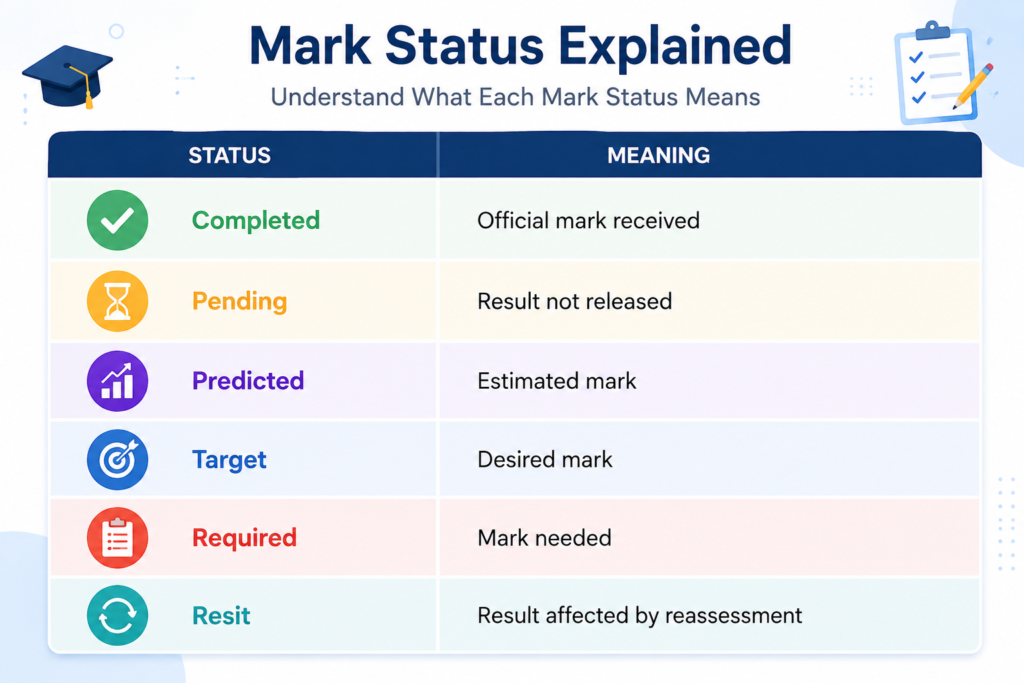
This makes your tracker much easier to interpret.
Tracking Predicted Grades
Predictions can be useful for planning.
For example, if you expect to receive 72% in an upcoming module, you can model the effect of that result.
But label it clearly as predicted.
Once the official mark arrives, replace or update the prediction rather than allowing both figures to be confused.
Tracking Resits and Capped Marks
Resits require additional care.
Record:
- Original mark
- Resit mark
- Recorded or capped mark
- Relevant university rule
For example, a student might originally receive 35% and later achieve 65% in a resit. The result recorded for classification purposes may not simply be 65%.
What Should You Include in a University Grade Tracker?
Essential Fields
A practical tracker should include:
- Module name
- Assessment name
- Mark
- Assessment weighting
- Module credits
- Academic year
- Result status
- Target mark
- Required mark
These fields allow you to move from simple record-keeping to meaningful academic planning.
Recommended Tracking Statuses
A clear status system prevents predicted and official results from becoming mixed.
[Comparison Table: Completed, pending, predicted, target, required and resit]
How to Keep Your Tracker Updated
A simple routine works well:
- Add each module at the beginning of the year.
- Record its credit value.
- Add assessment weightings.
- Enter official results when released.
- Mark pending results clearly.
- Recalculate your current average.
- Update completed and remaining credits.
- Recheck your target after significant results.
Updating regularly is more useful than trying to reconstruct your entire academic history immediately before graduation. University Grade Tracker
Common University Grade Tracking Mistakes
| Common Mistake | Why It Matters |
|---|---|
| Treating every module as equally weighted | Different credit values can have different influence on your average. |
| Using an unweighted average | A simple mean may not reflect a credit-weighted calculation. |
| Forgetting assessment weightings | Assessment marks cannot always be averaged directly. |
| Mixing predicted and confirmed marks | This can make your current average misleading. |
| Assuming Year 1 always counts | Universities have different classification rules. |
| Assuming every university uses the same year weighting | Year weightings vary between institutions and courses. |
| Ignoring high-credit modules | Dissertations and projects can have a substantial impact on your average. |
| Ignoring borderline rules | Additional checks may apply when you are close to a classification boundary. |
| Assuming rounding rules are universal | Universities can use different rounding arrangements. |
| Mishandling resit marks | Resit results may be subject to specific rules or mark caps. |
| Mixing assessment marks with module marks | They represent different stages of the calculation process. |
| Forgetting remaining credits | Remaining credits are needed when calculating future target marks. |
| Treating a generic calculator as official | Your university’s regulations always take priority. |
| Replacing original resit information | Keeping the original result and resit history makes your tracker easier to audit. |
| Not checking your university’s regulations | Course-specific rules may affect how your final degree is calculated. |
Expert Tips for Tracking Your University Grades
| Best Practice | Why It Helps |
|---|---|
| Record marks as soon as they are officially released | Keeps your tracker accurate and up to date. |
| Keep the credit value beside every module | Makes credit-weighted calculations easier. |
| Store assessment weightings separately from module credits | Prevents assessment and module weightings from being confused. |
| Label predicted marks clearly | Helps distinguish estimates from confirmed results. |
| Track completed and remaining credits together | Makes it easier to calculate future targets. |
| Set a target classification early enough to plan around it | Helps you understand what marks you may need. |
| Recalculate after each major result | Keeps your predicted outcome current. |
| Pay attention to high-credit modules | They may have a greater influence on your overall average. |
| Keep Year 1, Year 2 and Year 3 results separate | Makes year-specific weighting easier to apply. |
| Check your university’s official classification rules | Ensures your final prediction follows the correct requirements. |
| Record your course’s exact weighting | Avoids using a formula from another student or university. |
| Check whether borderline rules apply | These rules may affect students close to a classification boundary. |
| Keep original and resit results visible | Makes your academic record easier to review and audit. |
| Model several possible outcomes | Gives you a clearer range of potential final results. |
| Use the tracker as a planning tool | Your university’s official result remains the final authority. |
University Grade Tracker Worked Examples
Example 1 — Tracking Four Equal-Credit Modules
| Module | Mark | Credits |
|---|---|---|
| Business | 68% | 20 |
| Economics | 64% | 20 |
| Marketing | 72% | 20 |
| Finance | 66% | 20 |
| Total | — | 80 |
| Current Average | 67.5% | — |
Example 2 — Tracking Unequal-Credit Modules
| Module | Mark | Credits | Mark × Credits |
|---|---|---|---|
| Module A | 70% | 20 | 1,400 |
| Module B | 62% | 20 | 1,240 |
| Module C | 68% | 40 | 2,720 |
| Total | — | 80 | 5,360 |
| Credit-Weighted Average | 67% | — | — |
Example 3 — Calculating a Module From Coursework and Exam Marks
| Assessment | Mark | Weighting | Weighted Contribution |
|---|---|---|---|
| Coursework | 70% | 40% | 28.0 |
| Exam | 64% | 60% | 38.4 |
| Total | — | 100% | 66.4% |
| Final Module Mark | 66.4% | — | — |
Example 4 — Calculating a Full Academic-Year Average
| Module | Mark | Credits |
|---|---|---|
| Module 1 | 72% | Equal |
| Module 2 | 68% | Equal |
| Module 3 | 65% | Equal |
| Module 4 | 63% | Equal |
| Module 5 | 70% | Equal |
| Module 6 | 66% | Equal |
| Total | 404% | — |
| Year Average | 67.33% | — |
Example 5 — Tracking Towards a First
| Item | Value |
|---|---|
| Current Average | 67% |
| Completed Credits | 180 |
| Remaining Credits | 120 |
| Target Final Average | 70% |
| Required Average on Remaining Credits | 74.5% |
| Model Used | Simplified credit-weighted calculation |
Example 6 — Tracking Towards a 2:1
| Item | Calculation | Result |
|---|---|---|
| Current Average | Given | 58% |
| Completed Credits | Given | 180 |
| Remaining Credits | Given | 180 |
| Target Final Average | Given | 60% |
| Current Weighted Points | 58 × 180 | 10,440 |
| Total Credits | 180 + 180 | 360 |
| Target Total Weighted Points | 60 × 360 | 21,600 |
| Remaining Points Required | 21,600 − 10,440 | 11,160 |
| Required Average | 11,160 ÷ 180 | 62% |
Example 7 — Combining Year 2 and Year 3 Results
A stu
| Academic Year | Average | Weighting | Weighted Contribution |
|---|---|---|---|
| Year 2 | 64% | 1 | 64 |
| Year 3 | 72% | 2 | 144 |
| Total | — | 3 | 208 |
| Final Weighted Average | 69.33% | — | — |
Example 8 — Tracking a High-Credit Dissertation
A student has several completed 20-credit modules and one remaining 40-credit dissertation.
Rather than treating the dissertation as one ordinary module, the tracker should account for its 40-credit value when the university uses credit weighting.
The student can then model possible dissertation results and compare projected overall averages.
University Grade Tracker Practical Scenarios
First-Year Student Building Their First Tracker
A first-year student has received four results and wants to understand their current performance.
The best approach is to record every module, credit value, and official mark, while keeping the year separate from later classification calculations.
Second-Year Student Targeting a 2:1
A student currently has an average of 63% and wants to remain comfortably above the 60% classification threshold.
The tracker can show their current performance, remaining credits, and potential future outcomes.
This helps turn a vague concern about grades into a measurable target.
Final-Year Student Targeting a First
A student sitting around 67–68% wants to know whether a First remains achievable. University Grade Tracker
Rather than guessing, they can calculate the required average across their remaining credits and compare it with realistic future outcomes.
Student With a Low High-Credit Module
A student receives 48% in a 40-credit module but has stronger marks elsewhere.
The tracker should reflect the impact of the low result based on each module’s credit value, rather than treating all modules as identical.
Final-Year Student With a Dissertation
A final-year student has a high-credit dissertation remaining. University Grade Tracker
The tracker can model various dissertation outcomes and show how each could affect the student’s projected average.
The calculation still needs to follow the university’s classification method.
Frequently Asked Questions
What is a university grade tracker?
A university grade tracker is a tool or system used to record module marks, assessment results, credits, and weightings, so you can monitor your academic performance and estimate future outcomes.
How do I track my university grades?
Record each module, its credit value, and its official mark. For individual assessments, also record the assessment weighting. Then update your current average and remaining credits as new results arrive.
How does a university grade tracker calculate my average?
It can use assessment weightings to calculate module marks and credit weightings to calculate an overall average. The exact method should match your university’s regulations.
Can I track all my university modules in one place?
Yes. A tracker can contain every module from each academic year, together with marks, credits, assessment weightings and result status.
Can I track assignment and exam marks separately?
Yes. This is useful when a module contains multiple assessments. Recording each assessment separately allows you to calculate the module mark based on its weighting.
How do university credits affect my grade?
Where credit weighting applies, a higher-credit module has greater influence on the overall average than a lower-credit module.
Should I use a weighted or unweighted university average?
Use the method required by your university. If modules have different credit values and your university uses credit weighting, a simple unweighted average can produce an inaccurate result.
Should I use a weighted or unweighted university average?
Use the method required by your university. If modules have different credit values and your university uses credit weighting, a simple unweighted average can produce an inaccurate result.
How do I calculate my current university grade?
Enter your completed module marks and their credits into a suitable university grade calculator or tracker. The result should reflect the calculation method applicable to your course.
Can a university grade tracker predict my final degree classification?
It can estimate your likely outcome if you enter accurate marks and use the correct classification method. It cannot replace your university’s official classification decision.
What marks do I need for a First?
A First is typically associated with 70% or above, but your university’s classification regulations and any borderline provisions should be checked before treating 70% as an automatic outcome.
What marks do I need for a 2:1?
A 2:1 is typically associated with 60–69%. The precise classification procedure can vary between universities.
Does Year 1 count towards my final degree grade?
It depends on your university and programme. Do not automatically include Year 1 in a final classification calculation without checking the relevant regulations.
How much does Year 2 count towards a degree?
There is no single UK-wide weighting. Some universities use a particular Year 2/Year 3 ratio, while others use different methods.
How much does Year 3 count towards a degree?
Year 3 often has substantial importance in honours-degree calculations, but the exact weighting depends on the university and programme.
Does every UK university use the same degree classification formula?
No. Universities can use different year weightings, credit rules, borderline criteria and other classification arrangements.
How do I track my remaining university credits?
Subtract your completed credits from the total credits required for your degree:
Remaining credits = total required credits − completed credits
Can I use a university grade tracker for an integrated Master’s?
Yes, as a tracking tool, but integrated Master’s programmes can have different classification structures. The calculation should be adapted to the relevant university regulations.
How do resits affect my university grade tracker?
Record the original mark, resit result, and the mark actually used for classification where applicable. Resit rules can differ, so check your university’s regulations.
How accurate is a university grade tracker?
It can provide a useful estimate when the marks, credits and weightings are correct. It may not match the official result if your university applies special classification, borderline, rounding or resit rules.
Can a university grade tracker tell me what mark I need in my remaining modules?
Can a university grade tracker tell me what mark I need in my remaining modules?
Conclusion
Keeping track of university marks is much easier when you stop looking at individual percentages in isolation. University Grade Tracker
A good university grade tracker connects your assessment marks, module credits, academic-year results and remaining work. It can show where you currently stand, what you need to improve, and whether a target such as a First or 2:1 remains realistic.
The most important point for UK students is that there is no single formula that automatically applies to every university. Credit weighting, year weighting, borderline rules, resits, and other classification requirements can vary. University Grade Tracker
Use your tracker to understand your progress and plan, then check your university’s official regulations before treating a predicted classification as final. University Grade Tracker
![Read more about the article Does Your Degree Classification Matter? What UK Employers Actually Check [2026]](https://gradeforuni.com/wp-content/uploads/2026/10/featured-degree-classification-jobs-300x192.png)

![Read more about the article Missed the 15 October UCAS Deadline? What Still Works for Medicine & Oxbridge [2026]](https://gradeforuni.com/wp-content/uploads/2026/10/featured-missed-ucas-deadline-300x192.png)