

Failing a university subject can feel stressful, especially if it is your first experience of study failure. “Fail a University Module”
Many students quickly worry that they will be dropped from their course or repeat an academic year. Fail a University Module.
The good news is that failing one subject does not mean the end of your degree. Fail a University Module. Most UK universities have steps that allow students to retry Tests, repeat subjects, or continue their studies under certain conditions. “Fail a University Module”
Your next steps depend on factors, including:
- Your university’s regulations
- Your course requirements
- The number of credits failed
- Your overall average
- Whether the failed module is compulsory
This guide explains exactly what happens after failing a university module, what options you have, and how the decision may affect your final degree
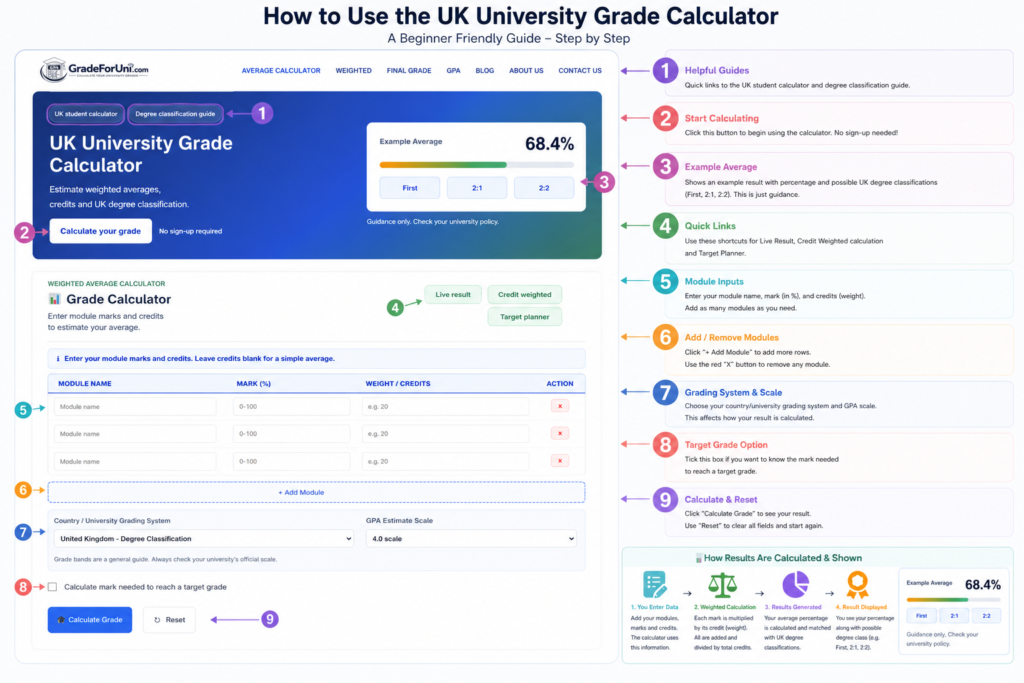
Click Here: UK University Grade Calculator
How to use UK University Grade Calculator
What Is a University Module?
A university module is a single unit of study that focuses on a specific subject within your degree programme. “Fail a University Module.” Think of a subject as one building block of your qualification. Fail a University Module. Every subject has its own learning outcomes, lectures, Tutorial sessions, coursework, exams, and credit value. Fail a University Module.
Instead of receiving one overall mark for a whole study year, your final results are made up of the marks you achieve in each subject. Fail a University Module. The credits you earn by passing these modules are added together until you have enough to complete your degree Fail a University Module.
Typical Credit Structure in the UK
Most UK undergraduate degrees require students to complete 360 credits over three years (or 480 credits for many four-year programmes with a placement or integrated master’s year). Fail a University module
Visit Now: Taxsal.comThis process continues on the credits
| Academic Year | Typical Credits Required |
| Year 1 | 120 Credits |
| Year 2 | 120 Credits |
| Year 3 | 120 Credits |
| Total Degree | 360 Credits |
To move from one year to the next, students usually need to pass enough modules to earn the required number of credits, although universities may allow some failed credits to be recovered through resits or compensation. Fail a University Module.
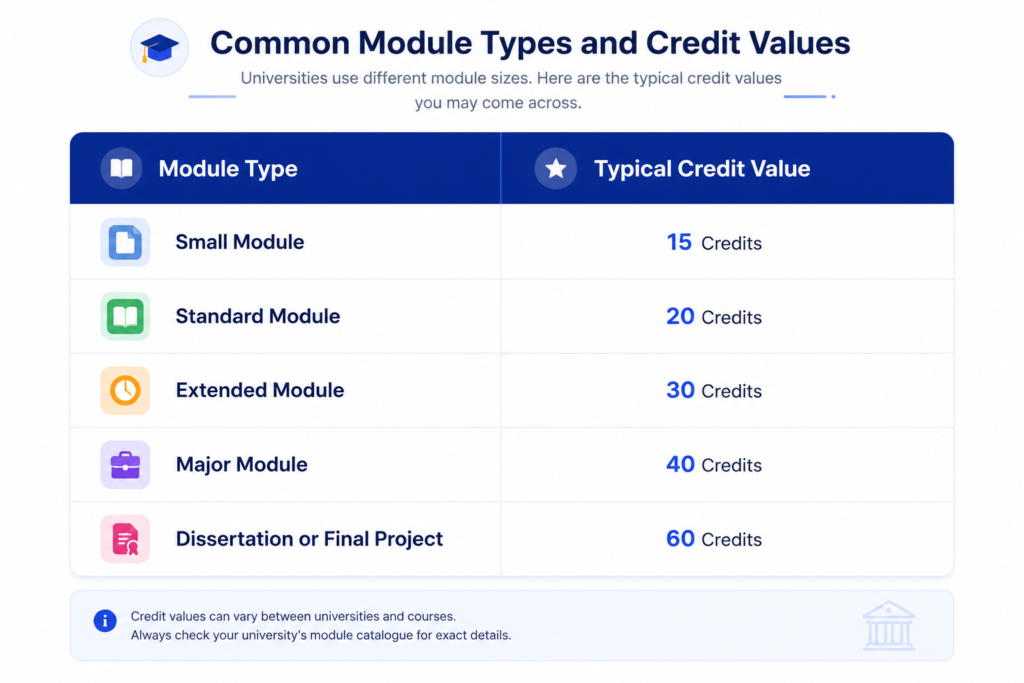
Common Module Credit Values
Not every module carries the same number of credits. Fail a University Module. The value usually reflects the amount of learning and assessment involved.
| Module Type | Typical Credit Value |
| Small Module | 15 Credits |
| Standard Module | 20 Credits |
| Extended Module | 30 Credits |
| Major Module | 40 Credits |
| Dissertation or Final Project | 60 Credits |
Generally, more credits mean a larger workload, with additional lectures, coursework, practical sessions, or examinations. Fail a University Module.
Read More:Weighted vs Unweighted Grades – What’s the Difference?
Example of a First-Year Student Failing a University Module )
Suppose a first-year Business Management student studies six modules.
| Module | Credits | Result |
| Business Management | 20 | Pass |
| Marketing Principles | 20 | Pass |
| Economics | 20 | Pass |
| Accounting | 20 | Pass |
| Business Law | 20 | Pass |
| Digital Skills | 20 | Pass |
Credit Calculation
| Module | Credits |
|---|---|
| Business Management | 20 |
| Marketing Principles | 20 |
| Economics | 20 |
| Accounting | 20 |
| Business Law | 20 |
| Digital Skills | 20 |
| Total Credits Earned | 120 |
Result: Since the student earned all 120 credits, they can normally progress to the second year. Fail a University Module.
Example: What Happens If You Fail One Module?
Now, imagine the same student fails the Accounting module Fail a University Module.
| Module | Credits | Result |
| Business Management | 20 | Pass |
| Marketing Principles | 20 | Pass |
| Economics | 20 | Pass |
| Accounting | 20 | Fail |
| Business Law | 20 | Pass |
| Digital Skills | 20 | Pass |
| Category | Details | Credits |
|---|---|---|
| Passed Modules | Business Management, Marketing Principles, Economics, Business Law, Digital Skills | 100 |
| Failed Module | Accounting | 20 |
| Total Credits Required | Full academic year | 120 |
| Total Credits Earned | Passed credits | 100 |
| Credits Remaining | Credits still needed | 20 |
Result: The student has earned 100 out of 120 credits, leaving them 20 credits short. Fail a University ModuleAt many UK universities, the student is typically offered a resit or reassessment for the failed 20-credit module instead of repeating the entire academic year Fail a University Module.
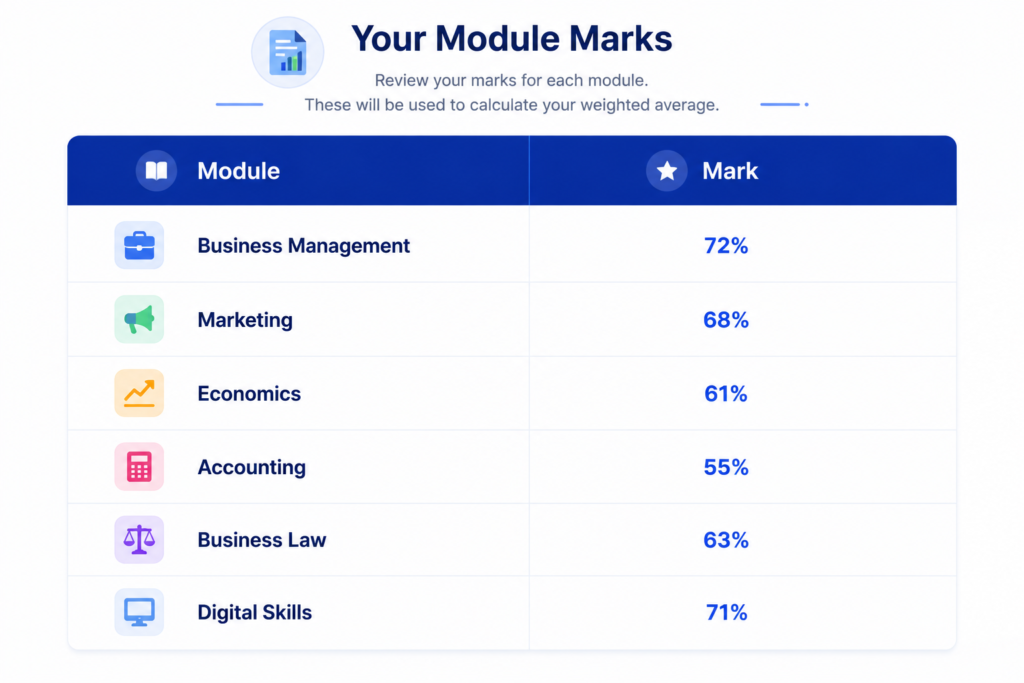
Example: Calculating Your Module Average
Universities often calculate the average mark for your modules Fail a University Module.
Suppose your marks are:
| Module | Mark |
| Business Management | 72% |
| Marketing | 68% |
| Economics | 61% |
| Accounting | 55% |
| Business Law | 63% |
| Digital Skills | 71% |
Calculation
(72 + 68 + 61 + 55 + 63 + 71) ÷ 6
= 390 ÷ 6
= 65% Average
A 65% average would usually place you within the Upper Second-Class Honours (2:1) range, although the exact calculation of your final degree depends on your university’s weighting rules. Fail a University Module.
Why Credits Matter
Credits are more than just numbers; they determine whether you can progress to the next year and ultimately graduate. Fail a University Module. Even if you get high marks in some subjects, failing to earn the required number of credits may mean you need to complete a retry, repeat a module, or, in some cases, repeat part of the academic year.”Fail a University Module.” Understanding how credits work can help you plan your studies more properly and avoid unexpected delays in completing your degree. If you’re wondering, “What Happens If You Fail a University Module?” understanding your university’s credit system is one of the most important things you can do
What Is the Pass Mark?
For most UK undergraduate courses:
- 40% = Pass
- Below 40% = Fail
For many postgraduate (Master’s) courses:
- 50% is the minimum pass mark.
Some professional degrees, such as Medicine, Nursing, Pharmacy, or Law, may have different requirements for failing a University Module.
Example of Passing and Failing
Imagine you complete four modules.
| Module | Mark |
| Business Strategy | 68% |
| Economics | 61% |
| Marketing | 55% |
| Finance | 34% |
Because Finance is below 40%, that module has failed.
You have passed 3 modules but failed 1.
Does Failing One Module Mean You Fail the Year?
| Possible Outcome | What It Means |
|---|---|
| Resit Assessment | Retake the failed exam or assessment to try to pass the module. |
| Resubmit Coursework | Improve and resubmit the failed assignment or coursework. |
| Repeat Module | Study and complete the failed module again in a future semester or academic year. |
| Compensated Pass | Pass the module despite a slightly lower mark if university rules allow compensation. |
| Carry Failed Credits | Progress to the next year while completing the failed credits later, if permitted. |
| Repeat the Year | Repeat the academic year if too many credits were failed or if university regulations require it. |
Summary: In most cases, students do not have to repeat the entire year after failing a single module. Universities usually offer one of the options above, depending on their academic policies. Fail a University Module
Exactly which option applies depends on university regulations.
Option 1: Resit the Assessment
| Item | Details |
|---|---|
| Option | Resit the Assessment |
| What It Means | Retake only the failed exam or assessment instead of repeating the entire academic year. |
| Original Exam Score | 32% |
| Required Pass Mark | 40% |
| Resit Period | Usually, during the summer resit period. |
| Resit Score | 58% |
| Final Outcome | The module is passed. |
| Important Note | At many universities, the recorded mark is capped at 40% for a passed resit, even if the actual resit score is higher. |
Example of a Capped Mark
| Result Stage | Score/Outcome |
|---|---|
| Original Result | 32% |
| Resit Score | 72% |
| Recorded Mark | 40% (Capped) |
Explanation: Although the student scored 72% in the resit, the official transcript may record 40% because the module was passed on a second attempt. However, some universities do not cap resit marks in certain situations, such as when a student has approved mitigating circumstances. Fail a University Module
Example of Resubmitting Coursework
| Stage | Details |
|---|---|
| Assessment Type | Coursework (Essay) |
| Original Essay Mark | 35% |
| Feedback Received | You receive feedback on areas that need improvement. |
| Resubmission | You revise and improve your assignment before resubmitting it. |
| Actual Resubmitted Mark | 67% |
| Recorded Mark | 40% (if the university applies a mark cap) |
Option 3: Repeat the Module
Sometimes, passing a retry test is not enough, and the university may require you to repeat the whole subject. Fail a University Module: This means enrolling in the module again during the next available teaching period, attending lectures, tutorials, or laboratory sessions, and completing all coursework and examinations from the beginning.
Repeating a module gives students another opportunity to understand the subject fully and demonstrate that they have met the required learning outcomes. Fail a University Module However, it can extend the time needed to complete your degree and, in some cases, may involve additional tuition fees or affect your student finance eligibility.
Universities typically require students to repeat a module when:
- Both the coursework and the final exam were failed.
- The overall module mark remains below the pass mark after a resit.
- Attendance or participation requirements were not met.
- Practical, laboratory, studio, or placement assessments must be completed again.
- The module is compulsory for professional accreditation and cannot be compensated for a Fail a University Module.
Example
Sarah is studying Engineering and takes a 20-credit Mechanics module.
- Coursework Mark: 30%
- Exam Mark: 28%
- Overall Module Mark: 29% (Fail)
She is offered a retry exam but scores 35%, which is still below the required 40% pass mark.
Because the module is compulsory and she has not met the learning outcomes, the university requires her to repeat the entire 20-credit module the following academic year. Fail a University Module. She must attend all classes again, complete new coursework, and sit a new final exam before those credits can count towards her degree.
Although repeating a module may feel like a setback, many students use the additional time to strengthen their understanding of the subject and go on to achieve much better results in their second attempt.
Read More: How Many Credits Count TowardOption 4: Compensation (Compensated Pass)
Many UK universities have compensation rules.
This means a failed module may still count as passed if:
- The mark is close to the pass mark.
- Your overall average is strong.
- You have enough credits elsewhere.
- The module is not essential for professional accreditation.
Example:
Module Mark = 38%
Overall Year Average = 64%
University compensation range = 35–39%
Result:
The module may be compensated and treated as passed.
Not every university offers compensation, so check your regulations.
Option 5: Repeat the Academic Year
Repeating the year is usually considered when:
- Too many credits have failed.
- Core modules have not been passed.
- Resits were unsuccessful.
- Professional requirements are not met.
Although repeating a year delays graduation, it allows students to rebuild their academic record.
How Many Credits Can You Fail?
Policies vary, but a common example is:
| Failed Credits | Typical Outcome |
| 15–20 Credits | Resit |
| 30–40 Credits | Multiple resits |
| 60 Credits | Repeat modules |
| More than 60 Credits | Repeat the year may be required |
Always check your university handbook, as credit limits vary. Fail a University Module.
Example Credit Calculation
Suppose your first year consists of:
| Module | Credits | Result |
| Module A | 20 | Pass |
| Module B | 20 | Pass |
| Module C | 20 | Pass |
| Module D | 20 | Fail |
| Module E | 20 | Pass |
| Module F | 20 | Pass |
| Category | Calculation | Result |
|---|---|---|
| Total Modules | 6 | 6 Modules |
| Credits per Module | 20 | 20 Credits |
| Total Credits | 20 + 20 + 20 + 20 + 20 + 20 | 120 Credits |
| Modules Passed | 5 | 5 Modules |
| Credits Passed | 20 × 5 | 100 Credits |
| Modules Failed | 1 | 1 Module |
| Credits Failed | 20 × 1 | 20 Credits |
Outcome: Since only one 20-credit module has been failed, many universities would normally offer a resit opportunity instead of requiring the student to repeat the entire academic year (subject to the university’s regulations).
Degree Classification Example Fail a University Module )
| Academic Year | Average Mark | Weight | Contribution to Final Degree |
|---|---|---|---|
| Year 2 | 62% | 30% | 18.6% |
| Year 3 | 71% | 70% | 49.7% |
| Final Degree Average | — | 100% | 68.3% |
Calculation Breakdown
| Step | Calculation | Result |
|---|---|---|
| Year 2 Contribution | 62 × 30% | 18.6 |
| Year 3 Contribution | 71 × 70% | 49.7 |
| Final Average | 18.6 + 49.7 | 68.3% |
Result
| Final Average | Likely Degree Classification |
|---|---|
| 68.3% | Upper Second-Class Honours (2:1) |
Note: If a failed module is later passed through a capped resit, the capped mark may reduce your overall degree average slightly, depending on your university’s assessment regulations.
Degree Classification Bands
| Final Average | Degree Classification |
| 70%+ | First Class |
| 60–69% | Upper Second (2:1) |
| 50–59% | Lower Second (2:2) |
| 40–49% | Third Class |
| Below 40% | Fail |
What If You Fail a Core Module?
Core (compulsory) modules are different from optional modules.
Failing a core module often means:
- Resit is mandatory.
- Compensation may not apply.
- You cannot progress until the module is passed.
Professional courses such as Nursing, Medicine, Teaching, and Engineering often have stricter rules.
What If You Fail an Optional Module?
| Option | What It Means | When It May Apply |
|---|---|---|
| Replace the Module | Choose a different optional module instead of repeating the failed one. | If your university allows optional module substitution. |
| Resit the Assessment | Retake the failed exam or resubmit coursework to achieve the required pass mark. | The most common option after failing an optional module. |
| Repeat the Module | Enroll in the same module again and complete all classes and assessments. | If a resit is unsuccessful or not available. |
| Compensated Pass | Receive a pass despite scoring slightly below the pass mark. | If your overall academic performance is strong and university regulations permit compensation. |
| Carry the Failed Credits | Progress to the next stage while completing the failed module later. | If you meet the university’s progression requirements. |
| Seek Academic Advice | Meet with your personal tutor or academic adviser to discuss your options. | Recommended in every situation after failing a module. |
Note: The options available after failing an optional module vary between universities. Always check your university’s academic regulations or speak with your academic adviser for guidance specific to your programme.
Because policies vary between universities, it’s always a good idea to check your student handbook or speak to your department as soon as your results are released.
Read More: What Is a Passing GradeWill Student Finance Still Pay?
Student Finance England, Wales, Scotland, and Northern Ireland can sometimes provide an additional year of funding if you repeat a year.
This is commonly referred to as a “gift year.”
However, eligibility depends on:
- Previous study
- Compelling personal reasons
- Funding history
- Course length
Always contact your student finance body before making decisions.
Does a Failed Module Stay on Your Transcript?
In most UK universities, yes, a failed module will usually appear on your academic transcript. The exact information shown depends on your university’s assessment regulations and transcript format.
Your transcript is an official record of your academic performance and may include details of both your original attempt and any reassessment. While universities have different policies, many transcripts contain the following information:
- Original mark: The score you achieved on your first attempt at the module.
- Resit mark: The mark obtained after completing a resit exam or resubmitting coursework, if applicable.
- Capped mark: If your university caps resit results, the transcript may show the capped mark (for example, 40% for undergraduate courses), even if you scored higher in the reassessment.
- Final status: Whether the module was ultimately Passed, Failed, Compensated, or Passed after Resit, depending on the university’s reporting system.
Example
| Module | First Attempt | Resit Score | Recorded Mark | Final Status |
| Economics | 35% | 62% | 40% | Passed (Resit) |
In this example, the student scored 35% on the first attempt and 62% in the resit. Because the university caps resit marks, the recorded mark on the transcript is 40%, and the module is shown as Passed after Resit.
Does It Matter to Employers?
Many employers only ask for your final degree classification (such as a First or 2:1) and do not request a full academic transcript. However, some graduate employers, professional bodies, and postgraduate universities may ask to see your transcript, particularly for competitive roles or further study.
A single failed module that was later passed is unlikely to have a significant impact on your career, especially if you complete your degree and perform well in your remaining modules.
Read More: University Resit Exams Explained Can You Appeal a Failed Module?
Yes, but appeals are usually based on process, not simply because you are unhappy with the mark.
Valid grounds may include:
- Administrative errors
- Mitigating circumstances (such as illness or bereavement)
- Procedural irregularities
You generally cannot appeal solely because you believe you deserved a higher mark.
What Should You Do After Failing?
Take a structured approach:
- Read your results carefully.
- Check your university regulations.
- Speak to your personal tutor.
- Contact your students’ union advice service.
- Understand your resit deadlines.
- Create a revision plan.
- Attend support workshops if available.
Many students recover successfully after one failed module.
Frequently Asked Questions (FAQs)
Is failing one university module a big deal?
Usually not. Most students are offered a resit or resubmission, especially if they have performed well in their other modules.
Can I still graduate if I fail one module?
Yes. If you pass the resit or meet your university’s compensation rules, you can usually continue towards graduation.
Do resit marks count?
Yes, but at many universities, the mark is capped at the minimum pass mark unless there are accepted mitigating circumstances.
Will employers know I failed a module?
Employers typically focus on your final degree classification. Some may request your academic transcript, which can show resits depending on your university’s reporting practices.
What happens if I fail a resit?
Often, yes. If only a single module has failed, repeating just that module is a common outcome.
Can failing one module stop me from getting a First?
It can affect your overall average, particularly if the resit mark is capped. However, whether it prevents you from achieving a First depends on your weighted average across the entire year
Conclusion
Failing a university module is disappointing, but it is rarely the end of your academic journey. UK universities recognise that students can face challenges and typically provide opportunities such as resits, coursework resubmissions, compensated passes, or module repeats.
The most important step is to understand your university’s specific regulations, seek advice early, and prepare thoroughly for any reassessments. Many graduates who achieve excellent degrees have experienced setbacks along the way. With the right support and a clear plan, a failed module can become a temporary obstacle rather than a permanent barrier to your success.