
How Are Maths Degrees Graded in the UK? Exams, Tripos Rules & Step Marks
Maths degrees are graded in the most exam-heavy way of any UK subject. While a history degree might split your marks between essays, coursework and a dissertation, a mathematics degree at most British universities still puts 80 to 100 percent of your module marks into a few hours of closed-book examination. At Queen’s University Belfast, the year-one assessment pattern for mathematics has been recorded at 90 percent closed-book exam and just 10 percent coursework. Maths degrees graded in this exam-heavy way concentrate your whole degree class into a handful of papers in May and June.
That exam-first culture produces some of the most distinctive grading machinery in UK higher education. Cambridge grades its mathematicians through the centuries-old Mathematical Tripos, with quality marks called alphas and betas. Oxford standardises every mark and applies a “strong paper rule” before it will award a class. Imperial openly scales its raw maths marks, warning that “due to the nature of Mathematics as an academic discipline it is often necessary for module marks to be scaled”. And almost everywhere, the marking rewards your method: correct intermediate steps earn credit even when the final answer is wrong.
This guide maps out how maths degrees are graded in the UK: the Tripos system versus the standard weighted-average system, real year weightings from Imperial, Reading, Warwick and Leicester, how step marks work, the borderline rules, the BSc-versus-MMath progression gates, and what IMA accreditation means for your career. Every figure comes from published university regulations.
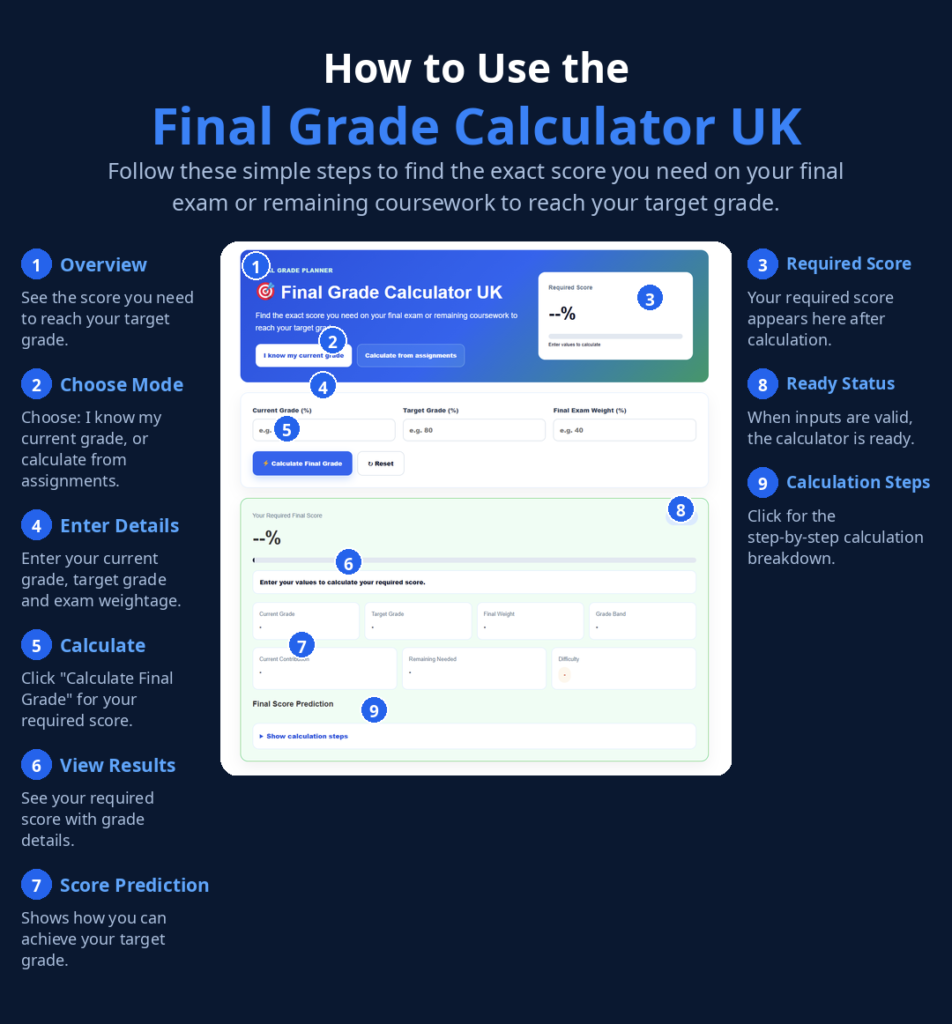
Click Here: Final Grade Calculator UK
How Maths Degrees Are Graded: Tripos vs Algorithms
Before anything else, understand that maths degrees graded in the UK fall into two genuinely different systems. At most universities, your marks flow through a degree algorithm: each module gets a percentage, each year gets a credit-weighted average, and the years are combined with published weightings into one final number that maps to a class. This is how the majority of maths degrees are graded.
At Oxford and Cambridge, the system is different. There, you are classed through a sequence of staged examinations with their own published conventions, standardised marks, and quality rules that can matter as much as your average. The overall logic is the same — turn exam performance into a degree class — but the machinery is bespoke, and it catches students out every year.
The table below gives the bird’s-eye view. The rest of this guide walks through both systems under which maths degrees are graded in the UK, one by one.
| Feature | Tripos/Parts system (Oxford, Cambridge) | Algorithm system (most other universities) |
|---|---|---|
| Classification mechanism | Classed examinations at each stage, with stage conventions | Credit-weighted yearly averages × published year weightings |
| Quality checks beyond the average | Yes: quality marks (Cambridge), strong paper rule (Oxford) | Rarely; the weighted mean normally decides |
| First year | Classed exam (Parts IA / Part A) that counts toward the final class | Usually 0–10% of the final classification |
| Borderline decisions | Board discretion informed by quality marks | Published numerical rules (e.g. within a set mark band) |
| Resits | Strictly limited; a failed stage usually means repeating the year | Standard capped resit rules apply |
Cambridge’s Mathematical Tripos: Alphas, Betas and the Part II Rule
The Mathematical Tripos is the oldest continuously running examination system in the English-speaking world, and maths degrees graded under it follow rules found nowhere else in the UK. You sit three classed examinations — Parts IA, IB and II — normally in three consecutive years. Each one awards you a class, and you must pass each part to progress to the next and to graduate.
The marking itself has a structure unique to the Tripos. Written papers have two sections. Section I questions are marked out of 10 and Section II questions out of 20. On top of the numerical mark, examiners award quality marks for completeness and quality: a beta for a Section I mark of 7 or more, a beta for a Section II mark between 10 and 14, and an alpha — the prized one — for a Section II mark of 15 or more. These quality marks feed directly into classification: examiners look at how many strong answers (alphas and betas) you produced, not just your total.
Another Tripos quirk: you cannot simply answer everything. Each paper restricts the number of questions for which credit can be obtained — a rubric on the paper tells you that you may obtain credit from attempts on at most N questions from a section. Question selection is part of the exam.
Then there is the rule that matters most. For students who started their course in 2020 or later, Cambridge awards an official overall class for the BA degree, and in the Mathematical Tripos that overall class is the class awarded in the Part II examination — the final-year papers. Your first- and second-year classes are real and must be passed, but they do not feed into a weighted average. Part II is where the degree class is won or lost. Historically, the very top first-class scorer in Part II was named the Senior Wrangler, a title with a lineage stretching back centuries; the formal rank-order publication of the class list ended in 1909, but the title survives as Cambridge folklore.
Oxford’s System: Standardised Marks and the Strong Paper Rule
Oxford’s Mathematics and Statistics course grades students through Parts A, B and C (Parts A and B for the BA, Part C for the MMath). The headline numbers from the university’s published examination conventions: Part A is weighted at 40 percent and Part B at 60 percent of the degree classification. Every unit mark is standardised before aggregation, producing an AvUSM — an average university standardised mark — which is then rounded symmetrically (62.49 rounds down, 62.50 rounds up).
The distinctive feature is the strong paper rule. To be awarded the nth class, a candidate needs at least 6 units (or the equivalent) at the nth-class standard or above. That means a very high average built on a handful of outstanding papers and a tail of weaker ones does not automatically buy the class — the examiners require breadth of strong performance. Conversely, a candidate whose average sits marginally below a boundary but who has six or more papers at the higher standard is in a far better position at the board meeting than the raw average alone would suggest.
Of all the rules under which maths degrees are graded in the UK, this is the single most misunderstood. Students fixate on the weighted average and miss that the strong paper rule operates as a quality gate: your marks must show consistent strength across papers, not just a flattering mean. Read the official examination conventions for your year, because the rule interacts with the examiners’ discretion at the boundary.
Maths Degrees Graded by Algorithm: Real UK Year Weightings
Outside Oxford and Cambridge, most maths degrees graded in the UK use a published algorithm: each module is marked out of 100, each year produces a credit-weighted average, and the yearly averages combine with fixed weightings. But the weightings vary far more than most students realise. First year is sometimes worth nothing and sometimes worth nearly a tenth of the degree. Here are verified schemes from published regulations.
| University / programme | Year 1 | Year 2 | Year 3 | Year 4 | Source |
|---|---|---|---|---|---|
| Imperial MSci Mathematics (G103) | 7.5% | 20% | 36.25% | 36.25% | Programme specification |
| Imperial MSci with Year Abroad (G104) | 7.5% | 25% | 25% | 42.5% | Programme specification |
| Reading MMath | — | 20% | 30% | 50% | Programme specification |
| Reading BSc Mathematics | — | 33.3% | 66.7% | — | Programme specification |
| Leicester BSc (3-year) | — | 40% | 60% | — | Student guide to assessment |
| Bath Econ & Maths (joint) | — | 32% | 68% | — | Course page |
Two patterns jump out. First, final year carries the heaviest weight almost everywhere — at Reading’s MMath it is half the degree, at Imperial’s G104 programme it is 42.5 percent. Second, year one is nearly irrelevant to the final class at the big London programmes (7.5 percent at Imperial, zero at Reading and Leicester). A common maths-student error is pouring revision hours into year-one papers that barely move the classification dial while under-investing in the final-year papers that decide it.
Warwick adds its own refinements to the algorithm model. Its published conventions calculate the mean to one decimal place, let students who take extra modules count the best subset that satisfies the course regulations (up to 150 CATS in a year against a normal 120), and carry forward the pass mark of 40 into the mean for any module passed on resit rather than the resit mark. Small rules, but they change who lands on which side of a boundary.
Exams vs Coursework: The 90% Rule
Maths degrees graded in the UK are among the most exam-heavy in the world. Bath’s published assessment breakdown puts its joint CS-and-maths programme at 60 to 80 percent examination, and the Queen’s University Belfast case study on assessment practice recorded year-one mathematics at 90 percent closed-book exam. Pure mathematics modules are frequently 100 percent exam; a few departments allow a small coursework component for things like computational projects or problem-sheet portfolios.
Coursework in maths does not look like coursework elsewhere. There are no 2,000-word essays. Instead, departments set weekly or fortnightly problem sheets — the real working material of a maths degree — and at some universities a fraction of the module mark comes from them. Computational modules may be assessed through a project, such as writing and testing code for a numerical method. But in most departments, problem sheets are formative: they do not count toward your mark directly, yet they are the only reliable route to performing under closed-book exam conditions. Students who treat unassessed problem sheets as optional are the ones who discover in June that exam technique is a skill, not a gift.
Step Marks: Why Your Method Earns Marks When the Answer Is Wrong
The single most reassuring fact for students of maths degrees graded in the UK is that markers reward the journey, not just the destination. Maths marking schemes break each question into credit-bearing steps: method marks for choosing and applying the correct technique, step marks for correct intermediate results, and answer marks for the correct final result. A sign error in the last line of a differential-equations question can still leave you with most of the question’s marks if the method and the intermediate steps were right.
This is why “show your working” is not a platitude in maths — it is the grading mechanism. An answer-only script gives the marker nothing to credit. A script that sets up the right method, executes most of the steps correctly, and slips on arithmetic gives the marker a ladder of credit points. Cambridge’s alpha and beta quality marks are the most formal expression of the same idea: they are awarded for completeness and quality of the answer, with alphas reserved for Section II answers scoring 15 or more out of 20.
Practically, this shapes exam strategy. A partial answer that demonstrates the right method is worth attempting on every question you touch, because the step marks add up across a paper. Conversely, spending fifteen minutes chasing the last two answer marks on a question you have already mostly solved is usually worse than banking the method marks on the next question. At Cambridge, remember the credit restriction: you only get credit for a limited number of questions per section, so the order in which you attempt them matters.
Worked Example 1: An Imperial-Style Weighted Classification
Take Daniel, an Imperial-style MSci student with yearly averages of 58, 64, 67 and 72 across years one to four, on the G103 weighting of 7.5 / 20 / 36.25 / 36.25. His final aggregate is:
- Year 1: 58 × 0.075 = 4.35
- Year 2: 64 × 0.20 = 12.80
- Year 3: 67 × 0.3625 = 24.2875
- Year 4: 72 × 0.3625 = 26.10
- Total = 4.35 + 12.80 + 24.2875 + 26.10 = 67.54 → 67.5%
Daniel finishes on 67.5 percent — a comfortable upper second, 2.5 percentage points below the First boundary. Now look at where those marks came from. His weak first year (58) cost him barely anything: each 10 percentage points of year-one average moves the total by only 0.75 points. His strong final year (72) contributed 26.10 points — over a third of the degree. This is the arithmetic reality for maths degrees graded at final-year-heavy universities: late excellence is rewarded and early wobbles are nearly forgiven. The mirror image is that a student who coasts to a 72 in year one and slides to a 58 in year four pays for it at full weight.
Worked Example 2: Why the Average Alone Doesn’t Decide at Oxford
Now consider two fictional Oxford candidates chasing a First. Amara finishes with an AvUSM of 70.4 — above the 70 boundary — but only 5 of her units sit at the first-class standard; the rest are strong 2:1s. Tom finishes with an AvUSM of 69.2 — below the boundary — but 7 of his units are at the first-class standard, with two weaker papers dragging his average down.
On the average alone, Amara is the First and Tom is the 2:1. The strong paper rule tells a different story. Amara, with only 5 units at first-class standard, does not satisfy the ≥6-unit requirement for the First — she is the weaker candidate for the higher class despite the higher average. Tom meets the rule and is the candidate the examiners’ discretion is designed to help. This is not an invitation to game the system: the examiners see both numbers. But few examples show better why maths degrees graded at Oxford demand the conventions read in full, not just a target average chased.
Worked Example 3: Reading-Style BSc with One-Third / Two-Thirds
Priya studies BSc Mathematics at a Reading-style university: Part 2 (second year) averages 58, Part 3 (final year) averages 71, weighted one-third to two-thirds. Her classification mark is:
- Part 2: 58 ÷ 3 = 19.33
- Part 3: (2 × 71) ÷ 3 = 47.33
- Total = 19.33 + 47.33 = 66.67 → 66.7%
A 66.7 percent final mark is a solid 2:1. Note the leverage: every extra mark Priya earned in Part 3 was worth twice as much as the same mark in Part 2. If she had reversed the two years — 71 then 58 — she would have finished on 62.3 percent, a weaker 2:1 despite the identical pair of yearly averages. Order matters in maths degrees graded almost everywhere.
Scaling and Standardisation: Why Raw Maths Marks Get Adjusted
One of the stranger features of maths degrees graded in the UK is that the mark you think you got is not always the mark that counts. Imperial’s published programme specification is unusually candid: it states that, due to the nature of mathematics as a discipline, it is often necessary for module marks to be scaled so they are comparable across modules and map appropriately onto the degree classification system. The scaling is applied consistently to the whole cohort and reported to the external examiners and the board.
Why does maths need this? Because maths exams are hard to calibrate. A paper with several fiendish questions can produce a cohort average in the 40s without the teaching having failed; a straightforward paper can produce 70s. Oxford’s answer is the standardised-mark system (AvUSM): marks are converted to a common scale before they are combined, so a brutal analysis paper and a gentler statistics paper contribute fairly. Other departments rescale raw totals so that the class profile matches what the examiners consider the right standard for that module.
For students, the takeaway is to stop converting raw paper scores into degree classes in your head during the exam. A 55 on a paper that the whole cohort found brutal may standardise to something far healthier; a 68 on a paper everyone aced may standardise downward. Only the board’s agreed marks are real.
Borderline Rules: The Maths-Specific Numbers
When your weighted mark lands near a boundary, published borderline rules decide whether you move up. Departments that grade maths degrees tend to publish unusually explicit borderline rules. Imperial’s honours scheme states that only candidates within 2.5 marks of the final boundaries may normally be considered for raising, widening to a 5-mark band where there are special circumstances — and it adds that a very good final year may qualify a student for being raised a class at the examiners’ discretion. Warwick calculates the mean to one decimal place, so a 69.95 rounds to 70.0 and the boundary question answers itself.
Notice how narrow these bands are compared with some other subjects. Maths examiners can point to an exact numerical gap and to paper-level quality evidence (alphas, strong units, step-mark patterns), so borderline decisions are more data-driven than in essay subjects. If you are sitting on a boundary, the evidence that helps most is strong performance in your final-year papers — exactly what Imperial’s scheme rewards.
MMath vs BSc: The Progression Gates Most Students Miss
Mathematics is one of the few subjects where the four-year integrated master’s (MMath/MSci) is the standard route for the strongest students — and getting onto and staying on it is itself a grading event. Imperial’s G104 year-abroad programme requires students to have normally achieved a 60 percent aggregate in Year 2 to remain on the route; students who fall short are transferred to the BSc or standard MSci. Reading’s regulations spell out the reverse move: students who do not meet the progression requirements for the MMath are eligible for the award of BSc Mathematics provided they satisfy the bachelor’s criteria. These progression gates are the easiest part of maths degrees graded in the UK to overlook — until they re-route you.
The MMath final year is graded differently from the years before it. You take advanced modules at master’s level, and the final year carries the largest single weight in the classification (50 percent at Reading, 36.25–42.5 percent at Imperial). Master’s-level modules are marked on the same 0–100 scale but the cohort is smaller and the standard higher. Dropping from the MMath to the BSc is not a failure — the BSc is a complete, classified honours degree — but it changes which years count and how much the final year is worth, so check the weighting table for the route you are actually on.
IMA Accreditation and Chartered Mathematician Status
Unlike medicine or engineering, mathematics has no statutory regulator — but it does have the Institute of Mathematics and its Applications (IMA), which runs a Course Accreditation and Recognition scheme. Accreditation matters for one specific reason: the path to Chartered Mathematician (CMath), the profession’s chartered designation, awarded by the IMA to practising mathematicians who demonstrate professional standing and keep up continuing professional development.
The IMA accredits courses at three levels. Recognition means the course meets the educational requirements for IMA membership — typically joint-honours degrees. Accredited (bachelor’s level) means a BSc meets the CMath educational requirements provided the graduate later gains the equivalent of master’s-level training through employment. Accredited (master’s level) means an integrated MMath meets the requirements outright — Northumbria University, for example, notes that its MMath graduates can apply for CMath status immediately on completion, while its BSc graduates need further training and experience first. Accreditation is granted for up to six years with regular review.
Does accreditation change your grades? No — it does not touch marking. But it signals to employers that your course meets a national professional standard, and it gives you the smoothest route to chartered status if you work as a mathematician. If two otherwise equal courses are on your shortlist, the accredited one is the safer pick for a maths career.

7 Mistakes That Cost Maths Students Marks
- Answer-only working. The marker cannot award step marks for working that is not there. A page of clean reasoning with a wrong final answer routinely outscores a bare correct answer.
- Over-investing in year one. At Imperial, year one is worth 7.5 percent of the degree; at Reading and Leicester it is worth nothing. It must be passed — but it is not where classes are won.
- Ignoring the examination conventions. The Oxford strong paper rule and Cambridge’s credit restrictions change optimal exam behaviour. Read your department’s conventions document; it is usually under 20 pages.
- Skipping unassessed problem sheets. They are the training ground for closed-book exams. The coursework may be worth little or nothing, but the practice is worth everything.
- Mental raw-to-class conversion. Scaled and standardised marks are what count. A raw 55 on a brutal paper can be a fine mark; a raw 70 on an easy one can be mediocre.
- Assuming resits are free. Warwick carries the 40 pass mark into the mean for resat modules; failed stages at Oxford or Cambridge usually mean repeating the year, not a quick resit.
- Missing the MMath gate. Routes with progression thresholds (60 percent at Imperial’s G104, for example) quietly re-route students who drift. Know your gate number.
Frequently Asked Questions
What is a good mark on a maths degree exam?
Maths degrees graded in the UK use the standard 0–100 scale: 70 and above is a First, 60–69 an upper second (2:1), 50–59 a lower second (2:2) and 40–49 a third. But raw maths paper marks are often scaled or standardised before they count, so a raw 60 on a very hard paper can map to a stronger agreed mark than the same number on an easy one. Judge yourself against your cohort’s distribution and your department’s published conventions, not the raw number alone.
Do first-year maths marks count toward the degree?
Usually very little or not at all. First year is worth 7.5% of the classification on Imperial’s MSci programmes and 0% at Reading and Leicester, where only years two and three (or two to four for integrated masters) feed the algorithm. You must still pass the year to progress, but year one is where you build foundations, not where your class is decided. Oxford and Cambridge are the exception: their first-year classed exams count as part of the staged system.
What are alpha and beta quality marks at Cambridge?
They are quality marks awarded on Mathematical Tripos papers on top of the numerical score. A beta is awarded for a Section I answer scoring 7 or more out of 10, or a Section II answer scoring 10–14 out of 20. An alpha — the highest quality mark — is awarded for a Section II answer scoring 15 or more out of 20. Examiners use the pattern of alphas and betas across your papers as evidence of the quality of your work when awarding your class.
Is a maths degree mostly exams?
Yes — maths degrees graded in the UK are among the most exam-heavy anywhere. Published assessment breakdowns put joint maths programmes at 60–80% examination, and some year-one mathematics modules are assessed as 90% closed-book exam with only 10% coursework. Pure mathematics modules are often 100% exam. Coursework, where it exists, usually takes the form of problem-sheet portfolios or computational projects rather than essays.
What is the strong paper rule at Oxford?
Oxford’s Mathematics and Statistics examination conventions state that to be awarded the nth class, a candidate needs at least 6 units (or the equivalent) at the nth-class standard or above. Your AvUSM — the standardised weighted average of your units, with Part A at 40% and Part B at 60% — is not the whole story: the examiners also require breadth of strong performance across papers before awarding a class.
Can you resit a failed maths module?
At most universities, yes, under standard capped-resit rules — typically the resit mark is capped at the pass mark of 40, and Warwick carries that 40 into the classification mean. At Oxford and Cambridge, failed stages are handled much more strictly: you generally cannot simply resit a Tripos part or Oxford paper, and failing a stage usually means repeating the year. Always check your department’s regulations, because maths is stricter than many subjects here.
What is the difference between BSc and MMath grading?
On maths degrees graded under the standard algorithm, a BSc is classified on years two and three (commonly 40:60 or one-third to two-thirds). An integrated MMath or MSci adds a fourth, master’s-level year that carries the largest single weight — 50% at Reading, 36.25–42.5% at Imperial. Staying on the MMath route itself has grading gates: for example, Imperial’s year-abroad programme normally requires a 60% year-two aggregate. Students who miss the gate transfer to the BSc, which is a full classified honours degree.
Does it matter if my maths degree is IMA accredited?
Accreditation by the Institute of Mathematics and its Applications does not change the way maths degrees are graded, but it smooths the path to Chartered Mathematician (CMath) status: an accredited integrated master’s meets the educational requirements outright, while an accredited BSc does so once you add equivalent master’s-level training through work. It also signals to employers that your course meets a national professional standard. If two courses are otherwise equal, pick the accredited one.
Conclusion
Maths degrees graded in the UK use some of the most carefully engineered assessment machinery in higher education — and almost all of it is published. The examination conventions, programme specifications and honours schemes quoted in this guide are public documents, and they contain everything that decides your class: the year weightings, the standardisation rules, the quality gates, and the borderline bands. The students who do best are not always the ones with the most raw talent; they are the ones who read the rules and allocate their effort where the marks actually live.
That means three concrete habits. First, show every step of your working in every exam, because step marks are real marks and they compound across a paper. Second, weight your revision by the classification table, not by sentiment: final-year papers at 36 to 50 percent of the degree deserve far more of your May than first-year papers at 0 to 7.5 percent. Third, if you are anywhere near a boundary, the evidence that moves boards is strong final-year performance — the one thing every system in this guide rewards. Work out exactly what your remaining papers need to deliver with the Final Grade Calculator, and chase the numbers that count.