
Fake Grade Emails & Result Scams: The Student Scams Targeting Your University Marks [2026]
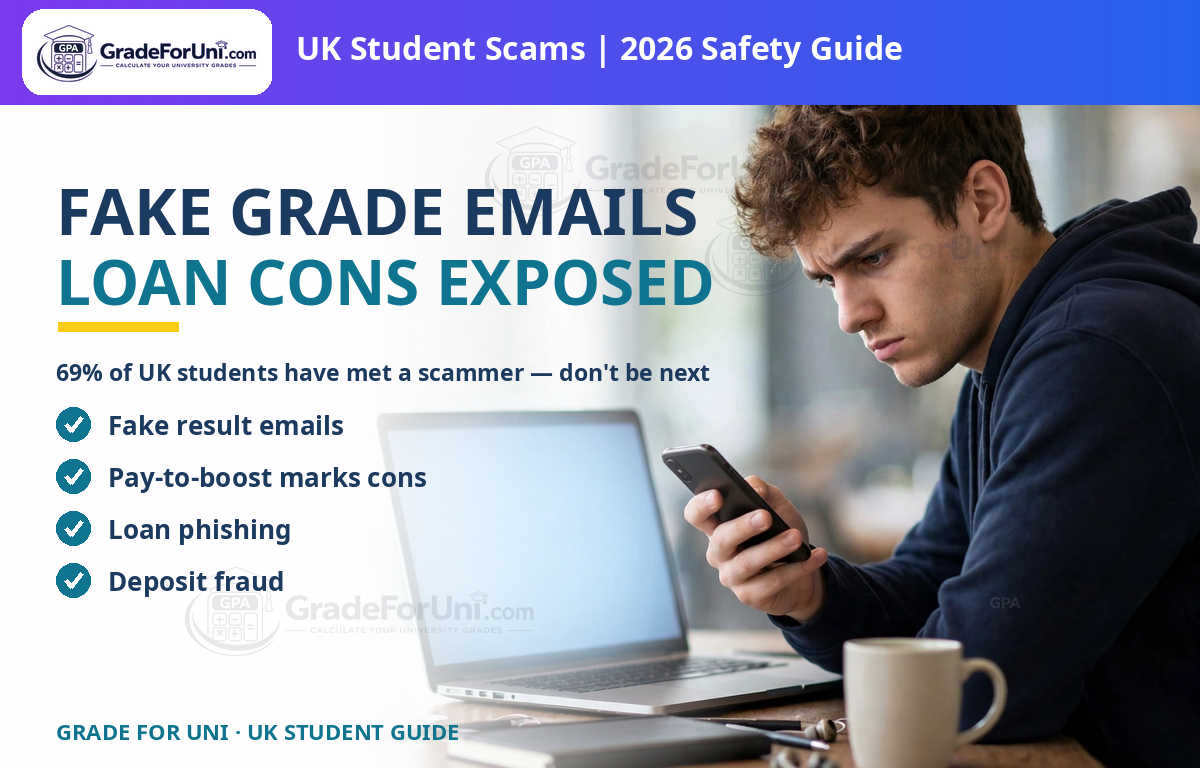
Your exam results are the most valuable thing a scammer can fake. Around results time, students get emails claiming their marks are ready, offers to ‘boost’ a module mark for a fee, and bogus scholarship awards — all designed to steal money, passwords, or personal details.
In October 2026, NatWest Group, Mastercard and the Home Office launched a nationwide fraud-awareness push aimed at students, estimating UK students could lose £20 million to fraud this academic year. This guide focuses on the scams that target your academic record first — because no legitimate marker ever takes payment to change a mark — and then covers the wider cons hitting students this term.
And scammers are no longer sticking to generic cons. Alongside the familiar fake jobs and bogus flat listings, fraudsters are now impersonating universities themselves — fake exam-result emails, lookalike grade portals, and “pay to boost your module mark” messages that prey on results anxiety. This guide breaks down the five scams actually hitting students this term, the grade-specific cons to watch for, and the concrete checks that keep your money and your marks safe.
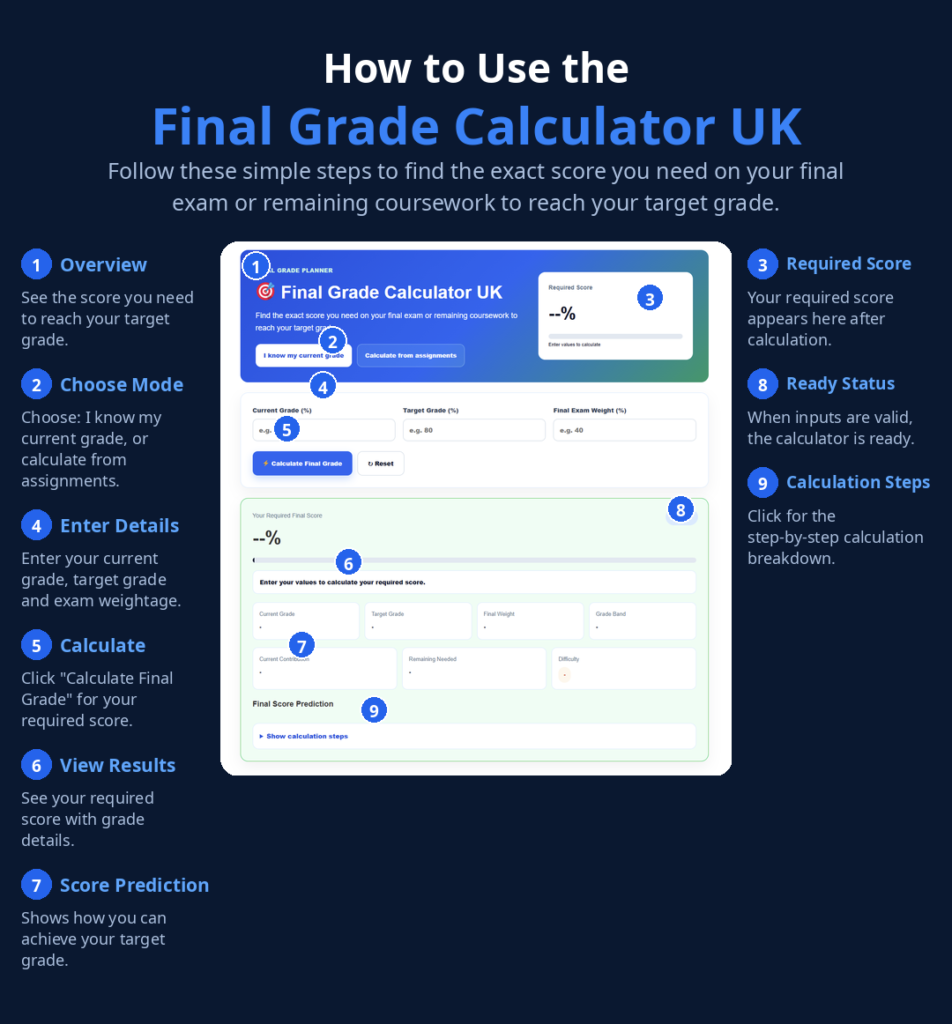
Click Here: Final Grade Calculator UK
The Scale of the Problem: What the October 2026 Figures Say
The NatWest–Mastercard–Home Office research, published via a NatWest Group press release on 14 October 2026, is the most current picture we have of student fraud in the UK. The numbers matter because they explain why students are targeted — new arrivals, busy inboxes, financial inexperience, and time pressure are exactly the conditions fraud thrives in.
| Figure | What it means |
|---|---|
| 69% of students have encountered a scam (vs 36% of the general population) | Students are almost twice as likely to be targeted — the opening line of the NatWest research |
| 78% of those encounters happened within three months of arriving on campus | The first term is the danger window, not the third year |
| £20 million estimated losses this academic year | NatWest’s analysis of scam reports from 16–25 year olds, July 2025 – June 2026 |
| ~500,000 freshers managing money independently for the first time | The cohort with the least practice at spotting cons |
| 27% feel very confident spotting a financial scam | From NatWest’s Student Handover Report — 5,000+ UK undergraduates |
| 29% lost money to a scam last academic year (vs 12% of wider population) | The Times survey of 1,000+ students and 1,000 members of the public, October 2026 |
Fraud Minister Lord Hanson put it bluntly in the campaign launch: “Fraudsters continue to prey on freshers, using bogus job adverts, fake flats and scam investments to steal their money.” The campaign’s advice for students is built around the threats currently doing the rounds — and the campaign posters, designed by up-and-coming UK artists, were released specifically to reach students where they are.
The Grade-Specific Cons: Fake Result Emails and “Pay to Boost Your Marks”
Here is where the fraud story meets gradeforuni.com/’s territory — and the most important sentence in this entire guide:
No legitimate marker, lecturer or exam office ever takes payment to change a mark. Anyone offering to “boost” your module result for a fee is a scammer by definition, and anyone selling “guaranteed grade changes” is selling nothing.
UK universities publish marks through their own student portals, on published release dates, and there is no lawful back door to the exam board. Knowing that single fact immunises you against the whole category.
Fake result emails around results release
The most common grade-flavoured scam follows a simple playbook: an email that looks like it came from your exam office arrives a day or two before or after results release, with a subject like “Your module results have been released” and a link to view them. The link leads to a lookalike login page that harvests your university credentials — which double as the keys to your email, your records, and sometimes your finance account.
The check is always the same: never log in through a link in an email. Open your browser, go to your university’s portal yourself (the URL you have always used), and look at your marks there. If the email’s marks were real, they will be waiting for you on the official page. Real universities also announce results release dates in advance on their published academic calendar — an “early results” email arriving off-cycle, urgently asking you to click, is exactly how phishing works.
The Five Scams Hitting Students This Term
Not every con is equally common. The Times’ October 2026 survey broke down what students were actually tricked by: purchase scams accounted for 28% of the frauds students fell for, and job scams promising work in return for investment accounted for 26%. NatWest and Mastercard flagged the same three headline threats — fake job ads, purchase fraud, and crypto or investment scams — while The Times found students were also being targeted by impersonation scammers posing as student finance officers or university staff, and frauds involving fake accommodation. Here is how each one works against students.
“Pay to boost your module mark” cons
The second grade scam is cruder but preys on desperation: a message offering to change your marks on the university system in exchange for payment — sometimes pitched as an “inside contact” in the exam office, sometimes as a “grade hacking service.” It is a pure advance-fee fraud. There is no insider, no access, and no mechanism: UK exam boards sign off marks collectively, and no single person can rewrite them for cash. Students who pay simply lose the money and hand their details to criminals. If a mark is wrong, the real routes are the ones your university publishes — a remark request or a formal grade appeal, never a payment to a stranger.
Fake scholarship and bursary emails
Grade-adjacent and common: the email saying you have “been selected” for a scholarship or bursary and must pay an “admin fee” or “release payment” to claim it. This is textbook advance-fee fraud — the prize does not exist, and the fee is the entire point. Real scholarships never require you to pay to receive money; it is their money they are giving to you. Check any offer against your university’s published scholarships page (find it yourself, not through the email’s link), and remember that The Times found impersonation scams specifically posing as student finance officers — the same pattern with a loan-shaped twist.
1. Purchase scams — the most common way students lose money
Purchase scams are straightforward: you pay for goods or services that never arrive. For students this usually means a marketplace listing — a laptop for the course, textbooks, a bike — at a price that undercuts every legitimate retailer. The Times found this was the single biggest category, responsible for 28% of student fraud losses. The defence is almost boring: never buy from an unverified seller outside a platform with buyer protection, and treat any “pay by bank transfer to get a better price” request as a scam, because bank transfers cannot be reversed.
2. Fake job ads and “jobs in return for investment”
Twenty-six percent of the students The Times surveyed had fallen for scams that promised jobs in return for investment — the classic “pay an admin fee to unlock your shifts” or “buy the starter kit, earn £1,000 a week.” Lord Hanson’s launch statement specifically named bogus job adverts. A genuine employer in the UK never asks you to pay for the privilege of working for them; training costs, uniform costs and admin fees that flow from your pocket to the employer’s before you start are not normal, and no legitimate campus job arrives via a WhatsApp message from an unknown number.
3. Impersonation: “student finance officers” and university staff
The Times found students were being targeted by impersonation scammers posing as student finance officers or university staff. This matters for grades too (more below), but the immediate version is the call or email that “needs to verify your account” to release your maintenance loan, or warns of a “problem with your enrolment” that requires an urgent payment. Your university and Student Finance England do not conduct account security over cold calls, and they do not threaten enrolment cancellation over the phone to extract card details.
4. Fake accommodation and deposit fraud
The Home Office campaign launch specifically named “fake flats,” and The Times’ survey found nearly half of targeted students were hit in their first month at university, with 17% targeted in their first week — exactly when most people are hunting for housing. The scam is a listing for a room or flat that doesn’t exist (or isn’t the scammer’s to let), with pressure to pay a deposit and first month’s rent quickly by bank transfer. Genuine landlords in England and Wales must protect your deposit in a government-backed scheme within 30 days — a “landlord” who can only take cash or a transfer and has no agency paperwork is a red flag.
5. Crypto and investment cons
NatWest and Mastercard named crypto and investment scams among the top threats students will encounter. The student-specific flavour often comes through social networks — a course mate mentions a platform “offering money in exchange” for small daily actions, which is how pyramid-style schemes recruit: the earliest people get paid, their referrals trust them, and the money disappears. The golden rule applies double for students with a maintenance loan to live on: if returns look effortless, they are. No investment guarantees 30% a month.
What It Actually Costs: Two Worked Examples
Scams feel abstract until you run the numbers. Here are two worked examples built from the scam patterns the October 2026 research describes, showing exactly what “it’s probably fine” costs when it isn’t.
Example 1: The fake-shifts “job”
Priya, a first-year, gets a WhatsApp message offering flexible evening shifts paying £180 a week. Before she can start, she is asked for a £45 “training and background-check fee,” then a £150 “refundable deposit” for the uniform and ID badge. She pays both, then never hears from the employer again.
| Item | Amount |
|---|---|
| “Training and background-check fee” | −£45 |
| “Refundable deposit” for uniform and ID badge | −£150 |
| Total paid | −£195 |
| Wages received | £0 |
| Net outcome | −£195, plus a week of wasted time |
The maths is the whole defence: £195 for a job that was never going to pay is a 100% loss, and no genuine UK employer charges new starters to begin work. Note the pattern the NatWest research flagged — these offers land in the first weeks of term, when budgets are tight and the pressure to find work is highest.
Example 2: The fake flat
Tom finds a room near campus at £150 below the local average. The “landlord” says three other students are viewing today and asks for the deposit plus first month’s rent by bank transfer to secure it. Tom pays £850 deposit + £950 first month = £1,800. The flat does not exist; the landlord’s number is dead by evening.
| Item | Amount |
|---|---|
| Deposit paid to “landlord” | −£850 |
| First month’s rent paid | −£950 |
| Total lost | −£1,800 |
| Emergency accommodation while re-hunting (typical 2 weeks) | −£300 to −£500 more |
| True cost | ≈£2,100–£2,300 |
The legitimate comparison: a real deposit in England and Wales must be protected in a government-backed tenancy deposit scheme within 30 days, and the landlord must give you the prescribed information about which scheme. A ten-minute check — view the property in person, confirm the agent on the letting agent’s website, and never pay before a signed tenancy agreement — costs nothing and prevents a £2,000 loss.
The Verified-Marks Checklist: How to Know Your Results Are Real
Grade cons rely on one thing: you acting before you verify. Pin this checklist next to your desk for results season.
| Check | What to do |
|---|---|
| Marks only appear in the official portal | Type the portal address yourself — never click through an email or text to “view results” |
| Results land on published dates | Check your university’s published academic calendar; off-cycle “early results” emails are phishing |
| The email address is the real one | Exam-office emails come from the university domain; a lookalike domain with one letter changed is a fake |
| No payment is ever involved | Viewing your marks, requesting a remark and lodging an appeal are processes — none of them runs on payments to individuals |
| A wrong mark has a real process | Use the official remark request or the formal grade appeal route, not a message from a “service” |
| Still unsure? | Phone or visit your department’s registry office using the number on the university website — not the number in the suspicious message |
If you believe a mark really is wrong, the legitimate paths are the ones your university publishes in its academic regulations. Our guides to the remark process and to how to appeal a university grade in the UK walk through both — and if the problem is circumstances that hit your performance rather than an error in the marking, the extenuating circumstances route is the honest channel universities designed for exactly that situation. Paying a stranger is never on the list.
If You Already Clicked, Paid or Shared Details: The Next 24 Hours
First, the framing the campaign gets right: this can happen to anyone — 69% of students have been targeted, and the cons are designed by professionals. Falling for one is not a character flaw, and hiding it only helps the scammer. Do these in order:
- Contact your bank’s fraud team immediately — most banks have a 24-hour fraud line and can sometimes reverse recent transfers. The sooner, the better.
- Change your passwords — start with your university login and your email (the email is usually the master key for password resets), then any account that shared the password.
- Report it to Action Fraud — the UK’s national reporting centre for fraud and cyber crime. Your report builds the pattern that gets repeat offenders caught.
- Tell your university — IT services can block phishing domains, and student wellbeing services can support you; most universities also have hardship funds if you are suddenly short on rent.
- Watch your accounts for a month — some scams harvest details to use weeks later, so keep an eye out for unfamiliar logins or small test transactions.
You can check what your real marks should look like independently of any suspicious email: our degree classification calculator recomputes your average from your module marks and weightings, so you can verify for yourself what your grades genuinely are.
The 60-Second Red-Flag Test
Before you click, pay or share anything in a message you weren’t expecting, run this test. One “yes” is a warning; two is a stop sign.
| Question | What a “yes” tells you |
|---|---|
| Is it asking you to act urgently? | Pressure is a tool — real universities and banks give you deadlines, not countdowns |
| Did it arrive as a link or a phone call you didn’t expect? | Legitimate institutions don’t send login links; navigate there yourself |
| Does it involve paying someone to get money, grades or a job? | Payments flow to you in all three cases — the reverse is fraud |
| Is the offer dramatically better than normal? | £150-below-market rent, £1,000-a-week from a phone app, guaranteed marks — none of these exist |
| Can you verify it on an official site you find yourself? | If you can’t, treat it as unproven — the 30 seconds of checking is the whole defence |
Frequently Asked Questions

Can scammers really change my module marks if I pay them?
No. No legitimate marker, lecturer or exam office takes payment to change a mark, and UK exam boards sign off marks collectively — no single person can rewrite them for cash. Anyone offering “grade boosting” for a fee is running an advance-fee fraud: you lose the money and hand your details to criminals. If a mark is wrong, use your university’s official remark request or grade appeal route.
I got an email saying my exam results are ready. Is it real?
Don’t click the link. Go to your university’s student portal yourself by typing its address, and check your marks there — if the email is genuine, the results will be waiting for you. Real universities announce results release dates in advance on their published academic calendar, so an off-cycle “early results” email urging you to click urgently is a classic phishing pattern.
How do I check my marks are genuine?
Log in to the official student portal (not through an email link) and compare the marks against your own records — module credits, weightings and any resit caps. You can recompute your weighted average independently with a grade calculator to see what your grades genuinely are. If a mark genuinely looks wrong, contact your department’s registry directly using the number on the university website.
Is it safe to click links in Student Finance emails?
The Times found students were being targeted by impersonation scammers posing as student finance officers. Student Finance England never asks you to confirm personal details by clicking a link in an email, and will not threaten your payments over a cold call. If a message claims there’s a problem with your loan, log in to your student finance account independently and check there.
How do I check a flat listing is legitimate before paying a deposit?
View the property in person, confirm the agent or landlord on an official website (not just the number in the ad), and never pay before you have a signed tenancy agreement. In England and Wales your deposit must be protected in a government-backed scheme within 30 days, with written confirmation of which one. Urgent “pay now by bank transfer or lose it” pressure is the number-one red flag.
What should I do if I already paid a scammer?
Act in this order: contact your bank’s 24-hour fraud team immediately (recent transfers can sometimes be reversed), change your university and email passwords, report the crime to Action Fraud, and tell your university — IT services can block the phishing source and wellbeing services can help if you’re suddenly short on money. Do this today; delay only helps the scammer.
Where do I report student scams in the UK?
Report financial fraud to Action Fraud, the UK’s national reporting centre for fraud and cyber crime. You should also report phishing emails to your university’s IT services (so they can warn other students and block the domain) and, if money is involved, to your bank. Reporting matters even if you didn’t lose money — it builds the pattern that catches repeat offenders.
Will falling for a scam affect my university record or grades?
No. Being targeted or even defrauded has no effect on your academic record — you haven’t done anything academically wrong. But act quickly: if scammers got your university login, change it immediately so they can’t lock you out or misuse your accounts. And never attempt to use a scam “service” to change marks yourself — that’s the point where an innocent victim becomes someone committing academic misconduct.
Conclusion
The October 2026 figures should settle any lingering idea that student scams are a minor nuisance: 69% of students have encountered one, nearly half of the targeted students were hit in their first month at university, and NatWest estimates £20 million is at stake this academic year. The NatWest–Mastercard–Home Office “Stop! Think Fraud” push exists because fraudsters have industrialised the first term — fake job ads, purchase cons, impersonation calls posing as student finance officers or university staff, fake flats, and now phishing emails that impersonate your own exam office around results release.
The habits that defeat all of them are the same few, and they cost nothing: never log in or pay through a link you didn’t request, verify every unexpected message on an official site you find yourself, and remember that no marker takes payment, no landlord needs cash before a contract, and no employer charges you to start work. Marks live in your portal on published dates; loans live in your student finance account; deposits live in a protected scheme. Anything arriving through another channel, asking you to hurry, is asking you to be a victim.
And if it already happened, do not sit on it in embarrassment — the bank’s fraud line, Action Fraud, and your university’s wellbeing and IT teams all exist precisely for this, and every report makes the next student harder to fool. Freshers’ Week should be remembered for the people you meet, not the money you lost. Keep this guide bookmarked, send it to your flatmates, and make the thirty-second check a reflex.