
How Are Physics Degrees Graded in the UK? Exams, Labs & Accreditation Rules [2026]
A physics degree is really two degrees wearing one gown. On paper you are solving Schrödinger equations and Maxwell’s equations under timed-exam conditions; in the lab you are aligning lasers, calibrating oscilloscopes, and defending a 5% error bar against a demonstrator who has seen every excuse. Both skill sets count toward your final classification — and, unusually among science subjects, the lab side is not optional decoration. The Institute of Physics, which accredits most UK physics degrees, sets national rules that say experimental competence must be demonstrated and, in key cases, simply cannot be compensated away.
That makes physics grading a three-pillar system: theory exams (typically the largest share of each year), laboratory and practical work (credit-bearing, often with must-pass hurdles), and investigative projects (which grow until they dominate the final year — half of it at some universities). Layered on top are the year weightings that decide how much each year matters, the progression gates that decide whether you stay on the four-year MPhys track, and borderline rules that differ from department to department.
This guide explains how physics degrees graded in the UK actually work, with real, published numbers: the IOP accreditation framework, year-weighting tables from Imperial, Oxford, Warwick and others, the exact MPhys progression gates, and two fully worked arithmetic examples — a Warwick-style MPhys weighted average and a Durham-style project-heavy final year — so you can see precisely where your marks come from and where a single weak component can cost you a classification.
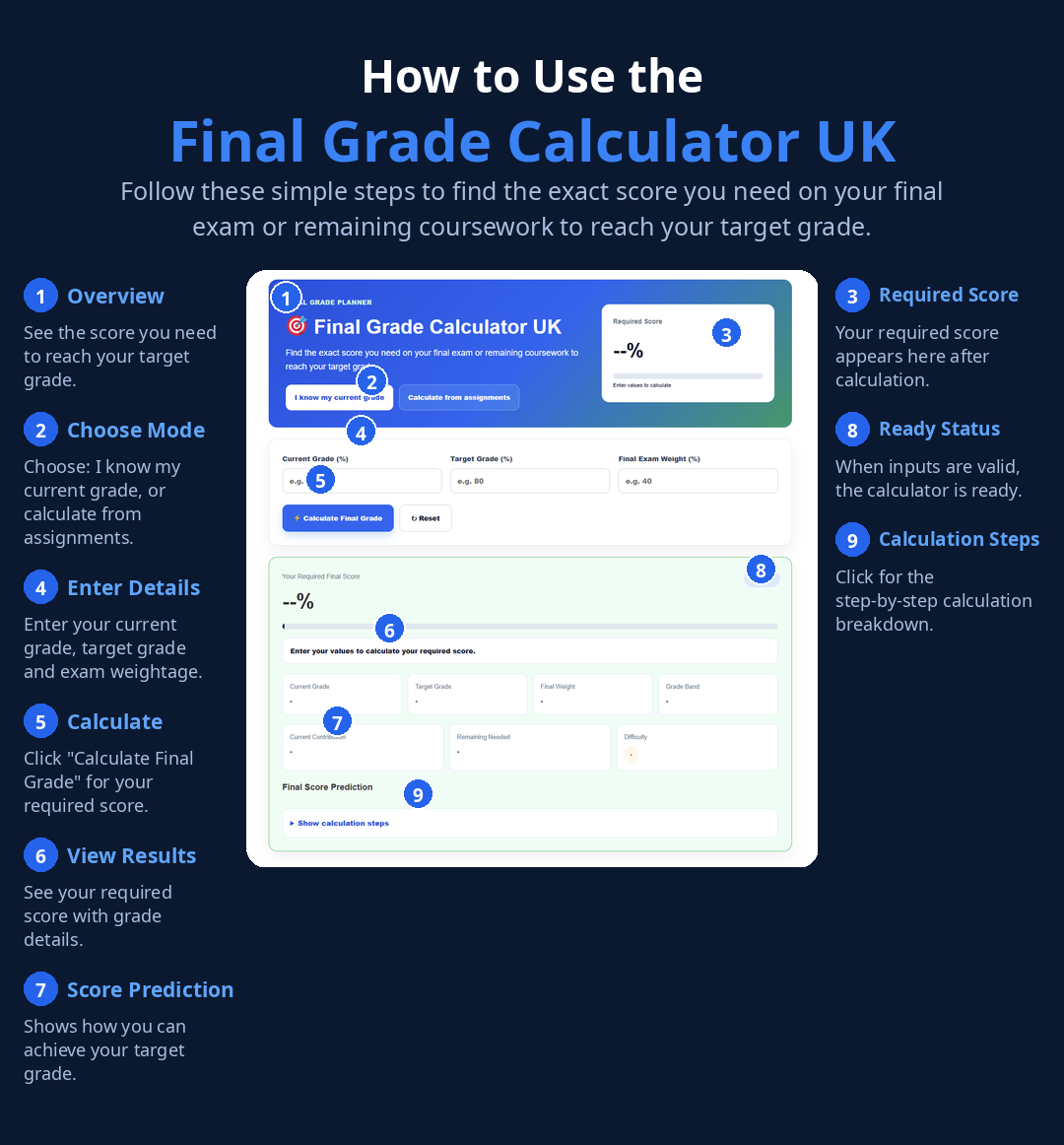
Click Here: Final Grade Calculator UK
The three pillars of a physics degree
Almost every UK physics degree assesses you through the same three channels, whatever the university calls them. The balance between them shifts as you progress, and understanding the split is the first step to working out where your effort pays off most.
| Pillar | What it covers | Typical share of a year | Key rule to know |
|---|---|---|---|
| Theory exams | Written papers in mechanics, electromagnetism, quantum physics, thermodynamics, mathematical methods | 70–90% in most years | Usually the dominant component; problem-solving under time pressure |
| Laboratory work | Supervised experiments, lab notebooks, write-ups, error analysis, computing exercises | 10–30% per year | Credit-bearing and often a must-pass hurdle — failing the lab can fail the year regardless of exam marks |
| Projects | Open-ended investigative work: a short project in year 2 or 3, a major project in the final year | 0% in year 1, rising to 25–50% of the final year | Must be passed; marked by independent markers, not your supervisor |
The progression is deliberate. Year 1 is about foundations — lectures plus supervised lab sessions that teach you how to handle equipment, keep a lab book, and do uncertainty analysis properly. Years 2 and 3 tilt toward written exams with assessed coursework alongside. The final year flips the balance: the MPhys or MSci project becomes the centrepiece, worth anywhere from 30 CATS credits (the IOP’s stated minimum for a “substantial” integrated-master’s project) to a full half of the year at Durham, where the MSci project is worth 60 of the year’s 120 credits.
This is what separates physics from, say, maths — where the maths-degrees article on this site showed assessment is almost entirely exam-driven. In physics, the lab is not a side dish. At Manchester, the first-year laboratory unit alone is worth 20 credits — a sixth of the year. At Warwick, students spend around 7 supervised practical hours per week in year 1. And as we will see, the IOP’s accreditation rules are the reason departments are not allowed to let you graduate without proving you can actually do physics with your hands.
The IOP accreditation rules behind your marks
The Institute of Physics accredits the great majority of UK physics degrees, and its Degree Accreditation Framework (July 2022) sets conditions that reach directly into how you are assessed. Accreditation matters to you: graduates of an accredited integrated master’s have fulfilled the educational requirements for Chartered Physicist status, and accredited BSc holders have partially fulfilled them. Departments keep their accreditation for a maximum of five years at a time, assessed by a peer panel — so these are not vague aspirations, they are audited requirements.
Here is what the framework says, in plain terms:
Core content is prescribed. Accredited programmes must teach the fundamental areas: electromagnetism, quantum and classical mechanics, statistical physics and thermodynamics, wave phenomena, and the properties of matter (with classical physics including special relativity). Your exam papers in these areas are not a local quirk — they are a national expectation.
Maths is a linked programme, not an afterthought. Departments must provide a mathematics programme tied to the scientific needs of the degree, giving you “a mathematical toolbox to engage with physics in a rigorous and quantitative manner”. Theoretical and mathematical physics degrees are expected to go further. This is why mathematical-methods modules carry real weight in your average.
Synoptic thinking is required. Students must be able to apply physics across topic boundaries “in unrehearsed contexts”. A general paper is described as “an established way of achieving this” — though not mandatory. Imperial’s year-3 “Comprehensive Physics” tutorial-based module is one department’s answer to this requirement.
Lab work has a floor. For experimental degrees, the framework says it is “unlikely that the required skills could be developed in less than 30 CATS” of lab work, and “thought unlikely that adequate development can be shown by only having experimental work in the first year”. Remote or virtual experiments may not make up the whole of it. Lab training must cover health and safety, risk assessments, error and uncertainty analysis, data analysis, presenting results, and iterating on experimental design. Theoretical degrees get a lighter guide figure of 15 CATS of experimental understanding.
Investigative work and the master’s project must be passed. Every BSc must include independent, open-ended investigative work that must be passed — and your supervisor is not allowed to mark the final report; it needs at least two independent markers. The integrated master’s project must be “substantial” (at least 30 CATS, 45 in an MSc), must also be passed, and again the supervisor may contribute progress marks but cannot mark the final report. Investigation ability and communication are marked independently.
Compensation has limits. The framework states that key expectations “must be met by all students” and that “policies such as compensation or condonement should not compromise the attainment of the key expectations”. In practice, this is why lab and project components so often carry must-pass hurdles: a department cannot simply let a strong exam average cover for a failed project and keep its accreditation. (Our condoned pass guide explains how compensation normally works — physics is one of the subjects where the rules are strictest.)
How physics degrees graded: the year weightings behind your classification
Like most UK degrees, physics classifications are computed from weighted year averages — but the weightings vary sharply between universities, and physics has one of the widest spreads. Your year-1 average typically counts for little or nothing; the later years carry the classification.
| University | Degree | Year weights | Notes |
|---|---|---|---|
| Imperial | MSci Physics (F303) | 7.5 : 20 : 36.25 : 36.25 | Years 3 and 4 dominate; year-4 progression needs ≥50% aggregate |
| Oxford | MPhys | Part A : B : C ≈ 23 : 35 : 42 | Prelims (year 1) count 0%; Part A is year 2, Part C is year 4 |
| Oxford | BA Physics | Part A : Part B ≈ 41 : 59 | Year 1 counts 0%; a Prelims Distinction is possible and “well regarded” |
| Warwick | BSc Physics | 10 : 30 : 60 | Year 3 alone is 60% of the classification |
| Warwick | MPhys | 10 : 20 : 30 : 40 | Year 3 counts 60% for BSc but 30% for MPhys — same lectures, different weight |
Two things stand out. First, the back-loading is extreme: at Warwick’s BSc, your third year is worth six times your first. At Imperial, years 3 and 4 together are 72.5% of the degree. A student who treats year 1 as a warm-up is not wrong — Prelims at Oxford literally do not count — but the ramp from year 2 is steep, and the MPhys gates (below) mean you cannot coast through year 2 either.
Second, the classification thresholds are the familiar UK ones: at Imperial, for example, First ≥70.00%, 2:1 ≥60%, 2:2 ≥50%, Third ≥40%, computed on the programme’s overall weighted average. If those boundaries look arbitrary, our guide to how UK universities round marks at boundaries explains what happens when you land at 69.5%.
Worked example 1: the MPhys weighted average — and the gate it has to clear
Take a Warwick MPhys student with these year averages: year 1 = 58%, year 2 = 63%, year 3 = 66%, year 4 = 71%. The MPhys weights are 10 : 20 : 30 : 40, so:
Final average = (58 × 0.10) + (63 × 0.20) + (66 × 0.30) + (71 × 0.40)
= 5.8 + 12.6 + 19.8 + 28.4 = 66.6% → Upper second-class (2:1)
Notice the leverage. That strong final year (71%) contributes 28.4 percentage points — nearly half the total — while the shaky first year contributes only 5.8. A 10-point swing in year 4 moves the final average by 4 full points; the same swing in year 1 moves it by 1.
Now the gate. Warwick requires MPhys students to hold an overall mark of at least 60% and a 60% CATS-weighted average across the examined physics modules to stay on the MPhys into year 3. Our student’s year-2 average is 63% — through the gate, though not comfortably.
Consider the counterfactual: the same student with a 57% year-2 average would fail the 60% gate and be moved to the BSc track, where year 3 then counts 60% of the classification instead of 30% — a completely different degree arithmetic from the same lectures. The gate does not just filter; it changes the rules of the game you are playing.
The MPhys vs BSc progression gates: the two-track system
Most UK physics departments run the BSc and MPhys as a single cohort for the first two years, then split. Staying on the four-year integrated master’s track is not automatic — it is gated on your marks, and the gates are published. This is one of the highest-stakes grading features in physics: miss the gate and your degree shortens by a year and your classification arithmetic changes.
| University | Gate | What happens if you miss it |
|---|---|---|
| Warwick | ≥60% overall and ≥60% across examined physics modules (end of year 2) | Revert to BSc track |
| Leicester | Year 2: minimum 55% (recommended 60%); Year 3: minimum 51% (recommended 55%) | Transfer to BSc; prerequisite modules must each be passed at ≥40% |
| Manchester | BSc→MPhys transfer possible at start of year 3; study-abroad MPhys routes imply a mid-50s bar (≈55% in June of year 2) | Stay on BSc |
| Oxford | Transfer to MMathPhys after Part B needs ≥2:1 at end of Part B plus committee acceptance | Not automatic — committee decision |
| Imperial | Year 4 (master’s year) needs ≥50.00% aggregate vs ≥40% for years 1–3 | Cannot progress to the master’s year |
The Leicester numbers deserve a closer look because they show how “minimum” and “recommended” diverge: 57% in year 2 clears the 55% minimum but sits below the 60% recommendation — you stay on the MPhys, but on notice. And note Manchester’s softer framing: transfer from BSc to MPhys is possible at the start of year 3, and its study-abroad guidance implies the internal bar sits around 55%. Physics departments rarely publish a single clean threshold the way Warwick does; more often there is a minimum, a recommendation, and a committee.
Practical implication: if you are on an MPhys offer, your year-2 average is the most consequential single number of your degree — it decides both your track and, through the weightings, a large slice of your classification. Aim for the recommended figure, not the minimum.
Labs: the hurdle most students underestimate
Exams get the revision guides; labs get the casualties. Because the IOP requires experimental competence to be demonstrated — and says compensation should not compromise it — departments build lab assessment with teeth. Three patterns recur:
Credit-bearing lab modules with real weight. At Manchester, first-year laboratory work is a 20-credit module — the same weight as two lecture modules. Warwick’s year-2 modules show the standard split: lecture modules like Quantum Mechanics sit at 85% exam / 15% coursework, while Physics Skills and Computational Physics are 100% coursework. Edinburgh’s pre-honours pattern is similar: lecture courses typically 80% unseen exam / 20% weekly hand-ins, with practicals assessed continuously through reports, lab notebooks, and computing checkpoints.
Must-pass and non-compensatable components. York’s module PHY00049I makes the “in-lab engagement” component pass/fail, and the module “cannot be passed or compensated without the ‘In-lab engagement’ component being passed” — an explicit no-compensation hurdle the department ties directly to IOP accreditation. Oxford’s regulations require students to submit evidence of “the successful completion of practical work” over the preceding three terms before Part A, and Prelims demand “satisfactory laboratory work”. Durham monitors lab attendance; non-attendance can trigger formal Academic Progress procedures.
Attendance as assessment. Warwick’s year-2 rules state that unsatisfactory attendance triggers a meeting with the Senior Tutor — labs are one of the few places where simply not turning up becomes a grading event. This is the practical face of the IOP’s line that experimental skills must be “developed and demonstrated”, not merely examined on paper.
The takeaway is blunt: a student averaging 65% in exams who treats labs as a chore is gambling with the one component the department is least able to forgive. Lab marks are also, frankly, the cheapest marks in the degree — continuous assessment, open notebooks, demonstrators who want you to succeed. Bank them.

Worked example 2: the project year — where half your year is one module
Durham’s MSci final year is the starkest illustration of project leverage: the project module (PHYS4213) is worth 60 credits — exactly half the final year — with 60 credits of taught modules alongside. Suppose our student scores 68% on the project and averages 62% across three 20-credit taught modules:
Final-year average = (68 × 60 + 62 × 60) ÷ 120 = (4,080 + 3,720) ÷ 120 = 65.0%
Now the counterfactuals. If the project slips to 58% while taught modules stay at 62%: (58 × 60 + 62 × 60) ÷ 120 = 60.0% — five full points lost from a ten-point project dip, because the project is half the year. Conversely, a 78% project with 62% taught modules gives 70.0% — a First-level year average carried almost single-handedly by the project. In a project-heavy final year, the project is not a module; it is the year.
Manchester’s version is less extreme but the same logic applies: the year-4 MPhys project is two 20-credit units (40 credits of the year), sitting alongside 10-credit lecture modules — so each project unit carries four times the weight of a standard module. And at Warwick, the year-3 Physics Project is assessed on an interim report, a final report, and a viva — the only part of most physics degrees where you defend your mark in person.
How projects are actually marked
Given their weight, project marking is deliberately rigorous — and deliberately independent. The IOP framework requires the final report to be marked by at least two independent markers, with the supervisor excluded from marking it (they may contribute progress marks). Investigation ability and communication are marked as separate strands.
Edinburgh’s year-4 project shows the standard four-component anatomy: a literature survey, the written project report, an oral presentation, and your performance throughout the project. Warwick adds the viva. Oxford’s Part B includes a mini project plus project report within the Finals mark, and the MPhys fourth year centres on the MPhys project alongside two major option courses. Imperial’s MSci year 4 pairs a research project in a real research group with a “Research Interfaces” core module and five options — the project is embedded in an active research environment, which is exactly what the external examiners are looking for.
Two practical consequences follow. First, project marks reward process, not just results: literature surveys, notebooks, presentations, and viva performance are all mark-bearing, so a project with null results can still score well if the method and analysis are sound. Second, because your supervisor cannot mark the final report, there is no “my supervisor likes me” premium — the report has to convince strangers. Write for the independent marker.
Exams, scaling and borderlines
Physics exams are typically unseen written papers — at Edinburgh’s pre-honours stage, usually 80% of the module with 20% from weekly hand-ins; at Warwick, the standard lecture-module split is 85% exam / 15% assessed coursework. Short-option papers (Oxford) and synoptic or “comprehensive” papers (Imperial’s year-3 Comprehensive Physics) test whether you can apply physics across topic boundaries in unrehearsed contexts — the IOP’s KE3 requirement made concrete.
Imperial’s published Exams & Feedback FAQ gives the clearest window into how marks are quality-controlled: exam papers are marked twice, and markers must moderate so that the average, the number of first-class marks, and the number of fails fall within expected ranges. Where results still “significantly deviate” from what is expected, scaling is applied to exam results — up or down, consistently across the cohort, with external examiners consulted. Indicative marks written on your paper can shift slightly under moderation, so the number you see at first is not always the number that counts.
On borderlines, Imperial states that “all degree average marks that are close to the boundary for a higher classification are reviewed” — the Board of Examiners, including external examiners, reviews your performance to date and decides at the final meeting.
This is the standard UK borderline mechanism (our rounding and borderlines guide covers the general rules), but note the discretionary character: near a boundary, your whole record is in the room, not just the average. Departments do not publish a universal band — Oxford’s physics-specific borderline band, for instance, is not published, so treat any claimed figure with suspicion unless it comes from the department’s own regulations.
7 mistakes that cost physics students marks
- Treating year 1 as irrelevant. It usually counts for little or nothing — but Warwick’s MPhys gate looks at your year-2 trajectory, Manchester’s implied bar needs ~55% in June of year 2, and Leicester wants prerequisites passed at ≥40%. Year 1 builds the maths toolbox everything else assumes.
- Neglecting the lab. The cheapest marks in the degree and the hardest to recover: York’s in-lab engagement cannot be compensated, Oxford requires evidence of completed practical work, and the IOP says compensation must not compromise experimental competence. A failed lab component can fail a year that your exams would have passed.
- Aiming for the MPhys minimum, not the recommendation. Leicester’s 55% minimum vs 60% recommendation, Warwick’s hard 60% — students who target the minimum leave themselves one bad paper from the BSc track.
- Underestimating the project. At Durham it is half the final year; at Manchester 40 credits against 10-credit lecture modules. A 10-point project swing moves the year average by 4–5 points. Start the literature survey early — Edinburgh marks it as a separate component.
- Writing the project report for your supervisor. They cannot mark the final report — two independent markers do. Write so a stranger can follow your method, your error analysis, and your conclusions without you in the room.
- Ignoring the viva/presentation. Warwick’s year-3 project includes a viva; Edinburgh marks the oral presentation and ongoing performance. Students who prepare slides the night before donate marks.
- Assuming the indicative mark is final. Imperial double-marks and moderates against expected ranges; scaling can move marks up or down. Do not celebrate — or despair — until the board has met.
Physics rewards a particular kind of student: strong under timed conditions, meticulous in the lab, and capable of sustained independent work on a project. The grading system is designed to test all three, and the IOP’s accreditation rules make sure no department can quietly drop any of them.
If that sounds demanding, it is — but it is also transparent. Every weighting, gate, and hurdle above is published. Plug your own numbers into the degree classification calculator and the final grade calculator, and you will know exactly where you stand — which, in a subject built on measurement, is only fitting. (The sibling guides in this series — how maths degrees are graded, how chemistry degrees are graded, and how engineering degrees are graded — cover the neighbouring subjects.)
Frequently asked questions
Do first-year marks count toward my physics degree classification?
In most cases, barely or not at all. Oxford Prelims count 0% toward classification (though a Distinction is possible and well regarded). Imperial’s MSci weights year 1 at just 7.5%, and Warwick’s BSc at 10%. But year 1 still matters: it builds the mathematical toolbox every later module assumes, prerequisite modules often must be passed at 40% to progress, and MPhys progression gates look at your year-2 trajectory — which is set in year 1.
What happens if I fail a lab module in a physics degree?
It depends on the department, but labs carry real jeopardy. At York, the pass/fail in-lab engagement component cannot be compensated — the module cannot be passed without it. Oxford requires evidence of successfully completed practical work before Part A. Durham monitors lab attendance and can trigger Academic Progress procedures for non-attendance. Because IOP accreditation requires experimental competence to be demonstrated, departments are limited in how much lab failure they can condone — check your programme handbook for must-pass rules.
What average do I need to stay on the MPhys instead of moving to the BSc?
It varies by university. Warwick requires at least 60% overall and 60% across examined physics modules at the end of year 2. Leicester requires a minimum 55% in year 2 (60% recommended) and 51% in year 3 (55% recommended). Manchester allows BSc-to-MPhys transfer at the start of year 3, with its guidance implying a mid-50s bar. Oxford’s transfer to MMathPhys needs a 2:1 at the end of Part B plus committee acceptance. Always aim for the recommended figure, not the minimum.
How is the final-year physics project marked?
Under IOP rules, the final report must be marked by at least two independent markers — your supervisor cannot mark it, though they may contribute progress marks. Typical components include the literature survey, the written report, an oral presentation or viva, and your performance throughout the project (Edinburgh assesses all four; Warwick’s year-3 project includes a viva). Investigation ability and communication are marked as separate strands. The project is heavy: half the final year at Durham (60 credits) and 40 credits at Manchester.
Do physics exams use step marks or method marks?
No UK physics department publishes a formal step-marks policy in the sources we reviewed, so do not assume one exists at your university. What is published: Imperial marks exam papers twice and moderates so that the average, the number of first-class marks, and the number of fails fall within expected ranges, with scaling applied where results significantly deviate. Indicative part-marks on your paper can shift under moderation. Check your own department’s exam conventions rather than relying on school-exam habits.
What does IOP accreditation mean for my physics degree?
It means your degree meets national standards set by the Institute of Physics: prescribed core content (electromagnetism, quantum and classical mechanics, statistical physics and thermodynamics, wave phenomena, properties of matter), a linked mathematics programme, synoptic problem-solving, a floor of experimental work (around 30 CATS for experimental degrees), and must-pass investigative work and master’s projects. For you, the payoff is recognition: accredited integrated-master’s graduates have fulfilled the educational requirements for Chartered Physicist status.
Can a failed module be compensated in a physics degree?
Sometimes — but physics is stricter than most subjects. The IOP framework says compensation policies should not compromise the key expectations, which is why lab and project components so often carry must-pass hurdles (York’s non-compensatable in-lab engagement is the clearest example). Ordinary lecture modules are usually compensatable within your university’s normal rules, but never assume a failed lab or project can be carried by strong exam marks — check the must-pass rules in your programme handbook.
How do universities handle borderline classifications in physics?
Near a boundary, your whole record goes before the Board of Examiners. Imperial states that all degree averages close to a higher classification boundary are reviewed by the board, including external examiners, who consider your performance to date before deciding. Marks may also be scaled — up or down — where cohort results significantly deviate from expected ranges. There is no universal published band, so be sceptical of any claimed figure (such as within 1%) unless it comes from your own department’s regulations.
Conclusion
How physics degrees graded in the UK comes down to three pillars — theory exams, laboratory work, and projects — held together by the IOP’s accreditation rules, which insist that experimental competence be demonstrated and that investigative work and master’s projects be passed outright. The year weightings are among the most back-loaded in UK higher education: your final two years can carry 70% or more of your classification, and at Warwick’s BSc the third year alone is worth 60%.
The two numbers that matter most are your year-2 average, which decides whether you stay on the MPhys track, and your final-year project mark, which at some universities is half the year. Labs are the quiet danger: credit-bearing, often must-pass, and the one component your department is least able to forgive. Treat the project like the independent-marked, viva-defended centrepiece it is, and do not assume the number on your exam paper is final until the board has met.
If there is one habit to take from this guide, it is measurement: work out your weighted average under your own university’s rules, check it against the progression gates, and see what your project needs to deliver. The final grade calculator will do the arithmetic — in a subject built on precision, guessing is the one experiment guaranteed to fail.