

Can You Still Get a First After Failing a Module? UK Rules [2026]
Daniel is in the final year of his BSc Economics. Five of his six 20-credit modules came back strong — 78, 76, 74, 72, 70. Then the sixth result lands: 35%. A fail, on one module, in the year that decides his degree. His first thought is the one thousands of UK students have every results day: is my First dead?
Here is the answer nobody gives him at first: it depends on arithmetic, not on the word “fail”. Failing a module does not disqualify you from a First at any UK university, because degree classification is decided by your credit-weighted average, not by a clean sweep of passes. What decides Daniel’s fate is which of three routes his university puts him on — compensation, a capped resit, or an uncapped retake — because each one feeds a different number into his average.
This guide walks through all three routes with the exact numbers: what each one does to your final average, two fully worked calculations showing when a First survives and when it doesn’t, the Masters version of the maths, the borderline trap most students never see coming, and a decision framework for the choice many students are actually offered — accept compensation, or take the resit.
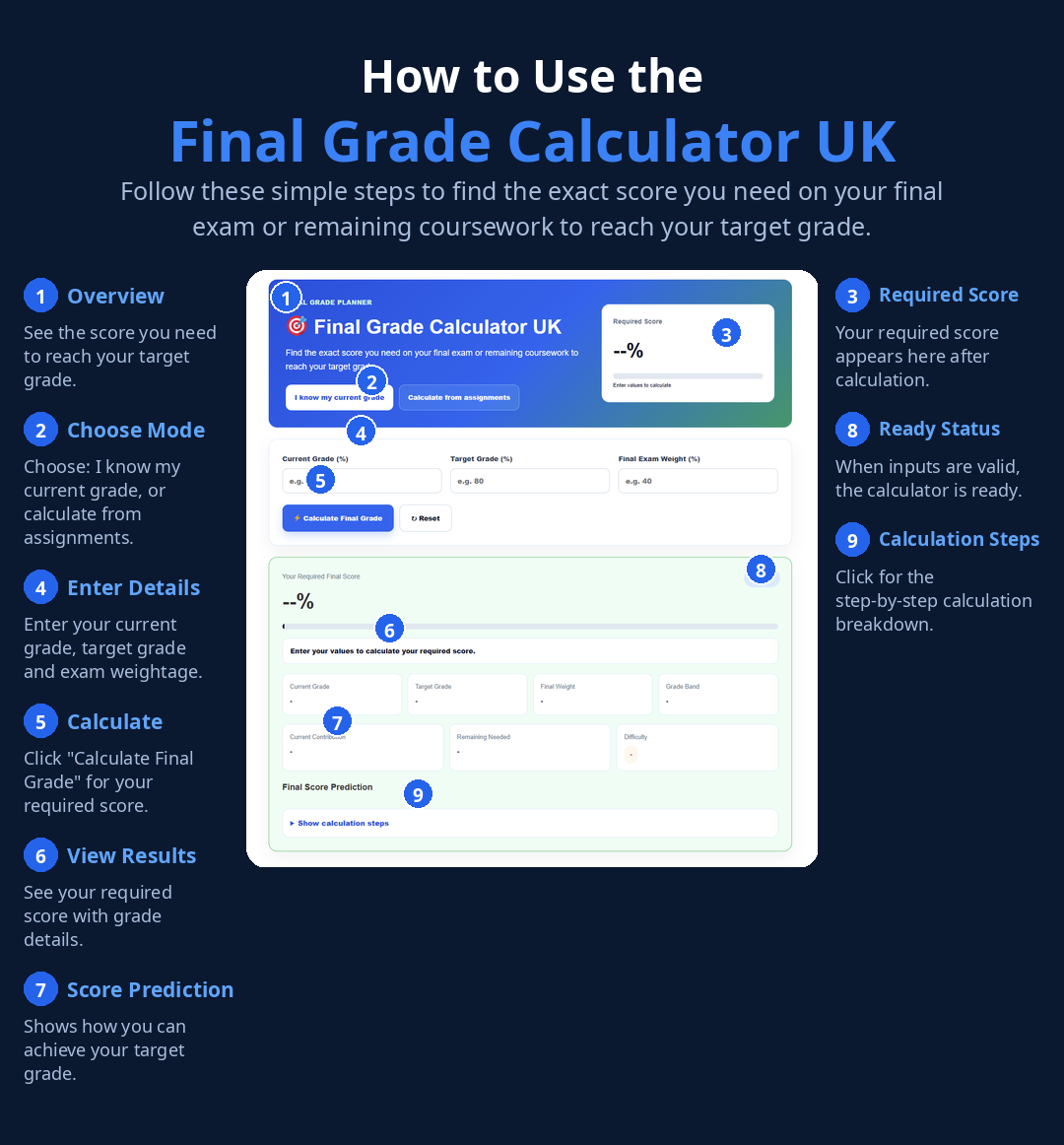
Click Here: Final Grade Calculator UK
The Three Routes After Failing a Module
When you fail a module at a UK university, the exam board does not simply record a zero and move on. It places you on one of three paths — and students are rarely told clearly which one they are on, or what it does to their numbers. Here they are, with the arithmetic each one implies:
| Route | What happens | What enters your average for the failed module | Typical limits |
|---|---|---|---|
| 1. Compensation (condoned pass) | The board awards you the credits without a resit; you never sit the exam again | Your actual failed mark — a 35 stays a 35 | Usually up to 20 credits per level; the failed mark must sit in a threshold band (e.g. 35–39 at Derby, 30+ at Oxford Brookes); your year average must stay above 40 |
| 2. Capped resit (referral) | You resit the failed assessment, usually in the summer resit period | The pass mark only — 40% for undergraduates, 50% for Masters — no matter how well you actually perform | No credit cap, but usually one attempt only |
| 3. Uncapped retake (“first sit”) | You resit with the cap lifted, so your real mark counts | Your actual resit mark, whatever it is | Rare — normally requires accepted mitigating or extenuating circumstances, or specific first-year rules |
The key insight is in the third column. Route 1 keeps your low mark. Route 2 replaces it with a fixed 40 (or 50). Route 3 replaces it with whatever you earn. The same 35% fail therefore produces three completely different final averages — and that is why “can I still get a First?” has no single answer. We explain the five conditions exam boards check for the first of these routes in our guide to what a condoned pass means at UK universities.
The Rule Students Keep Missing: The Failed Mark Stays in Your Average
Before the worked examples, one rule needs stating plainly, because almost every student gets it wrong at first. When a module is compensated, the failed mark does not vanish from your record and it is not rounded up to the pass mark. It goes into your degree average exactly as it stands. Oxford Brookes University’s assessment regulations say it without ambiguity: “A compensated pass grade is recorded on a transcript, and the actual mark achieved is used for the purposes of calculating the final degree classification and GPA.”
Swansea University’s undergraduate regulations say the same thing from the other direction: where failures are compensated, “the marks for all other modules including failures in non-core modules will be retained for the purposes of classifying the degree.” In other words, the 35% is still a 35% when the classification is calculated. There is no mechanism — at Brookes, Swansea, or anywhere else whose regulations were checked for this guide — by which a failed module is quietly excluded from the average.
To feel what that costs: on a 120-credit year, every mark below 40 on a 20-credit module drags your final average down by (40 − mark) × 20 ÷ 120. A compensated 35 costs you 0.83% of your final average versus a bare pass. A compensated 30 costs 1.67%. These are not rounding errors when the First boundary is a hard 70.0 — but they are also not the catastrophe students imagine, as the worked examples show.
Worked Example 1: The Compensated Route — What 77% Really Means
Back to Daniel. His university’s exam board compensates his 35% on the 20-credit module — no resit, credits awarded, the 35 locked into his average. His other five modules: 78, 76, 74, 72 and 70. Does the First survive?
| Module | Credits | Mark | Weighted points |
|---|---|---|---|
| Econometrics | 20 | 78% | 1,560 |
| Macroeconomic Theory | 20 | 76% | 1,520 |
| Development Economics | 20 | 74% | 1,480 |
| Labour Economics | 20 | 72% | 1,440 |
| Behavioural Economics | 20 | 70% | 1,400 |
| Financial Economics (compensated fail) | 20 | 35% | 700 |
| Total | 120 | 8,100 |
Final-year average: 8,100 ÷ 120 = 67.5% — a 2:1. The First is gone, by two and a half marks.
Now the general question: with one 20-credit module locked at a compensated fail, what must the other 100 credits average for a First? The target is a 70.0 average, i.e. 8,400 weighted points across 120 credits. The failed module contributes 20 × m points, where m is the compensated mark. So the required average on the rest is (8,400 − 20m) ÷ 100.
For Daniel’s 35: (8,400 − 700) ÷ 100 = 7,700 ÷ 100 = 77.0%. That is the number to remember: with a compensated 35 on a 20-credit module, everything else must average a high First — 77% — to drag the overall to 70. His 74% average on the rest falls three marks short, and the First dies at 67.5.
But change the inputs and the story flips. Meet Amara: same 20-credit fail, same compensated 35, but her other five modules average 78 (80, 79, 78, 77, 76). Her points: 7,800 + 700 = 8,500. Her average: 8,500 ÷ 120 = 70.83% — a First, by less than one mark, but a First is a First. The same failed module produces a 2:1 for Daniel and a First for Amara. The fail never decided anything by itself; the other 100 credits did.
Worked Example 2: The Capped-Resit Route — Why 76% Is the Number
Now suppose Daniel’s board offers a resit instead, capped at 40 for classification purposes — the standard position at UK universities. The University of Derby’s regulations state it plainly: “The maximum overall mark available for a retaken module is 40%.” Daniel resits, performs well, and the board records 40. How university referrals work — when they are offered and what the capped mark means — is covered in our separate guide.
The arithmetic shifts slightly in his favour. The failed module now contributes 800 points instead of 700. The required average on the other 100 credits becomes (8,400 − 800) ÷ 100 = 76.0% — a full mark easier than the compensated route’s 77%.
With Daniel’s actual 74 average on the rest: (7,400 + 800) ÷ 120 = 8,200 ÷ 120 = 68.33%. Still a 2:1 — closer, but the First remains out of reach. With Amara’s 78: (7,800 + 800) ÷ 120 = 8,600 ÷ 120 = 71.67%, a comfortable First.
This produces a genuinely useful rule of thumb. Let m be the mark that ends up in your average for the failed module, with the rest of your year totalling 100 credits against a 70 target:
Required average on the rest = 84 − 0.2 × m
| Mark in your average (m) | Required average on the other 100 credits |
|---|---|
| 35 (compensated) | 77.0% |
| 37 (compensated) | 76.6% |
| 39 (compensated) | 76.2% |
| 40 (capped resit) | 76.0% |
Two things fall out of this table. First, a capped resit is always at least as good as compensation at 35–39, and strictly better below 35 — the cap replaces a bad number with a fixed 40. Second, the difference between a compensated 39 and a capped resit is 0.2 marks on the required average — tiny. If your compensated mark is already 38 or 39, taking a resit to chase the cap is a lot of summer effort for almost no arithmetic gain, unless you are sitting at 69.7 and need every fraction. (More on borderlines below.)
The Third Route: When the Cap Comes Off
There is a third possibility, and it changes the maths dramatically. If your exam board accepts a claim of mitigating or extenuating circumstances — documented illness, bereavement, or other exceptional disruption to your first attempt — the resit can be treated as a “first sit”: uncapped, with your real mark counting. The University of Manchester’s Computer Science MSc handbook describes exactly this mechanism: a resit taken as a first attempt (possible only with severe mitigating circumstances) counts at its actual mark, while an ordinary resit is capped.
Run Daniel’s numbers with an uncapped resit at 65: the failed module contributes 1,300 points. Required average on the rest: 84 − 0.2 × 65 = 84 − 13 = 71.0%. With his 74 average elsewhere: (7,400 + 1,300) ÷ 120 = 8,700 ÷ 120 = 72.5% — a First, and not even a close one. The same failed module, the same student, three fates: 67.5 with compensation, 68.3 with a capped resit, 72.5 uncapped.
The practical point: if anything genuinely disrupted your first attempt — and “genuinely” means documented, not just a bad week — the mitigation claim is the single highest-value action you can take. The deadline is usually days after results, not weeks, so this is a first-48-hours job. A note on honesty: mitigation is not a loophole to be gamed. Boards require evidence, false claims are academic misconduct, and an uncapped resit you are not ready for can still go badly. But where the circumstances are real, claiming is not gaming the system — it is the system working as designed.

Masters Students: The Distinction-at-70 Arithmetic
At Masters level the ladder is compressed and every rung is higher: 50 to pass, 60 for merit, 70 for distinction. The University of Manchester’s Computer Science MSc handbook sets out the standard structure — pass at 50%, merit at 60%, distinction at 70% — with marks of 40–49.9% eligible for compensation. And the resit cap is higher too: Swansea’s postgraduate regulations cap redeemed failures at 50, not 40.
Take Priya on a 180-credit MSc. One 20-credit taught module comes back at 45 — a fail at Masters level, since the pass mark is 50. Two sub-cases:
| Route | Mark in average | Points | Rest (160 credits) must average for distinction |
|---|---|---|---|
| Compensated at 45 | 45 | 900 | (12,600 − 900) ÷ 160 = 73.1% |
| Capped resit at 50 | 50 | 1,000 | (12,600 − 1,000) ÷ 160 = 72.5% |
(12,600 is 70 × 180, the points needed for a 70 average.) So the resit is again slightly kinder — 72.5% versus 73.1% — but both demand a strong distinction-level performance across everything else. Note the asymmetry with undergraduate: because the Masters pass mark is 50, the capped resit contributes a full 10 marks more than the UG cap, softening the blow.
And the merit floor? For a 60 average Priya needs 10,800 points; with the capped 50 in the bank, the rest must average (10,800 − 1,000) ÷ 160 = 61.25% — very achievable. The realistic message for Masters students: a single failed module usually kills the distinction only if the rest of the profile was already borderline; the merit is almost always still alive. The 60-credit dissertation dominates everything — a 75 on the dissertation contributes 4,500 points, more than a third of the distinction target, which is why every supervisor’s advice to protect dissertation time is classification advice, not just academic advice.
The Borderline Trap: Failing a Module and the Credit-at-70 Rule
Here is the part almost nobody warns you about. Suppose the arithmetic lands you at 68.5 or 69.2 — inside the borderline zone below the 70 First boundary. Many universities will consider lifting you to a First, but the uplift is rarely automatic and almost never based on the average alone. A common pattern in UK regulations is the credit-profile rule: a minimum number of your credits must already sit in the higher band. How First boundaries and borderline rules work in detail is covered in our First-class guide.
One reported example: Manchester Metropolitan University’s approach of requiring 68% overall plus at least 60 credits at 70% or above for a First. Aston University’s regulations, as quoted by students, consider candidates within 2% of a boundary for promotion where 50% or more of their credit units sit in the higher classification. Manchester’s own MSc handbook sets a formal boundary zone of 68–69.9% for distinction. The exact numbers differ everywhere — treat these as illustrations of the shape, not your university’s rule — but the pattern is consistent: borderline average plus enough high-band credits can mean uplift.
Now see what a failed module does to this second test. If 60 of your 120 credits must be at 70+, and 20 credits are permanently locked at 35–40, you must earn 60 First-level credits from your remaining 100 — three-fifths of everything else at 70 or above. A student at 69.3 with a compensated fail needs not just a good average but a concentrated one. Two students can sit at 69.3 and only one gets the uplift: the one whose 70+ credits clear the threshold. This is why the worked examples above matter twice — once for the average, once for the profile.
Practical consequence: if you are heading for the borderline zone, the capped resit has a hidden second benefit beyond the 40-versus-35 arithmetic — every tenth of a percent closer to 68 keeps you inside the zone where the profile test can save you. And if your profile is thin on 70+ credits, no amount of average-massaging helps: the uplift was never available. Either way, the decision has to be made with both tests in view, not just the average.
Accept Compensation or Fight for a Resit? A Decision Framework
At some universities the board decides for you; at others you genuinely choose — Oxford Brookes notes that compensation is decided after the resit opportunities have taken place, and a student may or may not have sat the resit. Here is how to choose, in order:
| Your situation | What the arithmetic says | Verdict |
|---|---|---|
| Compensated mark 38–39, resit capped at 40 | Resit gains you 0.17–0.33% on the final average | Accept compensation — unless that fraction crosses a boundary you are sitting on |
| Compensated mark 30–34 | Resit gains up to 1.67% | Take the resit, if you can realistically pass it |
| Accepted mitigating circumstances on the table | Uncapped resit restores your real mark | Claim mitigation first, resit second — highest value of any option |
| Failed module is core or professionally accredited | Compensation may be unavailable — Derby excludes PSRB-accredited programmes, and Swansea bars compensation for core modules | Resit is the only route — confirm with your registry now |
| No resit window before the award board meets | Compensation is decided at the point of award | Accept it and move on; the board’s decision is final |
One factor the table cannot capture: timing and headspace. A resit means a summer of revision while your peers graduate, and a failed resit can mean repeating the year. If the arithmetic gain is under half a percent and you are not on a boundary, the resit is usually a bad trade — take the compensation, graduate with your cohort, and put the energy into the modules still in play.
6 Mistakes That Cost Students Their First
| Mistake | Why it hurts | The reality |
|---|---|---|
| 1. Assuming the failed module “disappears” from the average | You plan as if it were a zero-credit event | The actual failed mark is used in the classification (Brookes, Swansea) — plan with it, not around it |
| 2. Assuming compensation is automatic | You skip the resit, then learn you never qualified | Compensation needs threshold marks (e.g. Derby: 35–39, year average of 40+, max 20 credits) and board approval |
| 3. Taking a resit without doing the sums | A summer of stress for 0.2% | A compensated 38 versus a capped 40 is nearly identical — only boundary cases justify the effort |
| 4. Assuming the cap is always worse than compensation | You reject a resit that would have helped | A 40 cap beats any compensated mark below 40 — by over 1.5% on the final average at the extreme |
| 5. Ignoring the credit-profile test | You hit 69.3 and expect the uplift | Borderline uplift needs high-band credits; dead credits can’t count toward them |
| 6. Trying to resit modules you already passed | You ask for something that doesn’t exist | Resits exist to earn missing credits, not to polish passes — see our guide to university referrals |
Your First 48 Hours After the Fail
The rules above are only useful if you act inside the windows. In the first 48 hours: (1) read the exam board outcome letter carefully — it states whether you have been offered compensation, a referral, or a choice, and whether any cap is lifted; (2) check the mitigation deadline — it is usually counted in days from results day, and late claims are routinely refused; (3) ask your registry two questions: is this module compensatable (core? accredited?), and does my mark sit inside the compensation band?; (4) run your own numbers on the Final Grade Calculator before you decide anything — the board applies rules, it does not optimise your classification; (5) if a choice is offered, apply the decision framework above and decide once, properly. To model the whole degree rather than just the year, use the Degree Classification Calculator.
The questions below are the ones students actually ask about failing a module and the First — answered with the rules and arithmetic from this guide.
Can you still get a First after failing a module?
Yes — one failed module does not automatically rule out a First, because UK degree classification is decided by your credit-weighted average, not by a clean sweep of passes. What matters is the arithmetic: a compensated 35% on a 20-credit module means your other 100 credits must average 77% for a 70% overall, while a capped resit at 40 eases that to 76%. Check your own university’s compensation thresholds and caps, because the numbers differ — but the maths works the same everywhere.
Does a failed module count towards your degree average?
Yes. This is the single most misunderstood rule: a compensated fail enters your degree average at the actual mark you achieved — not at the pass mark, and not excluded. Oxford Brookes University’s regulations state it plainly: “A compensated pass grade is recorded on a transcript, and the actual mark achieved is used for the purposes of calculating the final degree classification and GPA.” Swansea University’s regulations say the same in different words — failed marks are retained for the purposes of classifying the degree. If you resit instead, the capped mark (usually 40%) is what counts.
Is a resit mark always capped at 40%?
At undergraduate level, almost always. The University of Derby’s assessment regulations state that “the maximum overall mark available for a retaken module is 40%”, and Swansea University caps resits at 40% for undergraduates (50% for Level 7 and Masters modules). The main exception is accepted mitigating or extenuating circumstances: if the board agrees your first attempt was seriously disrupted, the resit can be treated as a first sit with no cap. Without accepted mitigation, assume the cap applies.
What is the difference between compensation and a resit?
Compensation — also called a condoned pass — is when the exam board awards you the credits for a marginally failed module without any reassessment: the failed mark stays in your average and you never sit the exam again. A resit (referral) gives you another attempt at the assessment, but the mark is capped at the pass mark (40% at undergraduate level, 50% at Masters) for classification purposes. Whether you get a choice between the two depends on your university: some boards decide for you at the award stage, while others let you opt for the resit.
Should I accept compensation or take the resit?
Do the arithmetic first. On a 120-credit year with a 20-credit fail, the average your other credits must reach is 84 minus 0.2 times the failed mark. A compensated 35 needs 77% elsewhere; a capped resit at 40 needs 76% — so the resit is slightly better, worth about 0.83% on your final average. If your compensated mark is already 38 or 39, the difference shrinks to almost nothing, and skipping resit season may be the smarter call. Only the borderline cases — where a fraction of a percent decides 69.x versus 70.0 — make the resit clearly worth the effort.
Can a failed module stop me getting a borderline uplift to a First?
Yes, and this catches students out. Many universities only lift a borderline 68–69.9% average to a First if a set proportion of your credits already sit in the higher band — one reported example requires 68% overall plus at least 60 credits at 70% or above. A compensated fail locks up to 20 of your credits below that threshold permanently, so you must earn the required First-level credits from what remains: with one 20-credit fail, that means 60 of your other 100 credits at 70 or above. The exact uplift rules differ by university, so check your own regulations.
Can I get a Masters distinction after failing a module?
Possibly, but the ladder is steeper: at Masters level the pass mark is 50, merit is 60 and distinction is 70. Manchester’s Computer Science MSc rules allow marks of 40–49.9% to be compensatable, and resits are capped at 50. On a 180-credit MSc with one 20-credit fail: compensated at 45, your other 160 credits must average 73.1% for a distinction; via a capped resit at 50, they must average 72.5%. The 60-credit dissertation dominates the calculation, so a strong dissertation plus solid taught marks can still carry a distinction.
Will a failed module show on my transcript?
A compensated fail is recorded on your transcript as a compensated pass carrying the actual mark — Oxford Brookes confirms the compensated grade appears on the transcript. A resit appears with the capped mark. Employers who only see your degree certificate will never know; those who request a full transcript or academic reference may see it. One failed module, clearly recovered from, is a routine sight on graduate transcripts and is not the red flag students fear — but check your university’s transcript policy if you are applying for roles that require full academic disclosure.
Conclusion
A failed module feels like a verdict on your degree. The regulations say otherwise: no UK university classifies you on a pass-every-module rule, and the three routes — compensation, capped resit, uncapped retake — each give the same fail a different numerical fate. Daniel’s 35% is a 67.5 and a lost First under compensation, a 68.3 under a capped resit, and a 72.5 under an uncapped retake. The fail never changed. The route did.
That is the practical takeaway. Find out which route you are on before you do anything else, because everything downstream — the 77-versus-76 arithmetic, the borderline credit-profile test, the accept-or-resit decision — flows from it. Run the numbers yourself with the Final Grade Calculator and the Degree Classification Calculator, check the mitigation deadline today rather than tomorrow, and ask the registry the two questions that decide your options: is the module compensatable, and is the cap lifted?
And keep the scale of it in view. One failed module on a 120-credit year moves your final average by about one percent either way — the difference between 67.5 and 68.3, not between a First and a fail. Students lose Firsts to failed modules only when the rest of the profile was already borderline. If your other marks are genuinely at First level, the arithmetic in this guide shows the First surviving a 35 with room to spare. The fail is a problem to be calculated, not a sentence to be feared.