
How Are Chemistry Degrees Graded in the UK? Exams, Labs & RSC Rules [2026]
Every chemistry degree graded in the UK shares one unusual feature: no other mainstream science degree puts this much of your final result in the laboratory. The Royal Society of Chemistry requires every accredited programme to timetable a minimum of 300 laboratory hours — project work excluded — and its accreditation rules state plainly that practical and project work cannot be compensated or condoned. In other words, chemistry has hard gates that most degrees simply do not have.
The marks map looks different too. At Imperial, exams make up 75% of assessment in year one but only 25% by year four, with coursework and practical work taking over (F103 programme specification, 2025-26). Year weightings swing just as widely: Southampton excludes the first year of its integrated Masters entirely, while at Imperial every year counts, at very different weights.
This guide walks through the full picture: where chemistry marks actually come from year by year, the three assessment gates that can end a year regardless of your exam marks, two fully worked classification examples, a practical-gate audit you can apply to your own modules, the BSc versus MChem progression rules, and what the data says about getting a First.
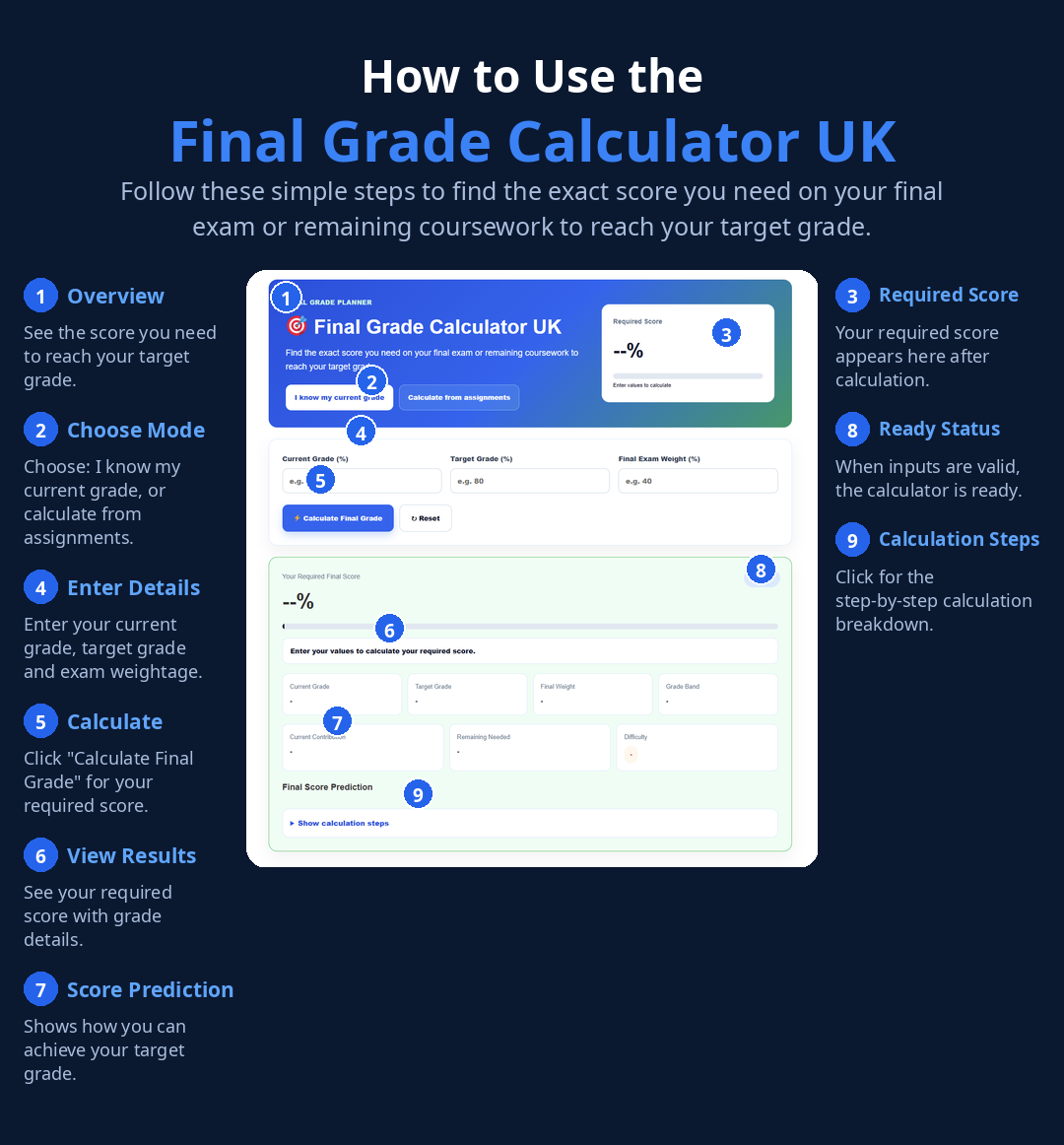
Click Here: Final Grade Calculator UK
Gate 1: The 300-Hour Lab Rule (RSC Accreditation)
More than 450 degree programmes at over 80 universities worldwide currently hold Royal Society of Chemistry accreditation — a peer-reviewed status granted by the RSC’s Committee for Accreditation and Validation that lasts five years. The RSC is explicit that it does not set a syllabus, saying it does not want to inhibit creative curriculum development, but it does set threshold standards through 16 Key Requirements covering knowledge, practical skills, project work and assessment.
Key Requirement 6 is the one that shapes every chemistry timetable in the country: programmes must expect students to attend and complete a minimum of 300 timetabled laboratory hours, exclusive of project or independent investigative work, and this applies to both Bachelor’s and integrated Master’s programmes. The same requirement insists that health and safety training precedes each practical and that practical work must be rigorously and appropriately assessed and contribute towards the final mark of the degree programme.
This is not a paper rule. The University of Leicester’s programme specifications state that, to meet RSC accreditation requirements, students must pass named practical modules at the first attempt with 100% lab attendance and no compensation of practicals — and that every student must pass at least one Level One or Level Two module in each of the three branches of the subject: organic, inorganic and physical chemistry.
One newer requirement worth knowing: the current RSC accreditation standards also require departments to have a clear policy on students’ use of generative AI — students must use it responsibly and ethically, understand its outputs may be inaccurate, and be able to critique them. Your department’s AI policy is now part of the accreditation furniture, so check it before coursework season. The accreditation guidance itself is published by the Royal Society of Chemistry.
Chemistry Degrees Graded: The Year-by-Year Marks Map
Where do the marks actually come from? The honest answer is that it depends on the year you are in. Imperial’s published assessment split for its MSci Chemistry (F103, 2025-26) shows the gradient better than any description:
| Year | Exams | Coursework and practical |
|---|---|---|
| Year 1 | 75% | 25% |
| Year 2 | 65% | 35% |
| Year 3 | 40% | 60% |
| Year 4 | 25% | 75% |
Source: Imperial College London, F103 MSci Chemistry programme specification 2025-26. Assessment types listed include open and closed-book exams, vivas, reports, posters, lab performance and a six-month independent research project in year four.
If you only remember one thing about chemistry degrees graded in the UK, remember the gradient: exams dominate when you arrive, but by the final years the lab bench and the project do most of the talking. Other universities tell the same story with different numbers. The University of York says that throughout its MChem, most work is assessed continuously rather than through final exams. Birmingham’s MSci with Industrial Experience splits coursework and written exams 42/58 in year one, 33/67 in year two, 100/0 in the industry year, and 50/50 in year four — with a practical exam weighting of 0% in every year, because practicals there are assessed through coursework-style reports rather than sit-down practical exams.
At module level, Warwick’s catalogue shows the same blend: the 60-credit final-year Research Project and Methodology module is 70% coursework and 30% exam; first-year Practical and Professional Chemistry Skills I is 86% coursework and 14% exam; and the Extended Laboratory module is assessed entirely through a poster (33%) and practical reports (67%). Cambridge’s Part II (third year) takes yet another shape: four written papers count for 75% of the mark, with continuously assessed work — two core practical courses, chemical informatics exercises and additional credits — making up the remaining 25%.
Year Weightings: How Each Year Counts Toward Your Classification
Knowing where marks come from is only half the map. The other half is how much each year counts — and here the differences between universities are stark:
| University | Year weighting scheme | How it works |
|---|---|---|
| Imperial (MSci) | 7.5 : 20 : 36.25 : 36.25 | Years 1–4 all count; the final two years carry nearly three-quarters of the classification. |
| UCL (integrated masters, Scheme A) | 1 : 3 : 5 : 5 | Years 1 and 2 count only the best 90 credits (weights 1 and 3); years 3 and 4 count all 120 credits at weight 5. |
| Durham | 2 : 3 : 4 | Weighted mean of module scores from FHEQ level 5 onwards, split 2:3:4 across the counting years. |
| Southampton (integrated masters) | 0 : 1 : 2 : 2 | Part I is excluded entirely — equivalent to 0:20:40:40 across the four Parts. |
| Leicester (MChem) | 20 : 30 : 50 | Years 2, 3 and 4 weighted 20/30/50; Leicester’s own worked example runs 65.00×0.20 + 66.37×0.30 + 72.75×0.50. |
Sources: Imperial F103 programme specification 2025-26; UCL Academic Manual 2025-26 (Scheme A); Durham Degree Outcomes Statement; Southampton integrated masters regulations; Leicester student guide to undergraduate assessment and award (Sept 2025).
Two consequences follow. First, a weak first year is recoverable almost everywhere — at Southampton it does not count at all. Second, the final year is almost always the heaviest single year, and it is also the year dominated by practicals and the project. That is why the gates in the following sections bite hardest exactly when the marks matter most.
Class boundaries are standard across the sector — Imperial publishes First at 70.00% and above, 2:1 at 60%, 2:2 at 50%, Third at 40% — but borderline rules differ. Durham considers students within 2 marks of a boundary for the higher class. Southampton promotes borderline students whose final average sits within 2 marks of the higher class with at least half their Part-weighted credits in that class. Leicester requires a CWA of at least 68.00% plus 70.00% or more in at least 180 credits (30 of them at level 6) for a borderline First. UCL awards a First at 69.50%, or 68.50% with 70% or more in at least half of final-year credits. Read our borderline grades guide to see how these uplifts work in practice, and model your own scheme with our Degree Classification Calculator — remembering that how universities round marks can matter at the boundaries too.
Gate 2: Must-Pass Practical Components (No Compensation)
This is the gate that surprises students most. In most degrees, a failed module can be compensated — a near-miss mark of 35–39% forgiven because the rest of the year is strong. The RSC’s Key Requirement 12 forbids exactly that for the parts of chemistry that matter most: practical and project work cannot be compensated or condoned. Universities implement this as explicit hurdle rules:
| University | The hurdle rule | What it means in practice |
|---|---|---|
| Oxford | Satisfactory completion of the prescribed core practical requirement is an absolute requirement for the award of Honours at Part IB and for progression to Part II. | You can pass every exam and still not progress if the practical requirement is not signed off. |
| Cambridge (Part II) | Dual 40% threshold: 40% in the combined theory papers AND 40% in the continuously assessed practical work. | Strong exams cannot rescue weak practicals, or vice versa — both sides must clear 40%. |
| Durham | Modules marked ~ (including the 20-credit Practical Chemistry 3 – Integrated) must be passed at 40% to progress; a mark of 30–39% cannot be compensated. Level 1 core practicals must also be passed at 40%. | One named practical module can hold up your entire progression. |
| Leicester | No resit opportunities for non-mitigated missed practical work; practical modules must be passed at the first attempt with 100% lab attendance. | Miss a practical without accepted mitigation and there is no second chance — the module is failed. |
| Warwick | The practical-reports component of the Extended Laboratory module lists no reassessment. | Fail that component and it cannot be retaken. |
This is what makes chemistry degrees graded in the UK different from most other degrees: the gates are practical, not just numerical. Notice what these rules have in common: they are about the practical work specifically, not the overall average. Cambridge assesses practicals in front of you week by week, with penalties for late submission. And the credit weight behind the hurdles is substantial — at Manchester, the year-two Practical Chemistry module was 30 of 120 credits and the MChem year-three Advanced Practical Training was 40 of 120 credits. A hurdle is not a technicality; it is a large, immovable chunk of your year.
Gate 3: The Final-Year Project
The third gate is the one students underestimate because it arrives last. The RSC’s project requirements (KR7 and KR8) give it real structural weight: a Bachelor’s programme must include student-led independent investigative work, typically around 25% of final-year workload, and the supervisor’s contribution to the project mark must be under 40%. For integrated Master’s programmes the research project should normally account for at least 50% of final-year workload, be individual, and be of a standard that is potentially publishable — again with the supervisor contributing under 40% of the mark.
In credit terms this is enormous. Warwick’s final-year Research Project and Methodology module is 60 credits — half the year — assessed 70% by coursework and 30% by exam. Imperial’s fourth year, which is 75% coursework and practical, centres on a six-month independent research project. At Oxford, the Part II thesis and viva alone count for 25% of the entire degree (against 15% for Part IA exams, 50% for Part IB papers and 10% for practicals, per Jesus College’s summary of the scheme). Cambridge weights Part III — the research year — at 85% of the class list against 15% carried forward from Part II. Reading’s programme specification describes its project assessed through laboratory work, the written report, a poster and an oral presentation; Southampton assesses its MChem project through the dissertation, an oral examination, a supervisor’s report on the student’s skills, and a literature review.
The supervisor-contribution rule matters for how you should read your project mark: with under 40% of the mark coming from the supervisor, the project is overwhelmingly your own work — the write-up, the data handling, the viva performance. A neglected project cannot be quietly carried by a generous supervisor. If your final year is where your classification is won or lost — and the weightings above say it usually is — then the project is where that year is won or lost. See our guide to improving a 2:2 to a 2:1 in final year for how students turn this around.
Worked Example 1: A 2:3:4 Weighting Across Three Years
Take Priya, a BSc Chemistry student on a Durham-style 2:3:4 weighting across her three years. Her year averages are 62% in year one and 68% in year two. In her final year she scores 60% on her 40-credit research project — solid, not spectacular — alongside four 20-credit modules:
| Final-year module | Credits | Mark | Weighted points |
|---|---|---|---|
| Research project | 40 | 60% | 2,400 |
| Inorganic Chemistry III | 20 | 68% | 1,360 |
| Organic Chemistry III | 20 | 66% | 1,320 |
| Physical Chemistry III | 20 | 64% | 1,280 |
| Advanced Analytical Techniques | 20 | 70% | 1,400 |
| Total | 120 | 7,760 |
Final-year average: 7,760 / 120 = 64.67%. Note how the 40-credit project, at a third of the year’s credits, anchors the average — the two strongest module marks (68% and 70%) cannot fully lift it.
Now the classification: (2 × 62 + 3 × 68 + 4 × 64.67) / 9 = (124 + 204 + 258.67) / 9 = 586.67 / 9 = 65.19% — an Upper Second-Class (2:1). Durham’s borderline rule considers students within 2 marks of a boundary for the higher class, but at 65.19% Priya is comfortably mid-band, so no borderline case arises. Try your own numbers in our Final Grade Calculator to see how sensitive your classification is to each year.
Worked Example 2: What a Failed Lab Gate Costs
Now take Daniel, an MChem student on Imperial’s 7.5 : 20 : 36.25 : 36.25 weighting. His year averages: 66% (year 1), 61% (year 2), 60% (year 3), 61% (year 4). His classification:
(0.075 × 66) + (0.20 × 61) + (0.3625 × 60) + (0.3625 × 61) = 4.95 + 12.20 + 21.75 + 22.11 = 61.01% — a 2:1, on the lower edge but a 2:1.
His year-three average of 60% is built from a 30-credit practical module at 66% (1,980 points) and 90 credits of theory averaging 58% (5,220 points): 7,200 / 120 = 60.00%.
Now the counterfactual. Suppose Daniel’s first attempt at that practical module scored 35% — a fail. Because it is a core practical module, it cannot be compensated: Imperial only permits compensation for non-core modules, and the RSC’s accreditation rules forbid compensating practical work outright. He must retake it, and the retake mark is capped at the pass mark — the standard UK convention (UCL publishes exactly this rule for resits; note that Imperial’s own published exam-board notes do not name a cap figure, so check your university’s regulations).
Retake recorded at the capped pass mark of 40%: 30 × 40 = 1,200 points. New year-three total: 1,200 + 5,220 = 6,420 / 120 = 53.50%. New classification: 4.95 + 12.20 + (0.3625 × 53.50) + 22.11 = 4.95 + 12.20 + 19.39 + 22.11 = 58.66% — a 2:2.
The failed gate cost Daniel 2.36 percentage points overall and one full degree classification — from a 2:1 to a 2:2 — even though his exams were untouched. That is the asymmetry at the heart of chemistry degrees graded in the UK: theory marks can be modelled and averaged, but a failed practical gate rewrites the year.
The Practical-Gate Audit: Which Failures Can Be Rescued
Use this table as an audit for your own modules. For each component, ask: if I failed this, could the rest of my year carry me — or does the year stop here?
| Component | Can it be compensated or condoned? | What happens if you fail it |
|---|---|---|
| Missed practical session with no accepted mitigation (Leicester rule) | No — no resit for non-mitigated missed practicals | The module is failed at the first and only attempt. |
| Failed core practical module (e.g. Imperial, RSC-accredited) | No — compensation is for non-core modules only, and RSC rules bar compensating practicals | Referred assessment; the retake mark is capped at the pass mark. |
| Practical Chemistry 3 – Integrated, Durham (20 credits, ~ module) | No — a mark of 30–39% cannot be compensated | Cannot progress without 40% or above. |
| Cambridge Part II continuous assessment (25% of Part II) | No — dual 40% threshold | The whole Part II examination is failed if either theory or practicals fall below 40%. |
| Oxford core practical requirement | No — absolute requirement for Honours | Honours cannot be awarded and progression to Part II is blocked. |
| Extended Laboratory practical reports, Warwick | No — no reassessment listed | The component mark stands as failed. |
| Final-year project (all RSC-accredited programmes) | No — practical and project work cannot be compensated or condoned | Must be passed, or the year — and the degree — cannot be completed. |
| Failed theory module, non-core (typical) | Sometimes — e.g. Imperial allows compensation in the 30.00–39.99 band for non-core modules (levels 4–6) with a year average of at least 40.00% and a 15-ECTS cap; Durham allows up to 40 credits at levels 5/6 with marks of 30%+ and an average of 40%+ | May be carried by the year average; otherwise a capped resit. |
The pattern is stark: everything practical is a hard gate, and only theory modules sometimes get a safety net. Manchester’s older handbook (2015/16 — treat as dated and indicative) shows how unforgiving the upper years can be: in years three and four there were no resits at all, with special compensation applied and the original mark left on the transcript with a C suffix. Durham, meanwhile, offers no resit opportunities at Level 6 — every final-year module must reach 40%. Read more about how compensation works in our condoned pass guide.

MSci and MChem vs BSc: The Progression Gates
Choosing — or staying on — the four-year integrated Master’s route adds another set of gates, because universities will not let students onto the research year without evidence they can handle it. There is no single national rule; each university sets its own:
| University | MChem progression gate | If you miss it |
|---|---|---|
| Leicester | Year 2 to 3 needs a CWA of 60% in year 2 (55–60% considered individually; below 55% only in exceptional circumstances). Year 3 to 4 needs a CWA of 50% in year 3. | Transfer to the BSc route. |
| Manchester (2015/16 handbook — dated, treat as indicative) | Year average of 55.0% plus at least 40% in 80 credits to reach year 4. | Classified for a BSc at the end of year 3; MChem degrees are not awarded below a 2.2. |
| UCL | BSc-to-MSci transfer allowed provided academic performance is consistently at 2:1 level or higher. | Remain on the BSc. |
| Durham | Students below MChem standard may progress to Level 3 of the BSc Chemistry (Honours or Ordinary stream), or be awarded a Bachelor of Chemistry (BChem). | Fall back to the BSc or take the BChem exit award. |
| Imperial | MSci students concluding at the end of year 3 may receive a BSc exit degree; honours classification requires year 3 to meet all BSc (Hons) requirements. | Graduate with the BSc instead. |
Note that the 60% figure students quote as a universal MChem rule is actually Leicester’s year-two gate — other universities set theirs differently, so check your own programme specification. One more difference worth knowing: an accredited Bachelor’s degree only partially meets the academic requirements for the RSC’s Chartered Chemist (CChem) award, while an accredited integrated Master’s fully satisfies them. If professional registration matters to your career plans, the MChem route carries that extra credential.
Is a Chemistry Degree Harder to Get a First In?
Students often assume the lab burden makes Firsts rarer in chemistry. The honest position is that there is no national chemistry-specific breakdown in the public HESA or OfS releases — anyone quoting one is guessing. What we can say:
Across the sector, the Office for Students reports that 28.8% of all classified UK degrees were Firsts in 2023-24, with Firsts and 2:1s combined at 77.2%. One 2024 study at a single UK university (9,112 STEM students — a useful data point, not a national figure) found 32.7% of chemistry students (771 of them) were awarded Firsts, compared with 50.4% in physics, 29.7% in maths and 38.6% in bioscience. The Times, citing HESA data, reports that science and engineering degrees typically have higher rates of first-class degrees than humanities subjects like English and history.
Put together, chemistry does not look like an unusually harsh grader — its First rate sits above the sector average in the one institution studied in detail, and continuous assessment arguably spreads risk across the year rather than concentrating it in a single exam season. The students who miss out tend to lose their classification at the gates described above, not at the grade boundaries.
Mistakes That Cost Chemistry Students Their Classification
Most classification damage in chemistry is self-inflicted and predictable. The recurring errors:
- Treating labs as the side dish. By year three, practicals and coursework can be 60–75% of your assessment (Imperial’s published split). Students who pour all their revision into theory while coasting through lab reports are optimising for the smaller half of the year.
- Missing practicals without mitigation. At Leicester there are no resit opportunities for non-mitigated missed practical work — a missed session can be a failed module, full stop.
- Assuming a 35–39% lab module can be compensated. It cannot — the RSC’s accreditation rules explicitly bar compensation of practical work, and universities like Durham write the exclusion into their regulations.
- Ignoring year weightings. A 55% first year means very different things at Southampton (Part I excluded) and Imperial (7.5% of the degree). Know your own scheme before you decide how hard to push.
- Letting the project drift. With the supervisor contributing under 40% of the project mark and the project worth up to half your final year, the project is the single highest-leverage component of most chemistry degrees. Weekly contact and early drafts are the difference.
- Sleeping on borderline rules. Within two marks of a boundary at Durham or Southampton, or 68%+ with 180 credits at 70+ at Leicester — these are published, checkable routes to the higher class that students discover too late.
- Never running the numbers. Model your position each term with our Final Grade Calculator — a classification is a weighted average, and weighted averages reward early, boring consistency.
Frequently Asked Questions
The eight questions below cover everything students ask most about chemistry degrees graded in the UK.
Do lab practicals count toward my degree classification?
Yes — directly. The RSC requires practical work to be rigorously assessed and to contribute toward the final mark of the degree. At Imperial, coursework and practical work make up 75% of assessment by year four; at Manchester, the year-three MChem advanced practical module alone was worth 40 of 120 credits. Labs are not a hurdle you clear for free — they are a large, marked part of your classification.
Can I fail chemistry because of labs even if my exams are good?
Yes. Cambridge’s Part II requires 40% in the theory papers and 40% in the continuously assessed practical work — strong exams cannot rescue weak practicals. Durham’s named practical modules must be passed at 40% to progress, with 30–39% marks that cannot be compensated. And as the worked example above shows, a single failed practical module can drag a 2:1 down to a 2:2.
What is RSC accreditation and does it change how I’m graded?
RSC accreditation is a peer-reviewed quality mark held by more than 450 chemistry degree programmes at over 80 universities, renewed every five years. It does not set your syllabus, but it sets threshold standards — including the 300 timetabled lab hours and the rule that practical and project work cannot be compensated or condoned. An accredited integrated Master’s also fully satisfies the academic requirements for Chartered Chemist (CChem) status; an accredited Bachelor’s only partially meets them.
What happens if I fail a chemistry practical?
It depends on your university, but the options are narrower than for failed theory. The module cannot be compensated under RSC rules. Typically you face a referred or retaken assessment, often capped at the pass mark — and some universities go further: Leicester offers no resit for non-mitigated missed practicals, Warwick lists no reassessment for its Extended Laboratory practical reports, and Durham offers no resits at Level 6.
How much does the final-year project count?
A lot. The RSC expects independent investigative work to be around 25% of final-year workload on a Bachelor’s and at least 50% on an integrated Master’s, with the supervisor contributing under 40% of the project mark. Warwick’s final-year project module is 60 credits — half the year — and at Oxford the Part II thesis and viva count for 25% of the entire degree.
Is a chemistry degree harder to get a First in?
The evidence does not suggest so. There is no national chemistry-specific breakdown, but one 2024 study at a single UK university found 32.7% of chemistry students were awarded Firsts — above the 28.8% sector average reported by the OfS for 2023-24 — and The Times reports that science and engineering degrees typically have higher first-class rates than humanities subjects.
BSc or MChem — which is better for my grades?
Neither is graded more generously; the difference is structure. The MChem adds a research-heavy fourth year that is usually the most heavily weighted year of the degree, and you must clear progression gates to reach it — such as Leicester’s 60% year-two average or Manchester’s 55% year average. The MChem also fully satisfies the academic requirements for Chartered Chemist status. If your grades are borderline, the BSc route removes the fourth-year gate but also the fourth year’s weighting.
Do chemistry exams allow formula sheets, or are they open book?
It varies by university and even by module. Imperial lists both open-book and closed-book exams among its chemistry assessment types, and York uses open-book assessments — so some chemistry exams are open book. Never assume: check each module handbook, because the same degree can mix open and closed-book papers.
Conclusion
Chemistry is graded like no other mainstream degree: 300 timetabled lab hours are non-negotiable, practical and project work cannot be compensated, and by the final year the bench and the project — not the exam hall — decide your classification. The students who do well are not necessarily the best exam-takers; they are the ones who treat every lab session as assessed work, clear the practical gates early, and give the final-year project the weight the regulations give it.
Audit your own position with the tables above: know your year weighting, list your must-pass practical components, and model the arithmetic — because as the worked example showed, a single failed gate can cost a full classification while the exams stay untouched. Run your numbers through our Final Grade Calculator each term, and treat the project as the highest-leverage module of your degree. In chemistry, consistency in the lab beats brilliance in the exam hall.
For every chemistry degree graded in the UK, the RSC’s framework is demanding but transparent: the gates are published, the weightings are published, and the borderline rules are published. Read them for your own university — preferably before you need them.