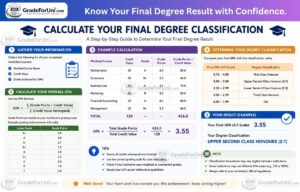

These are questions thousands of UK university students ask every year. If you’re studying for an undergraduate degree, a master’s programme, or preparing for your first set of university exams, understanding how pass marks work can save you a great deal of unnecessary stress.
The answer is not always as simple as “40% equals a pass. What Is a Passing Grade at University? Different universities have their own study regulations, postgraduate courses often have higher pass requirements, and factors such as credits, repeat, can all affect your academic progress.
This guide explains everything you need to know about the Passing Grade at University in the UK. You will learn how university pass marks work, what happens if you fail, how repeats affect your grades, and how degree classifications are calculated. At the end, you will have a much clearer understanding of where you stand and what steps to take next.
Click Here: UK University Grade Calculator
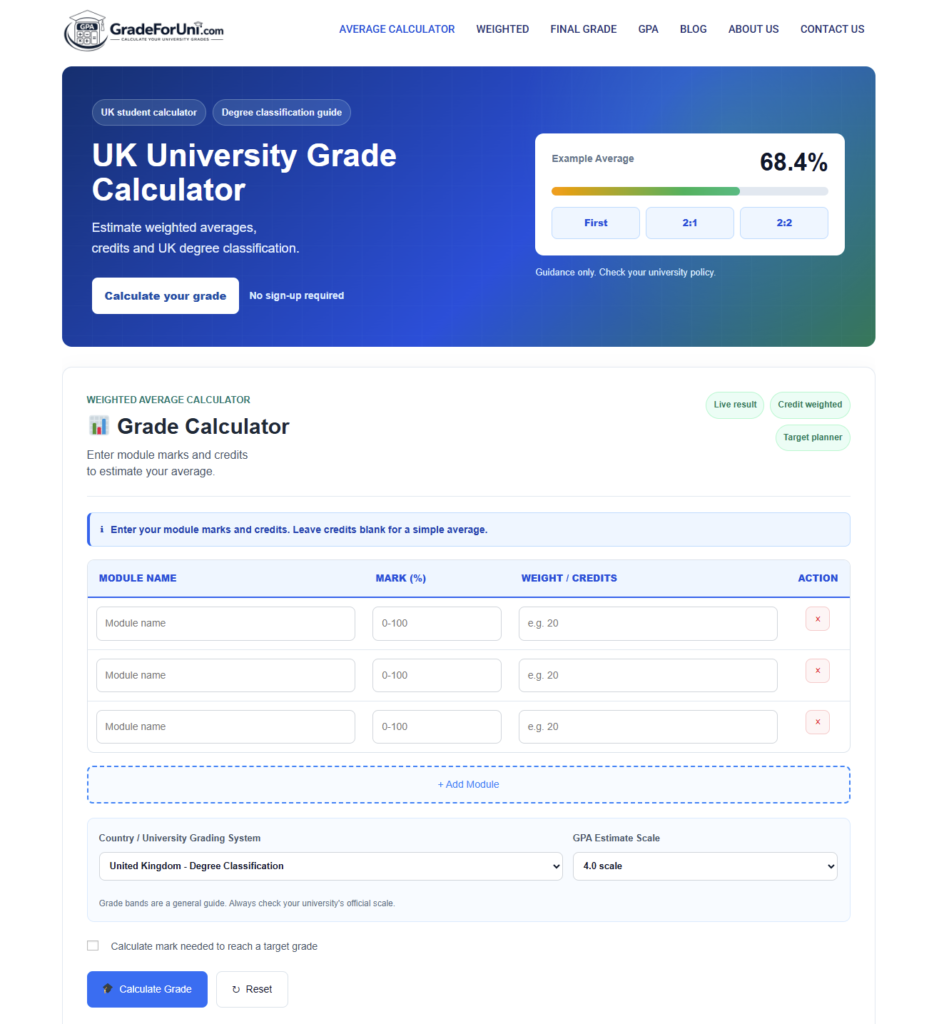
How to Use the UK University Grade Calculator
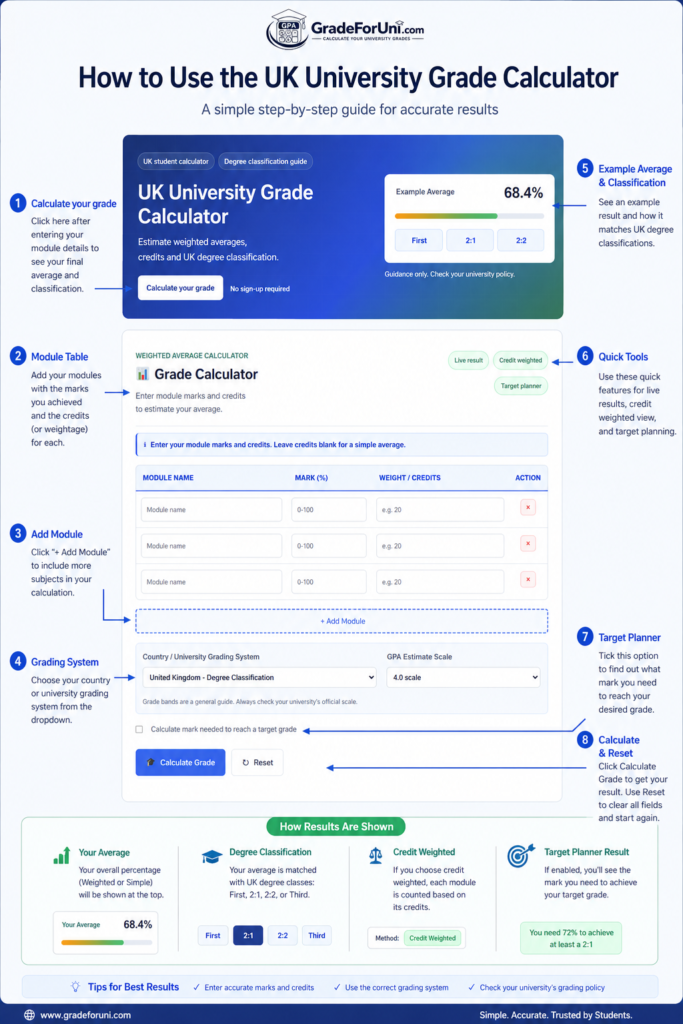
Check Your University Results Instantly
Not sure if your marks are enough to pass? Use our University Grade Calculator to calculate your final grade, estimate your final average, and understand your study achievements in just a few clicks. What Is a Passing Grade at University
Quick Answer Box
In most UK universities, the Passing Grade at University for undergraduate students is 40%, while postgraduate students usually need 50% to pass. But pass marks can vary depending on your university, course, or professional validation requirements. What is a Passing Grade at university? Passing a subject also depends on earning the required credits and meeting your university’s assessment regulations.
Read More: Degree Percentage CalculatorWhat Is a Passing Grade at University?
A passing grade is the minimum mark you must achieve to complete a university assessment, module, or course. Once you achieve this minimum requirement, you normally receive the study credits attached to that module.
Passing does not necessarily mean you’ve achieved a high mark. It simply means you’ve met the university’s minimum academic standard.
Most UK universities divide marks into different classification bands. While these classifications determine the quality of your degree, the pass mark determines whether you have completed your studies for that module.
Understanding the difference between passing and achieving a higher classification is important because many students confuse the two.
Visit Now: Mauricette CalculetteWhat Does “Passing Grade” Mean?
A passing grade means you have demonstrated enough understanding of the subject to meet the learning outcomes set by your university. What Is a Passing Grade at University
To pass, you may need to:
- Achieve the minimum percentage required.
- Complete all compulsory assessments.
- Meet any practical or placement requirements.
- Satisfy your university’s academic regulations.
For example, if your university requires 40% to pass an undergraduate module and you score 45%, you have successfully passed that module and usually receive the associated credits.
However, if you score 39%, you would normally fail unless your university applies compensation or other academic regulations.
What Percentage Is Considered a Pass in the UK?
Although every university sets its own academic regulations, the following pass marks are common across the UK. What Is a Passing Grade at University
| Course Level | Typical Pass Mark |
|---|---|
| Undergraduate Degree | 40% |
| Integrated Master’s (Some Modules) | 40–50% |
| Postgraduate Taught Degree | 50% |
| Postgraduate Research Assessments | Usually 50% or higher |
Some professional programmes, such as medicine, dentistry, nursing, pharmacy, and teaching, may require higher pass marks or additional competency assessments.
Always check your university handbook to confirm the rules for your specific course.
Why Most UK Universities Use a 40% Pass Mark
The 40% undergraduate pass mark has been widely adopted because it reflects the minimum level of knowledge and understanding expected at the university level.
A mark of 40% does not mean you answered only 40% of the questions correctly. University marking often rewards critical thinking, analysis and evidence rather than simple right-or-wrong answers. Because assessments are more demanding than school exams, a score of 40% represents satisfactory achievement of the required learning outcomes.
The exact reasoning behind the pass mark is determined by each institution’s academic standards and quality assurance processes.
What Is the Passing Grade for Undergraduate and Postgraduate Students?
One of the biggest misconceptions among students is that every university course has the same pass mark. In reality, undergraduate and postgraduate programmes often have different academic expectations.
Undergraduate Pass Marks
For most bachelor’s degrees in England, Wales, and Northern Ireland, the standard pass mark is 40%.
If you achieve at least 40% in a module and satisfy any additional assessment requirements, you will usually:
- Pass the module.
- Earn the module credits.
- Progress towards your degree.
- Continue to the next stage of your course, provided you’ve met progression requirements.
Keep in mind that simply passing every module does not guarantee a high degree classification. Your overall average still determines whether you graduate with a First, 2:1, 2:2, or Third-Class Honours degree.
Postgraduate Pass Marks
Master’s degrees are generally more demanding than undergraduate programmes. What Is a Passing Grade at University
For most taught postgraduate courses, the standard pass mark is 50%.
Universities expect postgraduate students to demonstrate:
- Greater depth of knowledge.
- Independent research skills.
- Critical evaluation.
- Advanced academic writing.
- Strong analytical thinking.
Because of these higher expectations, a mark that would be considered a pass at the undergraduate level may not be enough for a postgraduate student.
Are Pass Marks the Same at Every UK University?
No.
While many universities follow similar academic standards, each institution publishes its own regulations covering:
- Pass marks.
- Credit requirements.
- Progression rules.
- Resit opportunities.
- Compensation policies.
- Degree classification methods.
Professional accreditation bodies may also impose additional requirements for certain courses.
For example, a nursing student may need to pass both academic assessments and practical placements before progressing.
This is why you should always refer to your university’s official academic regulations rather than relying solely on general guidance.
Comparison Table: Undergraduate vs Postgraduate Pass Marks
| Feature | Undergraduate | Postgraduate |
|---|---|---|
| Typical Pass Mark | 40% | 50% |
| Academic Level | Bachelor’s Degree | Master’s Degree |
| Assessment Difficulty | Moderate | Advanced |
| Independent Research | Limited | Extensive |
| Dissertation Expectations | Final Year | Usually Required |
| Critical Analysis | Important | Essential |
UK University Degree Classification Explained
Passing a module and earning a degree classification are two different things.
A pass simply means you’ve met the minimum requirement for a module. What is a Passing Grade at University? Your degree classification reflects your overall academic performance across your course.
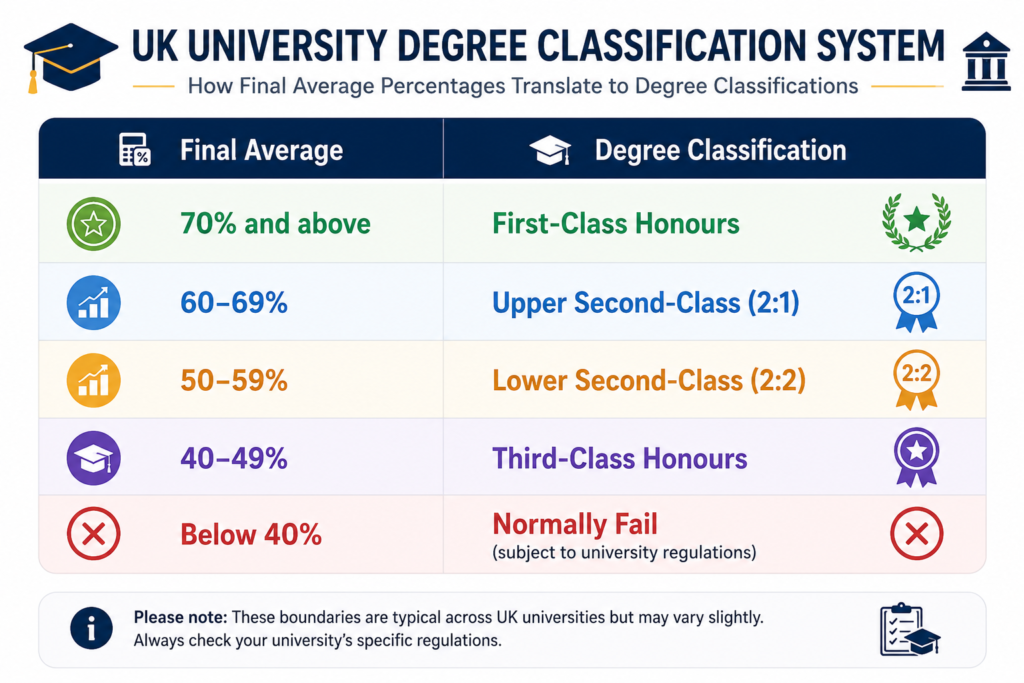
Most UK universities award honours degrees using the following classification system.
First-Class Honours
Percentage: 70% and above
A First-Class Honours degree is the highest undergraduate classification.
Students achieving this level consistently demonstrate:
- Excellent subject knowledge.
- Outstanding critical thinking.
- Original analysis.
- High-quality research.
- Exceptional academic writing.
Many competitive graduate employers and postgraduate programmes value applicants with First-Class degrees, although experience and practical skills remain equally important.
Upper Second-Class (2:1)
Percentage: 60–69%
The Upper Second-Class Honours degree, commonly known as a 2:1, is one of the most sought-after classifications.
Many graduate schemes list a 2:1 as their preferred minimum requirement.
Students achieving a 2:1 typically demonstrate:
- Strong understanding of the subject.
- Good analytical ability.
- Consistent academic performance.
- Effective problem-solving skills.
A 2:1 also meets the entry requirements for many postgraduate courses.
Lower Second-Class (2:2)
Percentage: 50–59%
A Lower Second-Class Honours degree remains a respected qualification.
Graduates with a 2:2 continue to access many career opportunities, although some competitive graduate programmes may require a higher classification.
Strong work experience, internships, and transferable skills can often strengthen your applications.
Third-Class Honours
Percentage: 40–49%
A Third-Class Honours degree represents the minimum honours classification.
Although it is the lowest honours award, it still confirms successful completion of an honours degree.
Graduates with a Third-Class degree often continue into employment, professional qualifications or further study depending on individual university requirements.
Ordinary Degree
Some universities may award an Ordinary Degree if a student does not meet the full honours requirements but has completed sufficient credits. What Is a Passing Grade at University
Unlike an honours degree, an Ordinary Degree does not include an honours classification.
Comparison Table: Percentage vs Degree Classification
| Final Average | Degree Classification |
|---|---|
| 70% and above | First-Class Honours |
| 60–69% | Upper Second-Class (2:1) |
| 50–59% | Lower Second-Class (2:2) |
| 40–49% | Third-Class Honours |
| Below 40% | Normally Fail (subject to university regulations) |
Does Passing a Module Mean You Pass the Entire Year?
Not necessarily. Passing individual modules is important, but universities usually assess your overall academic progress based on both your module results and the number of credits you have earned. What Is a Passing Grade at University
This means you could pass several modules but still be unable to progress if you haven’t achieved the minimum credit requirement for your course. Likewise, some universities allow students to continue even if they fail one module, provided they meet specific progression rules.
Understanding how modules, credits, and progression work together can help you avoid unexpected problems at the end of the academic year.
Module Pass Marks
A university module is an individual unit of study that contributes towards your overall degree. Each module has its own assessments, such as:
- Written examinations
- Coursework
- Essays
- Presentations
- Group projects
- Practical assessments
- Laboratory work
- Dissertations (for some courses)
Most undergraduate modules require a minimum mark of 40% to pass, while postgraduate modules generally require 50%.
However, some modules include additional conditions. For example, you may need to:
- Pass both the exam and coursework separately.
- Complete mandatory practical assessments.
- Attend placements or clinical sessions.
- Meet professional competency standards.
Failing one compulsory assessment may result in failing the entire module, even if your overall average appears to be above the pass mark.
Passing Credits vs Passing Modules
Passing a module usually means you earn the credits assigned to that module. What Is a Passing Grade at University
Credits measure the amount of learning completed rather than simply the marks achieved.
A typical UK bachelor’s degree follows this structure:
| Study Level | Typical Credits |
|---|---|
| Year 1 (Level 4) | 120 Credits |
| Year 2 (Level 5) | 120 Credits |
| Year 3 (Level 6) | 120 Credits |
| Total Degree | 360 Credits |
Imagine a student studies six modules worth 20 credits each.
| Module | Credits | Result |
|---|---|---|
| Business Management | 20 | Pass |
| Marketing Principles | 20 | Pass |
| Economics | 20 | Pass |
| Accounting | 20 | Fail |
| Business Law | 20 | Pass |
| Digital Skills | 20 | Pass |
The student has:
- Passed 5 modules
- Failed 1 module
- Earned 100 credits
- Missed 20 credits
Although the majority of modules were passed, the student may still need to resit the failed module to complete the missing credits.
Credit Requirements for Progression
Each university sets its own progression rules, but many undergraduate students must complete around 120 credits per academic year. What Is a Passing Grade at University
If you do not achieve the required number of credits, your university may allow you to:
- Take a resit assessment.
- Resubmit coursework.
- Repeat the failed module.
- Repeat the academic year.
- Progress with outstanding credits (in limited situations).
The exact outcome depends on your university’s academic regulations.
Comparison Table: Module Result vs Academic Outcome
| Module Result | Typical Outcome |
|---|---|
| Pass all modules | Progress to next year |
| Fail one module but pass resit | Continue after earning missing credits |
| Fail one module without compensation | Resit or repeat module |
| Fail several modules | Progression reviewed by the examination board |
| Fail compulsory practical assessment | May need reassessment regardless of overall average |
[Internal Link: University Credits Calculator]
What Happens If You Fail a University Module?
Failing a university module can feel disappointing, but it does not necessarily mean your degree is over. What Is a Passing Grade at University
Every year, many students fail one or more assessments for reasons such as illness, personal circumstances, poor exam preparation, or simply finding a subject particularly challenging. Universities recognise that setbacks happen and usually provide opportunities to recover.
The outcome depends on factors such as your overall performance, the number of failed modules, and your university’s regulations.
Failing One Assignment
Failing a single assignment does not automatically mean you fail the entire module. What Is a Passing Grade at University
Many modules include several assessments, for example:
- Coursework (40%)
- Mid-term test (20%)
- Final examination (40%)
Failing One Module
If you fail one module, universities commonly offer one of the following options: What Is a Passing Grade at University
- Resit the examination.
- Resubmit coursework.
- Repeat the module.
- Receive compensation (where applicable).
Which option applies depends on:
- Your overall average.
- Your course regulations.
- Whether the failed module is compulsory.
- The number of credits affected.
Many students successfully recover from failing a single module and continue their degree without major delays.
Failing Multiple Modules
Failing several modules usually has more serious consequences.
Possible outcomes include:
- Multiple resits.
- Repeating the academic year.
- Temporary suspension.
- Withdrawal from the programme in exceptional cases.
Your examination board will normally review your academic record before making a decision.
Universities often consider:
- Previous academic performance.
- Mitigating circumstances.
- Attendance.
- Professional course requirements.
- Remaining credits.
Can You Still Progress to the Next Year?
In many cases, yes.
Some universities allow progression if:
- You have earned enough credits.
- Your failed module qualifies for compensation.
- You complete a resit.
- The examination board approves progression.
However, professional courses such as nursing, medicine, pharmacy and teaching often have stricter progression rules because graduates must meet external professional standards.
University Resits and Capped Marks Explained
Resits are designed to give students another opportunity to demonstrate that they have achieved the required learning outcomes. What Is a Passing Grade at University
Although many students worry that a resit will permanently damage their academic record, understanding how reassessments work can help you plan your next steps more confidently.
What Is a Resit?
A resit is another attempt at completing an assessment you previously failed.
Depending on the module, this may involve:
- Sitting another examination.
- Completing new coursework.
- Repeating a presentation.
- Undertaking another practical assessment.
Resits are normally held during the summer assessment period, although some universities schedule them at other times of the academic year.
Are Resit Marks Capped?
In many undergraduate programmes, yes. What Is a Passing Grade at University
If you fail a module on your first attempt but later pass the resit, your recorded mark may be capped at the minimum pass mark.
For example:
| Original Mark | Resit Score | Recorded Mark |
|---|---|---|
| 35% | 68% | 40% |
Although you achieved 68% during the resit, your transcript may record only 40% because university regulations treat the reassessment as a second attempt.
However, there are important exceptions.
Some universities do not cap marks when:
- Mitigating circumstances are approved.
- The original assessment attempt was missed due to authorised reasons.
- Specific postgraduate regulations apply.
Always check your institution’s reassessment policy.
What Happens If You Fail a Resit?
Failing a resit can lead to several possible outcomes depending on university regulations.
These may include:
- Repeating the module.
- Repeating the academic year.
- Receiving an exit qualification.
- Leaving the programme if progression requirements cannot be met.
Professional programmes often have stricter reassessment limits than standard undergraduate degrees.
Can a Resit Affect Your Degree Classification?
Yes, although the impact varies. What Is a Passing Grade at University
If your resit mark is capped, it may reduce your final average because only the capped mark contributes towards your classification.
However, successfully completing the resit allows you to:
- Earn the required credits.
- Continue your studies.
- Remain eligible to graduate.
Passing a resit is almost always preferable to leaving the module incomplete.
Worked Example
Lucy receives:
- Original Exam: 33%
- Summer Resit: 72%
Because her university applies capped reassessments, the official mark recorded is 40%.
Although Lucy demonstrated much stronger knowledge during the resit, her transcript reflects the capped pass mark. Even so, she earns the module credits and progresses to her final year.
Compensation and Condonement Explained
Many students assume that failing a module automatically means repeating the year. In reality, some UK universities have academic policies that allow students to progress even if they have not passed every assessment. What Is a Passing Grade at university? Two of the most common policies are compensation and condonation.
What Is Compensation?
Compensation allows a university to award the credits for a failed module when a student’s overall academic performance shows they have met the required standard elsewhere. What Is a Passing Grade at University
In simple terms, the university recognises that one slightly weaker result should not necessarily prevent a capable student from progressing. What Is a Passing Grade at University
Compensation is often considered when:
- The failed mark is only slightly below the pass mark.
- Your overall average is strong.
- You have passed most of your other modules.
- The failed module is not professionally regulated.
- The examination board believes you have achieved the programme’s learning outcomes overall.
For example, if your university allows compensation for marks between 35% and 39%, a score of 38% may still earn you the credits without requiring a resit.
This decision is never automatic. It is normally made by the university’s examination board after reviewing your complete academic record.
What Is Condonement?
Condonement is another academic process used by some universities. What Is a Passing Grade at University
Instead of awarding credits because your overall performance compensates for the failed mark, condonation means the university decides to overlook a minor failure because it does not significantly affect your ability to complete the programme.
Condonement is usually applied only in limited circumstances and may be subject to conditions such as:
- A small credit deficit.
- A mark close to the pass threshold.
- Strong performance in other modules.
- No professional accreditation restrictions.
Not every university uses condonation, and those that do often apply strict limits.
When Can Universities Allow Compensation?
Universities usually consider compensation only if several conditions are met. What Is a Passing Grade at University
Common requirements include:
- Your overall average meets the required level.
- The failed mark falls within the compensation range.
- You have attempted all assessments.
- The module is eligible for compensation.
- You have not exceeded the maximum number of compensable credits.
Even if these conditions are satisfied, the final decision rests with the examination board.
Courses Where Compensation May Not Apply
Some degree programmes have strict professional standards that prevent universities from using compensation. What Is a Passing Grade at University
Examples include:
- Medicine
- Dentistry
- Nursing
- Midwifery
- Pharmacy
- Veterinary Science
- Teaching programmes with professional accreditation
In these courses, every essential competency must usually be passed individually to ensure graduates meet professional requirements.
Quick Summary
Compensation and condonement can help some students progress despite a failed module, but they are exceptions rather than guarantees. Always read your university’s academic regulations before assuming these policies apply to your course.
How Your Final Degree Classification Is Calculated
Passing your modules is only one part of earning a university degree. Your final classification depends on how your marks are combined across different years of study.
Many students are surprised to learn that first-year marks often contribute little—or nothing—to their final degree classification, while later years usually carry much greater weight.
Understanding how your classification is calculated can help you prioritise your efforts throughout your course.
Module Weightings
Every module has a specific credit value and contributes proportionally to your overall average.
For example:
| Module | Credits | Mark |
|---|---|---|
| Business Strategy | 20 | 68% |
| Marketing | 20 | 62% |
| Finance | 20 | 71% |
| Economics | 20 | 64% |
| Operations | 20 | 66% |
| Dissertation | 40 | 73% |
Because the dissertation is worth 40 credits, it contributes twice as much to the final average as a standard 20-credit module.
This is why performing well in high-credit modules can significantly improve your overall classification.
Year Weightings
Many UK universities place greater emphasis on your later years of study. What Is a Passing Grade at University
A common weighting structure is:
| Academic Year | Contribution to Final Degree |
|---|---|
| Year 1 | 0% (Progression only) |
| Year 2 | 30% |
| Final Year | 70% |
Some universities use different weighting systems, such as:
- 25% / 75%
- 40% / 60%
- Equal weighting across all years
Always check your course handbook for the exact calculation method.
Borderline Classifications
Sometimes a student’s final average falls just below the next classification boundary. What Is a Passing Grade at University
For example:
- 59.8%
- 69.7%
- 49.9%
- Performance in higher-level modules.
- Final-year improvement.
- Number of credits achieved within the higher classification.
- Overall academic profile.
This means two students with the same average may receive different outcomes depending on their university’s regulations.
Formula Box
Weighted Average Formula
Final Average = (Year 2 Average × Year 2 Weight) + (Final Year Average × Final Year Weight)
If module weightings are used:
Weighted Module Mark = (Module Mark × Module Credits) ÷ Total Credits
Worked Example
Sophie receives:
| Academic Year | Average | Weight |
|---|---|---|
| Year 2 | 63% | 30% |
| Final Year | 71% | 70% |
Calculation:
(63 × 0.30) + (71 × 0.70)
= 18.9 + 49.7
= 68.6%
Sophie’s final classification is likely to be an Upper Second-Class Honours (2:1).
If her university has a generous borderline policy, the examination board may review whether she qualifies for a First-Class degree, depending on her academic profile.
[Internal Link: Weighted Average Calculator]
Worked Examples of Passing Grades at University
UnderWorked Example 1: Passing with the Minimum Mark. What Is a Passing Grade at University
| Item | Result |
|---|---|
| Student | James |
| Module Credits | 20 |
| Module Mark | 40% |
| Outcome | Passed the module |
| Credits Earned | 20 Credits |
| Progression | Continues towards completing the academic year |
Worked Example 2: Missing the Pass Mark
| Item | Result |
|---|---|
| Student | Hannah |
| Exam Mark | 39% |
| Outcome | Normally fails the module |
| Possible Next Step | May qualify for compensation (if allowed) or complete a resit |
| Key Point | One percentage point can make a significant difference |
Worked Example 3: Failing One Module
| Item | Result |
|---|---|
| Student | Omar |
| Modules Passed | 5 |
| Modules Failed | 1 (36%) |
| Credits Earned | 100 out of 120 |
| Next Step | Summer resit |
| Final Outcome | Progresses after passing the reassessment |
Worked Example 4: Passing Coursework but Failing the Exam
| Assessment | Mark |
|---|---|
| Coursework | 74% |
| Examination | 28% |
| Overall Average | 51% |
| University Rule | Minimum 40% required in the final exam |
| Final Outcome | Failed the module despite an overall average above 50% |
Worked Example 5: Master’s Student Scores 49%
| Item | Result |
|---|---|
| Student | Michael |
| Course | Taught a Master’s Degree |
| Final Module Mark | 49% |
| Required Pass Mark | 50% |
| Outcome | Failed the module |
| Next Step | Eligible for reassessment |
| Credits Awarded | Not awarded until reassessment is passed |
Worked Example 6: Successful Resit
| Item | Result |
|---|---|
| Original Mark | 34% |
| Resit Mark | 67% |
| University Policy | Resit marks capped at 40% |
| Recorded Mark | 40% |
| Credits Earned | Yes |
| Progression | Student progresses to the next stage |
Worked Example 7: Calculating a Weighted Average
| Module | Credits | Mark |
|---|---|---|
| Module A | 20 | 64% |
| Module B | 20 | 58% |
| Module C | 20 | 72% |
| Module D | 20 | 61% |
| Module E | 20 | 69% |
| Dissertation | 40 | 74% |
| Total Credits | 140 | — |
Key Point: The dissertation is worth 40 credits, so it contributes twice as much to the final average as each 20-credit module.
Worked Example 8: Borderline Degree Classification
| Item | Result |
|---|---|
| Final Average | 69.8% |
| Initial Classification | Borderline First-Class |
| Credits Above 70% | 80 Credits |
| Final-Year Performance | Strong |
| Dissertation Mark | Excellent |
| Possible Outcome | The examination board may award a First-Class Honours degree if the university’s borderline regulations apply |
Class Honours degree if the university’s borderline regulations are met
Expert Tips for Passing University Successfully
Achieving a pass is only the first step. These practical tips can help you improve your academic performance throughout your degree. What Is a Passing Grade at University
Understand the Assessment Criteria
Before starting any assignment, carefully read the marking criteria.
Knowing exactly what lecturers expect often improves marks more than simply spending additional hours studying.
Aim Higher Than the Minimum Pass Mark
Although 40% may be enough to pass an undergraduate module, aiming for 60% or above provides much greater flexibility if one assessment goes badly.
Higher marks also improve your final degree classification.
Track Your Progress Regularly
Don’t wait until results day.
Calculate your average after each assessment so you always know where you stand academically.
Using a university grade calculator can make this much easier.
Learn How Credits Affect Your Degree
Understanding your course structure helps you prioritise important modules.
A 40-credit dissertation usually has a much bigger impact than a standard 20-credit module.
Start Preparing Early for Exams
Leaving revision until the final week often increases stress and reduces performance.
Creating a realistic study timetable several weeks before exams usually leads to better results
Frequently Asked Questions
What is a passing grade at university in the UK?
For most undergraduate degrees in the UK, the standard passing grade is 40%. Most taught postgraduate courses require 50% to pass. However, individual universities and professional courses may have different regulations.
Is 40% always considered a pass?
Not always. While 40% is the typical undergraduate pass mark, some modules require you to pass individual assessments, practical work or professional competencies separately. Always check your university’s assessment regulations.
Is 50% the passing grade for a master’s degree?
Yes, most taught master’s programmes require students to achieve at least 50% to pass a module. Some universities may set higher requirements for certain courses or dissertations.
Can I graduate if I fail one module?
In many cases, yes. Depending on your university’s regulations, you may be offered a resit, receive compensation or complete the module later. The outcome depends on your course structure, the number of credits involved, and your overall academic performance.
What happens if I fail a university exam?
Failing an exam does not automatically mean you fail the entire module. If the module includes coursework or other assessments, your overall average may still meet the pass requirement. Otherwise, you may be offered a reassessment or resit
Can I resit a failed university exam?
Most UK universities allow students to resit failed assessments. The reassessment may take place during the summer or another scheduled assessment period. Your university will explain the process and deadlines.
Are resit marks capped?
Many undergraduate programmes cap successful resit marks at the minimum pass mark, usually 40%. However, some universities make exceptions for approved mitigating circumstances or specific postgraduate regulations.
Do all UK universities have the same pass mark?
No. Although many universities follow similar grading systems, each institution has its own academic regulations covering pass marks, progression, compensation, resits, and degree classifications.
Can coursework help me pass a module?
Yes, if the module uses multiple assessments. Strong coursework marks can improve your overall average. However, some modules require students to pass both coursework and examinations separately.
How many credits do I need to progress?
Most undergraduate students need to complete 120 credits each academic year. Some universities may allow progression with a small credit shortfall, while others require all credits to be completed before progressing.
What is compensation at university?
Compensation is an academic policy that allows students to receive credits for a narrowly failed module if their overall academic performance meets certain conditions. The exact rules vary between universities.
What is condonation?
Condonement allows some universities to overlook a minor failure when it does not significantly affect the learning outcomes of the programme. Not every university uses this policy.
Conclusion
Understanding the Passing Grade at University is about much more than knowing that 40% is usually a pass. What Is a Passing Grade at University? Your academic progress also depends on factors such as module requirements, credit accumulation, assessment weightings, resit policies, and your university’s individual regulations. What Is a Passing Grade at University
For most undergraduate students, achieving 40% means successfully passing a module, while postgraduate students generally need 50%. What Is a Passing Grade at University? However, this is only one part of the picture. Knowing how degree classifications are calculated, how compensation works, and what happens after a failed assessment can help you make better academic decisions throughout your studies. What Is a Passing Grade at University
If you’re unsure where you currently stand, don’t wait until your final results are released. Regularly calculating your averages, tracking your credits, and understanding your university’s assessment rules can help you identify potential issues early and improve your chances of achieving your target classification.
Whether you’re aiming simply to pass or working towards a First-Class Honours degree, staying informed is one of the best ways to reduce stress and take control of your academic journey. What Is a Passing Grade at University
If you want a clearer picture of your progress, try our University Grade Calculator and related tools to estimate your results, monitor your averages, and plan your next steps with confidence. What Is a Passing Grade at University