

How Are Music Degrees Graded in the UK? [2026]
On most UK degrees, your final classification is decided by exams and essays you can revise for and redraft. On a music degree, the decisive moment can be forty minutes in front of three people you may never have met – and at the Royal Academy of Music, failing that one final recital can cost you your honours degree entirely, whatever your average says. Music is the subject where a single performance can carry a fifth of your whole degree classification, where marks are agreed by panel discussion rather than single markers, and where choosing a dissertation over a recital in your final year can swing your class.
This guide explains how music degrees are graded across UK universities and conservatoires: how recital panels actually mark you, which year weightings decide your classification, the must-pass rules that fail students with passing averages, and the final-year assessment choice that can move your degree by a full class. Every rule below comes from a published regulation or programme handbook – and the worked examples use the real arithmetic those rules produce.
The honest starting point is that a music degree has no single grading machine. A BA Music at Bristol can legally contain zero per cent performance, while a MusB at Manchester can let two-thirds of your final year be recitals, and a BMus at the Royal Academy of Music runs principal study through technical testing, chamber music and a three-examiner final recital panel. The same classification bands – 70, 60, 50, 40 – apply everywhere, but almost nothing else is the same. So the first skill is learning which machine you are inside.
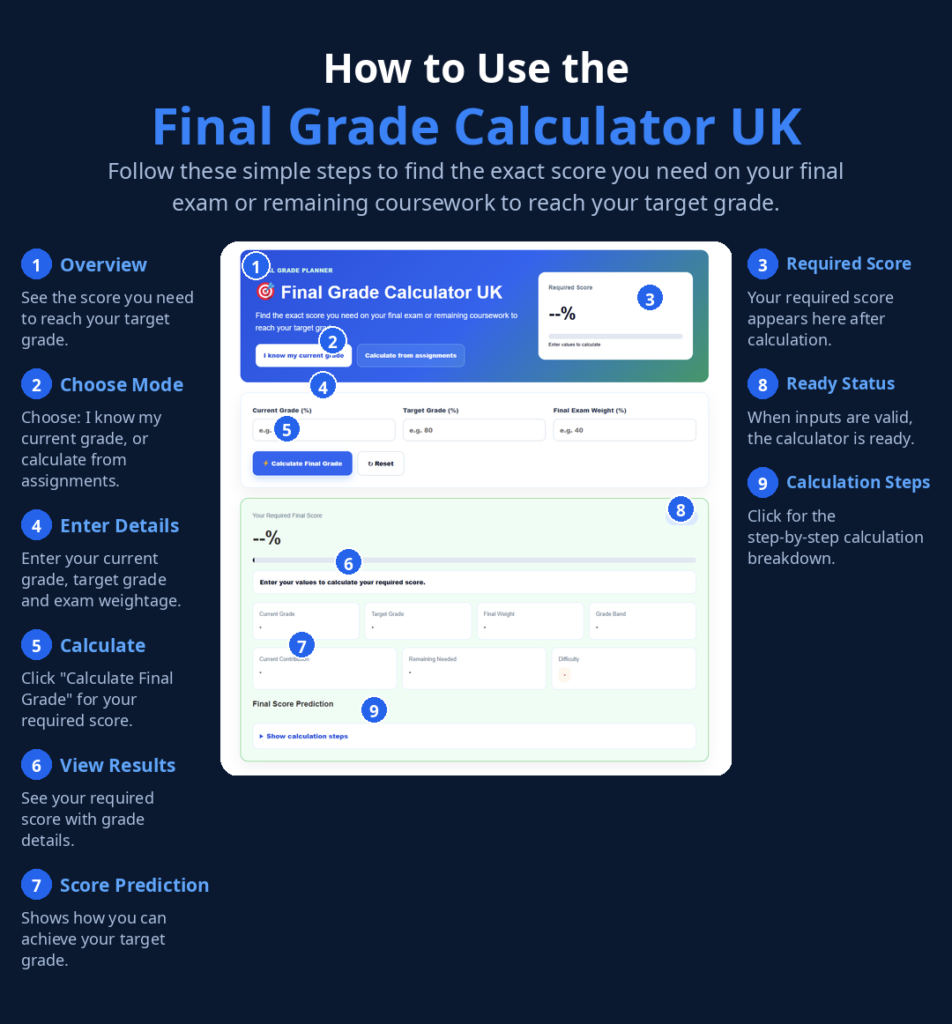
Click Here: Final Grade Calculator UK
Where music degree marks actually come from
Six assessment types appear across UK music degrees, in wildly different proportions:
| Assessment type | What it usually looks like | Typical share of a year |
|---|---|---|
| Solo recital / performance | 10-45 minute assessed performance, live panel | 0-67% |
| Composition / techniques portfolio | Portfolio of original works, sometimes with commentary | 0-33% |
| Written essays and analysis | 2,000-7,000 word essays, analysis papers, takeaway exams | Varies |
| Aural and musicianship tests | Practical aural exams, sight-singing, keyboard skills | Small |
| Dissertation / long project | 5,000-7,000 words, or a 40-credit project | 0-33% |
| Ensemble / participation | Orchestra, choir, chamber; attendance and engagement | 0-10% |
The spread is the story. Manchester’s MusB lets you take two 40-credit recitals in final year – 80 of 120 credits, two-thirds of the year, decided on stage. Durham gives you a 40-credit performance project (a 40-minute recital) worth a third of your final year. Bristol, by contrast, makes performance entirely optional: nobody is forced to perform at all, and the final year can be 40 credits of solo recital or none of it. A music degree is not one degree – it is a menu, and the marks distribution you choose is one of the biggest grade decisions you will make.
How your final recital is actually marked
At conservatoires, the panel is the instrument of judgment. The Royal Academy of Music’s examiner guidelines spell out the constitution: Year 1 recitals get a single examiner; Years 2 and 3 get two (a chair plus one other); final recitals get three – a chair drawn from senior staff, a specialist external assessor from outside the Academy who specialises in the instrument, and one further examiner. Timpani and percussion finals get four. The Royal Northern College of Music’s BMus programme specification confirms the same pattern: final recitals are marked by a panel of three.
The procedure matters as much as the people. Both the Academy and the RNCM require examiners to submit blind marks first, then discuss to reach an agreed mark. The Academy’s guidelines add sharp edges: marks are agreed at the end of each recital and earlier candidates’ marks cannot be revisited mid-session; a student’s own teacher, if on the panel, speaks last and only after slips are submitted; and the student is marked solely on the actual work submitted – the year’s profile and reputation must not enter the discussion. Marks stay provisional until the Examination Board ratifies them.
What are they listening for? Universities publish criterion-referenced descriptors, and York’s module learning outcomes name presentation and communication with a live audience alongside technique and musicianship. The five dimensions every UK musician meets in graded exams – pitch, time, tone, shape, performance (accuracy, rhythm and tempo, sound quality, musical shaping, and communication) – are the working vocabulary markers think in, even at degree level. Programme craft counts too: the Royal College of Music’s guidance lets examiners stop candidates mid-piece to fit the time, and timings run from first note to last – programming a recital you cannot finish is a marking event, not a scheduling one.
And the marks are moderated hard. The Academy treats a moderated 69, 59, 49 or 39 as not deserving the class above – the opposite of a gift at the boundary. Royal Holloway instructs its examiners to use the full 100-point scale, avoid bunching, and take special care at class borderlines and 1% below them. Where panels cannot agree, external examiners arbitrate. None of this is visible from the corridor outside the exam room, which is why students consistently underestimate how formal recital marking is.
The must-pass rule that can fail a 2:1 student
Here is the rule with the sharpest teeth in UK music grading. The Royal Academy of Music’s regulations state it plainly: a student who fails the final recital component of Principal Study 4 is ineligible for either an honours or an ordinary degree. Not capped, not compensated – ineligible. An average in the 60s does not save you.
The RNCM is nearly as strict in a different way: its BMus programme specification states there is no compensation on the programme at all. Fail a module and you retake it; the mark does not get absorbed by a good average.
Universities are kinder but not soft. York allows up to 40 credits of compensation, but only for marks above 30 and only if nothing else is failing – and individual modules can be designated non-compensatable. Durham caps compensation at 40 credits across Levels 2 and 3. Resits at York are capped at the pass mark, so a failed recital retaken and passed with a true 65 still enters your average as 40.
| Institution | If you fail a recital component |
|---|---|
| Royal Academy of Music | Final recital of Principal Study 4: no honours or ordinary degree |
| RNCM | No compensation anywhere; retake required |
| York | Up to 40 credits compensated if mark above 30; resits capped at 40 |
| Durham | Up to 40 credits compensated across Levels 2 and 3 |
The practical lesson: find out in week one whether your recitals are must-pass, compensatable, or neither. It is the single most consequential line in your programme handbook – and our guide to condoned passes explains how compensation works across UK universities.
What actually counts toward your class: year weightings
First year almost never counts. After that, every institution picks its own ratio, and the ratio decides how much your final-year recital matters:
| Institution | Year weighting | What it means |
|---|---|---|
| Durham | 2:3 (Level 2 : Level 3) | Final year = 60% of your degree |
| York | 2:3 (Stage 2 : Stage 3) | Final year = 60% of your degree |
| Bristol (Faculty of Arts) | 0:40:60 (Y1:Y2:Y3) | Final year = 60%; Year 1 = 0% |
| RNCM | 1:2 (Year 3 : Year 4) | Final year = two-thirds of classification |
| Royal Academy of Music | 1:2:3 (L5 : B3 : B4) | Final year = half of classification |
Borderlines are handled differently too. Durham’s board can consider a discretionary uplift if you land within two marks of a boundary – a 58 or 59 can be looked at for a 2:1, but it is a board decision, not a right. Bristol rounds your programme mark to the nearest integer before the borderline check, then applies a secondary rule: you only get the higher class if at least half your weighted credits sit at that class. The Academy rounds .5 up. Our guide to how UK universities round marks walks through borderline rules across the sector, and the Degree Classification Calculator will run your own numbers through your weighting.
One structural quirk worth knowing: the Royal College of Music’s own degree outcomes statement notes that conservatoires award a strikingly high proportion of firsts – 54.2% of its 2023 BMus graduates got a First, 37.5% a 2:1. That is not evidence of easy marking; it is evidence of selection. These are cohorts admitted by audition at Grade 8 standard or above.

Worked example 1: a final year built around one recital
Maya studies BA Music at Durham, where classification is the credit-weighted mean of module marks from Level 2, with Level 2 and Level 3 weighted 2:3. Her Year 2 average is 62.0. In Year 3 she takes the 40-credit performance project – a 40-minute solo recital – plus four 20-credit modules:
| Module | Credits | Mark |
|---|---|---|
| Performance project (recital) | 40 | 68 |
| Musicology option | 20 | 58 |
| Analysis | 20 | 64 |
| Ethnomusicology | 20 | 55 |
| Orchestration | 20 | 61 |
Year 3 average: (68 x 40) + (58 x 20) + (64 x 20) + (55 x 20) + (61 x 20) = 2,720 + 1,160 + 1,280 + 1,100 + 1,220 = 7,480; 7,480 / 120 = 62.33. Degree aggregate: (2 x 62.0 + 3 x 62.33) / 5 = (124.0 + 186.99) / 5 = 310.99 / 5 = 62.20 – a 2:1. Now the recital’s leverage: it contributes (68 x 40 / 120) x 0.6 = 13.6 points of the final 62.2. More than a fifth of Maya’s entire degree came from forty minutes on stage.
The counterfactual is brutal. If the recital goes badly – 52 instead of 68 – Year 3 becomes 6,840 / 120 = 57.0, and the degree becomes (124.0 + 171.0) / 5 = 295.0 / 5 = 59.0: a 2:2. A sixteen-mark swing on one performance moves the degree class. Durham’s board could consider the 59.0 for a discretionary uplift, since it sits within two marks of the 60 boundary – but that is a discussion, not an entitlement.
Worked example 2: the must-pass recital that fails
Daniel is a BMus student at the Royal Academy of Music, where classification comes from Levels 5, B3 and B4 weighted 1:2:3. His averages: Level 5 = 58, Level B3 = 64, and Level B4 is strong across the board – call it roughly 60 – except the final recital component of Principal Study 4, which he fails with 35.
Without the must-pass rule, the arithmetic sits in 2:1 territory: (58 x 1 + 64 x 2 + 60 x 3) / 6 = (58 + 128 + 180) / 6 = 366 / 6 = 61.0. With the rule, the arithmetic is irrelevant: failing the final recital component of Principal Study 4 makes a student ineligible for an honours or an ordinary degree. The Academy’s regulations define referral as the retake route for failure – the detail of when and how is an exam-board matter – but the headline stands: no average, however strong, overrides a must-pass component.
Contrast that with York, where the same 35 on a 20-credit recital could be compensated – credit awarded, the 35 staying in the average – provided nothing else is failing and the total compensated credit stays within 40. Fail it with a 25 and compensation is off the table: reassessment is required, and the resit mark is capped at the pass mark of 40 for classification purposes. Same instrument, same bad day, completely different machinery.
The final-year choice that can move your class
Most university music departments force a version of the same decision in final year: recital, dissertation, or composition portfolio – and each carries a different risk profile. Manchester’s MusB lets you build up to 80 of your 120 final-year credits from recitals; Durham’s compulsory 40-credit project can be a recital, a dissertation, a composition portfolio or a techniques portfolio; Birmingham’s final year runs on 40-credit special subjects; Edinburgh requires at least one of dissertation, recital, composition portfolio or creative project in Year 4; York’s final recital even offers a hedged option – a shorter 30-35 minute recital worth 80% plus a 2,500-3,000 word essay worth 20%.
| Choice (40 credits) | Best for | Grade risk |
|---|---|---|
| Solo recital | Strong performers; one big mark | High variance – one bad day |
| Dissertation | Strong writers; steady accumulators | Lower variance; draftable |
| Composition portfolio | Creators; iterative workers | Medium; portfolio spreads risk |
The arithmetic of a wrong choice: take a Durham student whose final year is 40 credits of recital at 55 versus the same 40 credits as a dissertation at 68. The 13-mark gap on 40 credits is 13 x 40 / 120 = 4.33 points on the year average – and with the 2:3 year weighting, 4.33 x 0.6 is about 2.6 points on the degree. That is more than the distance between a comfortable 2:1 and the borderline. Choose the assessment that fits your strengths, not your identity – the panel marks the work, not the person.
Seven mistakes that cost music students real marks
These are not practice tips. Each one has a documented grading consequence.
| Mistake | What it costs |
|---|---|
| 1. Missing admin deadlines | Durham’s Performance 2 docks 5% from the practical exam mark if the signed repertoire list is late. Royal Holloway’s performance courses require programme notes and concert diaries to hit in-course deadlines to qualify for final submission. |
| 2. Treating the academic add-ons as decoration | Northumbria’s Recital 2 is 30% lecture recital and 70% public recital; the Royal Welsh College’s final recital is 90% performance and 10% programme materials; York’s shorter-recital option makes a 2,500-3,000 word essay worth 20% of the module. The notes are marks. |
| 3. Skipping ensemble rehearsals | Durham’s Performance 2 scales the practical mark by engagement, from no deduction for excellent participation to a 5% deduction for none. Attendance is assessment. |
| 4. Banking on your year profile | The Academy’s examiner guidelines are explicit: students are marked solely on the actual work submitted, and the year’s profile must not be taken into consideration. A bad forty minutes cannot be rescued by a good year – and personal circumstances must not enter the panel’s discussion; those go through the separate extenuating-circumstances system. |
| 5. Confusing practice with assessment | Principal study builds across the year through technical testing and chamber music, but the graded event is the year-end recital exam. Formative performances – Northumbria’s in-class performances with peer feedback, York’s programme-proposal task – carry no marks but feed the one that does. |
| 6. Running over or under time | Conservatoire timing rules are codified: Guildhall’s MMus regulations deduct a mark per minute for recitals more than five minutes short and five marks for more than five minutes over, with the panel able to terminate; the Royal College of Music measures from first note to last and may stop candidates mid-piece. Rehearse the clock, not just the music. |
| 7. Choosing the wrong final-year assessment | See the recital-vs-dissertation arithmetic above: a 13-mark gap on a 40-credit component is about 2.6 points on a Durham-weighted degree. Pick the assessment that fits your strengths. |
Do you need Grade 8 to study music at university?
Mostly, no – at least not the certificate. Universities test you themselves. The pattern across official entry requirements is consistent:
| Institution | Practical requirement | Theory / academic requirement |
|---|---|---|
| Royal Academy of Music | No ABRSM certificate required; audition is the test | Grade 6 theory recommended if no school music |
| RNCM | Grade 8 standard demonstrated at audition | 2 A-levels at E+, normally incl. music |
| Cambridge | – | A-level Music or ABRSM Grade 8 Theory at Merit |
| Oxford | Interview includes prepared performance piece | AAA with A-level Music, or AAA + Grade 7+ theory |
| Durham | – | AAB incl. Music (Grade 6 theory accepted per course text) |
| Edinburgh | No interview; Grade 8 certificate only for Performance 1 | Demonstrable commitment to music |
The bottom line: audition and interview performance is the practical test at almost every university; theory grades are the thing most often specified on paper; and a Grade 8 practical certificate is a formal requirement mainly at conservatoires. For the admissions side of predicted grades and offers, see our predicted grades guide.
Frequently asked questions
Do I need Grade 8 to study music at university in the UK?
No – not the certificate, in most cases. Universities test your playing themselves through auditions or interview performances. The Royal Academy of Music requires no ABRSM practical certificate at all, and the RNCM asks you to demonstrate Grade 8 standard at audition rather than produce the certificate. Theory grades are the thing most often specified on paper: Cambridge accepts ABRSM Grade 8 Theory at Merit instead of A-level Music, Oxford asks for Grade 7+ theory if your school does not offer Music, and Durham’s course text accepts Grade 6 theory. Edinburgh only requires a Grade 8 certificate if you want to enrol on its Performance 1 course. Prepare for the audition, not the certificate.
How are music recitals marked at UK universities and conservatoires?
By panels, using published criteria. The Royal Academy of Music uses three examiners for final recitals – a chair, a specialist external assessor and one other – who submit blind marks and then discuss to reach an agreed mark; the RNCM uses the same panel-of-three, blind-marks-first procedure. You are marked solely on what happens in the room, not your year’s profile, and marks stay provisional until the Examination Board ratifies them. Criteria cover technique, interpretation and presentation, and examiners are told to use the full 100-point scale rather than bunching marks around the middle.
What happens if I fail my final recital?
It depends on your institution’s rules, and they differ sharply. At the Royal Academy of Music, failing the final recital component of Principal Study 4 makes you ineligible for an honours or an ordinary degree – a must-pass rule no average can override. The RNCM allows no compensation anywhere on its BMus. Universities are more flexible: York lets you compensate up to 40 credits of failed modules with marks above 30, and Durham up to 40 credits across Levels 2 and 3 – but resit marks are typically capped at the pass mark of 40, and some modules can be designated non-compensatable. Check your programme handbook’s compensation section in week one.
Can you get a First in a music degree?
Yes – the standard classification bands of 70, 60, 50 and 40 apply to music degrees everywhere, universities and conservatoires alike. Conservatoire cohorts actually achieve a high proportion of firsts: 54.2% of the Royal College of Music’s 2023 BMus graduates got a First, with 37.5% getting a 2:1. That reflects audition-selected cohorts rather than easy marking. At university, your class comes from the same weighted-average machinery as any other degree – Durham and York use a 2:3 Level 2 to Level 3 ratio, Bristol’s Faculty of Arts uses 0:40:60 – with borderline discretion rules on top.
Does first year count toward a music degree classification?
At almost every UK university, no. Durham, York and Bristol all exclude Level 1 from the classification calculation – Durham and York weight Levels 2 and 3 in a 2:3 ratio, Bristol’s Faculty of Arts uses 0:40:60. Conservatoires differ because their degrees are four years: the RNCM weights Years 3 and 4 in a 1:2 ratio, and the Royal Academy of Music weights Levels 5, B3 and B4 in a 1:2:3 ratio. First year still matters for progression – you must pass your credits to move up – but it does not touch your final class.
Is a music degree mostly practical or mostly written?
Your choice, at most universities. Manchester’s MusB lets up to 80 of your 120 final-year credits be recitals; Durham’s 40-credit final project can be a recital, dissertation, composition portfolio or techniques portfolio; Bristol makes performance entirely optional – a music degree with zero per cent performance is possible there. Conservatoire BMus degrees are performance-centred by design, with principal study running through every year. If you are a strong writer, the dissertation route usually has lower mark variance than a single high-stakes recital.
How much does my final-year recital count toward my degree?
A lot. Take a Durham student with a 40-credit recital marked at 68: it contributes (68 x 40 / 120) x 0.6 = 13.6 points of a 62.2 final aggregate – more than a fifth of the degree from one performance. If the same recital scores 52 instead, the degree drops to 59.0, a 2:2. At the RNCM the final year counts for two-thirds of the classification, and at the Academy for half. Work out what your remaining assessments need to be with our Final Grade Calculator UK.
What is the difference between a university music degree and a conservatoire degree?
Universities (BA/BMus at Durham, York, Manchester, Bristol, Oxford, Cambridge) mix academic and practical study and classify with the standard 70/60/50/40 bands, usually excluding first year and allowing some compensation for failed modules. Conservatoires (Royal Academy of Music, RNCM, Royal College of Music, Guildhall) centre the degree on principal study, assess through examiner panels with external assessors, and are stricter: the RNCM allows no compensation and the Academy makes the final recital must-pass. Both award honours classifications; the grading machinery around them is what differs.
Conclusion
Music degrees are graded by panels, not algorithms – but the arithmetic around the panels is unforgiving. A single recital can carry a fifth of your degree, a must-pass component can void a 2:1 average, and the choice between recital and dissertation in final year can move your class by more than two points. The students who do best are not always the best musicians in the room; they are the ones who read the programme handbook, know which components are must-pass, and choose the assessment that fits their strengths.
Three things to do this week: check your year weighting and borderline rules so you know what your remaining marks are worth; find out whether your recitals are compensatable or must-pass; and run your own numbers through our Degree Classification Calculator and Final Grade Calculator UK – including the counterfactual where the big recital goes badly, so the risk is priced in before the performance, not after.
And if you are choosing a course rather than surviving one, the grading structure is part of the choice: a performance-optional degree at Bristol, a recital-heavy MusB at Manchester, and a panel-marked BMus at a conservatoire are three different games wearing the same subject name. Pick the one whose marking machine suits you. This is the seventeenth in our series on how UK degrees are graded by subject.