

How to Calculate What You Need on Your Final Exam [2026]
Every exam season, the same question floods student forums in a dozen wordings: “I got 58 on my coursework, it’s worth 40%, what do I need on the exam to pass?” It is one of the most practical questions in all of university grading — and one of the least taught. Universities publish the weightings in your module handbook and then leave you to do the backward arithmetic yourself, usually at 1am, usually wrong on the first attempt.
This guide does the module-level maths properly. You will get the one-line formula for working out the final exam marks you need for any target, three fully worked examples with every step shown, a lookup table for the most common coursework/exam splits, the must-pass hurdle rules that can fail you even when your average says pass, the three mistakes that break the calculation, and a rescue plan for when the answer comes out above 100. One scope note: this is module maths — what you need on one exam for one module. For what your module marks mean for your degree classification, use our Degree Classification Calculator UK; for lifting a whole final year, see our 2:2-to-2:1 recovery guide.
Why bother with the arithmetic instead of just revising as hard as you can? Because a target changes how you revise. A student who needs 62 on the exam revises differently — calmer, more selectively — than a student who thinks they need 90. And a student who needs 122 needs to stop revising for a fantasy and start replanning, today, while there is still time. The formula takes ninety seconds. The clarity is worth far more.
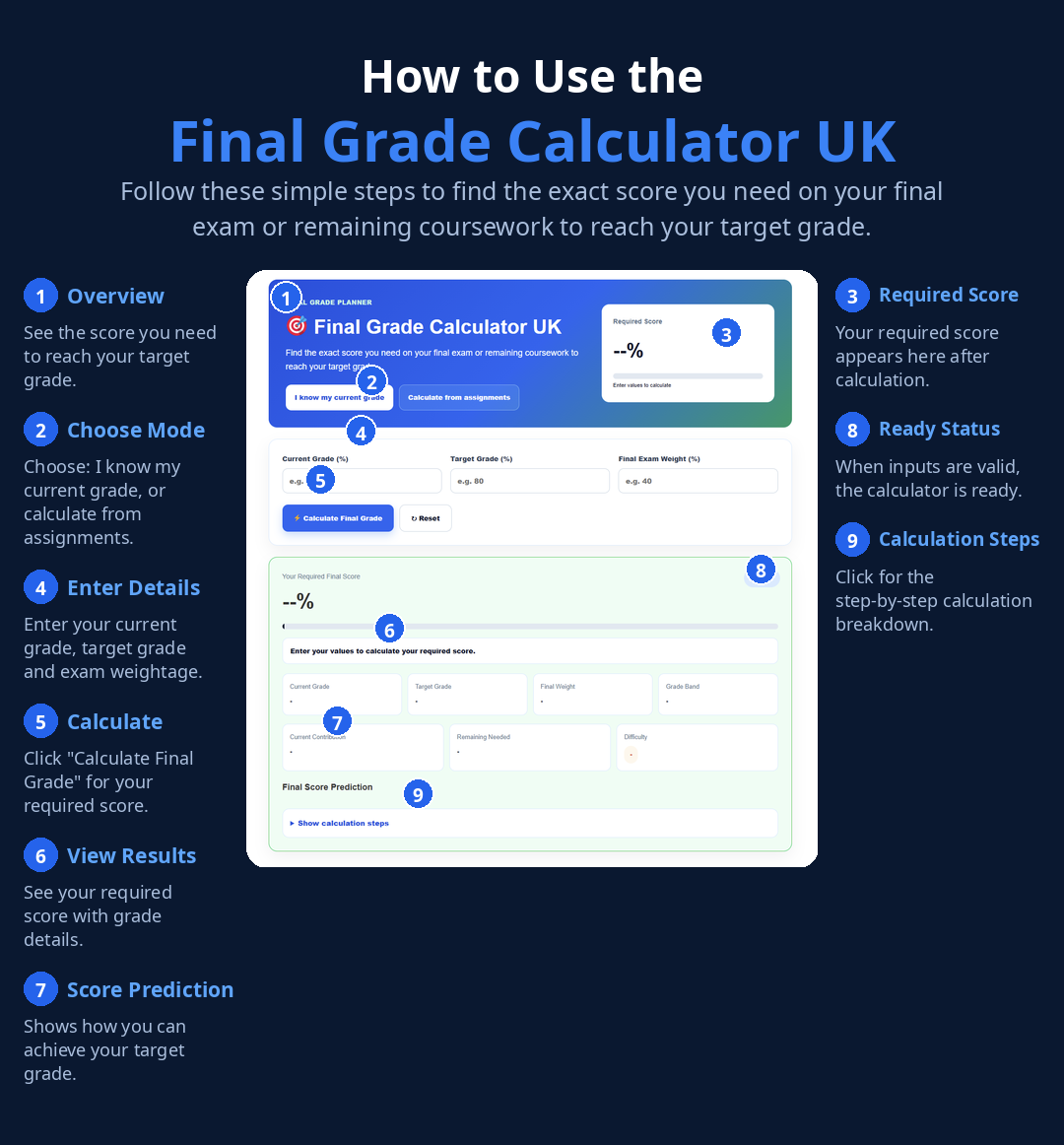
Click Here: Final Grade Calculator UK
The one-line formula
Your module mark is a weighted average of its components — coursework pieces and the exam, each multiplied by its share of the module and added together. The University of Bristol states it plainly in its assessment regulations: “the mark for each individual unit is calculated as the weighted average of the marks for each of its constituent assessments” (Bristol calculating-marks regulations). Working backwards from that definition gives the only formula you need:
Needed exam mark = (target module mark − marks already banked from coursework) ÷ exam weight as a decimal
Three definitions, because each one is a trap for someone:
1. Target module mark. The number you are aiming at for the whole module — usually the 40 pass mark, or 60/70 if you are protecting a classification. Pick it deliberately before you calculate; the formula cannot choose your ambition for you. 2. Marks already banked. Each completed coursework mark multiplied by its weight as a decimal (40% → 0.40), then added together. Coursework of 58 at 40% weight banks 58 × 0.40 = 23.2 marks. These are marks you already own — the exam only has to supply the rest. 3. Exam weight as a decimal. The exam’s percentage share of the module divided by 100. A 60%-weighted exam divides by 0.60. This is the step people get wrong most: dividing by 60 instead of 0.60 inflates the answer a hundredfold, which is how panicked forum posts end up claiming someone needs 6,133%.
One more rule before the examples: component marks are whole numbers. Westminster’s academic regulations award every assessment component a mark from 0 to 100 as an integer, and Bristol rounds the unit mark to the nearest integer — so when the formula gives you 61.33, the answer is 62, not 61. Always round the needed mark up: 61 on the exam would leave you a fraction short of the target, and fractions do not pass modules.
Worked example 1: Priya needs 62 on the exam
Priya’s research methods module is split 40% coursework, 60% exam. Her coursework — a lab report and a short essay, combined by the module’s stated weighting — came back at 58. She wants every module at 60 or above to protect her 2:1, so her target module mark is 60.
Step 1 — banked marks: 58 × 0.40 = 23.2. Step 2 — still needed: 60 − 23.2 = 36.8. Step 3 — divide by the exam weight: 36.8 ÷ 0.60 = 61.33. Step 4 — round up: Priya needs 62 on the exam.
Check it by running the formula forwards: 23.2 + (62 × 0.60) = 23.2 + 37.2 = 60.4, which clears 60. And notice why the rounding matters: 61 on the exam would give 23.2 + 36.6 = 59.8 — two-tenths short, a whole grade boundary missed for want of rounding up. Priya’s revision target is now a concrete number, and it is an achievable one: 62 is four marks above her coursework level, not forty.
Worked example 2: Daniel’s target is impossible — and that’s useful
Daniel’s statistics module is 50% coursework, 50% exam. His coursework averaged 42 — a rough term. He wants a 70 on the module to lift his year average toward a First-level trajectory, so his target is 70.
Banked: 42 × 0.50 = 21. Still needed: 70 − 21 = 49. Divide by the exam weight: 49 ÷ 0.50 = 98. Daniel needs 98 on the exam. That number is not a plan; it is a verdict. His best exam mark in two years at university is 71. Chasing 98 means revising as though a near-perfect paper is likely, which distorts every study decision for the next three weeks.
Now watch what happens when the coursework is weaker still. Take Tom: coursework 35 at 60% weight, exam 40%, target 70. Banked: 35 × 0.60 = 21. Needed: 70 − 21 = 49. Divide: 49 ÷ 0.40 = 122.5. The exam is marked out of 100. Tom cannot reach 70 on this module by any performance that exists. Even dropping the target to the 60 he actually needs: (60 − 21) ÷ 0.40 = 97.5 → 98 — possible on paper, but it would require the best exam of his degree by a distance.
This is the real value of the formula: it converts vague dread into a number, and sometimes the number says stop. Tom’s correct move is not heroic revision for 70; it is replanning around a realistic target — which is exactly what the rescue-plan section at the end of this guide covers. A calculation that tells you a target is impossible has saved you from the most expensive mistake in exam season: spending your scarcest weeks chasing marks that were never available.
Worked example 3: Amara chases a module-level 70
Amara’s cognitive psychology module: two coursework pieces — an essay worth 30% of the module (mark 62) and a presentation worth 20% (mark 72) — plus a 50% exam. She wants 70 on the module because her other modules are already banked at first-class level and this is the one that could drag the average down.
First, combine the coursework correctly — each piece weighted by its share of the module: (62 × 0.30) + (72 × 0.20) = 18.6 + 14.4 = 33 banked. (Note what we did not do: average 62 and 72 to 67 and apply 50%. That gives 33.5 — close here, but the error grows whenever the pieces carry unequal weight, and it is one of the classic mistakes covered below.) Still needed: 70 − 33 = 37. Divide by the exam weight: 37 ÷ 0.50 = 74. Amara needs 74 on the exam — check: 33 + 37 = 70 exactly.
Amara’s number sits in the productive middle: demanding but plausible, two marks above her best coursework piece. Her revision plan practically writes itself — she needs exam technique at the level of her presentation (72), plus a couple of marks of polish. That is a fundamentally different – and far less anxious – revision brief than “get a First on everything.”
The lookup table: common splits, three targets
If your module is a straight 50/50 split between coursework and exam, find your coursework mark in the left column and read across. Every cell is the exam mark you need for that target — already rounded up. Cells marked IMPOSSIBLE mean the target cannot be reached on this module, however well the exam goes:
| Your coursework mark (50% weight) | Need 40 (pass) | Need 60 (2:1 level) | Need 70 (First level) |
|---|---|---|---|
| 30 | 50 | 90 | IMPOSSIBLE (110) |
| 40 | 40 | 80 | 100 |
| 50 | 30 | 70 | 90 |
| 60 | 20 | 60 | 80 |
| 70 | 10 | 50 | 70 |
Two patterns worth noticing. First, the pass column is forgiving: even with coursework of 30, you need only 50 on the exam to pass the module — which is why panicking about failing after weak coursework is usually misplaced; run the numbers before you panic. Second, the First-level column turns brutal fast: coursework below 40 makes 70 unreachable, and coursework of 40 demands a perfect 100. The table also shows why the exam’s weight matters so much — on a 60%-exam module every one of these needed marks would be lower, and on a 40%-exam module higher. For non-50/50 splits, use the formula (or the calculator) rather than this table.
The must-pass hurdle: when the average says pass but you still fail
Here is the trap the formula alone will not catch. At many UK universities, individual assessment components can carry a qualifying mark — a minimum you must reach on that component for the module to pass, whatever your overall average. Westminster’s academic regulations define it explicitly: a component “may be defined in the module descriptor as being a qualifying assessment component, with a qualifying mark,” and that mark “must be reached in order to pass the module” (Westminster academic regulations 2026-27). King’s College London’s assessment chapter says the same: “achieving the qualifying mark is a prerequisite of passing the module.”
Queen Margaret University publishes one of the clearest versions of the rule: to pass an undergraduate module you need at least 40% overall and at least 30% in each component of assessment — and falling below the component minimum while clearing the overall mark is recorded as a qualifying fail on the transcript (QMU general assessment regulations). The rule applies to the first attempt; reassessment rules are set separately.
See what this does to the arithmetic. James’s physiology module: lab report 60 at 50% weight, exam 50%, with a qualifying mark of 40 on the exam stated in the module descriptor. James scores 38 on the exam. His module average is (60 × 0.50) + (38 × 0.50) = 30 + 19 = 49 — nine marks above the 40 pass line. He fails the module anyway, because 38 is below the 40 qualifying mark. His transcript shows a qualifying fail, not a 49 pass.
The practical rule: before you trust any needed-marks calculation, check your module descriptor for the words qualifying, must-pass, or hurdle next to the exam. If one is there, your real target is the higher of the formula’s answer and the qualifying mark — and no amount of strong coursework compensates for missing it. This is also why “I’ll bomb the exam, my coursework will carry me” is the most dangerous sentence in exam season: it is true at universities without hurdle rules and false at universities with them, and the only way to know which you attend is to read the descriptor.
Three mistakes that break the calculation
Mistake 1: weights that don’t add to 100%. The formula assumes every component’s weight is accounted for. If your module handbook lists coursework at 40% and the exam at 50%, something is missing — usually a small component (a quiz, participation, a lab book) worth the remaining 10%. Find it before you calculate; a missing 10% at a decent mark can move the needed exam mark by several points. If a pass/fail component genuinely carries no weight, renormalise: divide by the weights you have, not by 100.
Mistake 2: averaging coursework pieces that carry unequal weight. Shown in Amara’s example above: an essay worth 30% of the module and a presentation worth 10% must be weighted individually (62 × 0.30) + (72 × 0.20), not averaged first. Simple averaging is only correct when the pieces carry equal weight — two essays each worth 20% of the module can be averaged and then multiplied by 0.40. When in doubt, weight every piece separately; it is never wrong.
Mistake 3: rounding down, or not converting raw marks. A needed mark of 61.33 means 62 — rounding down to 61 leaves you short, as Priya’s check showed. And if your exam is marked out of anything other than 100, convert to a percentage first: 45 out of 80 is 56.25%, not 45. Feed raw marks into the formula and every downstream number is fiction. (If your marks look wrong after the fact, our guide to checking your university calculated your marks correctly walks through the audit step by step.)

When the answer is over 100: the rescue plan
So the formula says 122, or 98 when your personal best is 71. Here is what to do, in order — this week, not after results day:
1. Re-run the formula with an honest target. The difference between needing 70 and needing 60 on a module is often 20+ exam marks. Ask what the module actually needs to do for you: if your other modules already secure your classification, this module may only need a pass. Students routinely over-target the modules they are weakest at and under-target the ones where marks are cheapest — the Degree Classification Calculator UK will show you which modules actually move your average.
2. Check the compensation safety net. Many universities let a narrow fail (typically 35–39 against a 40 pass mark) be compensated — the module counts as passed without a resit — provided your overall average is strong enough and the module isn’t excluded from compensation. Our guide to condoned passes explains exactly how the mechanism works and which modules it covers. A calculated need of 98 for a 70 target might become a need of 55 for a compensated 38 — a survivable exam instead of an impossible one.
3. Talk to the module leader before the exam. Not to negotiate marks — that is not a thing — but to confirm the inputs to your calculation: the exact weightings, whether any hurdle rule applies, and how the paper is structured. Module leaders would far rather correct a student’s arithmetic in week 9 than explain a fail in week 14. Bring your numbers; it takes five minutes.
4. Know the referral maths in advance. If the exam goes badly despite all this, you will most likely be referred — resitting the failed component, usually with the resit mark capped at the pass mark. Our referrals guide covers how capped resits work and what they cost your average. Knowing this now removes the catastrophic framing: a failed exam is usually a capped resit, not the end of the degree.
5. If there are genuine circumstances, use the EC route now. If illness, bereavement, or another serious disruption is part of why the numbers look impossible, an extenuating circumstances claim made before the assessment can lead to a deferred attempt — uncapped, unlike a resit after a fail. Our extenuating circumstances guide explains the evidence and deadlines. Claiming after a bad result is far harder than claiming before it.
How do I calculate what I need on my final exam?
Use the one-line formula: needed exam mark = (your target module mark − marks already banked from coursework) ÷ the exam’s weight as a decimal. So with coursework of 58 at 40% weight (58 × 0.40 = 23.2 banked) and a target of 60, you need (60 − 23.2) ÷ 0.60 = 61.33, which rounds up to 62 on the exam. Our Final Grade Calculator UK does this arithmetic for you if you would rather not do it by hand.
What if the calculation says I need more than 100% on the exam?
Then the target is mathematically impossible on this module — no exam performance can get you there, so stop revising for a fantasy and replan. Re-run the formula with a lower target (the pass mark, or the next classification band down), check whether your university’s compensation or condonement rules could carry a near-miss, and speak to your module leader before the exam about what a realistic outcome looks like. The full rescue plan is in this article’s “when the answer is over 100” section.
Do I have to pass the exam itself, or just reach the module average?
It depends on your module descriptor. Many UK universities allow a component called a qualifying assessment to carry a minimum mark that you must reach to pass the module, regardless of your overall average — Westminster’s regulations state the qualifying mark “must be reached in order to pass the module,” and King’s College London’s assessment chapter says the same. Queen Margaret University requires at least 30% in each component (undergraduate) alongside 40% overall, and records a miss as a qualifying fail. Always check your own module descriptor: an average above 40 with an exam mark below the qualifying line is still a fail.
Does weak coursework change the pass mark for the module?
No — the module pass mark (normally 40% undergraduate, 50% postgraduate) is fixed. What weak coursework changes is how much of the remaining weight has to do the heavy lifting. Coursework of 35 at 60% weight banks only 21 marks, leaving 19 still needed from a 40%-weighted exam — a 47.5, rounded up to 48. The lower your banked marks, the steeper the exam target, which is why the formula matters most when coursework has gone badly.
How do I combine several coursework pieces before using the formula?
Weight each piece by its share of the module, not by its share of the coursework. If an essay is worth 30% of the module (mark 70) and a presentation 10% (mark 50), your banked marks are (70 × 0.30) + (50 × 0.10) = 21 + 5 = 26. The common mistake is averaging the two pieces first (60) and then applying the 40% coursework weight, which gives 24 — two marks short of the truth, and exactly the kind of error our guide to checking your university calculated your marks correctly warns about.
Should I round the needed mark up or down?
Always round UP. University component marks are whole numbers — Westminster awards marks from 0 to 100 as integers, and Bristol rounds unit marks to the nearest integer — so a calculated need of 61.33 means 61 is not enough: 61 on the exam would leave you at 59.8 against a 60 target. Rounding up to 62 is the only safe choice, and it is worth double-checking with the formula run in reverse.
What if my module is 100% exam — is there anything to calculate?
Barely: with no coursework banked, the needed exam mark simply equals your target module mark. A 100%-exam module with a target of 60 means you need 60 on the exam — but the must-pass and qualifying-mark rules still apply exactly as written, and there is no coursework cushion if the paper goes badly. These modules are the highest-variance assessments on most degrees, so the target-setting in this article matters most for them.
Is there a calculator that works this out for me?
Yes — that is exactly what the Final Grade Calculator UK is built for: enter your completed marks and their weights, set your target, and it tells you what you need on the remaining assessments. Use this article to understand the maths (so you can spot when something looks wrong), and the calculator for speed. For the bigger picture — what your module marks mean for your degree class — see the Degree Classification Calculator UK.
Conclusion
The whole of this guide compresses into one line of arithmetic: subtract what you have banked from what you need, divide by the exam’s weight, round up. Ninety seconds with a calculator replaces weeks of vague anxiety with a number — and numbers are actionable in a way that dread is not. Priya’s 62 tells her exactly what revision has to deliver; Daniel’s 98 tells him his target was the problem, not his effort; Amara’s 74 tells her which level of polish the exam demands.
Two caveats travel with the formula everywhere. First, check the module descriptor for qualifying or must-pass marks before you trust any calculation — an average above 40 means nothing if the exam component has a hurdle you missed. Second, remember this is module maths, not degree maths: what the module needs to do for your classification is a separate calculation, and over-targeting a weak module while under-targeting a strong one is the classic misallocation of revision effort.
Run your own numbers today — by hand once, so you understand the machinery, and then with our Final Grade Calculator UK for speed. Then revise to the number, not to the fear. The students who do best in exam season are rarely the ones who revise the most hours; they are the ones who knew, weeks in advance, exactly what each paper had to deliver — and aimed every hour at that target.