
Need in Your Final Module You’ve just checked your student portal and worked out something that’s making your stomach drop slightly: your final module hasn’t been marked yet, and your entire degree classification is riding on it. Maybe you’re sitting on a solid 2:1 average and wondering if a First is still realistic. Maybe you’re closer to the 2:2 boundary than you’d like and need to know exactly what score keeps you safe.
Either way, guessing isn’t good enough here. (Need in Your Final Module) Working out what grade you need in your final module means understanding how your remaining credits fit into your overall average — and that’s a calculation most students have never actually been taught how to do properly.
This guide walks through exactly that. No vague advice, no “just try your best” — real numbers, real formulas, and a clear method for working out the mark you need before results day arrives.
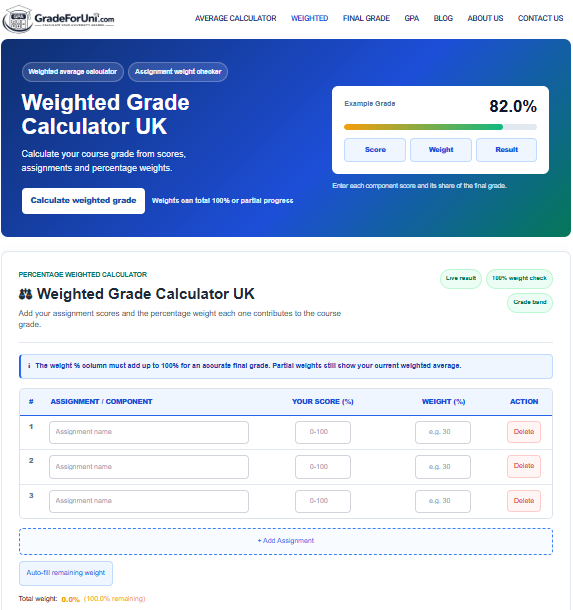
Click Here: UK University Grade Calculator
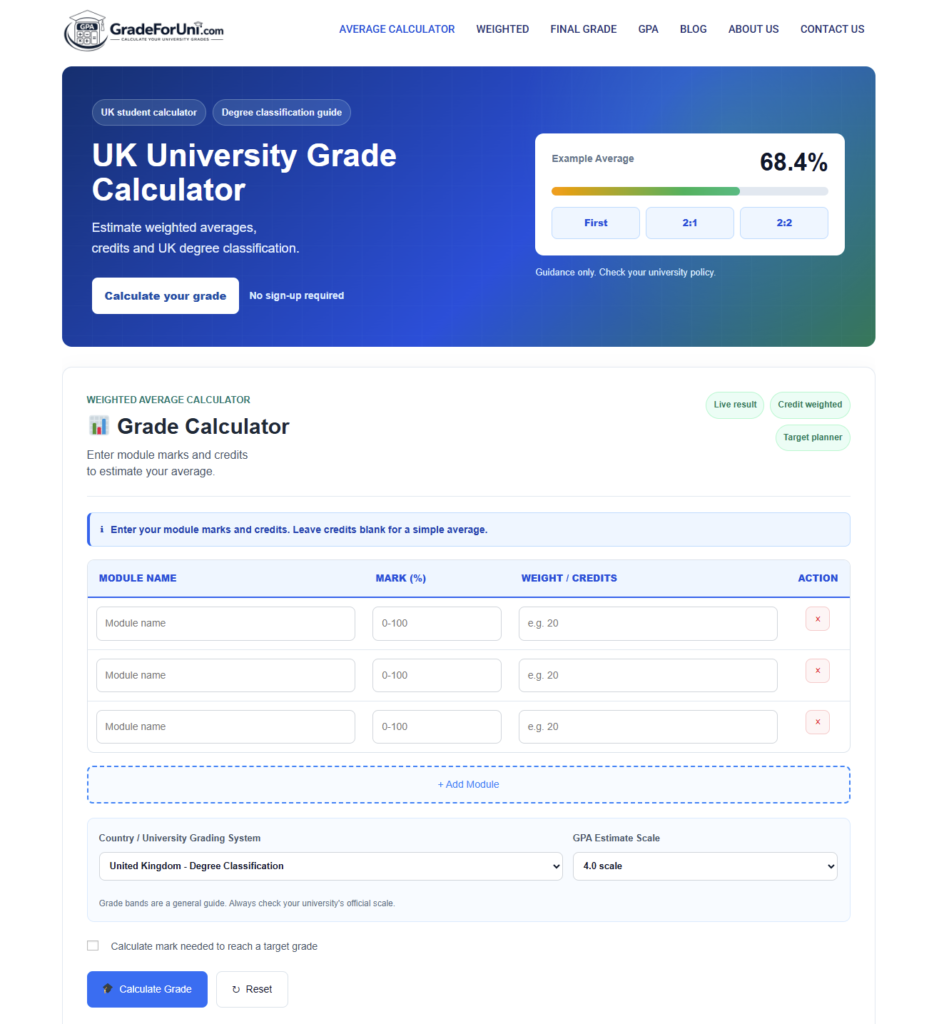
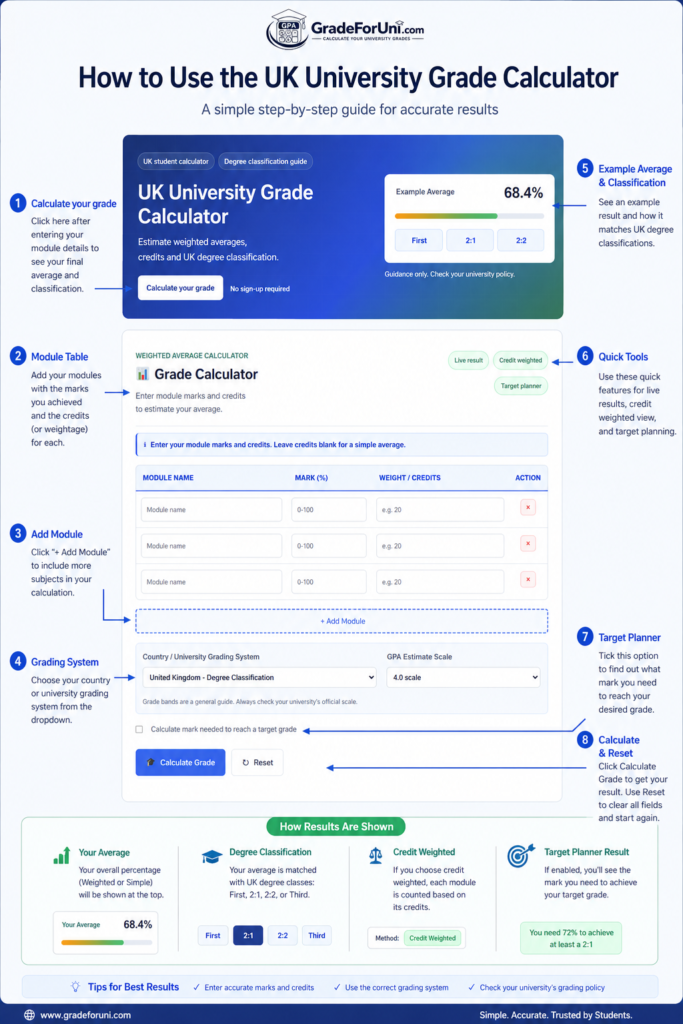
How to Use the UK University Grade Calculator
Quick Answer (Need in Your Final Module)
To find what grade you need in your final module, you need three things: your current weighted average, the credit value of your final module, and your target overall percentage. The formula rearranges to: (Need in Your Final Module) Mark Needed = [(Target Average × Total Credits) − (Current Average × Completed Credits)] ÷ Remaining Credits. This tells you the exact score your final module needs to hit, so you can plan your revision time realistically instead of guessing.
What This Guide Covers
Over the next few sections, you’ll learn how to work out precisely what mark you need in your final module to hit a specific degree classification. That includes:
By the end, you’ll be able to plug in your own numbers and know exactly where you stand — whether that’s reassuring you a 2:1 is already secure, or telling you honestly that your final exam needs an 80% to hit a First.
Why This Calculation Matters (Need in Your Final Module)
Here’s the problem most students run into: they know their current average “feels okay,” but they don’t know the actual number they need in their last piece of work. (Need in Your Final Module) That gap between feeling and fact leads to two opposite mistakes.
Some students underprepare because they assume their existing marks will carry them, only to discover on results day that they needed a 68% and got a 61%. Others overprepare, pouring far more revision time into a module than the maths actually required, at the cost of other priorities.
Knowing your exact target changes both outcomes. If you need 55% to secure your 2:1, that’s useful information — it tells you how much margin you have. If you need 78%, that’s useful too, because it tells you exactly how seriously to take that final push.
This matters even more for final modules specifically, because they’re usually worth more credits than a standard module. A 40-credit dissertation or a 30-credit final-year project doesn’t just count once — it can shift your overall average by several percentage points on its own.
Visit Now: Mauricette Calculette
Key Terms You Need to Understand First
Before working through the calculation, it helps to be clear on exactly what each term means. These show up constantly in grade calculators and academic regulations, and mixing them up is where most calculation errors start.
Weighted average — Your overall mark once every module has been multiplied by its credit value and divided by the total credits. This is what your university actually uses, not a simple average of all your percentages.
Credits — A number attached to each module (commonly 10, 15, 20, 30, or 40) representing how much study time and assessment weight it carries. Higher-credit modules pull your average more than lower-credit ones.
Current average — Your weighted average based only on the modules you’ve already completed and had marked.
Remaining credits — The credit value of whatever hasn’t been marked yet, whether that’s one final exam or a full dissertation.
Target average — The overall percentage you’re aiming for, usually tied to a specific classification boundary (70% for a First, 60% for a 2:1, and so on).
Mark needed — The score your final module has to achieve, on its own, to bring your overall average up to your target.
Quick Reference Table
| Term | What It Means | Example |
| Weighted average | Marks combined using credit values | 64.8% |
| Credits | Study weight assigned to a module | 40 credits (dissertation) |
| Current average | Average from completed modules only | 62.5% |
| Remaining credits | Credits still to be marked | 40 |
| Target average | Classification boundary you’re aiming for | 70% (First) |
| Mark needed | Score required in the final module | 80% |
How Your Final Module Fits Into Your Overall Average
This is the part that trips people up. (Need in Your Final Module) Your final module isn’t graded in isolation — it gets folded into everything you’ve already completed, using the same weighted average formula your university applies to your whole degree.
Picture your overall average as a see-saw. (Need in Your Final Module) Everything you’ve already completed sits on one side, already fixed in place. Your final module is the last weight going on the other side, and depending on how heavy it is (its credit value) and how high or low it scores, it can shift the whole balance more or less than you’d expect.
A 20-credit final module in a degree where you’ve already completed 100 credits has a moderate pull. A 40-credit dissertation carrying the same weight as two standard modules combined has a much bigger one. (Need in Your Final Module) That’s exactly why students working on a dissertation or capstone project need to take this calculation seriously — the stakes on that single piece of work are genuinely higher than on any other module they’ve completed.
Common Misconceptions About Final Module Marks
A few beliefs come up again and again, and most of them lead students to either panic unnecessarily or relax too soon.
“I need to average my target across all modules, including finished ones.” Not quite. (Need in Your Final Module) Your finished modules are locked in — you can’t change those marks retroactively. The calculation only asks what your remaining credits need to score to pull your overall average up to target.
“Every module counts the same amount.” Only true if every module carries identical credits, which is rare across a full degree. (Need in Your Final Module) A 10-credit optional module and a 40-credit dissertation are not equal contributors, even if both show up as a single percentage on your transcript.
“If my average is already above the boundary, my final mark doesn’t matter.” It still matters — it just has more room to move without dropping you out of the band. A final module scoring unexpectedly low can still pull a comfortable 2:1 average down towards a 2:2 if it carries enough credits.
“Resits work the same way as first-attempt marks.” Not always. Many universities cap resit marks at the pass boundary, so if your final module is a resit, check your university’s specific policy before relying on your calculation.
A Simple Worked Example
Say a student has completed 80 credits so far with a current average of 62.5%, and their final module is a 40-credit dissertation. (Need in Your Final Module) They’re aiming for a First (70% overall across their full 120 credits).
| Step | Formula | Result |
| Existing contribution | 62.5% × 80 credits | 5,000 points |
| Required total | 70% × 120 credits | 8,400 points |
| Points still needed | 8,400 − 5,000 | 3,400 points |
| Mark needed | 3,400 ÷ 40 credits | 85% |
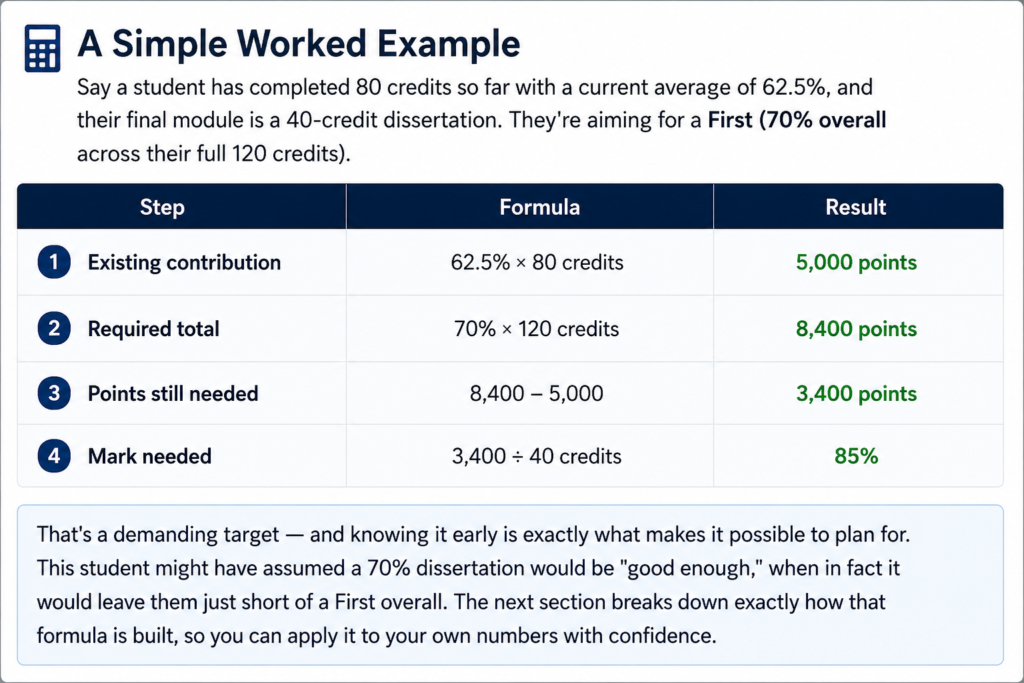
That’s a demanding target — and knowing it early is exactly what makes it possible to plan for. This student might have assumed a 70% dissertation would be “good enough,” when in fact it would leave them just short of a First overall. The next section breaks down exactly how that formula is built, so you can apply it to your own numbers with confidence.
The Formula, Broken Down Step by Step
The core formula looks intimidating at first glance, but it’s really just the weighted average formula rearranged to solve for one missing number instead of the total.
Mark Needed = [(Target Average × Total Credits) − (Current Average × Completed Credits)] ÷ Remaining Credits
Here’s what each part is doing:
- Target Average × Total Credits — Works out the total number of “points” you need across your whole degree (or module set) to hit your target percentage.
- Current Average × Completed Credits — Works out how many points your finished modules have already banked.
- Subtracting the two — Tells you how many points are still missing.
- Dividing by Remaining Credits — Spreads those missing points across whatever’s left to be marked, giving you the percentage your final module needs to score.
It’s the same logic as knowing you need 700 points across ten exams to pass a course, checking you’ve already scored 550 across nine of them, then working out what the tenth exam needs to make up the shortfall.
Step 1 — Work Out Your Current Weighted Average
List every completed module, its mark, and its credit value, then apply the standard weighted average formula:
Current Average = (Mark₁ × Credit₁ + Mark₂ × Credit₂ + …) ÷ Total Completed Credits
Skipping this step or estimating it roughly is where most miscalculations start. (Need in Your Final Module) A current average that’s out by even one or two percentage points can shift your final target by several points once it’s multiplied out across your remaining credits.
Step 2 — Confirm Your Total Credits and Remaining Credits
Check your module handbook or transcript for two numbers: the total credits in your degree (or the specific set of modules you’re calculating), and how many of those are still unmarked. For a standard three-year UK Honours degree, this is usually 360 credits total, though the exact figure your calculation should use depends on whether you’re working out your full degree average or just a single year.
If you’re only calculating your final year, use that year’s total credits rather than your whole degree. Mixing the two is a common error that produces a completely wrong target mark.
Step 3 — Set Your Target Average
Decide which classification boundary you’re aiming for. This is usually one of the standard UK bands:
| Classification | Target Percentage |
| First Class | 70% |
| Upper Second (2:1) | 60% |
| Lower Second (2:2) | 50% |
| Third Class | 40% |
Some students set a target slightly above the boundary — aiming for 72% instead of exactly 70%, for example — to build in a small safety margin. This is worth considering if your final mark rests on a single high-stakes exam, since a slightly lower-than-expected performance won’t tip you into the band below.
Step 4 — Run the Calculation
With all four numbers in hand — current average, completed credits, target average, and remaining credits — plug them into the formula and solve for the mark needed. If you’re using our University Grade Calculator, switching on target grade mode does this instantly, but working through it manually at least once is genuinely useful for understanding how sensitive the result is to each input.
Step 5 — Sanity-Check the Result
Once you have a number, ask whether it’s realistic. (Need in Your Final Module) A required mark of 45% means you’re comfortably on track. A required mark of 95% usually means the target classification is out of reach through this module alone, and it’s worth reconsidering either your target or checking whether other remaining assessments could help close the gap.
Real-Life Scenarios
Scenario 1: One Final Exam Remaining
A student has completed 100 credits with a current average of 66%, and one final 20-credit exam remains. They’re aiming for a 2:1 (60%).
| Step | Calculation | Result |
| Required total points | 60 × 120 | 7,200 |
| Points already banked | 66 × 100 | 6,600 |
| Points still needed | 7,200 − 6,600 | 600 |
| Mark needed | 600 ÷ 20 | 30% |
Here, the current average is already well above the target, so the final exam barely needs to register above a pass mark to keep the overall average inside the 2:1 band. (Need in Your Final Module) This is a common outcome for students who’ve been performing consistently well and are simply double-checking their standing before a final assessment.
Scenario 2: A Heavy Final-Year Dissertation
A student has completed 80 credits at 58% and has a 40-credit dissertation remaining, targeting a 2:1 (60% overall).
| Step | Calculation | Result |
| Required total points | 60 × 120 | 7,200 |
| Points already banked | 58 × 80 | 4,640 |
| Points still needed | 7,200 − 4,640 | 2,560 |
| Mark needed | 2,560 ÷ 40 | 64% |
Because the current average sits just below the target, the dissertation needs to outperform it by a modest margin. (Need in Your Final Module) This is the kind of scenario where knowing the exact number matters — the student can see that 64% is achievable without needing an exceptional result, which is far more useful than vaguely hoping “the dissertation goes well.”
Read More: University Grade Guide – UK Percentages, GPA and Degree Classes…
Scenario 3: Multiple Modules Remaining
Not every student has just one module left. Say a student has completed 60 credits at 55%, with two 20-credit modules remaining, targeting a 2:2 (50%).
| Step | Calculation | Result |
| Required total points | 50 × 100 | 5,000 |
| Points already banked | 55 × 60 | 3,300 |
| Points still needed | 5,000 − 3,300 | 1,700 |
| Combined mark needed | 1,700 ÷ 40 | 42.5% |
When more than one module remains, the calculation treats them as a combined block — the 42.5% is the combined average needed across both, not the mark required in each individually. (Need in Your Final Module) A student could score 35% in one and 50% in the other and still hit the target, as long as the combined weighted result reaches 42.5%.
Single Module vs Multiple Modules Remaining
| Factor | Single Module Remaining | Multiple Modules Remaining |
| Calculation complexity | Straightforward, one unknown | Slightly more involved, shared target across modules |
| Flexibility | None — one mark decides the outcome | More flexibility to offset a weaker module with a stronger one |
| Risk level | Higher, since everything rests on one result | Lower, spread across more than one assessment |
| Best approach | Focus all preparation on that module | Prioritise by credit value first |
Common Mistakes to Avoid (Need in Your Final Module)
Using your simple average instead of your weighted average. If your modules carry different credit values, a simple average will give you the wrong current average, which throws off everything that follows.
Forgetting to exclude Year 1 correctly. At most UK universities, Year 1 doesn’t count towards your final classification. Including it in your total credits when it shouldn’t be there will distort your target mark significantly.
Applying degree-wide totals to a single-year calculation. If you’re only working out what you need in your final Year 3 module, use Year 3’s total credits — not your full 360-credit degree total.
Ignoring resit caps. If your final module is a resit, check whether your university caps the mark (commonly at 40%). Calculating against an uncapped scenario when a cap applies will give you a misleadingly optimistic number.
Rounding too early. Rounding your current average before running the final calculation can shift the result by a percentage point or more once it’s multiplied across your remaining credits. Keep decimal places until the final step.
Expert Tips (Need in Your Final Module)
- Recalculate as soon as any new mark is confirmed. Your target mark for the final module changes every time a completed module’s result comes in.
- If your required mark comes out unrealistically high, check whether a lower classification target is more achievable, and plan your revision time accordingly rather than chasing an unlikely outcome.
- Where multiple modules remain, prioritise revision time on whichever carries the higher credit value — it has the bigger effect on your combined result.
- Always cross-check your total credit figures against your official transcript or module handbook rather than relying on memory.
Advanced Scenarios: When the Standard Formula Needs Adjusting
The formula covered so far assumes a fairly clean setup — one clear target, one clear set of remaining credits. (Need in Your Final Module) Real degrees are often messier than that, and a few situations need a slightly different approach.
Masters-Level Grading (Need in Your Final Module)
Masters courses don’t use the First, 2:1, 2:2, Third scale. Instead, they typically work with Distinction, Merit, and Pass boundaries:
| Masters Classification | Typical Percentage Boundary |
| Distinction | 70%+ |
| Merit | 60% – 69% |
| Pass | 50% – 59% |
The formula itself doesn’t change — you’re still solving for the mark needed in your remaining credits — but your target average needs to match the Masters scale, not the undergraduate one. This matters most for dissertation modules, which on many Masters courses carry a disproportionately large share of total credits, sometimes 60 out of 180. (Need in Your Final Module) A dissertation that size has an outsized effect on your final classification, so it’s worth running this calculation well before submission, not after.
Integrated Year Weighting Across a Full Degree
If your final module sits within a year that itself gets weighted against other years (the common 33:67 Year 2 to Year 3 split, for example), you can’t just plug your final module’s credits into the whole-degree formula directly. (Need in Your Final Module) You need to work in two stages:
- Work out what your Year 3 average needs to be to hit your overall target, factoring in your already-confirmed Year 2 result.
- Work out what your final module needs to score to hit that required Year 3 average, factoring in your other completed Year 3 modules.
This two-stage approach is easy to skip by accident, and skipping it is one of the most frequent reasons students end up with a target mark that doesn’t match what their university calculator later confirms.
Unusually High or Low Credit Final Modules
A 60-credit dissertation behaves very differently from a 10-credit final exam, even within the same degree. (Need in Your Final Module) The higher a module’s credit value relative to your total remaining credits, the more sensitive your overall result is to that one mark — small differences in performance translate into bigger swings in your final average. (Need in Your Final Module) A low-credit final module, by contrast, gives you very little room to shift your average either way. (Need in Your Final Module) That can be reassuring if you’re already close to target, but frustrating if you’re hoping a strong final performance will meaningfully boost a borderline result.
Frequently Overlooked Information
A few details get missed even by students who otherwise understand the calculation well:
- Provisional marks aren’t always final. Some universities apply moderation or external examiner adjustments after provisional marks are released, which can shift your actual average slightly from what you calculated.
- Compensation rules exist at some universities. A module scored just below the pass mark can sometimes be compensated by strong performance elsewhere, depending on your institution’s regulations — this doesn’t change your grade calculation, but it can affect what “passing” actually requires.
- Some universities use a best-X-out-of-Y-modules rule, dropping your lowest-scoring module from the final calculation. If this applies to you, your actual required mark could be lower than the standard formula suggests.
- Classification borderlines are often reviewed manually. If your final average lands within a percentage point or two of a boundary, many UK universities have a discretionary review process, which the formula alone can’t predict.
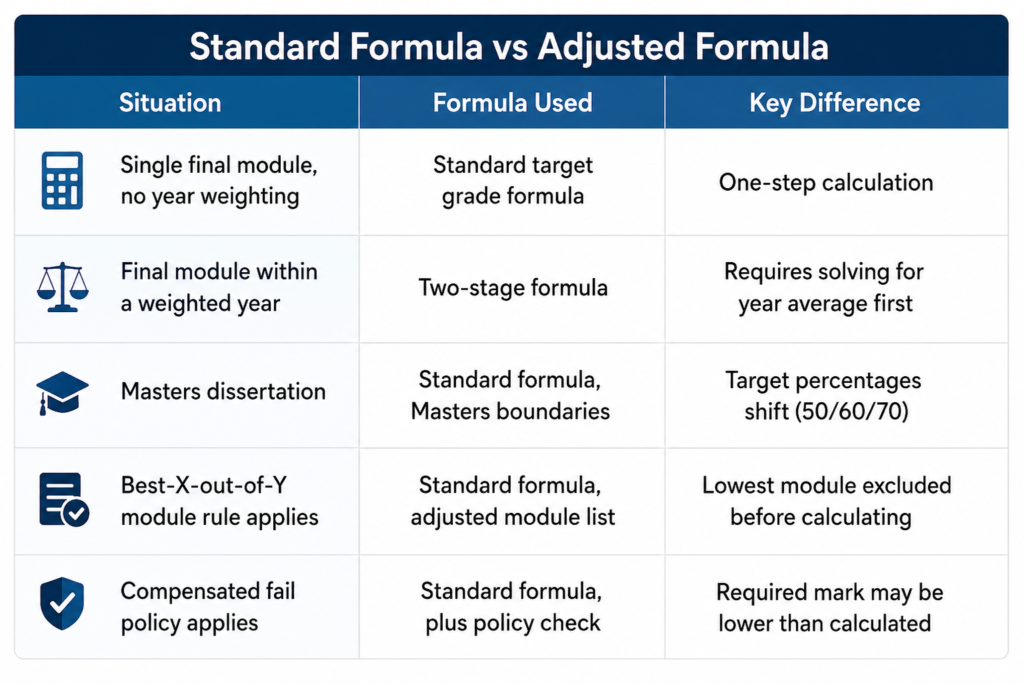
Standard Formula vs Adjusted Formula
| Situation | Formula Used | Key Difference |
| Single final module, no year weighting | Standard target grade formula | One-step calculation |
| Final module within a weighted year | Two-stage formula | Requires solving for year average first |
| Masters dissertation | Standard formula, Masters boundaries | Target percentages shift (50/60/70) |
| Best-X-out-of-Y module rule applies | Standard formula, adjusted module list | Lowest module excluded before calculating |
| Compensated fail policy applies | Standard formula, plus policy check | Required mark may be lower than calculated |
Key Takeaways
- Recalculating after every new confirmed mark keeps your target accurate throughout the year.
- Your final module’s required mark depends on four numbers: current average, completed credits, target average, and remaining credits.
- The formula rearranges the standard weighted average calculation to solve for what’s missing, rather than what’s already known.
- Higher-credit final modules, like dissertations, have a much bigger effect on your overall average than smaller modules.
- Multiple remaining modules share a combined target rather than each needing to hit the same mark individually.
- Year-weighted degrees often need a two-stage calculation rather than one single formula.
- Always confirm your university’s specific policies on resit caps, compensation, and dropped modules before relying on your result.
Conclusion
Working out what grade you need in your final module doesn’t have to feel like an unanswerable question hanging over the rest of your degree. (Need in Your Final Module) Once you understand the four numbers involved — your current average, your completed credits, your target percentage, and your remaining credits — the calculation is genuinely straightforward, even when a dissertation, a weighted final year, or multiple remaining modules complicate the picture slightly (Need in Your Final Module).
Whether that final number turns out to be reassuring or a genuine challenge, knowing it early gives you something far more useful than hope: a clear, specific target to work towards. (Need in Your Final Module) Run your own numbers through our University Grade Calculator to see exactly what you need in your final module, and check back in as each new result comes through the door (Need in Your Final Module).
FAQ’s
How do I calculate what grade I need in my final module?
Take your current weighted average, your completed credits, your target classification percentage, and your remaining credits, then apply: Mark Needed = [(Target Average × Total Credits) − (Current Average × Completed Credits)] ÷ Remaining Credits. This gives you the exact percentage your final module needs to score.
What if my final module is worth more credits than my other modules?
Higher-credit modules have a bigger effect on your overall average, for better or worse. A strong result pulls your average up more; a weak result pulls it down more. (Need in Your Final Module) Double-check your credit values are accurate before calculating, since an error here has an outsized impact on the result.
Can I still calculate this if I have two or more modules left?
Yes. Combine the remaining credits from all outstanding modules and solve for the combined average needed across them, rather than a single mark. (Need in Your Final Module) You then have flexibility to balance a weaker result in one module with a stronger result in another, as long as the combined weighted average hits your target.
What grade do I need for a First in my final module?
It depends entirely on your current average and remaining credits — there’s no fixed number that applies to everyone. A student already averaging 68% might need only a moderate final mark, while a student averaging 60% could need a mark in the 80s. (Need in Your Final Module) Running your own numbers through the formula is the only reliable way to know.
Does my final module count more if it’s a dissertation?
Usually, yes, simply because dissertations tend to carry more credits than standard modules (often 30, 40, or 60 credits). It’s not that dissertations are treated specially in the formula — it’s that their higher credit value naturally gives them more influence over your final average (Need in Your Final Module).
Do resits change what mark I need in my final module?
They can. If your final module is a resit, many universities cap the mark you can achieve, commonly at the standard pass boundary. (Need in Your Final Module) Check your institution’s resit policy before calculating, since a capped scenario changes what’s actually achievable.
Is Year 1 included when working out my final module target?
At most UK universities, no. Year 1 typically needs to be passed but doesn’t count towards your final classification, so it shouldn’t be included in your total or completed credits when calculating your final module target.
How accurate is this calculation compared to my university’s official result?
It’s accurate as a strong estimate, provided your inputs — marks, credits, and classification boundaries — match your university’s actual figures. Differences usually come from borderline review policies, compensation rules, or dropped-module allowances, which the standard formula doesn’t account for automatically.
What should I do if the mark I need seems unrealistic?
Treat it as useful information rather than a discouraging one. (Need in Your Final Module) If the required mark is unusually high, it may be worth adjusting your target classification, focusing revision time where it has the most impact, or speaking with an academic advisor about your specific options.
Can I use a calculator instead of doing this by hand?
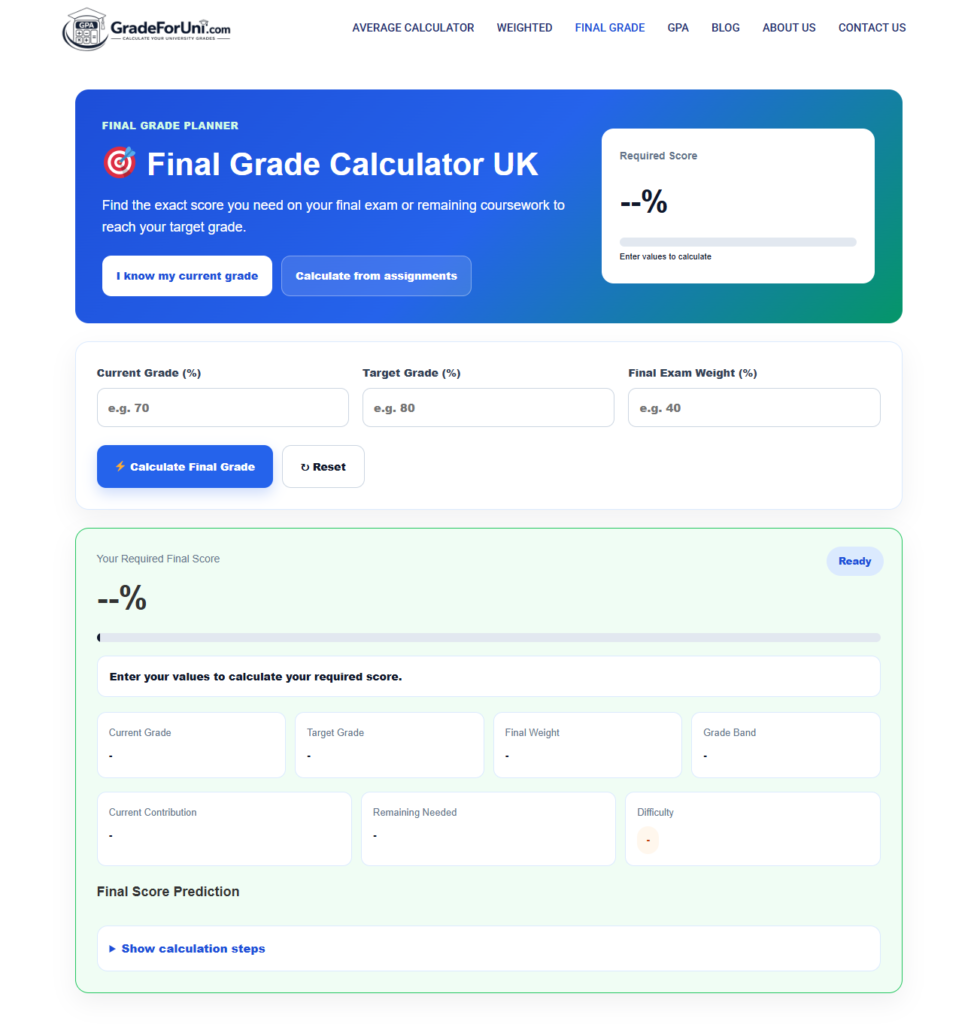
Yes. Our University Grade Calculator includes a target grade mode built specifically for this — enter your current marks and credits, set your target classification, and it works out the exact mark you need in your final module instantly.