
If your predicted grades sit a grade or two below a course’s entry requirements, most applicants assume the door is shut. It often isn’t. UK universities run official lower grade offers — known formally as contextual offers — that cut the A-level (or equivalent) conditions for applicants whose background suggests their grades understate their potential. These are published policies with published numbers, not favours, and they move thousands of students into courses they assumed were out of reach every cycle.
This guide explains how lower grade offers actually work: how much lower they go (usually one or two A-level grades, with the arithmetic to prove it), who qualifies, how universities find eligible applicants, the exact steps to check your own position, and — just as important — what these offers cannot do. Every figure comes from the universities’ own published pages for the 2027 entry cycle, cross-checked across institutions. Scheme pages roll over each year, so treat the numbers below as the verified 2026–27 picture and always confirm against the live course page before you apply.
One more thing to fix in your head before we start: a lower grade offer is not a worse degree, a back door, or something to be embarrassed about. Universities publish these schemes because their own data shows contextual offer holders succeed at the same rate as everyone else once admitted. Understanding the system is simply good application strategy — the same as choosing the right firm and insurance choices.
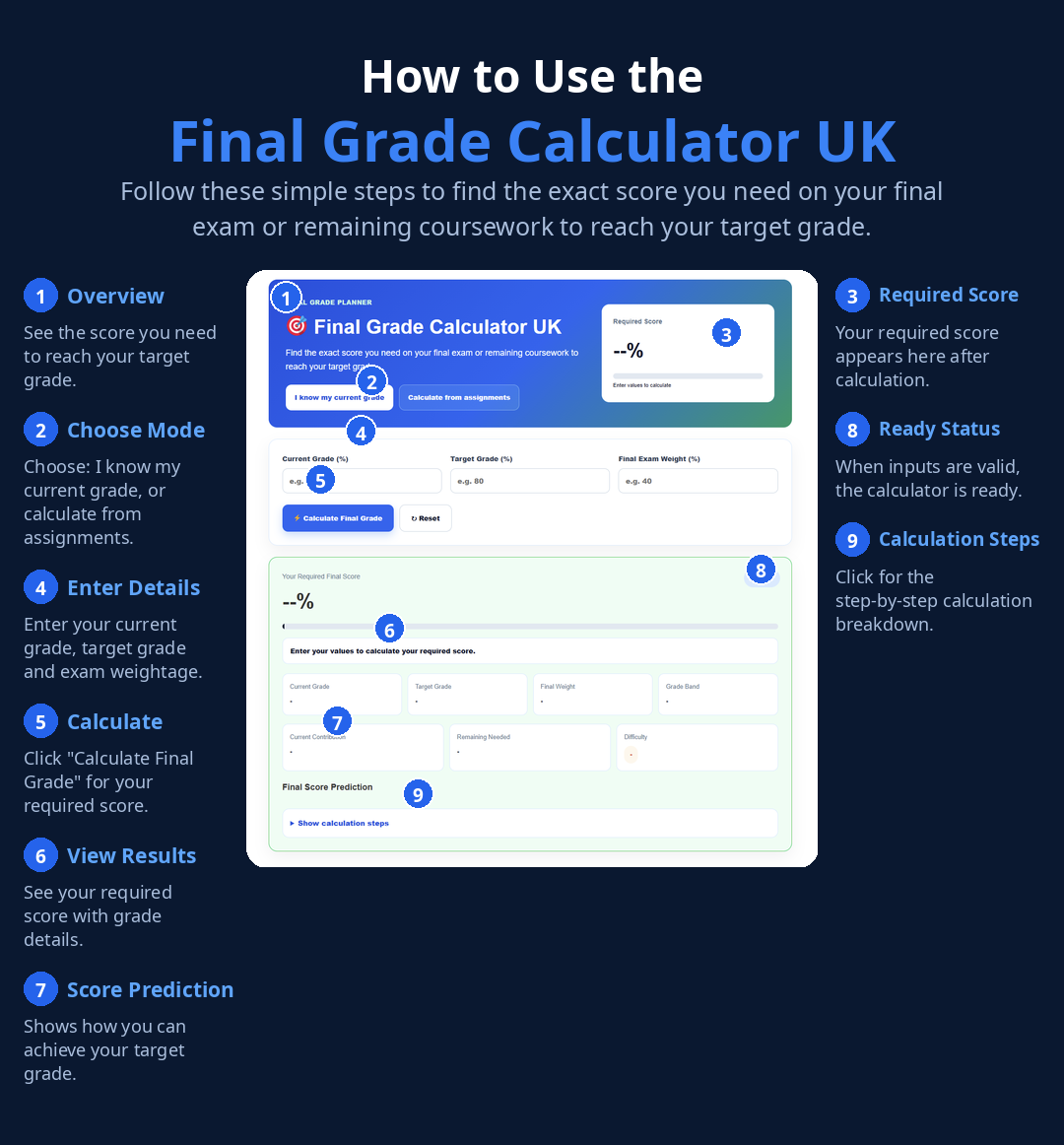
Click Here: Final Grade Calculator UK
What a Lower Grade Offer Actually Is
A lower grade offer is a conditional offer whose grade conditions sit below the course’s standard entry requirements, awarded because the university has taken the applicant’s context into account. The formal name is a contextual offer, and UCAS defines the underlying idea as contextualised admissions: using ‘contextual information and data’ to assess ‘an applicant’s achievement and potential in light of their educational and socio-economic background’ and ‘form a more complete picture of the characteristics of an individual applicant’. In plain terms: two applicants with ABB are not always judged identically, because ABB achieved at an underperforming school while caring for a parent does not mean the same thing as ABB achieved with every advantage.
Mechanically, it works like any conditional offer. If the standard offer is AAA and you are flagged as eligible, the university may instead offer you ABB — and your place is confirmed if you achieve ABB or better on results day. Nothing else about the offer changes: it is still conditional, it still sits in UCAS alongside your firm and insurance choices, and the degree you graduate with is identical. UCAS notes that the use of contextual data in admissions ‘is now widespread, but the way it’s used and the benefits to applicants can vary enormously’ — which is why this guide goes university by university rather than giving you one rule.
Two boundaries to set early. First, lower grade offers are about entry grades, not degree grades — they change what you need to get in, not how your degree is classified afterwards. Second, the reduction applies to the overall grade total, not to individual subject or GCSE requirements, a limit we will return to because it catches applicants out every year.
How Much Lower Offers Go: The Numbers
The consistent headline across the sector is one to two A-level grades below the standard offer. A Sutton Trust evidence review of contextual admissions found Durham’s contextual offers were ‘typically 1–2 grades lower’, and the same review confirmed that all 25 of England’s higher-tariff universities had committed to using contextual information, with 19 actively reducing academic entry criteria. But the exact reduction — and the route to it — differs by institution:
| University / scheme | Typical reduction | How you get it |
|---|---|---|
| Leeds — Access to Leeds | 2 grades (e.g. AAA → ABB) | Separate application + deadlines (see below) |
| Leeds — low-participation neighbourhood | 1 grade | Automatic, no application |
| Bristol | Up to 2 grades | Automatic from your UCAS form |
| King’s College London | Up to 2 grades | Listed per course page |
| Manchester — WP Plus flag | Usually 1 grade | Automatic flag from UCAS data |
| Manchester — Access Programme | 2-grade differential (stacks to max 3, floor BBC) | Complete the programme |
| UCL — Access UCL | No headline figure; set per course | Prospectus course pages; some routes need evidence |
| Durham (sector benchmark) | Typically 1–2 grades | Automatic consideration |
To feel what ‘two grades’ means in practice, convert it to UCAS tariff points — the currency offers are really written in. At A-level, each grade step is worth 8 points (A* = 56, A = 48, B = 40, C = 32), so one grade lower across a three-A-level offer is 8 tariff points, and two grades is 16. That gives you the ladder every contextual offer climbs down:
| Offer | Tariff points | Gap from AAA |
|---|---|---|
| AAA (standard) | 48 + 48 + 48 = 144 | — |
| AAB (one grade lower) | 48 + 48 + 40 = 136 | −8 points |
| ABB (two grades lower) | 48 + 40 + 40 = 128 | −16 points |
| BBB (three grades lower) | 40 + 40 + 40 = 120 | −24 points |
So when Leeds says its Access to Leeds offer can be ‘up to two grades lower’ and gives the example of AAA becoming ABB, it is describing a 16-point drop from 144 to 128 — and the example is stated verbatim on the university’s own scheme page, which also confirms the same two-grade figure in its published admissions policy. Our UCAS tariff points guide walks through the full conversion tables if you are mixing A-levels with BTECs, the IB or T-levels.
Worked Example 1: Amara’s Two-Grade Gap
Amara wants to study Geography at Leeds. The standard offer is AAA — 144 tariff points. Her predicted grades are ABB: 48 + 40 + 40 = 128 points, which is 16 points — exactly two grades — short of the standard offer. On predictions alone, she looks like a rejection.
But Amara’s background ticks two of the Access to Leeds criteria: she is the first in her family to go to university, and her secondary school sat below the national average Attainment 8 score at GCSE. She submits the separate Access to Leeds application before the deadline, completes the scheme’s academic-skills module, and makes Leeds her firm choice. Leeds makes her the contextual offer: ABB instead of AAA.
On results day Amara achieves A (48) + B (40) + B (40) = 128 points. Check it against both offers: 128 < 144, so she would have missed the standard AAA offer by 16 points — but 128 = 128, so she meets the contextual ABB offer exactly, and her place is confirmed. The two-grade reduction did not lower the bar for what she had to achieve in absolute terms — she still needed three strong A-levels — it simply aligned the bar with what her predictions said she could reach. That is the whole logic of the system in one calculation.
The counterfactual matters too. If Amara had achieved AAB (136 points) she would have beaten her contextual offer with 8 points to spare — but still fallen 8 points short of the standard offer. The contextual route is what converts ‘near miss’ into ‘confirmed place’, which is why checking eligibility before you firm your choices changes outcomes.
Who Qualifies: The Flags Universities Actually Use
There is no single national eligibility list — each university sets its own — but the same eight flags appear again and again across the published schemes. Learn them, because recognising even one in your own background is the trigger to investigate further:
| Flag | What it means | Universities that publish it |
|---|---|---|
| Free school meals | Eligible for FSM at some point during secondary education | Bristol, UCL, Manchester (2027 cycle) |
| Care experience | Time in local authority care (typically 3+ months) | Bristol, UCL, Manchester, Leeds |
| Low-participation neighbourhood | Home postcode in a low-HE-participation or high-deprivation area (POLAR4 / IMD quintiles) | Leeds, Manchester, Bristol |
| Low household income | e.g. £25,000 or below at Leeds | Leeds |
| First in family | Parents or carers did not attend university | Leeds |
| Underperforming school | School below national average attainment or progression measures | Leeds, Manchester, Bristol |
| Refugee or asylum background | Refugee status granted by the UK government (incl. Ukraine schemes) | Manchester, Leeds |
| Young carer / estrangement / disrupted education | Caring responsibilities, estrangement from parents, bereavement, serious disruption | Leeds, UCL (estrangement), Manchester (young carer, 2027) |
How the flags combine is where schemes differ most. Bristol needs just one of its criteria — a single flag is enough. Leeds’ Access to Leeds needs at least two personal-circumstances criteria plus UK fee status and the right qualifications. Manchester layers its flags into tiers: a WP flag gets your application a closer look, while the WP Plus flag is what ‘usually’ unlocks the one-grade-lower offer. The practical lesson: never assume one university’s rule is everyone’s rule, and never self-reject because you only match a single criterion — at Bristol, one is all it takes.
A note on evidence, because this is where applicants stall. Most flags are verified from data you have already supplied: universities match your home postcode against deprivation and participation indices (Bath’s published process describes the information being ‘matched to your application by UCAS using the home postcode listed on your application’), and free-school-meals data is cross-checked against the National Pupil Database or the school census. The flags that need you to act are the personal ones: tick the care-experience questions on the UCAS form, and where a scheme asks for evidence — UCL requires third-party evidence for estrangement and local-authority evidence for care — send it to the stated address within the stated window.
How Universities Spot You: Automatic Flags vs Application Schemes
Roughly half the sector finds you; the other half asks you to raise your hand. Knowing which system your target university uses decides whether you need to do anything beyond submitting a careful UCAS application.
The automatic route. At Bristol, the wording could not be plainer: apply through UCAS, and ‘if you meet any of the criteria… you’ll be automatically considered’ — no separate form, no extra deadline. Manchester works the same way: ‘we get all the information we need directly from your UCAS form’, and the WP/WP Plus flags are applied behind the scenes. On this route your only job is data hygiene: UCAS itself tells advisers to ‘encourage your students to complete all the relevant application fields in full’ because ‘the contextual information submitted on the UCAS application is critical to facilitating contextualised admissions’. An unticked care box or a missing postcode is a lost flag. Our guide to predicted grades and the UCAS application covers the mechanics of getting the form right.
The application-scheme route. Leeds’ Access to Leeds is the biggest example: the two-grade reduction requires a separate scheme application, and the deadlines are hard — for 2027 entry, completed applications must arrive by midday on Wednesday 21 October 2026 for Medicine (A100) and Dentistry (A200), and by midday on Thursday 21 January 2027 for all other courses. Miss the deadline and the two-grade offer simply does not exist for you, even if you meet every criterion. The scheme also requires you to complete an academic-skills module with a subject assignment and to make Leeds your firm choice — the lower offer is a package, not just a number.
The hybrid route. UCL’s Access UCL splits the difference: the postcode-based route is automatic from your UCAS data, but care-experienced applicants, estranged applicants and some free-school-meals applicants must proactively contact the university with their UCAS ID, generally within two weeks of submitting. And UCL sets a firm boundary on disputes: eligibility decisions can be challenged within two weeks of the decision, but ‘it may not be possible to change your offer conditions after you have replied to your offers via UCAS’. The pattern across all three routes is the same: the universities that ask you to do something tell you exactly what, where and by when — your job is to read the scheme page for each university on your shortlist and calendar anything with a deadline.

Worked Example 2: Daniel and the One-Grade Flag
Daniel is applying for History at Manchester, where the standard offer is AAA (144 points). He lives in a low-progression postcode and his school has sat below the national average for several years — two of Manchester’s published contextual criteria — so his application picks up the WP Plus flag, which Manchester describes as ‘usually’ unlocking a contextual offer one grade lower than standard. His offer comes back as AAB: 48 + 48 + 40 = 136 points, exactly 8 points — one grade — below standard.
Daniel’s predicted grades are AAB (136). He is exactly on his contextual line: 136 = 136. On results day he achieves A (48) + A (48) + B (40) = 136 points and his place is confirmed. Now run the counterfactual the other way: if Daniel had slipped to ABB (128), he would have missed his contextual offer by 8 points — one grade — and been thrown onto his insurance choice or into Clearing. The one-grade reduction moved his target from 144 to 136; everything below 136 was still his to earn. That 8-point margin is the difference between a summer of certainty and a results-day scramble, and it came from flags he did not even have to apply for — just from accurate UCAS data.
One Manchester-specific footnote for ambitious applicants: the university’s Access Programme carries its own 2-grade differential offer, which can stack with a WP Plus flag to a maximum reduction of three A-level grades — but never below a floor of BBC. A three-grade reduction sounds dramatic until you do the tariff: AAA (144) down three grades is BBB (120), still three solid B grades. Contextual offers compress the ladder; they never remove it.
Your 5-Step Lower-Offer Eligibility Check
Here is the practical sequence — do it in October or November, before your UCAS choices harden, because two of the five steps have deadlines attached:
Step 1 — Run your postcode. Several universities publish eligibility checkers (Bristol has one on its contextual offers page) that tell you instantly whether your home postcode sits in a qualifying deprivation or participation quintile. If it does, you are flagged at every university that uses area-based measures — automatically.
Step 2 — Audit your school. Was your secondary school below the national average for GCSE attainment or progression to higher education? This flag appears at Leeds, Manchester and Bristol, and it is assessed from official school data — not from anything you write. Your school’s published performance tables give you the answer in minutes.
Step 3 — List your personal flags. Work down the eight-flag table above honestly: free school meals, care experience, first in family, household income, refugee background, young caring responsibilities, estrangement, serious disruption to your education. One flag is enough at Bristol; Leeds’ bigger reduction wants two. Write them down — applicants routinely forget a qualifying circumstance they have lived with so long it feels normal.
Step 4 — Read the course page, not the policy page. General contextual policies describe the system; only the individual course page states the actual contextual offer for the course you want (King’s College London directs applicants to course webpages for ‘full details of the contextual entry requirements’). Compare the standard and contextual lines side by side and convert both to tariff points using the 8-points-per-grade ladder above.
Step 5 — Calendar the scheme deadlines. Automatic-flag universities need nothing more from you. Application-scheme universities need everything by the deadline: Leeds Access to Leeds closes at midday on 21 October 2026 for Medicine/Dentistry and midday on 21 January 2027 for other courses, and the UCAS equal-consideration deadline for 2027 entry is 14 January 2027. Put both in your phone now — a missed scheme deadline is the most expensive administrative error in this entire process.
What Lower Grade Offers Do NOT Do
The limits matter as much as the reductions, because every one of them has disappointed an applicant who assumed otherwise. All six are stated verbatim on the universities’ own pages:
| Limit | What it means in practice |
|---|---|
| Subject requirements stay put | King’s College London requires applicants to meet A-level subject requirements ‘at the level specified’; UCL states that ‘any subject-specific requirements for courses will still be included in the contextual offer’. If the course needs A-level Maths at grade A, the contextual offer still needs Maths at grade A — only the overall total drops. |
| GCSE requirements stay put | KCL: ‘you must still meet’ the course’s GCSE requirements. Contextual reductions apply to Level 3 grades, not to GCSEs. |
| Medicine, dentistry and some law courses are often excluded | KCL states that MBBS, dentistry and English Law & Hong Kong Law applicants ‘are not eligible for contextual offers’ (alternative access routes exist). Admission-test thresholds must still be met wherever tests are used. |
| Eligibility is not a guaranteed offer | UCL: Access UCL ‘is not a guaranteed offer scheme and eligibility for the scheme provides no indication that you will receive an offer.’ Competition, personal statements, references and interviews still decide. |
| Foundation and access routes are usually separate | Bristol excludes its CertHE Foundation and Gateway courses from contextual offers; Leeds’ Access to Leeds is not open to foundation-route qualifications. |
| You cannot negotiate one by email | Manchester and Bristol flag you automatically from UCAS data — there is nothing to ask for. UCL states it ‘does not consider circumstances outside the Access UCL eligibility criteria listed on this page as a route to eligibility’. |
Read that table twice if you are applying for a course with required subjects. The most common heartbreak in contextual admissions is an applicant who sees ‘two grades lower’ and stops reading — then discovers the B in Chemistry their offer required was never negotiable. The reduction is real, but it is a reduction in the total, applied around fixed subject pillars.
6 Mistakes That Cost Applicants Their Lower Offer
1. Assuming it is automatic everywhere. Bristol and Manchester flag you without a form; Leeds’ two-grade Access to Leeds offer requires a separate application. Check the mechanism per university, not per sector.
2. Missing the scheme deadline. The Leeds deadlines above — midday 21 October 2026 for Medicine/Dentistry, midday 21 January 2027 for everything else — are receipt deadlines for completed applications, evidence included. Late means out.
3. Trying to haggle. Emailing admissions to ask for lower grades does not work and can waste goodwill. The system runs on published criteria and UCAS data; the legitimate move is making sure your data is complete and your evidence is filed.
4. Ignoring the untouchables. Required subjects and GCSE thresholds do not move (see the table above). Build your application around the fixed pillars first, then treat the overall reduction as the flexible part.
5. Leaving UCAS fields blank. The care-experience and disability questions exist so universities can flag you. UCAS calls this data ‘critical to facilitating contextualised admissions’. An unanswered question is an unclaimed flag — and nobody will chase you for it.
6. Treating ‘contextual’ as ‘guaranteed’. Eligibility opens a door; your application still has to walk through it. Predicted grades, references, personal statements and admissions tests all still count, exactly as they do for standard offers.
Lower Offers vs Your Other Routes In
A lower grade offer is one of several legitimate ways to reach a course your predictions do not quite stretch to. Here is how the routes compare, so you can stack them sensibly instead of betting everything on one:
| Route | How it works | Typical grade effect |
|---|---|---|
| Contextual (lower grade) offer | Reduced conditions set before results day under a published scheme | 1–2 grades below standard |
| Near-miss confirmation | University accepts you anyway when you miss the standard offer slightly | Ad hoc — decided on results day |
| Clearing | Apply to courses with vacancies after results day | Varies — often at or below original offers |
| Foundation year | Extra preparatory year with much lower entry requirements | Several grades below standard |
| Lower-tariff universities | Choose universities whose standard offers already match your grades | No reduction needed |
These routes combine. A sensible strategy is a contextual offer as your firm choice (where you qualify), a realistic insurance choice at your predicted grades, and — if results day goes wrong — the missed-the-grades playbook covering Clearing and near-miss confirmation. Applicants who assumed one route would save them are the ones who end up with no plan B; applicants who layered two or three are the ones who sleep in August. If your predictions are far below degree-level entry entirely, a foundation year — whose grades typically do not count toward your final classification — may be the stronger route, and our guide to the universities with the most accessible entry requirements shows where standard offers already sit within reach.
What is a contextual offer, and is it the same as a lower grade offer?
They are the same thing. A contextual offer is the official name universities use for a conditional offer made with lower grade conditions than the standard offer, once the applicant’s background has been taken into account. UCAS describes the underlying idea as ‘contextualised admissions’: assessing an applicant’s achievement and potential ‘in light of their educational and socio-economic background’ to form a more complete picture of the individual. So when a course lists a standard offer of AAB and a contextual offer of ABB, the contextual offer is simply the lower grade offer – set by the university’s published policy, not negotiated by the applicant.
How much lower is a contextual offer than the standard offer?
Most contextual offers are one or two A-level grades below the standard offer, but the exact reduction – and who qualifies for it – differs by university, so you must check each course page. Verified examples: the University of Leeds’ Access to Leeds scheme offers up to two grades lower (AAA becomes ABB); Bristol’s contextual offer is ‘a grade reduction of up to two grades below the standard entry requirements’; King’s College London says contextual entry requirements ‘may be up to two grades below’ the standard; Manchester’s WP Plus flag usually means one grade lower. UCL does not publish a headline figure – its contextual requirements are listed per course in the prospectus.
Do I have to apply for a contextual offer, or does it happen automatically?
Both systems exist, and mixing them up is the single most common mistake. At Bristol and Manchester, contextual consideration is automatic: Bristol says if you meet any of its criteria ‘you’ll be automatically considered’ from your UCAS application, and Manchester says ‘we get all the information we need directly from your UCAS form’. At Leeds, the bigger two-grade reduction requires a separate Access to Leeds application with hard deadlines – midday on 21 October 2026 for Medicine and Dentistry, midday on 21 January 2027 for all other courses for 2027 entry – plus completing an academic-skills module and making Leeds your firm choice. UCL is a hybrid: the postcode route is automatic, but care-experienced, estranged and some free-school-meals applicants must contact the university with their UCAS ID.
I am eligible for free school meals. Does that guarantee me a lower grade offer?
No – and this is where applicants get hurt. Free-school-meals eligibility is one of the recognised contextual flags at Bristol, UCL and Manchester (for the 2027 cycle), but it is only one flag among several, and meeting any single criterion does not guarantee an offer of any kind. UCL states explicitly that Access UCL ‘is not a guaranteed offer scheme and eligibility for the scheme provides no indication that you will receive an offer.’ Universities still select on academic potential, references, personal statements and – where relevant – admissions tests and interviews. Treat eligibility as a door-opener, not a promise.
Can I get a lower grade offer for medicine or dentistry?
Usually not, or only through a separate route with its own rules. King’s College London states plainly that students applying for its MBBS courses or dentistry programmes ‘are not eligible for contextual offers’. UCL publishes contextual requirements per course rather than a blanket reduction, and medicine there keeps its own admissions-test thresholds. Leeds runs Access to Leeds for Medicine (A100) and Dentistry (A200) as a distinct strand with an earlier deadline (midday, 21 October 2026) and requires you to complete the scheme’s module and make Leeds your firm choice. Manchester’s reduced-offer programme excludes Medicine and Dentistry except via the relevant strands. If you are applying for these courses, read the course page – not the general contextual policy – before assuming anything.
Can I just email a university and ask them to lower my offer?
No. Lower grade offers are produced by published policies and data, not by negotiation. Manchester and Bristol flag eligible applicants automatically from the information already on the UCAS form – there is nothing to email about. UCL goes further and states it ‘does not consider circumstances outside the Access UCL eligibility criteria listed on this page as a route to eligibility for a contextual offer.’ What you can do is make sure the data is there to be found: complete every relevant UCAS field in full (UCAS itself stresses that ‘the contextual information submitted on the UCAS application is critical’), tick the care-experience questions if they apply to you, and – where a scheme needs evidence, such as care or estrangement at UCL – send it to the right address within the stated window.
Do lower grade offers also lower GCSE or subject requirements?
No. This is the most misunderstood limit in the whole system. King’s College London requires applicants to ‘still meet’ GCSE requirements and to meet A-level subject requirements ‘at the level specified’ – the grade reduction applies to the overall offer, not to the subjects in it. UCL’s wording is identical in spirit: ‘any subject-specific requirements for courses will still be included in the contextual offer’ – if the standard offer demands Physics and Chemistry, the contextual offer demands Physics and Chemistry too. So if your target course needs A-level Maths at grade A, a contextual offer will still need Maths at grade A; what drops is the total across your other subjects.
Will a lower grade offer affect my degree or how employers see it?
Not at all. Your degree certificate records the classification you earn, not the offer you entered on – employers, postgraduate admissions teams and background checks see the same award either way. And the outcomes data is reassuring: a Universities UK case study of Bristol reported that 90.9 per cent of contextual offer holders went on to achieve a ‘good degree’ (a first or an upper second), compared with 91.1 per cent of standard offer holders – effectively identical. Contextual offers exist precisely because universities’ own evidence says these students succeed at the same rate once admitted.
Conclusion
Lower grade offers are one of the least understood advantages in UK university admissions: an official, published mechanism that cuts entry requirements by one or two A-level grades for applicants whose background suggests their grades understate what they can do. The system is not a secret — every university in this guide publishes its scheme — but it rewards the applicants who read the fine print: which flags each university uses, whether flagging is automatic or needs an application, what the scheme deadlines are, and which requirements (subjects, GCSEs, medicine) never move.
If you take one action from this guide, make it the five-step eligibility check above, done before your UCAS choices harden. A postcode lookup, an honest pass down the eight flags, the course page’s contextual line converted to tariff points, and any scheme deadline in your calendar — that is an afternoon’s work that can move your firm-choice target by 8 to 16 tariff points. And once you know the number you actually need, model it precisely: plug your predicted and achieved grades into the Final Grade Calculator UK and see exactly where the contextual line sits for you. The students who get lower grade offers are not the luckiest applicants. They are the ones who knew the system existed.