
UCAS Tariff Points: What Your Grades Are Worth [2026]
Every year, hundreds of thousands of university applicants discover that their grades have a second currency. Your A-levels, BTECs, Scottish Highers or IB results are worth their letters — and they are also worth a number: your UCAS tariff points total. Universities write a huge share of their offers in that number (“112 UCAS points”), and misunderstanding the exchange rate is one of the most common, most avoidable ways applicants misjudge which offers they can meet.
This guide is the full 2026 tariff decoder. You will get the complete points tables for A-levels, AS-levels, the EPQ, BTEC Nationals, T-levels, Scottish Highers and Advanced Highers, and the International Baccalaureate — every value verified against current tariff data at write time — plus two fully worked examples, the crucial difference between points offers and grade offers, five mistakes that cost applicants their insurance choices, and the brand-new tariff for apprenticeships that applies from 2026 entry. One boundary to set first: this is about getting into university. Once you are in, the maths changes completely — see our Degree Classification Calculator UK and our guide to predicted grades and UCAS offers.
Why does the tariff exist at all? Because British 18-year-olds no longer all take the same exams. When every applicant took three A-levels, offers could simply say “ABB”. Today an applicant might hold a BTEC Extended Diploma, a T-level, five Scottish Highers, or a mix of BTEC and A-level — and universities need one common yardstick to compare them. The tariff is that yardstick: each qualification is scored by its size and grade, and everything adds into a single total. Think of it as an exchange rate for grades.
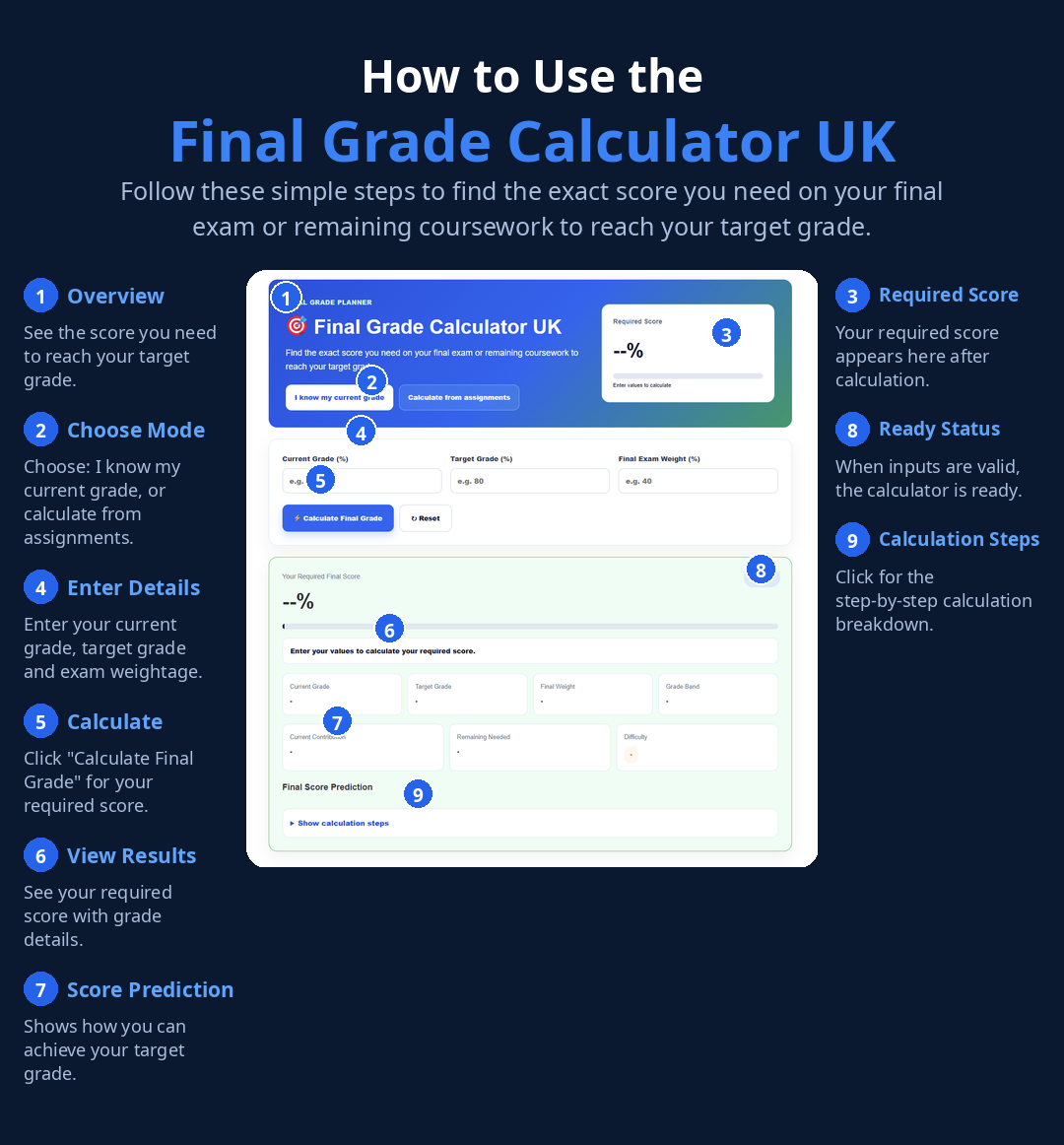
Click Here: Final Grade Calculator UK
What UCAS tariff points actually are
The UCAS tariff is a points system maintained by UCAS that assigns a numerical value to post-16 qualifications, so universities can set entry requirements as a single number instead of a list of grade combinations. Its main formal purpose, in UCAS’s own words, is giving universities a broad metric for Level 3 and SCQF Level 6 qualifications — every university uses it for data returns — but its practical purpose for applicants is simpler: it turns “DDM plus a C at A-level” into “160”, a number a computer can compare against an offer in milliseconds.
Three facts anchor everything else in this guide. First, nearly 70% of courses carry a tariff-point entry requirement, and over 80% of universities set a tariff requirement on at least one course (UCAS’s current figures) — so this is not a niche system; it is the default language of admissions. Second, the tariff only covers Level 3 qualifications: A-levels, BTECs, T-levels, Scottish Highers, the IB, the EPQ, Access to HE and similar. GCSEs carry zero points, whatever the grades. Third, UCAS republishes the tariff tables every May, and values do change — the tables below are the 2026 values, verified at write time against current tariff data.
A final framing point before the tables: the tariff measures qualification size and level, not how hard you found the course. A BTEC Extended Diploma at D*D*D* is worth 168 points — exactly the same as A*A*A* — because both are three-A-level-sized Level 3 qualifications at the top grade, not because anyone has declared the courses equally difficult. Universities know this perfectly well, which is why many still ask for specific grades in specific subjects alongside, or instead of, a points total.
A-level tariff: the 8-point ladder
A-levels are the reference qualification the whole tariff is built around, and their scale is beautifully regular: every step up the grade ladder is worth exactly 8 more points.
| A-level grade | UCAS tariff points | Common combinations |
|---|---|---|
| A* | 56 | A*A*A* = 168 |
| A | 48 | AAA = 144 |
| B | 40 | AAB = 136 |
| C | 32 | ABB = 128 |
| D | 24 | BBB = 120 |
| E | 16 | BBC = 112 / BCC = 104 / CCC = 96 |
Memorise the anchor combinations, because offers are written around them: 168 is three A*s, 144 is AAA, 136 is AAB, 128 is ABB, 120 is BBB, and 96 is CCC. When a course asks for 128 points, it is picturing ABB; when it asks for 112, it is picturing BBC. Knowing the anchors lets you read any points offer and instantly translate it into the grade profile the admissions tutor had in mind — which matters, because it tells you whether your particular mix of grades is really what they are looking for (more on that in the points-vs-grades section).
AS-levels and the EPQ: the top-up shelf
Two smaller qualifications sit on the top-up shelf, and both are worth understanding because they are the cheapest way to add points to a total that falls just short.
| Grade | AS-level points | EPQ points |
|---|---|---|
| A* | — | 28 |
| A | 20 | 24 |
| B | 16 | 20 |
| C | 12 | 16 |
| D | 10 | 12 |
| E | 6 | 8 |
The AS-level is worth roughly a third of a full A-level at each grade — an A is 20 points against the A-level’s 48 — which reflects that it is a smaller qualification, not a worse grade. The EPQ (Extended Project Qualification) is the more interesting case: an A* is worth 28 points, exactly half an A-level A*, making it one of the highest-value small qualifications in the tariff. For a student sitting on 112 points chasing a 120 offer, an EPQ at grade B (20 points) bridges the gap twice over.
The iron rule for both: no double-counting. If you hold an AS and an A-level in the same subject, only the higher-value qualification counts. An AS in maths (A = 20) plus an A-level in maths (B = 40) contributes 40 points, not 60 — the system credits the best version of each subject, once.
BTEC tariff: size matters as much as grade
BTEC Nationals confuse more applicants than any other qualification, and the confusion is almost always about size, not grades. Three different BTEC sizes exist at Level 3 — the Extended Certificate (one A-level), the Diploma (two A-levels) and the Extended Diploma (three A-levels) — and each has its own points scale. The tables below use the current BTEC grading of Distinction*, Distinction, Merit and Pass.
BTEC National Extended Diploma (three A-levels — the full-time BTEC most applicants hold):
| Extended Diploma grade | UCAS tariff points | A-level equivalent |
|---|---|---|
| D*D*D* | 168 | A*A*A* |
| D*D*D | 160 | above AAA |
| D*DD | 152 | A*AA |
| DDD | 144 | AAA |
| DDM | 128 | ABB |
| DMM | 112 | BBC |
| MMM | 96 | CCC |
| MMP | 80 | below CCC |
| MPP | 64 | around DDE |
| PPP | 48 | EEE |
BTEC National Diploma (two A-levels) and Extended Certificate (one A-level):
| Diploma grade (2 A-levels) | Points | Extended Certificate grade (1 A-level) | Points |
|---|---|---|---|
| D*D* | 112 | D* | 56 |
| D*D | 104 | D | 48 |
| DD | 96 | M | 32 |
| DM | 80 | P | 16 |
| MM | 64 | ||
| MP | 48 | ||
| PP | 32 |
Notice the design logic: the Extended Diploma’s scale is exactly three times the Extended Certificate’s — DDD (144) is 3 × 48, MMM (96) is 3 × 32. The tariff is doing precisely what it promises: scoring size times grade. The practical consequence is that misidentifying your BTEC size is catastrophic for planning. A student who thinks their BTEC Diploma (two A-levels) is an Extended Diploma will overestimate their total by a full A-level’s worth of points — up to 56 points of phantom tariff. Check your certificate or ask your tutor which size you are taking; it is the single most valuable thirty seconds of your application.
Scottish Highers and Advanced Highers
Scotland runs its own school system, and the tariff translates it onto the same scale. Scottish Highers (usually five taken in S5) are smaller than A-levels; Advanced Highers (usually one to three in S6) are A-level-sized.
| Grade | Scottish Higher points | Advanced Higher points |
|---|---|---|
| A | 33 | 56 |
| B | 27 | 48 |
| C | 21 | 40 |
| D | 15 | 32 |
An Advanced Higher at A is worth 56 — identical to an A-level A* — which is the tariff’s way of saying these are equivalent-size, equivalent-level qualifications. Five Highers at AABBC total 33 + 33 + 27 + 27 + 21 = 141 points, sitting just under the AAA-equivalent 144. Scottish applicants should also know that universities in Scotland typically make offers in Highers grades rather than tariff points, while English universities reading a Scottish application will often translate via the tariff — the same number, two different offer languages.
T-levels: the technical route’s tariff
T-levels — the technical qualifications combining classroom study with a substantial industry placement — carry full tariff weight at three-A-level size:
| T-level overall grade | UCAS tariff points | A-level equivalent |
|---|---|---|
| Distinction* | 168 | A*A*A* |
| Distinction | 144 | AAA |
| Merit | 120 | BBB |
| Pass (core graded C or above) | 96 | CCC |
| Pass (core graded D or E) | 72 | — |
Two things are worth noting. First, the Pass grade splits on the core component: a C or above on the core lifts the whole qualification from 72 to 96 points — a 24-point swing resting on one component, which makes the core the highest-leverage part of a T-level for points purposes. Second, partially achieved T-levels have their own bespoke tariff entries (UCAS lists them by subject), so students who complete the core but not the occupational specialism should check the tariff tables for their exact situation rather than guessing.
The IB: tariffed piece by piece
The International Baccalaureate is the qualification the tariff treats most unusually. UCAS does not convert your headline diploma score (the number out of 45) into points. Instead it tariffs every component separately and adds them up — six subjects plus the core — which is why your tariff total and your diploma score are two completely different numbers.
| IB grade | Higher Level points | Standard Level points |
|---|---|---|
| 7 | 56 | 28 |
| 6 | 48 | 24 |
| 5 | 32 | 16 |
| 4 | 24 | 12 |
| 3 | 12 | 6 |
| 2 or 1 | 0 | 0 |
Theory of Knowledge and the Extended Essay each add points on their own A–E scale: A = 12, B = 10, C = 8, D = 6, E = 4. So an IB student with Higher Level grades of 7, 6 and 5 (56 + 48 + 32 = 136), Standard Level grades of 7, 6 and 5 (28 + 24 + 16 = 68), a TOK grade B (10) and an EE grade C (8) holds 136 + 68 + 18 = 222 tariff points. A small honesty note: some third-party calculators quote a diploma-total conversion instead (45 → 720 and so on). The component method above is the 2026 tariff-table method — if a calculator gives you a wildly different number, check which method it is using before you trust it.
New for 2026 entry: apprenticeships earn tariff points
The genuinely new development in the tariff — and the reason this guide is dated 2026 — is that Level 3 apprenticeships now carry UCAS tariff points for the first time, for 2026 entry onwards. UCAS announced the change in December 2024 after a sector consultation in which around three-quarters of respondents supported the model (UCAS announcement). Points are awarded by expected duration, aligned across all four UK nations:
| Apprenticeship duration | Tariff points | A-level equivalent (per UCAS) |
|---|---|---|
| 36 months | 112 | around BBC |
| 24 months | 96 | AA / CCC |
| 18 months | 64 | — |
| 12 months | 48 | EEE |
A two-year apprenticeship is therefore worth 96 points — the same as CCC at A-level or a T-level Pass with a strong core — and UCAS explicitly encourages applicants to combine apprenticeship points with A-levels or BTECs (UCAS tariff overview for apprenticeships). The strategic point is aimed at former apprentices considering university: work you have already completed now counts in the same currency as school qualifications. One caveat, from UCAS itself: around 30% of courses use alternative entry requirements rather than tariff, so always check the specific course — tariff eligibility and course acceptance are two different things.
How universities actually use your points total
Knowing your number is only half the game; the other half is knowing what universities do with it. The landscape looks like this:
Points offers give you flexibility. An offer of “120 UCAS points” can be met by BBB, by BBC plus an EPQ, by DMM on a BTEC Extended Diploma, or by a dozen other combinations. This is the tariff working as designed — it lets admissions compare a BTEC applicant and an A-level applicant on one scale. Our guide to Russell Group entry grades shows how the most selective universities translate tariffs into their own requirements.
Grade offers give you none. More selective universities and courses tend to make offers in grades — “AAB”, or “36 IB points with 6,6,6 at Higher Level” — where the letters are the offer and no surplus of tariff points elsewhere compensates for a missed one. An applicant with AAB plus an EPQ at A* holds 160 points but still misses an “AAA” offer. If your offer letter names grades, plan to the grades; the tariff total is irrelevant.
Named-subject conditions are grade offers in disguise. “112 points including a B in Maths” means the 112 is flexible but the B in Maths is not. Applicants routinely clear the points bar and miss the named grade — especially in maths, sciences and English — so identify every named condition in your offer and treat each as its own mini grade offer.
Contextual offers lower the bar — sometimes. Universities running widening-participation schemes routinely make reduced offers (often one or two grades, or 8–16 points, below the standard) to eligible applicants. If you might qualify — through postcode, school, care experience or similar criteria — check the university’s contextual admissions pages; our guide to the universities with the most accessible entry requirements covers where flexibility is greatest.
Clearing runs on tariff. When courses list clearing vacancies, they usually state a tariff number — and in recent cycles there has been plenty of movement: Wonkhe’s analysis of the June 2026 UCAS deadline data found high-tariff providers making a record 928,710 offers with an offer rate of 65.3%, as institutions competed harder for applicants (Wonkhe, July 2026). If you enter clearing, your tariff total is the fastest way to filter which vacancies are realistic.
Worked example 1: Amara’s mixed BTEC and A-level total
Amara is taking a BTEC National Extended Diploma in Business alongside one A-level in Spanish. Her predicted grades: DDM on the BTEC, C in Spanish. What is her tariff total, and what does it unlock?
Step 1 — the BTEC: DDM on the Extended Diploma (three-A-level size) is worth 128 points from the table above. Step 2 — the A-level: grade C is worth 32 points. Step 3 — add: 128 + 32 = 160 points.
What does 160 mean? It sits 16 points above the AAA-equivalent 144 and 8 below A*A*A*-equivalent 168 — roughly “above AAA” in admissions shorthand. Concretely: it clears any 144-point offer with room to spare, and it means Amara could drop one BTEC grade (DDM → DMM = 112, total 144) and still meet a 144 offer. That is the planning power of the tariff — she can see exactly how much slippage each offer tolerates, subject by subject, before results day.
Worked example 2: Daniel and the offer-letter trap
Daniel’s predicted A-levels: AAB. He is also taking an EPQ, predicted A. His firm choice has offered him “AAB”; his insurance choice has offered “136 UCAS points”. His tariff total: AAB = 48 + 48 + 40 = 136, plus EPQ at A = 24, for 160 points.
The insurance offer is safe twice over: 160 clears 136 with 24 points to spare — Daniel could drop to ABB (128) plus the EPQ (24) = 152 and still be in. But the firm offer is where the trap sits. “AAB” is a grade offer: if Daniel achieves ABB, his 152 tariff points are worth nothing against it, because the offer never asked for points. The EPQ’s 24 points — real, tariff-backed, hard-earned — cannot rescue a missed grade when the offer is written in letters.
Daniel’s correct strategy, and the lesson of this guide: plan to the stricter language. Against a grade offer, every hour goes to protecting the named grades; the EPQ is a bonus, not a safety net. Against a points offer, the EPQ is load-bearing — it genuinely converts into offer-meeting currency. Read the offer letter, identify which currency it demands, and spend your revision accordingly.
Five mistakes that cost applicants their places
Mistake 1: counting GCSEs. Nine GCSEs at grade 9 add exactly zero tariff points. They matter for subject requirements and predicted grades, but they never enter the total — applicants who add them are planning against a fantasy number.
Mistake 2: double-counting AS and A-level in the same subject. The tariff credits the best version of each subject once. AS maths (A = 20) plus A-level maths (B = 40) contributes 40, not 60.
Mistake 3: confusing BTEC sizes. The Diploma (two A-levels, maximum 112) is not the Extended Diploma (three A-levels, maximum 168). Misidentifying your BTEC inflates or deflates your total by up to 56 phantom points — check which size you are taking.
Mistake 4: assuming points beat a grade offer. As Daniel’s example showed, surplus tariff points cannot satisfy an offer written in grades. Points offers reward breadth; grade offers demand the letters. Know which one you hold.
Mistake 5: trusting the wrong IB number. The 2026 tariff values IB components individually — a calculator quoting a diploma-total conversion is using a different method and may give a very different answer. For IB totals, work component by component as this guide does, or verify against UCAS’s official tables.

How many UCAS points is an A* worth?
An A* at A-level is worth 56 UCAS tariff points — the top of a ladder that drops 8 points per grade: A = 48, B = 40, C = 32, D = 24, E = 16. So three A*s (A*A*A*) total 168 points, AAA totals 144, ABB totals 128 and BBB totals 120. These combinations are the reference points most university offers are built around, which is why the full table is in this article.
Do GCSEs give you any UCAS points?
No — GCSEs carry zero UCAS tariff points, however good the grades. The tariff only covers Level 3 qualifications (and SCQF Level 6 in Scotland): A-levels, BTECs, T-levels, Scottish Highers, the IB, the EPQ and similar. GCSEs still matter enormously — universities routinely require specific GCSE grades, especially in English and maths, and they feed into predicted grades — but they add nothing to your points total. Anyone adding nine GCSEs to their tariff is inflating their total by exactly nothing.
Can I combine BTEC and A-level points in one total?
Yes — UCAS tariff points from different qualifications simply add together, which is exactly why the system exists. A BTEC National Extended Diploma at DDM (128 points) plus an A-level at grade C (32 points) gives 160. The thing to watch is qualification size: a BTEC National Diploma is worth two A-levels (maximum 112 points) while the Extended Diploma is worth three (maximum 168), and mixing them up is one of the five mistakes in this article. Always check which size of BTEC you are taking before you total.
Do universities make offers in points or in grades?
Both — and the difference matters more than most applicants realise. Around 70% of courses carry a tariff-point entry requirement (UCAS’s own figure), which gives you flexibility: a 120-point offer can be met by BBB, or by BBC plus an EPQ, or several other combinations. But more selective universities tend to make grade offers (“AAB”), where the letters are non-negotiable and extra points from an EPQ will not save a missed grade. Read your offer letter carefully: points offers reward breadth, grade offers demand the exact letters.
What does an offer of ‘120 UCAS points’ actually mean?
It means your Level 3 qualifications must total at least 120 tariff points — the equivalent of BBB at A-level, or DDM on a BTEC Extended Diploma, or several mixed combinations. The flexibility is the point: BBC (112) plus an EPQ at grade C (16) reaches 128 and clears it; so does a BTEC Extended Diploma at DMM (112) with an AS-level at grade C (12) on top, totalling 124. But check the fine print — offers sometimes say “120 points including a B in Maths,” and that named-grade condition works like a grade offer for that subject.
Do AS-levels still earn UCAS points?
Yes — AS-levels carry roughly half an A-level’s tariff: A = 20, B = 16, C = 12, D = 10, E = 6. They are a legitimate way to top up a points total, especially for students whose schools still enter them. The hard rule is no double-counting: if you hold both an AS and an A-level in the same subject, UCAS counts only the higher-value qualification — you cannot claim the AS points and the A-level points for the same subject twice.
How many UCAS points is the International Baccalaureate worth?
The IB is tariffed component by component, not from your headline diploma score out of 45. Each Higher Level subject scores 56 (grade 7), 48 (6), 32 (5), 24 (4) or 12 (3); each Standard Level subject scores 28, 24, 16, 12 or 6 on the same grade scale; and Theory of Knowledge and the Extended Essay each add 12 (A) down to 4 (E). So an IB student with Higher Level grades of 7, 6 and 5 (136), Standard Level grades of 7, 6 and 5 (68), a TOK grade B (10) and an EE grade C (8) holds 222 tariff points. Note that some third-party calculators quote a diploma-total conversion instead — always check which method a calculator uses before trusting its number.
Is there an official UCAS points calculator?
Yes — UCAS publishes its own tariff points calculator, refreshed each year as qualifications are added to the tariff, alongside the full downloadable tariff tables (republished every May). Use the official tables as your source of truth, especially for less common qualifications, because third-party calculators occasionally disagree on edge cases like the IB diploma total. And once you have your offer and your place, the maths flips from admissions to degree classification — our Final Grade Calculator UK and Degree Classification Calculator UK take over from there.
Conclusion
The UCAS tariff is, at bottom, a translation device — a way of writing “DDM plus a C” as “160” so that universities, applicants and clearing hotlines can all speak the same numbers. The applicants who use it well do three things: they learn the tables for their own qualifications cold, they read each offer letter to identify whether it demands points or grades, and they never let phantom points — GCSEs, double-counted AS-levels, the wrong BTEC size — inflate the total they are planning against.
Two things to do this week. First, compute your own total from the tables above — predicted grades if you are applying, achieved grades if you hold them — and write it next to each of your offers with the offer’s currency (points or grades) labelled beside it. The gap between the two numbers, offer by offer, is your real admissions position, and it is far more informative than any single grade. Second, remember that the tariff’s job ends the moment you enrol: from then on, your marks live in a completely different system of percentages, classifications and weightings, where our Final Grade Calculator UK and degree classification guide take over.
Grades get you the offer; the tariff just translates them. Learn the exchange rate now — it is the cheapest insurance in the entire application process, and unlike most insurance, it costs nothing but an hour with these tables.