

How Your Dissertation Is Marked at UK Universities [2026]
Your dissertation is the biggest single assessment most UK students will ever sit — and almost nobody explains how it is actually marked. You hand in 8,000 to 10,000 words, wait far longer than feels reasonable, and eventually a number appears that can swing your entire degree classification. What happened in between? Who read it? What were they looking for? And why does a 72 matter so much more here than it did on a coursework essay?
This guide opens the examiner’s desk drawer. It covers how much your dissertation is really worth in credit terms, the double-marking machinery that decides your number, the published rubrics examiners use (including the exact weightings one university publishes), the must-pass rules that can block your honours degree, why the mark takes so long, and — with two fully worked examples — how many classification points your dissertation is actually carrying. Every regulation cited below comes from a university’s own published documents, linked or named, and where rules vary between universities we say so.
One claim to get out of the way first, because it shapes everything else: your dissertation is not marked like an essay. It passes through more examiners, more checks and more formal stages than any other piece of work you will submit — which is both why it takes so long and why it is the most fairly scrutinised mark on your transcript.
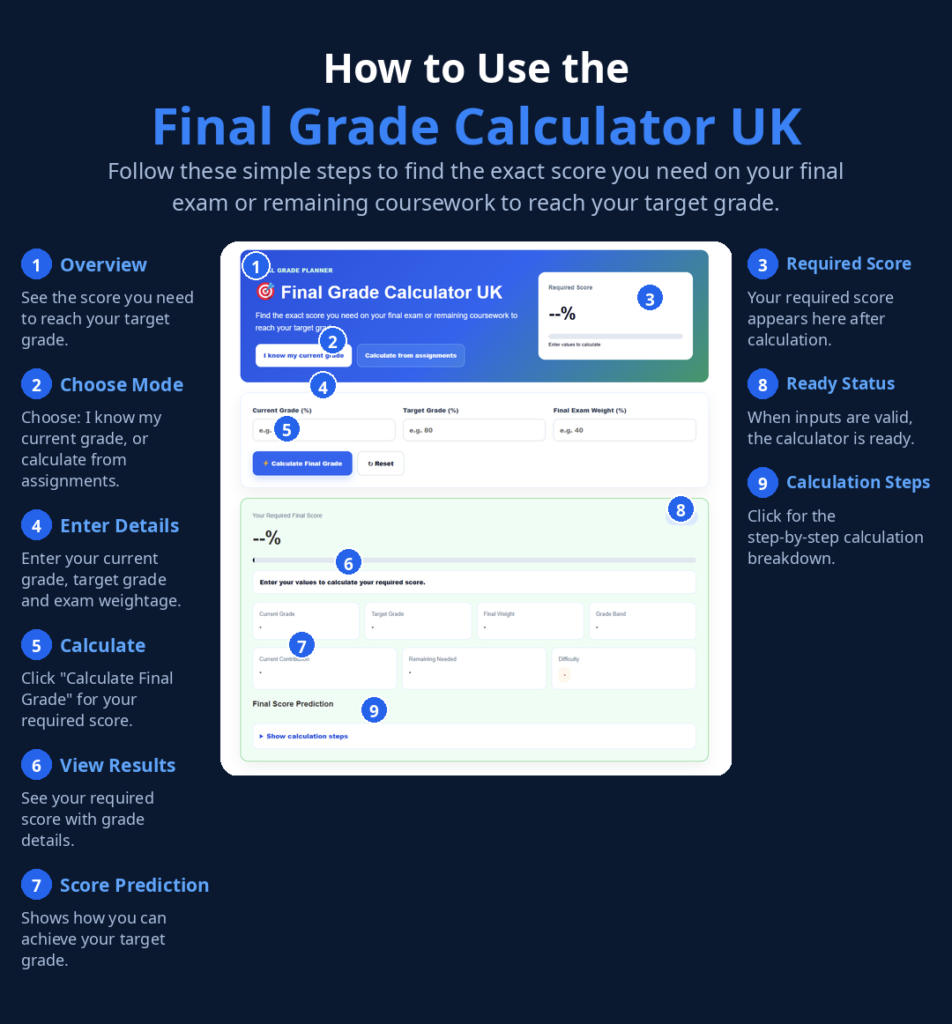
Click Here: Final Grade Calculator UK
How much is your dissertation actually worth?
Start with the credit value, because it determines everything else. Unlike essays, which are usually worth a fraction of a 20-credit module, the dissertation is a module in its own right — and a heavy one:
| University | Dissertation module | Credits |
|---|---|---|
| University of Suffolk | Mandatory Level 6 dissertation / extended project | 30 |
| University of Warwick | EN3K9-30 / EN3E0-30 dissertation modules | 30 |
| University of Exeter | Liberal Arts dissertation (LIB3000) | 30 |
| University of Bristol | Dissertation modules (e.g. POLI31555) | 40 |
| Durham University | Dissertation modules (e.g. Double Dissertation) | 40 |
| UCL | Final Year Project (BASC0073) | ´60 equivalent |
The pattern is clear: 30 to 40 credits is the norm, with some programmes going to the equivalent of 60. Shorter projects can be 20 credits. Check your own programme spec — the number matters because the arithmetic below scales directly with it.
Now convert credits into classification power. A final year is normally 120 credits, so:
| Dissertation credits | Share of final-year average | Share of whole classification (33:67 year split) |
|---|---|---|
| 30 credits | 25% | ≈16.7% |
| 40 credits | 33.3% (one-third) | ≈22.2% |
| 60 credits | 50% (one-half) | ≈33.3% |
Read the middle row again: a standard 40-credit dissertation is one-third of your final year and roughly 22 per cent of your entire degree classification. No other single assessment comes close. A 20-credit essay module, by comparison, is about 5.5 per cent of your classification under the same split. This is the single most important number in this guide: your dissertation carries four times the classification weight of a normal module.
Two examiners, not one: how double marking works
Your dissertation is read by at least two examiners, and the rules say so explicitly. Bournemouth’s marking policy requires all final-year dissertations and projects at Levels 5, 6 and 7 to be 100 per cent double or second marked — normally double marked. LJMU requires double marking of all dissertations worth at least 40 credits. Essex requires second or double marking for coursework items of at least 30 credits, explicitly including undergraduate capstone projects. This is not a favour your supervisor does you; it is a regulatory requirement.
Double marking is not the same everywhere, and the strongest version is blind double marking. Glasgow Caledonian’s assessment regulations require all final-level projects and dissertations to be marked by two independent examiners, neither of whom is aware of the other’s marks — and if the two cannot agree, a third marker determines the final mark. That is the gold standard: two genuinely independent judgements.
Northeastern University London publishes the clearest disagreement rule of any university we found. Its regulations: a discrepancy of under 5 per cent stands — the first marker’s mark is final — unless the difference crosses a classification border. Larger gaps go to discussion between the markers, and if they still cannot agree, the work is referred to a third party. The borderline exception matters: a 68 versus 71 disagreement (2:1 versus First territory) gets escalated even though it is under 5 per cent, because the stakes are a whole classification.
Then there is the second pair of eyes after the markers. At Heriot-Watt, the dissertation is marked by your supervisor and a second reader — and if it is borderline, it may also be assessed by the external examiner. The University of London’s assessment handbook confirms the pattern sector-wide: external examiners sample borderline marks, plus samples of Firsts and fails. Our guide to how university marking and moderation work explains the full machinery. The practical meaning: your dissertation is the most heavily scrutinised mark on your transcript, which is exactly why one harsh marker cannot sink it — and why one generous marker cannot save it either.
What the marks are for: the rubric, decoded
Examiners do not read your dissertation and assign a number by feel. They work from a marking rubric — published criteria, often with explicit weightings. Staffordshire University publishes one of the most detailed research-project rubrics of any UK university, and its weightings are worth studying because they reveal where the marks actually live:
| Criterion | Weighting | What it rewards |
|---|---|---|
| Background / literature | 25% | Understanding of the field, quality and range of sources |
| Methodology | 25% | Design of the study, justification of methods, rigour |
| Discussion | 25% | Analysis, interpretation, critical evaluation of findings |
| Results | 15% | Quality and presentation of what you found |
| Written communication / presentation / referencing | 10% | Clarity, structure, language, correct referencing |
Three-quarters of the marks — background, methodology and discussion — reward what you did and what it means. Presentation, the thing students obsess over most, is worth 10 per cent. That is not nothing, but it tells you where an hour of extra effort pays best: strengthening your methodology chapter or deepening your analysis buys two and a half times the marks of the same hour spent perfecting formatting. The full rubric is published in Staffordshire’s research project student guide.
Other universities publish the same dimensions without the numbers. Edinburgh Informatics assesses understanding of the problem, completion, quality of work, knowledge of the literature, critical evaluation and justification of design decisions. Heriot-Watt lists presentation, technical understanding, coverage of related work, critical analysis and originality, contribution to knowledge, and initiative. The vocabulary differs; the message does not: examiners reward the thinking, not the typing.

The rule most students never read: must-pass
Here is the fact that should change how seriously you take the dissertation. At the University of Leeds, the academic regulations state that to be eligible for a Bachelors degree with Classified Honours, candidates are required to pass the module or modules designated as comprising the final year project. Fail the project and you cannot graduate with classified honours — regardless of how strong the rest of your transcript is. That clause appears in both the current 2026/27 regulations and the archived 2025/26 version.
Durham applies the same logic at module level. Its 40-credit Double Dissertation is designated must-pass: it must be passed at 40 per cent or above for the award of an Honours degree, and a mark of 30 to 39 per cent cannot be compensated — it cannot be offset against stronger modules the way a normal fail sometimes can. Suffolk’s framework reaches the same place by a different route: dissertations are expected to be ‘core’ components, and in-module compensation does not apply to core components, so the dissertation must reach the 40 per cent pass mark on its own merits.
One honest caveat, because the research demands it: this is not universal. Exeter’s programme information lists its 30-credit Liberal Arts dissertation as condonable — implying condonement is possible under Exeter’s rules. Policies genuinely vary between universities, and some vary between programmes. The point is not that every dissertation is must-pass; it is that you must check whether yours is, because the consequences of failing it are unlike failing any other module. If you are in any doubt, read your programme handbook before you need it — and if the worst has already happened, our guide to failing a dissertation covers the resit and recovery routes.
Why your supervisor knows it is you: dissertations are not anonymous
Most UK coursework is marked anonymously — your name replaced by a candidate number — but dissertations are the standard exception. York St John’s code of practice explicitly exempts ‘extended projects, dissertations and theses’ from anonymous marking. Canterbury Christ Church’s anonymous marking policy is blunter still: ‘Individual Study or Dissertation — No.’ Birkbeck requires anonymous marking where practical but notes that closely supervised work such as dissertations may not be practical to anonymise. Loughborough allows exemptions for projects and dissertations where supervisors are key markers.
The reason is obvious once stated: your supervisor has guided the project for months, often helped shape the question, and is frequently one of the markers. Anonymity would be theatre. UEA’s regulations capture the resulting compromise honestly: written work is submitted by registration number rather than name, but supervisors ‘will know the real identities of their project and dissertation students’ — while external examiners do not.
What does this mean for you? Two things. First, the relationship with your supervisor is part of the assessment environment — choose your topic and supervisor thoughtfully, take supervision meetings seriously, and act on feedback, because the person advising you is often the person marking you. Second, do not confuse non-anonymous with biased: the double-marking machinery from the previous sections exists precisely to keep the process fair. If you believe marking was unfair, the route is a formal appeal or a remark request — never an informal complaint about your supervisor.
Why the mark takes so long — and when to expect it
Dissertation marks arrive weeks after essay marks, and the regulations explain why. For standard coursework, the sector standard is fast: Nottingham and Salford require marked work and feedback within 15 working days, and QMUL’s assessment handbook sets the same 15-working-day expectation. Dissertations get a different, longer clock.
UEA’s regulations state that dissertations, placement reports, projects and portfolios are ‘normally returned within 30 working days’ — double the standard turnaround. Manchester’s feedback policy allows up to 30 working days after the final deadline for single pieces of work weighted at 30 credits or more. And Manchester adds a line students should read carefully: provisional marks for dissertations should not be released to students before the exam board. QMUL similarly releases dissertation feedback after the exam period, timed to the board’s processing.
Put the pipeline together and the delay makes sense: supervisor marking, second/independent marking, disagreement resolution if needed, moderation sampling, external-examiner review, then the exam board’s formal confirmation — and only then your mark. Expect it after the board has met, not before. Chasing your department for an early number will not speed anything up, because the number is not official until the board confirms it. If you think an error slipped through once marks are published, our marks-checking guide shows how to audit your own record.
Worked example 1: what a strong dissertation does to a 2:1
Amara is in final year of a politics degree: Year 2 average 63 per cent, year weighting 33:67 (Leicester’s model). Her final year has four 20-credit modules and a 40-credit dissertation. Her taught modules come back at 64, 66, 61 and 65 — a solid, unremarkable set. The question is what the dissertation does.
With a 58 per cent dissertation (a low 2:2): final-year average = ((64 + 66 + 61 + 65) × 20 + 58 × 40) ÷ 120 = (5,120 + 2,320) ÷ 120 = 7,440 ÷ 120 = 62.0 per cent. Final classification: (0.33 × 63) + (0.67 × 62.0) = 20.79 + 41.54 = 62.3 per cent — a 2:1, but a fragile one, less than two and a half points above the boundary.
Now give the same student a 72 per cent dissertation (a First): final-year average = (5,120 + 2,880) ÷ 120 = 8,000 ÷ 120 = 66.7 per cent. Final classification: 20.79 + (0.67 × 66.7) = 20.79 + 44.69 = 65.5 per cent.
Fourteen marks on one module moved Amara’s classification by 3.2 points — from a nervous 62.3 to a comfortable 65.5. To get the same 3.2-point move from her taught modules alone, she would have needed to lift all four by eight marks each. That is the dissertation’s leverage in one number: because it is worth a third of the year, every mark on it counts double. Test your own scenario with the Degree Classification Calculator UK.
Worked example 2: the borderline, and how the dissertation can tip it
James finishes with a classification average of 69.4 per cent — agonisingly short of a First. At Leeds, the regulations state that classification averages within 0.5 of the next class boundary are awarded the higher classification, so 69.5 rounds up to a First and 69.4 does not. (That exact 0.5 rule is Leeds’s; every university has its own borderline policy — our rounding guide covers the main models.)
Now suppose James’s 40-credit dissertation scored 71 while his other final-year modules averaged 66. Under QMUL’s published borderline pattern — students in the zone of consideration with at least half their final-year credits at the upper-class level get raised, and the dissertation explicitly counts toward that half — his strong dissertation is precisely the evidence the board looks at. The dissertation does not just contribute its marks to the average; at some universities it is named in the discretion rules as a reason to lift a borderline candidate.
The lesson cuts both ways. A First-class dissertation in a 2:1 transcript is the strongest possible signal to an exam board exercising discretion — it is independent research, double-marked, externally sampled. A weak dissertation in an otherwise strong transcript is the opposite signal. When boards look for reasons, the dissertation is where they look first.
Six mistakes that cost dissertation marks
The rubric and the rules above point to where dissertations actually lose marks. These are the patterns examiners see every year:
| Mistake | Why it costs marks | What to do instead |
|---|---|---|
| Treating the dissertation as a long essay | The methodology criterion (25% at Staffordshire) has no essay equivalent — examiners expect a designed, justified method, not just argument | Write the methodology chapter as its own deliverable: choices made, alternatives rejected, limitations stated |
| Literature review as a list | Background is 25% of the rubric — a descriptive list scores low on critical evaluation | Organise the review around debates and gaps, not authors; every section should end by stating what is unresolved |
| Ignoring the published rubric | Examiners mark against published criteria — students who never read them optimise for the wrong things (usually presentation) | Get your department’s dissertation marking scheme before you start writing; check each chapter against it |
| Weak or missing justification | Edinburgh and Heriot-Watt both score justification of decisions and critical analysis — unexplained choices read as unthinking ones | Every significant choice (method, sample, framework) gets a sentence explaining why this and not that |
| Leaving it all to the final month | A 40-credit module deserves a third of your final-year effort — rushed analysis is visible to two independent markers | Work backwards from the deadline in weekly milestones agreed with your supervisor |
| Skipping supervision meetings | Your supervisor is often a marker, and their advice previews what the rubric rewards | Attend every meeting with written questions; act on feedback visibly in the next draft |
How is a dissertation marked at a UK university?
By at least two examiners working independently — that is the national norm. Bournemouth requires all final-year dissertations to be double or second marked, LJMU requires double marking of every dissertation worth 40 credits or more, and Essex requires second or double marking for coursework items of at least 30 credits including capstone projects. Your mark is then moderated: samples go to an external examiner from another university, and the exam board confirms it. This is why dissertation marks take far longer to come back than essay marks.
How much is a dissertation worth in the UK?
Typically 30 to 40 credits at most universities — Suffolk, Warwick and Exeter set theirs at 30 credits; Bristol and Durham at 40. A 40-credit dissertation is one-third of your final-year average, which under a common 33:67 year split works out at about 22 per cent of your entire degree classification. Some programmes go further: UCL’s final-year project is the equivalent of a 60-credit module — half the final year. Use our Final Grade Calculator UK to model exactly what yours is worth.
Do you have to pass your dissertation to get an honours degree?
At some universities, yes — unconditionally. Leeds requires candidates to pass the module(s) designated as comprising the final year project to be eligible for a Bachelors with Classified Honours: fail the project and you cannot graduate with classified honours. Durham marks its 40-credit Double Dissertation as must-pass at 40 per cent, with marks of 30–39 per cent barred from compensation. But the rules genuinely vary — Exeter’s programme spec implies its dissertation can be condoned — so check your own handbook. Our guide to what happens if you fail your dissertation covers the recovery routes.
Is dissertation marking anonymous?
Usually not. York St John explicitly exempts ‘extended projects, dissertations and theses’ from anonymous marking; Canterbury Christ Church’s policy answers ‘Individual Study or Dissertation — No’; and Birkbeck and Loughborough allow exemptions where supervisors are key markers. The reason is practical: your supervisor knows the project, the topic and usually you. UEA’s regulations put it plainly — written work is submitted by registration number, but supervisors know the real identities of their dissertation students.
Why do dissertation marks take so long?
Because the marking pipeline is the longest in the system. UEA gives itself 30 working days to return dissertations (versus 15–20 for standard coursework); Manchester allows up to 30 working days for single pieces of work worth 30 credits or more — and says provisional dissertation marks should not be released before the exam board. QMUL releases dissertation feedback after the exam period. Two independent markers, moderation, external-examiner sampling and the exam board’s sign-off all add weeks. Expect your mark after — not before — the board has met.
What do examiners look for in a dissertation?
Published rubrics cluster around the same dimensions: argument and analysis, research and scholarship, methodology, structure, and presentation. Staffordshire’s published research-project rubric weights Background 25 per cent, Methodology 25 per cent, Discussion 25 per cent, Results 15 per cent and written communication/presentation/referencing just 10 per cent — which tells you where the marks live: in what you did and what it means, not in how pretty it looks. Edinburgh Informatics scores understanding of the problem, completion, quality of work, knowledge of the literature and critical evaluation.
What happens if the two markers disagree?
Disagreement has a formal resolution process. Glasgow Caledonian uses blind double marking — two independent examiners, neither aware of the other’s marks — and if they cannot agree, a third marker determines the final mark. Northeastern University London’s rule: a discrepancy under 5 per cent stands (unless it crosses a classification border); bigger gaps go to discussion, then to a third party. Borderline dissertations may also be assessed by the external examiner, as at Heriot-Watt. So one harsh marker cannot sink you — but neither can one generous one save you.
Can a good dissertation move your degree classification?
Yes — the arithmetic makes it one of the most powerful levers you have. A 40-credit dissertation at 72 per cent instead of 58 lifts a 120-credit final-year average by 4.7 points; under a 33:67 year split that is 3.1 points on your whole classification — enough to cross a boundary. Borderline rules can also weigh it: QMUL’s policy lets the dissertation count toward the ‘half your credits at the upper class’ uplift test. The reverse is equally true, which is why the dissertation deserves more of your effort than any other single module.
Conclusion
Your dissertation is marked by two independent examiners against a published rubric, moderated and externally sampled, under rules that — at universities like Leeds and Durham — can make passing it a condition of your honours degree. It is worth 30 to 40 credits at most universities, which makes it roughly a fifth to a quarter of your entire classification. It is not marked anonymously, it takes around 30 working days to come back, and the marks live in your methodology and analysis far more than in your presentation.
That combination — huge weight, double scrutiny, published criteria — is actually good news. It means the dissertation is the fairest big mark you will ever receive, and the one where effort converts to classification points most efficiently. The worked examples showed it: fourteen marks on a 40-credit dissertation moved a classification by over three points, a swing no set of essays can match. If your degree were a portfolio, the dissertation would be your largest single holding — manage it like one.
Start with the arithmetic: put your current marks and your dissertation’s credit value into the Final Grade Calculator UK and see exactly what dissertation mark your target classification needs. Then read your department’s published marking scheme before you write another word. Students who know how the game is scored play it better — and on the dissertation, the scoring sheet is public.