

You submit an essay, wait for the result, and finally see 68% on your screen. At first, that looks straightforward. But then you notice your module result is 64%, even though your coursework mark was higher. In another module, you might have two assignments, an exam, and a presentation all contributing different amounts to the final result.
That is where university coursework marks can become confusing.
The reason is simple: your coursework mark is often only one part of your overall module mark. Universities can give different assessments different weightings, and some modules also have minimum marks or other assessment requirements.
Knowing how the calculation works makes it much easier to understand your results, work out what mark you need next, and see how individual assignments could affect your overall university grade.
Calculate your weighted university marks before working out your module or degree average.
Click Here: Weighted Grade Calculator UK
How To Use the Weighted Grade Calculator UK?
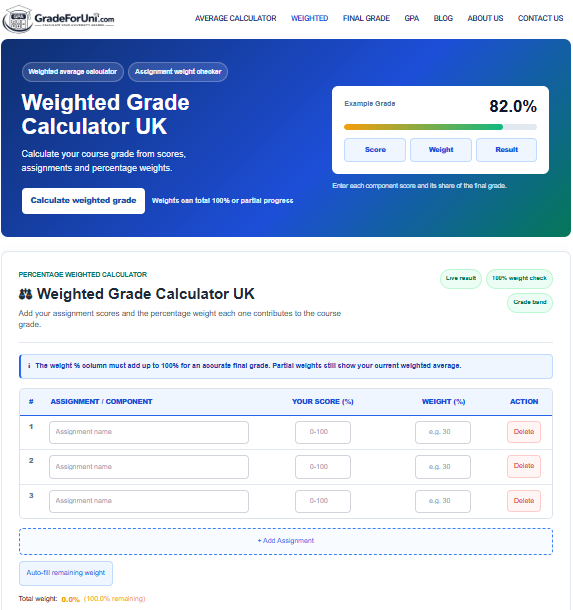
How University Coursework Marks Are Calculated
University coursework marks are usually calculated by multiplying each assessment mark by its weighting and then adding the weighted contributions together.
For example, if an essay is worth 40% and you score 70%, its contribution is:
| Exam Component | Percentage | Calculation | Marks |
|---|---|---|---|
| Exam | 40% | 70 × 0.40 | 28 marks |
| Exam | 60% | 65 × 0.60 | 39 marks |
| Module Mark | 100% | 28 + 39 | 67% |
However, the exact method depends on your university and module. Some courses have assessment hurdles, minimum component marks, different credit weightings, or specific reassessment rules.
What Is a University Coursework Mark?
A university coursework mark is the percentage result you receive for a coursework assessment such as an essay, report, presentation, project or portfolio.
For example:
| Assessment | Mark |
|---|---|
| Essay | 68% |
| Research report | 72% |
| Presentation | 65% |
| Dissertation | 74% |
These are individual assessment marks. They are not necessarily the same as your final module mark.
Visit Now: Taxsal.comCoursework Mark vs Module Mark
The coursework mark relates to one coursework assessment or a group of coursework assessments.
The module mark is the final result for the whole module after all relevant assessments have been combined according to their weightings.
For example:
| Assessment | Mark | Weighting |
|---|---|---|
| Coursework | 70% | 40% |
| Exam | 65% | 60% |
| Module mark | — | 67% |
Your coursework result is 70%, but your module result is 67% because the exam contributes 60% of the module.
Coursework Mark vs Overall University Grade
Your module mark can then contribute to a wider academic average.
The typical progression is:
Assessment mark → Module mark → Year/module average → Overall degree result
The exact degree calculation varies between universities and courses, particularly in relation to which years count and how credits are weighted.
Read Now: University Grade Tracker UKWhere to Find Your Coursework Weighting
Do not guess the weighting of an assignment.
Check your:
- Module handbook
- Module descriptor
- Assessment brief
- University assessment regulations
- Online learning platform
- Course documentation
A module might use a 30% coursework and 70% exam structure, while another could use 100% coursework or several smaller assessments.
The official weighting for your module should always take priority over a general example found online.
How Is a University Coursework Mark Calculated?
The basic calculation depends on the weighting attached to each assessment.
The Basic Coursework Mark Formula
The general formula is:
Weighted contribution = Assessment mark × Assessment weighting
If your assessment weighting is shown as 40%, convert it to 0.40 for the calculation.
For example:
| Item | Calculation | Result |
|---|---|---|
| Assessment contribution | 72 × 0.40 | 28.8 |
| Explanation | A mark of 72% in an assessment worth 40% contributes 28.8 percentage points towards the module. | 28.8 percentage points |
| Module mark | (Mark 1 × Weight 1) + (Mark 2 × Weight 2) + (Mark 3 × Weight 3) | Module mark |
The weightings should normally be expressed as decimals when using this formula.
How Assessment Weighting Changes Your Mark
A 70% coursework mark does not necessarily contribute 70 marks to your module.
Its effect depends on its weighting.
| Coursework Mark | Weighting | Contribution |
|---|---|---|
| 70% | 20% | 14 |
| 70% | 30% | 21 |
| 70% | 40% | 28 |
| 70% | 50% | 35 |
| 70% | 60% | 42 |
This is why a strong mark in a low-weight assessment may have less impact than a slightly lower mark in a high-weight assessment.
Read More: How University Credits and Grades Work TogetherWhat Happens When Coursework Is Worth 20%, 30%, 40% or 50%?
Suppose you score 68% in your coursework.
| Assessment Weight | Calculation | Contribution |
|---|---|---|
| 20% | 68 × 0.20 | 13.6 |
| 30% | 68 × 0.30 | 20.4 |
| 40% | 68 × 0.40 | 27.2 |
| 50% | 68 × 0.50 | 34 |
The same coursework performance therefore has a different effect depending on its weighting.
How Do You Calculate Multiple Coursework Assessments?
Some modules have several pieces of coursework rather than one large assignment.
You should not automatically take a simple average if the assessments have different weightings.
When Coursework Assessments Have Equal Weightings
If three assignments each contribute one-third of the coursework component, a simple average may be appropriate.
For example:
| Assessment | Mark |
|---|---|
| Essay | 66% |
| Report | 72% |
| Presentation | 69% |
| Average | 69% |
Your coursework average is therefore 69%.
This only works when the assessments have equal weighting.
Read Now: How Many Credits Count Toward Your Final Degree Classification?When Coursework Assessments Have Different Weightings
Suppose your module contains:
| Assessment | Weight | Mark |
|---|---|---|
| Essay | 20% | 65% |
| Presentation | 30% | 72% |
| Report | 50% | 78% |
Calculate each contribution separately:
| Assessment | Calculation | Contribution |
|---|---|---|
| Essay | 65 × 0.20 | 13 |
| Presentation | 72 × 0.30 | 21.6 |
| Report | 78 × 0.50 | 39 |
| Total | 13 + 21.6 + 39 | 73.6% |
Your weighted coursework mark is therefore 73.6%.
How to Calculate the Weighted Coursework Mark
Use these steps:
- Write down every assessment mark.
- Write down the weighting for each assessment.
- Convert each percentage weighting into a decimal.
- Multiply each mark by its weighting.
- Add the weighted contributions.
- Check the result against your university’s rounding rules.
How Are Coursework and Exam Marks Combined?
Coursework often forms only part of a module.
The remaining percentage might come from an exam, presentation, practical assessment, project or another component.
How Coursework Contributes to the Module Mark
| Assessment | Weight | Mark | Calculation | Contribution |
|---|---|---|---|---|
| Coursework | 40% | 72% | 72 × 0.40 | 28.8 |
| Exam | 60% | 65% | 65 × 0.60 | 39 |
| Module mark | 100% | 28.8 + 39 | 67.8% |
Depending on the university’s rounding rules, this may be recorded as approximately 68%.
How to Calculate a Coursework-and-Exam Module Mark
The general method is:
Module mark = (Coursework mark × coursework weighting) + (Exam mark × exam weighting)
For example:
| Assessment | Mark | Weight | Contribution |
|---|---|---|---|
| Coursework | 72% | 40% | 28.8 |
| Exam | 65% | 60% | 39 |
| Module | — | 100% | 67.8% |
The important point is that you do not simply calculate:
(72 + 65) ÷ 2
That would incorrectly treat the assessments as equally weighted.
Why Your Coursework Mark May Differ From Your Module Mark
Your coursework mark can be higher or lower than your final module mark because other assessments are included.
If coursework is 30% of the module, for example, even a very high coursework mark has a limited contribution compared with an exam worth 70%.
Conversely, a weaker coursework result may not prevent you from achieving a strong module result if the remaining assessments carry greater weight.
Read More: Weighted vs Unweighted GradesWhat Coursework Mark Do You Need to Reach a Target Grade?
Sometimes the most useful calculation is not your current module mark but the mark you need next.
For example, you might know that you have already received 55% for coursework and want to know what exam mark would give you a final module result of 60%.
How to Calculate the Mark You Need in Your Remaining Assessment
Use:
Required mark = (Target module mark − Existing contribution) ÷ Remaining weighting
Suppose:
| Item | Calculation | Result |
|---|---|---|
| Coursework | 55% | |
| Coursework weighting | 40% | |
| Exam weighting | 60% | |
| Target module mark | 60% | |
| Existing coursework contribution | 55 × 0.40 | 22 |
| You still need | 60 − 22 | 38 |
The exam must therefore contribute 38 marks.
Required exam mark:
38 ÷ 0.60 = 63.33%
You would need approximately 63.3% in the exam to reach a 60% module mark, before considering any university-specific rounding or assessment requirements.
What Mark Do You Need for 50%, 60% or 70%?
The answer depends on:
- Your current assessment marks
- The remaining assessment weighting
- Your target
- Any assessment hurdles
- Your university’s calculation rules
A useful approach is to calculate several targets rather than focusing on only one.
For example, if you already have 55% in coursework worth 40%:
| Target Module Mark | Required Exam Mark |
|---|---|
| 50% | 46.7% |
| 60% | 63.3% |
| 70% | 80.0% |
This can help you set a realistic target for the remaining assessment.
What Happens When Your Coursework Mark Is Low?
A low coursework mark does not automatically mean that you will fail the module.
The effect depends on the weighting.
For example, coursework worth 20% has a smaller mathematical impact than coursework worth 60%.
However, you must also check whether the module has a minimum mark requirement for a particular assessment.
How Does Your Module Mark Affect Your Overall University Average?
After individual assessments have been combined, you may need to calculate an average across several modules.
This is a different calculation from working out a single coursework or module mark.
Why Module Credits Matter
Modules can carry different numbers of credits.
For example:
- Module A: 20 credits
- Module B: 20 credits
- Module C: 40 credits
If the modules have different credit values, simply averaging their percentages can produce the wrong overall result.
A 40-credit module may have twice the mathematical weight of a 20-credit module when calculating a credit-weighted average, depending on the university’s rules.
How Credit-Weighted Module Averages Work
The basic formula is:
Credit-weighted average = Σ (Module mark × Module credits) ÷ Total credits
For example:
| Module | Mark | Credits |
|---|---|---|
| A | 65% | 20 |
| B | 70% | 20 |
| C | 74% | 40 |
Calculation:
| Calculation | Result |
|---|---|
| (65 × 20) + (70 × 20) + (74 × 40) | 5,560 |
| Total credits: 20 + 20 + 40 | 80 |
| Average: 5,560 ÷ 80 | 69.5% |
The credit-weighted average is 69.5%.
Read More: Credit Weighted Average CalculatorDoes a Higher-Credit Module Count More?
It can.
A module worth 40 credits represents twice as many credits as a 20-credit module, so it can have a greater influence on a credit-weighted average.
However, degree classification rules can be more complicated than simply applying one credit-weighted average to every year.
Can You Pass a Module After Failing Coursework?
A low coursework mark and a failed module are not necessarily the same thing.
Your university may calculate an overall module mark from several assessments, but some courses also impose minimum marks for particular components.
When a Low Coursework Mark Does Not Automatically Mean a Fail
Imagine:
| Assessment | Mark | Weighting | Calculation | Contribution |
|---|---|---|---|---|
| Coursework | 35% | 30% | 35 × 0.30 | 10.5 |
| Exam | 45% | 70% | 45 × 0.70 | 31.5 |
| Total | 100% | 10.5 + 31.5 | 42% |
If the module’s normal pass requirement is 40% and there is no additional component hurdle, the overall result could meet that threshold.
But that is only an example. Your own university may have additional requirements.
Assessment Hurdles and Minimum Component Marks
An assessment hurdle is a requirement that must be met separately from the overall weighted mark.
For example, a course might require students to achieve a minimum mark in a particular examination or assessment.
This means you should not assume:
Overall mark ≥ pass mark = automatic pass
That relationship can fail where specific assessment requirements apply.
Why University Rules Can Differ
UK universities do not all use identical assessment regulations.
Requirements can vary by:
- University
- Course
- Module
- Qualification level
- Professional accreditation
- Assessment type
Always check the rules that apply to your own course.
What Happens If You Fail or Resit Coursework?
If you fail a coursework assessment, the next step depends on your university’s reassessment regulations.
Coursework Resubmission and Reassessment
Possible outcomes can include:
- Resubmission
- Reassessment
- Resit
- Repeat assessment
- Repeat module
- Other progression arrangements
The terminology and conditions vary.
Do not assume that every university handles a failed coursework assessment in the same way.
How Capped Resit Marks Can Affect Your Result
Some reassessment systems may restrict the mark that can be recorded after a successful resit.
For example, a student could perform much better on reassessment but have the recorded result limited under the university’s rules.
This is why a simple calculation based on your new raw mark may not always predict the mark that appears on your transcript.
Why You Should Check Your University’s Reassessment Rules
Before calculating your expected result, check:
- Whether reassessment is available.
- Whether the assessment can be resubmitted.
- Whether the mark is capped.
- Whether the original mark remains relevant.
- Whether there is a separate assessment hurdle.
- Whether reassessment affects progression.
Are Coursework Marking Rules the Same at Every UK University?
No. General calculation principles are useful, but individual regulations can differ.
Undergraduate Coursework Marking
Undergraduate courses commonly use percentage marks, but the assessment structure varies between modules.
One module might use:
- 30% coursework
- 70% examination
Another could use:
- 20% essay
- 30% presentation
- 50% project
A third might assess the entire module through coursework.
Postgraduate Coursework Marking
Postgraduate courses can have different pass requirements and assessment rules from undergraduate courses.
Therefore, do not automatically apply undergraduate thresholds to a postgraduate programme.
Your course handbook and university regulations should be the source of truth.
University-Specific Assessment Requirements
Check for rules covering:
- Minimum assessment marks
- Module pass requirements
- Rounding
- Reassessment
- Compensation
- Progression
- Degree classification
- Credit requirements
Professional-Body and Course-Specific Requirements
Some courses may have additional requirements because of professional or regulatory expectations.
This can affect whether a student can pass a module even when the simple weighted calculation appears satisfactory.
| Area | Can Rules Vary? |
|---|---|
| Assessment weighting | Yes |
| Pass requirements | Yes |
| Component hurdles | Yes |
| Rounding | Yes |
| Resit rules | Yes |
| Degree classification | Yes |
| Professional requirements | Yes |
How Can Coursework Affect Your Final Degree Classification?
Coursework does not usually jump directly from an assignment mark to your final degree classification.
Instead, it can influence the chain of results leading towards the final award.
From Coursework Mark to Module Mark
First, individual assessments are combined according to their module weightings.
For example:
Coursework → Exam → Module mark
From Module Marks to Your Overall Average
Your module marks can then contribute to your year or overall academic average according to the relevant credit and classification rules.
This is where the credit value of modules can become important.
How Coursework Can Contribute to a 1st, 2:1, 2:2 or Third
A single coursework assignment normally does not determine your final degree classification by itself.
Its impact depends on:
- Its assessment weighting
- The module’s credit value
- The module mark
- Which academic years count
- Your university’s classification formula
If you want to estimate your classification, use the relevant degree classification tool rather than treating one coursework mark as your final degree result.
Practical University Coursework Mark Scenarios
Strong Coursework but Weak Exam
A student receives:
| Assessment | Mark | Weighting | Calculation | Contribution |
|---|---|---|---|---|
| Coursework | 78% | 40% | 78 × 0.40 | 31.2 |
| Exam | 45% | 60% | 45 × 0.60 | 27 |
| Module result | 100% | 31.2 + 27 | 58.2% |
The strong coursework helped significantly, but the lower exam mark pulled the module result down.
Weak Coursework but Strong Exam
Suppose:
| Assessment | Mark | Weighting | Calculation | Contribution |
|---|---|---|---|---|
| Coursework | 42% | 30% | 42 × 0.30 | 12.6 |
| Exam | 72% | 70% | 72 × 0.70 | 50.4 |
| Final module mark | 100% | 12.6 + 50.4 | 63% |
The exam’s higher weighting allowed the student to recover from the weaker coursework result.
Coursework Worth 70% of a Module
Consider:
| Assessment | Mark | Weighting | Calculation | Contribution |
|---|---|---|---|---|
| Coursework | 74% | 70% | 74 × 0.70 | 51.8 |
| Exam | 58% | 30% | 58 × 0.30 | 17.4 |
| Module mark | 100% | 51.8 + 17.4 | 69.2% |
Here, the coursework result has a major influence because it represents most of the module.
A Failed Coursework Component With an Overall Passing Mark
Suppose a module produces an overall weighted mark above 40%, but the student has scored below a separately required minimum in one assessment.
The mathematical average alone may not determine the outcome.
The student should check the module’s assessment hurdle before assuming they have passed.
Coursework Across Modules With Different Credit Values
A student achieves:
- 66% in a 20-credit module
- 68% in another 20-credit module
- 75% in a 40-credit module
The 40-credit module has greater influence on a credit-weighted average.
This is why students should distinguish between calculating an individual module mark and calculating an overall academic average.
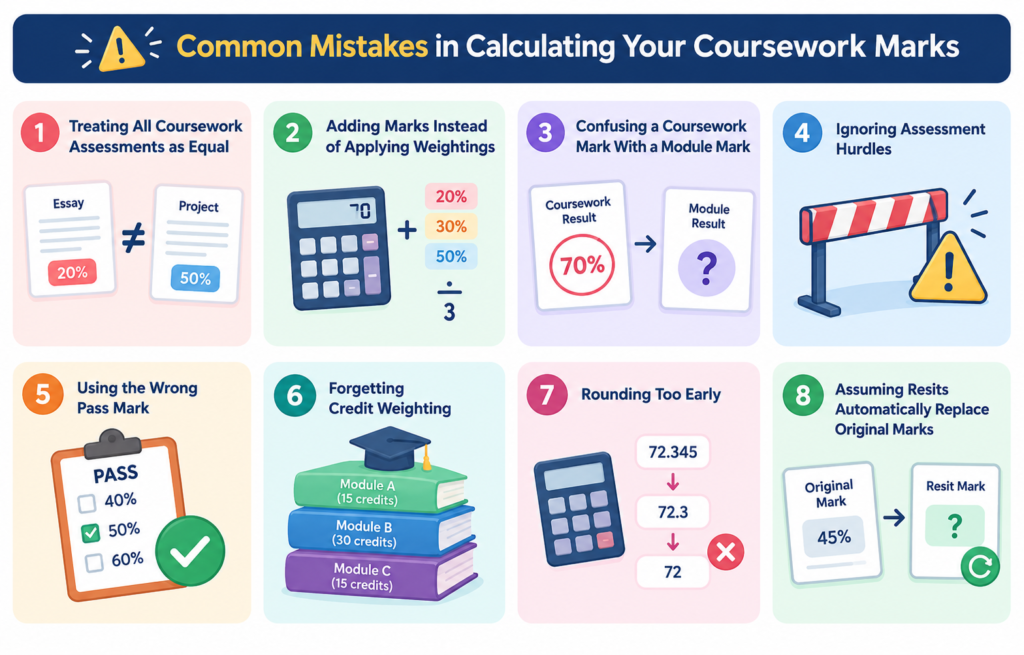
Common Mistakes When Calculating University Coursework Marks
| Common Mistake | Explanation |
|---|---|
| Treating All Coursework Assessments as Equal | A 20% essay and a 50% project should not automatically receive equal mathematical weight. |
| Adding Marks Instead of Applying Weightings | Adding assessment percentages and dividing by the number of assessments only works when the assessments have equal weight. |
| Confusing a Coursework Mark With a Module Mark | A 70% coursework result does not mean your module result will automatically be 70%. |
| Ignoring Assessment Hurdles | A module may have additional minimum requirements that are not visible from the weighted average alone. |
| Using the Wrong Pass Mark | Do not assume that the same pass threshold applies to every qualification, module or course. |
| Forgetting Credit Weighting | When calculating a wider academic average, module credits can affect how much each module contributes. |
| Rounding Too Early | Keep full precision during intermediate calculations where possible, then apply the university’s rounding rule at the appropriate stage. |
| Assuming Resits Automatically Replace Original Marks | Reassessment rules can include caps or other conditions. |
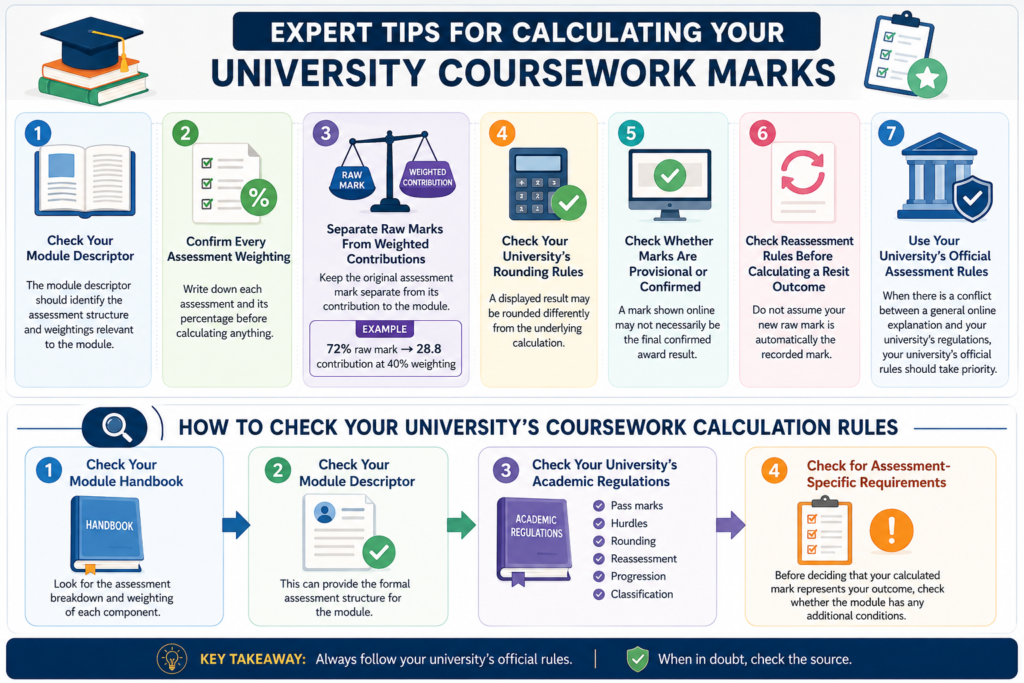
Expert Tips for Calculating Your University Coursework Marks
Check Your Module Descriptor
The module descriptor should identify the assessment structure and weightings relevant to the module.
Confirm Every Assessment Weighting
Write down each assessment and its percentage before calculating anything.
Separate Raw Marks From Weighted Contributions
Keep the original assessment mark separate from its contribution to the module.
For example:
72% raw mark → 28.8 contribution at 40% weighting
Check Your University’s Rounding Rules
A displayed result may be rounded differently from the underlying calculation.
Check Whether Marks Are Provisional or Confirmed
A mark shown online may not necessarily be the final confirmed award result.
Check Reassessment Rules Before Calculating a Resit Outcome
Do not assume your new raw mark is automatically the recorded mark.
Use Your University’s Official Assessment Rules
When there is a conflict between a general online explanation and your university’s regulations, your university’s official rules should take priority.
How to Check Your University’s Coursework Calculation Rules
Check Your Module Handbook
Look for the assessment breakdown and weighting of each component.
Check Your Module Descriptor
This can provide the formal assessment structure for the module.
Check Your University’s Academic Regulations
Use these for rules concerning:
- Pass marks
- Hurdles
- Rounding
- Reassessment
- Progression
- Classification
Check for Assessment-Specific Requirements
Before deciding that your calculated mark represents your outcome, check whether the module has any additional conditions.
How are university coursework marks calculated in the UK?
They are generally calculated by applying the weighting of each assessment to its mark and adding the weighted contributions. The exact calculation can vary by university and module.
How do I calculate my university coursework mark?
Multiply each coursework assessment mark by its weighting, then add the resulting contributions. If all assessments have equal weighting, a simple average may be appropriate.
What is coursework weighting at university?
Coursework weighting is the percentage of a module’s total assessment allocated to a coursework component. For example, coursework worth 40% contributes 40% of the module’s assessment calculation.
How does coursework contribute to my module mark?
Its contribution depends on its weighting. A 70% coursework mark worth 30% contributes 21 percentage points to the module calculation.
How do I calculate coursework with different weightings?
Multiply each mark by its own weighting and then add the results. Do not use a simple average when the weightings differ.
How are coursework and exam marks combined?
Multiply the coursework mark by its coursework weighting, multiply the exam mark by its exam weighting, and add the two contributions.
What does 40% coursework mean at university?
It means the coursework contributes 40% of the module’s assessment calculation, assuming the module uses that weighting structure.
Does every coursework assignment count equally?
No. Assignments can have different weightings. Your module documentation should show how much each assessment contributes.
What mark do I need in coursework to pass?
There is no universal answer. You need to consider the coursework weighting, other assessments, the module pass requirement and any minimum component thresholds.
Can I pass a module if I fail one coursework assessment?
Possibly. A low or failed coursework assessment does not always mean the whole module is failed, but some modules have minimum assessment requirements. Check your course regulations.
Conclusion
The key is to separate the different stages of university assessment.
Start with your individual coursework mark, then apply its weighting to find its contribution to the module. If your module contains an exam or other assessments, calculate their weighted contributions as well and combine them to find the module mark.
After that, credits and university-specific classification rules may determine how the module contributes to your wider academic result.
The basic process is:
- Check every assessment weighting.
- Record each assessment mark.
- Convert weightings to decimals.
- Calculate each weighted contribution.
- Add the contributions together.
- Check for assessment hurdles or minimum requirements.
- Apply the relevant rounding rules.
- Use module credits when calculating a wider average.
- Check your university’s official regulations before treating the result as final.