
Train to Teach: What Your Degree Class Unlocks in Bursaries and Scholarships [2026]
Your degree classification has a cash value — and in one profession, it is printed in pounds. Train to teach physics, chemistry, computing or maths in England in 2026-27 and the Department for Education will pay you a £29,000 tax-free bursary. Train to teach biology or geography and it is £5,000. Train to teach English, history or primary-age children and it is nothing at all. Every figure in this guide comes from the DfE’s own initial teacher training bursary funding manual for 2026-27, opened and verified for this article.
The part most graduates get wrong is what their degree class actually controls. It is not the amount — a First in physics and a 2:2 in physics both unlock the same £29,000. It is the door itself: the bursary requires at least a 2:2, and below that line the money disappears entirely. Meanwhile the subject you train to teach sets the figure, not the subject you studied — the DfE’s own example is a first-class biology graduate who gets £29,000 for training in physics but only £5,000 for training in biology. Class opens the door; subject sets the cheque.
This guide maps the whole system: the 2:2 eligibility rule, the full 2026-27 bursary table, the £31,000 scholarships that beat the bursaries, two worked examples showing exactly what each degree class is worth, the early-years route where your precise class does set the amount, and the undergraduate and veteran routes. If you want the other side of the story — how teaching degrees themselves are marked once you are training — our guide to how teaching degrees are graded covers PGCE marks, placements and QTS.
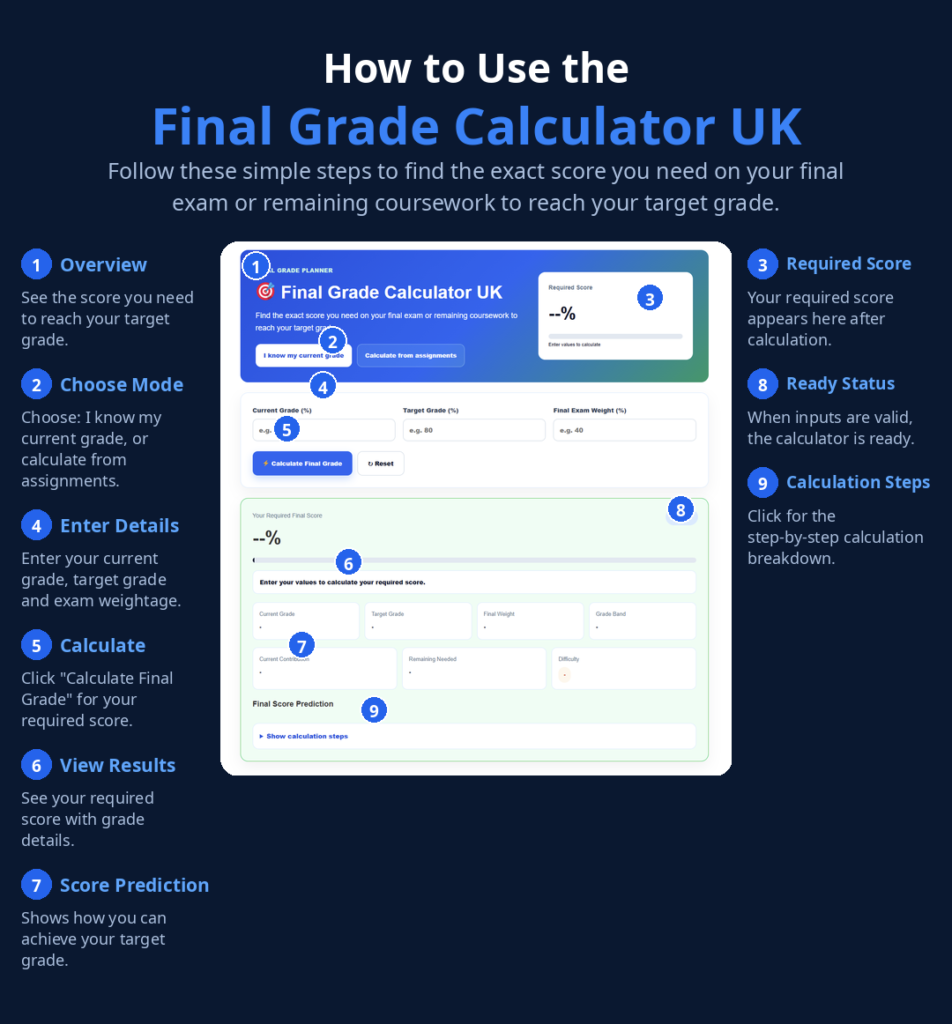
Click Here: Final Grade Calculator UK
The 2:2 Cliff Edge: Why Your Degree Class Decides Everything
The funding manual’s eligibility list is short and absolute. From the first day of training you must hold a UK first degree or equivalent ‘with at least lower second class honours’ — a 2:2. There is no discretion here, and no sliding scale: the postgraduate bursary is binary. Two details soften the edge slightly. First, providers assess your highest academic qualification, so a Masters or PhD can satisfy the requirement even if your undergraduate degree fell short. Second, the requirement does not apply to the undergraduate bursaries, which are awarded on course enrolment rather than degree class.
The rest of the eligibility list: you must be entitled to UK student finance (with a narrow transitional exception for languages and physics trainees offered places before 5pm on 7 May 2026), be on a qualifying postgraduate or undergraduate ITT course in England that leads to QTS — delivered by an accredited provider — and receive written confirmation of eligibility from your provider. You cannot get a bursary if you already hold, or are eligible for, QTS or QTLS, or if you do paid teaching work that contributes to your training while receiving it. Note what is not on the list: your degree subject. Suitability of subject knowledge is the provider’s recruitment judgement, explicitly separated from bursary eligibility.
If you are sitting just below the line, this is the moment to check your real numbers rather than your feared ones. Run your transcript through our Final Grade Calculator UK — students routinely discover that credit-weighting puts them a point or two above their gut estimate, and a point or two is the entire difference between £29,000 and £0. Our 2:2-to-2:1 recovery guide shows how final-year students claw back the average they need.
Teacher Training Bursaries 2026-27: The Full Table by Subject
Here is the DfE’s full table for postgraduate ITT courses starting between September 2026 and July 2027. Amounts are fixed for the duration of your programme and are not affected by training length:
| Training subject | Bursary | Scholarship (instead of bursary) |
|---|---|---|
| Chemistry | £29,000 | £31,000 |
| Computing | £29,000 | £31,000 |
| Physics | £29,000 | £31,000 |
| Mathematics | £29,000 | — |
| Design and technology (incl. engineering, food technology) | £20,000 | — |
| Languages: French, German, Spanish | £20,000 | £22,000 |
| Languages: all others, incl. ancient languages | £20,000 | — |
| Biology | £5,000 | — |
| Geography | £5,000 | — |
| All other subjects | £0 | — |
Three rules from the manual govern the table. First, the training subject rules, not your degree subject. A history graduate training to teach maths gets the maths money; a maths graduate training to teach history gets nothing — ‘no other ITT courses will attract a bursary, regardless of a trainee’s degree class.’ Second, combination courses: the course content must be at least 50% the bursary subject, and an exact 50/50 split takes the higher rate — so 50% physics with 50% biology earns the physics bursary, and 50% languages with 50% history earns the languages bursary even though history alone pays nothing. Third, never assume next year: the manual explicitly warns against projecting these values into future years — the DfE resets the table annually.
Bursaries vs Scholarships: The £2,000 Upgrade
For chemistry, computing, physics and modern languages, a second pot exists: scholarships of £31,000 (sciences) and £22,000 (French, German, Spanish), run with professional bodies rather than paid automatically. They are limited in number and replace the bursary — you cannot hold both — which makes the scholarship a straight £2,000 upgrade over the bursary for the same training year.
The trade-off is effort and uncertainty. Scholarships need a separate application with subject-specific assessment and interview, and each awarding body sets its own criteria; the DfE bursary, by contrast, is automatic once your provider confirms eligibility in writing. The sensible strategy the manual itself implies: apply for the scholarship, and if the application fails you fall back to the bursary — trainees whose scholarship application is unsuccessful may still be eligible for the training bursary. Our GREAT Scholarships 2027 guide covers the other major UK scholarship landscape if you are weighing postgraduate funding more broadly.
Worked Example 1: Amara’s 2:2 in Physics Is Worth £29,000
Amara graduates with a 2:2 in physics and enrols on a postgraduate physics ITT course in England leading to QTS. She clears the 2:2 floor, is entitled to student finance, and trains in a £29,000 subject — so her provider confirms a £29,000 tax-free bursary in writing. Paid in instalments across the training year (typically around ten monthly payments), that is roughly £2,900 per month, tax-free, that she never repays.
Now set it against the costs. PGCE tuition fees are commonly up to £9,790 for the year. If Amara lets the bursary offset her fees (allowed with her permission), £29,000 − £9,790 = £19,210 remains for living costs — about £1,921 a month over ten months, before any maintenance loan. And the career kicker from Get Into Teaching: qualified teachers start on a minimum salary of £34,000. Her 2:2 — the same class some graduates apologise for — unlocked nearly thirty thousand pounds of tax-free funding plus a £34,000 starting salary.
Consider the counterfactual the manual invites: if Amara had trained to teach biology instead, the identical 2:2 would have unlocked £5,000. Same graduate, same class, £24,000 less — because the subject sets the cheque. That single comparison is worth more than any generic ‘follow your passion’ advice when you are choosing a training subject.
Worked Example 2: Daniel’s Third in Chemistry Is Worth £0 — and His Three Options
Daniel graduates with a Third in chemistry and wants to train to teach it — a £29,000 subject. His degree class closes the bursary door: the manual’s 2:2 floor is absolute, with no discretion for providers to waive it. He has three honest routes:
Option 1: raise the highest qualification. Providers assess your highest academic qualification, and the manual explicitly allows ‘other relevant academic qualifications’. A Masters or PhD can therefore re-open the bursary door even with a Third underneath — but confirm with the specific provider before enrolling, because they must be confident the qualification has the breadth and depth expected of a 2:2-level UK degree. Our guide to doing a masters with a 2:2 maps that route.
Option 2: earn while you train. Salaried ITT routes pay you a salary instead of a bursary — and the manual’s bar on combining paid training work with a bursary simply does not bite, because there is no bursary involved. For a Third-class graduate, a salary beats a £0 bursary every time.
Option 3: check the undergraduate and early-years doors — honestly. The undergraduate £9,000 bursary does not use degree class at all, but it is only for specific secondary maths, physics, computing and languages QTS courses — and Daniel has already graduated, so it is likely closed. The early-years graduate-entry route does tier by class, but a Third gets £0 there too. The lesson: with a Third, the realistic funding is a salary or a higher qualification first — not the DfE bursary.
The Early-Years Exception: The One Place Your Exact Class Sets the Amount
There is exactly one DfE teacher-training route where the bursary amount — not just eligibility — moves with your degree class: the graduate-entry early-years route. The tiers, from the DfE’s 2026-27 early-years funding guidance, use your highest qualification:
| Highest qualification | Early-years bursary tier |
|---|---|
| First-class honours degree, or doctoral degree | Tier 1: £5,000 |
| 2:1 honours degree, or master’s degree | Tier 2: £4,000 |
| 2:2 honours degree | Tier 3: £2,000 |
| Third-class, ordinary or aegrotat degree, or no first degree | No bursary |
Notice the structure: every single class boundary is worth exactly £1,000. The jump from a 2:2 to a 2:1 is worth £2,000; from a 2:1 to a First, £1,000 more. It is the purest example on this page of a degree class converted directly into cash — and a vivid reason why borderline averages matter. If your final average is sitting at 59.x%, our Degree Classification Calculator UK will tell you precisely which side of the 2:1 line you are on.
Undergraduate Routes: £9,000 in Your Final Year
Not yet graduated? Two undergraduate routes pay while you are still studying. The standard undergraduate bursary is £9,000, paid in your final year, for trainees on secondary mathematics and physics courses leading to QTS — plus opt-in undergraduate secondary maths, physics, computing and languages QTS courses — beginning in 2026-27. Trainees on undergraduate courses that lead to QTS and a master’s degree get £9,000 in both the third and fourth years: £18,000 total. Degree class plays no part; enrolment on the eligible course is what counts.
The standout figure on the whole page belongs to veterans: a £40,000 undergraduate veteran teaching bursary for those who have left full-time employment in the British Army, Royal Air Force or Royal Navy within the last five years, enrolling on an eligible QTS course in biology, chemistry, computing, languages, mathematics or physics — £20,000 in each of the final two years. It cannot be combined with the standard undergraduate bursary.
Six Mistakes That Cost Trainees Their Bursary
The funding manual is precise, and its precision creates traps. Check your plan against these before you commit:
| The mistake | What the manual actually says | The fix |
|---|---|---|
| Assuming your degree subject sets the amount | The bursary follows the subject you train to teach, not the subject you studied | Price the training subject, not your degree — the biology-to-physics example is worth £24,000 |
| Training in English, history, PE or primary and expecting a bursary | ‘No other ITT courses will attract a bursary, regardless of a trainee’s degree class’ | Budget on student finance alone for non-bursary subjects |
| Assuming a 50/50 split course gets nothing | Equal content takes the higher bursary rate; 50%+ content takes that subject’s rate | Check the exact content split — 50% languages + 50% history still earns the languages bursary |
| Applying for a scholarship and a bursary together | Trainees cannot receive both; the scholarship replaces the bursary | Apply for the scholarship first — the bursary remains as fallback if you miss out |
| Doing paid training work while taking a bursary | Trainees must not be paid for teaching work that contributes to their training | Choose the bursary route or the salaried route, never both |
| Assuming last year’s figures still apply | The manual warns against projecting values into future years; the DfE resets annually | Always check the current-year manual — this guide uses 2026-27 |
What degree class do I need to get a teacher training bursary?
At least a 2:2. The Department for Education’s 2026-27 funding manual requires trainees to hold a UK first degree or equivalent ‘with at least lower second class honours’, and providers assess your highest academic qualification — so a Masters or PhD can count even if your undergraduate degree was weaker. You must also be entitled to UK student finance and be on a qualifying postgraduate or undergraduate ITT course in England that leads to QTS. Before you plan around the money, check you clear the 2:2 line with our Final Grade Calculator UK.
Does my degree subject have to match the subject I train to teach?
No — and this is the most misunderstood rule in the whole scheme. The bursary amount depends on the subject you train to teach, not the subject of your degree. The DfE’s own example: a trainee with a first-class degree in biology who trains to teach physics gets the £29,000 physics bursary; the same graduate training to teach biology gets £5,000. Your provider will still judge whether your subject knowledge is suitable, but the money follows the training subject.
How much is the bursary for physics, chemistry, computing and maths?
£29,000 tax-free for 2026-27, the top tier. Chemistry, computing and physics also have £31,000 scholarships available through professional bodies. Design and technology and languages sit at £20,000 (£22,000 scholarship for French, German and Spanish), while biology and geography get £5,000. No other subjects attract a DfE bursary at all, regardless of your degree class.
Can I receive a bursary and a scholarship at the same time?
No. Trainees cannot hold both — the scholarship replaces the bursary, which is why the £31,000 chemistry, computing and physics scholarships are worth chasing over the £29,000 bursary. Scholarships are limited in number, run by professional bodies with their own application and interview process, and each body sets its own criteria. If your scholarship application is unsuccessful, you may still be eligible for the training bursary.
I graduated with a Third — can I still train as a teacher?
The DfE bursary is closed to you: the 2:2 floor is absolute for postgraduate bursaries, and the early-years route pays £0 for a Third. But training itself is a separate question from funding — providers set their own entry requirements, so check course pages directly. Your strongest routes are a postgraduate qualification (providers assess your highest qualification, so a Masters or PhD can re-open the bursary door — confirm with the provider) or a salaried training route, where you earn while you train and need no bursary. Our guide to doing a masters with a 2:2 covers the postgraduate route.
Are teacher training bursaries taxed, and do I pay them back?
No to both. Training bursaries are tax-free cash grants, not loans — you never repay them. They sit alongside, not instead of, normal student finance: you can still take a tuition-fee loan and a maintenance loan. With your permission, a provider may use the bursary to offset your tuition fees partly or in full. Your provider confirms your eligibility in writing and sets the payment schedule.
Is there a bursary for primary teacher training?
Not a postgraduate one. The DfE’s 2026-27 postgraduate bursary table covers secondary subjects only — primary training attracts no bursary regardless of degree class. The undergraduate £9,000 bursary is also secondary-only (maths, physics, computing and languages courses leading to QTS). Primary trainees still get standard student finance, and the early-years graduate-entry route has its own tiered bursary if that path suits you.
When and how is the bursary paid?
In instalments across your training year — providers confirm the exact schedule in writing, and it is typically spread over around ten months. The award is fixed for the duration of your programme and is not affected by the length of training. One practical tip from the funding rules: if you need a student visa, your provider’s written bursary confirmation can serve as evidence of funds — but make sure you have enough to live on until the first payment lands.
Conclusion
The teacher-training funding system is unusually honest about what it values: shortage subjects, priced up to £29,000, and graduates good enough to clear the 2:2 bar. Your degree class does not negotiate the amount — physics pays £29,000 whether you scraped a 2:2 or starred a First — but it absolutely controls the door, and on the early-years route it prices every boundary at £1,000 a step. The two numbers that matter most are therefore the simplest: are you at or above 2:2, and which subject will you train to teach?
Answer the first with our Final Grade Calculator UK and cross-check the full picture with the Degree Classification Calculator UK — then read the current DfE funding manual for your training year before you apply, because the table resets annually and last year’s figures are never a promise. A 2:2 is the most valuable pass mark in English education: it is worth up to £29,000, tax-free, to the graduate who knows where to claim it.