How Are Teaching Degrees Graded in the UK? PGCE Marks, Placements & QTS [2026]
Teaching is the only mainstream UK degree where you graduate with two verdicts instead of one. Every other undergraduate walks away with a single classification — a First, a 2:1, a 2:2. A trainee teacher gets an academic award and a professional recommendation, decided by different people, against different standards, and on different scales. The PGCE essay you sweated over is graded Distinction, Merit or Pass at master’s level. The lesson observation that decided whether you can actually teach was graded with a single word: Met. Not met.
Students tie themselves in knots confusing the two. On The Student Room, trainee teachers repeatedly ask whether “only getting passes” on PGCE assignments will hurt their job prospects, whether schools can ask for their “QTS grade”, and whether a failed placement means the whole year is wasted. The answers are reassuring but precise: QTS has no grades at all, the PGCE’s grades matter far less than trainees fear, and a failed placement has a formal ladder of second chances — but the ladder is not infinite.
This guide separates the two verdicts cleanly: how the academic award is graded (with the actual schemes five named universities use), how QTS is judged (against all of the DfE’s Teachers’ Standards — no exceptions), what happens on placement and if it goes wrong, how the five training routes differ, and how your degree class converts into real money through 2026/27 bursaries and scholarships. Every figure below comes from providers’ own regulations, DfE documents, or GOV.UK.
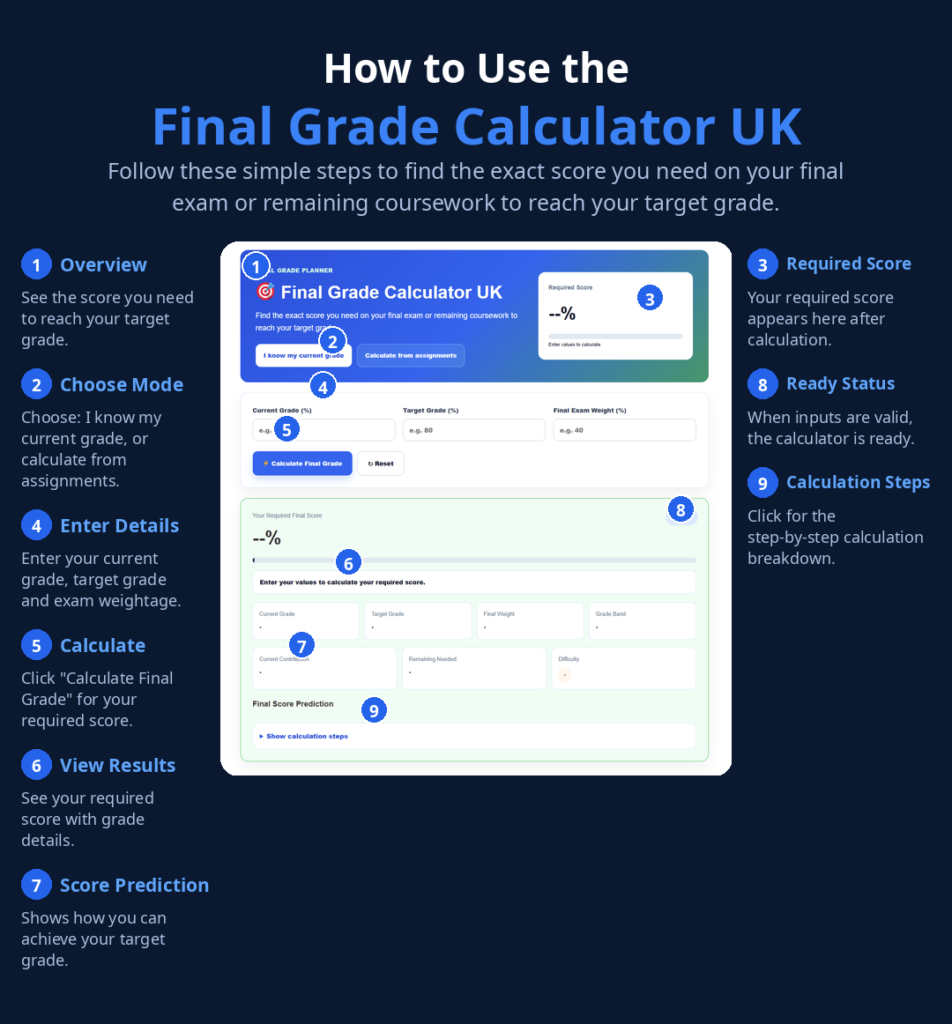
Click Here: Final Grade Calculator UK
The Short Answer: Two Verdicts, Not One
Every teacher-training course in England ends with two independent decisions. They are made by different people, they test different things, and — crucially — they do not depend on each other the way students assume.
| The verdict | Who decides | Judged against | Possible outcomes |
|---|---|---|---|
| The academic award (PGCE, PGDipEd, BEd, BA/BSc with QTS) | Your university or validating university | Master’s-level (Level 7) marking criteria for PGCE; standard honours criteria for undergraduate degrees | Distinction / Merit / Pass (PGCE), or First / 2:1 / 2:2 / Third (undergraduate) |
| The QTS recommendation | Your accredited provider, against DfE criteria | The Teachers’ Standards — all of them | Recommended for QTS, or not. Binary. No grades. |
Keep that split in mind and everything else on this page falls into place. The Department for Education’s initial teacher training criteria are explicit: providers must “ensure that no trainee teacher is recommended for the award of QTS until they have met all of these Standards”. Not most of them. All of them. And a parliamentary written answer confirms providers have “full discretion in assessing trainee ability to meet the Teachers’ Standards” — your provider’s judgement call, not a national algorithm, decides QTS.
Verdict One: How the Academic Award Is Graded
For a one-year postgraduate route, the academic award sits at master’s level (FHEQ Level 7). The typical load is 60 master’s-level credits — one-third of a full master’s degree, as Manchester Metropolitan’s UCAS listing puts it — earned through essays, reflective assignments, subject-knowledge audits and sometimes a small research project. But “typical” hides real variation, and the variation matters if you are comparing offers.
| Provider | M-level credit load | Grading scheme for the academic award |
|---|---|---|
| UCL (Institute of Education) | 2 × 30-credit Level 7 modules + professional practice module | Transcript records marks as Pass or Fail (from 2018/19) rather than individual classifications |
| University of Reading | Per 2025 programme specification | 70–100% Distinction, 60–69% Merit, 50–59% Pass (Good standard) |
| Canterbury Christ Church (SCITT PGCE) | Dual-level modules passed at Level 7 | Distinction or Pass only — no Merit band (November 2025 regulations) |
| Durham University | 90 credits (three 30-credit modules), portable into a part-time MA Education | Standard postgraduate 50% pass; re-examination rules apply per module |
| Manchester Metropolitan | 60 credits — “one-third of a masters degree” | Standard Level 7 postgraduate grading |
| Birmingham (PGDipEd, QTS) | 120 master’s-level credits | Assignments reported by trainees as marked pass / merit / distinction (student-reported) |
Three things to notice. First, UCL’s transcript rubric means you should not expect percentage marks on your UCL PGCE transcript even though the work is master’s level — Pass or Fail is what the document records. Second, Durham’s 90-credit structure is unusually generous: those credits can be carried into a part-time MA Education, so Durham trainees leave closer to a master’s than a standard PGCE cohort. Third, Birmingham’s 120-credit PGDipEd is the heavyweight option — double the usual M-level load, which trainees on forums describe as noticeably harder, though employers treat it as equivalent to a PGCE.
For undergraduate routes — the BEd (Hons), or a BA/BSc with QTS — the academic side is a perfectly ordinary honours degree. Portsmouth’s BEd (Hons) Primary Education with QTS, for example, runs FHEQ levels 4 to 6 with a standard classified award: First, 2:1, 2:2, Third. Reading’s BA Primary Education with English used the familiar 70/60/50/40 honours bands. The QTS recommendation sits alongside the degree as a separate decision: meet the Teachers’ Standards and pass the final school experience, and you get the recommendation too.
Verdict Two: QTS Is Pass or Fail — Nothing In Between
There is no such thing as a “QTS grade”. No Distinction QTS, no Merit QTS, no 2:1 QTS. The recommendation is binary: your provider either recommends you to the Department for Education for the award of Qualified Teacher Status, or it does not. The certificate, when it comes, records a status, not a score.
What providers are judging is your evidence against the Teachers’ Standards across your placements: lesson observations with written feedback, teaching files and portfolios, reflections on practice, and the formal assessment of school experience. Canterbury Christ Church’s SCITT regulations describe the end point precisely — school experience modules are non-credit-bearing, marked Pass or Not Pass through a Work Placement Report, and the summative judgement at the end of the final placement is “Met or Not Met” against the Standards. That binary language is the honest shape of QTS everywhere; other providers dress it in more paperwork, but the decision is the same.
Do not confuse the binary recommendation with a lack of differentiation along the way. Providers do rate placement performance internally — “outstanding”, “good”, “requires improvement” and similar judgements appear in observation feedback and can shape your reference. Schools hiring newly qualified teachers read those references closely. But the rating never becomes a QTS grade, because there isn’t one.
Placements: What “Meeting the Standards” Looks Like in Practice
Most of your training year happens in schools, not lecture halls. A standard PGCE includes two main placements in contrasting schools, with a rising teaching load — from observing and team-teaching early on to carrying a substantial timetable (often 60–80% of a full teacher’s load) by the final placement. Every lesson you teach is potential evidence, and mentors observe you formally at intervals, grading those observations against the Teachers’ Standards.
The paperwork is the part trainees underestimate. You are building an evidence base, not just surviving lessons: lesson plans with evaluations, mentor meeting records, reflections linking your practice to the Standards, and subject-knowledge development logs. Under the reformed ITT requirements (post the 2024 market-review accreditation round, which left 179 accredited providers in England), placements must include intensive training and practice elements with trained lead mentors — so the observation-feedback loop is tighter than it was five years ago.
One point of confusion to clear up now, because it costs trainees sleep: struggling on placement is normal and is not the same as failing. Mentors raise “causes for concern” through formal support plans long before anyone talks about failing a placement. A bad week, a difficult class, even a failed observation are routine parts of training. The fail decision comes only when, after support, you still cannot evidence the Standards — and providers document that journey carefully, because withdrawing a trainee is a serious decision with appeal rights.
Worked Example: Priya’s BEd Classification — the Arithmetic Still Applies
The QTS recommendation may be binary, but the degree half of an undergraduate teaching degree uses exactly the credit-weighted machinery every other UK degree uses — the same arithmetic our degree classification calculator models. Take Priya, on a BEd (Hons) Primary Education with QTS using a 40:60 Level 5 to Level 6 weighting (simplified to year averages for clarity):
| Year | Credit-weighted average | Weighting | Contribution |
|---|---|---|---|
| Level 5 | 62.4% | 40% | 62.4 × 0.40 = 24.96 |
| Level 6 | 66.8% | 60% | 66.8 × 0.60 = 40.08 |
| Final mark | 24.96 + 40.08 = 65.04% → Upper second-class (2:1) |
Priya graduates with a 2:1 and — assuming she met all the Teachers’ Standards on her final placement — a QTS recommendation alongside it. Now consider the counterfactual that shows why the two-verdict split matters: if Priya’s final placement had collapsed and she had not evidenced the Standards, her 65.04% would still have earned the 2:1. Portsmouth’s own exit awards make this explicit: trainees who complete the academic work but are not recommended for QTS can leave with a “BEd (Hons) Primary Education” — the classified honours degree, without the QTS. The degree and the professional licence genuinely come apart.
The Five Routes: Same QTS Bar, Different Academic Wrappers
The QTS standard does not change with your route — meet all the Teachers’ Standards or no recommendation, whether you trained at a university or in a school. What changes is the academic award attached, and whether you are paid while you train.
| Route | Academic award | M-level credits | Funding note |
|---|---|---|---|
| University-led PGCE | PGCE with QTS recommendation | Typically 60 | Tuition fees; bursary if subject + degree class qualify |
| School Direct (tuition fee) | PGCE with QTS recommendation | Typically 60 (via partner university) | Tuition fees; bursary if eligible |
| School Direct (salaried) | QTS only — “not eligible for the PGCE award” (UCL) | None | Salaried; no bursary |
| SCITT | QTS, plus PGCE if the SCITT validates one (e.g. Canterbury: Distinction or Pass) | Varies by validating partner | Tuition fees; bursary if eligible |
| Teach First | PGDE over two years (UCL: four 30-credit Level 7 modules + practice) | 120 | Salaried from day one; no bursary |
Two traps in this table deserve emphasis. First, the salaried routes (School Direct salaried, Teach First) pay you a wage instead of a bursary — you cannot collect both, and bursaries are only for fee-funded, non-salaried routes. Second, the postgraduate teaching apprenticeship (PGTA) sits slightly apart: from 2026/27 the DfE aligned its funding with bursary levels, so schools training apprentices can receive up to £29,000 for maths, chemistry, physics and computing trainees and £20,000 for modern languages. Check which award a route gives you before you apply, because “QTS-only” versus “QTS plus PGCE” affects your options years later — the M-level credits are the currency of a future master’s.

What Happens If You Fail: the Placement Ladder
Failing a placement is not the end of the road — every provider has a formal sequence, and the sequences rhyme. Reading’s 2025 programme specification spells out a typical ladder: fail the autumn placement and you normally suspend until the following autumn; fail the spring placement and you resit at the next placement opportunity with the summer placement deferred; fail the summer placement and you resit the following autumn. Canterbury Christ Church permits one further placement attempt where professional expectations have not been met. The pattern is consistent: one more properly supported attempt, not an instant exit.
Failing the academic side has its own separate ladder. Durham allows one re-examination attempt for taught modules scoring below 50%; if an M-level module is failed twice, the trainee is re-registered on the Level 3 version and may exit with a Graduate Diploma — explicitly “not awarded with distinction”. UCL’s exit awards tell the same two-verdicts story from the other direction: pass the taught Level 7 modules but fail professional practice, and you leave with a Postgraduate Certificate in Education Studies — a real postgraduate award, but no QTS.
The principle to internalise: failing the academic work does not automatically cost you QTS, and failing the Standards does not automatically cost you the academic award. Providers decide each verdict on its own evidence. Where trainees do get withdrawn entirely, it is usually for the third category — unsuitability on professional conduct grounds — which sits outside both grading systems and is handled through fitness-to-practise procedures instead.
Worked Example: Daniel’s Bursary — Where Your Degree Class Becomes Cash
Here is where the grade on your first degree turns into money. For courses starting between September 2026 and July 2027, the DfE pays tax-free bursaries in flat bands by subject — and your degree class decides which band of eligibility you clear. This is the detail most guides get wrong: in 2026/27 the amounts are not tiered by class within a subject (older DfE schemes did tier them). Your class gates the door; the subject sets the amount.
| Subject | 2026/27 bursary | Scholarship | Minimum degree class |
|---|---|---|---|
| Chemistry | £29,000 | £31,000 | 2:2 for bursary; 2:1 for scholarship |
| Computing | £29,000 | £31,000 | 2:2 for bursary; 2:1 for scholarship |
| Maths | £29,000 | — (bursary only) | 2:2 |
| Physics | £29,000 | £31,000 | 2:2 for bursary; 2:1 for scholarship |
| Languages / Design & Technology | £20,000 | £22,000 (French, German, Spanish) | 2:2 for bursary; 2:1 for scholarship |
| Biology / Geography | £5,000 | — | 2:2 |
| English, Art, Music, RE, Primary | £0 | — | — |
Take Daniel, a chemistry graduate. With a 2:1 he can apply for the Royal Society of Chemistry scholarship at £31,000 — £2,000 more than the £29,000 bursary his 2:2 friend receives for the same course, awarded by the independent subject body rather than the DfE. That 2:1 is doing real financial work: £2,000 tax-free, paid over a minimum of ten months by the provider, and never repaid. But note the cliff edges the table hides. Daniel’s flatmate with a biology degree watched her subject’s bursary fall from £26,000 to £5,000 for 2026/27 — a £21,000 cut decided in Whitehall, nothing to do with her grades. And his friend training to teach English gets £0 regardless of whether she graduated with a First or a Third: eight subject categories were cut for 2026/27, with English, art, music, RE and primary among those reduced to nothing.
Two funding footnotes that catch trainees out. First, the DfE’s funding manual is blunt: courses leading only to “a solely academic award such as a postgraduate certificate in education (PGCE) without QTS” are not eligible for bursary or scholarship funding — the course must lead to a QTS recommendation. Check the current figures on the official GOV.UK bursaries and scholarships page before you apply, because the bands move between cycles. Second, trainees who need to top up rusty subject knowledge can get a Subject Knowledge Enhancement bursary of £175 per week. Bursaries are tax-free and never repaid, which makes the effective value higher than the headline figure suggests.
Does the Grade Actually Matter? The Honest Answer
Ask trainee teachers and a clear consensus emerges — one that should lower your blood pressure. For getting hired, the PGCE is effectively pass/fail. Schools hiring newly qualified teachers care that you have QTS, that your references describe strong classroom practice, and that you interview well. As one much-quoted Student Room thread puts it, the PGCE’s assignment grades are “effectively pass/fail for employment” — schools do not ask whether your reflective essay got a Merit.
The grades matter in exactly three places. First, the M-level credits only become valuable if you later want a master’s: 60 credits is a third of an MA Education, 90 (Durham) or 120 (Teach First PGDE, Birmingham PGDipEd) is a serious head start — and a Distinction profile strengthens a future master’s application. Second, your undergraduate degree class gates bursary and scholarship eligibility, as Daniel’s example showed: a 2:2 unlocks the bursary, a 2:1 unlocks the scholarship. If you are in your final undergraduate year and considering teaching, that boundary is worth fighting for — our 2:2 to 2:1 recovery guide exists for exactly this arithmetic. Third, a small number of school application forms ask for the PGCE’s master’s grade, though it rarely decides anything. And for the bigger career question — whether your degree class matters at all — our employer guide runs the numbers.
5 Mistakes Trainees Make About Teaching-Degree Grading
| Mistake | Reality |
|---|---|
| Assuming QTS has grades | QTS is pass/fail against the Teachers’ Standards. There is no QTS grade for a school to ask for — though some forms ask for the PGCE master’s grade instead. |
| “With QTS” vs “leading to QTS” means different outcomes | All wording variants mean the same thing. Universities can only recommend QTS; the DfE awards it. (Student-reported consensus.) |
| A PGCE without QTS still gets a bursary | No — the DfE funding manual excludes “a solely academic award such as a PGCE without QTS” from bursary and scholarship funding. |
| Salaried route + bursary | Salaried trainees (School Direct salaried, Teach First) are paid a wage and are not eligible for bursaries. One or the other, never both. |
| All PGCEs carry the same M-level weight | They don’t: 60 credits is typical, but Durham carries 90 and Birmingham’s PGDipEd carries 120. It changes how much of a future master’s you’ve banked. |
What Changed in 2026
Four developments are worth knowing before you apply. First, the curriculum all providers teach to — the Initial Teacher Training and Early Career Framework (ITTECF), which merged the old ITT core content with the Early Career Framework — was updated in 2026 with stronger oracy and SEND/early-cognitive-development content. It changes what you are trained in, not how you are graded, but mentor expectations have moved with it. Second, the bursary cuts above: eight subject categories reduced for 2026/27, with biology and geography falling from £26,000 to £5,000 and English, art, music, RE and primary cut to zero. Third, from 9 September 2026 teachers trained in Nigeria, Ghana or India can no longer use the DfE’s “Apply for QTS in England” service — a reminder to check the current eligibility rules rather than last year’s blog posts. Fourth, postgraduate teaching apprenticeship funding was aligned with bursary levels from 2026/27, with up to £29,000 grants for STEM apprenticeships. If you are weighing routes, the masters-with-a-2:2 guide is the natural companion read for the M-level credit question.
Is QTS graded, or is it pass or fail?
QTS is pass or fail — there is no such thing as a QTS grade. Your provider either recommends you to the Department for Education for the award of Qualified Teacher Status, once you have met all of the Teachers’ Standards, or it does not. Some school application forms ask for your PGCE’s master’s-level grade instead, which is the graded part of your training year.
What do Distinction, Merit and Pass mean on a PGCE?
They are the standard UK postgraduate bands applied to master’s-level (Level 7) work: typically 70% and above for Distinction, 60–69% for Merit and 50–59% for Pass — the University of Reading’s 2025 programme specification uses exactly these bands. But schemes vary: UCL records PGCE marks as Pass or Fail on transcripts, and Canterbury Christ Church’s SCITT PGCE awards only Distinction or Pass, with no Merit band.
Do schools care about my PGCE grades when hiring?
Barely. For newly-qualified-teacher hiring, the PGCE is effectively pass or fail: schools care that you hold QTS, that your references describe strong classroom practice, and that you interview well. The grades matter most if you later want a master’s degree, because 60 M-level credits (or 90–120 on some routes) count as a third or more of an MA Education.
Can I fail the PGCE but still get QTS?
Yes — the two verdicts are decided separately. If you meet all the Teachers’ Standards on placement but fail the academic assignments, your provider can still recommend you for QTS while you exit with a lower or alternative academic award (for example, UCL’s Postgraduate Certificate in Education Studies). The reverse is also true: a classified degree without a QTS recommendation is a standard exit award.
Can you get a First on a teaching degree?
On an undergraduate teaching degree — a BEd (Hons) or BA/BSc with QTS — yes: these are classified exactly like other honours degrees on the 70/60/50/40 scale, giving a First, 2:1, 2:2 or Third. On a postgraduate PGCE there is no First; the academic award uses Distinction, Merit and Pass, and QTS itself is ungraded.
What bursary will my degree class get me in 2026/27?
Your degree class gates eligibility rather than setting the amount: you need a 2:2 or higher for a bursary and usually a 2:1 for a scholarship, while the subject sets the figure — £29,000 for chemistry, computing, maths and physics (£31,000 scholarship for chemistry, computing and physics), £20,000 for languages and design & technology, £5,000 for biology and geography, and £0 for English, art, music, RE and primary. Bursaries are tax-free and never repaid.
What is the difference between “with QTS” and “leading to QTS”?
Nothing. Universities use several wordings — “with QTS”, “leading to QTS”, “with QTS recommendation” — and they all mean the same outcome: the university recommends you, and the Department for Education awards QTS. No university can award QTS directly; recommendation is the most any provider can offer.
Do School Direct and Teach First give the same qualification as a university PGCE?
The QTS bar is identical on every route — all trainees must meet the full Teachers’ Standards. What differs is the academic wrapper: School Direct (tuition fee) and SCITT routes usually attach a standard PGCE, School Direct (salaried) is QTS-only with no PGCE, and Teach First awards a 120-credit PGDE spread over its two salaried years. Salaried trainees receive a wage instead of a bursary.
Conclusion
Teaching degrees ask you to hold two ideas at once, and the trainees who thrive are the ones who learn the split early. Chase the academic award with the seriousness master’s-level work deserves — the M-level credits are genuinely bankable toward a future master’s, and a Distinction profile never hurts. But recognise where the real jeopardy sits: the QTS recommendation, decided lesson by lesson against the Teachers’ Standards, with no grade to hide behind and no partial credit for meeting most of them.
The reassuring corollary is that neither verdict can quietly sink the other. A failed essay does not cancel a brilliant placement; a failed placement does not erase a Distinction average — each is judged on its own evidence, with formal resit ladders and honest exit awards when things go wrong. And if you are still an undergraduate weighing this path, the single highest-leverage number in your control is your degree class: the difference between a 2:2 and a 2:1 can be worth £2,000 in scholarship money for a chemistry trainee, and it decides whether the bursary door opens at all.
So grade your year correctly: one eye on the essays, both eyes on the classroom. The certificate on your wall will show a PGCE grade and a QTS status side by side — and now you know exactly what each of them means, who decided it, and what to do if either one wobbles.