
![You are currently viewing Pass/Fail Modules at UK Universities: What They Do to Your Average, Degree and Transcript [2026]](https://gradeforuni.com/wp-content/uploads/2026/10/featured-pass-fail-modules.png)
Pass/Fail Modules at UK Universities: What They Do to Your Average, Degree and Transcript [2026]
Every year, thousands of UK students meet a module that refuses to give them a number. No 62, no 71, no agonising 58 that sits two marks off a boundary. Just a single word on the results portal: Pass. Or, if things went wrong: Fail. These are pass/fail modules — sometimes called ungraded modules — and they follow a set of rules that most students never read until the module has already done its damage, or its favour.
The confusion is understandable, because pass/fail modules live in a strange halfway house. They carry full academic credit, so they count toward your 120 credits for the year and your 360 for the degree. But they carry no mark, so they are excluded from the averages that decide your degree classification — a rule written explicitly into university assessment regulations. A 20-credit module you passed with flying colours contributes exactly zero to a borderline 2:1, while a failed pass/fail module can still stop you progressing to the next year. Credits count; marks don’t. That asymmetry is the whole story, and this guide works through every consequence of it.
Below: what “pass/fail” legally means at a UK university, where these modules hide (placements, year-abroad, clinical practice, employability modules), the exclusion rule with the actual regulation wording from Teesside, Reading, UWE and Plymouth Marjon, two fully worked examples showing the arithmetic of exclusion — including a 69.80% borderline that a pass cannot rescue — what happens when you fail one, how they appear on transcripts and what employers and masters admissions make of them, the five mistakes students keep making, and a three-question checklist to run on any pass/fail module before you decide how much effort it deserves.
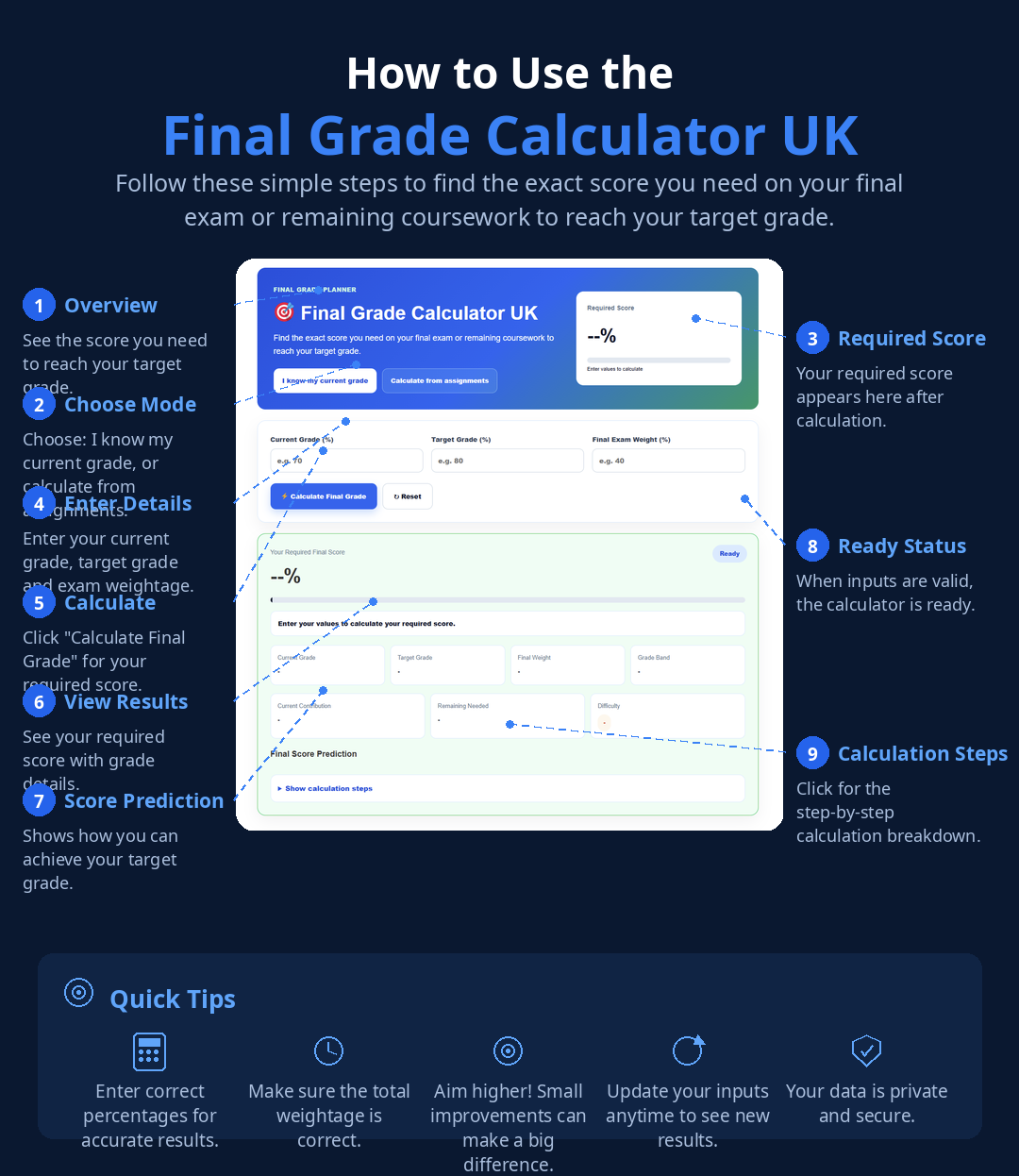
Click Here: Final Grade Calculator UK
What “pass/fail” actually means at a UK university
A pass/fail module is a module whose assessment scheme awards only a pass or fail grade instead of a percentage mark. The module has been approved to use only pass/fail grades — the wording comes from Teesside University’s assessment regulations — and the minimum criterion to pass is simply the achievement of an overall pass grade. There is no 40, no 55, no number at all recorded against your name for that module. Some modules mix the two schemes: a pass/fail component sits alongside percentage-marked components, in which case you must meet both the pass grade and the minimum aggregated mark in the other components.
Two things about the UK system surprise students who arrive expecting the American version of this. First, you almost certainly cannot choose it. In the US, many universities let students elect a pass/fail option for individual courses. In the UK there is no general right to convert a graded module into an ungraded one; the assessment scheme is fixed when the module is validated, and your course handbook states it per module. If your module is graded, it stays graded. The COVID-19 era was the rare exception — UCL’s transcript key still carries a “CX: Module Completed but result not expected due to Covid-19” code from the no-detriment period — but that window closed years ago.
Second, pass/fail does not mean easy or unassessed. A pass/fail clinical placement or professional practice module can demand hundreds of logged hours, competency sign-offs, and reflective portfolios. The marking is binary, but the workload is not. Students who hear “it doesn’t count toward my average” and mentally file the module under “optional” are making the single most expensive mistake in this guide — as the failing section below shows.
Where pass/fail modules actually show up
You rarely meet a pass/fail module in a standard lecture-and-exam first year. They cluster in parts of a degree where a percentage would be arbitrary or unfair. The five most common homes:
| Where | Typical module | Why it’s pass/fail |
|---|---|---|
| Sandwich / placement year | Work placement module (often 120 credits) | No two placements are comparable, so a percentage would be meaningless; the year is assessed on completion and reflective work |
| Year or semester abroad | Study-abroad module | Partner universities use different grading scales; many UK universities record the year as pass/fail rather than convert foreign marks |
| Professional courses | Clinical practice, teaching placements, social-work practice | Competency-based assessment: you are either safe and competent or you are not — a 63% would be a strange thing to award a nurse |
| Employability / skills modules | Career development, enterprise, volunteering modules | Assessed on engagement and reflection; universities keep them out of classification averages deliberately |
| Zero-credit or hurdle requirements | Academic integrity courses, lab safety, fieldwork sign-off | Threshold requirements: pass them and move on, fail them and you’re stuck |
The placement-year row deserves a pause, because it’s where the most money and the most confusion live. On some sandwich degrees the placement year carries 120 credits assessed entirely pass/fail; on others the placement contributes a percentage to the degree. Two students on apparently identical “placement years” at different universities can have completely different classification mathematics. If you’re choosing a sandwich course, the module specification — not the prospectus headline — tells you which version you’re getting.
The golden rule: credits count, marks don’t
Strip away the variations and every UK university applies the same two-part rule to pass/fail modules. Part one: the credits count toward progression and the award. A passed 20-credit pass/fail module is 20 credits in the bank toward your 120 for the year, exactly like a 20-credit module you scored 72 in. Teesside’s regulations put it plainly: “Pass/fail module credits will contribute towards progression and the award.”
Part two: the module contributes nothing to any average or classification calculation. It is excluded from the level averages, the weighted year averages, and the final classification aggregate. Teesside again, unambiguous: “Pass/Fail modules do not contribute to the calculation of level averages or to the classification of an award.” Reading University’s programme specifications say the same for its own system: “Pass/fail modules are excluded from weighted average calculations but must be passed to avoid failure of the Part or degree.” UWE’s academic regulations repeat the exclusion for both Level 5 and Level 6 weighted averages. And Plymouth Marjon spells out the mechanics: “Modules that are not assigned a numeric mark, e.g. pass/fail modules, do not count towards degree classification. Mean values will be calculated on the remaining credits pro rata.”
That last phrase — on the remaining credits pro rata — is the operational bit most students get wrong. The university doesn’t substitute a guess (40, 50, “average”) for the missing mark. It simply shrinks the denominator: your average is computed over the graded credits only, as if the pass/fail module weren’t there for averaging purposes. A year with one 20-credit pass/fail module has its average calculated over 100 credits, not 120. The worked example below shows exactly what that does to the numbers.
What exclusion looks like in numbers: Amara’s second year
Amara is in second year. Five modules, 120 credits, and one of them — a 20-credit employability module — is pass/fail. She passed it. Her graded results:
| Module | Credits | Result | Contribution |
|---|---|---|---|
| Research Methods | 30 | 72 | 30 × 72 = 2,160 |
| Social Theory | 30 | 64 | 30 × 64 = 1,920 |
| Data Analysis | 20 | 58 | 20 × 58 = 1,160 |
| Global Politics | 20 | 69 | 20 × 69 = 1,380 |
| Employability in Practice | 20 | Pass (ungraded) | excluded |
The correct calculation excludes the pass/fail module from both the top and the bottom of the fraction:
(2,160 + 1,920 + 1,160 + 1,380) ÷ 100 = 6,620 ÷ 100 = 66.2%
Amara’s year average is 66.2% — a solid 2:1. Now watch what happens with the two wrong methods students actually use. Wrong method 1: plugging in 40 as a pretend mark for the pass (“a pass is basically 40, right?”). That gives (6,620 + 800) ÷ 120 = 7,420 ÷ 120 = 61.8% — more than four percentage points lower than reality, and enough to send her into final year believing she’s further from a First than she is. Wrong method 2: plugging in the year’s running average, which just reproduces 66.2% while hiding the real structure. Neither is what any UK university does. The regulation method is exclusion, full stop.
And here’s the counterfactual that completes the picture. Suppose the employability module had been graded and Amara had scored 85 in it. Her average would have been (6,620 + 1,700) ÷ 120 = 8,320 ÷ 120 = 69.3% — a full 3.1 points higher. The pass/fail format cost her that lift. Exclusion is symmetrical: it can never rescue a weak average and can never drag down a strong one. It simply removes the module from the classification maths while keeping its credits toward progression.
The borderline trap: Daniel’s 69.80%
Daniel is in final year, and his story is the one that generates the angriest emails to personal tutors every summer. His final-year modules: a 40-credit dissertation and three 20-credit taught modules, plus a 20-credit pass/fail professional development module which he passed comfortably.
| Module | Credits | Mark | Contribution |
|---|---|---|---|
| Dissertation | 40 | 71 | 40 × 71 = 2,840 |
| Advanced Topics A | 20 | 70 | 20 × 70 = 1,400 |
| Advanced Topics B | 20 | 69 | 20 × 69 = 1,380 |
| Advanced Topics C | 20 | 68 | 20 × 68 = 1,360 |
| Professional Development | 20 | Pass (ungraded) | excluded |
Final-year weighted average: (2,840 + 1,400 + 1,380 + 1,360) ÷ 100 = 6,980 ÷ 100 = 69.80%. Two-tenths of a point short of a First. Daniel’s first reaction was that the pass must count for something — he’d worked hard on the professional development portfolio, after all. It counts for 20 credits toward his degree. It contributes precisely zero to the 69.80. Whether his university’s borderline rules then lift him to a First is a separate question entirely (see our guide to how UK universities round marks at classification borderlines), but the pass/fail module itself cannot be the thing that pushes him over. Nothing graded 85 that term could have been excluded; nothing ungraded can be included. The symmetry from Amara’s example holds at the boundary too.
Run the counterfactual once more, because it kills the most persistent myth — that pass/fail modules “protect” your average. If Daniel’s professional development module had been graded: at 85, his average becomes (6,980 + 1,700) ÷ 120 = 8,680 ÷ 120 = 72.33%, a comfortable First; at 60, it’s (6,980 + 1,200) ÷ 120 = 68.17%, barely moved; at 40, it’s (6,980 + 800) ÷ 120 = 64.83%, nearly five points destroyed. The real system gave him 69.80% — exactly what his graded work earned, no more, no less. Pass/fail neither shields nor sabotages. It abstains.
Failing a pass/fail module is still failing
Here is where the “it doesn’t count” folk wisdom turns dangerous. The golden rule’s first half — credits count toward progression — has a mirror image: a failed pass/fail module is a failed module, and failed modules block progression. Reading University’s regulations state the position bluntly: “A Fail in a Pass/Fail module will be treated as not meeting the minimum threshold requirement for progression or classification.” You cannot progress, and you cannot graduate, with an unpassed pass/fail module sitting in your credit total.
What happens next depends on your university, but the shape is familiar from the standard referral system: you will normally be offered a reassessment — a resit of the failed component — and because there is no numeric mark, there is nothing to “cap.” You simply get another attempt at achieving the pass grade (see our full guide to how university referrals and resits work). Fail the reassessment and you move down the familiar ladder: repeat the module, trail the credit, or in the worst case face the progression board’s tougher options — the same ladder that can end in condoned passes being unavailable for core modules. Note that condonement — the board forgiving a marginal fail — is generally designed around numeric marks; an ungraded fail is harder to condone and at many universities simply isn’t eligible.
The placement-year version of this is the nightmare scenario worth naming explicitly. A student who treats a 120-credit pass/fail placement year as a holiday, fails the placement’s assessment, and discovers the failure can’t be condoned or compensated is suddenly facing a repeat year or a degree without the “with placement” title. The module didn’t affect the average, but it absolutely affected the degree. Effort allocation for pass/fail modules should be driven by the consequence of failing, never by the absence of a mark.
Transcripts, masters applications and employers: what a “P” looks like from the outside
On your transcript, a pass/fail module appears as a line with the module title, its credit value, and a grade of P (or F, if that’s how it ended). UCL’s official transcript key — the document that accompanies every UCL transcript sent to employers and other universities — lists “P: Pass” as a standard grade alongside fails, condoned passes and deferrals. Your university transcript and HEAR record will show the same. There is no percentage to infer, no hidden mark behind the letter; anyone reading it sees a pass.
How much does that matter? Honestly, less than students fear — with two exceptions. First, competitive taught masters: admissions tutors assessing whether you meet a 2:1 threshold work from your graded average, which the pass/fail modules don’t enter. A transcript heavy with P grades in your final year won’t disqualify you, but it gives selectors less evidence of high-level performance, so the graded modules you do have need to carry the argument. Second, professional-body courses: for nursing, teaching, social work and similar degrees, the pass/fail practice modules are often the part employers scrutinise most — a P there is expected and unremarkable, but it must be there.
For general graduate employers, a pass/fail placement or employability module is entirely normal and needs no explanation. What does raise eyebrows is a transcript where core academic modules appear ungraded without an obvious reason — which, in the UK system, basically never happens, because students can’t elect the format. If a module is pass/fail on your transcript, any experienced recruiter or admissions tutor knows the university made that decision, not you.
Five mistakes students keep making with pass/fail modules
| # | The mistake | Why it hurts |
|---|---|---|
| 1 | Plugging 40 or 50 into an average calculator as a pretend mark | Invents a number your university never uses; Amara’s example showed a 4.4-point phantom drop from this alone |
| 2 | Assuming a pass “adds” to the average | It adds credits, not marks — Daniel’s 69.80% stayed 69.80% despite a comfortable pass |
| 3 | Coasting because “it doesn’t count” | A fail blocks progression and often can’t be condoned; the consequence of failing is the real grade |
| 4 | Believing you can switch a weak graded module to pass/fail | The UK has no general elective pass/fail system — the scheme is fixed at module validation |
| 5 | Ignoring the module specification | Mixed pass/fail-plus-percentage modules have dual requirements (pass grade and minimum aggregated mark); missing either one fails the module |
Your three-question pass/fail checklist
Before you decide how to treat any pass/fail module, answer three questions from your module handbook — it takes ten minutes and prevents every mistake above:
1. Is the whole module ungraded, or only a component? Teesside’s regulations cover the mixed case explicitly: where pass/fail and percentage grades combine, both minimum requirements must be met. A module that is “pass/fail for the presentation, percentage for the report” can still fail you on the number.
2. What exactly happens if I fail it? Find the reassessment rule for this specific module: is there an in-year retrieval, a summer resit, or does the failure roll into the progression board? Placement and professional-practice modules sometimes have only one reassessment route per year — miss it and you’re waiting twelve months.
3. Does anything external depend on it? Professional, statutory and regulatory body requirements (nursing, teaching, social work) can make a practice module the single most important module in your year despite its zero contribution to your average. If your degree is a licence to practise, the P is the licence.
Get those three answers and the strategy writes itself: exclude the module from every average you compute (use the Final Grade Calculator with graded modules only), invest effort in proportion to the cost of failing, and never invent a mark where your university records none.
Do pass/fail modules count towards my degree classification?
No. UK universities explicitly exclude ungraded modules from classification calculations. Teesside University’s regulations state that “Pass/Fail modules do not contribute to the calculation of level averages or to the classification of an award,” and Reading, UWE and Plymouth Marjon apply the same exclusion. Your classification is computed from your graded modules only, on a pro-rata basis.
Can a pass/fail module lower my average?
No — and it can’t raise it either. Because the module is excluded from both the numerator and the denominator of the average, it is mathematically invisible to your classification. A pass adds nothing to a borderline 2:1, and a strong performance in a pass/fail module never lifts a weak average. The credits still count toward progression and your degree.
What happens if I fail a pass/fail module?
A fail is still a fail: Reading University’s regulations treat it as “not meeting the minimum threshold requirement for progression or classification,” so it can block your progression to the next year or your graduation. You will normally be offered a reassessment of the failed component. Because there is no numeric mark, condonement is often unavailable for ungraded fails — check your course handbook for the exact reassessment route.
Do I still get the credits for a pass/fail module?
Yes. Passed pass/fail modules contribute their full credit value toward progression and your award — a 20-credit pass is 20 credits in the bank, exactly like a 20-credit module you scored 72 in. This is the “credits count, marks don’t” rule: the credits move you toward your 120 for the year and 360 for the degree, while no mark enters any average.
Can I choose to take a module pass/fail at a UK university?
Generally no. Unlike some US universities, the UK has no general system for electing pass/fail on individual modules. The assessment scheme is fixed when each module is validated, and your course handbook states it per module. If your module is graded, it stays graded. The COVID-19 no-detriment period was a rare historical exception.
How do pass/fail modules appear on my transcript?
As a line showing the module title, its credit value, and a grade of P (Pass) or F (Fail) — no percentage. UCL’s official transcript key lists “P: Pass” as a standard grade, and your HEAR record shows the same. There is no hidden mark behind the letter, and experienced recruiters and admissions tutors know the university chose the format, not you.
How do I calculate my average if I have a pass/fail module?
Exclude the module entirely: remove its credits from the denominator and add nothing to the numerator. For example, with 100 graded credits averaging 66.2% and one 20-credit pass, your average is 66.2% — not a blended figure. Never plug in 40 or 50 as a pretend mark; no UK university does this. Enter only your graded modules into the Final Grade Calculator.
Do employers or masters courses care about pass/fail modules?
For general graduate jobs, a pass/fail placement or employability module is completely normal and needs no explanation. For competitive taught masters, selectors work from your graded average, so P grades give them less evidence of high performance — your graded modules must carry the argument. For professional courses like nursing or teaching, the pass/fail practice modules are often the part employers scrutinise most: the P is expected, but it must be there.
Conclusion
Pass/fail modules are the quietest modules on your transcript and, misunderstood, the most treacherous. The entire system reduces to one sentence: credits count, marks don’t. The credits move you toward progression and your degree; the absence of a mark removes the module from every average your university computes. Amara’s 66.2% was exactly what her graded work earned, and Daniel’s 69.80% stayed 69.80% no matter how comfortably he passed his professional development module. No invented 40, no hopeful averaging — exclusion, applied symmetrically, is the honest mathematics.
The practical consequence is a change in how you budget effort. A pass/fail module deserves attention in direct proportion to the cost of failing it, not in proportion to its (non-existent) contribution to your average. A pass/fail clinical placement on a nursing degree can matter more than any graded essay you’ll write that year. A pass/fail employability module with a simple summer resit matters less. Run the three-question checklist, exclude the module from every average you calculate, and give the “it doesn’t count” voice in your head the correction it needs: it doesn’t count toward the average, but it absolutely counts toward the degree.
And when you’re modelling your final classification, remember the exclusion rule cuts both ways: your graded modules alone decide your class, which means every percentage point you earn in them carries slightly more weight than it would in a fully graded year. Run only those graded marks through the Final Grade Calculator, see precisely what your remaining assessments need to deliver, and treat the pass/fail module as what it is — a hurdle to clear cleanly, not a number to chase.


![Read more about the article ECTS Credits Explained: How ECTS Works and Converts to UK Credits [2026]](https://gradeforuni.com/wp-content/uploads/2026/10/featured-ects-credits-300x192.png)
![Read more about the article Placement Year Grading: How Sandwich Years Are Marked [2026 Guide]](https://gradeforuni.com/wp-content/uploads/2026/10/featured-placement-year-grading-300x192.png)