Improve Your Degree Classification There’s a specific kind of stress that comes with staring at a weighted average that’s just short of a 2:1, or just short of a First. You know you’re close, but you don’t know if “close” actually means anything once the exam board sits down and makes its decision.
The honest answer is: sometimes you can improve your classification, and sometimes the door has already closed. It depends on where you are in your degree, how close you are to the boundary, and what your university’s specific policy allows. Here’s how it actually works.
Visit Now: https://www.taxsal.com/
How UK Degree Classification Works, Quickly
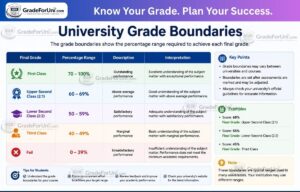
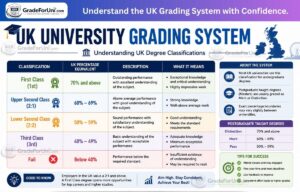
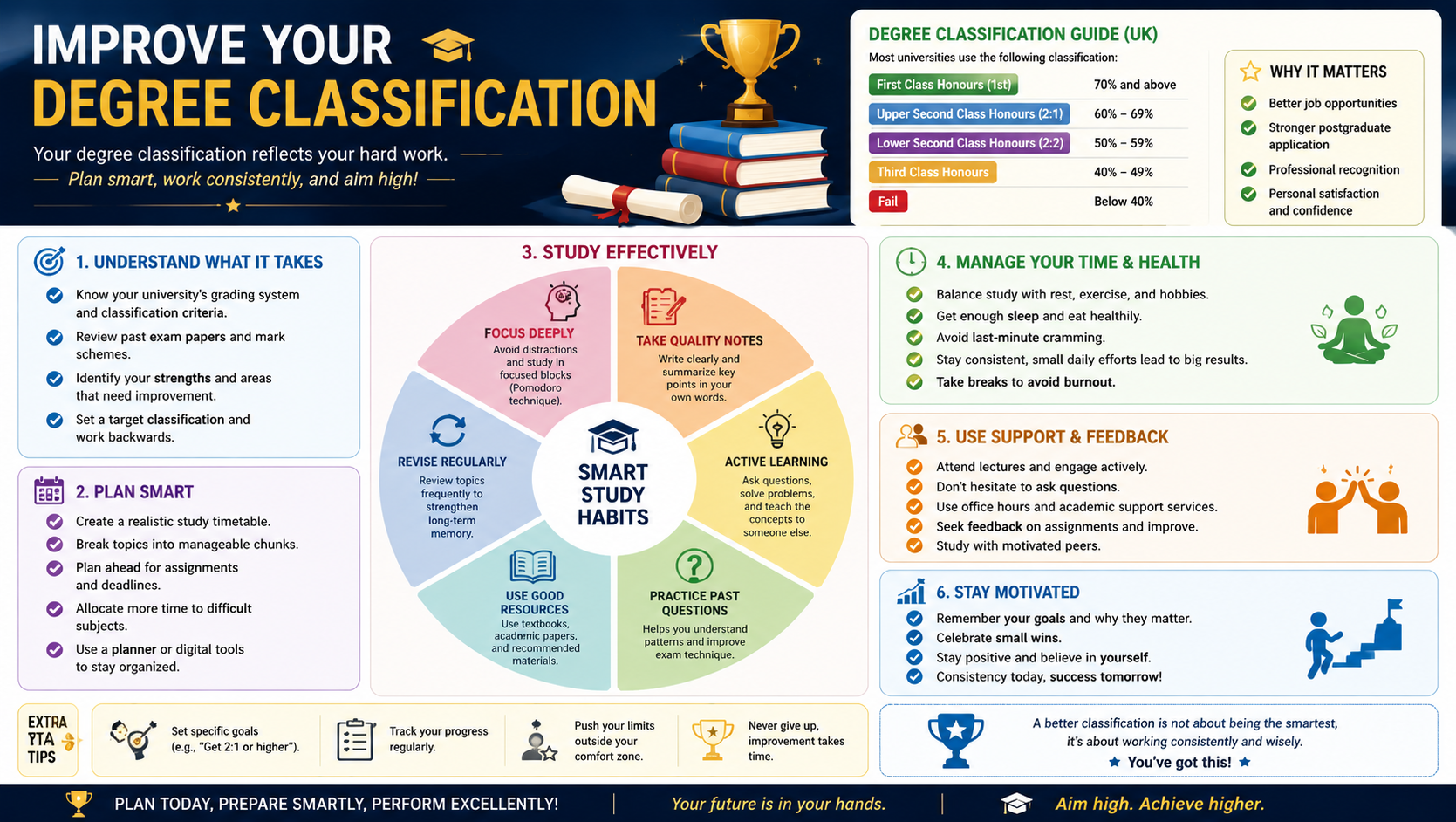
Before getting into what you can influence, it helps to know the standard boundaries most UK universities use for undergraduate Honours degrees:
- First Class (1st): 70% and above
- Upper Second (2:1): 60% to 69%
- Lower Second (2:2): 50% to 59%
- Third Class: 40% to 49%
Your final classification is based on a credit-weighted average across your modules, usually with later years counting for more than earlier ones. That weighting is exactly why final-year performance tends to matter so much more than anything from first year.
If You’re in the Borderline Zone, You Might Get an Automatic Boost
This is the scenario most people are actually asking about. If your final average lands close to a classification boundary, typically within 1 to 2 percentage points below it, many universities have a formal borderline policy that allows an exam board to review your case for an uplift.
Common factors that get considered include:
- Whether most of your final-year modules already sit at the higher classification. If the majority of your credits are already at First-level, for example, that strengthens the case for an uplift even if your overall average sits just under 70%.
- Your trajectory across the degree. A board is generally more convinced by a student whose grades climbed steadily than one who peaked early and dropped off.
- Outstanding performance on a dissertation or major project. A strong result on your flagship piece of work can carry real weight in a borderline decision, since it demonstrates ability that a simple average doesn’t always capture.
- Documented extenuating circumstances. If you had approved mitigating circumstances on file, an exam board can take those into account, though they generally can’t consider anything that wasn’t formally submitted at the time.
It’s worth being clear about something important here: this isn’t something you can request or negotiate after the fact. Most universities apply borderline reviews automatically to anyone who falls within the defined zone, and not every university has this policy at all. Checking your institution’s academic regulations, usually searchable by terms like “classification” and “borderline,” will tell you exactly where you stand.
Read More: GPA vs Percentage: 7 Essential
Resits Can Help, But They Come with a Catch
If you’ve failed a module, most universities allow one resit attempt. The catch is that resit marks are almost always capped at the pass mark, 40% for undergraduate modules in most cases, even if you actually score much higher on the retake. This exists specifically to stop students from strategically failing modules to get a second attempt.
What this means practically is that a resit can rescue your degree from a fail, but it rarely does much to lift your overall classification unless your average was already very close to the next boundary. If you were borderline before the resit, a capped pass might be just enough to tip your weighted average over the line. If you were well below the boundary, a capped resit mark generally won’t move the needle much.
Repeating a Year or Deferring Graduation
In some cases, particularly if you’ve failed multiple modules or had a genuinely disrupted year, you may have the option to repeat the year or defer your graduation to retake assessments properly, rather than through a capped resit. (Improve Your Degree Classification) This route is more involved, since it usually means delaying your graduation date, but it can, in the right circumstances, lead to a better outcome than accepting a capped mark. This is a decision worth discussing directly with your personal tutor or academic support team, since the implications for funding, timelines, and your final transcript vary a lot between universities.
Read More: Final Grade Calculator: 7 Easy Tips to Know What Grade You Need on Your Final Exam
Extenuating Circumstances and Appeals
If illness, bereavement, or another serious personal circumstance affected your performance during assessments, submitting a formal extenuating circumstances claim, ideally at the time it happened rather than afterward, can lead to a reassessment opportunity without the usual resit cap applying.
Separately, if you believe there was a procedural error in how your grade or classification was calculated, most universities have a formal academic appeals process.(Improve Your Degree Classification) It’s worth knowing that appeals are almost never a route to argue you deserved a higher mark academically. They’re designed for cases where something in the process itself went wrong.
What About After You’ve Already Graduated?
This is where the honest answer gets less encouraging. Once your degree has been formally conferred, your classification is generally fixed. There’s no standard process to go back and “upgrade” a 2:2 to a 2:1 after graduation.
That said, there are indirect ways people work around a classification they’re not happy with:
- A relevant postgraduate qualification, particularly a Master’s with a strong result, can carry real weight with employers and shift the conversation away from your undergraduate classification.
- Professional certifications or conversion courses, depending on your field, can demonstrate the competence your degree classification didn’t fully capture.
- Building a strong portfolio or work experience, especially in fields where employers weigh demonstrable skills as heavily as, or more heavily than, the classification itself.
None of these change what’s printed on your certificate, but they can meaningfully change how that classification is read by the people making hiring decisions.
What Doesn’t Actually Affect Your Classification
A few things people assume matter, but generally don’t:
- Attendance, beyond its indirect effect on coursework and participation marks, isn’t factored into your classification directly.
- Extracurricular activities don’t influence your academic result, though they can strengthen your employability and applications separately.
- First-year marks, at most UK universities, don’t count toward your final classification at all, even though passing the year is still required to progress.
Knowing what genuinely doesn’t matter can save you a lot of unnecessary worry in the final stretch.
Practical Steps If You’re Aiming to Improve Your Result
- Find your university’s specific borderline policy rather than assuming a generic rule applies. Zone width and criteria vary significantly between institutions.
- Prioritise final-year, high-credit modules. These carry the most weight in your overall average, so extra effort here has the biggest impact.
- Take your dissertation or major project seriously early on. It’s often the single assessment with the most influence over a borderline decision.
- Submit extenuating circumstances promptly, with proper documentation, rather than waiting until results are already out.
- Talk to your personal tutor if you’re unsure where you stand. They can usually tell you, in plain terms, whether resits, deferral, or simply focusing on remaining assessments makes the most sense for your situation.
Final Thoughts
If you’re sitting close to a boundary, the most useful thing you can do is find out exactly how your university defines “borderline” and what it actually rewards, rather than guessing. For everyone else, the classification that matters most is the one you’re actively building through your remaining assessments, not one you can request after the fact.
FAQ’s
Is it actually possible to improve your degree classification?
Yes, in some cases you can improve your degree classification, mainly through borderline uplift policies, resits, or repeating a year, depending on how close you are to the boundary.
What is the easiest way to improve your degree classification?
The most common way to improve your degree classification is through a borderline review, where your final-year performance is checked against the higher classification’s criteria.
Can resits help improve your degree classification?
Resits can help improve your degree classification slightly, but the mark is usually capped at the pass boundary, so the impact is limited unless you were already very close to the next class.
Does your dissertation help improve your degree classification?
Yes, a strong dissertation result is one of the most effective ways to improve your degree classification, especially in borderline cases where the overall average falls just short.
Can you improve your degree classification after graduating?
No, once your degree is officially conferred, you generally cannot improve your degree classification. Further qualifications or experience can still strengthen your profile though.
Do extenuating circumstances help improve your degree classification?
Yes, documented extenuating circumstances submitted at the right time can help improve your degree classification by prompting a formal reassessment
Can appealing my grade improve my degree classification?
Not usually. Appeals are meant for procedural errors, not for requesting to improve your degree classification simply because you disagree with the outcome.