

There is a particular kind of email that makes a student’s stomach drop: “You are invited to attend a viva voce examination.” No mark, no feedback, just a date, a room number, and the names of two academics you may never have met. For PhD candidates it is the final hurdle of a three-to-four-year doctorate. For undergraduates it usually means one of two things — you are sitting on a borderline that could move your degree classification up, or someone suspects your work is not entirely your own.
A viva voce exam — Latin for “with living voice” — is an oral examination in which you defend your work face to face with examiners. It is one of the oldest forms of university assessment in the world, and in the UK it survives in places written exams cannot reach: the doctoral thesis defence, borderline degree decisions, academic misconduct investigations, and professional training from medicine to modern languages. Unlike a written paper, there is nowhere to hide in a viva. But there is also something a written paper never gives you — the chance to talk your way out of a misunderstanding, or into a higher classification.
This guide explains what a viva voce exam actually involves at UK universities, the four different kinds you might face, how examiners mark them (and what “marking” even means when there is no mark scheme), and how to prepare — with two fully worked examples showing exactly how a viva can move, or sink, your results.
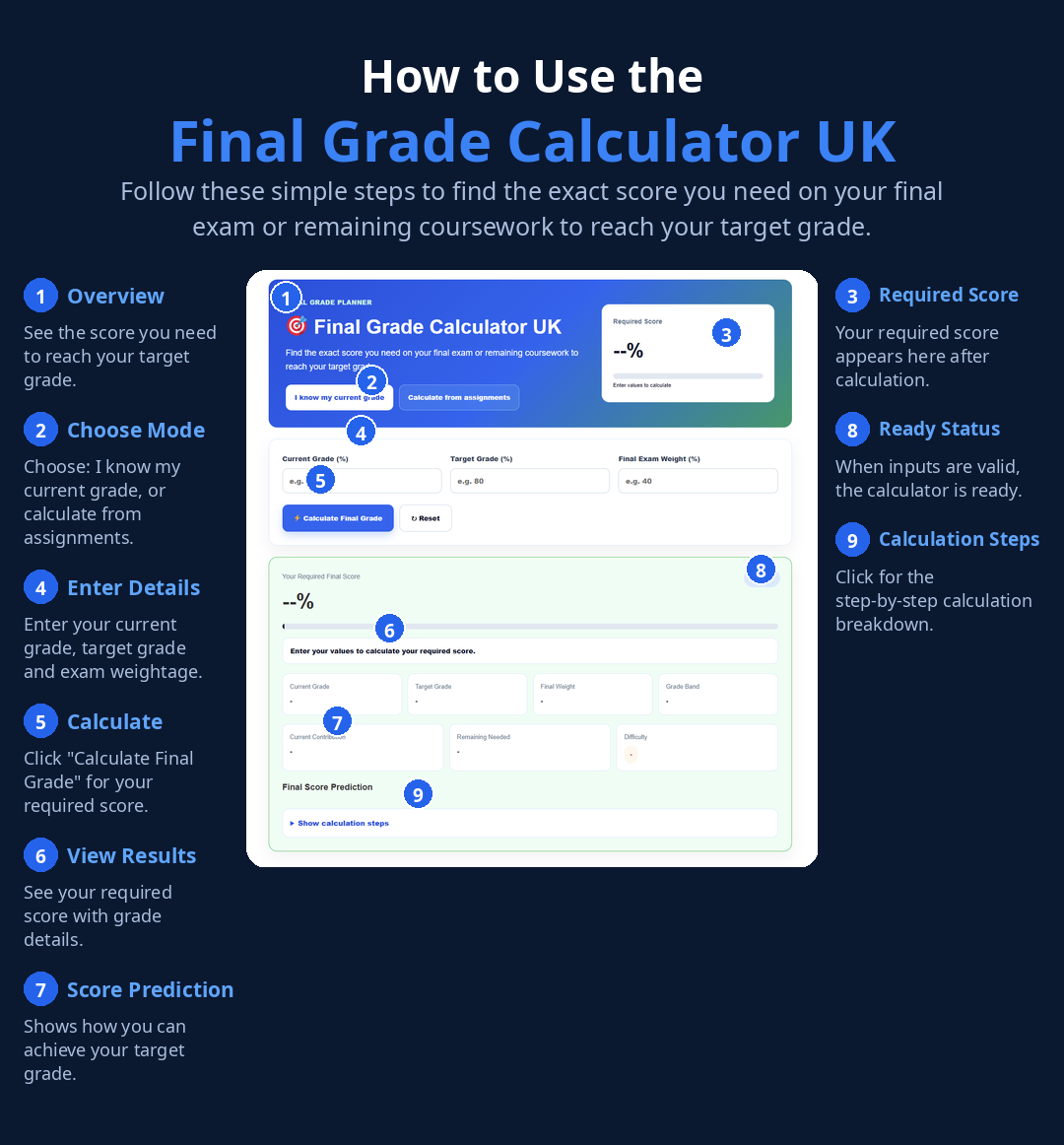
Click Here: Final Grade Calculator UK
What “Viva Voce” Actually Means
Viva voce translates from Latin as “by live voice” or “with living voice.” The name is a deliberate contrast with viva scripta — assessment by written word. In medieval universities, almost all serious examination was oral: a scholar proved their learning by disputing, defending, and answering questions in real time, in front of masters. The written exam as we know it only took over in the 19th century.
The UK kept the oral tradition alive longer than most countries, and for a practical reason. A viva tests things a written paper struggles to test: whether you genuinely understand the work carrying your name, whether you can think on your feet, and whether your thesis or project holds up under sustained expert questioning. That is why the viva voce exam in the UK clusters around three pressure points — the doctorate, where originality must be defended; the borderline, where a classification hangs in the balance; and misconduct cases, where authorship itself is in doubt.
One thing to clear up immediately: a viva is not a job interview, and it is not a trick. Published viva guidelines used across UK universities stress that the viva “is not intended to be an intimidating experience, and is not an alternative to a written examination” — its stated aim is to give you an opportunity to show what you know and understand. Examiners are generally looking for reasons to pass you, not fail you. Understanding that changes how you prepare.
The 4 Types of Viva Voce Exam at UK Universities
Students hear “viva” and assume everyone means the same thing. They do not. There are four distinct species, with different panels, different stakes, and different rules. Knowing which one you have been called to is the single most important step, because the preparation for each is completely different.
| Viva type | Who faces it | Typical panel | What’s at stake |
|---|---|---|---|
| Doctoral viva | PhD / professional doctorate candidates | Internal + external examiner (supervisor usually excluded) | The degree itself — pass, corrections, or resubmission |
| Borderline viva | Finalists within ~1–2% of a classification boundary | Internal examiners, sometimes the external examiner | Discretionary uplift to the higher classification |
| Misconduct / authenticity viva | Students whose work is suspected of plagiarism or AI use | Module leader + subject specialist | Whether your mark stands — or goes to a misconduct panel |
| Professional / language oral | Medicine, nursing, law, modern languages students | Assessors against a mark scheme | A weighted mark like any other assessment |
The doctoral viva is the famous one, and it is the only viva most UK students will never sit — only around 1–2% of UK undergraduates progress to a doctorate. The other three, though, can land on any student, often with only a week or two of warning. We will take each in turn.
The PhD Viva: Format, Examiners and the 8 Possible Outcomes
The doctoral viva is the purest form of the viva voce exam. After submitting an 80,000-word thesis (the typical UK PhD maximum), the candidate defends it in a closed oral examination, usually lasting between one and three hours. There is no audience. The panel is normally two people: an internal examiner from your own university and an external examiner — a recognised expert from another institution, deliberately chosen to be independent. Your supervisor is normally excluded from the examining role, though they may attend as an observer if you agree.
Examiners read the thesis in advance and each writes an independent preliminary report before the viva. The oral itself then probes the thesis: the originality of the contribution, the soundness of the methodology, the candidate’s grasp of the wider field, and — bluntly — whether the candidate actually did the work. After questioning, the candidate is asked to leave the room while examiners deliberate, then recalled for an indicative result.
The range of formal outcomes is wider than most candidates expect. Queen Mary University of London’s published research-degree regulations list eight possible viva outcomes, and most UK universities operate a near-identical ladder:
| Outcome | What it means | Typical deadline |
|---|---|---|
| Pass | Degree awarded outright | Immediate |
| Pass with minor amendments | Typos, clarifications, small rewording | Up to 6 months |
| Pass with major amendments | Substantial rewriting or re-analysis | Up to 9 months |
| Revise and resubmit | Thesis not yet at doctoral standard; second examination | Up to 18 months |
| Written/practical exam | Additional assessment instead of re-examining the thesis | Set by examiners |
| Second oral examination | Another viva on the same thesis | Up to 18 months |
| MPhil awarded | Work meets master’s, not doctoral, standard | With or without corrections |
| Fail outright | No degree, no resubmission | — |
Here is the reality that calms most candidates down: in practice, the overwhelming majority of UK PhD vivas end in “pass with minor corrections.” Examiners do not let a thesis go to viva unless they already believe it is defensible — a candidate whose work is fundamentally inadequate is normally warned long before submission. The viva is a test you are expected to pass, and the corrections list — usually a few pages of typos, clarifications and small additions — is simply part of the process. Once your corrections are approved, the degree is awarded, and nobody ever asks about them again.
Undergraduate Vivas: Borderlines and Misconduct Investigations
At undergraduate level, vivas are rarer but higher-stakes, because they arrive unannounced in your final year. There are two completely different reasons you might be called.
Borderline vivas. If your final weighted average lands just below a classification boundary — the classic published borderline bands are 68.00–69.99% (borderline First), 58.00–59.99% (borderline 2:1) and 48.00–49.99% (borderline 2:2) — some universities invite you to a viva to decide whether you deserve the higher classification. Before the meeting, the external examiner may review your exam scripts, coursework, project and full marks profile; the viva itself is a conversation about your work, sometimes ranging across modules from earlier years. The examiners are looking for evidence that you can think and discuss at the level of the higher classification — not for detailed recall of every topic.
Important nuance: not every university does this. The University of Aberdeen’s assessment code, for example, states explicitly that “viva voce exams are not permitted for determining the final classification of borderline students” — borderline decisions there rest on grade profiles, exit velocity and mitigating circumstances instead. So a borderline viva is a privilege of some institutions’ regulations, not a universal right. If you are sitting at 68.4% and dreaming of a First, check your own university’s assessment regulations first; our borderline grades guide explains how discretionary uplift rules work in detail.
Misconduct and authenticity vivas. The fastest-growing use of the undergraduate viva has nothing to do with borderlines. When a marker suspects plagiarism, collusion, contract cheating or AI-generated work, many universities now invite the student to a viva to establish whether they actually understand — and therefore authored — the submitted work. The procedures are formal. Goldsmiths’ assessment regulations allow “a special oral or written examination arranged for the purpose of establishing the original source of any work submitted,” and warn that failure to attend without adequate reason counts as non-completion — a fail. The University of Westminster’s misconduct procedure requires two members of academic staff (at least one a subject specialist) to be present, written advance notice of the reason for the viva, and a written record of the discussion — a copy of which goes to the student.
One protection worth knowing: at universities like Edge Hill, an oral investigation is exactly that — an investigation. Their regulations state that oral investigations exist “to provide evidence for further investigations only,” that they “are not malpractice panels,” and that no sanction can be applied directly as a result of one. The viva gathers evidence; a separate panel decides guilt. If you are ever called to one, our guide to appealing a university grade covers your rights when an academic decision goes against you.
How Examiners Actually Mark a Viva
This is the question students ask most, and the answer is unsatisfying until you understand the logic: most vivas are not “marked” the way an essay is marked. There is no mark scheme with 70 points to collect. Instead, examiners make a holistic academic judgement against published criteria, and that judgement maps onto one of a small set of outcomes. How that works depends on the viva type.
Doctoral vivas are pass/fail judgements, not percentages. Nobody scores a PhD viva 68%. The examiners ask one question: does this thesis, and this candidate’s defence of it, meet the standard for the degree? The outcome ladder above — pass, minor corrections, major corrections, resubmit — is the marking system. The corrections are the mark, expressed as work to be done rather than a number.
Borderline vivas feed examiner discretion. The viva does not change your percentage — your 68.4% stays 68.4% on the transcript. What changes is the board’s willingness to exercise discretion and award the higher classification. Examiners are effectively answering: “Has this student demonstrated understanding at First-class level?” A strong viva supplies the evidence; a weak one confirms the lower award.
Professional and language orals are the exception — these usually do carry marks against a rubric, like any other assessment. A modern languages oral might weight pronunciation, fluency, accuracy and range; a nursing OSCE station scores each clinical step.
Across all types, examiners are listening for the same four things. Think of this as the hidden mark scheme:
| Criterion | What examiners listen for | What sinks candidates |
|---|---|---|
| Command of the material | Accurate, specific answers that show you know the work deeply | Vague generalities; contradicting your own written work |
| Critical thinking | Acknowledging limitations, weighing alternatives, justifying choices | Defending every decision reflexively; unable to name a weakness |
| Ownership | Explaining why you did things, in your own words | Answers that sound memorised or disconnected from the work |
| Composure under questioning | Pausing, thinking aloud, asking for clarification when needed | Bluffing through questions you don’t understand |
Notice what is missing: perfection. Examiners do not expect you to answer everything. Saying “I don’t know, but here’s how I’d find out” is a strong answer; inventing one is a weak one. The viva rewards intellectual honesty more than encyclopaedic recall.

Worked Example 1: A Borderline 2:1 Viva
Amara is a final-year History student. Her university weights Year 2 at 25% and Year 3 at 75%, and her marks are:
- Year 2 average: 66.0% (four modules: 64, 65, 67, 68)
- Year 3 average: 69.2% (four modules: 67, 68, 70, 72 — including a 72 on her dissertation)
- Final weighted average: (66.0 × 0.25) + (69.2 × 0.75) = 16.5 + 51.9 = 68.4%
68.4% is a 2:1 — but it sits inside the 68.00–69.99% borderline band for a First, so her university invites her to a borderline viva with two internal examiners. Here is the maths that matters: the viva cannot change her 68.4%. If the examiners are convinced, the board awards a First despite the 68.4%, and her transcript still reads 68.4% with a First-class classification. If not, she graduates with a 2:1 at 68.4% — a strong 2:1, but a 2:1.
Amara’s preparation is targeted. Her profile already argues for her: clear upward trajectory (66.0 → 69.2), dissertation at 72, majority of final-year marks at 68+. In the viva she focuses on her dissertation — its argument, its sources, what she would change — because that is where examiners will probe for First-level thinking: original interpretation, critical engagement with historiography, independent judgement. She does not waste time revising first-year content.
The result: the examiners report that she “demonstrated sustained critical analysis at a level consistent with First-class work,” and the board uplifts her. The lesson is structural, not personal — a borderline viva is winnable when your profile already points upward and the viva confirms it. If Amara’s marks had been sliding downward (70 in Year 2, 66 in Year 3), the same viva performance would likely not have saved her. Before banking on a viva, check your trajectory with the Final Grade Calculator UK — and read how borderline uplift rules treat profiles like yours.
Worked Example 2: A Misconduct Viva, Step by Step
Daniel, a second-year Business student, submits a 2,000-word essay on supply chain strategy. The marker notices the essay uses terminology never taught on the module and Turnitin flags a 42% similarity score with odd source matches. Daniel receives a formal letter: he is invited to a viva voce to discuss the essay, with the module leader and a subject specialist present, in ten days’ time. He is told the viva’s purpose in writing, as regulations require.
Here is how the numbers behind his case work. The essay is worth 50% of the module; his other component (a group presentation) scored 58%. Three outcomes are possible:
- Work authenticated (mark stands): Daniel explains the terminology convincingly, references his notes and drafts, and the examiners accept authorship. Essay keeps its provisional mark of 64%. Module average: (64 × 0.5) + (58 × 0.5) = 61% — a 2:1-level module, no further action.
- Authorship not established: Daniel cannot explain key arguments or contradicts the essay. The essay is treated as a non-submission: 0 for that component. Module average: (0 × 0.5) + (58 × 0.5) = 29% — a fail, referred assessment capped at 40%.
- Referred to misconduct panel: the viva produces enough concern to escalate. A formal panel — not the viva — then decides the penalty, which can range from a capped resubmission to expulsion for repeat offences.
The swing is brutal: 61% versus 29% on a single module, decided in a 20-minute conversation. That is why preparation for a misconduct viva is mostly evidence preparation: bring your drafts, your notes, your search history, your bibliography annotations — everything showing the essay’s journey from blank page to submission. And know your rights: you can usually bring a supporter, you must receive the allegation in writing beforehand, and the viva itself cannot directly impose a penalty — it only gathers evidence. If the outcome goes against you, the appeals process is your next step, and extenuating circumstances may be relevant if personal difficulties affected your work.
7 Ways to Prepare for a Viva Voce Exam
Generic advice — “be confident,” “know your stuff” — is useless because it is not actionable. These seven steps are, and they differ by viva type.
1. Identify your viva type and read the right regulations. A PhD candidate should read their university’s research-degree examination regulations (they are public — search “[your university] PhD examination regulations”). An undergraduate should find the assessment regulations covering borderline decisions or academic misconduct. The rules of your viva are written down; most students never read them.
2. Re-read your own work as a stranger would. For doctoral and borderline vivas, read your thesis or project start to finish, marking every claim you would challenge if you were the examiner. Examiners consistently probe methodology choices, limitations, and the single weakest chapter. Prepare a two-minute spoken summary of your entire argument — if you cannot summarise it, you cannot defend it.
3. Build a question bank from real viva questions. The same questions recur for decades: What is your original contribution? Why this methodology and not the alternative? What are the limitations? What would you do differently? How does your work relate to [key scholar/theory]? Write full spoken answers — not bullet points — and say them aloud. A viva is a speaking exam; silent preparation does not transfer.
4. Do a mock viva. This is the highest-value preparation that exists. Ask a tutor, a friend, or your supervisor to question you for 30 minutes using your question bank. Record it if you can. You will discover within minutes whether your answers are specific or vague — and vagueness is the number one viva killer.
5. For misconduct vivas: assemble your paper trail. Drafts with timestamps, notes, annotated readings, outlines, tutor feedback on earlier drafts. The question is not “are you clever” but “did you write this” — and the evidence that answers it is documentary. Bring printed copies; do not rely on being able to open your laptop.
6. Prepare your logistics, not just your content. Confirm the room, the time, who will be present, and whether you may bring water, notes, or a copy of your work. For PhD vivas, bring a printed thesis with sticky tabs marking key sections — examiners will jump between chapters and you need to follow instantly. Arrive early; a calm start compounds.
7. Plan your “I don’t know” strategy. You will be asked something you cannot answer — that is by design. The winning response has three parts: acknowledge it directly (“That’s beyond what I examined”), show your thinking (“My instinct would be…”), and bridge back (“It’s related to the limitation I discuss in chapter 4”). Examiners respect this far more than bluffing, which they detect instantly and which damages your credibility for everything after.
If Your Viva Goes Wrong: Appeals and Next Steps
Sometimes the viva does not go your way. A borderline viva confirms the lower classification; a misconduct viva escalates to a panel; a PhD viva returns “revise and resubmit.” Each has a defined next step, and panic is never one of them.
For undergraduate outcomes, the academic appeal route is the formal channel — but note that appeals generally challenge procedure (was the viva conducted fairly? was evidence considered?) rather than academic judgement (the examiners’ opinion of your answers). “I think I deserved the uplift” is not grounds; “the panel included only one examiner when regulations require two” is. Gather the written record of your viva — you are entitled to it — and act within the deadline, which is typically 10–21 working days.
For PhD outcomes, “revise and resubmit” feels catastrophic and usually is not. It means the examiners believe the thesis can reach doctoral standard with more work — up to 18 months of it. Candidates who treat the corrections list as a project plan, stay in close contact with their supervisor, and resubmit methodically overwhelmingly pass second time around. A “fail” with an MPhil offered is still a postgraduate degree; it is not nothing.
And whatever the outcome, keep perspective on what a viva actually measures. It measures your ability to defend a specific piece of work on a specific day — not your intelligence, and not your future. The students who do best in vivas are rarely the ones who know most; they are the ones who prepared most specifically, understood exactly which viva they were sitting, and walked in knowing the rules. Now you do too.
What is a viva voce exam?
A viva voce exam (Latin for “with living voice”) is an oral examination in which a student defends their work face to face with examiners. At UK universities, vivas are used for PhD thesis defences, borderline degree classification decisions, academic misconduct investigations, and professional or language assessments. Unlike a written exam, a viva tests whether you genuinely understand the work carrying your name and can discuss it under questioning.
How long does a PhD viva last?
A UK PhD viva typically lasts between one and three hours, though some run longer. The examination is private: usually just the candidate, an internal examiner and an external examiner (an independent expert from another university). After questioning, the candidate leaves the room while examiners deliberate, then returns for an indicative result. The formal outcome follows in writing from the university’s research degrees office.
Can you fail a viva voce exam?
Yes, but outright failure is rare. Most UK PhD vivas end in “pass with minor corrections” — typos and small clarifications to complete within a few months. Examiners rarely let a thesis proceed to viva unless they already believe it is defensible. Other outcomes include major corrections, revise and resubmit (up to 18 months), award of an MPhil instead of a PhD, or, very rarely, outright failure with no resubmission permitted.
Do undergraduate students have vivas at UK universities?
Yes, in two main situations. Borderline vivas are offered to finalists whose average sits just below a classification boundary (for example 68.00–69.99% for a First) so examiners can decide on a discretionary uplift. Misconduct vivas are held when a marker suspects plagiarism, collusion or AI-generated work, to establish whether the student actually authored the submission. Not all universities use borderline vivas — some, like Aberdeen, prohibit them for classification decisions.
What happens at a viva for suspected plagiarism?
You receive written notice of the allegation and the viva’s purpose, usually with at least a week’s notice. Two members of academic staff (at least one a subject specialist) question you about the work — its arguments, sources and methods — to test authorship. A written record is made and shared with you. The viva itself gathers evidence; any penalty is decided by a separate misconduct panel. If you cannot demonstrate understanding of the work, the mark may be set to zero.
How should I prepare for a viva voce exam?
The highest-value preparation is a mock viva: have someone question you aloud for 30 minutes using likely questions (your contribution, methodology choices, limitations, what you would change). Re-read your own work critically, prepare a two-minute spoken summary of your argument, and plan an honest “I don’t know” response — examiners respect it far more than bluffing. For misconduct vivas, assemble your paper trail: drafts, notes and annotated sources proving the work’s journey.
Who attends a PhD viva?
The standard UK panel is an internal examiner (from your own university) and an external examiner (an independent expert from another institution). Your supervisor is normally excluded from examining, though they may attend as a silent observer if you agree. Some universities also appoint an independent chair to oversee proceedings. There is no audience — the viva is a private academic examination.
Can a viva change my degree classification?
A borderline viva can lead to a discretionary uplift to the higher classification — but it does not change your percentage. If your average is 68.4% and the board uplifts you, your transcript still reads 68.4% with a First-class classification. The viva supplies evidence of higher-level understanding; examiners cannot award marks you did not earn in your assessed work.
Conclusion
A viva voce exam is one of the few moments in UK higher education where your degree is decided by conversation rather than by marks on a page. Whether it is a doctoral defence, a borderline viva, or an authenticity investigation, the underlying test is the same: can you show, in real time, that the work is yours and that you understand it deeply?
The students who do well share a few habits. They know exactly which type of viva they are facing and prepare for that one, not for vivas in general. They prepare to explain and defend rather than to recite. And they treat the examiners as colleagues asking hard questions, not as opponents — because in the overwhelming majority of cases, the panel wants to pass them.
If you take one thing from this guide, let it be this: the viva rewards ownership. Know your work, know its weaknesses as well as its strengths, and answer honestly. Check where you stand with our Final Grade Calculator, read your university’s viva regulations before the day, and walk in ready to talk about the work you did. That is what the viva has always been for.


![Read more about the article Do UK Universities Curve Grades? How Scaling, Moderation & Final Marks Really Work [2026]](https://gradeforuni.com/wp-content/uploads/2026/10/featured-curve-grades-uk-300x192.png)
![Read more about the article Can You See Your Marked Exam Scripts? UK Student Rights Explained [2026]](https://gradeforuni.com/wp-content/uploads/2026/10/featured-exam-scripts-uk-300x192.png)